The First Step to Becoming an On-Chain Bank: Polymarket Launches Native Stablecoin

Odaily星球日报Publicado em 2026-04-07Última atualização em 2026-04-07

Resumo

Polymarket, a leading prediction market platform, has announced a major upgrade involving the launch of its own native stablecoin, Polymarket USD (pegged 1:1 to USDC), replacing USDC.e as the platform's collateral. While the transition is designed to be seamless for most users, this move represents a strategic shift beyond a simple technical update. The introduction of Polymarket USD allows the platform to consolidate user funds within its own ecosystem, effectively creating a captive pool of capital. This transforms Polymarket from a pure transaction facilitator into an entity that holds and controls significant reserves. With over $400 million in open interest, these dormant funds present a major new revenue opportunity. By investing the underlying USDC reserves into instruments like U.S. Treasuries, Polymarket could generate tens of millions annually in risk-free yield, drastically expanding its business model beyond transaction fees. This evolution signifies Polymarket's ambition to become a chain-based bank, leveraging its position as a major distribution channel for stablecoins to capture more value from the financial infrastructure it operates on, fundamentally altering its identity from a prediction market to a financial orchestrator.

Original | Odaily Planet Daily (@OdailyChina)

Author | Golem (@web3_golem)
On April 6, Polymarket announced a major upgrade to the platform in the next 2 to 3 weeks, including upgrading both CTF and CLOB to V2, and replacing the platform collateral from USDC.e to the native stablecoin Polymarket USD.

According to the official introduction, Polymarket USD is 1:1 backed by USDC. For most users, the transition from USDC.e to Polymarket USD is seamless, with the frontend handling it automatically—users only need to confirm once. For advanced users and API-only traders, the transition process might be a bit more complex but still not difficult; they need to wrap their USDC or USDC.e into Polymarket USD through the wrap() function of the collateral access contract.

On the surface, Polymarket is merely changing the trading collateral in the backend. As the platform grows, continuing to use USDC.e is indeed a potential issue. Back in February, Circle and Polymarket had already announced plans to migrate bridged USDC.e to native USDC, and this is just a normal progression of that cooperation.

However, Polymarket did not choose to directly introduce native USDC to replace USDC.e; instead, it added an extra layer, aiming to pool USDC within its own treasury. The name of this layer is Polymarket USD. Therefore, the emergence of Polymarket USD is definitely a "One more thing" (Odaily Note: "One more thing" is a classic tradition of Apple keynotes, now symbolizing a company's finale move or industry-disrupting actions).

Polymarket Gains the Right to Mint Currency

The first layer of significance is that Polymarket can pool user funds.

Previously, money deposited by users into Polymarket would become USDC.e. You can think of it as Polymarket being a huge trading venue—it only handles matching, pricing, and清算; the money flows through it, but the money itself does not belong to its system. Polymarket is not a treasury.

But that's about to change. When USDC.e is replaced with Polymarket USD, Polymarket can reach out to that money which was originally just "passing through." As Polymarket officially stated, the daily user experience is unaffected, but the actual on-chain settlement path behind the scenes has been altered. This transformation is no less significant than an exchange transitioning from relying on third-party清算机构 to building its own清算 center.

Polymarket USD is 1:1 backed by USDC, meaning that for every Polymarket USD in the market, there will be a corresponding USDC in Polymarket treasury. Currently, every Yes/No share pair on Polymarket is backed by USDC.e. When players place bets or settle, USDC.e also moves on-chain. But after switching to Polymarket USD, although it will also move on-chain with user operations, the USDC in Polymarket treasury won't experience any movement because of it. Therefore, as long as users don't come to redeem, this money is essentially属于 Polymarket.

Polymarket has gone from being a use case for a stablecoin to反过来掌握ing the on-chain minting right. Polymarket USD diverts user assets from the "open sea" to Polymarket's "internal lake." Once funds begin to pool, Polymarket is no longer just a prediction trading platform, and its business model doesn't have to rely solely on trading fees, because it can start playing the oldest "money makes money" game in finance.

Increasing Polymarket's Revenue Channels

The second layer of significance is the expansion of Polymarket's business.

The current business model of prediction markets is simple: charging transaction fees. After Polymarket adjusted its fee mechanism on March 30 (Odaily Note: Expanding the taker fee scope to include Finance, Politics, Economics, Culture, Weather, and other market categories, in addition to the original Crypto and Sports categories), its daily fee revenue has surpassed $1 million.
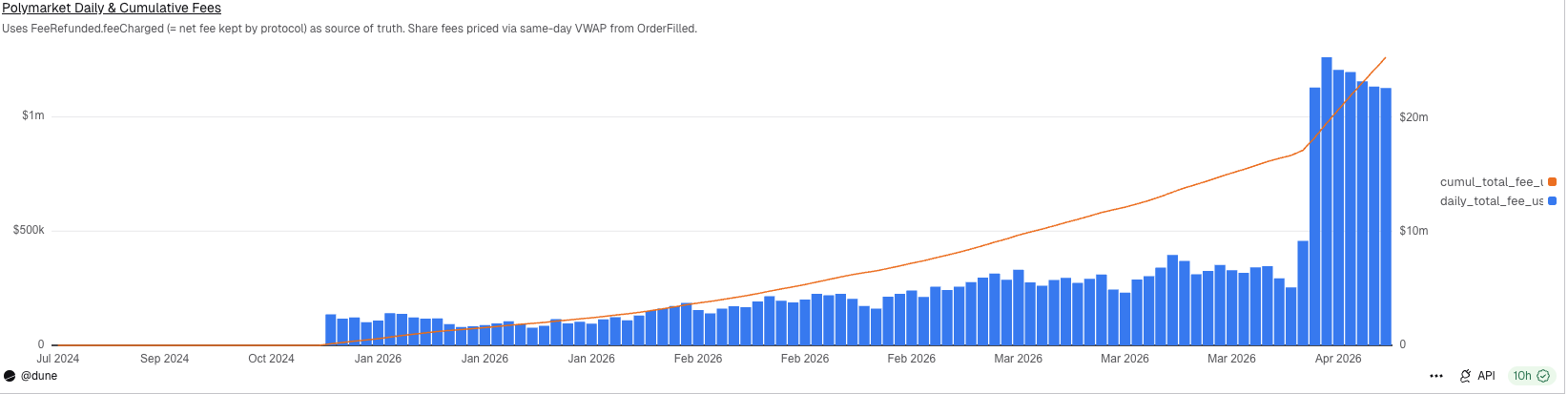
Polymarket's Daily Fee Revenue

Although impressive, it's not enough to satisfy Polymarket's ambitions. Prediction markets, while currently the most sought-after sector, have a business model with a relatively low ceiling, a single moat (regulatory approval), and not exceptionally high user stickiness. In the current landscape where everyone is doing prediction markets, how can Polymarket ensure it won't be surpassed by competitors in the future?

The answer it gives is: I don't just match trades; I can also put players' money to work.

From a business essence perspective, the most attractive aspect of stablecoins over the years has never been fast payments and transfers, but the low-profile yet highly profitable money-printing machine behind them—reserve asset yield. In 2025, the vast majority of Circle's revenue still came from reserve income. Polymarket understood this model, so it launched Polymarket USD.

According to Dune data, the value of open interest on the Polymarket platform has exceeded $400 million. If all this money is converted into Polymarket USD, Polymarket只需要把底层抵押的 USDC 都存进 Circle 的机构账户或者放到美债协议里,按 4%-5% 的无风险利率算,每年坐着不动就能收几千万美金的“利息税”。

Defillama founder 0xngmi even directly stated that Polymarket user wallets hold approximately $1.25 billion. If they keep this interest income, at current rates, they would earn an additional $54 million annually. Polymarket could even participate in DeFi yield farming with higher APYs, turning the idle funds on the prediction platform into active leverage, and then returning the maturity proceeds to users, effectively hedging for them.
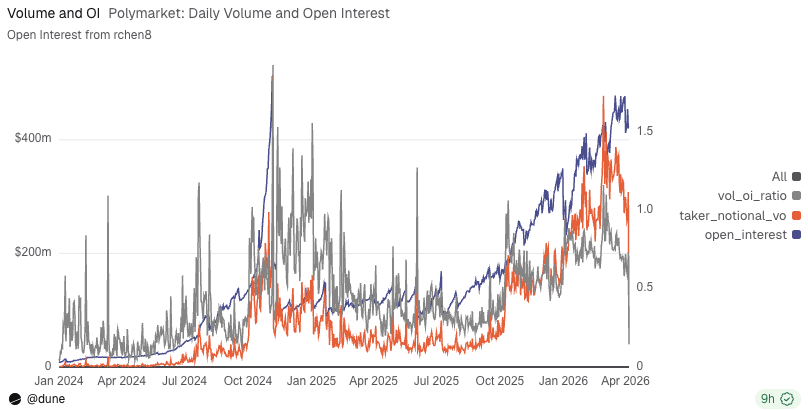
Polymarket's Daily OI and Trading Volume Curve

Prediction markets naturally have two characteristics: first, fund滞留, and second, high-frequency reallocation driven by events. Users' money doesn't truly enter and exit instantly like in a casino; it's either already in a position or sitting in an account waiting for the next event, the next odds change. This type of money is most suitable for financial reprocessing, and for users, there's also a beautiful excuse: improving capital efficiency.

Of course, Polymarket hasn't publicly stated yet that it will definitely engage in yield extraction or on-chain wealth management after launching the stablecoin. But this path is almost a natural next step. As long as the scale of Polymarket USD grows larger in the future, it naturally gains the space to do yield management, collateral expansion, and financial combinations within the platform.

Some time ago, the 《CLARITY Act》 faced resistance for potentially prohibiting crypto companies from offering interest on stablecoins to users. If the outcome of the dispute remains a prohibition, all the above演绎 of Polymarket USD's potential will come to naught. However, on April 6, according to US media reports, the core disagreement between the US crypto industry and banks over the stablecoin yield mechanism may be接近解决. Although details have not been disclosed, the overall expectation is optimistic, and the 《CLARITY Act》 may enter the deliberation stage in committee in late April.

So, don't think Polymarket is far from this.

Polymarket Gains USDC Distribution Rights

The launch of the stablecoin by Polymarket has a third layer of significance: gaining USDC distribution rights.

From today's perspective, Polymarket is still a major distribution scenario within the USDC ecosystem. Circle provides native USDC, Polymarket distributes USDC, and both sides are harmonious. Polymarket is currently experiencing strong growth. Undoubtedly, the USDC reserves pooled within its platform will become larger in the future, potentially even becoming a distribution channel as important as Coinbase. When that time truly comes, the relationship between Polymarket and Circle might also sour.

A reality in the stablecoin world is that distribution rights are as important as issuance rights, which is why Coinbase can take away over half of Circle's reserve income. Therefore, in the future, when Polymarket becomes an important distributor of USDC, it will also inevitably grow bargaining power and will be entitled to take a large share of the reserve收益.甚至, when Polymarket USD is mature enough, it can explore multi-collateral backed stablecoins, not just putting all its eggs in the USDC basket.

This is also why I believe Polymarket USD is not an ordinary upgrade for Polymarket, but an identity update. Polymarket will evolve from a "platform collecting fees围绕事件波动" to one that also兼具 "platform organizing and清算围绕美元".

The former is casino logic, while the latter is bank logic.

Polymarket's moat has thus gained another layer. It still maintains the beautiful narrative of information as a market and pricing facts early. But in terms of its business model, it is quietly moving itself towards a more important position—no longer satisfied with being surface-level market traffic, no longer satisfied with仅仅靠赔率吸引用户, and no longer satisfied with continuing to leave the fattest part of the industry chain (asset reserve收益) to others.


Perguntas relacionadas

QWhat is the primary significance of Polymarket launching its native stablecoin, Polymarket USD?

AThe primary significance is that Polymarket can now pool user funds, moving from being a mere transaction platform to controlling the minting power of its own stablecoin. This allows it to retain USDC reserves in its own treasury, enabling potential revenue from reserve assets and expanding its business model beyond just transaction fees.

QHow does the transition from USDC.e to Polymarket USD affect the average user on the platform?

AFor the average user, the transition is seamless and handled automatically on the frontend with a single confirmation click. The change is largely imperceptible in their user experience, as the platform manages the conversion process behind the scenes.

QWhat new revenue stream does Polymarket potentially gain by introducing its own stablecoin?

APolymarket gains the potential to earn significant revenue from the interest on the USDC reserves backing Polymarket USD. With over $400 million in open interest, it could generate millions annually from low-risk yields like U.S. Treasury bonds or DeFi protocols, diversifying beyond transaction fees.

QWhy is the move to Polymarket USD compared to a shift from a 'gambling logic' to a 'banking logic'?

AThe shift is made because Polymarket is evolving from merely collecting fees on event-based transactions (gambling logic) to managing and清算 user assets, controlling stablecoin issuance, and earning from reserve yields—functions akin to a bank's role in financial systems (banking logic).

QWhat regulatory consideration could impact Polymarket's ability to generate yield from its stablecoin reserves?

AThe CLARITY Act in the U.S., which may prohibit crypto firms from providing interest on stablecoins, could hinder this revenue stream. However, recent reports suggest potential resolutions are being discussed, with the act expected to enter committee review soon, indicating cautious regulatory progress.

Leituras Relacionadas

Trading

Spot
Futuros

Artigos em Destaque

O que é $BANK

Bank AI: Um Passo Revolucionário no Futuro da Banca Introdução Em uma era marcada por avanços rápidos na tecnologia, o Bank AI está na interseção da inteligência artificial (IA) e dos serviços bancários. Este projeto inovador visa redefinir o panorama financeiro, melhorando a eficiência operacional, as medidas de segurança e as experiências dos clientes através do poder da IA. Ao embarcarmos nesta exploração do Bank AI, iremos aprofundar no que o projeto implica, suas dinâmicas operacionais, seu contexto histórico e marcos significativos. O que é o Bank AI? No seu cerne, o Bank AI representa uma iniciativa transformadora com o objetivo de integrar a inteligência artificial em várias operações bancárias. Este projeto aproveita as capacidades da IA para automatizar processos, melhorar os protocolos de gestão de risco e melhorar a interação com os clientes através de serviços personalizados. Os principais objetivos do Bank AI incluem: Automatização das Funções Bancárias: Ao aproveitar as tecnologias de IA, o Bank AI visa automatizar tarefas rotineiras, reduzindo o peso sobre os recursos humanos e aumentando a eficiência. Gestão de Risco Melhorada: O projeto utiliza algoritmos de IA para prever e identificar riscos, fortalecendo assim as medidas de segurança contra fraudes e outras ameaças. Personalização dos Serviços Bancários: O Bank AI foca em oferecer produtos e serviços financeiros ajustados, analisando dados e comportamentos dos clientes. Melhoria da Experiência do Cliente: A implementação de soluções impulsionadas por IA, como chatbots e assistentes virtuais, visa proporcionar aos usuários interações mais humanizadas, revolucionando a forma como os clientes se envolvem com os bancos. Com esses objetivos, o Bank AI posiciona-se como um ator crucial para tornar a banca mais eficiente, segura e centrada no usuário. Quem é o Criador do Bank AI? Os detalhes sobre o criador do Bank AI permanecem desconhecidos. Assim, nenhuma pessoa ou organização específica foi identificada nas informações disponíveis. O anonimato que cerca a origem do projeto levanta questões, mas não diminui a sua ambiciosa visão e objetivos. Quem são os Investidores do Bank AI? Semelhante ao criador do projeto, informações específicas sobre os investidores ou organizações que apoiam o Bank AI não foram divulgadas. Sem essas informações, é difícil delinear o apoio financeiro e institucional que pode estar impulsionando o projeto para frente. No entanto, a importância de ter uma sólida base de investimento é fundamental para sustentar o desenvolvimento em um campo tão inovador. Como Funciona o Bank AI? O Bank AI opera em várias frentes inovadoras, focando em fatores únicos que o diferenciam das estruturas bancárias tradicionais. Abaixo estão as principais características operacionais: Automatização: Ao aplicar algoritmos de aprendizado de máquina, o Bank AI automatiza vários processos manuais dentro dos bancos. Isso resulta na redução dos custos operacionais e permite que os trabalhadores humanos redirecionem os seus esforços para atividades mais estratégicas. Gestão de Risco Avançada: A integração da IA nas práticas de gestão de risco equipa os bancos com ferramentas para prever com precisão potenciais ameaças, como fraudes, garantindo que as informações e ativos dos clientes permaneçam seguros. Recomendações Financeiras Personalizadas: Através do aprendizado contínuo a partir das interações com os clientes, os sistemas de IA desenvolvem uma compreensão sutil das necessidades dos usuários, permitindo oferecer conselhos adaptados sobre decisões financeiras. Interações Melhoradas com os Clientes: Utilizando chatbots e assistentes virtuais alimentados por IA, o Bank AI permite uma experiência de cliente mais envolvente, permitindo que os usuários tenham suas dúvidas resolvidas rapidamente, reduzindo assim os tempos de espera e melhorando os níveis de satisfação. Juntas, estas características operacionais posicionam o Bank AI como um pioneiro no setor bancário, estabelecendo novos padrões para a prestação de serviços e a excelência operacional. Cronologia do Bank AI Compreender a trajetória do Bank AI requer uma análise do seu contexto histórico. Abaixo está uma cronologia que destaca marcos e desenvolvimentos importantes: Início de 2010: A conceituação da integração da IA nos serviços bancários começou a ganhar atenção à medida que instituições bancárias reconheciam os potenciais benefícios. 2018: Ocorreu um aumento significativo na implementação de tecnologias de IA, quando os bancos começaram a usar ferramentas de IA como chatbots para atendimento ao cliente básico e sistemas de gestão de risco para melhorar o tratamento de segurança. 2023: A sofisticação da IA continuou a avançar, com a introdução de IA generativa para tarefas mais complexas, como processamento de documentos e análise de investimentos em tempo real. Este ano marcou um salto significativo nas capacidades proporcionadas aos bancos pela tecnologia de IA. 2024-Estado Atual: Neste ano, o Bank AI está em uma trajetória ascendente, com pesquisas e desenvolvimentos em andamento prontos para aprimorar ainda mais as capacidades nas operações bancárias. A exploração contínua das aplicações de IA sugere desenvolvimentos emocionantes por vir. Pontos Chave Sobre o Bank AI Integração da IA na Banca: O Bank AI foca na adoção da inteligência artificial para simplificar os processos bancários e melhorar as experiências dos usuários. Automatização e Foco em Gestão de Risco: O projeto enfatiza fortemente essas áreas, visando transferir o peso das tarefas rotineiras enquanto melhora as estruturas de segurança através de análises preditivas. Soluções Bancárias Personalizadas: Ao aproveitar os dados dos clientes, o Bank AI possibilita serviços bancários ajustados que atendem às necessidades individuais dos usuários. Compromisso com o Desenvolvimento: O Bank AI permanece comprometido com contínuas pesquisas e esforços de desenvolvimento, garantindo a sua adaptabilidade e relevância contínua à medida que a tecnologia continua a evoluir. Conclusão Em resumo, o Bank AI exemplifica um passo crucial em frente na indústria bancária, aproveitando a inteligência artificial para remodelar paradigmas operacionais, melhorar a segurança e promover a satisfação do cliente. Apesar das lacunas de informação em torno do criador e dos investidores, os objetivos claros e os mecanismos funcionais do Bank AI fornecem uma base sólida para sua evolução contínua. À medida que a tecnologia de IA continua a avançar e se fundir com o setor bancário, o Bank AI está bem posicionado para impactar significativamente o futuro dos serviços financeiros, aprimorando a maneira como entendemos e interagimos com a banca.

40 Visualizações TotaisPublicado em {updateTime}Atualizado em 2024.12.03

O que é $BANK

Como comprar BANK

Bem-vindo à HTX.com!Tornámos a compra de Lorenzo Protocol (BANK) simples e conveniente.Segue o nosso guia passo a passo para iniciar a tua jornada no mundo das criptos.Passo 1: cria a tua conta HTXUtiliza o teu e-mail ou número de telefone para te inscreveres numa conta gratuita na HTX.Desfruta de um processo de inscrição sem complicações e desbloqueia todas as funcionalidades.Obter a minha contaPasso 2: vai para Comprar Cripto e escolhe o teu método de pagamentoCartão de crédito/débito: usa o teu visa ou mastercard para comprar Lorenzo Protocol (BANK) instantaneamente.Saldo: usa os fundos da tua conta HTX para transacionar sem problemas.Terceiros: adicionamos métodos de pagamento populares, como Google Pay e Apple Pay, para aumentar a conveniência.P2P: transaciona diretamente com outros utilizadores na HTX.Mercado de balcão (OTC): oferecemos serviços personalizados e taxas de câmbio competitivas para os traders.Passo 3: armazena teu Lorenzo Protocol (BANK)Depois de comprar o teu Lorenzo Protocol (BANK), armazena-o na tua conta HTX.Alternativamente, podes enviá-lo para outro lugar através de transferência blockchain ou usá-lo para transacionar outras criptomoedas.Passo 4: transaciona Lorenzo Protocol (BANK)Transaciona facilmente Lorenzo Protocol (BANK) no mercado à vista da HTX.Acede simplesmente à tua conta, seleciona o teu par de trading, executa as tuas transações e monitoriza em tempo real.Oferecemos uma experiência de fácil utilização tanto para principiantes como para traders experientes.

364 Visualizações TotaisPublicado em {updateTime}Atualizado em 2025.05.09

Como comprar BANK

Discussões

Bem-vindo à Comunidade HTX. Aqui, pode manter-se informado sobre os mais recentes desenvolvimentos da plataforma e obter acesso a análises profissionais de mercado. As opiniões dos utilizadores sobre o preço de BANK (BANK) são apresentadas abaixo.

活动图片