The Era of Population Deflation: The Future Belongs to 'Super Individuals + AI + Web3'

marsbitPublicado em 2026-01-20Última atualização em 2026-01-20

Resumo

The article "The Era of Population Deflation: The Future Belongs to 'Super Individuals + AI + Web3'" argues that global population decline is not merely a labor issue but a fundamental structural shift that will redefine economic and technological systems. Key points include: - Population collapse (e.g., China’s birth rate halving in 7 years) erodes labor supply, content creation, and long-term demand for assets like real estate and pensions. - AI is not just an efficiency tool but a structural solution to replace human labor, enable exponential productivity growth, and empower "super individuals" and solo creators. - Web3 provides the infrastructure for trustless collaboration, transparent value distribution, and programmable rules in a low-trust, low-human environment. - Together, AI and Web3 form a complete response: AI handles production, while Web3 enables decentralized coordination and economic participation for both humans and AI agents. The article advises investors to focus on AI, productivity tools, and Web3 infrastructure, and urges individuals to become AI-augmented, platform-independent, and self-sovereign economic units.

Author: Amelia I Biteye Content Team

Over the past century, almost all economic growth models have assumed one premise: the next generation will be larger than the current one.

More people mean a more abundant labor force, a larger consumer market, and more predictable long-term returns.

But this premise is failing globally.

China, Japan, South Korea, Europe, and even the United States - declining birth rates are shifting from "statistical data" to a structural reality.

And when "people" are no longer the most abundant, cheapest, and most replicable factor of production, the entire narrative of technology and institutions will be forced to rewrite.

The emergence of Web3 and AI is not an accidental technological wave but an inevitable response to the era of population deflation.

I. Population Cliff: The Underestimated Systemic Risk

When discussing population decline, many debates only focus on "labor shortage."

But if you only understand it as a "labor issue," you severely underestimate its destructive power.

What population deflation truly erodes are three deeper layers of structure.

Labor: From a Cyclical Problem to an Irreversible Structural Scarcity
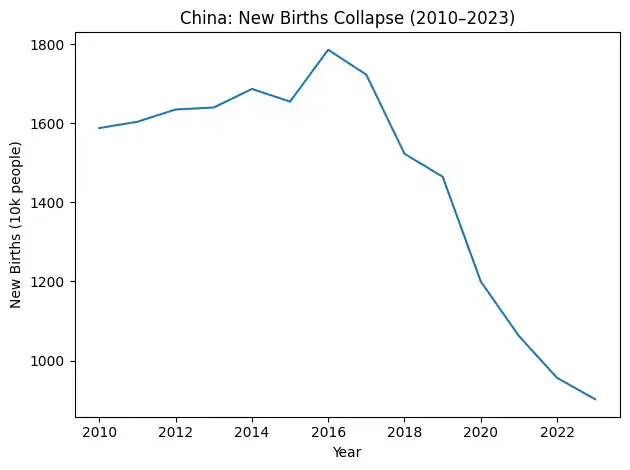
China's Birth Population Cliff (2010–2023)

Visually, what you see is not a "decline" but a clear cliff-like drop.

Taking China as an example:

  • 2016: approximately 17.86 million newborns

  • 2023: approximately 9 million newborns

  • 2025: expected to fall below 8 million

Halved in just 7 years.

What does this mean?

Those born in 2023 will enter the labor market around 2045: not "a bit fewer," but "half as many."

This is not a cyclical fluctuation but a structural collapse of the population.

More critically, this trend has been confirmed by long-term projections: according to the UN's "World Population Prospects 2022" report, China's working-age population (15–64 years) will decrease by approximately 170 million between 2020 and 2050.

In the past, business systems assumed: "People can always be hired; it's just a matter of price."

In the era of population deflation, the problem changes.

Delayed retirement, immigration, and birth subsidies are slow variables.

But business systems cannot wait twenty years.

This is precisely where all technological narratives begin to transform.

Attention and Creator Supply Shrink Simultaneously: Web2's Hidden Fatal Flaw

A declining young population brings not only a reduction in labor but also a more hidden, more fatal problem: Who will produce content, and who will consume it?

  • Declining number of content producers

  • Slower diffusion of new culture and narratives

  • Failure of platform traffic growth logic

Web2's reliance on the "user growth → traffic → advertising → commissions" model is essentially built on population expansion.

When new users no longer appear, platforms begin to compete internally, rules change frequently, and trust between creators and platforms collapses.

This is Web2's most difficult structural flaw to repair in the era of population deflation.

Systemic Collapse on the Long-Term Demand Side: Long-Termism Forced to Be Revalued

Real estate, education, long-term consumer goods, pension systems...

The commonality of these systems is: they all assume that there will be more people in the future.

When this assumption is broken, all "long-termist assets" will be repriced.

II. Why Is AI a Necessity in the Era of Population Deflation?
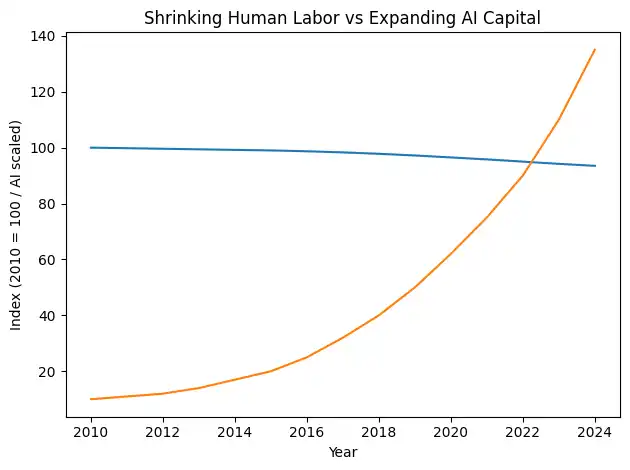
Human Labor Contraction vs. AI Capital Exponential Expansion

One side is a slow but certain decline, the other is exponential growth. The only "labor force" that can still expand is not human.

If population deflation changes the problem itself, then AI is becoming the only viable answer.

AI Is Not an Efficiency Tool but a "De-humanizing Tool"

We are accustomed to describing AI as an "efficiency tool."

But in the real world, it does not solve efficiency problems but a structural one: the system no longer needs so many people.

AI customer service, AI content generation, AI research assistants, AI trading systems - their significance is not to make people 20% faster but to remove "people" from the necessary conditions of the system.

In a population-deflated world, the real question is no longer: "Can we hire someone for this position?" but: "Does this环节 still require human participation?"

AI is not replacing inefficient people; it is rewriting the entire society's assumption of dependence on "human labor."

AI Is the Only Labor Force Capable of Exponential Growth

  • Population: Linear growth, even negative growth

  • AI: Computing power, models, data → Exponential expansion

This is also why, despite extreme macroeconomic uncertainty, capital still chooses to heavily invest in AI.

Because in the era of population deflation, only AI has the "ability to scale."

AI Allows the "Individual" to Become a Production Unit Again
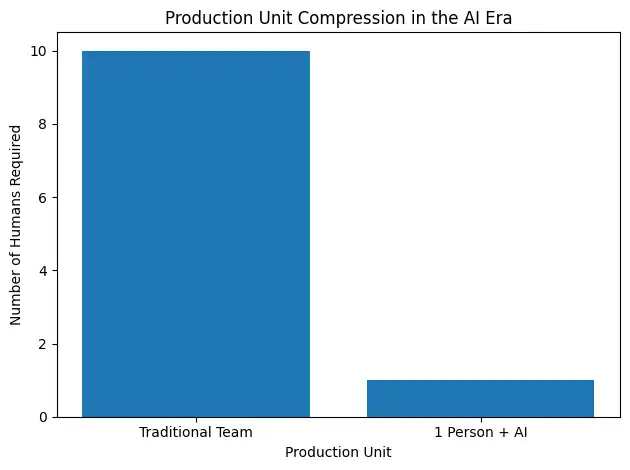
Production Unit Compression Diagram (Team → Individual + AI)

From a "10-person team" to "1 person + AI," production units are being rapidly compressed.

AI is giving rise to a new organizational form:

  • One-person companies

  • Super individuals

  • Solo Founders

  • AI Native creators

When society cannot mass-produce young people, the system can only choose to: amplify the individual.

III. What Role Does Web3 Play Here?

If AI solves "who will do the work," then Web3 solves a more fundamental problem:

In an era of fewer people, how do we collaborate, distribute, and build trust?

How to Collaborate at Low Cost in an Era of Fewer People?

DAOs, Permissionless collaboration, project-based contributions—

Web3 restructures "organizations" from long-term employment relationships into temporary, flexibly combinable collaboration networks.

When hiring people becomes increasingly expensive, trust and settlement must be automated.

How to Distribute Value in an Era of Fewer People?

In an era where labor becomes scarce, if value distribution is not transparent, the system will quickly lose participants.

Tokens, on-chain incentives, and instant settlement do not address "speculation" but a practical problem:

How to make scarce labor willing to stay and continue to build?

How to Build Long-Term Trust in an Era of Fewer People?

The younger generation's trust in long-term commitments is collapsing:

  • Distrust in pensions

  • Distrust that platforms won't change rules

  • Distrust in long-term incentives from centralized institutions

Smart contracts and on-chain rules essentially answer:

When there aren't enough people and not enough trust, can the rules execute themselves?

IV. Web3 + AI: The Complete Solution for the Era of Population Deflation

An increasingly clear judgment is forming: Web3 is not a competitor to AI but the institutional shell for the AI era.

What do AI Agents need?

  • Identity

  • Wallet

  • Autonomous transaction capability

  • Programmable rules

These are precisely the native capabilities of Web3.

In the near future, we may see:

  • AI-native companies

  • AI autonomous DAOs

  • AI-to-AI economic collaboration

In this system, humans may no longer be the largest group of economic participants.

V. Final Thoughts: What Does This Mean for the Individual?

For the individual, it is a harsh but real fact: you will no longer be lifted by the红利 of "population growth."

But it also意味着 new windows of opportunity:

  • AI amplifies individual productivity

  • Web3 allows individuals to directly participate in global systems

  • A world with fewer people is反而 more friendly to high-cognition, high-action individuals

If you are an investor/creator, here is actionable advice from Biteye:

For investors:

  • Population deflation is a 20–30 year-level certain variable, not macroeconomic noise

  • All business models relying on "population expansion" should be discounted valuations

  • Only three categories are truly worth long-term attention:

    • AI that can directly replace human labor

    • Tools that amplify individual productivity

    • Web3 infrastructure that operates in low-trust environments

For creators / individuals:

  • Stop assuming "the platform will give you long-term returns"

  • Try to turn yourself into:

    • A node that can be amplified by AI

    • A personal brand that can migrate across platforms

    • An independent production unit capable of direct settlement

After all, in the era of population deflation: the system will not take care of you, but the system needs you.

This is not an era of more and more people,

but an era where each individual must become stronger and stronger; and what you must rely on are AI and Web3.


Leituras Relacionadas

Understanding CPO (Co-Packaged Optics) in One Article: Why Nvidia Is Willing to Spend $3.2 Billion on a Fiber?

NVIDIA and Corning announced a multi-year strategic partnership on May 6, 2026, with NVIDIA committing up to $3.2 billion to support Corning's U.S. expansion. This investment will triple Corning's manufacturing plants and significantly boost its optical fiber and communications production capacity. The core driver behind this massive investment is the fundamental shift from copper to optical interconnect technology within AI data centers. As GPU clusters scale, copper wires face critical limitations: severe signal attenuation over distance, high energy consumption for signal integrity, and excessive heat generation. Optical fiber, transmitting light instead of electrical signals, solves these issues with minimal loss, near-light speed, and lower power needs. The article outlines a three-stage evolution of data center interconnect: 1. **Traditional Copper Interconnects:** The mainstream solution of the 2010s, now being phased out due to scaling bottlenecks. 2. **Pluggable Optical Modules:** The current mainstream, where modules convert electrical signals to light externally. This process still introduces energy loss and latency. 3. **CPO (Co-Packaged Optics):** The next-generation technology where the optical engine is integrated directly with the GPU chip package. This drastically reduces the electrical signal travel distance to mere millimeters, slashing power consumption and latency while boosting data density. NVIDIA CEO Jensen Huang has identified CPO as an essential core technology for AI infrastructure. NVIDIA's investment signifies a strategic shift from being a buyer to actively controlling its supply chain for critical components. With demand for specialized optical fiber far outstripping supply—evidenced by soaring prices—securing long-term manufacturing capacity has become a competitive necessity. While Corning's expansion may pressure some suppliers, a projected global fiber supply gap of 5-15% over the next few years creates a significant opportunity window, particularly for Chinese manufacturers competitive in optical preforms, chips, and modules. Ultimately, NVIDIA's move is not about chasing a trend but an engineering imperative. The transition to light-based interconnects like CPO is driven by the physical limits of copper, marking a definitive step in the ongoing AI computing revolution.

marsbitHá 2m

Understanding CPO (Co-Packaged Optics) in One Article: Why Nvidia Is Willing to Spend $3.2 Billion on a Fiber?

marsbitHá 2m

KOL's Perspective: Why Is SOL Set to Rise from This Point?

**Summary: Why SOL is Positioned for Growth at This Level** The article argues that SOL is poised for an upward move from its current price point, citing several key factors. Primarily, SOL has just broken out of a 4-month consolidation phase. This breakout signals a return of risk appetite to the broader crypto market, as SOL is seen as a key indicator of overall crypto health. The token's ownership has reportedly shifted from short-term traders and tourists to long-term accumulators, leading to low volume. Any meaningful increase in trading activity could thus trigger significant upward momentum. Fundamental strengths include strong institutional adoption, integration with DeFi and RWAs (Real-World Assets), and the potential benefits from the Clarity Act. Despite its high volatility—having dropped 70% from its all-time high but still up 12x from its bear market low—SOL is highlighted as one of the few tokens from the last cycle to reach new highs. It boasts a robust ecosystem of applications, users, and protocols. Future catalysts include the expected influx of AI developers following the Miami Accelerate conference, which focused on AI on Solana. Furthermore, Solana is positioned as the premier chain for memecoin activity, a trend expected to continue and drive network usage and fees. The article concludes that recent price action reflects a healthy transfer to long-term holders, setting the stage for growth.

marsbitHá 52m

KOL's Perspective: Why Is SOL Set to Rise from This Point?

marsbitHá 52m

Those Pre-Bitcoin PoW Protocols Have Recently Been Reimplemented

This article details a recent surge in replicating pre-Bitcoin Proof-of-Work (PoW) protocols, specifically focusing on Hal Finney's 2004 RPOW (Reusable Proofs of Work). Within five days in May 2026, multiple independent builders in the Bitcoin/cypherpunk community launched projects inspired by this early electronic cash proposal. The initiative began with Fred Krueger's `rpow2.com`, a centralized but auditable system that replaced RPOW's original IBM 4758 hardware with Ed25519 signatures. Initially a faithful replica, it later adopted Bitcoin-like features (21M supply cap, difficulty adjustment) and a controversial 5.24% founder allocation. This sparked rapid forks, including `rpow4.com` which incorporated full Bitcoin parameters, a prediction market (`rpowmarket.com`), and a DEX (`rpow2swap.com`). Concurrently, Mike In Space created a prototype of Wei Dai's 1998 b-money proposal (`b-money.replit.app`), pushing the historical exploration even further back. The article contrasts these centralized, server-dependent experiments with Bitcoin's core innovation of decentralized, trustless consensus. It also highlights a parallel development: the `HASH` project on Ethereum, which uses smart contract hooks to enable a purely fair-launch, browser-mineable PoW token with 0% allocations to team or VCs. The collective activity is framed as a meme-driven, educational exploration of cypherpunk history rather than a serious financial movement, with all projects heavily disclaiming any investment value.

marsbitHá 57m

Those Pre-Bitcoin PoW Protocols Have Recently Been Reimplemented

marsbitHá 57m

South Korean Exchanges 'Battle' Regulators, Challenging the Boundaries of Enforcement and Legislation

South Korea's cryptocurrency industry is engaged in a rare, direct confrontation with regulators. The Financial Intelligence Unit (FIU), the primary anti-money laundering (AML) watchdog, has recently imposed heavy penalties on major exchanges like Upbit and Bithumb for alleged violations involving unregistered overseas VASPs and AML procedures. However, exchanges are now actively challenging these actions in court and through industry associations. In a significant shift, the Seoul Administrative Court ruled in favor of Upbit's operator, Dunamu, overturning part of an FIU-ordered business suspension. The court found the FIU's penalty criteria and justification insufficiently clear. Similarly, the court suspended the enforcement of a six-month business suspension against Bithumb pending a final ruling, citing potential irreversible harm to the exchange. Beyond legal battles, the industry is contesting proposed legislative amendments. The Digital Asset eXchange Alliance (DAXA) strongly opposes a draft rule that would mandate Suspicious Transaction Reports (STRs) for all crypto transfers over 10 million KRW (~$6,800). DAXA argues this "poison pill" clause violates legal principles and would overwhelm the STR system, increasing reports from 63,000 to an estimated 5.45 million annually for major exchanges, thereby crippling effective AML monitoring. This conflict highlights a structural tension in South Korea's crypto governance: comprehensive digital asset laws are still developing, while regulators rely heavily on AML enforcement. The industry's move from passive compliance to active legal and legislative challenges signifies a new phase, pressing for clearer rules and more proportionate enforcement. While short-term disputes may intensify, this clash could ultimately lead to a more mature and sustainable regulatory framework for South Korea's vibrant crypto market.

marsbitHá 1h

South Korean Exchanges 'Battle' Regulators, Challenging the Boundaries of Enforcement and Legislation

marsbitHá 1h

Trading

Spot
Futuros

Artigos em Destaque

Como comprar ERA

Bem-vindo à HTX.com!Tornámos a compra de Caldera (ERA) simples e conveniente.Segue o nosso guia passo a passo para iniciar a tua jornada no mundo das criptos.Passo 1: cria a tua conta HTXUtiliza o teu e-mail ou número de telefone para te inscreveres numa conta gratuita na HTX.Desfruta de um processo de inscrição sem complicações e desbloqueia todas as funcionalidades.Obter a minha contaPasso 2: vai para Comprar Cripto e escolhe o teu método de pagamentoCartão de crédito/débito: usa o teu visa ou mastercard para comprar Caldera (ERA) instantaneamente.Saldo: usa os fundos da tua conta HTX para transacionar sem problemas.Terceiros: adicionamos métodos de pagamento populares, como Google Pay e Apple Pay, para aumentar a conveniência.P2P: transaciona diretamente com outros utilizadores na HTX.Mercado de balcão (OTC): oferecemos serviços personalizados e taxas de câmbio competitivas para os traders.Passo 3: armazena teu Caldera (ERA)Depois de comprar o teu Caldera (ERA), armazena-o na tua conta HTX.Alternativamente, podes enviá-lo para outro lugar através de transferência blockchain ou usá-lo para transacionar outras criptomoedas.Passo 4: transaciona Caldera (ERA)Transaciona facilmente Caldera (ERA) no mercado à vista da HTX.Acede simplesmente à tua conta, seleciona o teu par de trading, executa as tuas transações e monitoriza em tempo real.Oferecemos uma experiência de fácil utilização tanto para principiantes como para traders experientes.

452 Visualizações TotaisPublicado em {updateTime}Atualizado em 2025.07.17

Como comprar ERA

Discussões

Bem-vindo à Comunidade HTX. Aqui, pode manter-se informado sobre os mais recentes desenvolvimentos da plataforma e obter acesso a análises profissionais de mercado. As opiniões dos utilizadores sobre o preço de ERA (ERA) são apresentadas abaixo.

活动图片