
The Era of Easy Money with Stablecoins Is Over, DeFi Native Stablecoins May Become the New Engine in Regulatory Gaps

marsbitPublicado em 2026-04-09Última atualização em 2026-04-09

Resumo

The era of passive income from stablecoins is ending due to regulatory changes, particularly the proposed CLARITY Act in the U.S., which aims to restrict centralized exchanges (CEXs) like Coinbase from offering interest on stablecoin holdings such as USDC. This legislation, backed by banking industry lobbying, seeks to prevent stablecoins from functioning as "chain-based deposits" that compete with traditional banks by offering Treasury-like yields without banking regulations. However, the CLARITY Act carves out exceptions for rewards based on "identifiable activities," including platform engagement, transactions, and contributions to blockchain infrastructure. This creates an opportunity for DeFi-native stablecoins like USDe and USDS, which generate yields through mechanisms such as staking, derivatives hedging, and protocol revenue sharing—activities framed as active participation rather than passive income. As a result, centralized stablecoins may revert to their core roles in payments and settlements, while DeFi alternatives could thrive by offering compliant, activity-based yields, reshaping the stablecoin landscape into a dual structure of utility-focused and yield-generating assets.

Author: Jae, PANews

Many regulatory obstacles have emerged on the path to earning interest by holding USDC.

The yield logic of the stablecoin market is undergoing a restructuring from "easy money" to "earned rewards".

The CLARITY Act is taking aim at severing the passive income channels of CEXs (Centralized Exchanges), yet it preserves room for activity rewards for DeFi native stablecoins. According to the draft text disclosed in March, if this bill passes, it could mean: the days of users holding USDC on Coinbase to earn a 4% annualized yield are about to become history.

The old-era dividends of centralized stablecoins may be coming to an end, while DeFi native stablecoins like USDe and USDS have the opportunity to open up growth space in the gaps of regulation, ushering in a further expansion opportunity.

Banking Industry Spends $56.7 Million Lobbying to Block "On-Chain Deposits"

The GENIUS Act, which took effect in July 2025, for the first time established stablecoin issuance rules at the federal level, requiring 1:1 reserves and restricting issuers from directly paying interest, but it left a "distributor loophole": Platforms like Coinbase could, through revenue sharing with issuers like Circle, return U.S. Treasury yield to users in the form of "rewards". This is like banks not being able to directly pay interest on user deposits but being able to give users "red envelopes" through third parties—it's essentially the same thing.

In this gray area, stablecoins quietly broke through their positioning as payment tools, transforming into "on-chain deposits" with built-in yield.

The emergence of the CLARITY Act is precisely to plug this gap. The latest draft text disclosed in March shows that the ban has been extended from issuers to all "digital asset service providers," including CEXs, brokers, and their affiliated companies.

This restrictive trend reflects regulatory considerations regarding the conflict between the "monetary attributes" and "securities attributes" of stablecoins. In regulatory consensus, payment-oriented stablecoins are considered a "Narrow Bank" tool: their functional positioning is for payment and settlement, not as investment products for capital appreciation.

The stringent restrictions on yield distribution in the CLARITY Act are the result of a carefully orchestrated defense battle by the U.S. banking industry. To prevent stablecoins from offering competitive yields, the ABA (American Bankers Association) spent a whopping $56.7 million on lobbying.

The banking industry argues that if users can earn Treasury-like yields of 4%-5% by holding stablecoins, free from traditional banking regulation and deposit insurance constraints, then up to $1.5 trillion in low-cost retail deposits could flow out of the commercial banking system.

This "Deposit Flight" phenomenon is particularly fatal for U.S. community banks, as they heavily rely on retail deposits to support loans to farms, small and medium-sized businesses, and mortgage housing.

Estimates from Standard Chartered show that if stablecoin yields are not banned, the banking system could face a funding gap of $500 billion by 2028.

However, PANews believes that this calculation is based on several assumptions; the speed and scale of deposit migration will be influenced by multiple factors such as user habits, platform security, and regulatory transparency.

The overlap between stablecoin users and bank retail deposit users is relatively limited. The calculation of $1.5 trillion in deposit outflows is based on extreme assumptions, and the actual impact will likely be far lower.

Furthermore, stablecoins and bank deposits differ fundamentally in risk attributes and usage scenarios; the two may not be perfect substitutes.

Passive Yield Sentenced to "Death," Activity Rewards Leave a Narrow Door Open

The CLARITY Act does not impose a blanket ban on all rewards but sets "Identifiable Activity" screening criteria to legally avoid the "expectation of profit" judgment condition in the Howey Test.

The CLARITY Act explicitly prohibits interest payments based on "idle balances," which severely impacts the sharing model that Coinbase and Circle have maintained for years. For a long time, Coinbase has offered rewards as high as 3.5%-5% to its USDC holders, with the source of funds being the interest income from U.S. Treasuries in Circle's reserves.

Data shows that the correlation between USDC rewards and the 3-month U.S. Treasury yield is as high as 98.7%. By cutting this link, regulators are essentially stripping CEXs of their most attractive user growth weapon.

In contrast, the CLARITY Act preserves the legitimacy of incentives for "active behavior." According to Section 404(b)(2) of the bill, rewards generated from three types of activities are deemed compliant:

  1. Platform Activities: Loyalty programs, promotional lotteries, subscription discounts, etc.;
  2. Transactions and Consumption: Payments, transfers, cross-border remittance settlements, etc., made using stablecoins;
  3. On-Chain Infrastructure Contribution: Participating in protocol validation, staking, governance voting, or providing liquidity.

This classification creates a new legal logic: If the yield is not "given for free" but is earned by the user through undertaking specific risks or performing specific labor, then it is no longer a "deposit" but a form of "Payment for Service."

Strictly speaking, the path to earning yield with USDC is not completely blocked; users can still earn rewards by participating in activities using USDC. However, since participating in activities involves certain costs, compared to the previous "easy money" model, the yield obtained will inevitably incur损耗 (loss/wear and tear). The utility of USDC will also revert more to payment, settlement, and consumption.

This恰好 (precisely) creates a clear compliance path and growth opportunity for DeFi native stablecoins.

Derivatives Hedging and Protocol Profit-Sharing, DeFi Native Stablecoins Step on the Compliant "Escape Hatch"

While CEXs tread carefully in the "regulatory minefield," DeFi native stablecoins like USDe and USDS,凭借 (relying on) their截然不同的 (entirely different) yield logic, have stepped into the regulatory gap for compliance.

Taking USDe as an example, it抛弃 (abandons) bank dollar reserves and is supported by a "synthetic dollar" derivatives architecture, with the underlying logic being Delta neutral hedging.

USDe's yield comes from two separate activities, both of which can be interpreted under the CLARITY Act as "activity-based rewards":

  • Staking Layer Yield (Staking Yield): Earned by holding staking tokens like stETH, obtaining consensus layer rewards from the Ethereum network, which is explicitly listed in the bill as a compliant activity for "participating in validation or staking";

  • Derivatives Layer Yield (Funding Rates): By opening equivalent perpetual contract positions on exchanges. In a market with strong bullish sentiment, the funding fees paid by long positions to short positions constitute the main source of yield for USDe.

Under the framework of the CLARITY Act, the yield obtained by USDe holders is essentially a reward for users participating in the specific activity of "risk management and hedging operations," not interest paid by the protocol based on deposit balance.

Because USDe's yield is volatile and bears counterparty risk and smart contract risk, it will legally depart from the category of "bank deposit equivalents."

USDS represents another DeFi native force adapting to regulation.

Users deposit USDS into the Sky protocol, which deploys the deposits to other lending protocols or liquidity pools. In this process, the revenue or fees generated on Sky, as well as RWA (Real World Asset) yields, are distributed to users as returns.

Therefore, USDS incentivizes users through "protocol profit-sharing" rather than "interest payments." The provision in the CLARITY Act draft regarding rewards for "providing liquidity" also, to some extent, provides a legal shield for DeFi protocols adopting models similar to USDS.
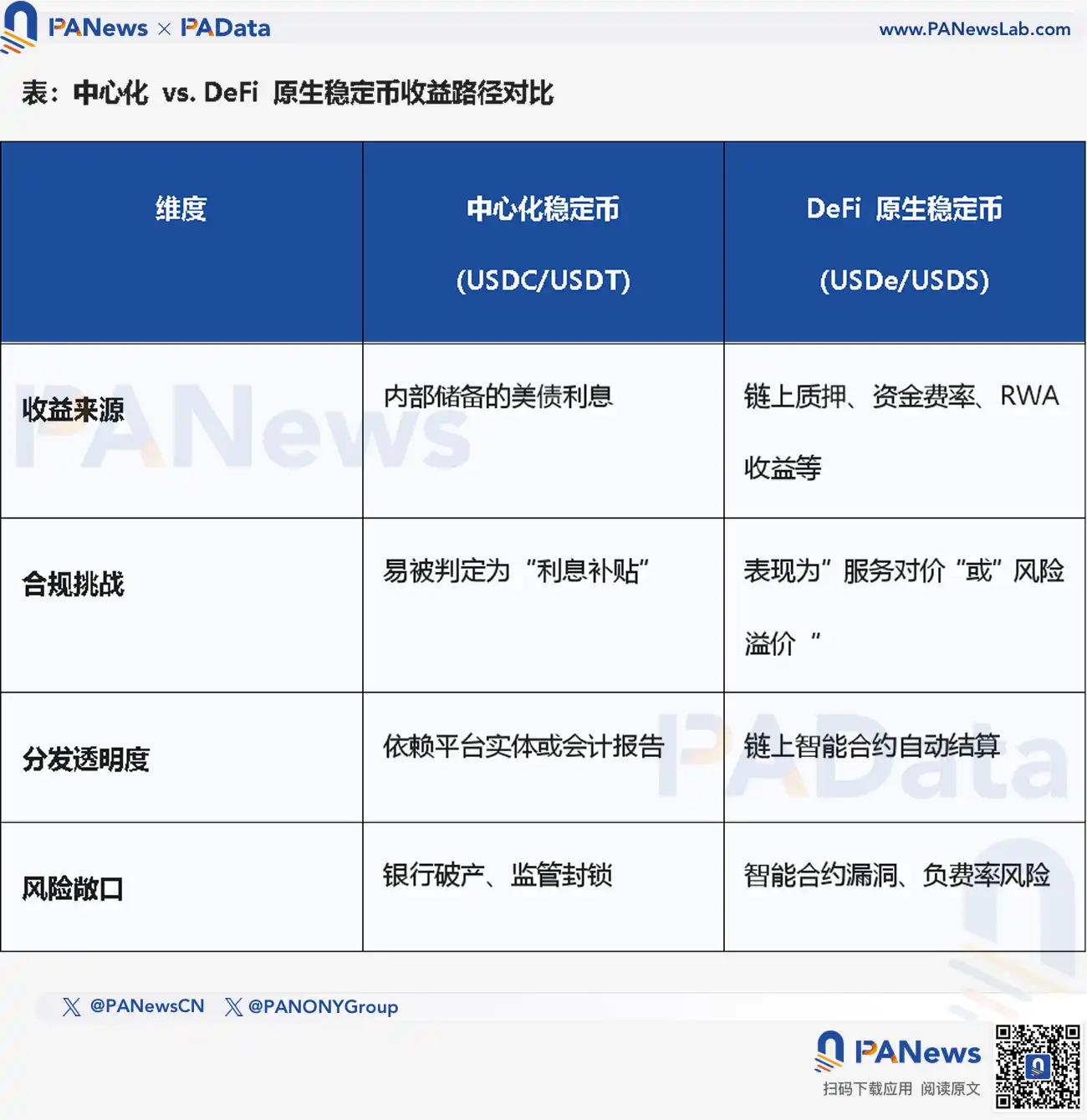
The advancement of the CLARITY Act宣告着 (declares) the impending end of the era of wild growth for stablecoins. Under the spotlight of regulation, the market is moving towards a clear dual-track structure. There are no absolute winners, only survivors who adapt to the rules.

Centralized stablecoins like USDC will inevitably become "instrumentalized," returning to their本源 (origin) of payment and settlement.凭借 (Relying on) compliance, liquidity, ecosystem coverage, and cross-border transfer experience, they will become the preferred digital cash for most ordinary users and enterprises, with yield no longer being their competitive barrier.

DeFi native stablecoins like USDe may承接起 (take on) wealth management needs, becoming the "yield engine" of the crypto market. By deeply anchoring asset value to complex on-chain activities like Delta neutral hedging and liquidity mining, they巧妙地 (cleverly) circumvent the regulatory狙击 (sniper fire) aimed at "bank deposits."

The differentiation in the stablecoin track is an inevitable result of the market seeking optimal solutions within the compliance framework. For investors, understanding the deep logic behind this migration is more important than chasing high yields: future stablecoin yields will no longer belong to passive "holders" but to active "contributors" who participate in protocol activities.

This transformation is both a result of regulatory constraints and an opportunity for DeFi innovation to adapt to regulation.


Perguntas relacionadas

QWhat is the main regulatory challenge facing stablecoins like USDC in the United States according to the article?

AThe main regulatory challenge is the proposed CLARITY Act, which aims to restrict passive income generation from holding stablecoins by prohibiting rewards based on idle balances, effectively ending the 'earn' programs offered by platforms like Coinbase for USDC holders.

QHow does the CLARITY Act differentiate between prohibited 'passive rewards' and allowed 'activity-based rewards'?

AThe CLARITY Act prohibits rewards based solely on idle balances (passive interest) but allows rewards for identifiable activities such as platform engagement (loyalty programs), transactions (payments, transfers), and on-chain contributions (staking, providing liquidity, governance).

QWhy are traditional banks lobbying against stablecoins offering competitive yields?

ATraditional banks, represented by the American Bankers Association (ABA), are lobbying to prevent stablecoins from offering competitive yields because they fear it could lead to significant deposit flight from the banking system, especially from community banks that rely on low-cost retail deposits for lending.

QHow do DeFi-native stablecoins like USDe and USDS generate yield in a way that may comply with the CLARITY Act?

AUSDe generates yield through staking rewards (e.g., from stETH) and funding rates from perpetual futures positions, which are classified as rewards for specific activities like validation and risk management. USDS uses protocol revenue sharing from deployments in lending or liquidity pools, framed as rewards for providing liquidity.

QWhat is the expected long-term impact of regulations like the CLARITY Act on the stablecoin market?

AThe regulations are expected to create a dual-track market: centralized stablecoins like USDC will become more utility-focused for payments and settlements, while DeFi-native stablecoins like USDe will serve as yield-generating engines for active participants in on-chain activities, aligning with regulatory frameworks for activity-based rewards.

Leituras Relacionadas

Breaking: OpenAI Undergoes Major Reorganization, President Brockman Assumes Command

OpenAI has announced a major internal reorganization just months before its anticipated IPO. The company is merging its three flagship product lines—ChatGPT, Codex, and the API platform—into a single, unified product organization. The most significant leadership change involves co-founder and President Greg Brockman moving from a background technical role to take full, permanent control over all product strategy. This follows the indefinite medical leave of AGI Deployment CEO Fidji Simo. Additionally, ChatGPT's longtime lead, Nick Turley, has been reassigned to enterprise products, with former Instagram executive Ashley Alexander taking over consumer offerings. The consolidation, internally framed as a strategic move towards an "Agentic Future," aims to break down internal silos and create a cohesive "Super App." This planned desktop application would integrate ChatGPT's conversational abilities, Codex's coding power, and a rumored internal web browser named "Atlas" to autonomously perform complex user tasks. The reorganization occurs amid significant internal and external pressures. OpenAI has recently seen a wave of high-profile departures, including Sora co-lead Bill Peebles and other senior technical leaders, leading to concerns about a thinning executive bench. Externally, rival Anthropic recently secured funding at a staggering $900 billion valuation, surpassing OpenAI's own. Google's upcoming I/O developer conference also poses a competitive threat. Analysts suggest the dramatic restructure is a pre-IPO move to present a clearer, more focused narrative to Wall Street—streamlining operations and demonstrating decisive leadership under Brockman to counter internal turbulence and intense market competition.

marsbitHá 1h

Breaking: OpenAI Undergoes Major Reorganization, President Brockman Assumes Command

marsbitHá 1h

Two Survival Structures of Market Makers and Arbitrageurs

Market makers and arbitrageurs represent two distinct survival structures in high-frequency trading. Market makers primarily use limit orders (makers) to profit from the bid-ask spread, enjoying high capital efficiency (nominally 100%) but bearing inventory risk. This "inventory risk" arises from passive, fragmented, and discontinuous order fills in the limit order book (LOB). This risk, while a potential cost, can also contribute to excess profit if managed within control boundaries, allowing for mean reversion. Market makers essentially sell "time" (uncertainty over execution timing) to the market for price control and low fees. In contrast, cross-exchange arbitrageurs typically use market orders (takers) to exploit price differences or funding rates, resulting in lower nominal capital efficiency (requiring capital on both exchanges) and higher transaction costs. Their risk exposure stems from asymmetries in exchange rules (e.g., minimum order sizes), execution latency, and infrastructure risks (e.g., ADL, oracle drift). These exposures are active, exogenous gaps that primarily erode profits rather than contribute to them. Arbitrageurs essentially sell "space" (capital sunk across venues) for localized, immediate certainty. Both strategies engage in a trade-off between execution friction and residual risk. Optimal systems allow for temporary, controlled risk exposure rather than enforcing zero exposure at all costs. Their evolution converges towards hybrid models: arbitrageurs may use maker orders to reduce costs, while market makers may use taker orders or hedges for risk management. Ultimately, both use different forms of risk exposure—market makers exposing inventory, arbitrageurs immobilizing capital—to extract marginal, hard-won certainty from the market.

链捕手Há 1h

Two Survival Structures of Market Makers and Arbitrageurs

链捕手Há 1h

Who Will Define the Rules of the AI Era? Anthropic Discusses the 2028 US-China AI Landscape

This article, based on Anthropic's analysis, outlines the intensifying systemic competition between the U.S./allies and China for AI leadership by 2028. It argues that access to advanced computing power ("compute") is the critical bottleneck, where the U.S. currently holds a significant advantage through chip export controls and allied innovation. However, China's AI labs remain competitive by exploiting policy loopholes—via chip smuggling, overseas data center access, and "model distillation" attacks to copy U.S. model capabilities—keeping them close to the frontier. The piece presents two contrasting scenarios for 2028. In the first, decisive U.S. action to tighten compute controls and curb distillation locks in a 12-24 month AI capability lead, cementing democratic influence over global AI norms, security, and economic infrastructure. In the second, policy inaction allows China to achieve near-parity through continued access to U.S. technology, enabling Beijing to promote its AI stack globally and integrate advanced AI into its military and governance systems, altering the strategic balance. Anthropic contends that maintaining a decisive U.S. lead is essential for shaping safe AI development and governance. The core recommendation is for U.S. policymakers to urgently close compute and model access loopholes while promoting global adoption of the U.S. AI technology stack to secure a lasting strategic advantage.

marsbitHá 3h

Who Will Define the Rules of the AI Era? Anthropic Discusses the 2028 US-China AI Landscape

marsbitHá 3h

Trading

Spot
Futuros

Artigos em Destaque

Como comprar ERA

Bem-vindo à HTX.com!Tornámos a compra de Caldera (ERA) simples e conveniente.Segue o nosso guia passo a passo para iniciar a tua jornada no mundo das criptos.Passo 1: cria a tua conta HTXUtiliza o teu e-mail ou número de telefone para te inscreveres numa conta gratuita na HTX.Desfruta de um processo de inscrição sem complicações e desbloqueia todas as funcionalidades.Obter a minha contaPasso 2: vai para Comprar Cripto e escolhe o teu método de pagamentoCartão de crédito/débito: usa o teu visa ou mastercard para comprar Caldera (ERA) instantaneamente.Saldo: usa os fundos da tua conta HTX para transacionar sem problemas.Terceiros: adicionamos métodos de pagamento populares, como Google Pay e Apple Pay, para aumentar a conveniência.P2P: transaciona diretamente com outros utilizadores na HTX.Mercado de balcão (OTC): oferecemos serviços personalizados e taxas de câmbio competitivas para os traders.Passo 3: armazena teu Caldera (ERA)Depois de comprar o teu Caldera (ERA), armazena-o na tua conta HTX.Alternativamente, podes enviá-lo para outro lugar através de transferência blockchain ou usá-lo para transacionar outras criptomoedas.Passo 4: transaciona Caldera (ERA)Transaciona facilmente Caldera (ERA) no mercado à vista da HTX.Acede simplesmente à tua conta, seleciona o teu par de trading, executa as tuas transações e monitoriza em tempo real.Oferecemos uma experiência de fácil utilização tanto para principiantes como para traders experientes.

456 Visualizações TotaisPublicado em {updateTime}Atualizado em 2025.07.17

Como comprar ERA

Discussões

Bem-vindo à Comunidade HTX. Aqui, pode manter-se informado sobre os mais recentes desenvolvimentos da plataforma e obter acesso a análises profissionais de mercado. As opiniões dos utilizadores sobre o preço de ERA (ERA) são apresentadas abaixo.

活动图片












