The AI Industrial Revolution: Where Are We Now?

marsbitPublicado em 2026-05-27Última atualização em 2026-05-27

Resumo

This article explores the current stage of the AI industrial revolution, arguing we are still merely attaching new tools to old workflows rather than fundamentally redesigning production. The author compares this to the early Industrial Revolution, where factories simply replaced waterwheels with steam engines without changing their core structure. Similarly, today we embed AI chat windows into existing software but leave organizational processes unchanged. While massive investment floods into AI infrastructure (data centers, chips), akin to railway manias of the past, the real transformation lies in "dismantling the old workshop"—reorganizing companies around AI. Examples include Notion's use of hundreds of AI Agents and Y Combinator's experiments with self-improving AI systems that operate autonomously. The author notes a critical gap: while China has vast AI user growth, few companies have rebuilt core workflows. AI is beginning to impact entry-level jobs, and early adopters are gaining a compounding advantage. The conclusion is that the pivotal moment will not be the invention of better models, but when organizations decide to tear down old structures and rebuild around AI, shifting the bottleneck from human coordination to computing power. The future workplace and job titles are yet to be defined, but the imperative is to move away from legacy processes and position oneself where the new "railway" is being built.

Written by: Will Awang

Over the past year, I've attended several AI-themed industry conferences. Guests on stage took turns demonstrating the wonders of AI, while people in the audience held up their phones to film the screen, posted on social media, and then went back to scrolling. But back in the office, it was the same weekly meetings, the same approval processes, the same status reports. Big tech companies have already written token consumption into KPIs; some become model employees by writing scripts to inflate usage. Those same people on social media—Claude revolution today, Codex amazing tomorrow, Gemini long live the day after—is this embracing revolution, or just rushing from one spectacle to another?

All of this is noise, not the answer I'm looking for.

The real question isn't whether AI is powerful enough—the steam engine has been built. The question is who will be the first to tear down the old workshop.

The day the Industrial Revolution truly began wasn't when Watt improved the steam engine; it was when the factory owners in Lancashire decided to move away from the river and rebuild their workshops around the steam engine. The most important moment for AI is the same—not the day the large language model was invented, but the day the first organization decides to dismantle its old processes and rebuild its mode of production around AI. That day hasn't arrived yet. But it's on its way.

Two people saw this early. Notion CEO Ivan Zhao wrote an article at the end of 2025 titled "Steam, Steel, and Infinite Minds", offering a cold judgment: we are still in the "replacing the waterwheel" stage—attaching AI chatbots to existing tools, but no one is redesigning the factory. Former OpenAI employee Leopold Aschenbrenner took another path: he wrote a 165-page document titled "Situational Awareness", then started a fund that grew from $225 million to $13.68 billion, all betting on AI infrastructure. One looks inward, the other bets outward.

This article is not about them. It's about us—where we stand now, and which part of history we are repeating.
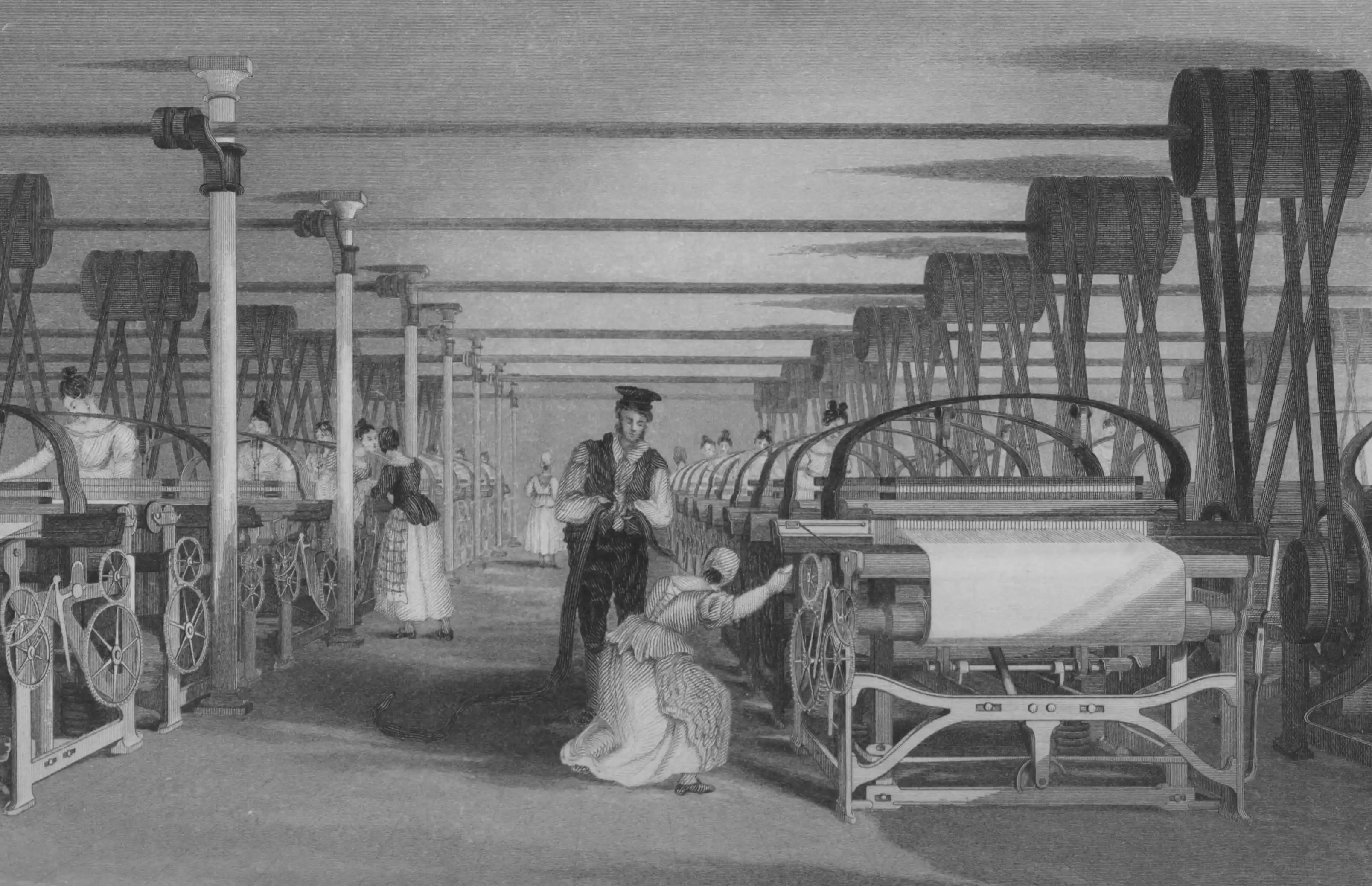
( Power-loom weaving, engraving by J. Tingle after Thomas Allom, 1835 / Wikimedia Commons )

I. The Workshop Is Still Old

Most people's day goes like this: use AI to write an email in the morning, saving ten minutes; then spend two hours in an unnecessary weekly meeting; copy and paste the same set of data between three tools in the afternoon; post on social media at night saying "AI is so great." The ten minutes saved are completely eaten back by the old processes.

Similarly, when the steam engine first appeared, factory owners initially just replaced the waterwheel with the steam engine, leaving everything else unchanged—factories were still built by the river, still multi-story buildings, still with a central drive shaft powering the entire production line. We embed ChatGPT into Slack, add Copilot to Office, place AI chat windows into workflows—we're doing the same thing. The tool is upgraded, but the workshop remains the same.

But replacing the machine is not the same as replacing the workshop. As McLuhan famously said:

We look at the present through a rear-view mirror. We march backwards into the future. Using old processes to accommodate new tools is like early films being merely recorded stage plays. The real breakthrough comes when someone completely frees the steam engine from the river and redesigns the entire production system around the new power source.

Looking at the Industrial Revolution timeline and comparing it to AI, we can roughly locate where we are on the map:
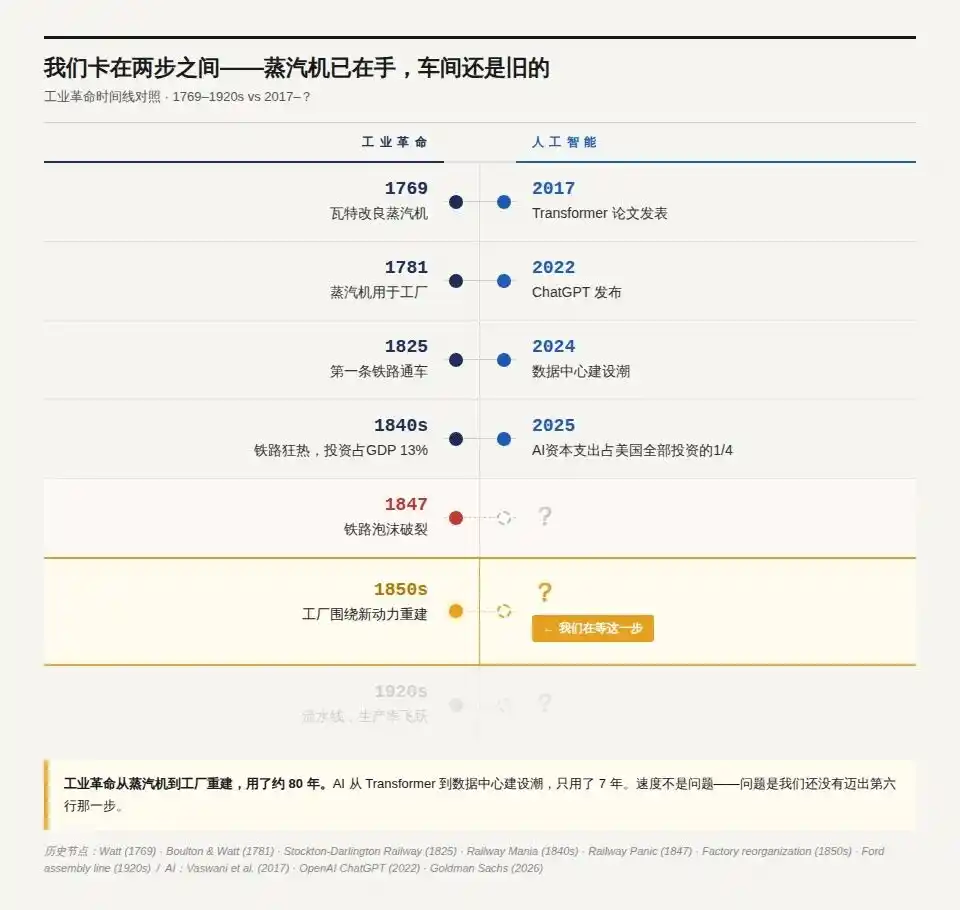
Now the timeline is extremely compressed. The Industrial Revolution took 60 years from the steam engine to the railway mania; AI took only 7 years from Transformer to the data center construction boom.

Speed is not the problem; the problem is where we are stuck—the first four rows are still the stage of installing new machines in old workshops. The steam engine is installed, railways are being laid, but the mode of production remains intact. The sixth row is the real watershed. We are most likely stuck between these two steps.

The steam engine is in our hands, but the workshop is still old.

II. All the Money Is Bet on the Layer Farthest from the Factory

Infrastructure is always overbuilt. It's the investors who go bankrupt, not the infrastructure.

In 1846, the British Parliament passed 263 Railway Acts, approving the construction of 9,500 miles of new railway. At its peak, railway investment accounted for 13% of Britain's GDP. Railway shares could be bought with only a 10% down payment, and the middle class flocked to invest. The bubble burst in 1847. One-third of the approved lines were never built, and countless investors lost everything. Darwin lost 60% on railway stocks, and he was luckier than most.

But the railways remained.

Today's AI infrastructure is following the same path. Goldman Sachs' latest estimate puts global AI infrastructure capital expenditure at $765 billion in 2026, projected to reach $1.6 trillion annually by 2031. The proportion of capital expenditure to operating cash flow for hyperscale cloud providers has risen from about 40% in 2023 to nearly 70% in 2025. AI-related investments already account for about a quarter of all US investment. Aschenbrenner's $13.68 billion is betting on this layer—he's not betting on which application will win, but on the underlying compute power itself.

This capital cycle is isomorphic to real estate development. Building data centers is like building buildings: land is electricity, building materials are GPUs and storage, contractors are data center builders, developers are cloud providers, tenants are AI application companies, and rent is API revenue. The cloud providers' business model is to "rent to cover the loan"—using API revenue to cover data center capital expenditure, waiting for the valuation leap brought by the explosion of AI applications.
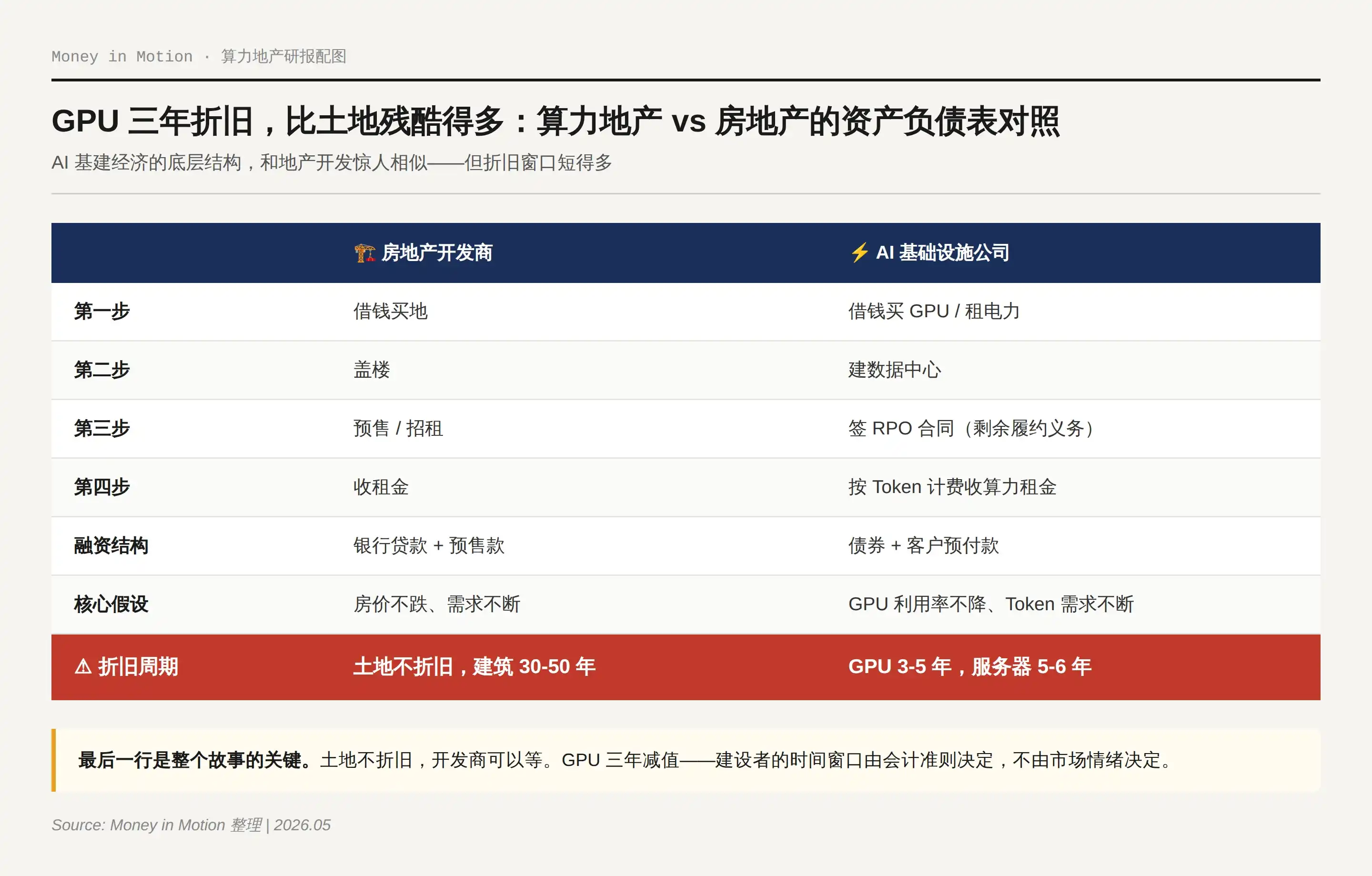
(Compute Power Real Estate: Each generation has its own infrastructure)

The core risk is the same: is the growth rate of API call volume offsetting the decline in API unit price? If rent falls below the loan repayment line—this is a nightmare familiar to real estate developers. The lesson of 2008 was not that too many houses were built, but that the structure of the houses built did not match the structure of real demand. The equivalent risk for AI is: an oversupply of general-purpose compute power, while specialized capabilities that can truly handle high-value scenarios like financial compliance or medical diagnosis remain scarce.

Railways, real estate, AI—infrastructure investments across three eras share the same rule: overbuilding is the norm, material suppliers always lose pricing power, and long-term returns always belong to the owners of "prime locations." Look at the Q1 fund holdings on Wall Street—probably 80% is concentrated in this infrastructure layer: NVIDIA, data centers, cloud infrastructure. But the railway mania teaches us: this is not the full picture of the AI revolution, and it's not even the layer with the highest returns.

What is the prime location for AI? It's unique industry data and deeply embedded workflows. For individuals, the real "prime location" is not the stocks you hold, but your own irreplaceable judgment and industry knowledge—provided you have already rebuilt the way you use them around AI.

The real returns are in the next layer. But between infrastructure and value creation, there is no seamless connection. There is a gap in the middle—historically, this gap has swallowed decades.

III. Who Is Tearing Down the Workshop

Those tearing down the workshop and those "using AI for efficiency" are not doing the same thing.

Notion co-founder Simon used to be a "10x programmer"; now he rarely writes code himself—he simultaneously controls three or four AI coding agents, achieving 30x to 40x efficiency. Notion now has 1,000 employees and over 700 AI agents. The gap isn't the tools; it's that Simon tore down his old workshop, while most people just replaced their waterwheel.

600 million Chinese users have used generative AI tools, a year-on-year increase of 142%—this is the world's largest pool of AI demand. But almost no Chinese company has rebuilt its core workflows around AI. The world's largest demand side, paired with a nearly stagnant supply side in terms of organizational change. This contrast itself is a signal: it's not that the tools are lacking, it's that organizations haven't kept up. The context of knowledge work is scattered across dozens of tools and dozens of minds, outputs are not verifiable, and no one knows how to judge whether a strategic memo is effective.
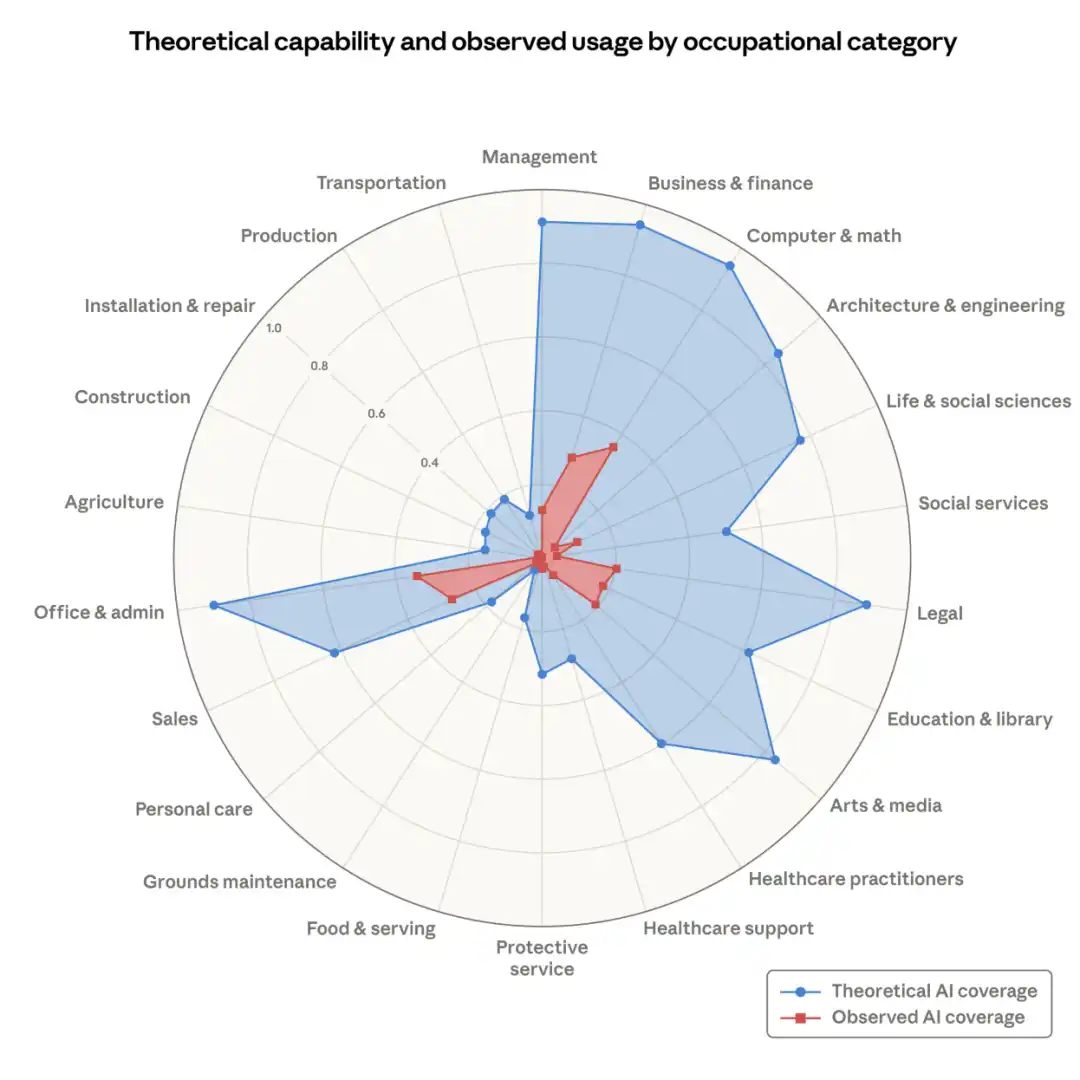
(Labor market impacts of AI: A new measure and early evidence)

Anthropic is already moving on a larger scale. They released an Economic Index, using real usage data to depict which tasks and industries AI is replacing first, then building according to this blueprint: forming a joint venture AI-native enterprise services company with Goldman Sachs, Blackstone, and Hellman & Friedman; establishing a global alliance with KPMG, connecting 276,000 employees to Claude; Accenture forming a business group, training 30,000 people, focusing on finance, life sciences, and healthcare.

The role these consulting firms play is not that of AI users, but AI railway engineers—they don't build steam engines or lay tracks; they help enterprises tear down old factories and rebuild production lines around the new power source. Without this role, most factory owners wouldn't know where to start.

The signals are already flashing. One of the sharpest comes from the job market.

Young people aged 22-25 entering AI-high-exposure professions are 14% less likely to find a job than their peers entering low-exposure professions. Junior positions are already being squeezed.

If I were a new graduate, this number would directly affect my job search. If I were a manager, the next batch of junior positions I hire might not be people.

Organizations are dismantling. What about individuals? My degree, my resume, the industry experience I've accumulated over the years—these are my waterwheels. They once drove my entire production line, but the steam engine has arrived. A degree from a top university is no longer a moat; it just proves I once built a decent factory by the river.

Now the question is, do we have the ability to leave that river?

Anthropic's data shows that users who have used AI tools for more than 6 months have a task success rate 10% higher than new users. Those who started half a year earlier are already leading by 10%, and this gap compounds over time.

But no company has gone bankrupt yet from not using AI, at least my law firm is still advancing full steam ahead around AI. The winners haven't been selected by the market yet. The learning curve is real—early adopters are already accumulating advantages, but most are still at the starting line.

IV. My Next Job Doesn't Have a Name Yet

Will my current job title exist ten years from now? How many of the tools I used daily five years ago are still used today? The answers are likely both negative. But I don't know what the things that replace them are called—because those things don't exist yet.

It's been this way every time in history. New things aren't planned; they grow on their own after old constraints disappear.

Before railways were built, Britain was a collection of isolated local economies. The price of cotton cloth in Manchester and London could differ by 30%. Each city had its own time standard, and no one saw a problem. In the twenty years after railways were built, everything changed. A national unified market appeared for the first time, price differences were smoothed out; standard time was forced by railways, not invented; stationmasters, telegraph operators, travel agents—these jobs didn't exist at all before railways.

No one foresaw department stores when laying railways. No one foresaw standard time when building steam engines.

(Steam, Steel, and AI Infinite Intelligence)

The history of cities tells the same story. Cities hundreds of years ago were human-scale—forty minutes to walk across Florence. Steel frames made skyscrapers possible, railways connected cities to their hinterlands, and elevators, subways, and highways followed. Tokyo, Chongqing, Dallas—these are not bigger versions of Florence; they are entirely new ways of life.

Current knowledge work is also human-scale. Teams of a few dozen people, meetings and emails set the rhythm, becoming unmanageable beyond a few hundred people. We are building Florence with stone and wood. AI makes "Tokyo" possible—organizations composed of thousands of AI agents and people, with workflows running continuously across time zones. Old weekly meetings, quarterly planning, annual reviews may no longer make sense.

Simon no longer writes code—his job has become "managing AI agents." This position didn't exist two years ago. My next job title might not have a name yet. But someone is already building that future we cannot yet name.

V. What Does the New Workshop Look Like

After tearing down the old workshop, what do you build? Y Combinator's answer is: let the company improve itself.

Their internal system now modifies its own code at night. An employee ran a query during the day that failed. A supervising agent read about this failure, deduced the cause, wrote code to fix it, submitted it for review, and deployed it. The same query ran successfully the next day. The whole thing happened while everyone was asleep.

This isn't AI helping people produce 30% more. This is the system running through an entire closed loop on its own, figuring out how to become better.

In an internal talk, YC partner Tom Blomfield called this company form a "recursive self-improving AI loop." His judgment is direct: most companies are still Roman legions—information trickles down layer by layer and aggregates up layer by layer, with people acting as conduits. What AI breaks is not the efficiency of a certain link, but the very premise of this entire hierarchical structure.

His new logic is: burn tokens, not headcount. The bottleneck is shifting from manpower to compute power. The data YC sees shows that companies reaching Demo Day have about 5 times higher revenue per capita than 18 months ago. The role of middle management is being taken over by AI—"coordination" no longer requires humans. Everyone should be an IC, a builder, an operator. Every task has a named owner, not a committee.

There's another prerequisite: the company must be "readable" to AI. Things that aren't recorded are, to AI, as if they never happened. YC now archives all partner emails, records all Slack messages and office hour recordings. One partner used 2,000 hours of recordings accumulated over three months to have AI regenerate a 150-page internal manual—much better than the old version. This manual updates automatically every month, becoming a perpetually fresh "living brain."

Tom left a question:

If you were building your company from scratch today, would you set it up in this form? If your company already has a hierarchical structure, you face a harder question—will the pain of rebuilding be less than the cost of continuing to operate as a Roman legion?

People are not at the center of the workshop; they are on the periphery—responsible for the places AI can't yet reach: on-the-ground judgment, entirely new situations, high-stakes, high-emotion moments. The center of the company is a "corporate brain" pieced together from data, records, and industry knowledge. The software running on it is consumable—if it can be generated, it can be regenerated. What's valuable resides in people's minds—how the business runs, which steps involve judgment; this understanding is the real asset.

What Ivan Zhao describes in "Steam, Steel, and Infinite Minds" is the other side of this direction—an organization of 1,000 employees and over 700 AI agents collaborating, where people are responsible for judgment, and agents are responsible for execution. Aschenbrenner bets on compute infrastructure; Zhao bets on organizational reconstruction. Both paths ultimately point to the same destination: a new mode of production rebuilt around AI.

VI. Conclusion

Between the 1840s and 1850s—the railways were laid, but the factories hadn't been rebuilt.

Where are we? Simon no longer writes code. He tore down his own waterwheel.

The question has never been whether the steam engine is good enough. The question is who will be the first to tear down the old workshop.

I don't intend to predict the future department stores. I only intend to take care of myself—ensuring I stand along the railway line, not guarding a river that is drying up.

What about you?

Perguntas relacionadas

QWhat is the central argument of the article regarding our current phase in the 'AI Industrial Revolution'?

AThe central argument is that we are currently in the 'steam engine' phase of the AI revolution. We have powerful new tools like Large Language Models, but are largely using them to perform old tasks within existing organizational structures and workflows ('the old workshop'). The real revolution hasn't begun yet. It will start not when AI is invented, but when organizations fundamentally dismantle old processes and rebuild their core production methods around AI.

QAccording to the author, what is the key difference between simply 'using AI for efficiency' and truly transforming work?

AThe key difference is between 'replacing the waterwheel' and 'dismantling the old workshop.' Using AI for efficiency means attaching AI chatbots to existing tools (like adding ChatGPT to Slack) to save time on discrete tasks, but leaving the underlying workflows and organizational logic unchanged. True transformation involves redesigning the entire 'factory' around the new 'engine'—reimagining processes, roles, and structures from the ground up with AI as the core driver, as exemplified by individuals like Notion's Simon who manage AI agents instead of writing code.

QWhat historical parallel does the author draw to the massive investment in AI infrastructure (like data centers and GPUs), and what warning does this imply?

AThe author draws a parallel to the British 'Railway Mania' of the 1840s. This implies a warning of a potential investment bubble where capital is overwhelmingly poured into foundational infrastructure (the 'rail lines' and 'real estate' of AI—data centers, chips, cloud capacity), far ahead of proven, high-value applications. The risk is that the 'rent' (API revenue) may not cover the 'mortgage' (capital expenditure) if the growth in usage doesn't outpace price declines, leading to overcapacity in generic compute while specialized, industry-transforming capabilities remain scarce.

QWhat does the author suggest is the 'core location' or most valuable asset for individuals in the AI era, and why?

AFor individuals, the author suggests the true 'core location' is not stock holdings in infrastructure companies, but their own 'irreplaceable judgment and industry knowledge.' This is because AI commoditizes execution and information retrieval. The unique value lies in human capabilities like offline judgment, navigating novel situations, and high-stakes emotional intelligence—areas where AI currently cannot reach. However, this knowledge is only a valuable asset if the individual has already rebuilt their way of working to leverage AI effectively.

QWhat is the 'recursive self-improving AI loop' described in the Y Combinator example, and what does it signify about future organizations?

AThe 'recursive self-improving AI loop' is when an AI system autonomously identifies a failure in its own operations, diagnoses the cause, writes and deploys code to fix it, and verifies the solution—all without human intervention. This signifies a move beyond AI as a productivity tool for humans. It points to future organizations where AI forms a 'company brain' from data and communications, enabling systems to self-optimize. This undermines traditional hierarchical ('Roman legion') structures, as coordination and middle-management tasks are automated. The future organization is 'AI-readable,' with humans focused on high-judgment roles at the periphery.

Leituras Relacionadas

Bankless Co-founder: Why I Sold All My ETH

Author David Hoffman, founder of Bankless, explains his decision to sell all his ETH, despite being a prominent figure in the Ethereum ecosystem. He clarifies that his move is not a bearish take on Ethereum itself, which he remains highly optimistic about as a network. His core argument is that the "ETH is money" thesis, which he helped popularize, has largely played out. Hoffman argues that ETH has achieved the market valuation it deserves based on Ethereum's current success and competitive position. He details several reasons for this view. First, the path for ETH to become global money required nearly flawless execution and sustained dominance across Ethereum's entire technical and social stack—a coordination challenge he now believes had a narrower window for success than anticipated. Second, market data shows a strong correlation between L1 chain activity/fees and the price of its native asset; Ethereum's fee dominance has been challenged by competitors like Solana. Third, the "strong version" of crypto (decentralized, native crypto economies) that ETH's monetary thesis relied upon has struggled to maintain a positive mainstream narrative and stable adoption beyond a brief period. Finally, Ethereum's architecture as a "giver"—providing secure block space and tokenization capabilities at cost to L2s and applications—means it doesn't capture premium value directly. Its rollup-centric roadmap further directs most profits to L2s and applications ("fat app theory"). In conclusion, Hoffman believes the opportunity for ETH to be revalued significantly upward as money has diminished. He sold not because ETH will fail, but because its monetary thesis has matured, and he seeks to allocate capital to other opportunities he finds more compelling.

链捕手Há 19m

Bankless Co-founder: Why I Sold All My ETH

链捕手Há 19m

From Issuer to Infrastructure Owner: Circle's Arc Strategy and the Fatal Gap in the GENIUS Act

Circle raised $222 million for its proprietary Layer-1 blockchain, Arc, positioning itself not just as a stablecoin issuer but as the owner of the settlement infrastructure USDC relies on. This move, backed by investors like BlackRock and Apollo, highlights a significant structural conflict unaddressed by the GENIUS Act of 2025. While the act focuses on stablecoin reserves and issuer oversight, it remains silent on the market structure implications of an issuer controlling the underlying network—a scenario akin to a currency issuer also owning the payment rails. Traditionally, financial regulations separate issuers from settlement infrastructure to ensure neutrality. With Arc, Circle gains control over transaction ordering, fees, and network rules, potentially favoring USDC over competitors. The article argues that this creates a permanent structural temptation, even if no abuse occurs. The solution lies in applying established market infrastructure principles: mandating neutral transaction ordering, transparent fee schedules, and governance separated from Circle’s commercial interests. The current pre-mainnet phase offers a critical window for regulators to establish these rules before Arc becomes entrenched. Once operational, enforcing changes would be costly and disruptive. The core question remains: should a regulated stablecoin issuer be allowed to own the settlement network its competitors must use? The GENIUS Act doesn’t answer this, but Circle’s Arc strategy makes it urgent.

marsbitHá 24m

From Issuer to Infrastructure Owner: Circle's Arc Strategy and the Fatal Gap in the GENIUS Act

marsbitHá 24m

What Are the Key Variables Determining the AI Bull Market?

Title: What Determines the AI Bull Market? Key Variables Revealed Despite rising oil prices above $100/barrel, persistent inflation, and fragile Fed rate cut expectations—a traditionally hostile environment for high-valuation tech stocks—the AI sector continues to drive the market to new highs. According to analysts, the current AI boom is in a phase of "rational fervor": while bubbles exist, they are not yet out of control. The crucial shift is the emergence of Agentic AI, which is evolving from an assisting tool (Copilot) to an autonomous execution tool (Autopilot), creating a clearer commercial path from investment to revenue. This shift accelerates Token consumption and inference computing demand while boosting revenue forecasts for leading firms. The market is now rewarding capital expenditure as it transforms from a burden into a competitive moat, supporting hardware chains like GPUs, optical modules, and storage. However, valuations have already priced in growth expectations for 2027-2028. The forward P/E ratio for the "Magnificent Seven" tech giants is about 35x, compared to 25x for the rest of the S&P 500. This premium implies AI adoption must occur 5 to 8 times faster than past technological revolutions—a scenario with little room for error. The sustainability of the AI bull market hinges on three key variables: 1. **Short-term liquidity shocks**: Risks include sustained high oil prices, resurgent inflation, rising interest rates, and potential unwinding of the yen carry trade. The critical question is whether the upward revision speed of Annual Recurring Revenue (ARR) can outpace the rise in interest rates. 2. **Mid-term industry realization**: Can the actual pace of AI adoption and commercialization match the current lofty valuations? Historically, general-purpose technology revolutions follow a non-linear path with periods of acceleration and deceleration. 3. **Long-term structural constraints**: These include energy and power grid limitations, employment displacement and consumer purchasing power, social acceptance and potential backlash, and potential hardware technology breakthroughs that could disrupt current supply chains. While the long-term prospects for AI remain optimistic with potential for significant productivity gains, the stock market's pricing depends not just on the vision but on the actual speed of realization amid these growing constraints. The direction is clear, but the pace of execution will determine whether the bubble remains controlled or spirals out of control.

marsbitHá 25m

What Are the Key Variables Determining the AI Bull Market?

marsbitHá 25m

Morning Post | Hyperliquid Launches Off-chain Event Prediction Market Contract; Strategy Completes $1.5 Billion Debt Buyback; Kelp DAO Announces rsETH Fully Restored

Crypto Market Digest (May 27, 2026) Ondo Finance's founder Nathan Allman has passed away, with President Ian De Bode taking over as CEO. In regulatory news, Hong Kong authorities concluded a consultation on virtual asset service provider licensing, aiming to align rules with traditional finance. Kelp DAO announced its rsETH token has fully recovered five weeks after a $293 million hack by Lazarus Group, though the incident caused significant damage to DeFi lending protocols like Aave. Key industry developments include Hyperliquid launching off-chain event prediction market contracts, and the CME introducing futures for Avalanche and Sui. A report highlights the rise of AI Agent payments, with over $73 million settled on-chain in a year, predominantly using USDC. Meanwhile, blockchain detective ZachXBT exposed market manipulation involving several BSC tokens. In investment news, a firm referred to as "Strategy" completed a $1.5 billion debt buyback. Political contributions from the crypto sector for the 2026 U.S. elections have surpassed $500 million, heavily favoring Republican candidates. BitMEX founder Arthur Hayes revealed Zcash is his second-largest holding, citing the growing necessity for monetary privacy. The digest concludes with trending memecoins on Ethereum, Solana, and Base networks, and highlights in-depth articles covering the impending SpaceX IPO, Polymarket's regulatory challenges, and an analysis of the on-chain treasury landscape.

链捕手Há 58m

Morning Post | Hyperliquid Launches Off-chain Event Prediction Market Contract; Strategy Completes $1.5 Billion Debt Buyback; Kelp DAO Announces rsETH Fully Restored

链捕手Há 58m

Trading

Spot
Futuros

Artigos em Destaque

O que é GROK AI

Grok AI: Revolucionar a Tecnologia Conversacional na Era Web3 Introdução No panorama em rápida evolução da inteligência artificial, a Grok AI destaca-se como um projeto notável que liga os domínios da tecnologia avançada e da interação com o utilizador. Desenvolvida pela xAI, uma empresa liderada pelo renomado empreendedor Elon Musk, a Grok AI procura redefinir a forma como interagimos com a inteligência artificial. À medida que o movimento Web3 continua a florescer, a Grok AI visa aproveitar o poder da IA conversacional para responder a consultas complexas, proporcionando aos utilizadores uma experiência que é não apenas informativa, mas também divertida. O que é a Grok AI? A Grok AI é um sofisticado chatbot de IA conversacional projetado para interagir com os utilizadores de forma dinâmica. Ao contrário de muitos sistemas de IA tradicionais, a Grok AI abraça uma gama mais ampla de perguntas, incluindo aquelas tipicamente consideradas inadequadas ou fora das respostas padrão. Os principais objetivos do projeto incluem: Raciocínio Fiável: A Grok AI enfatiza o raciocínio de senso comum para fornecer respostas lógicas com base na compreensão contextual. Supervisão Escalável: A integração de assistência de ferramentas garante que as interações dos utilizadores sejam monitorizadas e otimizadas para qualidade. Verificação Formal: A segurança é primordial; a Grok AI incorpora métodos de verificação formal para aumentar a fiabilidade das suas saídas. Compreensão de Longo Contexto: O modelo de IA destaca-se na retenção e recordação de um extenso histórico de conversas, facilitando discussões significativas e contextualizadas. Robustez Adversarial: Ao focar na melhoria das suas defesas contra entradas manipuladas ou maliciosas, a Grok AI visa manter a integridade das interações dos utilizadores. Em essência, a Grok AI não é apenas um dispositivo de recuperação de informações; é um parceiro conversacional imersivo que incentiva um diálogo dinâmico. Criador da Grok AI A mente por trás da Grok AI não é outra senão Elon Musk, um indivíduo sinónimo de inovação em vários campos, incluindo automóvel, viagens espaciais e tecnologia. Sob a égide da xAI, uma empresa focada em avançar a tecnologia de IA de maneiras benéficas, a visão de Musk visa reformular a compreensão das interações com a IA. A liderança e a ética fundacional são profundamente influenciadas pelo compromisso de Musk em ultrapassar os limites tecnológicos. Investidores da Grok AI Embora os detalhes específicos sobre os investidores que apoiam a Grok AI permaneçam limitados, é reconhecido publicamente que a xAI, a incubadora do projeto, é fundada e apoiada principalmente pelo próprio Elon Musk. As anteriores empreitadas e participações de Musk fornecem um forte apoio, reforçando ainda mais a credibilidade e o potencial de crescimento da Grok AI. No entanto, até agora, informações sobre fundações ou organizações de investimento adicionais que apoiam a Grok AI não estão prontamente acessíveis, marcando uma área para exploração futura potencial. Como Funciona a Grok AI? A mecânica operacional da Grok AI é tão inovadora quanto a sua estrutura conceptual. O projeto integra várias tecnologias de ponta que facilitam as suas funcionalidades únicas: Infraestrutura Robusta: A Grok AI é construída utilizando Kubernetes para orquestração de contêineres, Rust para desempenho e segurança, e JAX para computação numérica de alto desempenho. Este trio assegura que o chatbot opere de forma eficiente, escale eficazmente e sirva os utilizadores prontamente. Acesso a Conhecimento em Tempo Real: Uma das características distintivas da Grok AI é a sua capacidade de aceder a dados em tempo real através da plataforma X—anteriormente conhecida como Twitter. Esta capacidade concede à IA acesso às informações mais recentes, permitindo-lhe fornecer respostas e recomendações oportunas que outros modelos de IA poderiam perder. Dois Modos de Interação: A Grok AI oferece aos utilizadores a escolha entre “Modo Divertido” e “Modo Regular”. O Modo Divertido permite um estilo de interação mais lúdico e humorístico, enquanto o Modo Regular foca em fornecer respostas precisas e exatas. Esta versatilidade assegura uma experiência adaptada que atende a várias preferências dos utilizadores. Em essência, a Grok AI combina desempenho com envolvimento, criando uma experiência que é tanto enriquecedora quanto divertida. Cronologia da Grok AI A jornada da Grok AI é marcada por marcos fundamentais que refletem as suas fases de desenvolvimento e implementação: Desenvolvimento Inicial: A fase fundamental da Grok AI ocorreu ao longo de aproximadamente dois meses, durante os quais o treinamento inicial e o ajuste do modelo foram realizados. Lançamento Beta do Grok-2: Numa evolução significativa, o beta do Grok-2 foi anunciado. Este lançamento introduziu duas versões do chatbot—Grok-2 e Grok-2 mini—cada uma equipada com capacidades para conversar, programar e raciocinar. Acesso Público: Após o seu desenvolvimento beta, a Grok AI tornou-se disponível para os utilizadores da plataforma X. Aqueles com contas verificadas por um número de telefone e ativas há pelo menos sete dias podem aceder a uma versão limitada, tornando a tecnologia disponível para um público mais amplo. Esta cronologia encapsula o crescimento sistemático da Grok AI desde a sua concepção até ao envolvimento público, enfatizando o seu compromisso com a melhoria contínua e a interação com o utilizador. Principais Características da Grok AI A Grok AI abrange várias características principais que contribuem para a sua identidade inovadora: Integração de Conhecimento em Tempo Real: O acesso a informações atuais e relevantes diferencia a Grok AI de muitos modelos estáticos, permitindo uma experiência de utilizador envolvente e precisa. Estilos de Interação Versáteis: Ao oferecer modos de interação distintos, a Grok AI atende a várias preferências dos utilizadores, convidando à criatividade e personalização na conversa com a IA. Base Tecnológica Avançada: A utilização de Kubernetes, Rust e JAX fornece ao projeto uma estrutura sólida para garantir fiabilidade e desempenho ótimo. Consideração de Discurso Ético: A inclusão de uma função de geração de imagens demonstra o espírito inovador do projeto. No entanto, também levanta considerações éticas em torno dos direitos autorais e da representação respeitosa de figuras reconhecíveis—uma discussão em curso dentro da comunidade de IA. Conclusão Como uma entidade pioneira no domínio da IA conversacional, a Grok AI encapsula o potencial para experiências transformadoras do utilizador na era digital. Desenvolvida pela xAI e impulsionada pela abordagem visionária de Elon Musk, a Grok AI integra conhecimento em tempo real com capacidades avançadas de interação. Esforça-se por ultrapassar os limites do que a inteligência artificial pode alcançar, mantendo um foco nas considerações éticas e na segurança do utilizador. A Grok AI não apenas incorpora o avanço tecnológico, mas também representa um novo paradigma de conversas no panorama Web3, prometendo envolver os utilizadores com conhecimento hábil e interação lúdica. À medida que o projeto continua a evoluir, ele permanece como um testemunho do que a interseção da tecnologia, criatividade e interação humana pode alcançar.

444 Visualizações TotaisPublicado em {updateTime}Atualizado em 2024.12.26

O que é GROK AI

O que é ERC AI

Euruka Tech: Uma Visão Geral do $erc ai e as suas Ambições no Web3 Introdução No panorama em rápida evolução da tecnologia blockchain e das aplicações descentralizadas, novos projetos surgem frequentemente, cada um com objetivos e metodologias únicas. Um desses projetos é a Euruka Tech, que opera no vasto domínio das criptomoedas e do Web3. O foco principal da Euruka Tech, particularmente do seu token $erc ai, é apresentar soluções inovadoras concebidas para aproveitar as capacidades crescentes da tecnologia descentralizada. Este artigo tem como objetivo fornecer uma visão abrangente da Euruka Tech, uma exploração das suas metas, funcionalidade, a identidade do seu criador, potenciais investidores e a sua importância no contexto mais amplo do Web3. O que é a Euruka Tech, $erc ai? A Euruka Tech é caracterizada como um projeto que aproveita as ferramentas e funcionalidades oferecidas pelo ambiente Web3, focando na integração da inteligência artificial nas suas operações. Embora os detalhes específicos sobre a estrutura do projeto sejam um tanto elusivos, ele é concebido para melhorar o envolvimento dos utilizadores e automatizar processos no espaço cripto. O projeto visa criar um ecossistema descentralizado que não só facilita transações, mas também incorpora funcionalidades preditivas através da inteligência artificial, daí a designação do seu token, $erc ai. O objetivo é fornecer uma plataforma intuitiva que facilite interações mais inteligentes e um processamento eficiente de transações dentro da crescente esfera do Web3. Quem é o Criador da Euruka Tech, $erc ai? Neste momento, a informação sobre o criador ou a equipa fundadora da Euruka Tech permanece não especificada e algo opaca. Esta ausência de dados levanta preocupações, uma vez que o conhecimento sobre o histórico da equipa é frequentemente essencial para estabelecer credibilidade no setor blockchain. Portanto, categorizamos esta informação como desconhecida até que detalhes concretos sejam disponibilizados no domínio público. Quem são os Investidores da Euruka Tech, $erc ai? De forma semelhante, a identificação de investidores ou organizações de apoio para o projeto Euruka Tech não é prontamente fornecida através da pesquisa disponível. Um aspeto que é crucial para potenciais partes interessadas ou utilizadores que consideram envolver-se com a Euruka Tech é a garantia que vem de parcerias financeiras estabelecidas ou apoio de empresas de investimento respeitáveis. Sem divulgações sobre afiliações de investimento, é difícil tirar conclusões abrangentes sobre a segurança financeira ou a longevidade do projeto. Em linha com a informação encontrada, esta seção também se encontra no estado de desconhecido. Como funciona a Euruka Tech, $erc ai? Apesar da falta de especificações técnicas detalhadas para a Euruka Tech, é essencial considerar as suas ambições inovadoras. O projeto procura aproveitar o poder computacional da inteligência artificial para automatizar e melhorar a experiência do utilizador no ambiente das criptomoedas. Ao integrar IA com tecnologia blockchain, a Euruka Tech visa fornecer funcionalidades como negociações automatizadas, avaliações de risco e interfaces de utilizador personalizadas. A essência inovadora da Euruka Tech reside no seu objetivo de criar uma conexão fluida entre os utilizadores e as vastas possibilidades apresentadas pelas redes descentralizadas. Através da utilização de algoritmos de aprendizagem automática e IA, visa minimizar os desafios enfrentados por utilizadores de primeira viagem e agilizar as experiências transacionais dentro do quadro do Web3. Esta simbiose entre IA e blockchain sublinha a importância do token $erc ai, que se apresenta como uma ponte entre interfaces de utilizador tradicionais e as capacidades avançadas das tecnologias descentralizadas. Cronologia da Euruka Tech, $erc ai Infelizmente, devido à informação limitada disponível sobre a Euruka Tech, não conseguimos apresentar uma cronologia detalhada dos principais desenvolvimentos ou marcos na jornada do projeto. Esta cronologia, tipicamente inestimável para traçar a evolução de um projeto e compreender a sua trajetória de crescimento, não está atualmente disponível. À medida que informações sobre eventos notáveis, parcerias ou adições funcionais se tornem evidentes, atualizações certamente aumentarão a visibilidade da Euruka Tech na esfera cripto. Esclarecimento sobre Outros Projetos “Eureka” É importante abordar que múltiplos projetos e empresas partilham uma nomenclatura semelhante com “Eureka.” A pesquisa identificou iniciativas como um agente de IA da NVIDIA Research, que se concentra em ensinar robôs a realizar tarefas complexas utilizando métodos generativos, bem como a Eureka Labs e a Eureka AI, que melhoram a experiência do utilizador na educação e na análise de serviços ao cliente, respetivamente. No entanto, estes projetos são distintos da Euruka Tech e não devem ser confundidos com os seus objetivos ou funcionalidades. Conclusão A Euruka Tech, juntamente com o seu token $erc ai, representa um jogador promissor, mas atualmente obscuro, dentro do panorama do Web3. Embora os detalhes sobre o seu criador e investidores permaneçam não divulgados, a ambição central de combinar inteligência artificial com tecnologia blockchain destaca-se como um ponto focal de interesse. As abordagens únicas do projeto em promover o envolvimento do utilizador através da automação avançada podem diferenciá-lo à medida que o ecossistema Web3 avança. À medida que o mercado cripto continua a evoluir, as partes interessadas devem manter um olhar atento sobre os avanços em torno da Euruka Tech, uma vez que o desenvolvimento de inovações documentadas, parcerias ou um roteiro definido pode apresentar oportunidades significativas no futuro próximo. Neste momento, aguardamos por insights mais substanciais que possam desvendar o potencial da Euruka Tech e a sua posição no competitivo panorama cripto.

483 Visualizações TotaisPublicado em {updateTime}Atualizado em 2025.01.02

O que é ERC AI

O que é DUOLINGO AI

DUOLINGO AI: Integrar a Aprendizagem de Línguas com Inovação Web3 e IA Numa era em que a tecnologia transforma a educação, a integração da inteligência artificial (IA) e das redes blockchain anuncia uma nova fronteira para a aprendizagem de línguas. Apresentamos DUOLINGO AI e a sua criptomoeda associada, $DUOLINGO AI. Este projeto aspira a unir o poder educativo das principais plataformas de aprendizagem de línguas com os benefícios da tecnologia descentralizada Web3. Este artigo explora os principais aspectos do DUOLINGO AI, analisando os seus objetivos, estrutura tecnológica, desenvolvimento histórico e potencial futuro, mantendo a clareza entre o recurso educativo original e esta iniciativa independente de criptomoeda. Visão Geral do DUOLINGO AI No seu cerne, DUOLINGO AI procura estabelecer um ambiente descentralizado onde os alunos podem ganhar recompensas criptográficas por alcançar marcos educativos em proficiência linguística. Ao aplicar contratos inteligentes, o projeto visa automatizar processos de verificação de habilidades e alocação de tokens, aderindo aos princípios do Web3 que enfatizam a transparência e a propriedade do utilizador. O modelo diverge das abordagens tradicionais de aquisição de línguas ao apoiar-se fortemente numa estrutura de governança orientada pela comunidade, permitindo que os detentores de tokens sugiram melhorias ao conteúdo dos cursos e à distribuição de recompensas. Alguns dos objetivos notáveis do DUOLINGO AI incluem: Aprendizagem Gamificada: O projeto integra conquistas em blockchain e tokens não fungíveis (NFTs) para representar níveis de proficiência linguística, promovendo a motivação através de recompensas digitais envolventes. Criação de Conteúdo Descentralizada: Abre caminhos para educadores e entusiastas de línguas contribuírem com os seus cursos, facilitando um modelo de partilha de receitas que beneficia todos os colaboradores. Personalização Através de IA: Ao empregar modelos avançados de aprendizagem de máquina, o DUOLINGO AI personaliza as lições para se adaptar ao progresso de aprendizagem individual, semelhante às características adaptativas encontradas em plataformas estabelecidas. Criadores do Projeto e Governança A partir de abril de 2025, a equipa por trás do $DUOLINGO AI permanece pseudónima, uma prática frequente no panorama descentralizado das criptomoedas. Esta anonimidade visa promover o crescimento coletivo e o envolvimento das partes interessadas, em vez de se concentrar em desenvolvedores individuais. O contrato inteligente implementado na blockchain Solana indica o endereço da carteira do desenvolvedor, o que significa o compromisso com a transparência em relação às transações, apesar da identidade dos criadores ser desconhecida. De acordo com o seu roteiro, o DUOLINGO AI pretende evoluir para uma Organização Autónoma Descentralizada (DAO). Esta estrutura de governança permite que os detentores de tokens votem em questões críticas, como implementações de funcionalidades e alocação de tesouraria. Este modelo alinha-se com a ética de empoderamento comunitário encontrada em várias aplicações descentralizadas, enfatizando a importância da tomada de decisão coletiva. Investidores e Parcerias Estratégicas Atualmente, não existem investidores institucionais ou capitalistas de risco publicamente identificáveis ligados ao $DUOLINGO AI. Em vez disso, a liquidez do projeto origina-se principalmente de trocas descentralizadas (DEXs), marcando um contraste acentuado com as estratégias de financiamento das empresas tradicionais de tecnologia educacional. Este modelo de base indica uma abordagem orientada pela comunidade, refletindo o compromisso do projeto com a descentralização. No seu whitepaper, o DUOLINGO AI menciona a formação de colaborações com “plataformas de educação blockchain” não especificadas, com o objetivo de enriquecer a sua oferta de cursos. Embora parcerias específicas ainda não tenham sido divulgadas, estes esforços colaborativos sugerem uma estratégia para misturar inovação em blockchain com iniciativas educativas, expandindo o acesso e o envolvimento dos utilizadores em diversas vias de aprendizagem. Arquitetura Tecnológica Integração de IA O DUOLINGO AI incorpora dois componentes principais impulsionados por IA para melhorar as suas ofertas educativas: Motor de Aprendizagem Adaptativa: Este motor sofisticado aprende a partir das interações dos utilizadores, semelhante a modelos proprietários de grandes plataformas educativas. Ele ajusta dinamicamente a dificuldade das lições para abordar desafios específicos dos alunos, reforçando áreas fracas através de exercícios direcionados. Agentes Conversacionais: Ao empregar chatbots alimentados por GPT-4, o DUOLINGO AI oferece uma plataforma para os utilizadores se envolverem em conversas simuladas, promovendo uma experiência de aprendizagem de línguas mais interativa e prática. Infraestrutura Blockchain Construído na blockchain Solana, o $DUOLINGO AI utiliza uma estrutura tecnológica abrangente que inclui: Contratos Inteligentes de Verificação de Habilidades: Esta funcionalidade atribui automaticamente tokens aos utilizadores que passam com sucesso em testes de proficiência, reforçando a estrutura de incentivos para resultados de aprendizagem genuínos. Emblemas NFT: Estes tokens digitais significam vários marcos que os alunos alcançam, como completar uma seção do seu curso ou dominar habilidades específicas, permitindo-lhes negociar ou exibir as suas conquistas digitalmente. Governança DAO: Membros da comunidade com tokens podem participar na governança votando em propostas-chave, facilitando uma cultura participativa que incentiva a inovação nas ofertas de cursos e funcionalidades da plataforma. Cronologia Histórica 2022–2023: Conceituação O trabalho preliminar para o DUOLINGO AI começa com a criação de um whitepaper, destacando a sinergia entre os avanços em IA na aprendizagem de línguas e o potencial descentralizado da tecnologia blockchain. 2024: Lançamento Beta Um lançamento beta limitado introduz ofertas em línguas populares, recompensando os primeiros utilizadores com incentivos em tokens como parte da estratégia de envolvimento comunitário do projeto. 2025: Transição para DAO Em abril, ocorre um lançamento completo da mainnet com a circulação de tokens, promovendo discussões comunitárias sobre possíveis expansões para línguas asiáticas e outros desenvolvimentos de cursos. Desafios e Direções Futuras Obstáculos Técnicos Apesar dos seus objetivos ambiciosos, o DUOLINGO AI enfrenta desafios significativos. A escalabilidade continua a ser uma preocupação constante, particularmente no equilíbrio dos custos associados ao processamento de IA e à manutenção de uma rede descentralizada responsiva. Além disso, garantir a criação e moderação de conteúdo de qualidade num ambiente descentralizado apresenta complexidades na manutenção dos padrões educativos. Oportunidades Estratégicas Olhando para o futuro, o DUOLINGO AI tem o potencial de aproveitar parcerias de micro-certificação com instituições académicas, proporcionando validações verificadas em blockchain das habilidades linguísticas. Além disso, a expansão cross-chain poderia permitir que o projeto acedesse a bases de utilizadores mais amplas e a ecossistemas de blockchain adicionais, melhorando a sua interoperabilidade e alcance. Conclusão DUOLINGO AI representa uma fusão inovadora de inteligência artificial e tecnologia blockchain, apresentando uma alternativa focada na comunidade aos sistemas tradicionais de aprendizagem de línguas. Embora o seu desenvolvimento pseudónimo e o modelo económico emergente tragam certos riscos, o compromisso do projeto com a aprendizagem gamificada, educação personalizada e governança descentralizada ilumina um caminho a seguir para a tecnologia educativa no domínio do Web3. À medida que a IA continua a avançar e o ecossistema blockchain evolui, iniciativas como o DUOLINGO AI poderão redefinir a forma como os utilizadores interagem com a educação linguística, empoderando comunidades e recompensando o envolvimento através de mecanismos de aprendizagem inovadores.

416 Visualizações TotaisPublicado em {updateTime}Atualizado em 2025.04.11

O que é DUOLINGO AI

Discussões

Bem-vindo à Comunidade HTX. Aqui, pode manter-se informado sobre os mais recentes desenvolvimentos da plataforma e obter acesso a análises profissionais de mercado. As opiniões dos utilizadores sobre o preço de AI (AI) são apresentadas abaixo.

活动图片