Derive [DRV] gains 40% on Upbit news – THIS zone marks next major hurdle

ambcryptoPublicado em 2026-07-14Última atualização em 2026-07-14

Resumo

Derive (DRV) surged approximately 40% following news of its upcoming listing on the South Korean exchange Upbit, with trading in KRW, BTC, and USDT pairs set to begin on July 14th. The announcement triggered aggressive buying, raising the price from $0.1147 to a peak of $0.19, though it later settled near $0.1471. Market capitalization reached roughly $109.64 million, and 24-hour trading volume spiked by over 1744% to $9.38 million. Technical indicators like the RSI hitting 84.43 prompted early profit-taking, suggesting overheated momentum. The key challenge for DRV is to prove sustained demand beyond the initial listing hype. Maintaining support above $0.131 will be crucial to confirm continued buyer interest, while metrics like holder growth, stable volumes, and exchange flows will determine if the rally can evolve into a stronger, long-term market foundation or follow a typical post-listing reversal pattern.

Derive [DRV] will enter one of Asia’s largest crypto markets after Upbit announced KRW, Bitcoin [BTC], and Tether [USDT] trading pairs. Trading will begin on 14th of July, expanding access following Derive’s migration from Lyra Finance.

The listing opens the protocol to South Korea’s active retail market and could attract broader global participation. Greater accessibility could deepen liquidity and strengthen price discovery across multiple trading pairs.
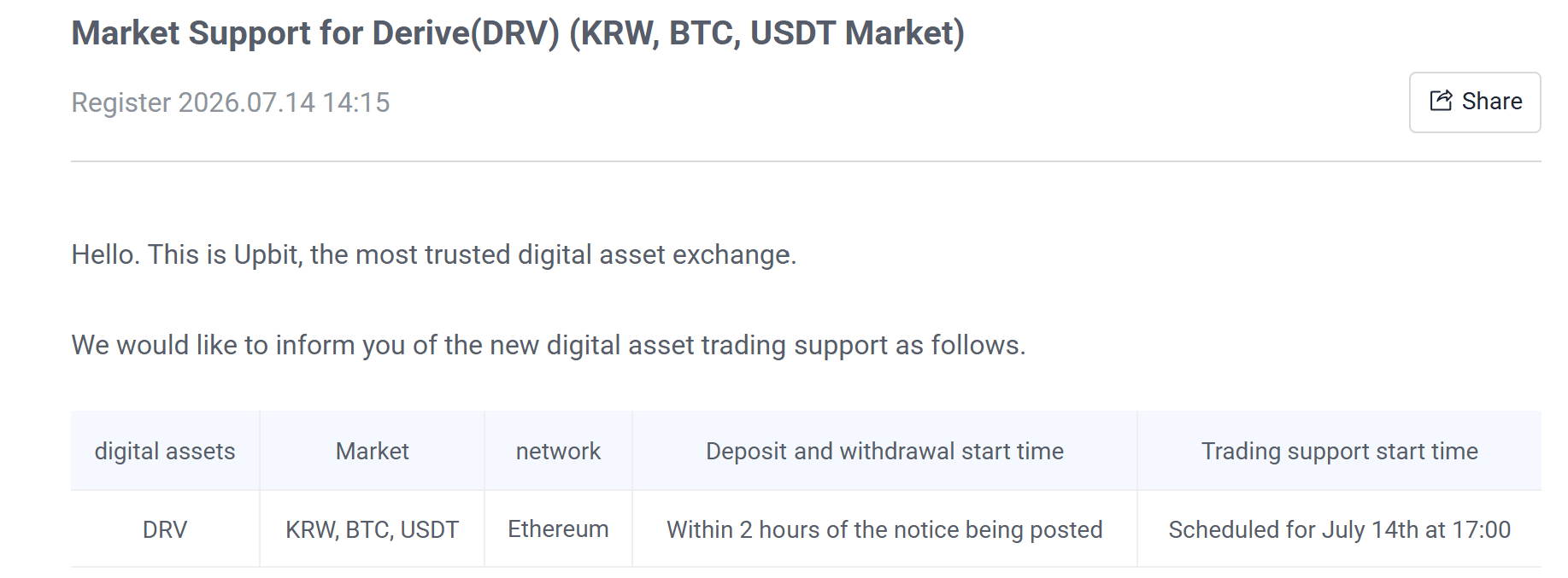
Source: UPbit

Derive has continued expanding its on-chain options and perpetual futures ecosystem following its 2024 rebranding.

However, it is unlikely that simply receiving additional Exchange support will help to create long-term demand.

Traders must deliver stronger volumes, deeper order books, and consistent participation. Those metrics will reveal whether broader accessibility strengthens Derive’s market position beyond its initial listing.

Why did DRV rally?

The announcement quickly changed DRV’s market dynamics. Rather than waiting for trading to begin, buyers aggressively repriced the token in anticipation of stronger liquidity and broader market participation.

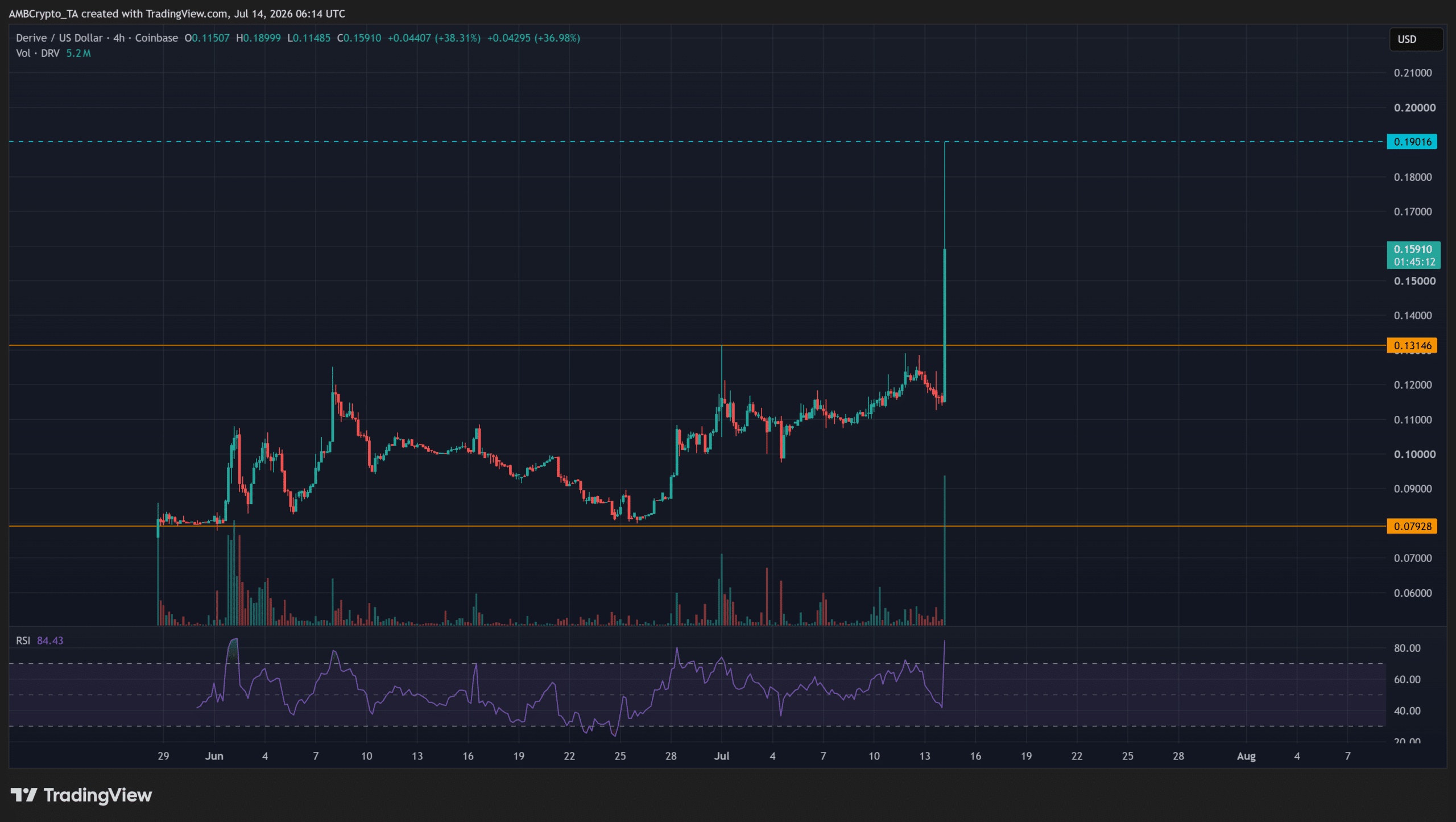
The price rose by approximately 40%, or from $0.1147 to $0.19, before falling to $0.1486. Meanwhile, market capitalization rose to approximately $109.64 million.

Notably, 24-hour trading volume grew by 1744.3% to $9.38 million. These developments suggested that the rally attracted fresh capital instead of isolated buying.
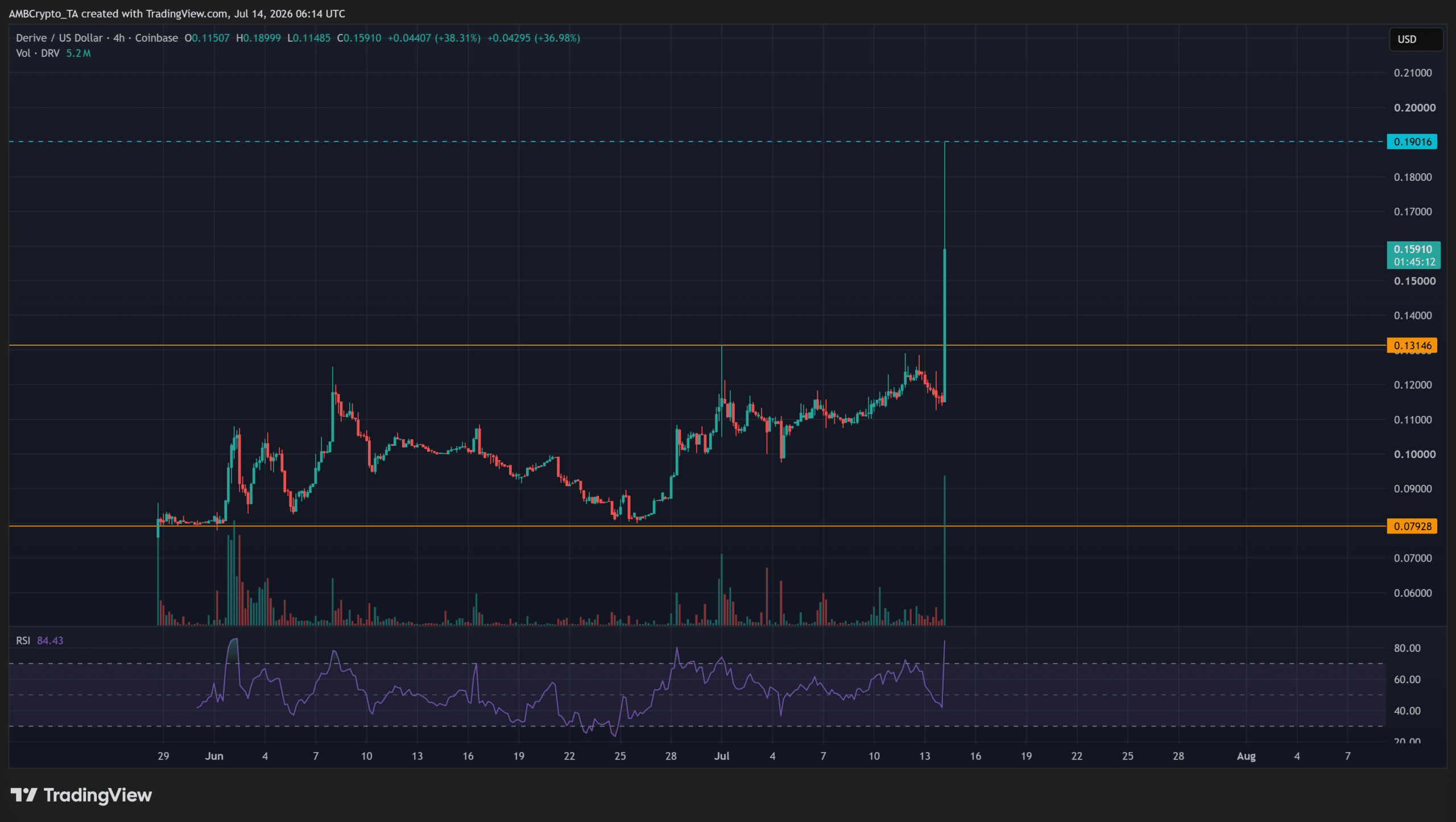
Source: DRV/USD on TradingView

However, the Relative Strength Index (RSI) reached 84.43.

As a result, it prompted early profit-taking as momentum became overheated.

That reaction implied that traders were locking in gains rather than abandoning the breakout completely. At the press time, the token was trading near $0.1471.

Still, holding above $0.131 would confirm buyers continue absorbing supply, whereas losing that level would suggest speculative demand is fading.

Can DRV build on the listing rally?

Early investor enthusiasm for the token has been evident in recent price action. The next challenge is proving that demand extends beyond the listing catalyst.

In many cases, speculative buying by short-term traders drives early price movement. However, sustained price appreciation requires continued investment over time after the immediate hype from the listing wears off.

Rising holder growth would indicate investors are accumulating rather than flipping tokens. Meanwhile, stable trading volumes and improving market depth would suggest liquidity is becoming more resilient.

More importantly, exchange net flows will also reveal whether buyers continue absorbing supply or early participants dominate selling.

Together, those indicators will determine whether DRV develops a stronger market foundation or follows the familiar pattern of post-listing reversals.


Final Summary

  • Derive [DRV] is set to gain broader liquidity and market access as Upbit prepares to open KRW, BTC, and USDT trading.
  • Derive now turns its focus from securing a major exchange listing to proving the rally reflects lasting demand.


Perguntas relacionadas

QWhy did DRV's price rally by approximately 40%?

AThe price rallied by approximately 40% following the announcement of DRV's upcoming listing on Upbit. Buyers aggressively repriced the token in anticipation of stronger liquidity and broader market participation from the new trading pairs.

QWhat are the new trading pairs for Derive (DRV) on Upbit and when does trading begin?

AUpbit announced KRW, Bitcoin (BTC), and Tether (USDT) trading pairs for Derive (DRV). Trading is set to begin on the 14th of July.

QWhat key price level does the article suggest buyers must hold above to confirm continued demand?

AThe article suggests that holding above $0.131 would confirm buyers continue absorbing supply, whereas losing that level would suggest speculative demand is fading.

QWhat does the article say is needed to create long-term demand for DRV beyond the initial listing hype?

AThe article states that simply receiving additional exchange support is unlikely to create long-term demand. It requires stronger trading volumes, deeper order books, consistent participation, rising holder growth, and resilient liquidity to build a stronger market foundation.

QWhat did the high RSI reading of 84.43 prompt among traders, according to the article?

AThe high RSI reading of 84.43 prompted early profit-taking as momentum became overheated, indicating traders were locking in gains.

Leituras Relacionadas

Marvell: Can't Compare to NVIDIA, Can't Meet Expectations, Overvaluation Gets Squeezed First?

Marvell Technology (MRVL.O) reported its Q2 FY2027 earnings (ending July 2026) after market close on August 27. Key points include: The company raised its full-year revenue outlook for FY2027 to $12 billion (from $11.5B) and for FY2028 to $18 billion (from $16.5B). However, these upward revisions were only slightly above market expectations and significantly trailed NVIDIA's recent explosive guidance. The Data Center segment, accounting for 79% of revenue, grew 19% quarter-over-quarter to $2.17 billion, primarily driven by connectivity products. For FY2028, management forecasts over 60% growth for this segment, again below NVIDIA's >70% outlook. A major disappointment for investors was the lack of an upward revision to the Custom ASIC business guidance, despite Marvell's recent partnership agreement with Google. The market had anticipated potential gains from Google's TPU orders, but the maintained guidance for "over 100% growth" in FY2028 (with no specific target for FY2027) led to concerns that the Google deal may be a less favorable "framework agreement" where Marvell holds a weaker negotiating position. Adjusted gross margin was flat at 58.3%. Q3 revenue guidance is $3.15 billion, slightly above consensus. Overall, the report was largely in line with expectations, but the subsequent stock decline is attributed to growth forecasts that failed to meet heightened market expectations (particularly versus NVIDIA) and lingering uncertainty around the tangible benefits of the Google ASIC partnership. High valuation faces near-term pressure, but expectations for >50% growth in the coming years and long-term ASIC opportunity may provide support.

marsbitHá 21m

Marvell: Can't Compare to NVIDIA, Can't Meet Expectations, Overvaluation Gets Squeezed First?

marsbitHá 21m

US Stock Market Trend (August 31st): Kashkari's Hawkish Remarks Weigh on Chip Stocks, US-Iran Weekend Strikes Boost Oil Prices

U.S. stock markets ended lower on Friday following hawkish remarks from Federal Reserve Chair Wash at the Jackson Hole symposium, which sharply increased the probability of a September rate hike from 35% to nearly 60%. Major indexes fell: the S&P 500 dropped 0.25%, the Nasdaq declined 0.52%, and the Dow was essentially flat. This shift in interest rate expectations pressured rate-sensitive assets, leading to significant declines in chip stocks. The Philadelphia Semiconductor Index fell 3.47%, with Nvidia dropping 4.57%, erasing about half its post-earnings gains. Geopolitical tensions also escalated over the weekend as the U.S. and Iran exchanged military strikes, raising concerns over the security of oil transit through the Strait of Hormuz. This pushed oil prices up over 2% in early Asian trading on Monday, reintroducing a geopolitical risk premium. In other energy news, former President Trump announced a landmark 25-year oil deal with Venezuela, aiming to significantly increase the country's oil production. However, this long-term supply boost was overshadowed in the short term by the Middle East conflict and the dominant market focus on interest rates. The core market narrative for the coming week revolves around the interplay between re-priced hawkish rate expectations and escalating geopolitical risks. Key areas to watch include the trajectory of Treasury yields, the evolution of U.S.-Iran tensions and its impact on oil prices, and whether the sell-off in high-valuation tech and semiconductor stocks stabilizes or continues under the pressure of higher rates.

marsbitHá 37m

US Stock Market Trend (August 31st): Kashkari's Hawkish Remarks Weigh on Chip Stocks, US-Iran Weekend Strikes Boost Oil Prices

marsbitHá 37m

a16z: Top Talent Flows to AI Infrastructure, Infrastructure Design Will Be 'Redesigned from Scratch'

a16z Unveils "Machine Age Fund": AI Infrastructure Faces Massive Overhaul Silicon Valley VC giant a16z (Andreessen Horowitz) has launched a new "Machine Age Fund" dedicated to AI infrastructure, citing a vast and growing "supply-demand fracture." Key takeaways: * **Unlimited Demand vs. Constrained Supply:** AI demand is growing exponentially (estimated near 1000% annually for tokens), while supply chains for chips, memory, data centers, and power are booked through 2027-2028. GPU prices are rising against historical trends. * **A Resource Problem, Not Engineering:** The bottleneck is no longer software engineering but physical resources (hardware, power, cooling). Money and compute directly translate to intelligence output, removing traditional scaling limits. * **Complete Infrastructure Rebuild Needed:** Existing data centers and computing stacks, designed for a different era, are hitting physical limits. Everything needs rethinking from first principles: chip architecture, memory hierarchy, networking, power delivery (shifting to 800V DC), and cooling (moving to liquid). * **Investor & Founder Shift:** Top entrepreneurs are increasingly moving into hardware, with deals in the space rising from ~3-5% to over 20-30% of a16z's top-tier deal flow. Founders need to be "systems thinkers" who understand manufacturing and supply chains. * **Massive Economic Scale:** Training a frontier model now costs $3-5B. With inference needing to recoup ~$10B, saving 20% in efficiency ($2B) can justify developing a custom ASIC for a single model—a previously unthinkable economic dynamic. * **Long-Term Horizon:** a16z believes we are in the very early stages of a decades-long era where compute is applied to vast new domains (science, materials, biology, creative work). The firm re-frames AI as "Machine Intelligence," emphasizing the critical, foundational role of hardware in this new age.

marsbitHá 1h

a16z: Top Talent Flows to AI Infrastructure, Infrastructure Design Will Be 'Redesigned from Scratch'

marsbitHá 1h

Trading

Spot
活动图片