The 2026 Showdown: Will the Financial Super App Ultimately Belong to HOOD or COIN?

marsbitPublicado em 2025-12-31Última atualização em 2025-12-31

Resumo

Coinbase and Robinhood are competing to build the ultimate financial super app, but with distinct strategies. Robinhood (HOOD) is creating an all-in-one platform for everyday financial life, targeting a young user base (75% under 44) with its digital banking features, Robinhood Gold subscription, and integrated services like stock trading, crypto, and a 3% cash-back card. It aims to capture the generational wealth transfer and keep users within its ecosystem. Coinbase (COIN) is building a crypto-native super app with recent updates like 24/5 commission-free stock trading, prediction markets via Kalshi, and a DEX aggregator. Beyond its user-facing app, Coinbase’s larger vision is to become the backend infrastructure for traditional finance (TradFi), offering crypto custody, stablecoin-as-a-service, and institutional solutions. Its revenue is diversifying, with 41% from subscriptions and services in Q3 2025. While both are expanding into each other’s territories—Robinhood with tokenized stocks and its own chain, Coinbase with extended trading hours and stock perps—their core visions differ: Robinhood wants to be the user’s financial home, and Coinbase aims to be the pipes powering the on-chain economy. Both face risks like costly incentives (HOOD) and stagnant user growth (COIN), and their stocks have seen significant rallies. The race in 2026 will test which foundation proves stronger.

Source: Bankless

Author: David Christopher

Compiled and Edited by: BitpushNews

The debate between Coinbase and Robinhood has been discussed many times by many observers—including us.

But the system update released by Coinbase on December 17 gives us reason to revisit this topic in depth. The company announced the launch of 24/5 commission-free stock and ETF trading, native prediction market integration via Kalshi, and a decentralized exchange (DEX) aggregator providing instant access to millions of tokens—a clear step towards becoming an "everything app" that can rival Robinhood's breadth.

These announcements clarify the future Coinbase is building and allow us to compare it more comprehensively with Robinhood. Their competitive goal is now unmistakable: to become the single platform for users to manage their entire financial lives. By mastering users' fund balances, they aim to master user behavior. But the way each is constructing this "super app" theory shows two distinctly different philosophies—and 2026 will test which foundation is more solid.

HOOD (Robinhood)

Robinhood is building a financial super app the old-fashioned way—by continuously stacking products until users can manage their entire financial life on one platform.

In addition to stock, options, and cryptocurrency trading, Robinhood offers its 3.9 million Robinhood Gold subscribers a suite of products that give it functionality comparable to a digital neobank. This subscription service, which saw 77% year-over-year growth, bundles a 3% cash-back credit card, 3.25% cash interest, and a 3% IRA (Individual Retirement Account) match. Users' salaries, savings, investments, and daily spending are all concentrated in one interface—a data advantage traditional brokerages cannot match.

This positioning seems particularly relevant when considering demographics—75% of Robinhood's 26.9 million funded customers are under the age of 44, a highly mobile-first and "financially conscious" user base. As argued by Omar Kanji of Dragonfly and others, this foundation helps position the company as a primary beneficiary of the anticipated over $10 trillion wealth transfer in the next decade, when older generations pass assets to younger ones. These inheritors are likely to consolidate assets into the platforms they use every day—and Robinhood is making itself very suitable for daily use.

Beyond digital banking features, Robinhood's revenue sources are already quite diversified. Options trading remains its "cash cow." Cryptocurrency contributes 21% of total revenue. Net interest income accounts for 35% of revenue. And the prediction market business via Kalshi is already generating $100 million in annualized revenue.

The data supports this:

  • Transaction-based revenue grew 129% year-over-year, primarily driven by cryptocurrency.
  • Q3 net profit reached a record $556 million—a 271% increase year-over-year.
  • Operating expenses have remained flat since September 2022.

COIN (Coinbase)

Coinbase is also building a super app—but with a distinct "crypto-native" flavor and an underlying second-layer ambition.

On the front end, Coinbase aims to be the single place for users to manage their on-chain and off-chain financial lives, though it currently remains more focused on the former. The December system update made this clear: 24/5 commission-free stock and ETF trading, prediction markets via Kalshi, and ongoing on-chain integration for instant access to millions of tokens. Add to that direct deposit, high-yield savings via USDC lending rates, borrowing up to $5 million against BTC (up to $1 million against ETH), and earning crypto rewards through debit card spending—the pieces of the super app are falling into place.

While cryptocurrency prices have fallen, the builders and deliverers are still in action.

However, Coinbase is not just building products for its own users. Its broader vision seems to be turning every product it offers into plug-and-play infrastructure powering all other institutions entering the on-chain space.

The theory here is that traditional finance (TradFi) giants like JPMorgan, Fidelity, and Morgan Stanley will not build their own crypto infrastructure. They will outsource it to Coinbase because it's cheaper, they lack the technical expertise, and Coinbase has 13 years of proven security. Over 200 institutions are already using Coinbase's "Crypto as a Service" platform—meaning users might be trading crypto on the front end of a traditional bank, but Coinbase handles everything behind the scenes.

This focus on infrastructure extends across the business. Coinbase holds Bitcoin and Ethereum for most major spot ETFs—a near-monopoly in cryptocurrency custody. They are allowing institutions to use Coinbase's infrastructure to issue their own stablecoins. The acquisition of Echo brought fundraising and token issuance in-house. And the acquisition of Deribit captured about 90% of Bitcoin options open interest.

The revenue structure reflects this dual focus. Q3 2025 revenue was $1.8 billion, with subscription and service revenue hitting a quarterly record of $747 million (41% of total revenue). Stablecoin revenue from the USDC partnership contributed $354.7 million, up 44% year-over-year. Staking brought in $185 million. Custodied assets exceeded $300 billion, driven by ETF inflows, generating custody fees of approximately $143 million.
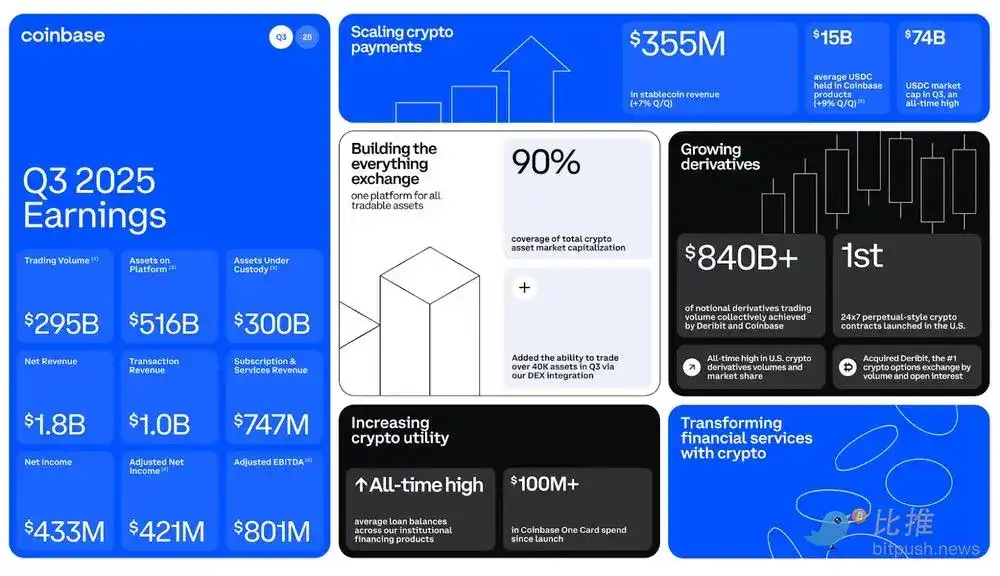
Robinhood's grand vision is to be the go-to place for handling all aspects of personal financial life, while Coinbase is playing two games at once: building the best crypto super app for its own users, while simultaneously becoming the backend powering crypto products for everyone else.

Diverging Crypto Strategies

Both companies see cryptocurrency as core to their super app ambitions, but their approaches reflect their origins.

Robinhood treats cryptocurrency as just another asset class alongside stocks and options. It is a revenue driver that fits perfectly into the existing product suite. The acquisition of Bitstamp ($200 million) provided it with global licenses and institutional infrastructure. Tokenized equities—currently around 800 available in the EU, including private companies like OpenAI and SpaceX—expand the product offering. The real test will be the success of Robinhood Chain, which should make many of these tokenized equities more versatile (e.g., for loans), though we currently have few details on the extent of "DeFi" or other on-chain activities the chain will support.

Beyond this, Robinhood faces more immediate limitations, such as token selection. In the U.S., users have access to fewer than 50 tokens on the platform, while Coinbase offers nearly unlimited tokens indirectly (via Jupiter and Base) and directly supports over 200.

Coinbase's approach to cryptocurrency is clearly different, offering everything from its own Layer 2 network to the various products mentioned in the previous section. It has set the standard for "crypto-specific" products to the point that it now seems to be shifting focus to building the rails for others to use. We see x402, aimed at becoming the industry standard for agent-to-agent (A2A) payments, and Coinbase's announcement that it will offer a "Stablecoin-as-a-Service" platform for companies to create whitelisted stablecoins, with Coinbase managing all technical complexity. From issuance to trading to custody, Coinbase occupies every stage of the asset lifecycle.

2026 Outlook

Both companies have very aggressive roadmaps—and the overlap is increasing.

Coinbase's December 2025 system update, with stock and ETF trading beyond traditional market hours (thanks to tokenization) and the announcement of stock perps launching next year, strongly encroached on Robinhood's territory. Native Kalshi integration brought prediction markets. There's also Coinbase Business, an all-in-one business operations platform powered by crypto, and Coinbase Tokenize, an "end-to-end" platform for institutional tokenization.

Robinhood's 2026 plans delve deeper into crypto infrastructure. Tokenized stocks will achieve 24/7 trading via Bitstamp in early 2026 and become extractable and composable in DeFi by late 2026. In prediction markets, Robinhood is moving from being a distribution partner to launching its own market. The platform hopes to offer cryptocurrency staking, pending regulatory approval. It also has ambitions to "socialize" trading with Robinhood Social, an upcoming feed where traders can post content and display their actual trades and P&L. And of course, there's Robinhood Chain.

The challenge for Robinhood Chain will be building a developer ecosystem—an area where Base has already built momentum. Crypto-native culture is hard to manufacture artificially.

Conclusion

Perhaps a better framework here is "COIN and HOOD," not "COIN vs. HOOD." These two companies occupy different lanes, touching but not fully overlapping.

Robinhood is both a "super app" bet and a demographic wealth transfer bet. With 75% of its users under 44 and a full-stack digital bank keeping assets on the platform, the company is poised to become a new hub for deposits, spending, investing, and speculation.

Coinbase is a bet on a technological transformation. It bets on the global economy moving on-chain, with Coinbase becoming the infrastructure layer powering everyone else—from ETF custody to stablecoin backends to Crypto-as-a-Service for traditional banks.

Both face risks. Robinhood's generous Gold incentives (3% match, 3% cash back, 3.25% cash interest) are costly and have already shown vulnerability to rate cuts—this rate was recently 4-5% and is directly tied to the Fed rate. Adoption of tokenization depends on issuer decisions, which are beyond Robinhood's control. For Coinbase, user growth remains a significant risk, with monthly active users stagnating since 2021.

Moreover, both stocks may already be at highs. Over the past few years, these two stocks have been major market winners—as of this writing, Coinbase (COIN) is up about 7x from its 2022 lows, and Robinhood (HOOD) is up 15x. Although they have pulled back from recent all-time highs, their valuations remain elevated after such stunning gains. This is worth investors pondering.

Ultimately, while both companies are building financial super apps—and increasingly encroaching on each other's turf in the process—their visions actually serve different goals.

Robinhood is committed to building a one-stop financial platform—allowing users to bank, spend daily, trade, and invest, all in one place without leaving the platform.

Coinbase is focused on building the infrastructure to get everyone on-chain—it does build a crypto super app for its own users, but more importantly, it is becoming the backend rails that financial institutions, fintech companies, and even traditional banks rely on to enter the crypto space.

One aims to be your financial home, the other aims to be the plumbing underneath everyone's financial home. Both could succeed.


Criptomoedas em alta

Perguntas relacionadas

QWhat are the key differences between Robinhood and Coinbase in building their financial 'super apps'?

ARobinhood is building a traditional financial super app by layering products like banking suite, stock/options/crypto trading, and prediction markets, targeting a young demographic for wealth transfer. Coinbase is building a crypto-native super app with features like 24/5 stock trading, DEX aggregation, and high-yield savings via USDC, while also focusing on being a backend infrastructure provider for institutions through services like crypto custody, stablecoin-as-a-service, and institutional tokenization.

QHow does Robinhood's revenue diversification compare to Coinbase's?

ARobinhood's revenue is diversified with options trading as its cash cow, crypto contributing 21%, net interest income at 35%, and prediction markets via Kalshi generating $100M annualized. Coinbase's Q3 2025 revenue was $1.8B, with 41% from subscriptions/services ($747M), stablecoin revenue from USDC at $354.7M (up 44% YoY), staking at $185M, and custody fees around $143M driven by ETF inflows.

QWhat are the major strategic focuses for Robinhood and Coinbase in 2026?

AIn 2026, Robinhood plans to expand crypto infrastructure with 24/7 tokenized stock trading via Bitstamp, launch its own prediction markets, introduce crypto staking (pending regulatory approval), and develop Robinhood Social for trading socialization. Coinbase aims to enhance its super app with stock perpetual contracts, native Kalshi integration, Coinbase Business for crypto-driven operations, and Coinbase Tokenize for institutional tokenization, while continuing to build backend infrastructure for the crypto economy.

QWhat risks do both companies face in their super app strategies?

ARobinhood faces risks from costly Gold subscription incentives (3% match, cashback, and interest) that are vulnerable to interest rate cuts, and adoption of tokenization depends on issuer decisions beyond its control. Coinbase risks stagnant user growth, with monthly active users flat since 2021, and both companies have high valuations after significant stock price increases (COIN up 7x and HOOD up 15x from 2022 lows), posing potential overvaluation concerns.

QHow do Robinhood and Coinbase differ in their approach to cryptocurrency integration?

ARobinhood treats crypto as an asset class alongside stocks and options, with limited token selection (under 50 tokens in the U.S.) and a focus on tokenized equities and global expansion via Bitstamp. Coinbase offers extensive crypto access (over 200 directly supported tokens and millions via DEX aggregation), emphasizes crypto-native products like its Layer 2 network Base, and provides infrastructure services such as stablecoin-as-a-service and institutional custody, aiming to dominate the entire asset lifecycle from issuance to trading.

Leituras Relacionadas

Will the Fed Definitely Raise Interest Rates in September? How Will Crypto and U.S. Stocks Withstand the Pressure?

The market's expectation for a September Fed rate hike surged dramatically in early August, jumping from under 50% to over 80% within a week. This shift followed a contentious July FOMC meeting, where a 9-3 vote to hold rates revealed growing dissent from hawkish members advocating for an immediate hike to combat persistent inflation. The primary catalyst for this repricing is rising oil prices, driven by renewed geopolitical tensions around the Strait of Hormuz, which threaten global supply. Energy costs directly influence inflation metrics, making the upcoming July CPI report (due August 12th) a critical data point. If it shows inflation reaccelerating, the probability of a September hike will solidify. For Bitcoin and crypto assets, this is typically bearish news. Bitcoin continues to behave as a high-beta, liquidity-sensitive risk asset. A rate hike raises the opportunity cost of holding non-yielding assets and could drive capital toward money markets, pressuring crypto prices in the short term. However, historical patterns suggest that if a hike is perceived as the end of a tightening cycle rather than the start, any negative price impact may be brief. U.S. stocks, particularly crypto-linked equities like Coinbase and growth-oriented tech stocks, are also vulnerable. Higher rates increase discount rates in valuation models, putting pressure on high-multiple companies. This coincides with a pivotal tech earnings season where investor focus has shifted from massive AI capital expenditure to tangible revenue and cash flow generation. Companies with negative cash flow and weak growth narratives could face heightened volatility if borrowing costs rise in September. In summary, a September Fed hike has evolved into a mainstream market scenario. Key factors to watch are oil prices, the July CPI report, and Fed communications, which will determine the final decision and its impact on volatile crypto and equity markets.

marsbitHá 4m

Will the Fed Definitely Raise Interest Rates in September? How Will Crypto and U.S. Stocks Withstand the Pressure?

marsbitHá 4m

A 'Overlooked' Market Event: Joint US-Japan-South Korea Intervention, Rare US Treasury Involvement, and Bessent's Quiet 'Market Rescue'?

Summary: The United States, Japan, and South Korea executed their largest coordinated foreign exchange intervention in nearly 30 years. The action targeted depreciation pressure on the Japanese yen and South Korean won. This move is seen as a significant effort by the US to stabilize the financial markets of its key allies and prevent the spillover of risks. Key details: * Japan reportedly intervened on July 30 using approximately 8.45 trillion yen (about $52.8 billion). South Korean authorities also intervened that day, selling dollars to support the won. * Notably, the US Treasury Department intervened directly in yen markets for the first time in roughly 30 years. The New York Fed, reportedly acting on behalf of the Treasury, sold euros to buy yen via Goldman Sachs and Morgan Stanley on July 31. Analysts view the use of the euro-yen pair as a way to alleviate yen pressure without adding selling pressure to the US dollar. * Prior to the action, the New York Fed conducted "rate checks" on both USD/JPY and EUR/JPY, a newer signaling tool that falls between verbal and physical intervention. The intervention is interpreted as going beyond traditional currency stabilization. Analysts, such as Michael Hartnett of Bank of America, suggest it resembles a "Price Keeping Operation" for the AI era. The core US objectives are perceived to be: 1. Preventing rapid yen depreciation from triggering a sharp rise in Japanese government bond yields. 2. Containing financial stress from spreading across Asian markets like South Korea and Japan. 3. Reducing the risk of disorderly capital flows impacting the US bond market. This coordinated action underscores the importance of Japan and South Korea as critical partners in the US semiconductor and AI supply chain. Stabilizing their financial markets is seen as vital to mitigating risks to the broader tech industry and the US market itself. The intervention coincides with market pressures, including the KOSDAQ index hitting a low since October 2022. While seen as a move to control volatility, some analysts caution it may not fundamentally reverse existing market trends.

marsbitHá 8m

A 'Overlooked' Market Event: Joint US-Japan-South Korea Intervention, Rare US Treasury Involvement, and Bessent's Quiet 'Market Rescue'?

marsbitHá 8m

Will the Federal Reserve Definitely Raise Interest Rates in September? How Will Cryptocurrencies and US Stocks Bear the Pressure?

In early August 2024, market expectations for a September Federal Reserve rate hike surged dramatically, from below 50% to over 80%, driven by renewed inflation concerns. This shift followed a contentious July FOMC meeting where a 9-3 vote to hold rates revealed a growing hawkish faction advocating for an immediate hike, citing prolonged above-target inflation. The key catalyst is escalating conflict near the Strait of Hormuz, which has pushed oil prices up approximately 20% in July, threatening to reignite inflation. The next critical data point is the July CPI report on August 12th; a hot reading could solidify hike expectations. For crypto assets, particularly Bitcoin, this represents near-term pressure. Bitcoin continues to exhibit high-beta, risk-on characteristics, making it sensitive to tightening liquidity and higher opportunity costs. However, historical precedent suggests that if a hike is perceived as the cycle's end rather than its start, the negative impact may be brief, with markets quickly pivoting to anticipate future rate cuts. U.S. stocks, especially crypto-linked equities like Coinbase and high-valuation tech stocks, face amplified volatility. Higher rates increase discount rates in valuation models, pressuring growth stocks. This coincides with a pivotal tech earnings season where investor focus has shifted from massive AI capital expenditures to demonstrable revenue and cash flow generation. Companies with negative cash flows and weak growth narratives could see severe pressure if a September hike materializes, as financing costs would rise. Key indicators to watch include oil prices, upcoming inflation data, and Fed commentary at events like the Jackson Hole symposium.

Odaily星球日报Há 8m

Will the Federal Reserve Definitely Raise Interest Rates in September? How Will Cryptocurrencies and US Stocks Bear the Pressure?

Odaily星球日报Há 8m

Trading

Spot

Artigos em Destaque

Como comprar SUPER

Bem-vindo à HTX.com!Tornámos a compra de SuperFarm (SUPER) simples e conveniente.Segue o nosso guia passo a passo para iniciar a tua jornada no mundo das criptos.Passo 1: cria a tua conta HTXUtiliza o teu e-mail ou número de telefone para te inscreveres numa conta gratuita na HTX.Desfruta de um processo de inscrição sem complicações e desbloqueia todas as funcionalidades.Obter a minha contaPasso 2: vai para Comprar Cripto e escolhe o teu método de pagamentoCartão de crédito/débito: usa o teu visa ou mastercard para comprar SuperFarm (SUPER) instantaneamente.Saldo: usa os fundos da tua conta HTX para transacionar sem problemas.Terceiros: adicionamos métodos de pagamento populares, como Google Pay e Apple Pay, para aumentar a conveniência.P2P: transaciona diretamente com outros utilizadores na HTX.Mercado de balcão (OTC): oferecemos serviços personalizados e taxas de câmbio competitivas para os traders.Passo 3: armazena teu SuperFarm (SUPER)Depois de comprar o teu SuperFarm (SUPER), armazena-o na tua conta HTX.Alternativamente, podes enviá-lo para outro lugar através de transferência blockchain ou usá-lo para transacionar outras criptomoedas.Passo 4: transaciona SuperFarm (SUPER)Transaciona facilmente SuperFarm (SUPER) no mercado à vista da HTX.Acede simplesmente à tua conta, seleciona o teu par de trading, executa as tuas transações e monitoriza em tempo real.Oferecemos uma experiência de fácil utilização tanto para principiantes como para traders experientes.

250 Visualizações TotaisPublicado em {updateTime}Atualizado em 2026.06.02

Como comprar SUPER

Discussões

Bem-vindo à Comunidade HTX. Aqui, pode manter-se informado sobre os mais recentes desenvolvimentos da plataforma e obter acesso a análises profissionais de mercado. As opiniões dos utilizadores sobre o preço de SUPER (SUPER) são apresentadas abaixo.

活动图片












