Learning from real battles, stealing skills from the masters. This hand between Keating and Airball with AK versus 99 at the WPT Global high-stakes cash table is a classic example. On the surface, it's a common high card versus medium pocket pair scenario, but in reality, it's an extreme confrontation under deep stack conditions, pushing image, credibility, and range reading to the limit.
To understand the direction of this hand, we must first understand the table personas of the two players, because at this level, hand strength is just the entry point; the core of decision-making is how much your opponent believes you.
Table Personas: One Relies on Chaotic Pressure, the Other on Reading Hands to Counter
Alan Keating is one of the most popular and difficult types to face at high-stakes tables. His VPIP is extremely high, his entering range is so wide it's almost distorted—he plays strong hands, marginal hands, and even garbage hands, daring to use massive sizing to apply pressure and bluff. His bankroll depth and risk preference give him a natural advantage in many confrontations, making it hard for opponents to pin down his hole cards using traditional signals, as his raises could be AA or 72 offsuit.
This near-crazy image can yield significant fold equity in the long run, but it also erodes his credibility. Once opponents categorize him as "polarized with a high bluff frequency," his big moves are easily counter-interpreted, ultimately becoming the starting point of a tragedy.
Nik Airball is the other extreme. A regular on shows like Hustler Casino Live, he is known for his incessant speech play and strong aggression. Public opinion on him is divided, but his technical foundation should not be underestimated. He is quite solid in range reading and tempo adjustment, especially skilled at making exploitative calls against specific opponents.
Facing an overly aggressive opponent like Keating, he knows when to increase his calling frequency and when to use calls to let the opponent bluff all the way. In other words, he isn't competing with Keating to see who is more aggressive, but rather who is better at turning the opponent's image into harvestable EV.
Pre-flop Raising War: Not AK vs 99, but the Pricing of Credibility
The hand starts with Airball opening with 9♠9♦. Keating's 3bet with A♠K♥ is a standard strong hand line, aiming to isolate the opponent and establish initiative. Airball then chooses to 4bet. This move is crucial in a deep stack scenario. 99 is an awkward medium pocket pair in most frameworks—it doesn't just seek set value like small pocket pairs, nor is it as comfortable under pressure as QQ or better. Airball's 4bet is both a test and a counter, betting that Keating's 3bet range is wide enough for him to still extract value and maintain initiative in the confrontation.
The real turning point occurs when Keating makes a 5bet, raising to 165,000. For most players, a 5bet is often seen as a signal for AA or KK, but in Keating's image framework, his 5bet is closer to a polarized move—either the nuts or using deep stacks and table credibility to force a fold. The question at this moment becomes: does Airball believe Keating's "represented range"? Airball doesn't shove all-in, nor does he fold. Instead, he chooses to call, taking the decision to the flop, using position and information advantage to delay the decision—a common high-level approach in high-stakes games, preserving room to observe Keating's post-flop line.
Flop: J♠4♦6♠, The Purpose and Cost of Keating's Overbet Shove
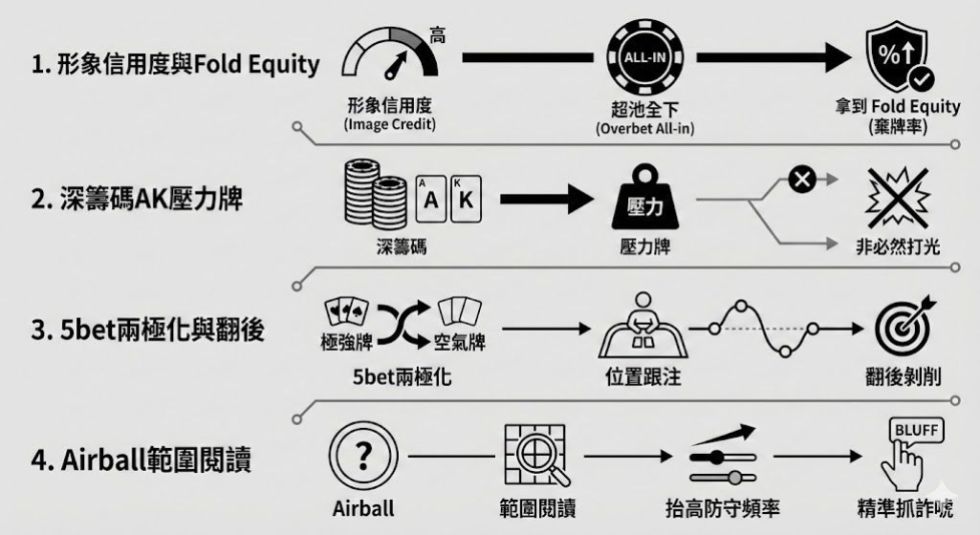
The flop doesn't bring an A or K; AK misses. Keating still chooses an overbet All-in shove. The core of this line is not hand strength, but maximizing Fold Equity. He hopes to use an extreme size to represent high-weight combinations like AA, KK, JJ, or strong flush draws, forcing a medium pocket pair like 99 to fold under immense pressure. Because if he checks or makes a small bet, AK can easily be passively led to a showdown disadvantage.
From a pure strategy perspective, this is a decision that settles the outcome in one go—success means taking the pot directly, failure means risking almost the entire buy-in.
The problem is, an overbet shove极度依赖信用度 (relies extremely on credibility). If the opponent believes you, it's a highly efficient pressure tool. If the opponent doesn't believe you, it becomes a move that locks the opponent's calling range into the "specifically designed to catch your bluff" zone, providing the opponent with the best incentive to call with your maximum size.
Airball's Instant Call: Calling with 99, Catching the Crack in Keating's Image
Airball's instant call looks like a hand strength decision, but it's actually a model decision. He calculates Keating's entire line within the framework of his opponent's persona: Keating has a wide pre-flop range, his 5bet has polarized characteristics, and when he misses the flop, he is more likely to push all the way with his two high-card air using a large size, trying to win the pot in one go.
Under this assumption, the relative strength of 99 on J♠4♦6♠ increases significantly. The call isn't about toughing it out; it's about exploiting the structural flaw of an opponent who applies excessive pressure and lacks credibility. They run it twice; neither runout produces an A or K. 99 holds its lead and busts Keating. The ending is sealed by the deal, but the logic of victory was actually determined the moment the instant call was made.
CoinPoker Gambling – The Overall Best Bitcoin Poker Gambling Site
CoinPoker has long been regarded as the most comprehensive Bitcoin gambling platform in the crypto space, establishing high competitiveness with its smooth interface, diverse gameplay, and strong bonus structure. The platform offers a 150% welcome bonus, with the first deposit going up to $2,000, making it an extremely attractive starting condition for both beginners and advanced players, and successfully solidifying its position as a mainstream BTC gambling site.

In terms of gameplay, CoinPoker offers over 15 betting markets, covering live sports, esports, virtual events, and more. It also supports deposits in multiple mainstream cryptocurrencies. Withdrawals are known for instant processing, zero fees, and anonymous settlement, ensuring players can withdraw their winnings quickly and safely. Beyond sports betting, the platform also features a mature casino system, including high-quality live dealer games, presented in HD stream from Blackjack to Roulette, allowing players to enjoy an immersion close to a physical casino on their mobile or desktop.
For poker players, CoinPoker's appeal is even more evident. The platform offers stable, active poker tables and diverse tournament formats. A 33% online poker rakeback is offered every Monday, providing substantial value for long-term players. Coupled with the platform's transparent operation and continuously promoted events, it creates a highly rated professional poker environment for global players.
CoinPoker combines Bitcoin gambling, live dealer casino, and a professional poker ecosystem, offering fast settlement,完善的奖金制度 (完善的 bonus system), and high anonymity, making it an ideal choice for crypto players seeking security, speed, and entertainment.
Enter CoinPoker to Play
Conclusion: The True Hand Strength in High-Stakes Games is How Your Opponent Sees You
The value of this hand lies in how clearly it illustrates the most essential reality of high-stakes games: the power of your bet is not only determined by the board but also by how your opponent prices your image. Keating's chaotic style can force excessive folds against many opponents, earning him a lot of non-showdown EV in the long run. But once he encounters an opponent who can calculate his bluff frequency into the equation, his 5bet and flop shove lose their intimidation power, even反过来 becoming the most comfortable calling point for the opponent. Airball wins by daring to increase his calling frequency and accurately choosing the most suitable structure to withstand the pressure.
A more realistic statement is: in a deep stack environment, AK is no longer a no-brainer all-in weapon. It's more like a pressure hand that requires credibility加成 (credibility bonus). When you are perceived as loose-aggressive, you must accept that opponents will call more boldly; your value lines need to be more direct, and your bluff lines need to be more selective. The reason this hand becomes a classic is not because 99 beat AK, but because it demonstrates the ultimate rule of high-stakes games: when your opponent sees through who you are, the cards in your hand get repriced.