Texas grid is heating up again, this time from AI, not Bitcoin miners

cointelegraphPublicado em 2025-12-11Última atualização em 2025-12-11

Resumo

Texas is rapidly becoming a major hub for AI-driven energy demand, with a significant surge in large-load power requests—now dominated by AI data centers rather than Bitcoin miners. ERCOT, the state’s grid operator, reports a queue of 226 gigawatts of new power requests, 73% of which are linked to AI facilities. While the supply side has 1,999 generation proposals totaling 432 GW, mostly solar and battery projects, these sources can't provide the 24/7 power AI data centers need, creating potential reliability issues. Regulators are adapting with new rules for large power users and increased transmission projects. Meanwhile, Bitcoin miners, once major energy users, are shifting toward AI computing to capitalize on growing demand, as seen in projects like Galaxy’s $460 million conversion of a Texas mining site into an AI data center.

Texas is rapidly emerging as an epicenter of artificial intelligence-driven energy demand, with an unprecedented surge in large-load power requests, a wave now dominated by AI data centers rather than Bitcoin miners.

The figures, highlighted in The Miner Mag’s latest newsletter and drawn from ERCOT’s new System Planning and Weatherization Update, point to a grid facing a fundamentally different kind of growth.

ERCOT, the Electric Reliability Council of Texas, which operates the state’s independent power grid and oversees reliable electric service for about 90% of Texans, reported that its large-load interconnection queue has ballooned to 226 gigawatts of new requests, roughly 73% tied to AI facilities.

Developers have already filed 225 large-load requests this year, and on the supply side, ERCOT is reviewing 1,999 generation proposals totaling 432 GW, according to The Miner Mag.

However, the load is growing faster than the supply. While the generation queue is massive, it remains dominated by solar and battery projects, which are resources that don’t provide the around-the-clock power that AI data centers require. That mismatch is setting up future reliability and investment challenges.

Source: Ben Bajarin

State regulators are racing to adapt, The Miner Mag reported. New rules are being developed to classify any customer requesting 75 MW or more as a “special handling” case, and ERCOT has more than doubled the number of transmission projects under review.

Related: Bitcoin miners gambled on AI last year, and it paid off

What about Bitcoin miners?

The Miner Mag report drew a contrast between today’s surge in AI-driven power demand and the earlier boom from Bitcoin (BTC) miners, noting that Texas’ emerging grid crunch is now being fueled by AI, not crypto.

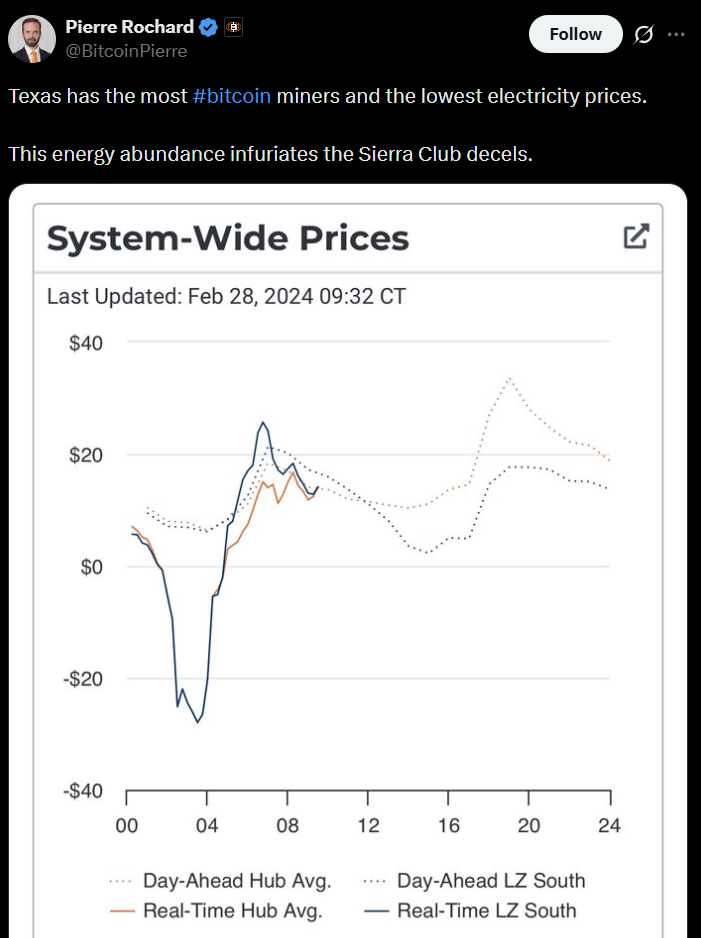
Bitcoin miners were once among the largest new power users in the state. Their impact was arguably positive: Miners frequently curtailed operations during peak demand and, according to a January study by the Digital Asset Research Institute, helped bolster grid stability and save the state an estimated $18 billion.
Source: Pierre Rochard

However, the landscape is shifting. Many miners and digital asset operators are reallocating their infrastructure toward AI computing to capitalize on the soaring demand for GPU capacity.

A recent example is Mike Novogratz’s Galaxy, which secured $460 million to convert its former Texas Bitcoin mining site into a large-scale AI data center.

Related: Bitcoin miners enter ‘harshest margin environment of all time’

Leituras Relacionadas

Weekly Review and Outlook | Circle Issues 500 Million USDC on Solana; Japan Plans to Include Crypto Assets in Securities Regulatory Framework; Gemini Approved by CFTC to Establish Prediction Market; Fed Cuts Benchmark Rate by 25 Basis Points

This week in crypto and financial markets was marked by significant developments and regulatory shifts. Circle issued an additional 500 million USDC on the Solana network, reflecting strong demand for the stablecoin, with trading volume exceeding $11.9 billion within 24 hours. Dubai Customs partnered with Binance to explore crypto payments for trade and logistics, aiming to enhance efficiency and reduce costs. Twenty One Capital, backed by Tether and Bitfinex, began trading on the NYSE, though its stock fell 20% on the first day. Strive launched a $500 million ATM financing plan, partly to acquire more BTC, while American Bitcoin increased its holdings to 4,783 BTC. Japan's FSA proposed bringing crypto assets and IEOs under securities regulations, requiring stricter disclosures and cracking down on insider trading. Jupiter announced its own stablecoin, JUP USD, and acquired RainFi to offer peer-to-peer lending services. Gemini received CFTC approval to launch a blockchain-based prediction market, potentially expanding into crypto derivatives. The Federal Reserve cut interest rates by 25 basis points to 3.50%-3.75%, responding to slowing economic growth. Looking ahead, HashKey Group plans to raise up to HK$1.67 billion in its Hong Kong IPO on December 17. Several tokens, including Starknet, Arbitrum, and LayerZero, are scheduled for unlocks next week, which may influence market liquidity.

cointelegraph_中文Há 13m

Weekly Review and Outlook | Circle Issues 500 Million USDC on Solana; Japan Plans to Include Crypto Assets in Securities Regulatory Framework; Gemini Approved by CFTC to Establish Prediction Market; Fed Cuts Benchmark Rate by 25 Basis Points

cointelegraph_中文Há 13m

Trading

Spot
Futuros
活动图片