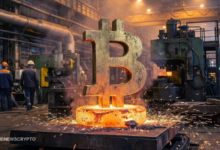
Bitcoin’s price ‘fails’ twice, but here’s why a crypto-winter is still unlikely

ambcryptoPublicado em 2025-12-12Última atualização em 2025-12-12

Resumo

Bitcoin's price has failed twice to break the $94k resistance level, maintaining a bearish higher timeframe trend despite recent gains. Analysts attribute this to a significant drop in stablecoin inflows to exchanges—down 50% since August—indicating weakened buying demand. On-chain data reveals short-term holders are experiencing their deepest losses of 2025, adopting a "sell-the-bounce" mentality that further suppresses upward momentum. Each price increase is met with profit-taking, reflecting fearful market sentiment. However, the current phase is viewed as stabilization rather than a full bear market, making a severe crypto winter unlikely.

Bitcoin’s [BTC] recovery efforts haven’t been totally successful lately. In the last 8 days, Bitcoin has tested the $94k local resistance twice.

Both times, it failed to break through. As things stand, the higher timeframe trend remains bearish for the world’s largest cryptocurrency, despite the uptick from $84k over the last three weeks.

In a post on X, analyst Darkfost explained that the lack of incoming liquidity might be the biggest issue holding BTC back. Stablecoin inflows to exchanges have fallen by 50% since August. It meant that there has been a lack of steady demand for Bitcoin to drive the prices higher.

Other on-chain metrics showed that short-term holders have been suffering and may be in no position to drive a market recovery.

Short-term BTC holders are still in the real pain zone

A post on CryptoQuant Insights explained how the short-term holder cohort may be experiencing its deepest loss regime of 2025. They have been holding losses, which suggested that each Bitcoin price bounce offered an opportunity to sell.

Underwater holders willing to sell the bounce, combined with the dwindling demand, could be tough obstacles for the bulls.

The 24-hour sum of STH holdings sent to exchanges is another way to keep track of trends. During an uptrend, losses from STH will be minimal. During a downtrend, holdings tend to be at a loss in greater numbers.

Over the past month, the lack of an upward trend shift combined with strong profit-taking activity. The price bounce in mid-October saw fewer BTC sent at a profit to exchanges – A sign that there was confidence of further gains.

Since 27 November, the spikes in STH profit-taking have underlined the statement made earlier. Market sentiment is fearful, and each price bounce is for selling.

There may be an argument that the current market phase is stabilization, and not outrightly bearish. Thus, the developments of this cycle mean that a full-blown winter is unlikely.


Final Thoughts

  • The lifeblood of crypto markets, stablecoins saw reduced inflows to exchanges to reflect a fall in demand.
  • Metrics revealed that short-term holder behavior has shifted into a “sell-the-bounce” mentality.

Leituras Relacionadas

You Should Still Believe in Crypto

The article "You Should Still Believe in Crypto" addresses the growing sense of burnout and disillusionment within the cryptocurrency industry, sparked by a post from Aevo co-founder Ken Chan titled "I Wasted 8 Years of My Life in Crypto." It acknowledges the collective fatigue many feel due to the industry's fast-paced, often speculative nature, where narratives shift rapidly, and projects frequently fail or disappear. However, the piece argues that the core value of crypto remains vital. It references Nic Carter’s response, highlighting crypto’s potential to create a more robust monetary system, encode business logic via smart contracts, establish true digital property rights, improve capital market efficiency, and enhance global financial inclusion. The article revisits Bitcoin’s origin as a peer-to-peer electronic cash system born from the 2008 financial crisis, emphasizing its purpose as a trustless, decentralized alternative to traditional finance. It points to real-world adoption in high-inflation countries like Argentina and Turkey, where Bitcoin and stablecoins serve as essential financial tools, and notes increasing institutional embrace from firms like BlackRock and Fidelity. Finally, it draws a parallel to the early internet era, arguing that despite chaos, failed projects, and speculative excess, the crypto industry—like the internet—is laying foundational groundwork for future technological and financial evolution. The conclusion is a call to persevere, recognizing that the collective efforts of developers, researchers, and builders worldwide are contributing to a transformative global shift.

marsbitHá 1h

You Should Still Believe in Crypto

marsbitHá 1h

Trading

Spot
Futuros
活动图片