Telegram’s Lighter integration fuels HYPE – Breakout toward $42 IF…

ambcryptoPublicado em 2026-04-07Última atualização em 2026-04-07

Resumo

Telegram's integration with Lighter brought attention to Hyperliquid (HYPE), but a significant whale moved against the trend by selling 12.2K HYPE ($449.1K) and placing an additional 10.4K HYPE sell order ($386K), while withdrawing $1.26M in USDC. This activity, following the whale's exit from large long positions, created a divergence between the bullish narrative and capital flow. HYPE maintained a bullish flag pattern, trading between support at $35.37 and resistance at $38. While the structure remained intact with buyers stepping in at lower levels, failure to break $38 indicated hesitation. A breakout toward $42.10 was possible if resistance was overcome. The RSI showed weakening buying pressure, stabilizing near 49.18. Short liquidations dominated recent activity ($26.58K vs. $4.14K long liquidations), supporting upward pressure and short squeezes. However, the funding rate, though positive at 0.0008%, was declining, signaling reduced conviction among longs. This aligned with whale distribution, suggesting weakened confidence. The overall setup remained constructive but faced headwinds near resistance, leaving a breakout uncertain.

Telegram’s Lighter integration drew attention to Hyperliquid. However, a large whale moved in the opposite direction immediately.
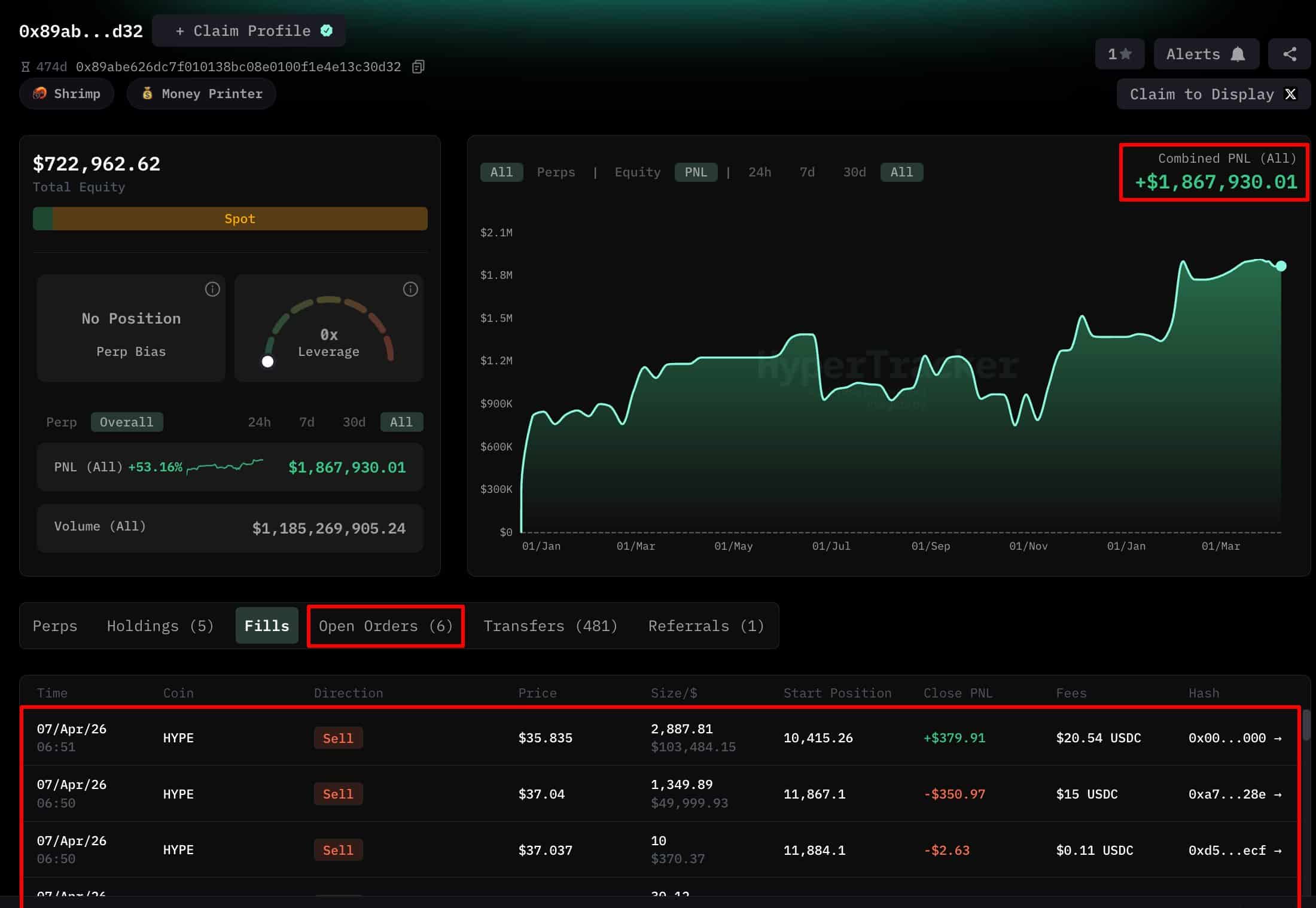
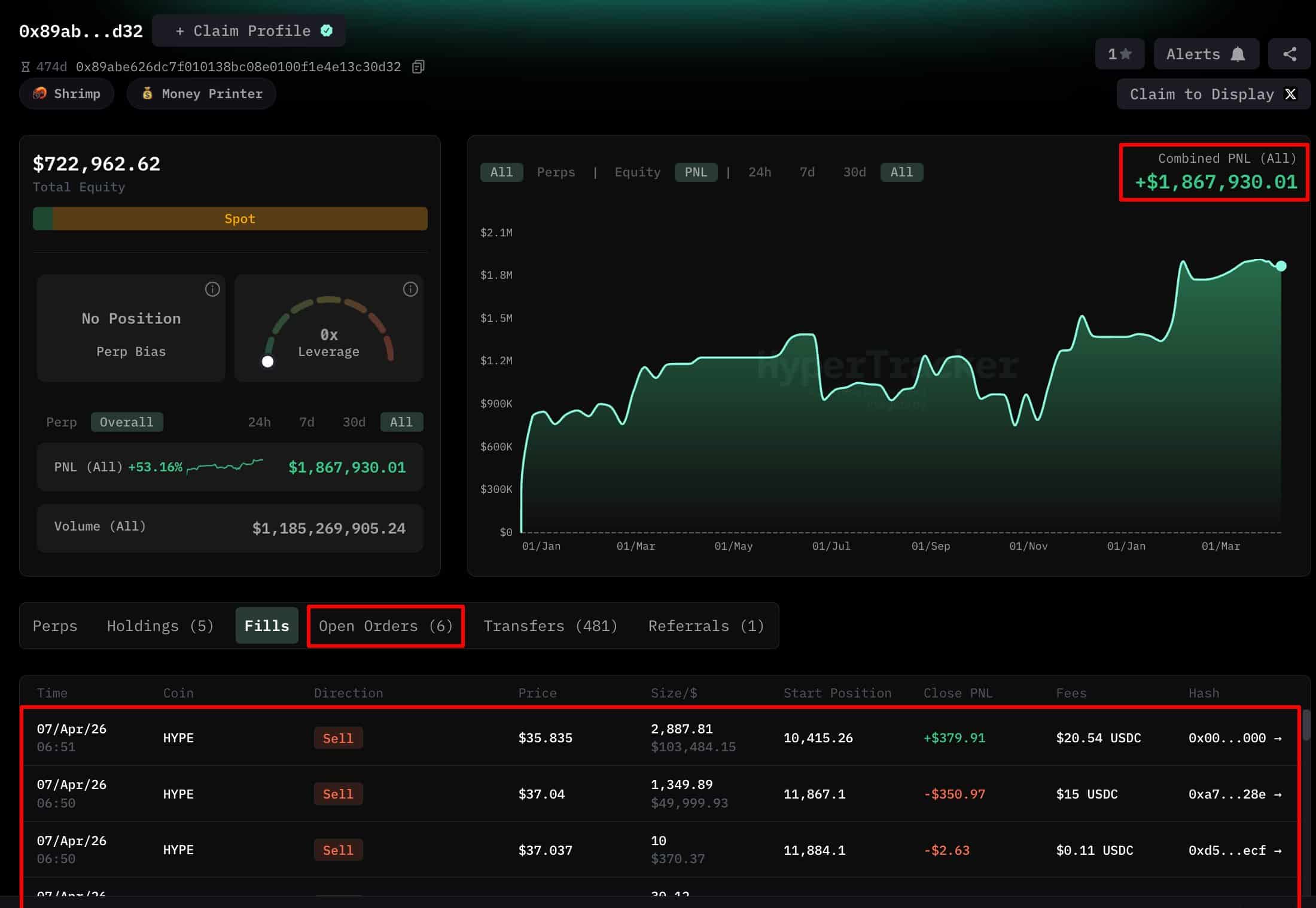
Source: Onchain Lens

The whale dumped 12.2K HYPE worth $449.1K and placed another 10.4K HYPE sell order worth $386K. He also withdrew $1.26M in USDC, reducing exposure.

That move followed his exit from multi-million dollar HYPE longs after the 3rd of April. His $1.72M+ lifetime PnL suggested calculated positioning.

However, this created a divergence between the bullish narrative and capital flow. That shift raised concerns about distribution in strength.

Bullish flag holds as HYPE compresses

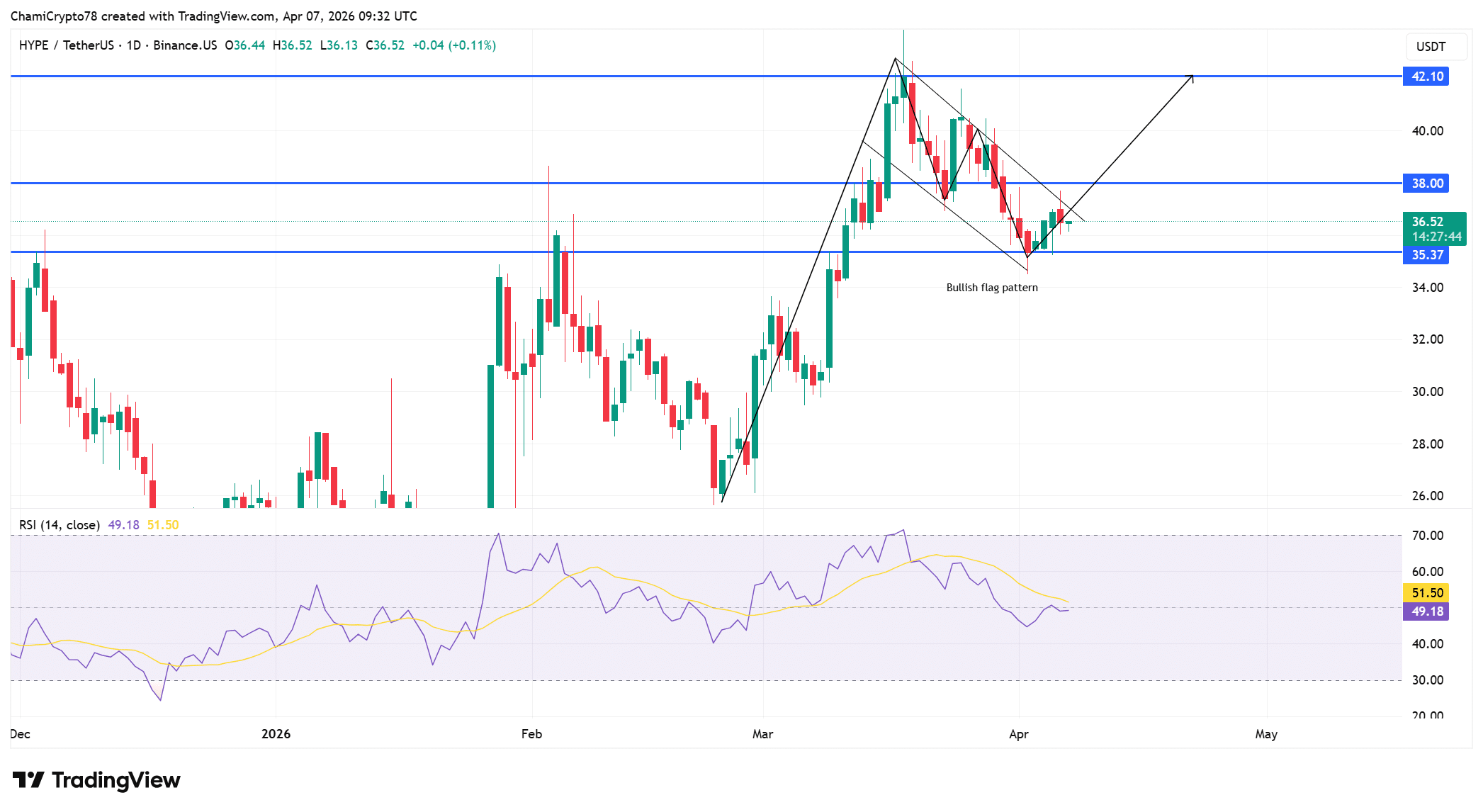
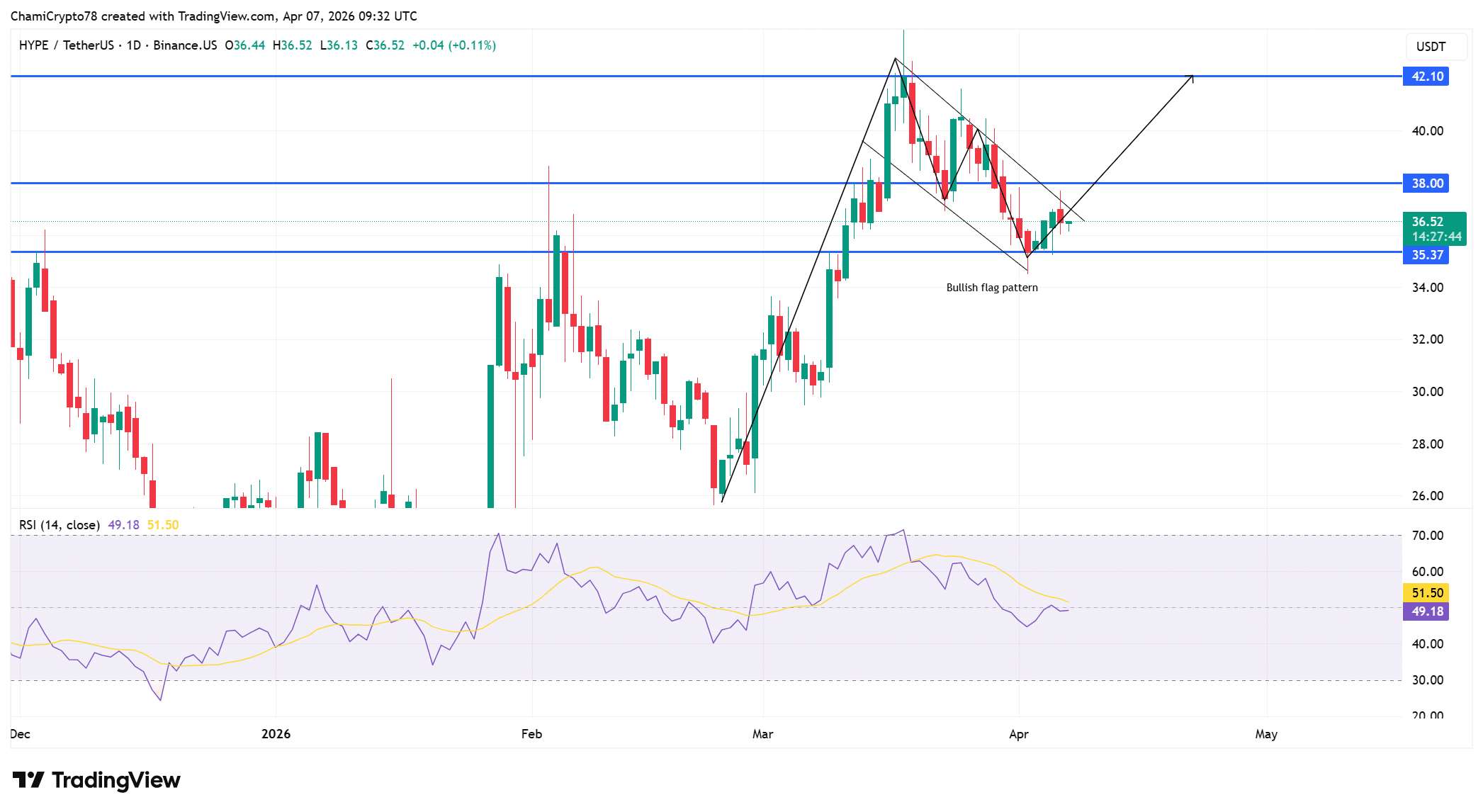
HYPE maintained a bullish flag after rallying toward $42.10. Price pulled back into a descending channel, forming the structure.

The asset traded between $35.37 support and $38 resistance, showing controlled consolidation. Each lower-bound retest attracted buyers, preserving structure.

However, Hyperliquid [HYPE] failed to reclaim $38 decisively, signaling hesitation near resistance. This left the market waiting for a breakout.

A move toward $42.10 remained likely if resistance broke.

RSI stabilized near 49.18, with its moving average near 51.50. The indicator cooled after nearing overbought levels around 70.

Lower highs on RSI suggested weakening buying pressure.
Source: TradingView

HYPE short liquidations dominate recent activity

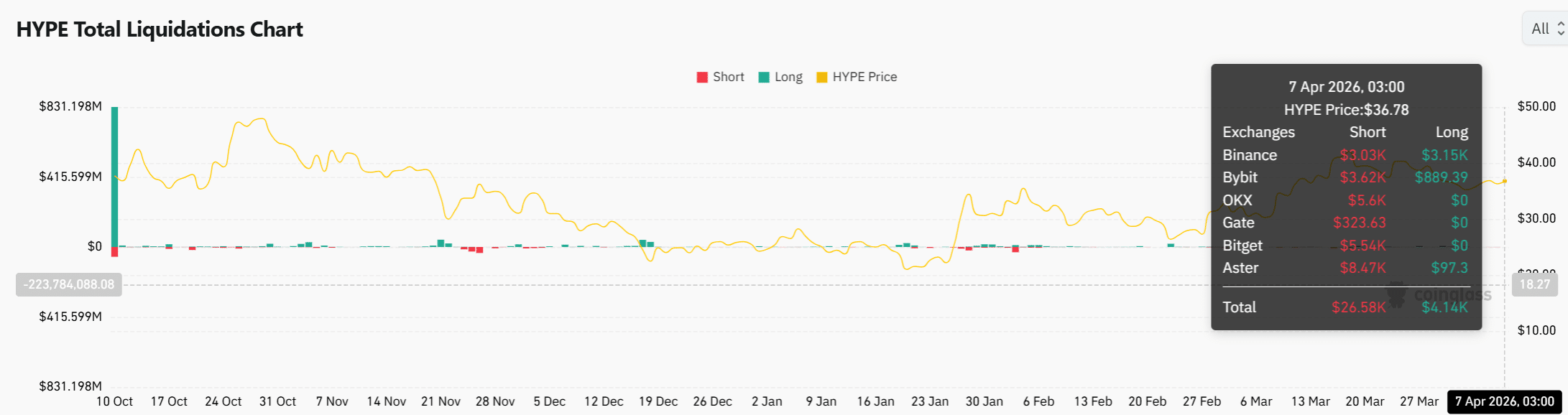
The Liquidation chart had shown that short liquidations had outweighed long liquidations, reinforcing upward pressure in the market.

Recent figures had recorded $26.58K in short liquidations compared to $4.14K in long liquidations.

This imbalance had indicated that bearish positions had been forced out as the price held above key levels.

As a result, the market had experienced localized short squeezes, which had supported price stability within the flag.

However, the absence of large liquidation spikes had suggested controlled volatility rather than aggressive expansion.

Liquidity had continued to build around the $35.37 support and $38 resistance zones, leaving the market positioned for a decisive move.
Source: CoinGlass

Funding stays positive but weakens

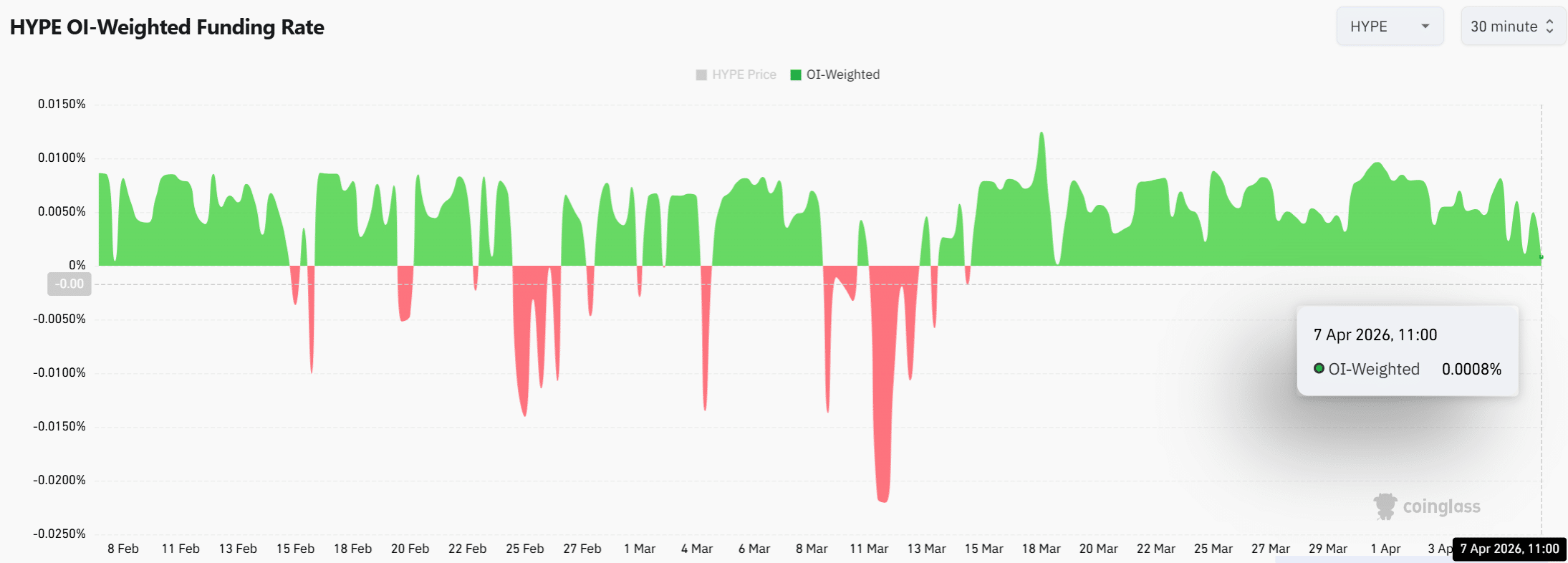
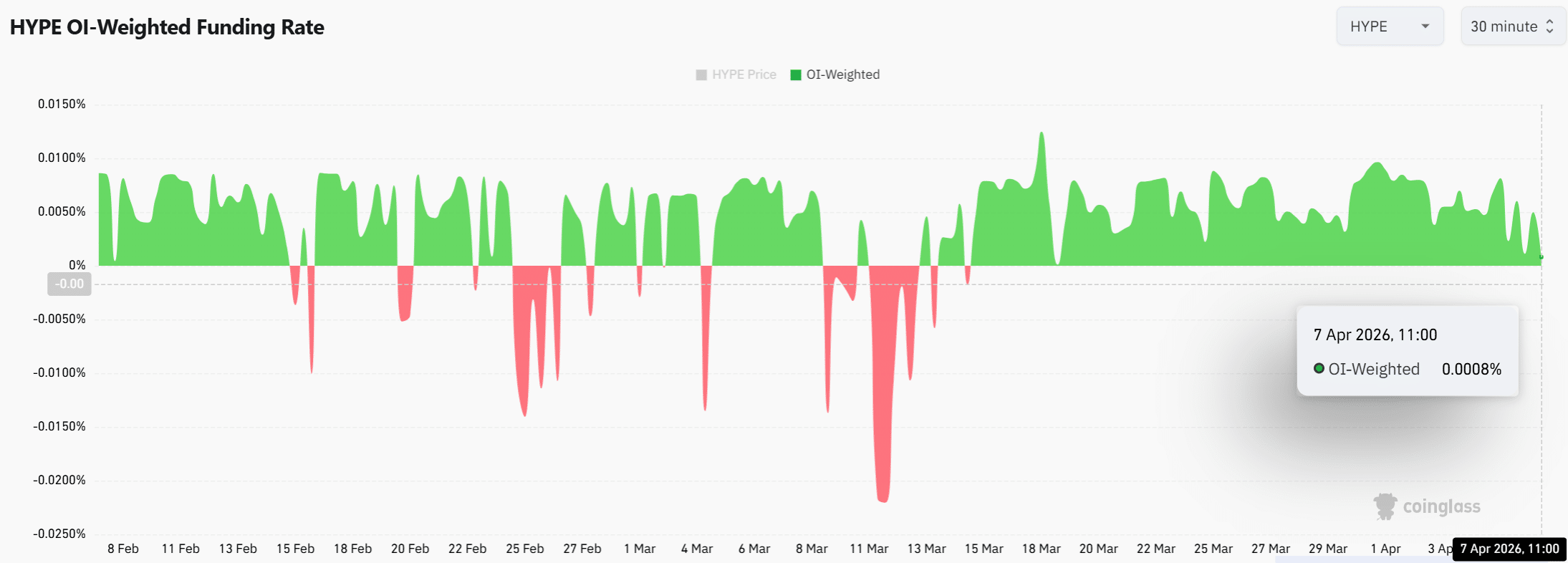
The OI-Weighted Funding Rate remained positive at 0.0008% on the 7th of April, confirming long dominance.

However, Funding Rates trended downward, signaling weakening conviction among longs.

Traders showed less willingness to pay premiums, reflecting caution near resistance.

That decline contrasted with a bullish price structure and short liquidations. It also aligned with whale-selling activity.

This suggested confidence had not fully backed further upside.
Source: CoinGlass

Can HYPE sustain a breakout?

HYPE had retained a bullish structure, supported by short liquidations and stable price action. However, declining funding rates and whale distribution had introduced clear hesitation.

The setup had remained constructive, yet conviction had weakened near resistance.

A breakout had remained possible, though underlying signals had suggested that upside strength might face immediate pressure.


Final Summary

  • HYPE held a bullish flag between $35.37 support and $38 resistance, showing controlled consolidation rather than a breakdown.
  • Repeated rejection near $38 indicated hesitation, with buyers unable to confirm a breakout yet.

Perguntas relacionadas

QWhat was the impact of Telegram's Lighter integration on Hyperliquid (HYPE)?

ATelegram's Lighter integration drew significant attention to Hyperliquid (HYPE), creating a bullish narrative for the asset.

QWhat significant trading activity did a large whale perform that contradicted the bullish sentiment?

AA large whale dumped 12.2K HYPE worth $449.1K, placed a 10.4K HYPE sell order worth $386K, and withdrew $1.26M in USDC, reducing their exposure and moving in the opposite direction of the bullish trend.

QWhat is the key price range HYPE was trading within, and what does it signify?

AHYPE was trading between the $35.37 support level and the $38 resistance level, which signifies a period of controlled consolidation within a bullish flag pattern.

QWhat did the liquidation data reveal about market pressure for HYPE?

AThe liquidation data showed that short liquidations ($26.58K) significantly outweighed long liquidations ($4.14K), indicating upward pressure as bearish positions were being forced out, supporting price stability.

QWhat was the trend of the Funding Rate, and what does it suggest about trader sentiment?

AThe OI-Weighted Funding Rate remained positive but was trending downward, signaling that while long positions were still dominant, conviction among longs was weakening and traders were showing caution near the resistance level.

Leituras Relacionadas

How to Do Research Well: Deliberately Practice the Real Skills That Matter

No one truly teaches you how to do research. You're often given a desk, a pre-selected problem, and vague instructions to "create something new." Consequently, many people reverse-engineer the job based on visible outputs—papers, posts, announcements—learning only how to *appear* like a researcher rather than how to *become* one. True research capability is built from stacking small, trainable skills, nearly all of which can be developed through deliberate practice. **Pick Your Own Problem:** Most researchers absorb problems from advisors or trends, lacking the underlying reasoning. Choosing a problem you genuinely care about, as John Schulman advises, leads to original work. Develop "taste" like a muscle: predict experiment outcomes, guess paper results from methods, and track which findings remain important over time. **Upgrade Your Inputs:** Relying on shared reading lists (arXiv hot lists, filtered group chats) leads to unoriginal conclusions. Undervalued old literature often holds crucial insights (e.g., MoE, LSTM, backpropagation). Richard Sutton's "The Bitter Lesson" or Claude Shannon's 1952 talk on creative thinking are more predictive than lengthy modern surveys. Breadth matters as much as depth: draw from neuroscience, mechanism design, hardware knowledge, and honest statistics. Read papers directly, especially appendices and limitations sections. **Write Everything Down:** As Paul Graham noted, writing exposes flaws in seemingly mature ideas. Writing is the cheapest defense against self-deception. Following Feynman's principle, Darwin programmatically wrote down facts contradicting his theory to combat memory bias. Maintain a detailed log of hypotheses, setups, predictions, results, and updated understandings. Reviewing past logs fosters essential humility.

marsbitHá 1h

How to Do Research Well: Deliberately Practice the Real Skills That Matter

marsbitHá 1h

Following US Ban on Fable 5, Zhipu AI's Stock Soars 47%

On June 15th, shares of Zhipu AI surged dramatically on the Hong Kong stock market, peaking at a 47.6% gain before closing 32.82% higher. This sharp increase was directly triggered by two recent industry events. On June 12th, Anthropic announced it was suspending global access to its latest flagship models, Claude Fable 5 and Claude Mythos 5, to comply with a U.S. government export control order. The next day, Zhipu AI announced it would open access to its latest open-source flagship model, GLM-5.2, under the permissive MIT license. The Anthropic incident highlighted a critical issue beyond raw model capability: the risk of sudden, unpredictable loss of access to advanced AI models, especially for developers and enterprises deeply integrated with them. This has shifted industry and market focus toward factors like stability, sustainable access, and controllability. Zhipu's move, promoting "frontier intelligence for all," positions its openly available model as a reliable and accessible alternative. The GLM-5.2 model emphasizes "Long Horizon Task" capabilities with a 1M context window, targeting complex, multi-step coding and engineering workflows where maintaining context is crucial. Analysts note this event exposes the risk of dependency on closed-source models subject to single jurisdictional controls, potentially accelerating a shift toward domestic base models and localized deployments. The market's reaction signals a new valuation dimension in AI: providers who can offer stable, long-term, and sustainably accessible AI capabilities are gaining strategic importance.

marsbitHá 1h

Following US Ban on Fable 5, Zhipu AI's Stock Soars 47%

marsbitHá 1h

Fully Entering the AI Era: Alipay Bets on Conversation, WeChat Holds Fast to Social

In May 2026, Alipay announced over 300 million AI payment transactions. Shortly after, WeChat opened its mini-programs for AI integration, sparking controversy by requiring developer source code access. This highlights their diverging approaches to AI integration. Alipay is testing "Project Treasure," an optional AI-native interface replacing traditional app grids with a conversational window. Users can command complex tasks (e.g., "book a ride and order coffee") handled end-to-end by AI. This shift follows an abandoned standalone AI app, focusing instead on enhancing its existing user base. For unmodified mini-programs, Alipay's AI uses "screen-reading" to simulate user interactions, bypassing the need for developer overhaul. It also introduced "Token Pay" for micro-transactions and "AI Wallets" for autonomous agent spending. WeChat, prioritizing its core social function, is taking an embedded approach. Its AI agent will operate within existing contexts like group chats and official accounts, assisting without a separate interface. To enable this, WeChat offers developers two paths: granting source code access for direct AI control ("Automatic Mode") or manually encapsulating services into standardized "Skills." Both place significant burden on developers. Key differences emerge in handling legacy services: WeChat demands developer cooperation (code or labor), while Alipay's screen-reading offers immediate, if potentially less stable, compatibility. Alipay's 3 billion AI transactions demonstrate user acceptance of AI-driven commercial actions. The divergent strategies may reshape mini-program ecosystems—Alipay passively "AI-fying" services, WeChat potentially favoring resource-rich developers—and set competing technical standards. Ultimately, the competition centers on where users entrust the command to "help me get things done."

marsbitHá 1h

Fully Entering the AI Era: Alipay Bets on Conversation, WeChat Holds Fast to Social

marsbitHá 1h

Trading

Spot
Futuros

Artigos em Destaque

Como comprar TON

Bem-vindo à HTX.com!Tornámos a compra de The Open Network (TON) simples e conveniente.Segue o nosso guia passo a passo para iniciar a tua jornada no mundo das criptos.Passo 1: cria a tua conta HTXUtiliza o teu e-mail ou número de telefone para te inscreveres numa conta gratuita na HTX.Desfruta de um processo de inscrição sem complicações e desbloqueia todas as funcionalidades.Obter a minha contaPasso 2: vai para Comprar Cripto e escolhe o teu método de pagamentoCartão de crédito/débito: usa o teu visa ou mastercard para comprar The Open Network (TON) instantaneamente.Saldo: usa os fundos da tua conta HTX para transacionar sem problemas.Terceiros: adicionamos métodos de pagamento populares, como Google Pay e Apple Pay, para aumentar a conveniência.P2P: transaciona diretamente com outros utilizadores na HTX.Mercado de balcão (OTC): oferecemos serviços personalizados e taxas de câmbio competitivas para os traders.Passo 3: armazena teu The Open Network (TON)Depois de comprar o teu The Open Network (TON), armazena-o na tua conta HTX.Alternativamente, podes enviá-lo para outro lugar através de transferência blockchain ou usá-lo para transacionar outras criptomoedas.Passo 4: transaciona The Open Network (TON)Transaciona facilmente The Open Network (TON) no mercado à vista da HTX.Acede simplesmente à tua conta, seleciona o teu par de trading, executa as tuas transações e monitoriza em tempo real.Oferecemos uma experiência de fácil utilização tanto para principiantes como para traders experientes.

553 Visualizações TotaisPublicado em {updateTime}Atualizado em 2026.06.02

Como comprar TON

Discussões

Bem-vindo à Comunidade HTX. Aqui, pode manter-se informado sobre os mais recentes desenvolvimentos da plataforma e obter acesso a análises profissionais de mercado. As opiniões dos utilizadores sobre o preço de TON (TON) são apresentadas abaixo.

活动图片