Teachers union claims risks to retirement funds in crypto market structure

cointelegraphPublicado em 2025-12-10Última atualização em 2025-12-10

Resumo

The American Federation of Teachers (AFT) opposes the Senate's proposed crypto market structure legislation, arguing it threatens retirement fund stability. The union claims the bill fails to regulate crypto assets with the same rigor as traditional pension holdings and could expose retirement plans like 401(k)s to unsafe investments. Similar concerns were raised by another labor group in October. Meanwhile, former President Trump has issued an executive order to allow cryptocurrencies in 401(k) plans, and some asset managers have already started including crypto in retirement portfolios. The Senate is expected to release an updated draft of the bill soon.

The American Federation of Teachers (AFT), a union championing educators in the United States, has voiced its opposition to crypto market structure legislation moving through the Senate, claiming it “threatens the stability of their retirement security.”

In a Monday letter to Republican and Democratic leaders on the US Senate Banking Committee provided by CNBC, the AFT said it opposed passage of the Responsible Financial Innovation Act, the bill that senators said “built on” the House of Representatives’ proposed solution to market structure, the CLARITY Act. According to the teachers’ union, the bill presents “profound risks” to economic stability and retirement plans.

“This bill fails to provide a regulatory structure for crypto assets and stablecoin that is equivalent to that for other pension holdings,” said the letter. “Most pensions do not carry crypto assets because of their risk. This legislation pretends that crypto assets are stable and mainstream, and they are not.”
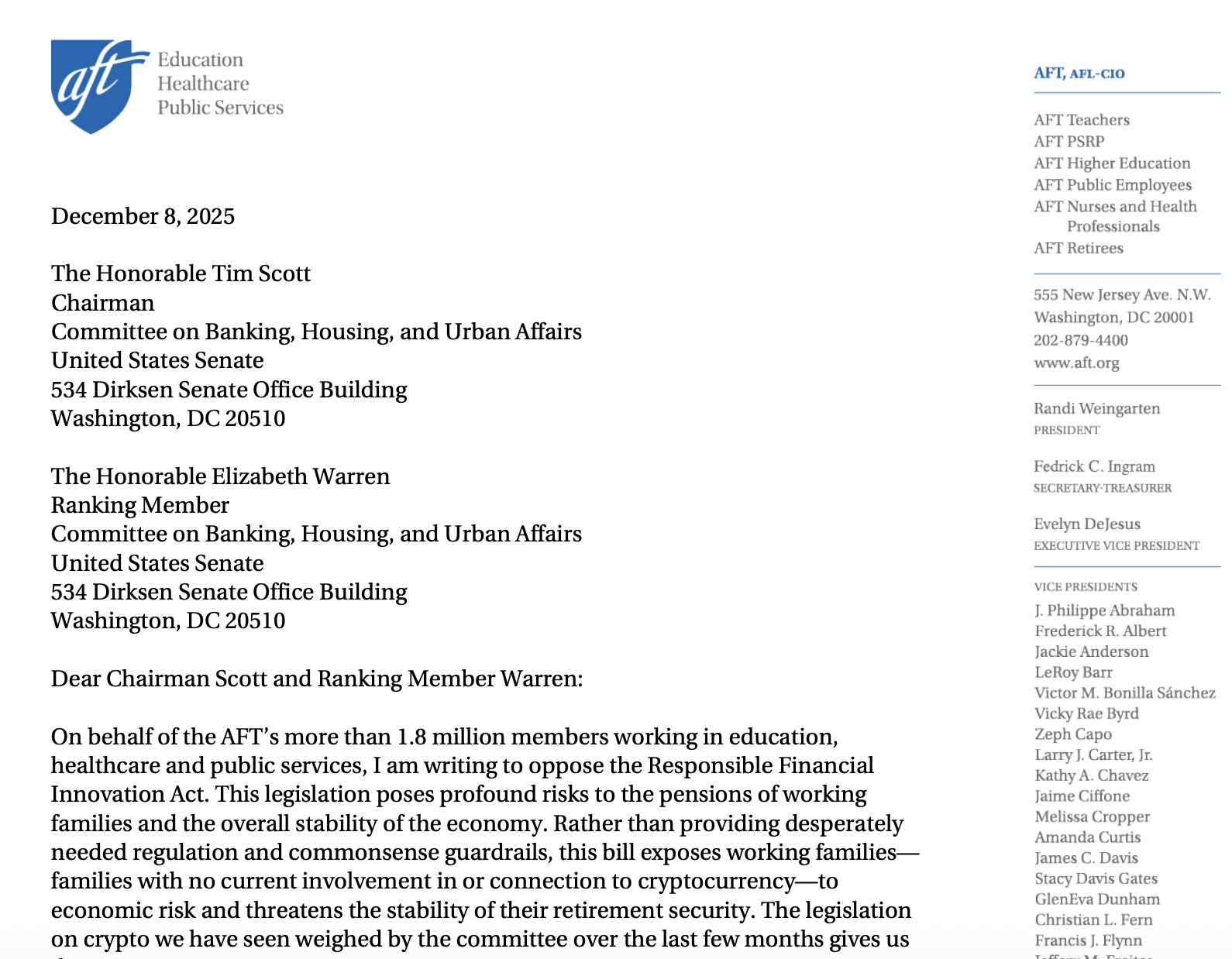
Source: CNBC

The CLARITY Act, a July draft of the market structure bill proposed by the Senate Banking Committee, and a November draft from the Senate Agriculture Committee did not explicitly mention allowing digital assets to be used in pensions or retirement funds. The AFT claimed that if the bill were to be passed, “Pensions and 401(k) plans will end up having unsafe assets even if they were invested in traditional securities.”

The American Federation of Labor and Congress of Industrial Organizations raised similar concerns over the market structure bill posing risks to “retirement funds and to the overall financial stability of the US economy” in an October letter to the banking committee. The group claimed that the legislation would “increase workers’ exposure by greenlighting retirement plans like 401(k)s and pensions to hold this risky asset.”

Related: Japan plans major shift as crypto moves from payments to securities law

The AFT represents 1.8 million members working in education, healthcare and public services. According to the National Association of State Retirement Administrators, aggregate public pension assets, including teachers, totaled more than $6.5 trillion as of the second quarter of 2025, while the Investment Company Institute reported in September that total retirement assets in the US were about $45.8 trillion.

Trump is addressing crypto in retirement funds through executive orders

Separate from the Senate’s efforts to pass market structure, US President Donald Trump has attempted to change policy to allow cryptocurrencies to be included in 401(k) retirement plans. In August, Trump signed an executive order directing the Labor Department to reevaluate restrictions around alternative assets in defined-contribution plans, including digital assets.

Asset management companies have already been making moves signaling openness to adding digital assets to individual retirement arrangements (IRAs) and 401(k)s.

In October, Morgan Stanley reportedly began allowing its advisers to suggest crypto funds as part of its clients’ retirement portfolios. State-managed retirement funds, such as those in Michigan and Wisconsin, also have exposure to crypto through digital asset-linked exchange-traded funds.

It’s unclear when the Senate will vote on a market structure bill in the full chamber. Wyoming Senator Cynthia Lummis, one of the bill’s most outspoken proponents, said on Tuesday that she anticipated the banking committee releasing an updated draft this week, with a possible markup hearing before Congress broke for the holidays.

Magazine: When privacy and AML laws conflict: Crypto projects’ impossible choice

Criptomoedas em alta

Leituras Relacionadas

Micron Shuts Up the Bears, Makes India's 'Buffett' Regret: Sold Too Early, Missed Out on $2 Billion

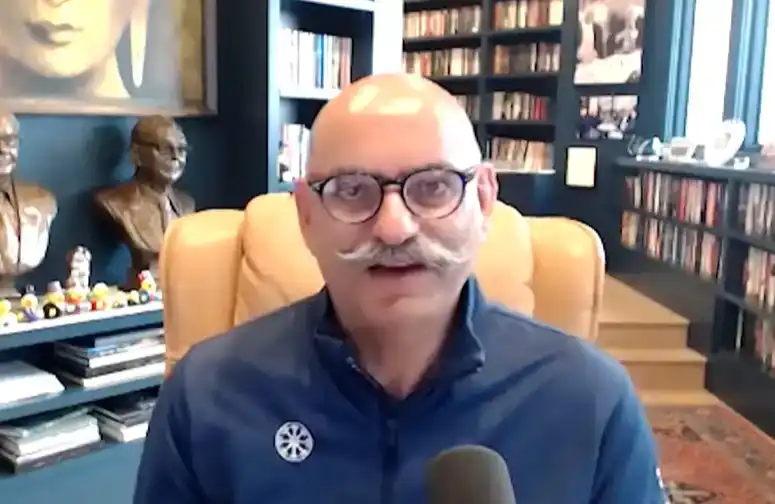
Indian value investor Mohnish Pabrai, a disciple of Warren Buffett, revealed his costly mistake of selling shares in Micron Technology too early. He initially invested in 2017, holding it for six years and building a position as large as 77% of his portfolio, based on a thesis that the memory chip industry would consolidate into a stable oligopoly of Samsung, SK Hynix, and Micron. However, he sold his entire stake in September 2023, fearing oversupply after Samsung announced production expansion. Shortly after his exit, demand for high-bandwidth memory (HBM) surged with the rise of AI, and Micron's stock price skyrocketed over 15 times in two years. Pabrai estimates this premature sale cost him roughly $20 billion in potential gains. He expressed similar regret over selling his investment in SK Hynix too soon, stating he violated his own principle of holding companies forever. Reflecting on these errors, Pabrai emphasized his core investment checklist principles: avoiding leverage, focusing on the durability of a company's competitive moat, and assessing management's character. Despite these personal trading missteps, his long-term view on the remaining memory chip leaders remains bullish, advising current holders not to sell as "the party is just getting started." He concluded by sharing his philosophical outlook, prioritizing character over wealth, and his goal to donate his entire fortune before his passing.

marsbitHá 22m

Micron Shuts Up the Bears, Makes India's 'Buffett' Regret: Sold Too Early, Missed Out on $2 Billion

marsbitHá 22m

Mihoyo's Next Protagonist Is Her, Who Plays the Piano

Mihoyo, widely recognized for its hit game Genshin Impact, has long harbored a grander ambition: creating a virtual world where one billion people would want to live. While its character design is unparalleled, the company recognizes a fundamental limitation—these beloved virtual characters are not truly "alive." Their dialogue and actions are pre-scripted. This drive for authentic "living" characters has guided Mihoyo's strategic investments in cutting-edge fields like brain-computer interfaces, AI (including an early investment in MiniMax), and nuclear fusion. Following the release of ChatGPT in late 2022, co-founder Cai Haoyu stepped down from management to lead a new overseas AI venture, Anuttacon, focused on creating AI-driven virtual beings. Mihoyo's path has involved experimentation and iteration. Anuttacon's early project, *Whisper of the Stars*, showcased real-time AI conversation but revealed limitations in underlying language models. The team subsequently focused its resources on developing a sophisticated "emotional" large language model, distinct from purely utilitarian AI. Co-founder Liu Wei (Dawei) announced plans to invest up to 100 billion RMB in this AI pursuit. The first tangible product of this vision is *BSide: Olivia Lin*, a free Steam application featuring a piano-playing virtual companion. Unlike typical AI chatbots demanding constant interaction, Olivia Lin operates on a slower, more deliberate rhythm—responding to letters, playing user-submitted melodies, and serving as a desktop presence. This design emphasizes "lifelikeness" over exhaustive conversation, strategically working around current technological constraints while building a sense of authentic connection. The company's journey traces back to its name, "miHoYo," where "mi" pays homage to the virtual singer Hatsune Miku. For nearly two decades, fans have loved Miku, a character unaware of their devotion. Mihoyo's ultimate goal, now backed by massive investment and AI research, is to bridge that gap—to create virtual beings that can truly know they are loved.

marsbitHá 40m

Mihoyo's Next Protagonist Is Her, Who Plays the Piano

marsbitHá 40m

Citrini Research: Taking Stock of 5 Major Investment Themes Overshadowed by the AI Trade

Citrini Research identifies five under-the-radar investment themes potentially overshadowed by the dominant AI trade. With capital and analyst attention overwhelmingly focused on AI infrastructure, these overlooked areas present alpha opportunities as market dynamics shift. **Theme 1: Airlines** – Despite strong fundamentals, stocks like Delta and United have been penalized for 18 months due to macro concerns (tariff-inflation, oil prices), not profitability. A rebound is expected as these headwinds fade, aided by trends like premiumization and the 2026 World Cup. **Theme 2: Senior Housing** – A pure demographic play. The U.S. population over 80 is projected to grow 56% in the next decade, drastically outpacing supply. This creates a compelling need for facilities, benefiting REITs like Welltower and operators like Brookdale. **Theme 3: Live Events & Entertainment** – "Being there" is becoming a luxury. This sector has outperformed even tech over the past decade. Companies like TKO Group (WWE/UFC), Cinemark, and IMAX are capitalizing on demand for premium, in-person experiences. **Theme 4: Exchange Competition** – CME Group's ~98% monopoly in U.S. interest rate derivatives faces its first real challenge from FMX Futures Exchange. Backed by major Wall Street banks, FMX offers lower fees and margin savings. While CME's deep liquidity remains an advantage, FMX provides a competitive alternative. **Theme 5: Fintech Recovery** – Heavily sold off in 2026, fintech stocks like SoFi, Robinhood, and Upstart are showing signs of a rebound based on improving fundamentals—SoFi's stablecoin launch, Robinhood's transformation into a "financial super app," and Upstart's renewed AI lending narrative—rather than a change in sector outlook. The report advises maintaining some AI exposure but diversifying into these neglected "small themes" where mispricing exists due to a simple shortage of investor attention.

marsbitHá 1h

Citrini Research: Taking Stock of 5 Major Investment Themes Overshadowed by the AI Trade

marsbitHá 1h

21Shares Mid-Year Key Report: Bitcoin's Four-Year Cycle Remains Intact, Stablecoins and Tokenization Emerge as New Growth Engines

21Shares Mid-Year Report 2026: Bitcoin Cycle Intact, Stablecoins & Tokenization Emerge as New Engines This mid-year review assesses progress against 21Shares' ten predictions for 2026. While the overarching shift from narrative to fundamentals holds, performance varies. Key findings show Bitcoin's four-year cycle remains evident despite market maturation. Global crypto ETP AUM has declined to ~$140B, lagging the $400B target, though product innovation continues. Stablecoin supply surpassed $320B, demonstrating non-cyclical demand but falling short of the $1T forecast due to slower regulatory clarity. DeFi TVL, stalled at ~$140B, was hindered by major security incidents. Corporate crypto treasuries hold ~1.28M BTC ($100B), with consolidation pressuring weaker players. Prediction markets are on track, with $57.5B volume already surpassing half the $100B annual target. AI agent infrastructure is ready, but adoption is early. Ethereum L2 consolidation is underway, with the top 5 capturing nearly 90% of activity. Compliant token launches have a platform but lack mainstream volume. Tokenized RWAs total ~$31B on public chains, but institutional pipeline growth is strong. In summary, fundamentals like stablecoins, tokenization, and prediction markets are advancing, but targets require faster adoption or price appreciation. The market is maturing, yet cyclical patterns persist.

marsbitHá 1h

21Shares Mid-Year Key Report: Bitcoin's Four-Year Cycle Remains Intact, Stablecoins and Tokenization Emerge as New Growth Engines

marsbitHá 1h

Trading

Spot
Futuros

Artigos em Destaque

O que é NASDAQ100

O Índice Nasdaq-100 inclui 100 das maiores empresas não financeiras listadas no Mercado de Ações Nasdaq e é amplamente utilizado como referência para ações de crescimento e tecnologia de grande capitalização nos EUA.

10 Visualizações TotaisPublicado em {updateTime}Atualizado em 2026.06.18

O que é NASDAQ100

Como comprar NASDAQ100

Bem-vindo à HTX.com!Tornámos a compra de Nasdaq-100 Index (NASDAQ100) simples e conveniente.Segue o nosso guia passo a passo para iniciar a tua jornada no mundo das criptos.Passo 1: cria a tua conta HTXUtiliza o teu e-mail ou número de telefone para te inscreveres numa conta gratuita na HTX.Desfruta de um processo de inscrição sem complicações e desbloqueia todas as funcionalidades.Obter a minha contaPasso 2: vai para Comprar Cripto e escolhe o teu método de pagamentoCartão de crédito/débito: usa o teu visa ou mastercard para comprar Nasdaq-100 Index (NASDAQ100) instantaneamente.Saldo: usa os fundos da tua conta HTX para transacionar sem problemas.Terceiros: adicionamos métodos de pagamento populares, como Google Pay e Apple Pay, para aumentar a conveniência.P2P: transaciona diretamente com outros utilizadores na HTX.Mercado de balcão (OTC): oferecemos serviços personalizados e taxas de câmbio competitivas para os traders.Passo 3: armazena teu Nasdaq-100 Index (NASDAQ100)Depois de comprar o teu Nasdaq-100 Index (NASDAQ100), armazena-o na tua conta HTX.Alternativamente, podes enviá-lo para outro lugar através de transferência blockchain ou usá-lo para transacionar outras criptomoedas.Passo 4: transaciona Nasdaq-100 Index (NASDAQ100)Transaciona facilmente Nasdaq-100 Index (NASDAQ100) no mercado à vista da HTX.Acede simplesmente à tua conta, seleciona o teu par de trading, executa as tuas transações e monitoriza em tempo real.Oferecemos uma experiência de fácil utilização tanto para principiantes como para traders experientes.

10 Visualizações TotaisPublicado em {updateTime}Atualizado em 2026.06.18

Como comprar NASDAQ100

O que é RE

I. Introdução ao Projeto O Re Protocol é um mercado de capitais onchain que conecta capital em stablecoin a resseguros totalmente colateralizados e regulados. O resseguro permite que as companhias de seguros transfiram partes do seu risco para outros seguradores especializados, ajudando-as a absorver grandes perdas e a continuar a fornecer cobertura. II. Informações sobre o Token Nome do token: RE(Re) III. Links Relacionados Website:https://re.xyz/ Exploradores:https://bscscan.com/token/0xd41fdb03ba84762dd66a0af1a6c8540ff1ba5dfb https://etherscan.io/token/0x526526528f35ac738177003b8773b402b8df8143 Twitter:https://twitter.com/re Nota: A introdução ao projeto provém dos materiais publicados ou fornecidos pela equipa oficial do projeto, que é apenas para referência e não constitui aconselhamento de investimento. A HTX não se responsabiliza por quaisquer perdas diretas ou indiretas resultantes.

100 Visualizações TotaisPublicado em {updateTime}Atualizado em 2026.06.18

O que é RE

Discussões

Bem-vindo à Comunidade HTX. Aqui, pode manter-se informado sobre os mais recentes desenvolvimentos da plataforma e obter acesso a análises profissionais de mercado. As opiniões dos utilizadores sobre o preço de A (A) são apresentadas abaixo.

活动图片