Recently, the four major analog giants released their financial reports.
ON Semiconductor reported revenue of $1.604 billion, up 9% year-over-year and 6% sequentially. Texas Instruments (TI) reported revenue of $5.463 billion, up 23% year-over-year and 13% sequentially; notably, its analog business, which accounts for nearly 80% of company revenue, grew by 26%. STMicroelectronics reported revenue of $3.487 billion, up 26% year-over-year and 12.7% sequentially. NXP Semiconductors reported revenue of $3.496 billion, up 19% year-over-year and 10% sequentially. The third-quarter guidance from all four companies still points to sequential growth.
Beyond the earnings, several operating metrics turned positive at the same time. STMicroelectronics' book-to-bill ratio approached 2, and the company has seen supply tightening for some products. TI's backlog continued to increase in the second quarter, with lead times extending by several weeks from the previous sub-13-week level. NXP's channel inventory dropped back to 11 weeks.
By mid-2026, the analog chip market has finally begun its upward cycle.
Industrial First, Automotive Follows
The industrial market was the first to recover. TI's President and CEO Haviv Ilan disclosed at the beginning of the earnings call that industrial revenue grew approximately 30% year-over-year and about 10% sequentially in Q2. Data center revenue doubled year-over-year and grew about 20% sequentially. The previously sluggish automotive market also began to rebound, showing a year-over-year increase in the teens and a sequential increase approaching double digits.
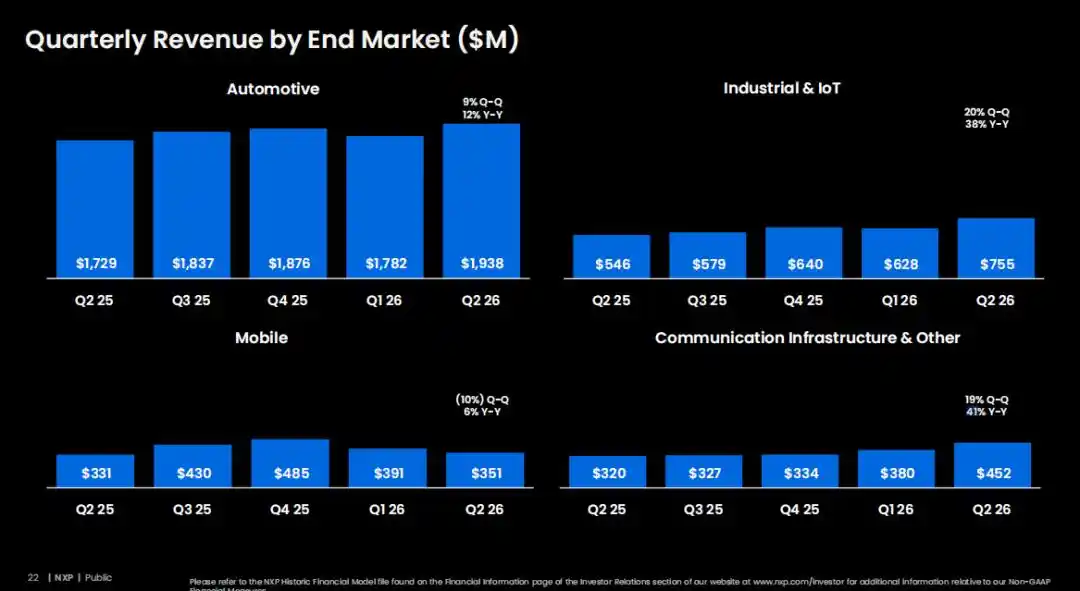
Source: NXP Semiconductors
NXP's revenue structure showed similar changes. According to NXP's disclosed financial report, its Industrial & IoT business grew 38% year-over-year and 20% sequentially, the Automotive business grew 12% year-over-year and 9% sequentially, and the Communications Infrastructure & Other business grew 41%. The Mobile business declined 10% sequentially, while Consumer Electronics remains a relatively weak spot.
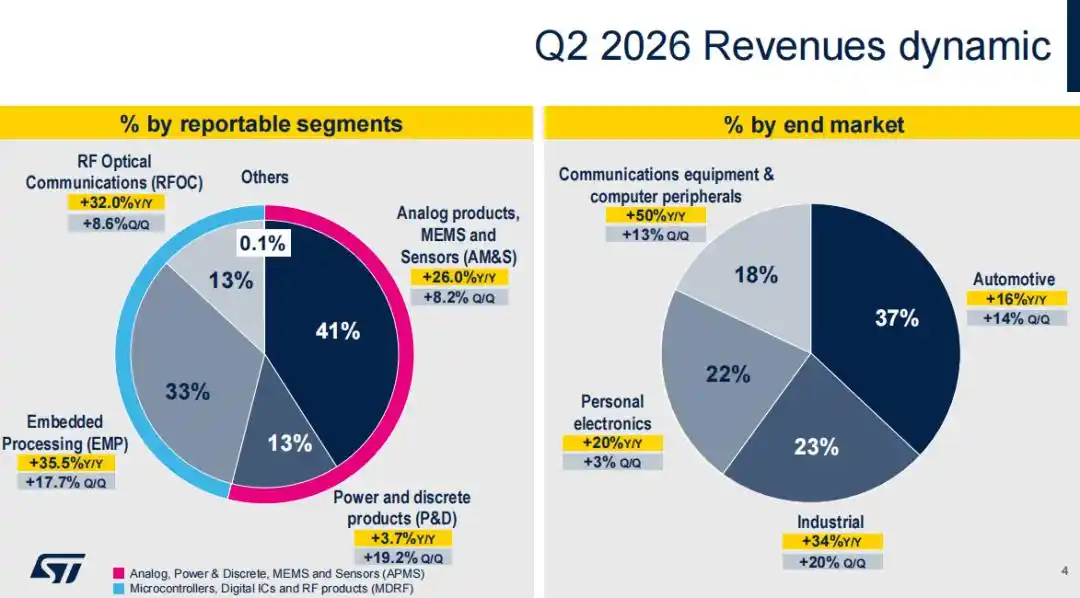
Source: STMicroelectronics
STMicroelectronics' industrial revenue grew 34% year-over-year, automotive grew 16%, and communication equipment and computer peripherals grew 50%. Revenue from its Analog, MEMS, and Sensors (AMS) business grew 26%, driven by contributions from the acquisition of NXP's MEMS business as well as recovering demand from industrial and automotive sectors.
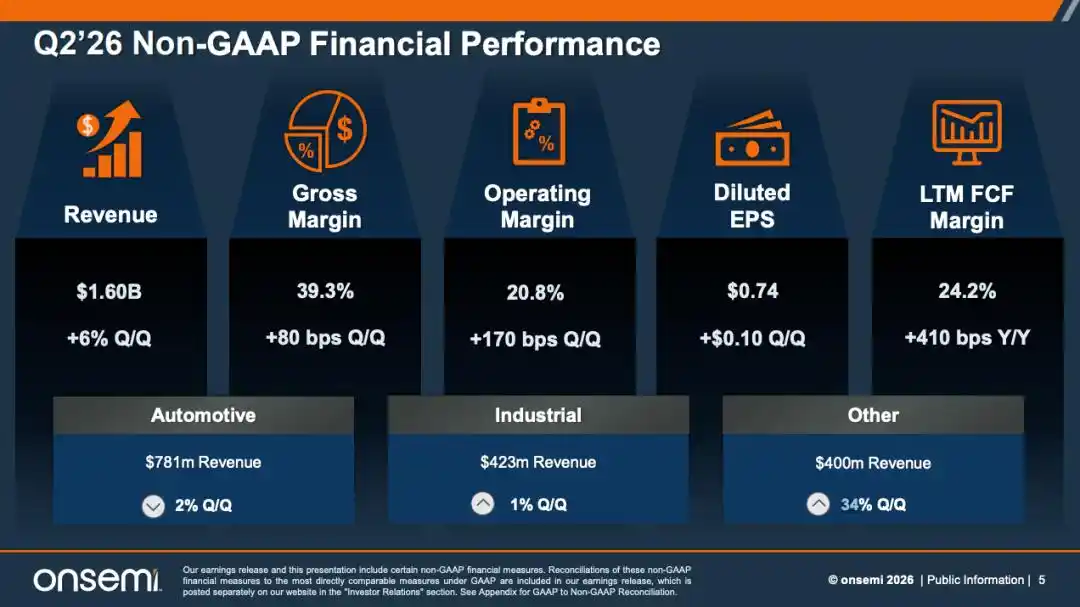
Source: ON Semiconductor
ON Semiconductor's recovery pace was relatively moderate. Automotive revenue was $781 million, down 2% sequentially; Industrial revenue was $423 million, up 1% sequentially; revenue from Other Markets, including AI data centers, was $400 million, up 34% sequentially. By business segment, Power Solutions revenue grew 19% year-over-year, Analog and Mixed-Signal revenue declined 2% year-over-year, and Intelligent Sensing revenue grew 7%. Different product lines within the same company already show significant performance differences.
Looking at the financial reports of these four giants, the growth is no longer supported by a single market. Industrial led the way, data centers followed closely, and automotive clearly caught up in the second quarter. TI CEO Haviv Ilan judged during the earnings call: A relatively broad-based upturn may have just begun.
However, "broad-based" does not mean all products are recovering simultaneously. According to the financial data, STMicroelectronics' Power and Discrete segment revenue grew only 3.7% year-over-year, with an operating margin still at -21.4%. NXP's Mobile business also did not rebound with the overall market. Demand has expanded from individual bright spots to multiple markets, yet significant differences between product performances persist.
The Real Inflection Point Lies in Inventory
This performance variation needs to be viewed from the perspective of inventory levels across the supply chain.
Analog chip demand is fragmented, and product lifecycles are long. A leading manufacturer may have tens of thousands of part numbers, serving a vast number of customers in automotive, industrial equipment, home appliances, communications, etc., with many products selling continuously for over a decade or more. Compared to digital chips which have concentrated customers and rapid iteration cycles, analog chip inventory is hidden within a longer and more complex chain.
Chip manufacturers hold finished goods, distributors stock inventory, automotive Tier 1s and equipment manufacturers stockpile components, and end customers may also hold equipment and finished products. During an upturn, double-ordering amplifies layer by layer along the chain. After demand weakens, inventory can only be digested step by step. A drop in original equipment manufacturer (OEM) inventory does not necessarily mean the channel is empty; a drop in channel inventory does not indicate that equipment manufacturers and end customers have resumed purchasing.
Haviv Ilan mentioned on the call that in the previous phase, customers accumulated not just chips, but also equipment and finished goods. End markets need to digest these inventories first, and only then will new systems designed over the past four to five years translate into new semiconductor orders. This also explains why the adjustment in industrial analog chips lasted so long: destocking did not occur only in chip warehouses but was transmitted all the way from OEMs to channels, Tier 1s, and end equipment manufacturers.
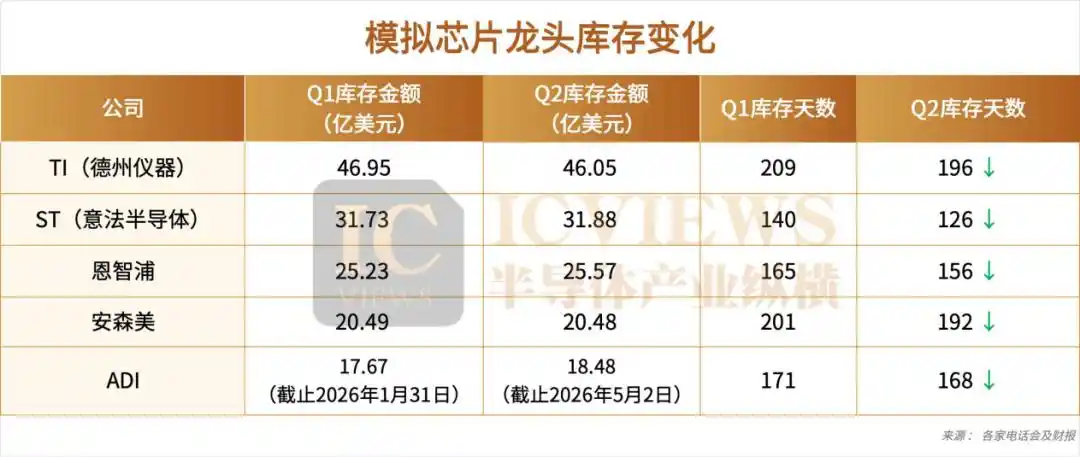
In the second quarter of this year, inventory levels across different tiers began to return to normal ranges simultaneously. STMicroelectronics' days of inventory decreased from 166 days a year ago to 126 days, and distributor inventory has fallen below the company's targeted normal level. NXP's channel inventory dropped to 11 weeks, returning to its long-term target. TI's Chief Financial Officer Rafael Lizardi stated on the call that TI's inventory value decreased by $90 million sequentially, with days of inventory down by 13 days. Haviv Ilan's assessment of the downstream situation was more direct: Industrial customer destocking has basically ended, and automotive customer inventory has even fallen to a level that is difficult to sustain long-term.
ON Semiconductor provides another example. According to the company's financial report, Q2 inventory was $2.0475 billion, showing almost no change sequentially; Executive Vice President and CFO Thad Trent stated on the call that days of inventory decreased by 9 days sequentially to 192 days, as the company continues to digest strategic inventory prepared earlier for long-term customer demand. Flat inventory value with improving turnover indicates that recovering shipments are absorbing existing stock, rather than simply relying on production cuts to reduce inventory.
The inventory cycle for analog chips is crossing three nodes: destocking → inventory normalization → new order transmission restarting.
Restocking Begins, End Demand Takes Over
After inventory drops to low levels, customers need to resume purchasing, but not all new orders come from end demand. The automotive, industrial, and data center markets in Q2 were simultaneously driven by restocking and genuine demand.
Restocking characteristics are most evident in the automotive market. TI stated that automotive demand strengthened month by month within Q2, with the increase mainly coming from new energy vehicles (NEVs) and hybrid electric vehicles (HEVs) in the Chinese market. At the same time, automotive customers had previously pushed their inventories very low. A slight rise in end sales forces the supply chain to simultaneously replenish safety stock. Therefore, automotive orders consist of two parts: growth in sales volume and chip content per vehicle, plus previously deferred purchases.
The industrial market recovery is closer to genuine end-demand recovery. TI saw year-over-year and sequential growth across all industrial sub-sectors and regions, with contributions from energy infrastructure, aerospace, robotics, and industrial automation. The company attributed growth to the start of volume production for new equipment introduced over the past few years, and an increase in the number of chips required for next-generation equipment, rather than price increases. Haviv Ilan later added that new systems designed over the past four to five years are now releasing demand.
Order structure is also changing. STMicroelectronics CEO Jean-Marc Chery said on the call that the book-to-bill ratio for all end markets in Q2 was above 1, with the overall ratio close to 2; communication equipment and computer peripherals were significantly above 2, primarily driven by optical connectivity and silicon photonics business. TI's backlog saw increases in both immediate-delivery and long-delivery demand.
Immediate orders typically correspond to low inventory and urgent replenishment, while long-delivery orders reflect customers' confidence in future production plans. The simultaneous increase in both types of orders indicates that this round of recovery has moved beyond purely channel restocking. Restocking pushes orders off the bottom, and end demand will determine the length of the upturn cycle.
Price Increase Notices Don't Equal Widespread Shortages
After order recovery, the channel is most sensitive to price. Since the beginning of this year, news of price adjustments for some products from TI, STMicroelectronics, Infineon, and other manufacturers has frequently surfaced, with notable price increases for some products. However, the realized pricing reflected in financial reports appears much more moderate.
From TI's perspective, Haviv Ilan believes TI's overall pricing was roughly flat in the first half of 2026. Long-term prices for analog chips typically see slight annual declines, so stabilization itself already indicates improved supply-demand dynamics. TI is also advancing a new round of price adjustments, but given the large number of customers and varying contract cycles, price increases require customer-by-customer negotiation: some will take effect in Q3, some in Q4, and some will be left for next year's price negotiations. TI expects that Q3 revenue growth will still come mainly from shipment volume, with price contribution "almost negligible." Price increase notices indicate that manufacturers are beginning to reclaim some pricing power, but do not mean that quoted prices have been widely translated into revenue.
Lead times convey similar signals. TI's Q2 lead times remained below 13 weeks, having extended by several weeks recently. The company still has cleanroom space that can be equipped and ramped, and maintains inventory for rapid supply. Although STMicroelectronics has seen some product categories begin to tighten, it still incurred $37 million in idle capacity charges in Q2, and its Q3 gross margin guidance includes approximately 70 basis points of impact from idle capacity.
Domestic chip design companies feel the tightness more acutely. When asked about 8-inch foundry capacity, 3Peak stated that as downstream demand is released, overall upstream foundry capacity is tightening, and the company is negotiating with core suppliers for more capacity. Joulwatt believes the tightness in wafer fabrication and packaging segments may be related to AI demand crowding out capacity and transfer of overseas orders. AWINIC stated that rising mature-node foundry prices have already put pressure on gross margins.
The difference stems from business models. IDM manufacturers like TI and STMicroelectronics own their wafer fabrication capabilities; unused cleanroom space and idle capacity provide a supply buffer. Most domestic analog chip companies rely on external foundries, making them more likely to feel the structural tightness in 8-inch production lines first. Tightness can occur first in the foundry segment without yet translating into shortages for all end products.
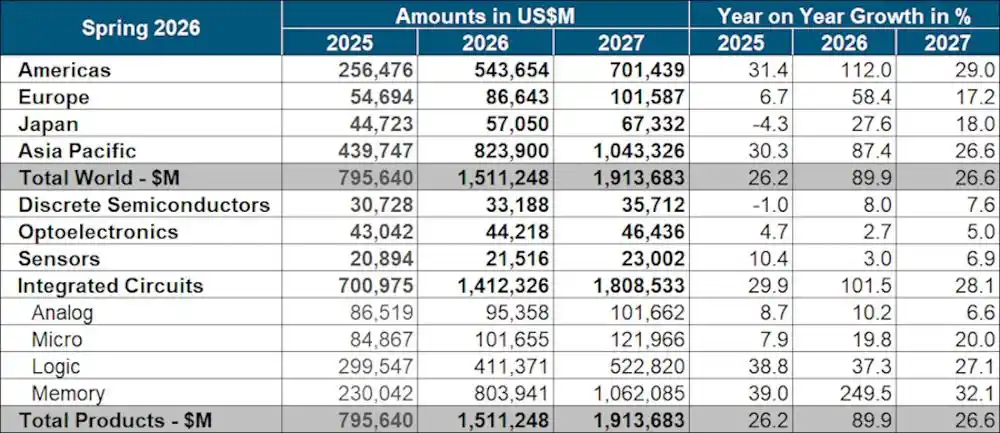
The WSTS Spring 2026 forecast further illustrates the temperature differences across sectors. WSTS predicts the global semiconductor market will grow 90% in 2026, reaching $1.51 trillion. This is primarily driven by approximately 250% growth in memory chips; analog chips are forecast to grow about 10%, discrete devices 8%, and sensors and optoelectronic devices about 3%. Analog chips have entered an upward trajectory but are not the hottest sector in this round of semiconductor market conditions.
Currently, tighter supply is concentrated in automotive analog, power management, AI server power chain, optical module analog front-ends, and some sensors. General-purpose parts, consumer electronics, and some power and discrete devices still face price competition.
AI Brings Analog Chips into the Main Narrative
Market attention on AI hardware has long focused on GPUs, HBM, advanced nodes, and high-speed interconnects. As the power and density of compute clusters rise rapidly, power conversion, thermal management, and signal transmission are becoming system constraints, moving analog chips from peripheral components onto the core bill of materials.
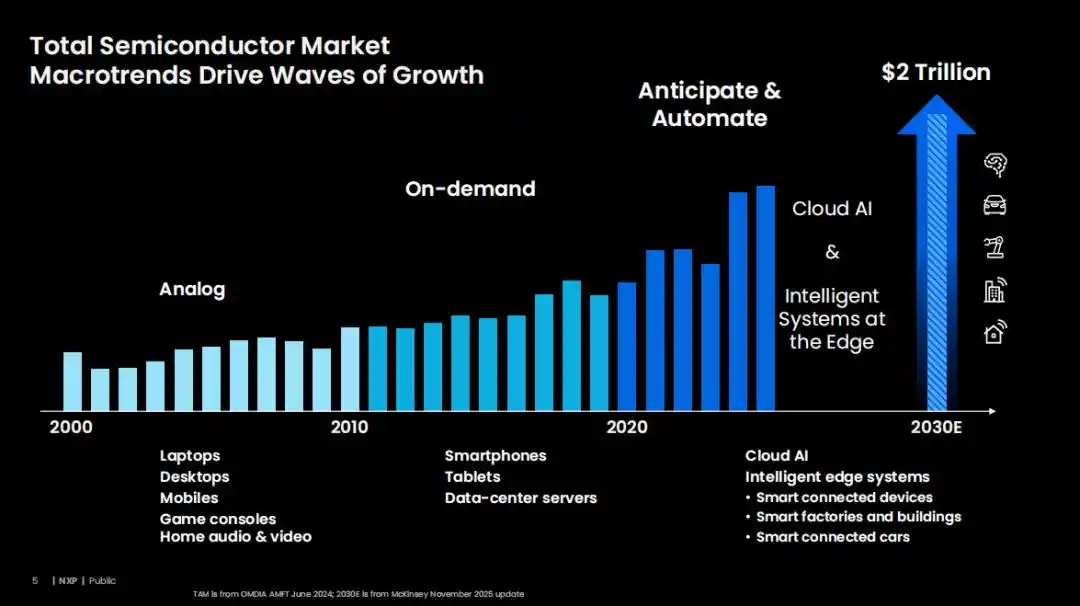
Cloud AI has brought the first incremental path: data center power supplies, optical modules, energy infrastructure, as well as thermal management and environmental monitoring. An AI data center needs to convert AC power from the grid step by step into the different voltages required by GPUs, CPUs, memory, and networking chips, while continuously monitoring current, temperature, energy consumption, and faults. Each layer—from AC/DC conversion and intermediate bus to board-level power and point-of-load regulation—requires power management, power devices, current sensing, isolation, hot-swap, temperature sensing, and controller chips. The higher the compute power per rack, the more complex the power system, and the higher the analog chip value per system.
Optical modules require transimpedance amplifiers, drivers, clocks, data converters, and power management. Domestic manufacturers have already generated revenue in this chain. NOVOSENSE stated that its AI server power business covers multiple leading customers, with related digital power revenue growing rapidly year-over-year and sequentially in Q1. Its products are used in primary and secondary power supplies, covering digital isolation, drivers, interfaces, sampling, and current sensors, including high-voltage GaN driver chips which are already shipping in volume, and medium/low-voltage GaN co-packaged products have completed sampling tests.
Bright Power Semiconductor's digital multi-phase controllers, DrMOS, POLs, and electronic fuses (eFuses) have also entered mass production and volume sales stages. In 2025, the company's high-performance computing (HPC) power chip revenue reached 96 million yuan, up 122.26% year-over-year; new-generation graphics card customers began shipping in large volumes. 3Peak already has several optical module chips in mass delivery, with analog front-ends (AFEs) required for high-speed optical modules achieving stable supply. SG Micro stated that its optical module-related revenue is growing rapidly.
The other path comes from Physical AI, where AI enters cars, robots, and industrial equipment. Robots need to sense the environment, control motors, manage batteries, and ensure operational safety. Cars require radar, sensors, battery management, body control, and powertrain systems. Industrial equipment relies on real-time control, predictive maintenance, and edge computing. Processors handle computation, while sensors, analog front-ends, isolators, motor drivers, and power management chips are responsible for connecting the computation to the physical world.
On both fronts, international leaders have provided outlooks: STMicroelectronics raised its 2026 data center revenue target to over $1 billion and expects it to exceed $2 billion in 2027. TI's Q2 data center revenue doubled year-over-year. NXP lists data centers and Physical AI as new growth engines alongside automotive and industrial.
ON Semiconductor's President and CEO Hassane El-Khoury stated in the earnings report that AI data centers have become the company's fastest-growing business, expecting revenue to more than double year-over-year in 2026. The company also disclosed that it has expanded its power supply business within the NVIDIA MGX ecosystem and secured design wins for EliteSiC, silicon MOSFETs, and controllers in Chinese cloud infrastructure power supplier Great Wall's AI data center platform.
The benefits AI brings have clear boundaries. It increases the value of analog chips in high-power-density, high-reliability, and high-speed signal scenarios. General-purpose consumer products are less likely to benefit to the same extent. Players involved gain a new growth curve not reliant on the traditional consumer electronics cycle, while product and profit differentiation will deepen accordingly.
In recent years, domestic analog chip companies have generally expanded their product portfolios, increased R&D investment, and extended into markets like automotive, industrial, communications, and high-performance power supplies.
SG Micro's product platform already covers several promising directions. In its late-July earnings call, the company stated that orders for the second half of the year are higher than the first half, supply is normal for most products, and lead times have extended for some products due to rapid demand growth. Its broad product and customer base allow it to capture the recovery in industrial, computing, and automotive simultaneously.
NOVOSENSE uses chip value per vehicle to measure product expansion. Currently, its automotive chips in mass production can cover a chip value of about 1,700 yuan per vehicle; including products in sampling and validation, the figure is close to 2,000 yuan. The company's long-term target is 3,000 to 4,000 yuan. Its products already cover three-electric systems, body control & lighting, intelligent driving & cockpit, and chassis & safety.
3Peak currently has optical module analog front-ends moving from R&D to stable delivery; automotive audio bus chips are in stable supply to some automakers, AFE for power battery BMS has completed customer technical validation, and custom LiDAR products are still in R&D and delivery stages.
After Inventory Hits Bottom
For domestic analog chip companies, there is a time lag between cost increases and price adjustments. NOVOSENSE has issued price increase notices and is negotiating with customers. Joulwatt stated that it will adjust prices only when cost increases truly need to be passed through. AWINIC adjusted pricing for some products in Q1 to maintain market share while absorbing rising mature-node wafer costs, putting pressure on overall gross margin. AWINIC's path to improvement is to increase the proportion of higher-margin industrial and automotive business. Market recovery first translates into revenue; whether it translates into profits depends on the speed of price increases, product mix, and cost control.
This round of analog chip adjustment sequentially squeezed out inventory from OEMs, channels, Tier 1s, and end equipment manufacturers. In Q2, industrial, automotive, and data center markets recovered simultaneously, inventory levels returned to normal ranges, and orders began transmitting back to OEMs. Lead time extensions and price increase signals have already appeared for some automotive analog, power management, and optical communication products, while general-purpose products and some power devices still face supply pressure.
Currently, the bottom for analog inventory has become apparent.
This article is from the WeChat public account "Semiconductor Industry Perspective" (ID: ICViews), author: Jiu Lin