Stop Using Gold as a Reference: Bitcoin Is Not a Safe-Haven Asset

marsbitPublicado em 2026-02-16Última atualização em 2026-02-16

Resumo

In the ongoing debate about Bitcoin's role as a "digital gold" or safe-haven asset, this article argues that Bitcoin is not a reliable hedge like gold. Through statistical analysis, including correlation and cointegration tests (Engle-Granger and ADF), the data shows no robust long-term relationship or mean-reverting behavior between Bitcoin and gold. Their occasional parallel movements are coincidental rather than structurally linked. Bitcoin exhibits extreme volatility (over 50% annualized) and behaves as a high-risk speculative asset, not a stable store of value. The article dismisses narratives about capital rotation from metals to crypto as post-hoc explanations without empirical basis. Instead, it suggests that Bitcoin should be treated as a unique and evolving market, influenced more by internal factors like derivatives positioning, funding rates, open interest, and sentiment extremes than by external analogies. True market lows often coincide with extreme fear, derivative liquidations, and widespread pessimism—key indicators to watch rather than relying on cross-asset comparisons.

Editor's Note: As Bitcoin underperforms while gold and U.S. stocks repeatedly hit new highs, the narrative that "funds are rotating from precious metals to crypto assets" has once again gained popularity in the market. This article does not follow this intuitive judgment to provide trading conclusions but instead returns to the data itself to systematically examine whether there is a verifiable long-term relationship between Bitcoin and gold.

Through correlation and cointegration analysis, it can be seen that Bitcoin and gold do not have a robust mean reversion or a structural "see-saw" relationship. The so-called rotation is more of an ex-post explanation rather than a repeatable, verifiable market mechanism. Bitcoin is neither a safe-haven metal nor a stock index; it is an independent market with extremely high volatility and an evolving structure.

The article further points out that to judge Bitcoin's bottom, rather than applying analogies from other assets, it is better to focus on the factors that truly determine market trends, such as positioning, derivatives structure, and sentiment clearing. Historical experience shows that most true bottoms are formed when almost everyone has given up.

Below is the original text:

The crypto market is not exactly hot right now. While stock and metal prices continue to hit new all-time highs, crypto assets have been on the "pain train" since last October.

Recently, timelines have been flooded with claims like: "Funds are rotating from precious metals to crypto assets, and it's about to happen any time now." Unfortunately, the people making these claims are often industry-famous "talkers," whose only consistently profitable PnL comes from the engagement revenue they earn monthly on platform X.

I want to take a moment to analyze whether this so-called "rotation from precious metals to crypto" has any substantive basis (spoiler alert: it doesn't), and then share some key turning points in crypto market history and how you can identify these moments.

The Relationship Between Bitcoin and Gold

First, an obvious problem: to look for a relationship between gold peaking and Bitcoin's performance, the premise is that gold itself must frequently "peak." But in reality, over the past decade, there haven't been many true tops in gold.
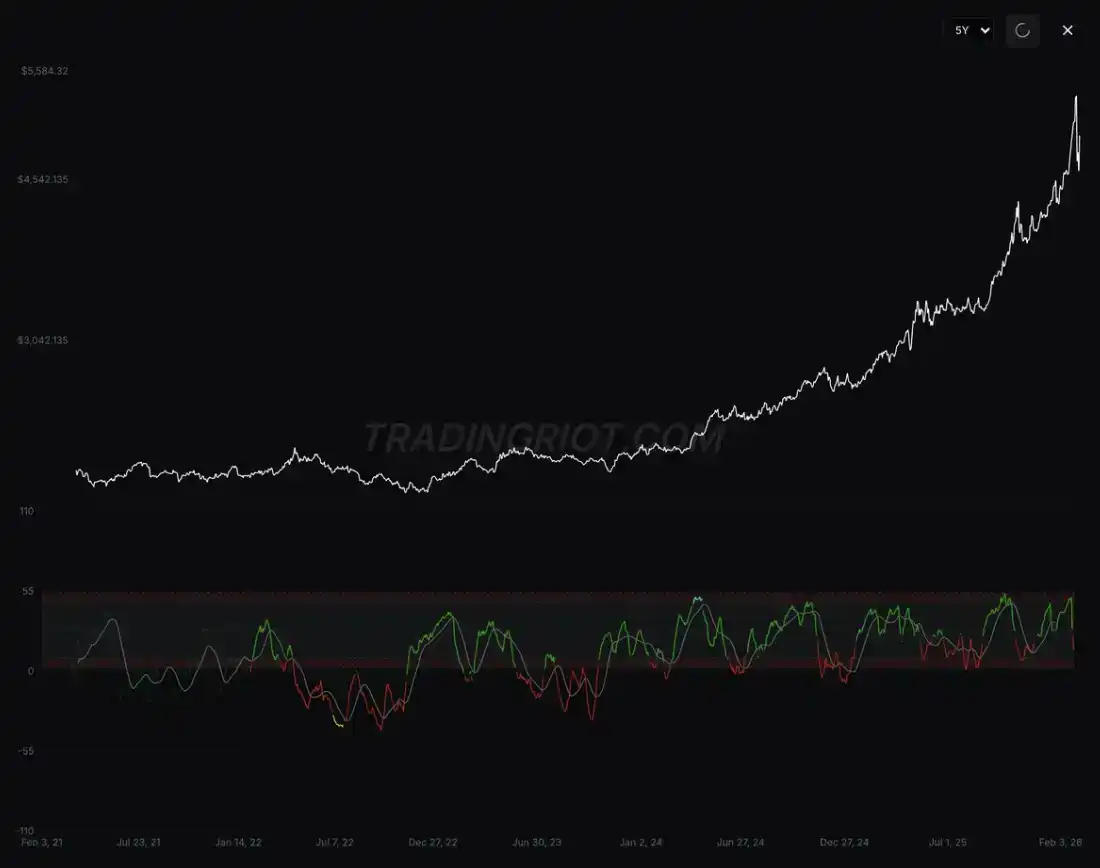
Getting hyped up is fun, but when throwing out opinions on the internet, it's best to have data to back them up, so you don't sound like a complete fool. In the past decade, gold has only experienced three relatively significant pullbacks: in 2018, 2020, and 2022. That is, only three data points. This alone is enough for me to stop further research; but to finish this article, let's dig a little deeper.
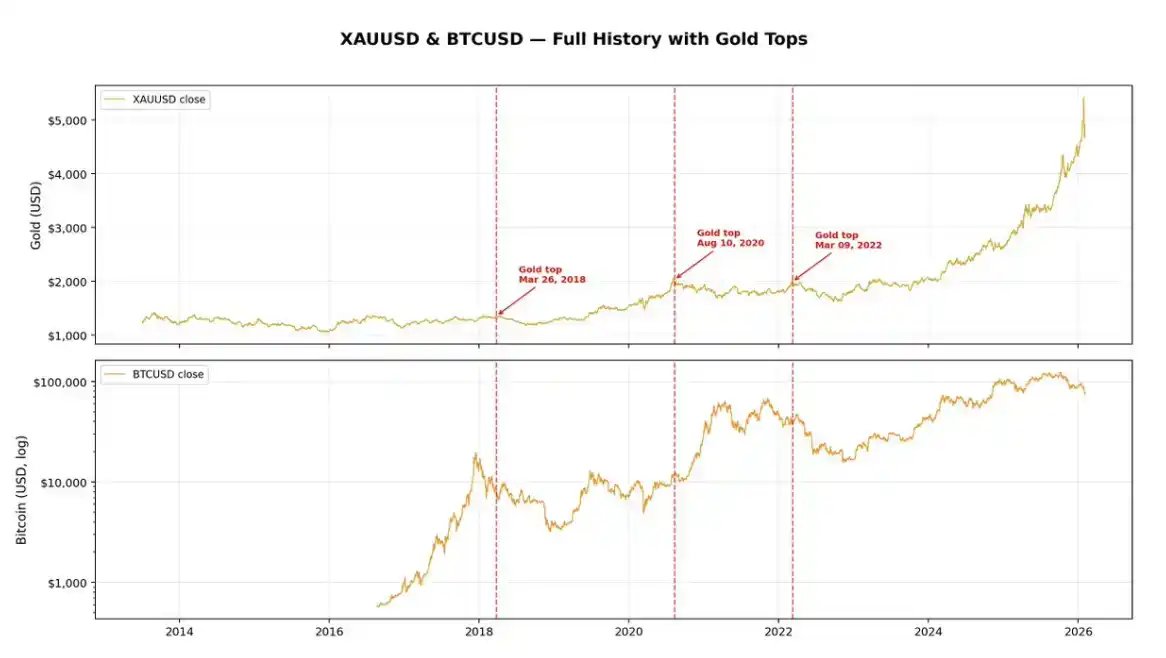
If you look at the chart above, you'll see that two of the three阶段性 highs in gold actually occurred before Bitcoin's downtrend, in 2018 and 2022. The only time Bitcoin strengthened after a gold pullback was during the typical "risk-on" frenzy of 2020.
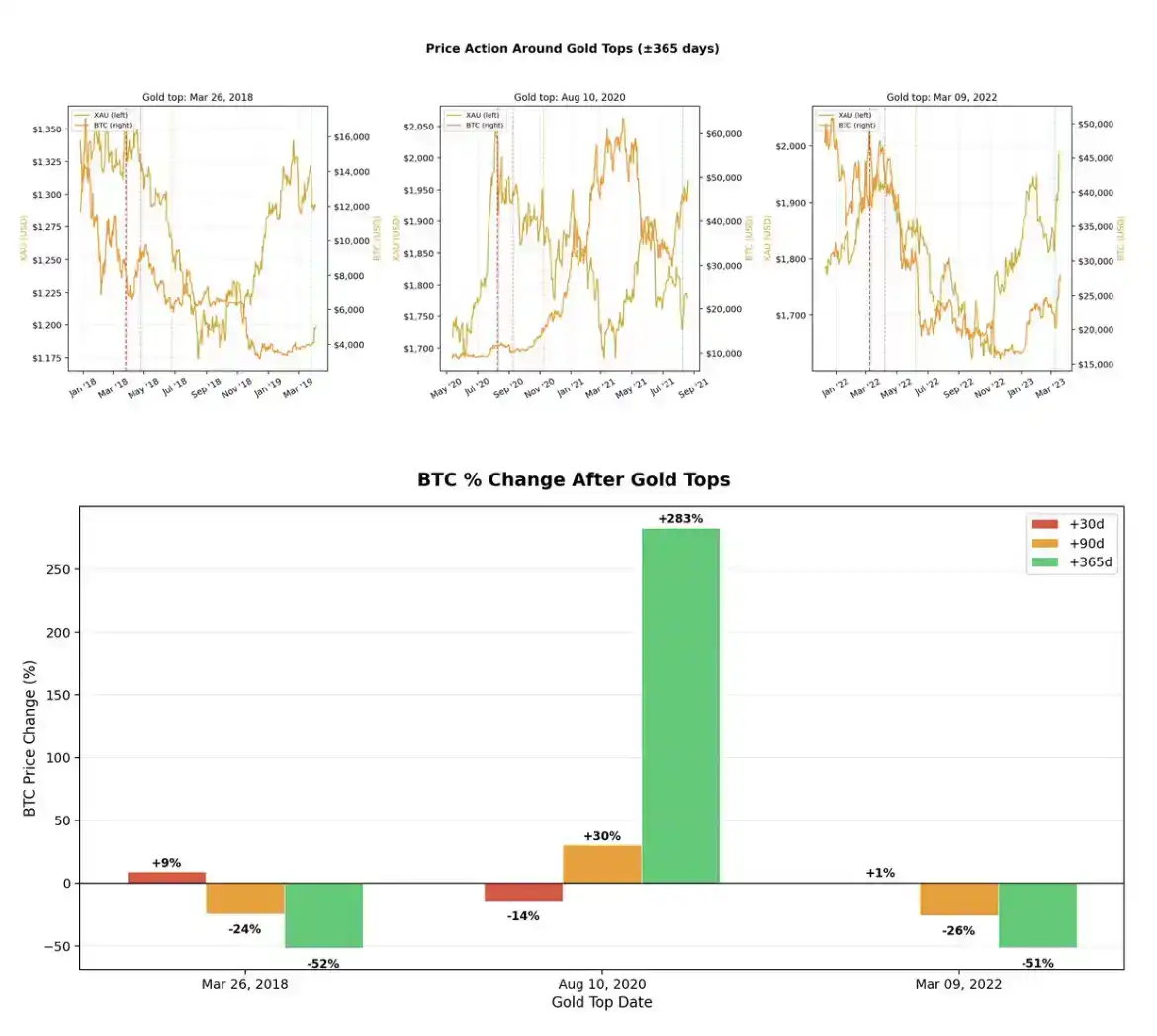
Over the past approximately 10 years of data, the overall correlation coefficient between Bitcoin and gold is close to 0.8, which is not surprising—because in the long run, both markets have been rising. But correlation doesn't answer the question you really care about.

If you want to determine whether there is a "see-saw, strength rotation, eventual reversion" relationship between two assets, looking at correlation is not enough; you need to look at cointegration.

Cointegration

Correlation measures whether two assets "rise and fall together" in daily fluctuations.
Cointegration asks another question: do these two assets maintain a stable relationship over the long term, such that any deviation is pulled back?

Think of it like two drunk people walking home together:

They may each stagger and wander chaotically (non-stationary), but if the two are tied together with a rope, they can't stray too far from each other. That "rope" is the cointegration relationship.

If the narrative of "funds rotating from gold to crypto assets" has any substance, you would at least need to see a cointegration relationship between Bitcoin and gold—that is, when gold surges and Bitcoin significantly underperforms, there should be some real force in the market that pulls them back onto the same long-term track.
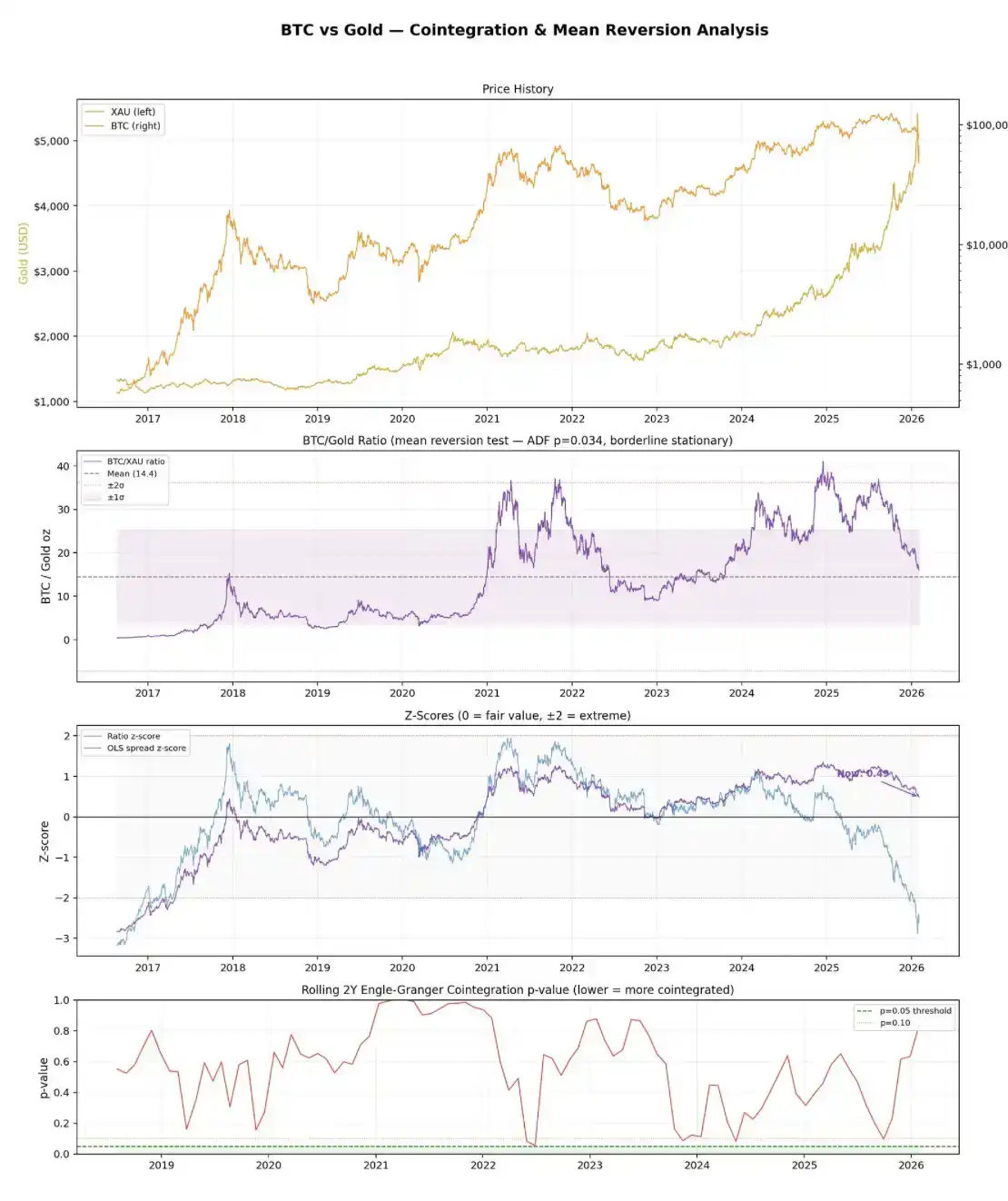
Combined with the chart above, the real message from the data is this: The Engle–Granger cointegration test did not find any cointegration relationship.

The p-value for the full sample is 0.44, well above the usual 0.05 significance threshold. Looking further at rolling two-year windows, none of the 31 intervals showed cointegration at the 5% significance level. At the same time, the spread residuals themselves are non-stationary.

The simpler BTC / gold ratio looks slightly more "optimistic," but not by much. An ADF test on this ratio is only marginally stationary (p = 0.034), meaning it may have very weak mean reversion characteristics. But the problem is that its half-life is about 216 days, or nearly 7 months—absurdly slow, almost completely淹没 in noise.

From current levels, Bitcoin's price is equivalent to about 16 ounces of gold, about 11% higher than the historical average of 14.4. The corresponding z-score is -2.62, and from a historical perspective, Bitcoin seems "relatively cheap" compared to gold.

But the key here: this reading is mainly driven by gold's recent parabolic rise, not because there is some reliable mean reversion relationship that will pull them back together.

In fact, there is no robust cointegration relationship. They are fundamentally two completely different types of assets: gold is a mature safe-haven asset; Bitcoin is a high-volatility risk asset that just happens to show an upward trend over the same period.

If you have no idea what any of that meant, here's a super brief statistics crash course:

The Engle–Granger test is the standard method for judging cointegration. It first performs a regression on the two assets, then tests whether the regression residuals (i.e., the "spread" between them) are stationary—whether they fluctuate around a stable mean rather than drifting infinitely. If the residuals are stationary, it means the two assets are cointegrated.

The ADF test (Augmented Dickey-Fuller) is used to test whether a time series is stationary. It essentially tests for the presence of a "unit root,"通俗点说, whether this series will trend发散 indefinitely or revert to the mean.
A p-value below 0.05 means you can reject the "unit root" hypothesis and consider the series stationary, i.e., mean-reverting.

Half-life describes how quickly mean reversion occurs. If a spread has a half-life of 30 days, it means that after being pulled apart, it takes about a month to修复 half of the deviation.
Short half-life = tradable;
Very long half-life = basically useless except for "holding long and praying."

Ultimately, I've always felt that trying to force Bitcoin into a relationship with any traditional financial asset is absurd in itself. Most of the time, people just use this comparison to迎合 the narrative that best suits their current position: today Bitcoin is "digital gold," tomorrow it's "leveraged Nasdaq."

In comparison, the correlation with the stock market is much more real. Over the past five years, Bitcoin's tops and bottoms have been highly synchronized with the S&P 500 (SPX)—until this phase: SPX is still稳稳地 near all-time highs, while Bitcoin has already pulled back 40% from its peak.
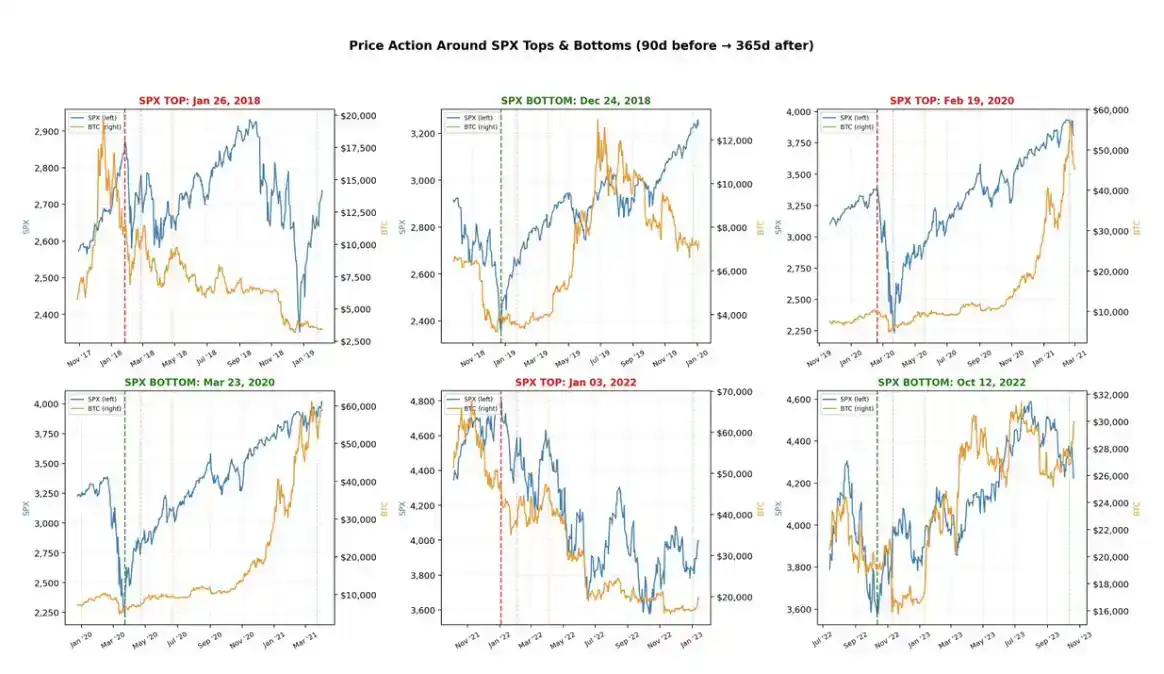
Because of this, you should view Bitcoin as an independent entity. It is not a metal—no one considers an asset with an annualized volatility exceeding 50% a safe-haven asset (for comparison, gold's annualized volatility is around 15%, and even that is considered relatively high volatility among "store of value" assets).
It is also not a stock index—Bitcoin has no constituent stocks; it is essentially just a piece of code.

Over the years, Bitcoin has been constantly套上 various narratives: payment tool, store of value, digital gold, global reserve asset, etc.

These all sound great, but the reality is that this is still a very young market, and it's hard to say whether it has clear, stable practical uses beyond being a "speculative asset." Ultimately, there's nothing wrong with treating it as a speculative asset; the key is to be清醒 and realistic about it.

The Bottom

Stably and reliably catching Bitcoin's bottom is extremely difficult—of course, it's not easy in any market, but Bitcoin's problem is that it has changed so much over the years that historical patterns themselves are becoming less and less relevant.

Ten years ago, the market structure of gold and the S&P 500 (SPX) hadn't changed much compared to now;
But in 2015, one of the main uses of holding Bitcoin was still to buy heroin online.

This has obviously changed dramatically. Today's market participants are much more "legitimate," especially after the significant growth in open interest of CME Bitcoin futures and options in 2023, and the launch of Bitcoin ETFs in 2024, which brought institutional funds正式 and大规模 into this market.
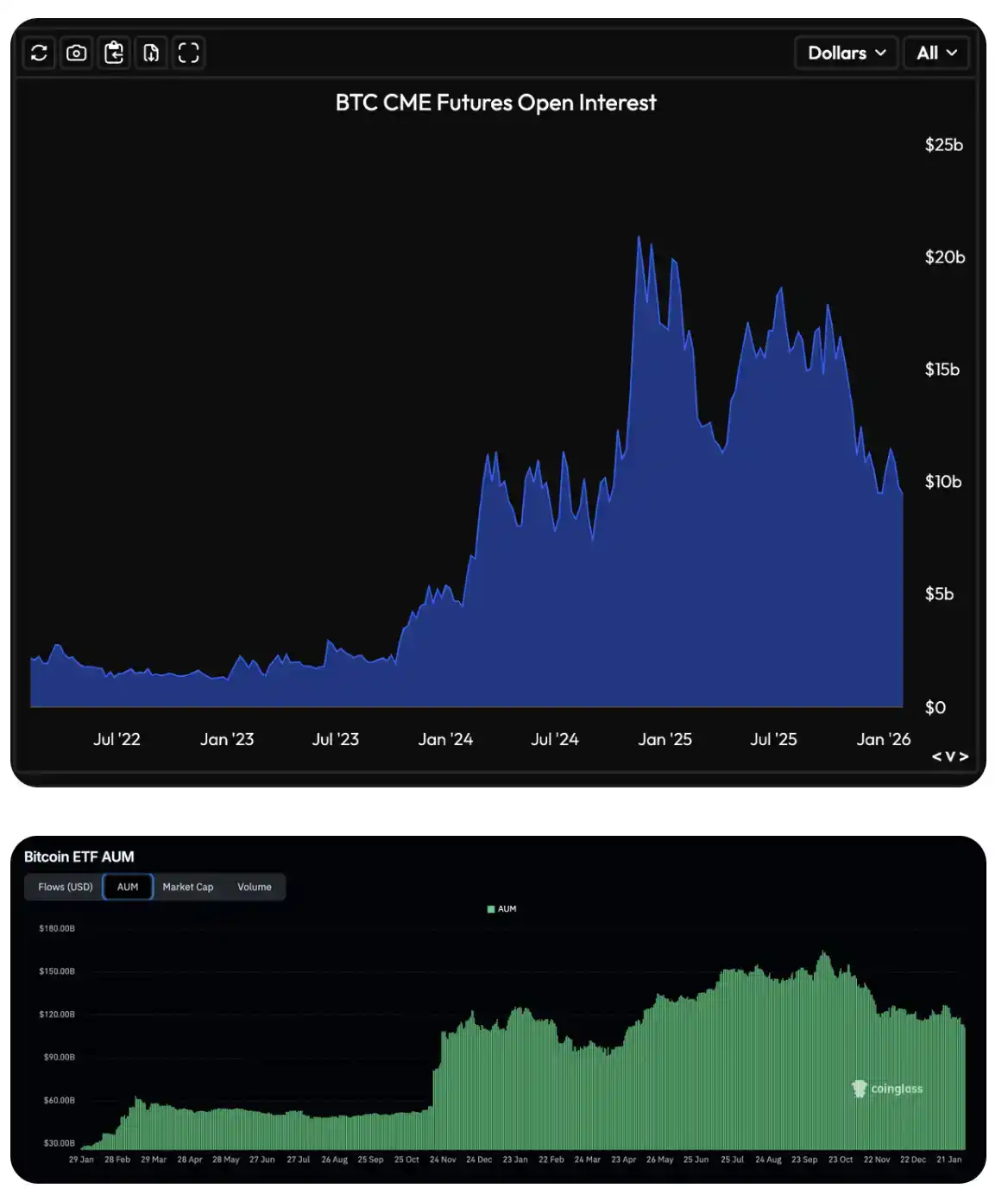
Bitcoin is a highly volatile market. If there's one conclusion we can state with relative confidence, it's this: market bottoms are accompanied by剧烈过度反应 and "stampede-like clearing" across various derivatives.

This signal is reflected both in crypto-native indicators, such as extreme fluctuations in open interest and funding rates; and in more institutionalized indicators, such as异常 changes in options skew and ETF fund flows.
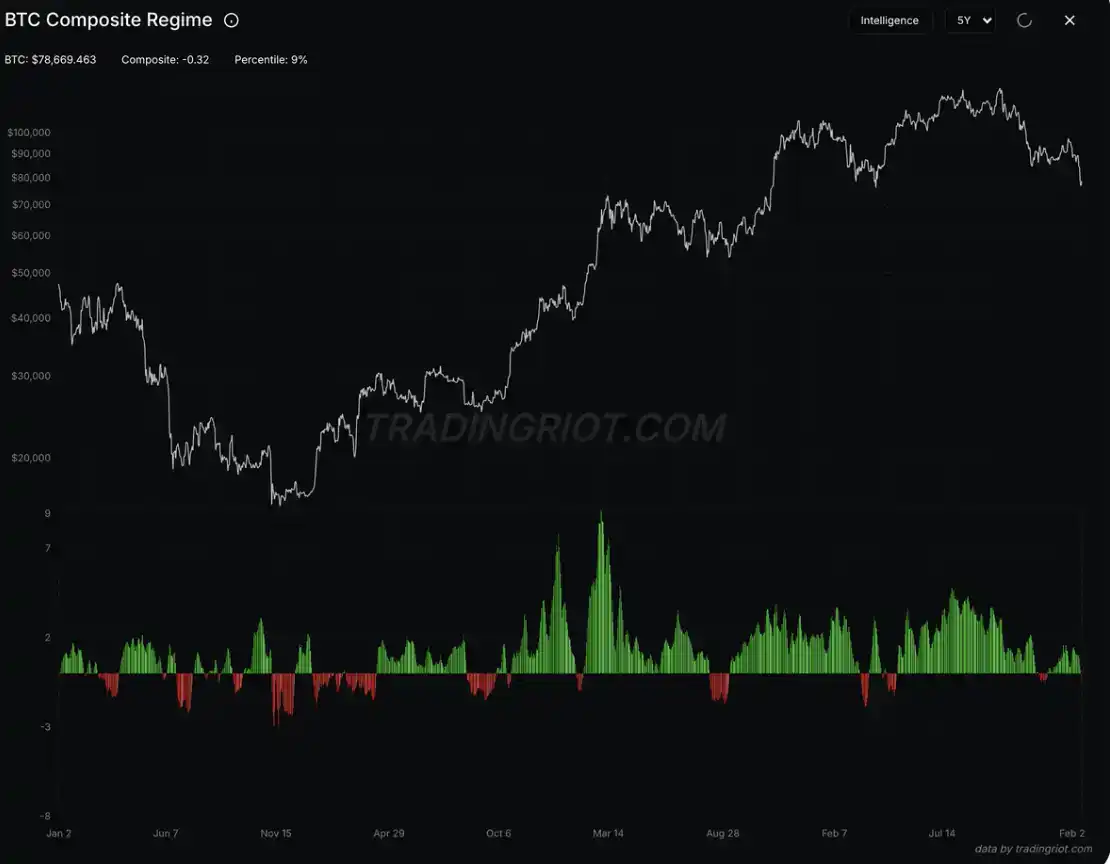
I personally built an indicator that integrates these signals into a composite regime for tracking (disclaimer: this indicator is not publicly available for now, sorry). As seen in the chart, the areas marked in red usually correspond to phases of极度低迷 market sentiment: open interest持续下降, funding rates turning negative, traders paying excessive premiums for put options, and realized volatility exceeding implied volatility.

At the same time, the spot-volatility correlation in Bitcoin, while still somewhat messy overall, is increasingly showing characteristics similar to stock indices.
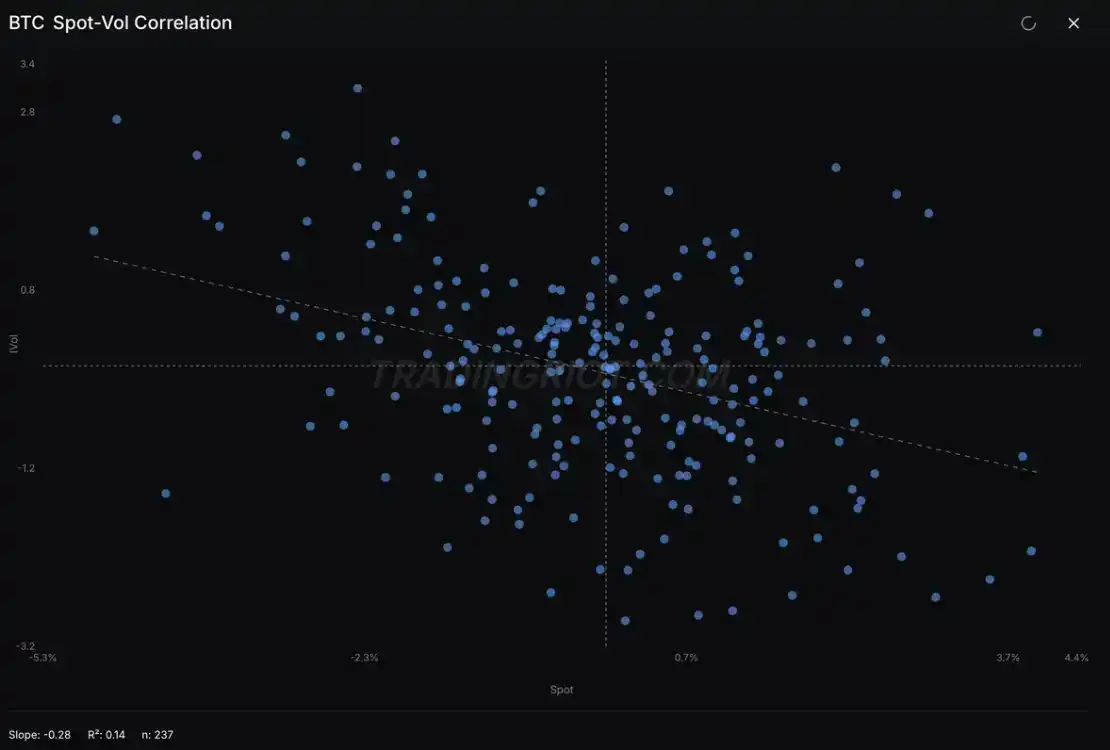
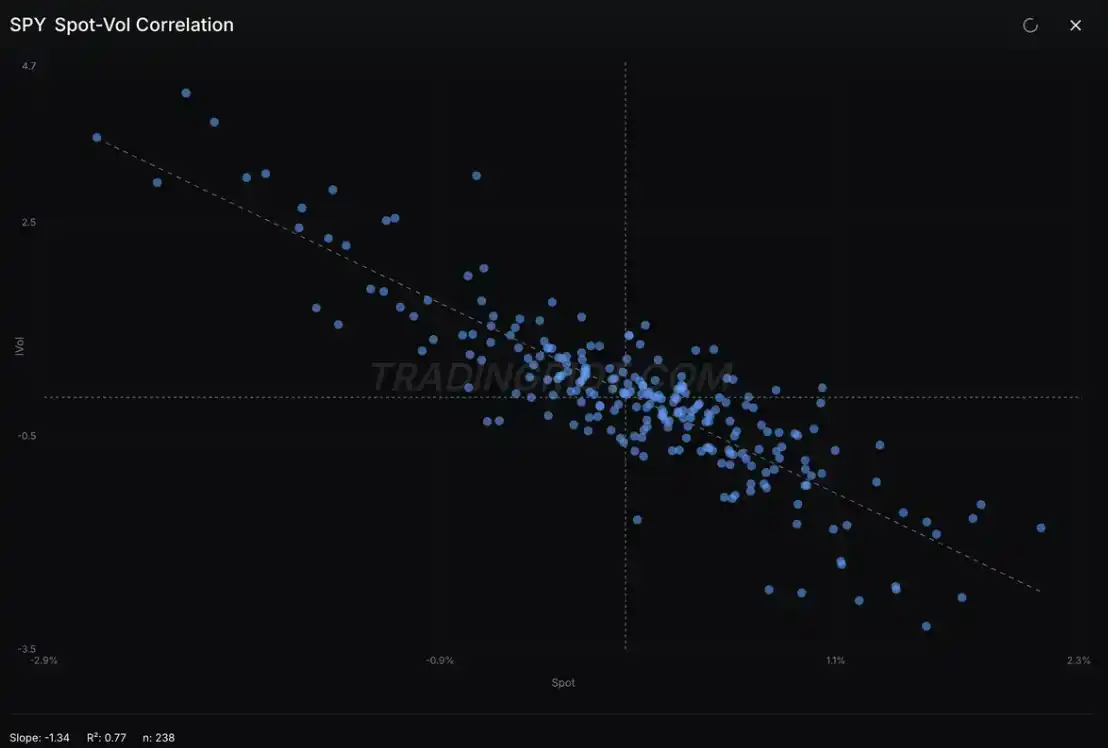
Summary

If you came here for "entry points, stop-loss, take-profit (Entry / SL / TP)," then I can only say sorry to disappoint you (not really that sorry).

The purpose of this analysis was more to clarify a seemingly obvious but often overlooked fact: Bitcoin is an independently operating market. At某些阶段 it looks like gold, at other times like stocks, but fundamentally, there is no necessary reason for them to move in sync over the long term.

If you're staring at the falling price right now, trying to judge when the bottom will appear, rather than applying analogies from other assets, it's better to focus on the data that truly matters to this market. Look at the positioning structure—it often tells the most真实, and also the most残酷, story.

Also remember: most true bottoms are formed when almost everyone has already given up.

Perguntas relacionadas

QWhat is the main argument of the article regarding the relationship between Bitcoin and gold?

AThe article argues that Bitcoin is not a safe-haven asset like gold, and there is no robust, verifiable long-term cointegration or 'rotation' relationship between the two. They are fundamentally different asset classes.

QWhat statistical method does the author use to test for a long-term equilibrium relationship between Bitcoin and gold?

AThe author uses the Engle-Granger cointegration test to determine if a long-term, mean-reverting relationship exists between Bitcoin and gold.

QWhat was the result of the cointegration test between Bitcoin and gold?

AThe cointegration test found no cointegration relationship. The p-value for the full sample was 0.44, far above the 0.05 significance threshold, indicating no reliable mean-reverting link.

QAccording to the article, what is a more reliable factor to watch for identifying market bottoms in Bitcoin?

AThe article suggests that instead of comparing Bitcoin to other assets, one should focus on market-specific data like positioning structure, open interest, funding rates, and options skew, which often tell the most真实 story.

QHow does the article describe the nature of the Bitcoin market?

AThe article describes Bitcoin as an independent, highly volatile, and still-maturing speculative asset with an evolving market structure, not a stable safe-haven metal or a stock index.

Leituras Relacionadas

Will the Fed Still Cut Interest Rates? Tonight's Data Is Crucial

The core debate surrounding the Federal Reserve's potential interest rate cuts is intensifying amid geopolitical conflict and rebounding inflation. The key question is whether high energy prices will cause persistent inflation or weaken consumer demand enough to force the Fed to cut rates. Citigroup presents a bullish case for cuts, arguing that oil supply disruptions from the Strait of Hormuz are temporary and will not lead to lasting inflationary pressure. They point to receding bond yields and oil prices as evidence the market is pricing in a short-lived shock. Citi's data also shows tightening financial conditions, a stabilizing labor market, and healthy tax returns, supporting their view that the path to lower rates remains open. Conversely, Deutsche Bank offers a starkly contrasting, more hawkish outlook. They argue the Fed's current policy is already neutral and expect rates to remain unchanged indefinitely. Their view is based on stalled disinflation progress and a shift toward more hawkish rhetoric from key Fed officials like Waller, who cited risks from prolonged Middle East conflict and tariffs. Other officials, including Williams and Hammack, signaled rates would likely stay on hold for a "considerable time." The market pricing has shifted dramatically, now forecasting zero cuts in 2026. The imminent release of the March retail sales "control group" data is highlighted as a critical test. This metric, which excludes gas station sales, will reveal if high gasoline prices are eroding consumer spending in other areas. A weak reading could support the case for imminent rate cuts, while a strong one would bolster the argument for the Fed to hold steady. This data is pivotal for determining the near-term policy path.

marsbitHá 22m

Will the Fed Still Cut Interest Rates? Tonight's Data Is Crucial

marsbitHá 22m

The Second Half of Macro Influencer Fu Peng's Career

Fu Peng, a prominent Chinese macroeconomist and former chief economist of Northeast Securities, has joined Hong Kong-based digital asset management firm Bitfire Group (formerly New Huo Group) as its chief economist. This move, announced in April 2026, triggered an 11% surge in Bitfire's stock price. Fu, known for his accessible macroeconomic commentary and large social media following, will focus on integrating digital assets into global asset allocation frameworks, particularly combining FICC (fixed income, currencies, and commodities) with cryptocurrencies for institutional clients. His career includes roles at Lehman Brothers and Solomon International, with significant influence gained through public communication. However, in late 2024, Fu faced temporary social media bans after a controversial private speech at HSBC on China's economic challenges, though he denied regulatory sanctions. He later left Northeast Securities citing health reasons. Bitfire, a licensed virtual asset manager serving high-net-worth clients, seeks to build trust and attract traditional capital through Fu’s expertise and credibility. The partnership represents a strategic shift for both: Fu enters the crypto sector after a traditional finance peak, while Bitfire aims to leverage his macro framework for institutional adoption. Outcomes remain uncertain regarding capital inflows and compatibility within corporate structure.

marsbitHá 1h

The Second Half of Macro Influencer Fu Peng's Career

marsbitHá 1h

Trading

Spot
Futuros

Artigos em Destaque

O que é BITCOIN

Compreender o HarryPotterObamaSonic10Inu (ERC-20) e a Sua Posição no Espaço Cripto Nos últimos anos, o mercado de criptomoedas assistiu a um aumento na popularidade das moedas meme, cativando não apenas os traders, mas também aqueles que procuram envolvimento comunitário e valor de entretenimento. Entre estes tokens únicos está o HarryPotterObamaSonic10Inu (ERC-20), um projeto intrigante que mistura referências culturais no tecido das criptomoedas. Este artigo explora os principais aspetos do HarryPotterObamaSonic10Inu, examinando os seus mecanismos, a sua ética orientada pela comunidade e o seu envolvimento com o vasto panorama cripto. O que é o HarryPotterObamaSonic10Inu (ERC-20)? Como o nome sugere, o HarryPotterObamaSonic10Inu é uma moeda meme construída na blockchain Ethereum, classificada sob o padrão ERC-20. Ao contrário das criptomoedas tradicionais, que podem enfatizar a utilidade prática ou o potencial de investimento, este token prospera no valor de entretenimento e na força da sua comunidade. O projeto visa promover um ambiente onde utilizadores envolvidos possam reunir-se, partilhar ideias e participar em atividades inspiradas por diversos fenómenos culturais. Uma característica notável do HarryPotterObamaSonic10Inu é a zero taxa sobre transações. Este elemento atraente visa encorajar a negociação e o envolvimento da comunidade, isento de encargos adicionais que podem desencorajar os traders de pequena escala. A oferta total da moeda está fixada em mil milhões de tokens, uma cifra que marca a sua intenção de manter uma circulação substancial dentro da comunidade. Criador do HarryPotterObamaSonic10Inu (ERC-20) As origens do HarryPotterObamaSonic10Inu estão um pouco envoltas em mistério; os detalhes sobre o criador permanecem desconhecidos. O desenvolvimento deste token carece de uma equipa identificável ou de um plano explícito, o que não é raro no setor das moedas meme. Em vez disso, o projeto surgiu de forma orgânica, com o seu progresso a depender fortemente do entusiasmo e da participação da sua comunidade. Investidores do HarryPotterObamaSonic10Inu (ERC-20) No que diz respeito a investimentos externos e apoios, o HarryPotterObamaSonic10Inu também permanece ambíguo. O token não lista quaisquer fundações de investimento conhecidas ou apoio organizacional significativo. Em vez disso, o “sangue vital” do projeto é a sua comunidade de base, que informa o seu crescimento e sustentabilidade através da ação coletiva e do envolvimento no espaço cripto. Como Funciona o HarryPotterObamaSonic10Inu (ERC-20)? Como uma moeda meme, o HarryPotterObamaSonic10Inu opera principalmente fora dos quadros tradicionais que muitas vezes governam o valor dos ativos. Existem vários aspetos distintivos que definem como o projeto funciona: Transações Sem Taxas: Sem taxas sobre transações, os utilizadores podem comprar e vender o token livremente, sem a preocupação de custos ocultos. Envolvimento da Comunidade: O projeto prospera na interação da comunidade, aproveitando plataformas de redes sociais para criar entusiasmo e facilitar a participação. Discussões, partilha de conteúdo e envolvimento são elementos cruciais que ajudam a expandir o seu alcance e a fomentar a lealdade entre os apoiantes. Sem Utilidade Prática: Deve ser notado que o HarryPotterObamaSonic10Inu não oferece utilidade concreta dentro do ecossistema financeiro. Em vez disso, é classificado como um token principalmente para entretenimento e atividades comunitárias. Referência Cultural: O token incorpora de forma inteligente elementos da cultura popular para atrair interesse, conectando-se tanto com entusiastas de memes como com seguidores de criptomoedas. HarryPotterObamaSonic10Inu exemplifica como as moedas meme operam de forma diferente de projetos de criptomoedas mais tradicionais, entrando no mercado como construções sociais inovadoras em vez de ativos utilitários. Linha do Tempo do HarryPotterObamaSonic10Inu (ERC-20) A história do HarryPotterObamaSonic10Inu é marcada por vários marcos notáveis: Criação: O token surgiu de um meme viral, capturando a imaginação de muitos entusiastas de criptomoedas. Datas específicas de criação não estão disponíveis, sublinhando a sua ascensão orgânica. Listagem em Exchanges: O HarryPotterObamaSonic10Inu conseguiu entrar em várias exchanges, permitindo um acesso e negociação mais fáceis pela comunidade. Iniciativas de Envolvimento da Comunidade: Atividades contínuas direcionadas a melhorar a interação comunitária, incluindo concursos, campanhas em redes sociais e geração de conteúdo por fãs e defensores. Planos de Expansão Futura: O roteiro do projeto inclui o lançamento de uma coleção de NFTs, mercadorias e um site de eCommerce relacionado aos seus temas culturais, envolvendo ainda mais a comunidade e tentando adicionar mais dimensões ao seu ecossistema. Pontos-Chave sobre o HarryPotterObamaSonic10Inu (ERC-20) Natureza Orientada pela Comunidade: O projeto prioriza a contribuição coletiva e a criatividade, assegurando que o envolvimento dos utilizadores está na vanguarda do seu desenvolvimento. Classificação como Moeda Meme: Representa o epítome da criptomoeda baseada em entretenimento, destacando-se dos veículos de investimento tradicionais. Sem Afiliação Direta com o Bitcoin: Apesar da semelhança no nome do ticker, o HarryPotterObamaSonic10Inu é distinto e não tem qualquer relação com o Bitcoin ou outras criptomoedas estabelecidas. Foco na Colaboração: O HarryPotterObamaSonic10Inu é projetado para criar um espaço de colaboração e partilha de histórias entre os seus detentores, proporcionando uma via para a criatividade e o fortalecimento da comunidade. Perspectivas Futuras: A ambição de expandir além da sua premissa inicial para NFTs e mercadorias delineia um caminho para o projeto potencialmente entrar em avenidas mais mainstream dentro da cultura digital. À medida que as moedas meme continuam a capturar a imaginação da comunidade cripto, HarryPotterObamaSonic10Inu (ERC-20) destaca-se devido aos seus laços culturais e abordagem centrada na comunidade. Embora possa não se encaixar no molde típico de um token orientado para utilidade, a sua essência reside na alegria e camaradagem fomentadas entre os seus apoiantes, destacando a natureza em evolução das criptomoedas em uma era cada vez mais digital. À medida que o projeto continua a desenvolver-se, será importante observar como as dinâmicas comunitárias influenciam a sua trajetória no panorama em constante mudança da tecnologia blockchain.

1.2k Visualizações TotaisPublicado em {updateTime}Atualizado em 2024.12.03

O que é BITCOIN

Como comprar BTC

Bem-vindo à HTX.com!Tornámos a compra de Bitcoin (BTC) simples e conveniente.Segue o nosso guia passo a passo para iniciar a tua jornada no mundo das criptos.Passo 1: cria a tua conta HTXUtiliza o teu e-mail ou número de telefone para te inscreveres numa conta gratuita na HTX.Desfruta de um processo de inscrição sem complicações e desbloqueia todas as funcionalidades.Obter a minha contaPasso 2: vai para Comprar Cripto e escolhe o teu método de pagamentoCartão de crédito/débito: usa o teu visa ou mastercard para comprar Bitcoin (BTC) instantaneamente.Saldo: usa os fundos da tua conta HTX para transacionar sem problemas.Terceiros: adicionamos métodos de pagamento populares, como Google Pay e Apple Pay, para aumentar a conveniência.P2P: transaciona diretamente com outros utilizadores na HTX.Mercado de balcão (OTC): oferecemos serviços personalizados e taxas de câmbio competitivas para os traders.Passo 3: armazena teu Bitcoin (BTC)Depois de comprar o teu Bitcoin (BTC), armazena-o na tua conta HTX.Alternativamente, podes enviá-lo para outro lugar através de transferência blockchain ou usá-lo para transacionar outras criptomoedas.Passo 4: transaciona Bitcoin (BTC)Transaciona facilmente Bitcoin (BTC) no mercado à vista da HTX.Acede simplesmente à tua conta, seleciona o teu par de trading, executa as tuas transações e monitoriza em tempo real.Oferecemos uma experiência de fácil utilização tanto para principiantes como para traders experientes.

3.8k Visualizações TotaisPublicado em {updateTime}Atualizado em 2025.03.21

Como comprar BTC

O que é $BITCOIN

OURO DIGITAL ($BITCOIN): Uma Análise Abrangente Introdução ao OURO DIGITAL ($BITCOIN) OURO DIGITAL ($BITCOIN) é um projeto baseado em blockchain que opera na rede Solana, com o objetivo de combinar as características dos metais preciosos tradicionais com a inovação das tecnologias descentralizadas. Embora partilhe um nome com o Bitcoin, frequentemente referido como “ouro digital” devido à sua percepção como uma reserva de valor, o OURO DIGITAL é um token separado projetado para criar um ecossistema único dentro da paisagem Web3. O seu objetivo é posicionar-se como um ativo digital alternativo viável, embora os detalhes sobre as suas aplicações e funcionalidades ainda estejam em desenvolvimento. O que é o OURO DIGITAL ($BITCOIN)? OURO DIGITAL ($BITCOIN) é um token de criptomoeda explicitamente projetado para uso na blockchain Solana. Em contraste com o Bitcoin, que fornece um papel amplamente reconhecido como armazenamento de valor, este token parece focar em aplicações e características mais amplas. Aspectos notáveis incluem: Infraestrutura Blockchain: O token é construído na blockchain Solana, conhecida pela sua capacidade de lidar com transações de alta velocidade e baixo custo. Dinâmicas de Oferta: O OURO DIGITAL tem um fornecimento máximo limitado a 100 quatrilhões de tokens (100P $BITCOIN), embora os detalhes sobre o seu fornecimento circulante ainda não tenham sido divulgados. Utilidade: Embora as funcionalidades precisas não estejam explicitamente delineadas, existem indicações de que o token poderia ser utilizado para várias aplicações, potencialmente envolvendo aplicações descentralizadas (dApps) ou estratégias de tokenização de ativos. Quem é o Criador do OURO DIGITAL ($BITCOIN)? Neste momento, a identidade dos criadores e da equipa de desenvolvimento por trás do OURO DIGITAL ($BITCOIN) permanece desconhecida. Esta situação é típica entre muitos projetos inovadores no espaço da blockchain, particularmente aqueles alinhados com finanças descentralizadas e fenómenos de moedas meme. Embora tal anonimato possa fomentar uma cultura orientada pela comunidade, intensifica as preocupações sobre governança e responsabilidade. Quem são os Investidores do OURO DIGITAL ($BITCOIN)? As informações disponíveis indicam que o OURO DIGITAL ($BITCOIN) não tem apoiantes institucionais conhecidos ou investimentos proeminentes de capital de risco. O projeto parece operar num modelo peer-to-peer focado no apoio e adoção da comunidade, em vez de rotas de financiamento tradicionais. A sua atividade e liquidez estão principalmente situadas em exchanges descentralizadas (DEXs), como a PumpSwap, em vez de plataformas de negociação centralizadas estabelecidas, destacando ainda mais a sua abordagem de base. Como Funciona o OURO DIGITAL ($BITCOIN) A mecânica operacional do OURO DIGITAL ($BITCOIN) pode ser elaborada com base no seu design de blockchain e nas características da rede: Mecanismo de Consenso: Ao aproveitar o exclusivo proof-of-history (PoH) da Solana combinado com um modelo de proof-of-stake (PoS), o projeto assegura uma validação eficiente das transações, contribuindo para o alto desempenho da rede. Tokenomics: Embora mecanismos deflacionários específicos não tenham sido extensivamente detalhados, o vasto fornecimento máximo de tokens implica que pode atender a microtransações ou casos de uso de nicho que ainda estão por definir. Interoperabilidade: Existe o potencial para integração com o ecossistema mais amplo da Solana, incluindo várias plataformas de finanças descentralizadas (DeFi). No entanto, os detalhes sobre integrações específicas permanecem não especificados. Cronologia de Eventos Chave Aqui está uma cronologia que destaca marcos significativos relacionados ao OURO DIGITAL ($BITCOIN): 2023: O lançamento inicial do token ocorre na blockchain Solana, marcado pelo seu endereço de contrato. 2024: O OURO DIGITAL ganha visibilidade ao tornar-se disponível para negociação em exchanges descentralizadas como a PumpSwap, permitindo que os utilizadores o negociem contra SOL. 2025: O projeto testemunha atividade de negociação esporádica e potencial interesse em envolvimentos liderados pela comunidade, embora não tenham sido documentadas parcerias ou avanços técnicos notáveis até ao momento. Análise Crítica Forças Escalabilidade: A infraestrutura subjacente da Solana suporta altos volumes de transações, o que pode aumentar a utilidade do $BITCOIN em vários cenários de transação. Acessibilidade: O potencial preço de negociação baixo por token pode atrair investidores de retalho, facilitando uma participação mais ampla devido a oportunidades de propriedade fracionada. Riscos Falta de Transparência: A ausência de apoiantes, desenvolvedores ou um processo de auditoria publicamente conhecidos pode gerar ceticismo em relação à sustentabilidade e confiabilidade do projeto. Volatilidade do Mercado: A atividade de negociação depende fortemente do comportamento especulativo, o que pode resultar em volatilidade significativa dos preços e incerteza para os investidores. Conclusão O OURO DIGITAL ($BITCOIN) surge como um projeto intrigante, mas ambíguo, dentro do ecossistema em rápida evolução da Solana. Embora tente aproveitar a narrativa do “ouro digital”, a sua divergência do papel estabelecido do Bitcoin como reserva de valor sublinha a necessidade de uma diferenciação mais clara da sua utilidade pretendida e estrutura de governança. A aceitação e adoção futuras dependerão provavelmente da abordagem da atual opacidade e da definição mais explícita das suas estratégias operacionais e económicas. Nota: Este relatório abrange informações sintetizadas disponíveis até outubro de 2023, e desenvolvimentos podem ter ocorrido além do período de pesquisa.

92 Visualizações TotaisPublicado em {updateTime}Atualizado em 2025.05.13

O que é $BITCOIN

Discussões

Bem-vindo à Comunidade HTX. Aqui, pode manter-se informado sobre os mais recentes desenvolvimentos da plataforma e obter acesso a análises profissionais de mercado. As opiniões dos utilizadores sobre o preço de BTC (BTC) são apresentadas abaixo.

活动图片