Stop Blindly Clicking Confirm: Ethereum Wants You to Understand What You're Signing

marsbitPublicado em 2026-05-20Última atualização em 2026-05-20

Resumo

The article criticizes the common practice of "blind signing" in Web3, where users confirm cryptographic transactions without understanding the content, typically presented as unreadable hexadecimal code. It introduces Ethereum's new initiative, "Clear Signing," as a solution aimed at making transaction signatures human-readable. Clear Signing, based on the ERC-7730 standard, allows protocols to provide standardized, structured metadata (like a "translation dictionary") that explains the semantic meaning of a transaction—such as "Swap 1,000 USDC for at least 0.42 WETH on Uniswap V3." This metadata is stored in a public registry for wallets to fetch and display in plain language, moving beyond mere structured data formats like EIP-712. The article clarifies that Clear Signing is not an instant fix but a foundational infrastructure shift that requires widespread adoption by protocols and wallet support. It complements, rather than replaces, existing wallet security features like transaction simulation. The initiative represents a crucial step toward genuine user sovereignty by restoring informed consent, making blockchain accessible to non-technical users and addressing a long-standing security and usability debt in the ecosystem.

Author: Xiaobai

This article is an original submission from the author. The views expressed are solely the author's personal understanding. ETHPanda has edited and organized the content.

Blockchain has always emphasized "being your own bank," but few have seriously addressed another question: If users fundamentally cannot understand what they are signing, how real is that control? From blind signing to Clear Signing, Ethereum is finally working on a fundamental, albeit overdue, piece of the puzzle, aiming to make transaction signatures slowly transition from being understandable by programmers to something comprehensible by ordinary users.

Blind Signing Isn't User Carelessness

I've had a lingering question ever since I started using a crypto wallet.

Why does the wallet confirmation screen always show a string of hexadecimal code every time I go to sign?

I'm clearly clicking Swap, Mint, Claim, or Approve on a website, but at the final confirmation step, the screen suddenly switches to a bunch of 0x-prefixed gibberish. Countless educational videos repeatedly warn people not to sign randomly, as many phishing sites steal assets this way.

This creates a major contradiction.

On one hand, telling regular users that signing is dangerous and they must be careful. On the other hand, presenting the very thing they need to see in a format utterly incomprehensible to the average person.

This isn't user carelessness; it's an inherently anti-human interaction design.

I later learned this situation has a name: blind signing. When you click confirm, cryptographically you are authorizing a transaction, but from a human understanding perspective, you are essentially signing a document you cannot read.

The problem isn't that users don't understand security is important; it's that they lack sufficient information to judge whether something is safe or not.

The Ethereum Foundation recently announced that Clear Signing is now live, with a straightforward goal: to make human-readable transaction signing the default experience. The Clear Signing website puts it even more plainly: See what you sign. Let you truly see what you are signing.

It's not just a simple wallet UI optimization; it's building a foundational piece that Ethereum has been missing for ordinary users.

Wallet security in the past mostly focused on warning you before something went wrong. For example, some browser extensions would check if a site is a phishing risk and flash red warnings. Wallets like Rabby also added many transaction previews and risk warnings, showing you roughly how your asset balance would change after signing.

These are very useful.

But they are more like adding security guards next to the transaction, rather than solving the problem at the root of the signature itself. You still have to trust the extension, trust the wallet simulation, trust its ability to identify the risks of that website and that transaction.

Clear Signing Aims to Translate Transactions into Plain Language

What Clear Signing wants to do is more fundamental.

It doesn't just tell you "this site might be dangerous." It enables protocol developers to write the transaction semantics in a standard format, allowing wallets to reliably translate calldata into human-understandable actions.

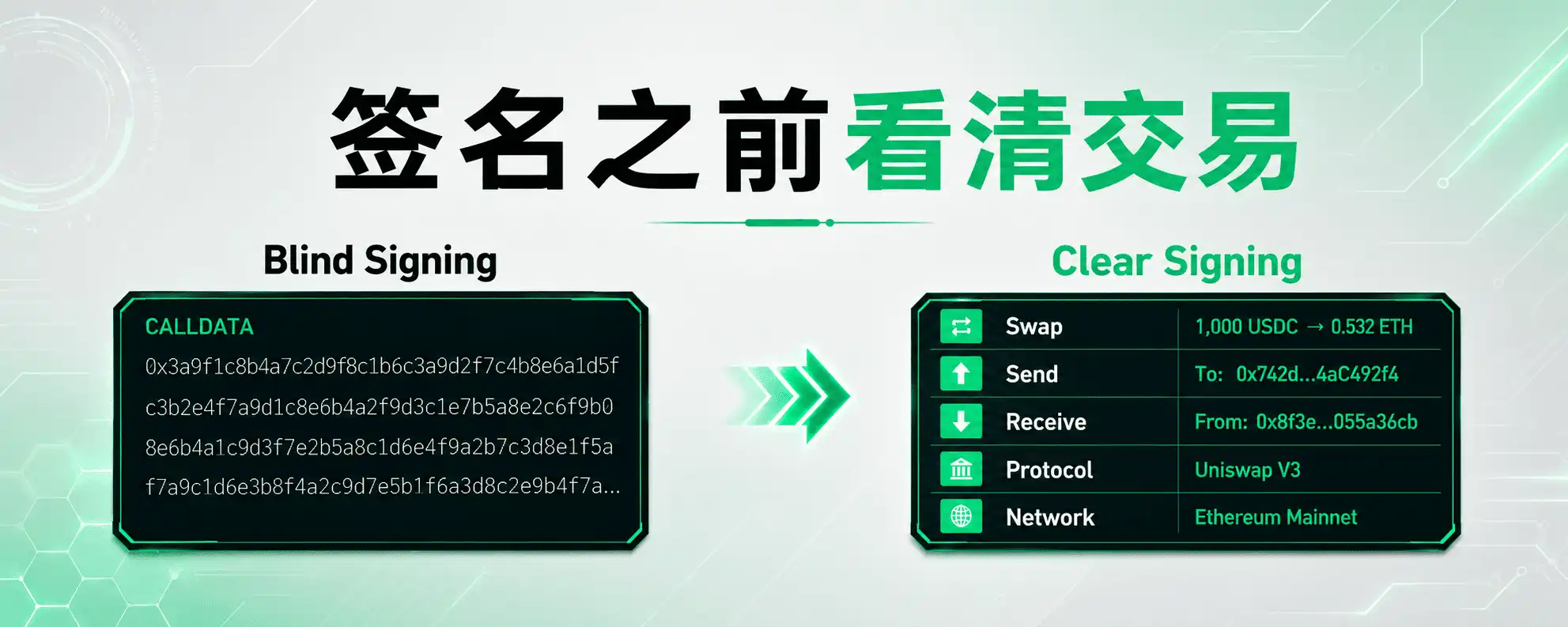
For example, what you used to see was a long string of hex.

Ideally in the future, what you should see is: Swap, sending 1,000 USDC, minimum to receive 0.42 WETH, protocol is Uniswap V3, network is Ethereum.

This is what the signature confirmation page should look like for humans.

Here we can reference Ray's explanation. In his post, he said something I think is very insightful: "Structured code is still code."

This statement actually highlights the difference between EIP-712 and ERC-7730. EIP-712 turns chaotic signature data into structured data, but structured doesn't equal human-readable. What ordinary users truly need is not rows of neater variable names and parameters, but action language they can understand at a glance.

Ray also described Clear Signing as **"adding a layer of translation between code and the ordinary user."** That's an excellent analogy.

How ERC-7730 and the Registry Work

The core standard behind Clear Signing is ERC-7730.

It defines a JSON metadata format.

In simple terms, it allows protocol developers to create a "translation dictionary" for their contract functions. They specify, in advance and in a standard way, how a particular contract function, a particular parameter, or an amount field should be displayed to the user. This description is then submitted to a public registry. Before signing, the wallet consults this dictionary to translate the underlying calldata into a confirmation page the user can understand.

An ABI can tell a wallet, "Here is a uint256 amount."

But an ABI can't necessarily tell the user that this amount is for USDC with 6 decimals, or for ETH with 18 decimals. Nor can it necessarily tell the user if this operation is a Swap, Stake, Approve, or Claim.

ERC-7730 fills in this semantic layer.

The registry then plays the role of a public directory. The clear-signing-erc7730-registry repository maintains the metadata files within the registry directory. Protocol developers submit their description files, and wallets and tools read them, finally enabling the translation of transactions into clearer human language.

According to the snapshot from the Clear Signing website on May 7, 2026, the registry already covers 44 protocols and has published 346 descriptors. Projects like 1inch, Aave, Circle, Lido, Uniswap, Safe, WalletConnect, and WETH can already be seen in the list.

It's Not a Magic Switch, But the Direction is Right

The numbers look promising, but Clear Signing has only just begun.

Blind signing problems haven't suddenly disappeared just because the EF made an announcement. In reality, a vast number of contracts have not registered according to ERC-7730, and wallet integration won't happen overnight either. The official website currently clearly states Ledger is live, Trezor is in development. Other wallets, tools, and protocols will need time to integrate.

So the practical issue Cos raises is crucial. Protocols need to complete registration according to the ERC-7730 standard for wallets and tools supporting ERC-7730 to parse and display information properly. At the same time, the existing parsing, simulation, and risk-warning capabilities on the wallet side must remain and cannot be discarded.

I really agree with this point.

Clear Signing addresses what a transaction *claims* it will do. Transaction simulations like Rabby's address what *might* happen after execution. One looks at intent, the other at outcome. A truly good wallet security experience should have both layers.

Because attackers won't stop evolving.

If users start trusting clear signatures in the future, attackers might try submitting misleading metadata, or use long-tail contracts, unregistered contracts, or complex batch transactions to bypass proper display. The official documentation also specifically mentions that wallets need to decide for themselves which registries, review signals, and attestations to trust.

Therefore, Clear Signing is not a magic switch; it's more like a new industry discipline.

Protocols need to clearly define transaction semantics.

The registry needs to have review and trust signals.

Wallets need to decide which metadata can be displayed.

Users finally don't have to be forced to face indecipherable gibberish.

I think this is especially significant for the Chinese-speaking community.

It's not that many people don't want to enter the on-chain ecosystem; the barrier is genuinely too high. Most users aren't programmers, and even programmers might not understand Solidity, calldata, ABI, selector, permit, delegatecall, and so on.

The on-chain experience of the past often defaulted to the assumption that users should bear the cost of understanding themselves.

If you can't understand it, you're not professional enough.

If you get scammed, you weren't careful enough.

If you're afraid to use it, you haven't learned enough yet.

But this isn't the posture a mass-market application should have.

If a financial-grade system requires ordinary users to understand hexadecimal code before signing, that's not a failure of user education; it's a sign the product and infrastructure haven't matured yet.

I had a similar idea earlier during the Web3 Winter Internship Program by LXDAO and ETHPanda. At the time, I submitted a PR to add security courses in Headbook. My thought was simple: I wanted to help educate users on how wallets parse the first four hexadecimal digits of a signature (the function selector) to understand its meaning. I didn't have a complete solution back then, just a simple belief that users shouldn't have to guess their fate based on hex.

Looking back now, ERC-7730 is systematically answering this question.

It's not just about parsing the first four selector digits; it's about enabling protocols to write verifiable, reusable, wallet-consumable structured metadata for functions, fields, amounts, addresses, and context.

This is more important than simply looking up a function name.

Because function names can be deceptive too. A malicious function could be named `claimRewards` or `deposit`. The truly valuable display isn't just telling you what the function is called, but telling you the action, asset, amount, protocol, network, and risk boundaries associated with that signature.

This is informed consent.

In its early days, Ethereum sacrificed a lot of human readability to get smart contracts running fast. Historically, this is understandable. Without that rapid experimentation then, there might not be the DeFi, NFT, DAO, and the entire EVM ecosystem we have today.

But technical debt doesn't disappear; it only returns to collect payment later, in the form of phishing, accidental signatures, malicious approvals, and cold wallet thefts, as the user base grows.

Future Outlook

Now with the emergence of Clear Signing, it at least shows the Ethereum ecosystem is seriously starting to pay back this debt.

I don't think it will change everyone's wallet experience in a matter of months. A more realistic assessment is that over the next few years, as mainstream protocols submit metadata, mainstream wallets gradually add support, and auditing and attestation mechanisms improve, clear signing will slowly become the default experience.

But the direction is right.

Blockchain shouldn't remain forever in the stage of "only those who understand code dare to use it." True mass adoption isn't about making everyone learn to read calldata; it's about enabling everyone to understand, in their own language, what they are authorizing before they sign.

The world has suffered from blind signing for far too long.

This is the significance of Clear Signing: It's not about making wallets look prettier; it's about gradually returning the right to informed consent for transaction signatures back to the users.


Perguntas relacionadas

QWhat is the main issue addressed by Clear Signing in the Ethereum ecosystem, according to the article?

AThe main issue addressed by Clear Signing is 'blind signing,' where users are presented with complex hexadecimal data (like calldata) they cannot understand when confirming a transaction, making informed consent nearly impossible for non-technical users. Clear Signing aims to provide 'human-readable transaction signing' so users can see and understand what they are authorizing.

QHow does ERC-7730 specifically work to enable Clear Signing?

AERC-7730 defines a standardized JSON metadata format. Protocol developers use this format to create a 'translation dictionary' for their contract functions. This dictionary explains how function parameters, amounts, and actions should be displayed in a user-friendly way. This metadata is submitted to a public registry. Wallets can then query this registry before a user signs a transaction to translate the underlying calldata into a clear, human-readable confirmation screen.

QWhat is the role of the registry in the Clear Signing framework?

AThe registry acts as a public directory or catalog. It stores and maintains the metadata files (descriptors) submitted by various protocols according to the ERC-7730 standard. Wallets and other tools read from this registry to obtain the information needed to translate complex transaction data into clear, understandable language for the end-user. As of the article's snapshot, it covered 44 protocols and 346 descriptors.

QAccording to the article, how does Clear Signing differ from existing wallet safety features like transaction simulations and risk warnings?

AClear Signing addresses a more foundational layer. Features like transaction simulations (e.g., in Rabby) show the *potential outcome* of a transaction (what might happen after signing). Clear Signing focuses on revealing the *intent* of the transaction (what the user is actually authorizing at the moment of signing). The article argues that a good security experience requires both layers: understanding the claimed action (Clear Signing) and understanding the potential consequences (simulations).

QWhy does the author believe Clear Signing is particularly significant for achieving mass adoption of blockchain?

AThe author believes that for blockchain to achieve mass adoption, it must move beyond a state where only those who understand code can use it safely. Clear Signing is a step towards this by shifting the burden of understanding from the user to the infrastructure. It aims to return the 'right to informed consent' to users by allowing them to understand transactions in their own language, rather than expecting everyone to learn to read calldata or hexadecimal data.

Leituras Relacionadas

Warsh's First Day in Office, Markets Deliver a 'Wake-up Call': Rate Hike Expected This Year

On his first day in office, newly inaugurated Federal Reserve Chairman Warsh received a stark market warning, with expectations now fully pricing in a 25-basis-point interest rate hike this year. The shift was triggered by hawkish remarks from Fed Governor Waller, who stated that inflation is now the key policy "driver" and that the odds of a hike or cut are evenly split. This sent short-term Treasury yields higher. Waller signaled a significant pivot in his stance, citing disappointing inflation and labor data. He suggested removing "easing bias" language from Fed statements and did not rule out future rate increases if inflation fails to recede, though he noted immediate action isn't warranted without signs of unanchored inflation expectations. Chairman Warsh faces immediate pressure at his first FOMC meeting in June. With the preferred inflation gauge at a three-year high, analysts warn that failing to hike could be interpreted as an implicit easing of policy. The geopolitical situation in the Middle East is adding to existing price pressures. The market's expectation for a hike contrasts sharply with earlier forecasts for multiple cuts. While long-term Treasury yields have been contained by lower energy prices recently, analysts note they remain under structural upward pressure. Warsh's swearing-in at the White House highlights political scrutiny over Fed independence. However, the market has made it clear that inflation is the most urgent challenge, leaving the new chairman little time to settle in.

marsbitHá 1h

Warsh's First Day in Office, Markets Deliver a 'Wake-up Call': Rate Hike Expected This Year

marsbitHá 1h

Has Microsoft Lost Its Way in the AI Race, and Can Copilot Bring It Back on Track?

Microsoft, once seen as an early AI frontrunner due to its investment in OpenAI, is navigating a strategic shift amid increased competition. Its initial reliance on OpenAI’s GPT models has been complicated by OpenAI’s growing ambitions as a direct competitor, rapid advancements from rivals like Claude and Gemini, and the disruptive rise of AI agents, which challenge its traditional SaaS business model. These factors contributed to stock declines and slower-than-expected adoption of its flagship Copilot products. In response, CEO Satya Nadella has taken a hands-on role in product development, signaling the urgency of change. Microsoft is pivoting from a model-centric strategy to a "model-agnostic" enterprise platform approach. It aims to become the foundational layer connecting various AI models—from OpenAI, Anthropic, or its own new "Superintelligence" team—with enterprise workflows, data, security, and cloud services. Recent organizational changes merged consumer and enterprise Copilot teams to accelerate innovation, exemplified by new products like Copilot Tasks and Copilot Cowork. However, this transformation comes at a high cost. Microsoft faces massive capital expenditures, potentially reaching ~$190 billion by 2026, to support AI infrastructure. While its platform strategy shows early signs of traction with growing Azure AI revenue, it must balance startup-like agility with the reliability expected by enterprise clients. The core challenge is no longer being the sole AI winner but defending its position as the essential enterprise software entry point amidst rapid technological commoditization and the shift towards always-on AI agents.

marsbitHá 1h

Has Microsoft Lost Its Way in the AI Race, and Can Copilot Bring It Back on Track?

marsbitHá 1h

Why Haven't Forex Stablecoins Taken Off?

Why FX Stablecoins Never Took Off: A Path Forward via Synthetic FX Despite the explosive growth of stablecoin-powered digital banking, which has seen ~$6B in VC investment and a 24x surge in crypto card spending in under a year, a major limitation persists: these banks are essentially dollar-only accounts. This leaves 95-99% of global accounts, which are denominated in non-USD currencies, underserved. Attempts to create native foreign currency (FX) stablecoins (like EURC) have largely failed, with total FX stablecoin TVL at ~$600M compared to $400B for USD stablecoins—a 700x gap. These FX tokens face critical challenges: fragile pegs due to low liquidity, limited exchange/FinTech acceptance, poor on/off-ramps, complex regional compliance, and a chicken-and-egg adoption problem. The article argues that the solution lies not in competing with entrenched USD stablecoin networks (USDT/USDC), but in adopting a synthetic FX model inspired by traditional finance. Specifically, it advocates for Mark-to-Market Non-Deliverable Forwards (NDFs)—cash-settled FX derivatives that allow users to maintain underlying USD stablecoin holdings while having their account balance and P&L denominated in a foreign currency. This approach offers key advantages: strong oracle-based pegs, retention of deep USD stablecoin liquidity and yield, superior on/off-ramps, scalability to any currency with a reliable feed, and capital efficiency. It mirrors how modern institutional FX markets operate. Primary use cases for on-chain NDFs include: 1. **Digital Banks/Wallets:** Enabling multi-currency accounts for international users without leaving the USD stablecoin ecosystem, boosting deposits and retention. 2. **FX Carry Trade Vaults:** Offering access to sovereign interest rate differentials (e.g., earning yield on BRL) in a more stable and scalable format than crypto-native products like Ethena. 3. **Global Enterprise Payments:** Allowing merchants to receive payments in local currency equivalents while settling in USD stablecoins, similar to services offered by Stripe for fiat. The conclusion is that synthetic FX, not native FX stablecoins, is the viable path to integrating foreign exchange into the growing stablecoin digital banking landscape, potentially unlocking the next phase of institutional DeFi and multi-trillion-dollar global adoption.

链捕手Há 2h

Why Haven't Forex Stablecoins Taken Off?

链捕手Há 2h

IOSG Founder: Web3 Is 'Losing Blood,' How Can Practitioners Survive Better?

IOSG Founder: Web3 Is "Bleeding Out" – How Can Practitioners Survive Better? In a candid reflection, the founder of IOSG Ventures voices deep concerns about the current state of Web3, describing an ecosystem experiencing severe "blood loss." Despite the recent MuShanghai event showcasing a successful pivot towards a more diverse, global community, a somber reality persists: many crypto-native attendees were there exploring exits or new labels in biotech, AI, and robotics. The core issue is identified as a breakdown in the ecosystem's positive feedback loop. Alarmingly, underestimated "low-probability bad events" are occurring simultaneously: a significant brain drain of Chinese developers to AI, a lack of breakout applications despite massive funding, and a widening credibility gap for practitioners globally, often stigmatized as scam artists. This has created a dire接班人 (successor) problem, with the next generation seeing little professional prestige or financial upside in crypto compared to fields like AI. A significant portion of the critique focuses on Ethereum and Vitalik Buterin. While not pessimistic about Ethereum's technology, the founder worries that critical development windows were missed by focusing on niche technical narratives like ZK and L2 instead of mass-market applications. A more urgent concern is that Vitalik may be isolated in an "information bubble," shielded from the grassroots community's hardships by layers of intermediaries, preventing crucial feedback from reaching him. The call is for Vitalik to return to a founder's mindset, re-engage directly with the community, and rally efforts for the next decade. The divergence between U.S. and Chinese OG (Original Gangster) ecosystems is stark. While many U.S. builders reinvest their wealth into the ecosystem, the Chinese scene suffers from a severe lack of "造血能力" (blood-making ability), with most market-driven funds struggling and many early success stories cashing out entirely. This threatens the entire Asian Web3 ecosystem's survival. For individual practitioners, survival advice is pragmatic: find your core "why," maintain life balance beyond token prices, continuously learn new skills (like AI), form small, trusted alliances for mutual support, and practice self-compassion. The industry's greatest need is not money or tech, but lighthouses—individuals at all levels who offer mentorship, grants, referrals, and honest reflection to guide others. The piece concludes with a direct appeal: OGs must pay forward the opportunities the industry gave them; founders must not struggle alone; and builders must continue their work, ensuring it remains a viable profession. The survival of Web3's "cathedral" depends not on any single leader but on the collective responsibility of everyone who remains.

marsbitHá 3h

IOSG Founder: Web3 Is 'Losing Blood,' How Can Practitioners Survive Better?

marsbitHá 3h

Trading

Spot
Futuros

Artigos em Destaque

O que é ETH 2.0

ETH 2.0: Uma Nova Era para o Ethereum Introdução ETH 2.0, amplamente conhecido como Ethereum 2.0, marca uma atualização monumental à blockchain do Ethereum. Esta transição não é meramente uma mudança estética; visa melhorar fundamentalmente a escalabilidade, segurança e sustentabilidade da rede. Com uma mudança do mecanismo de consenso em Proof of Work (PoW), intensivo em energia, para um Proof of Stake (PoS) mais eficiente, o ETH 2.0 promete uma abordagem transformadora ao ecossistema blockchain. O que é ETH 2.0? ETH 2.0 é um conjunto de atualizações distintas e interconectadas focadas na otimização das capacidades e desempenho do Ethereum. Esta reformulação foi projetada para abordar desafios críticos que o mecanismo atual do Ethereum enfrentou, particularmente em relação à velocidade das transações e à congestão da rede. Objetivos do ETH 2.0 Os principais objetivos do ETH 2.0 giram em torno da melhoria de três aspectos centrais: Escalabilidade: Com o objetivo de melhorar significativamente o número de transações que a rede pode manejar por segundo, o ETH 2.0 procura ultrapassar a limitação atual de aproximadamente 15 transações por segundo, alcançando potencialmente milhares. Segurança: Medidas de segurança melhoradas são integrais ao ETH 2.0, especialmente através da resistência aprimorada contra ciberataques e da preservação do ethos descentralizado do Ethereum. Sustentabilidade: O novo mecanismo PoS foi projetado não apenas para melhorar a eficiência, mas também para reduzir drasticamente o consumo de energia, alinhando a estrutura operacional do Ethereum com considerações ambientais. Quem é o Criador do ETH 2.0? A criação do ETH 2.0 pode ser atribuída à Ethereum Foundation. Esta organização sem fins lucrativos, que desempenha um papel crucial no apoio ao desenvolvimento do Ethereum, é liderada pelo co-fundador notável Vitalik Buterin. A sua visão de um Ethereum mais escalável e sustentável tem sido a força motriz por trás desta atualização, envolvendo contribuições de uma comunidade global de desenvolvedores e entusiastas dedicados a melhorar o protocolo. Quem são os Investidores do ETH 2.0? Embora os detalhes sobre os investidores do ETH 2.0 não tenham sido tornados públicos, é sabido que a Ethereum Foundation recebe apoio de várias organizações e indivíduos no espaço da blockchain e tecnologia. Esses parceiros incluem firmas de capital de risco, empresas de tecnologia e organizações filantrópicas que compartilham um interesse mútuo em apoiar o desenvolvimento de tecnologias descentralizadas e infraestrutura de blockchain. Como Funciona o ETH 2.0? ETH 2.0 é notável por introduzir uma série de características chave que o diferenciam do seu predecessor. Proof of Stake (PoS) A transição para um mecanismo de consenso PoS é uma das mudanças de destaque do ETH 2.0. Ao contrário do PoW, que depende da mineração intensiva em energia para a verificação de transações, o PoS permite que os utilizadores validem transações e criem novos blocos de acordo com a quantidade de ETH que apostam na rede. Isso leva a uma maior eficiência energética, reduzindo o consumo em aproximadamente 99,95%, tornando o Ethereum 2.0 uma alternativa consideravelmente mais ecológica. Shard Chains As shard chains são outra inovação crítica do ETH 2.0. Estas cadeias menores operam em paralelo com a cadeia principal do Ethereum, permitindo que várias transações sejam processadas simultaneamente. Esta abordagem melhora a capacidade geral da rede, abordando preocupações de escalabilidade que têm atormentado o Ethereum. Beacon Chain No coração do ETH 2.0 está a Beacon Chain, que coordena a rede e gere o protocolo PoS. Ela atua como uma espécie de organizador: supervisiona os validadores, garante que as shards permaneçam conectadas à rede e monitora a saúde geral do ecossistema blockchain. Linha do Tempo do ETH 2.0 A jornada do ETH 2.0 tem sido marcada por vários marcos chave que traçam a evolução desta atualização significativa: Dezembro de 2020: O lançamento da Beacon Chain marcou a introdução do PoS, preparando o caminho para a migração para o ETH 2.0. Setembro de 2022: A conclusão de “The Merge” representa um momento crucial em que a rede Ethereum fez a transição com sucesso de um quadro PoW para um PoS, anunciando uma nova era para o Ethereum. 2023: O lançamento esperado das shard chains visa melhorar ainda mais a escalabilidade da rede Ethereum, solidificando o ETH 2.0 como uma plataforma robusta para aplicações e serviços descentralizados. Características Chave e Benefícios Escalabilidade Melhorada Uma das vantagens mais significativas do ETH 2.0 é a sua escalabilidade melhorada. A combinação de PoS e shard chains permite que a rede expanda a sua capacidade, permitindo que acomode um volume de transações muito maior em comparação com o sistema legado. Eficiência Energética A implementação do PoS representa um enorme passo em direção à eficiência energética na tecnologia blockchain. Ao reduzir drasticamente o consumo de energia, o ETH 2.0 não só reduz os custos operacionais, mas também se alinha mais estreitamente com os objetivos globais de sustentabilidade. Segurança Aprimorada Os mecanismos atualizados do ETH 2.0 contribuem para uma segurança melhorada em toda a rede. O uso do PoS, juntamente com medidas de controle inovadoras estabelecidas através das shard chains e da Beacon Chain, assegura um maior grau de proteção contra potenciais ameaças. Custos Mais Baixos para os Utilizadores À medida que a escalabilidade melhora, os efeitos sobre os custos de transação também serão evidentes. Aumentada a capacidade e reduzida a congestão, espera-se que isso se traduza em taxas mais baixas para os utilizadores, tornando o Ethereum mais acessível para transações do dia a dia. Conclusão ETH 2.0 marca uma evolução significativa no ecossistema da blockchain do Ethereum. Ao abordar questões fundamentais como a escalabilidade, o consumo de energia, a eficiência das transações e a segurança geral, a importância desta atualização não pode ser subestimada. A transição para o Proof of Stake, a introdução das shard chains e o trabalho fundamental da Beacon Chain são indicativos de um futuro em que o Ethereum pode atender à crescente demanda do mercado descentralizado. Em uma indústria movida pela inovação e progresso, o ETH 2.0 representa um testemunho das capacidades da tecnologia blockchain em pavimentar o caminho para uma economia digital mais sustentável e eficiente.

100 Visualizações TotaisPublicado em {updateTime}Atualizado em 2024.12.03

O que é ETH 2.0

O que é ETH 3.0

ETH3.0 e $eth 3.0: Uma Análise Profunda do Futuro do Ethereum Introdução No ambiente em rápida evolução da criptomoeda e da tecnologia blockchain, o ETH3.0, frequentemente denotado como $eth 3.0, emergiu como um tema de considerável interesse e especulação. O termo abrange dois conceitos principais que merecem esclarecimento: Ethereum 3.0: Esta representa uma potencial atualização futura destinada a aumentar as capacidades da atual blockchain do Ethereum, focando especialmente na melhoria da escalabilidade e desempenho. ETH3.0 Meme Token: Este distinto projeto de criptomoeda procura aproveitar a blockchain do Ethereum na criação de um ecossistema centrado em memes, promovendo o envolvimento na comunidade de criptomoedas. Compreender esses aspectos do ETH3.0 é essencial não apenas para entusiastas de criptomoedas, mas também para aqueles que observam as tendências tecnológicas mais amplas no espaço digital. O que é ETH3.0? Ethereum 3.0 Ethereum 3.0 é promovido como uma atualização proposta para a rede Ethereum já estabelecida, que tem sido a espinha dorsal de muitas aplicações descentralizadas (dApps) e contratos inteligentes desde a sua criação. As melhorias vislumbradas concentram-se principalmente na escalabilidade—integrando tecnologias avançadas como sharding e provas de conhecimento zero (zk-proofs). Essas inovações tecnológicas visam facilitar um número sem precedentes de transações por segundo (TPS), potencialmente alcançando milhões, abordando assim uma das limitações mais significativas enfrentadas pela tecnologia blockchain atual. A melhoria não é meramente técnica, mas também estratégica; visa preparar a rede Ethereum para uma adoção generalizada e utilidade em um futuro marcado por uma maior demanda por soluções descentralizadas. ETH3.0 Meme Token Em contraste com o Ethereum 3.0, o ETH3.0 Meme Token aventura-se por um domínio mais leve e divertido, combinando a cultura dos memes da internet com a dinâmica das criptomoedas. Este projeto permite que os usuários comprem, vendam e negociem memes na blockchain do Ethereum, proporcionando uma plataforma que fomenta o envolvimento da comunidade através da criatividade e interesses compartilhados. O ETH3.0 Meme Token visa demonstrar como a tecnologia blockchain pode interseccionar com a cultura digital, criando casos de uso que são tanto divertidos quanto financeiramente viáveis. Quem é o Criador do ETH3.0? Ethereum 3.0 A iniciativa em direção ao Ethereum 3.0 é impulsionada principalmente por um consórcio de desenvolvedores e pesquisadores dentro da comunidade Ethereum, notavelmente incluindo Justin Drake. Conhecido por suas percepções e contribuições para a evolução do Ethereum, Drake tem sido uma figura proeminente nas discussões sobre a transição do Ethereum para uma nova camada de consenso, referida como “Beam Chain”. Esta abordagem colaborativa ao desenvolvimento significa que o Ethereum 3.0 não é fruto de um único criador, mas sim uma manifestação da engenhosidade coletiva focada no avanço da tecnologia blockchain. ETH3.0 Meme Token Os detalhes sobre o criador do ETH3.0 Meme Token são atualmente indetectáveis. A natureza dos tokens de meme frequentemente leva a uma estrutura mais descentralizada e impulsionada pela comunidade, o que poderia explicar a falta de atribuição específica. Isso alinha-se com a ethos da comunidade de criptomoedas mais ampla, onde a inovação geralmente surge de esforços colaborativos em vez de esforços individuais. Quem são os Investidores do ETH3.0? Ethereum 3.0 O apoio ao Ethereum 3.0 provém principalmente da Fundação Ethereum, juntamente com uma comunidade entusiástica de desenvolvedores e investidores. Esta associação fundacional proporciona um grau significativo de legitimidade e melhora as perspectivas de uma implementação bem-sucedida, uma vez que aproveita a confiança e credibilidade construída ao longo de anos de operações de rede. Em um clima em rápida mudança no mundo das criptomoedas, o apoio da comunidade desempenha um papel crucial no impulso ao desenvolvimento e adoção, posicionando o Ethereum 3.0 como um sério candidato a futuros avanços na blockchain. ETH3.0 Meme Token Embora as fontes atualmente disponíveis não forneçam informações explícitas sobre as fundações ou organizações de investimento que apoiam o ETH3.0 Meme Token, é indicativo do modelo típico de financiamento para tokens de meme, que frequentemente depende de apoio base e engajamento da comunidade. Os investidores em tais projetos costumam consistir em indivíduos motivados pelo potencial de inovação impulsionada pela comunidade e pelo espírito de cooperação encontrado dentro da comunidade cripto. Como Funciona o ETH3.0? Ethereum 3.0 As características distintivas do Ethereum 3.0 residem em sua proposta de implementação de sharding e tecnologia zk-proof. Sharding é um método de partição da blockchain em partes menores e gerenciáveis ou “shards”, que podem processar transações simultaneamente em vez de sequencialmente. Esta descentralização do processamento ajuda a prevenir congestionamentos e garante que a rede permaneça responsiva mesmo sob carga pesada. A tecnologia de prova de conhecimento zero (zk-proof) contribui com outra camada de sofisticação ao permitir a validação de transações sem revelar os dados subjacentes envolvidos. Este aspecto não apenas melhora a privacidade, mas também aumenta a eficiência geral da rede. Há também conversas sobre a incorporação de uma Máquina Virtual Ethereum de conhecimento zero (zkEVM) nesta atualização, amplificando ainda mais as capacidades e utilidade da rede. ETH3.0 Meme Token O ETH3.0 Meme Token distingue-se ao capitalizar sobre a popularidade da cultura dos memes. Estabelece um mercado para que os usuários participem da negociação de memes, não apenas para entretenimento, mas também para potencial ganho econômico. Ao integrar recursos como staking, provisão de liquidez e mecanismos de governança, o projeto fomenta um ambiente que incentiva a interação e participação da comunidade. Ao oferecer uma mistura única de entretenimento e oportunidade econômica, o ETH3.0 Meme Token visa atrair um público diversificado, variando de entusiastas de criptomoedas a conhecedores casuais de memes. Cronologia do ETH3.0 Ethereum 3.0 11 de novembro de 2024: Justin Drake sugere a próxima atualização do ETH 3.0, centrada nas melhorias de escalabilidade. Este anúncio sinaliza o início de discussões formais sobre a futura arquitetura do Ethereum. 12 de novembro de 2024: A proposta antecipada para Ethereum 3.0 deve ser revelada no Devcon em Bangkok, preparando o cenário para um feedback mais amplo da comunidade e potenciais próximos passos no desenvolvimento. ETH3.0 Meme Token 21 de março de 2024: O ETH3.0 Meme Token é oficialmente listado no CoinMarketCap, marcando sua entrada no domínio público das criptomoedas e aumentando a visibilidade de seu ecossistema baseado em memes. Pontos Chave Em conclusão, Ethereum 3.0 representa uma evolução significativa dentro da rede Ethereum, focando em superar limitações quanto à escalabilidade e desempenho através de tecnologias avançadas. As atualizações propostas refletem uma abordagem proativa às futuras demandas e usabilidade. Por outro lado, o ETH3.0 Meme Token encapsula a essência da cultura impulsionada pela comunidade no espaço das criptomoedas, aproveitando a cultura dos memes para criar plataformas envolventes que incentivam a criatividade e participação dos usuários. Compreender os distintos propósitos e funcionalidades do ETH3.0 e $eth 3.0 é fundamental para qualquer pessoa interessada nos desenvolvimentos contínuos dentro do espaço cripto. Com ambas as iniciativas a pavimentar caminhos únicos, elas sublinham coletivamente a natureza dinâmica e multifacetada da inovação em blockchain.

100 Visualizações TotaisPublicado em {updateTime}Atualizado em 2024.12.03

O que é ETH 3.0

Como comprar ETH

Bem-vindo à HTX.com!Tornámos a compra de Ethereum (ETH) simples e conveniente.Segue o nosso guia passo a passo para iniciar a tua jornada no mundo das criptos.Passo 1: cria a tua conta HTXUtiliza o teu e-mail ou número de telefone para te inscreveres numa conta gratuita na HTX.Desfruta de um processo de inscrição sem complicações e desbloqueia todas as funcionalidades.Obter a minha contaPasso 2: vai para Comprar Cripto e escolhe o teu método de pagamentoCartão de crédito/débito: usa o teu visa ou mastercard para comprar Ethereum (ETH) instantaneamente.Saldo: usa os fundos da tua conta HTX para transacionar sem problemas.Terceiros: adicionamos métodos de pagamento populares, como Google Pay e Apple Pay, para aumentar a conveniência.P2P: transaciona diretamente com outros utilizadores na HTX.Mercado de balcão (OTC): oferecemos serviços personalizados e taxas de câmbio competitivas para os traders.Passo 3: armazena teu Ethereum (ETH)Depois de comprar o teu Ethereum (ETH), armazena-o na tua conta HTX.Alternativamente, podes enviá-lo para outro lugar através de transferência blockchain ou usá-lo para transacionar outras criptomoedas.Passo 4: transaciona Ethereum (ETH)Transaciona facilmente Ethereum (ETH) no mercado à vista da HTX.Acede simplesmente à tua conta, seleciona o teu par de trading, executa as tuas transações e monitoriza em tempo real.Oferecemos uma experiência de fácil utilização tanto para principiantes como para traders experientes.

3.1k Visualizações TotaisPublicado em {updateTime}Atualizado em 2025.03.21

Como comprar ETH

Discussões

Bem-vindo à Comunidade HTX. Aqui, pode manter-se informado sobre os mais recentes desenvolvimentos da plataforma e obter acesso a análises profissionais de mercado. As opiniões dos utilizadores sobre o preço de ETH (ETH) são apresentadas abaixo.

活动图片













