'Stock God' Trump's 3,642 Trades Disclosed: The 'Perfect Closed Loop' of Policy and Portfolio

marsbitPublicado em 2026-05-18Última atualização em 2026-05-18

Resumo

Summary: Donald Trump's First Quarter stock trades, totaling 3,642 transactions, have been disclosed. While the White House maintains the trades were managed by an advisor and complied with disclosure laws, they reveal a portfolio heavily aligned with his policy agenda. The trades show a rotation away from major tech stocks like Microsoft, Amazon, and Meta, and into semiconductor and AI hardware companies such as NVIDIA, AMD, Broadcom, Dell, and Intel. Notably, Trump's account purchased Dell stock before he publicly praised the company, after which its stock rose. The Dell family also pledged funds to a Trump-affiliated policy project. A critical case is Intel. The Trump administration converted $8.9 billion in CHIPS Act subsidies into a 9.9% equity stake, making the U.S. government Intel's largest shareholder. Months later, Trump's personal account also bought Intel stock. This intertwines national industrial policy with potential personal financial interest. Unlike typical insider trading concerns, this situation creates a "closed loop": policy decisions (e.g., subsidies, tariffs, crypto regulation) can boost the value of his holdings, and those holdings may, in turn, influence future policy directions. This blending of presidential power and personal portfolio, while legally disclosed, raises profound questions about conflicts of interest that current rules do not address.

While dealing with the Iran war, placing 3,642 orders in a US stock account.

This is Trump's Q1.

At the same time, he was also handling tariffs, negotiating trade deals, and signing executive orders. Last Thursday, a 113-page document was publicly posted on the US Office of Government Ethics website. A handwritten note was on the cover, stating the filer had paid a late fee. The world's most scrutinized transaction disclosure was finally released.

In the same week, the US Congress was advancing bills to ban officials from stock trading. According to Axios, related proposals have garnered support from over 120 lawmakers, with versions in both the Senate and the House, and public support polls exceeding 70%.

But the biggest loophole in these bills is that they don't cover the president.
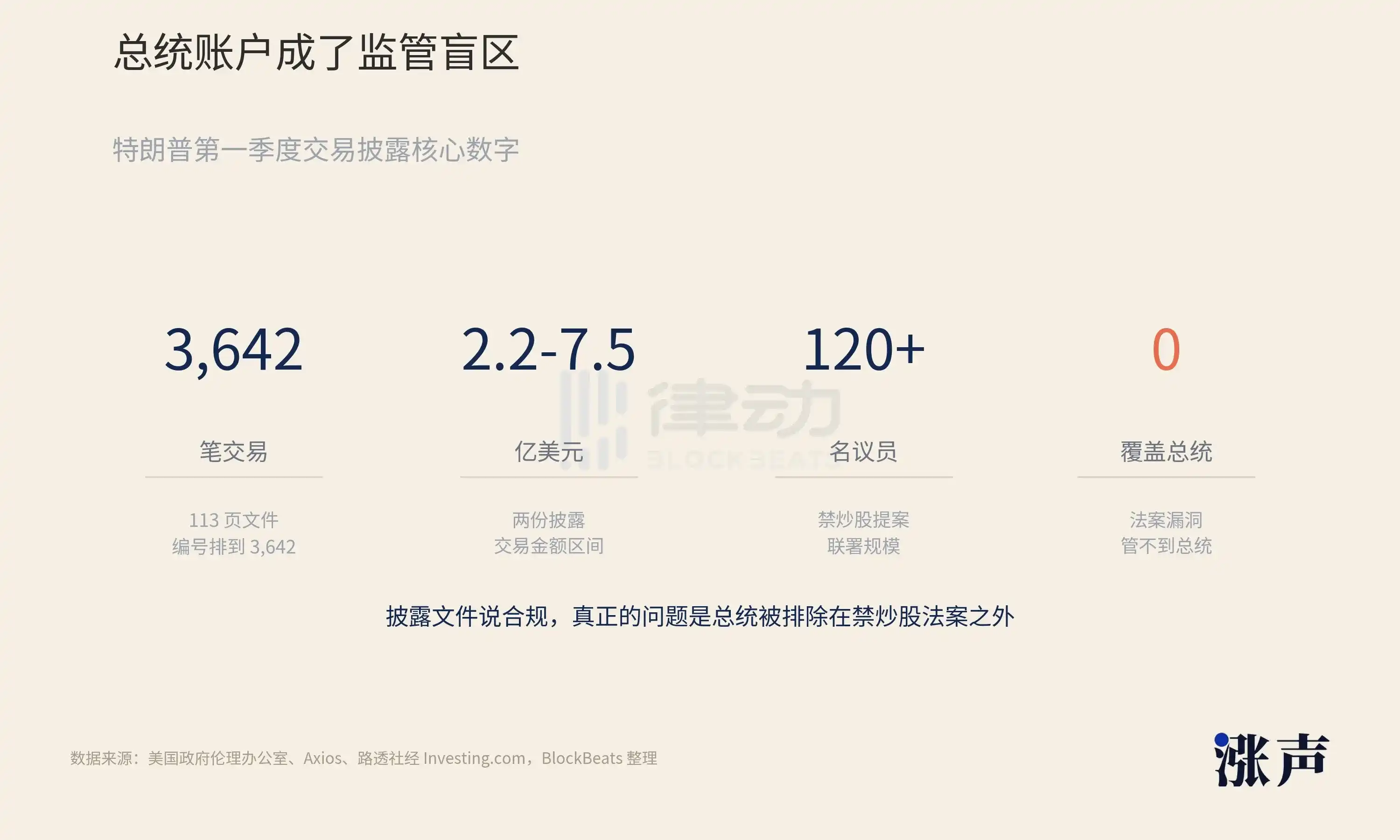
The White House response is also familiar. The president's assets are managed by his children, trades are executed by account managers, fully compliant with all requirements of the STOCK Act, and no conflicts of interest exist. This statement has been repeated many times over the past year. Every time new details emerge, it's recited again. The repetition itself has become a form of information.

A person who can influence tariffs, trade, industrial subsidies, crypto regulation, and market sentiment, while retaining a massive US stock portfolio.

The disclosure document says the trades are compliant. What the market really wants to see is what he actually bought, how much he made, and whether these stocks are moving in the same direction as his policies.

Money Moving Out of Big Tech, Heading Towards Policy-Proximate Areas

Federal disclosure rules only require reporting amount ranges, not exact prices or actual profits/losses.

After page-by-page verification of Trump's scanned document by Benzinga, estimates show NVIDIA purchases of approximately $2.4 million to $6.6 million, Microsoft about $2.4 million to $8.1 million, Amazon about $2.5 million to $8.3 million, and Oracle about $2.2 million to $10.6 million.

For Big Tech, it was a different set of actions.

The largest sell orders were in Microsoft, Amazon, and Meta, with single transactions reaching up to $25 million. For the same batch of companies, holdings were present in the first part of Q1, sold off in the latter part, with buys and sells alternating in the statements. Money moved out of Big Tech and went into the semiconductor and AI hardware supply chain.

NVIDIA, AMD, Broadcom, Dell, and Intel were the most frequently appearing names in this line. Also Coinbase, Robinhood, SoFi. The timing of these positions coincided with the window of federal Bitcoin reserve discussions and the successive announcements of the 'Trump Account' retirement plan.

According to Euronews statistics, if the holdings were maintained until the disclosure date, paper gains exceeding 100% included AMD, Intel, Marvell, SanDisk, Seagate, etc.
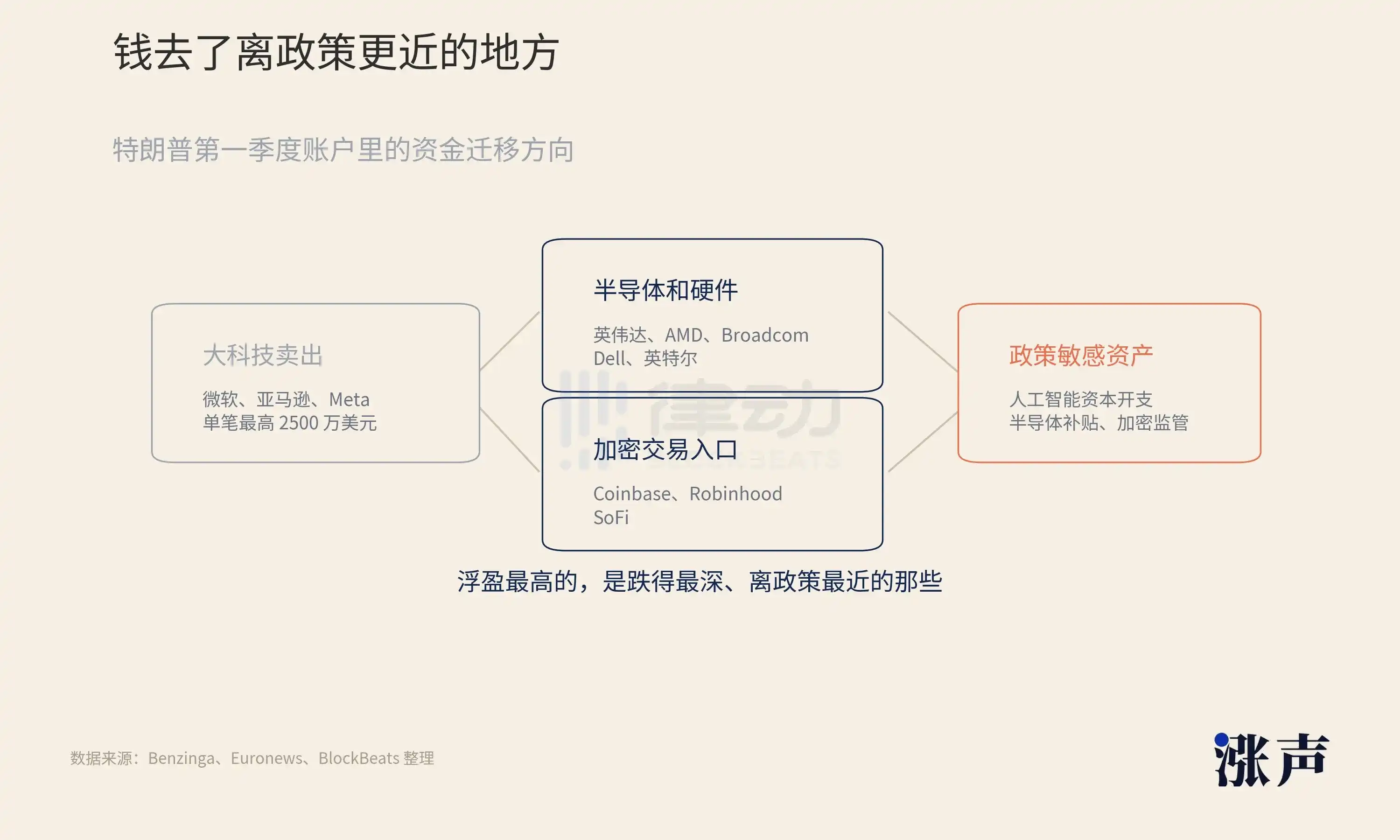
The highest paper gains were in those that had fallen the most and were closest to policy.

In this set of trades, Big Tech remains the core holdings. Microsoft has enterprise software and cloud services, Amazon has cloud computing and advertising, Meta has advertising cash flow and AI recommendation efficiency, Oracle has databases and cloud infrastructure. They are the most convenient names when US market funds flow back into risk assets.

The growth is in the hardware chain.

NVIDIA is the center of GPU supply, AMD is the second option, Broadcom makes custom chips and datacenter networking, Dell delivers AI server whole machines. Every additional GPU cloud providers buy, companies on this chain get one more order. Big Tech money bets on the valuation logic of platform companies, hardware chain money bets on the first ones to get paid when AI capital expenditures materialize.

In comparison, Dell is the cleanest timeline case here.

February 10, 2026, the Trump account opened a position in Dell, amount range $1 million to $5 million. May 8, Trump publicly praised Dell's hardware products at a White House event, Dell rose about 12% that day. Six days later, the transaction disclosure came out.

On the same line, there's another background. The Dell family had previously pledged $6.25 billion to the 'Trump Account' retirement plan. Each link, viewed separately, is legal, confirmed by the STOCK Act.

And, no one is under investigation.

This is also what makes the Trump account different from ordinary politician trades. For ordinary officials' stock disclosures, readers look to see if they anticipated a policy direction. Trump's disclosure adds another layer. He's not just placing bets from the sidelines; his public activities, policy initiatives, and industry relationships themselves become part of market pricing.
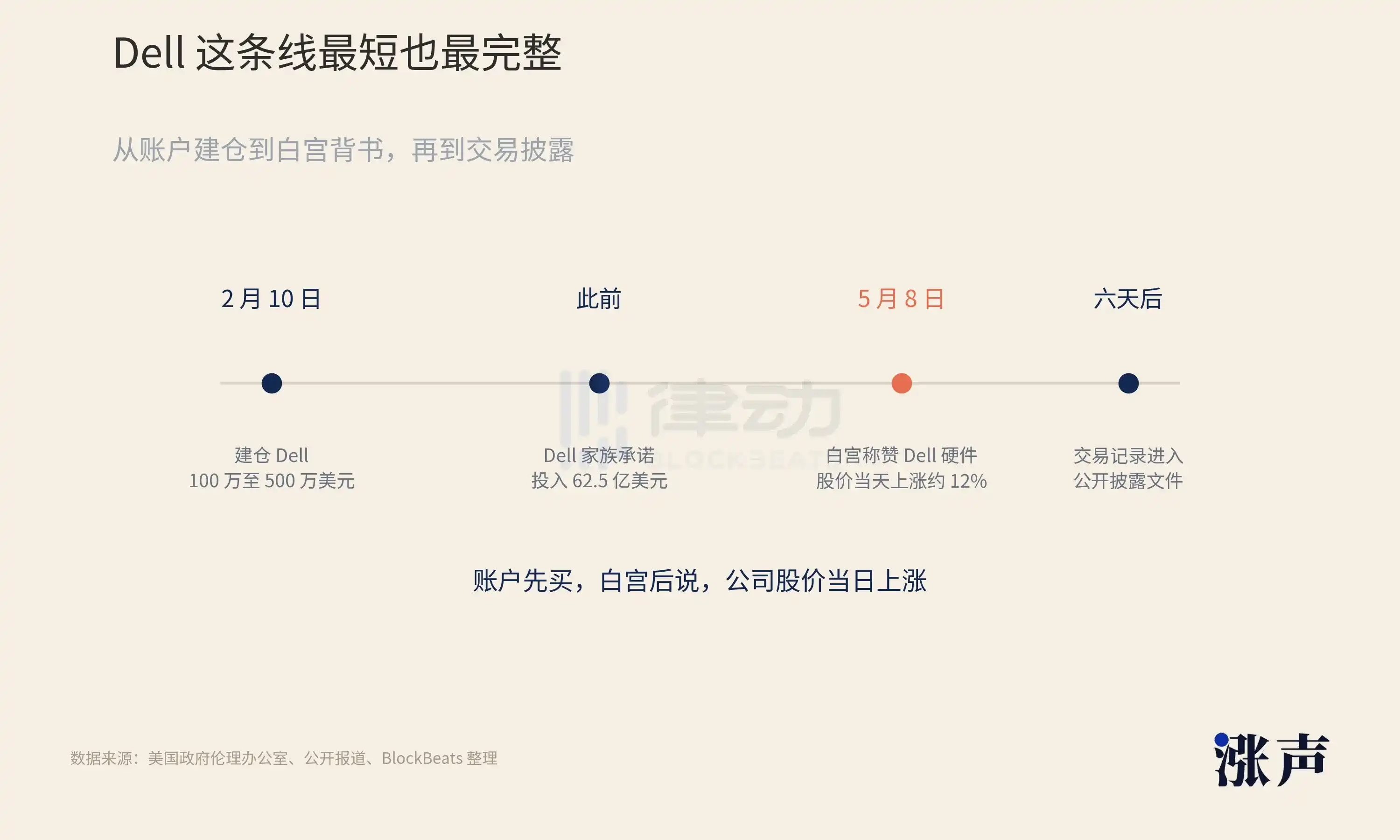
The Dell timeline is short and complete.

Account buys first, White House speaks later, company stock rises that day, family funds then enter Trump policy projects. It doesn't need to prove any link illegal to be sufficient for the market to treat it as a sample of politician trading.

Intel Bought Into an 'American State-Owned Enterprise'

There is one trade in the US stock portfolio not in Trump's personal account.

In August 2025, the CHIPS and Science Act still had $5.7 billion in subsidies for Intel unallocated, plus $3.2 billion for the 'Secure Enclave' project, totaling $8.9 billion.

The Trump administration converted this subsidy into equity. 433.3 million shares of Intel common stock at $20.47 per share, acquiring approximately 9.9% equity. The US government became Intel's largest shareholder, officially designated a 'passive investor,' not requesting board seats.

This was a provision not designed into the CHIPS and Science Act. Subsidies were deliberately designed as non-equity forms with a clear purpose. The government gives money but doesn't intervene in governance. Take the money, not the stock. Because with stockholding, the government gains a financial stake in the company's future, making it difficult to remain neutral.

Trump changed the rules.

Before this transaction, Intel's stock had been languishing below $20 for nearly a year, revenue declining persistently, process technology lagging, the market's verdict being a company losing competitiveness. After the government stepped in, a new variable entered Intel's valuation: the US government would not let this company die.

This judgment doesn't fit into a DCF model, but the market prices it.

Chip manufacturing is a national strategy, the largest shareholder won't stand idly by, Intel's tail risk was cut off by policy from this moment. Trump's personal account's Intel position appeared in early March 2026, six months after the government completed the transaction.

By then, Intel had exceeded earnings expectations for six consecutive quarters, AI inference demand drove CPU order recovery, Apple foundry rumors persisted, and the narrative of fundamental recovery began to hold water. By May 15, 2026, Intel closed at $108.77. From the government entry price of $20.47, a gain of about 431%, with the government's stake's paper value increase of about $38.2 billion.
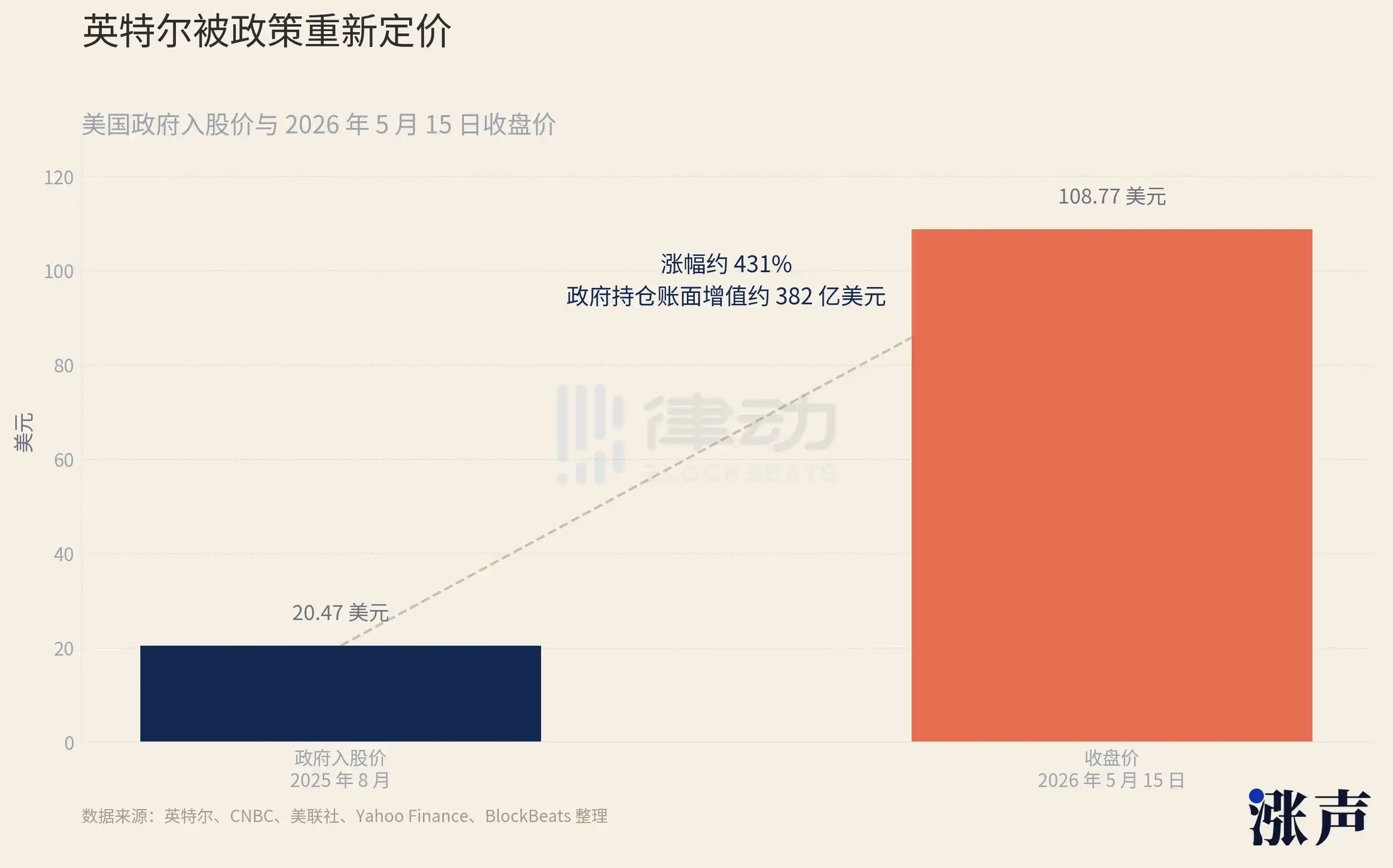
First use taxpayer money to backstop, then follow up with one's own money. This sounds harsh, but the sensitivity of the Intel case lies here.

Public information already exists, Trump's personal account buying Intel may not involve non-public information. The issue is, when the government has already pushed a company to the center of national strategy, the president's personal account appearing next to the same company makes it difficult for the market to see it as just an ordinary investment.

The community calls Intel the 'American state-owned enterprise.' Behind the joke is a very real judgment.

It differs from traditional SOEs, but when the government buys a 9.9% stake with $8.9 billion, Intel is placed within the policy framework of American manufacturing, supply chain security, AI compute sovereignty, and semiconductor subsidies. What investors buy, besides Intel's next quarter profits, is the expectation that the US government won't let it fail.

This is also why Intel is more important than Dell.

Dell is a clear single-stock timeline.

Intel is an institutional timeline. It starts from converting subsidies to equity, linking industrial policy, government financial interest, personal holdings, and market pricing together.

In recent years, the market tracking Pelosi family trades followed only one logic. Policymakers knew something in advance, so they bought early. That's a one-way causality: policy generates information, information brings trading opportunities, officials front-run.

Intel is different. The key here goes beyond knowing a policy in advance; the government itself becomes part of the trade. Subsidies, equity, manufacturing reshoring, AI compute, personal accounts, all converge on the same company.

This case explains why that batch of AI hardware and semiconductor assets in the Trump account is important.

NVIDIA and AMD are compute chips, Broadcom is networking and custom chips, Dell is server whole machines, Intel is the US government personally stepping in to backstop domestic manufacturing.

These targets seem scattered but point in the same direction. The US market is buying AI capital expenditure, the US government is buying domestic semiconductor capability, and the Trump account also appears alongside these assets.

The Closed Loop: Portfolio and Policy Push Each Other Forward

The market has tracked politicians' US stock accounts for many years.

Pelosi family trades have been tracked for years, the logic always simple. The policymakers knew something in advance, so they bought early. Policy generates information, information brings trading opportunities, officials profit from the time lag.

This logic has a legal framework to handle it, for which the STOCK Act was created.

Trump's US stock account adds another layer, and one that's harder to address.

He holds Intel, so he has a financial motive to maintain semiconductor subsidies. He holds Coinbase and Robinhood, so he has a motive to advance crypto legalization. He holds the AI hardware chain, so he has a motive to keep datacenter capital expenditure expanding. He holds broad index funds and Big Tech, so he has a motive to keep overall US market risk appetite high.

The account and policy move in the same direction, the two reinforce each other. Over time, it's hard for outsiders to tell which is pushing which.

Policy influences holdings, holdings in turn influence policy inclination, then policy pushes up holding values. Once this cycle spins up, outsiders find it difficult to judge, on any specific decision, whether financial interests played a role, and how big a role.

Successive presidents insisted on using blind trusts, the core meaning lies here. Money goes in, one doesn't know what is held, so when making policy, there is no financial bias. Severing this feedback loop is a basic assumption of institutional design.

Trump doesn't have this system.

The CHIPS Act initially designed subsidies as non-equity precisely to prevent the government from becoming a shareholder and losing neutrality. Trump changed it to equity, the government took 9.9%. Six months later, his own account also entered Intel. Now, the direction of semiconductor subsidy policy and the market value of his two accounts point in the same direction.

The STOCK Act regulates officials trading on non-public inside information.

Most information here is public. The problem is, when decision-making power and financial interests are tied to the same person, current rules have no means to constrain this bundling, only requiring him to report the results.

On April 9, 2025, he posted that now is a great time to buy. Less than four hours later, Trump announced a tariff pause, the S&P 500 rose 9.5%. Washington University law professor Kathleen Clark later said, 'He's sending a signal that he can blatantly manipulate the markets.'

One year later, the account comes out.

The Dell family put $6.25 billion into the 'Trump Account,' Trump opened a Dell position in Q1, publicly endorsed Dell from the White House in Q2, Dell rose about 12% that day, six days later transaction records entered the public file.

Everyone on this chain got what they wanted.

The market got a story to explain the stock price. The company got exposure from the White House. The Trump account got paper gains. The policy project got corporate family funds.

The 113-page disclosure document can tell you what he bought. What it doesn't tell you is: policy influences holdings, and holdings, in turn, influence policy.


Perguntas relacionadas

QAccording to the article, what is the unique aspect of Trump's stock trading disclosures compared to other politicians?

AUnlike other politicians whose disclosures are typically scrutinized for using non-public information, Trump's disclosures raise a different issue. His decisions and public activities (like policy announcements and public endorsements) can themselves move the market, and his personal financial holdings can create a situation where policy and portfolio interests reinforce each other in a loop, which is harder for existing rules to address.

QWhat was the government's unconventional move regarding Intel, as described in the article?

AInstead of providing the remaining $8.9 billion in subsidies to Intel under the CHIPS and Science Act as grants, the Trump administration converted this amount into equity. The US government purchased approximately 433.3 million shares of Intel common stock at $20.47 per share, acquiring about a 9.9% stake and becoming the largest shareholder, effectively anointing Intel as an 'American state-owned enterprise' in the eyes of the market.

QHow does the article describe the transaction chain involving Dell?

AThe article describes a clear transaction chain involving Dell: 1) Trump's account established a position in Dell (between $1-5 million) on February 10, 2026. 2) On May 8, Trump publicly praised Dell's hardware products at a White House event, causing Dell's stock to rise about 12% that day. 3) Six days later, the transaction disclosures were made public. Furthermore, the Dell family had previously committed $6.25 billion to a 'Trump Account' retirement plan.

QWhat is the major loophole in the proposed congressional bill to ban stock trading by officials, as mentioned in the article?

AThe major loophole in the proposed congressional bill to ban stock trading by officials is that it does not apply to the President of the United States.

QWhat general shift in investment focus does the article identify within Trump's disclosed Q1 trades?

AThe article identifies a shift from 'Big Tech' companies (like Microsoft, Amazon, Meta) towards semiconductor and AI hardware chain companies. Money flowed out of Big Tech and into names like NVIDIA, AMD, Broadcom, Dell, and Intel, which are positioned to benefit directly from AI capital expenditure. The article notes that the most profitable holdings were those that were deeply undervalued and closest to policy support.

Leituras Relacionadas

Bloomberg Uncovered: How Do China's Wealthy Circumvent the Annual $50,000 Limit to Transfer Assets?

**Summary: How Wealthy Chinese Circumvent $50,000 Annual Foreign Exchange Limits** Despite China's strict capital controls, including an annual $50,000 per person foreign exchange quota, an estimated $150 billion in funds still leaves the country annually via various gray and underground channels. This report outlines the evolution of China's "capital wall" and the methods used to bypass it. **The Evolving Capital Controls:** * **Foundation (1994):** The system of "current account convertibility with strict capital account controls" was established. * **Quota Set (2007):** The $50,000 individual annual forex purchase limit was formalized. * **Crackdown Begins (2015-2017):** Following market volatility, enforcement tightened. Banks were required to scrutinize transactions, and channels like using UnionPay cards for Hong Kong insurance premiums or buying overseas property were blocked. * **Digital & Legal Upgrades (2024-2026):** Enhanced algorithms now flag suspicious patterns (e.g., "smurfing"). The Common Reporting Standard (CRS) provides Chinese tax authorities with data on citizens' offshore accounts. Unlicensed cross-border brokers have been targeted. **Five Primary Methods for Moving Capital:** 1. **Underground Banking / "Hawala" (Duiqiao):** The largest-scale method. No money crosses borders. Clients pay RMB to a domestic account; an overseas associate deposits equivalent foreign currency into the client's offshore account. Risks include high fees, account freezes, and legal penalties. 2. **"Smurfing" or "Ant Moving":** Using multiple individuals' $50,000 quotas to pool funds for one offshore recipient. Increasingly detected by anti-money laundering algorithms. 3. **Trade Invoice Manipulation:** Businesses over-invoice imports or under-invoice exports via offshore shell companies, creating a pretext to transfer excess funds abroad under the guise of trade. 4. **Channel Migration:** After a crackdown on internet brokers, funds flow toward more compliant but costly channels like major banks' cross-border wealth management services or Qualified Domestic Institutional Investor (QDII) quotas. 5. **Structural Arrangements:** High-net-worth individuals use complex, high-cost legal structures involving offshore trusts, insurance, and investment migration programs to transfer asset ownership. **Regulatory Response: Focusing on People, Not Just Money** The current strategy extends oversight from enterprises to **individual residents**. Tools like CRS allow retroactive visibility into offshore assets. Cryptocurrencies, once seen as a potential loophole, are now actively monitored and prosecuted as an illegal channel. The underlying driver remains: with significant wealth concentrated among millions of affluent households seeking diversification amid domestic economic shifts, the incentive to move assets offshore persists despite regulatory barriers.

marsbitHá 7m

Bloomberg Uncovered: How Do China's Wealthy Circumvent the Annual $50,000 Limit to Transfer Assets?

marsbitHá 7m

Ethereum's Ballmer Moment: As Everyone Is Bearish, the Circulating Supply Is Disappearing

"Ethereum's Ballmer Moment: Circulation Shrinks Amid Bearish Sentiment" Amid widespread bearish sentiment, with prominent figures like Bankless founder David Hoffman selling ETH and young developers flocking to Solana, some argue Ethereum is entering its "Ballmer era"—akin to Microsoft's perceived stagnation under Steve Ballmer. While surface-level criticisms about slow protocol development, cautious leadership, and competitive pressure are valid, underlying fundamentals tell a different story. Approximately 30% of ETH is staked, major holders like BitMine are accumulating, and spot ETFs continue to absorb supply. Regulatory clarity, including the SEC/CFTC's March ruling on staking rewards and the potential passage of the CLARITY Act, is transforming crypto from a regulatory threat into a legitimized framework. This institutionalization, alongside a shrinking circulating supply (with net issuance around 0.23% annually), creates significant buy-side pressure independent of fee-based value capture. The broader crypto total addressable market is expanding through regulated stablecoins, tokenized assets, and institutional adoption. While public chains face competition from permissioned alternatives, the winning model appears to be permissioned assets settling on public chains like Ethereum and Solana. The author advocates a non-maximalist, barbell strategy: holding ETH for its institutional role and supply squeeze, SOL for consumer/throughput trends, BTC as a macro hedge, and a basket of next-gen L1s. Key bullish drivers for ETH include rapid circulation shrinkage, potential Q2 staked ETF approvals, regulatory tailwinds solidifying its role as a default settlement layer, and the optionality of an eventual "Satya moment" leadership shift. Despite bearish consensus, the current setup—where crypto is "not hot" and regulatory groundwork is being laid—presents a compelling investment opportunity. The crypto cycle's focus may have shifted to AI, but blockchain infrastructure is gaining a legal and institutional foothold precisely while attention is elsewhere.

marsbitHá 7m

Ethereum's Ballmer Moment: As Everyone Is Bearish, the Circulating Supply Is Disappearing

marsbitHá 7m

Claude Code Introduces Dynamic Workflows: Enabling AI to Form Teams and Collaborate

Claude Code introduces dynamic workflows, enabling AI to coordinate teams of specialized agents for complex tasks. This transforms Claude from a code assistant into a programmable workbench. Workflows address key limitations of single-agent systems: agentic laziness (premature task completion), self-preferential bias (favoring own outputs), and goal drift (losing sight of original objectives). The system allows Claude to dynamically create execution frameworks using JavaScript. It can split tasks, dispatch parallel agents for isolated work (e.g., in separate worktrees), implement adversarial validation, run tournaments, and synthesize results. This multi-agent approach is valuable for tasks requiring deep research, factual verification, code migration, root cause analysis, large-scale triage, and qualitative sorting. Key patterns include: classify-and-route, fan-out-and-synthesize, adversarial verification, generate-and-filter, tournaments, and loop-until-done. While token usage is higher, workflows excel where tasks resemble programming—needing problem decomposition, isolated context, hypothesis testing, and handling many details. They extend Claude Code's utility beyond technical work to areas like business plan review, resume screening, and naming brainstorm. The feature is not a universal solution but points to a future where AI tool competitiveness depends on organizing reliable, reusable, and auditable execution flows for complex goals.

marsbitHá 49m

Claude Code Introduces Dynamic Workflows: Enabling AI to Form Teams and Collaborate

marsbitHá 49m

Hyperliquid, Wall Street's 24/7 Trading Convenience Store

Hyperliquid: The 24/7 Trading "Convenience Store" for Wall Street Hyperliquid, a decentralized cryptocurrency exchange, has become a go-to platform for Wall Street traders seeking to trade around the clock, especially during traditional market closures. Founded by Jeff Yan, a former quantitative trader, after the FTX collapse, the platform emphasizes user self-custody of assets. It offers a wide range of perpetual contracts—leveraged derivatives with no expiry—on assets from Bitcoin and crude oil to the S&P 500 and even pre-IPO companies like SpaceX. A notable example involves a hedge fund trader who capitalized on geopolitical news over a weekend, securing a 243% return on oil derivatives before markets reopened. The platform, run by just 11 employees, generated approximately $800 million in revenue last year, and its native token HYPE has seen significant growth. Its rise highlights the merging of traditional finance and crypto. While U.S. users are currently restricted, recent CFTC rule changes could open access. The platform is known for its transparency, having processed $10 billion in liquidations during a market crash while competitors faltered. Regulators warn of the high risks and complexity of perpetual contracts for retail investors. Key to its appeal is a strong community culture, direct engagement with founders, and a simple interface. Despite rules against VPN use, it attracts global users with its permissionless approach. Hyperliquid plans to expand into prediction markets and options, aiming to eventually host all financial activity.

marsbitHá 49m

Hyperliquid, Wall Street's 24/7 Trading Convenience Store

marsbitHá 49m

Trading

Spot
Futuros
活动图片




