StarkWare Makes Drastic Cuts to Survive, L2 'Technical Faith' Liquidated by the Market

marsbitPublicado em 2026-04-14Última atualização em 2026-04-14

Resumo

StarkWare, the infrastructure company behind Starknet, has announced a major restructuring, including layoffs and splitting into two separate business units. This move comes as the Layer 2 network faces a severe decline, with monthly revenue plummeting over 95% from its late 2023 peak to just tens of thousands of dollars. CEO Eli Ben-Sasson stated the company had become "too big and inefficient" and must return to a startup mentality. The new structure creates a Starknet development unit, focused on the core protocol, and an applications unit, tasked with direct revenue generation by building products that leverage StarkWare's unique tech stack, potentially in quantum security and Bitcoin-related areas. This reflects a wider crisis in the L2 sector triggered by Ethereum's EIP-4844 upgrade, which drastically reduced data availability fees and shattered the core business model of profiting from gas差价. The market has since polarized. Base and Arbitrum now dominate, capturing the majority of value and fees, while Starknet's TVL sits at a fraction of Base's and its native token STRK trades below its total historical fundraising amount. The article concludes that technical superiority is no longer enough to win; distribution power and strategic alliances are now the key drivers. StarkWare's shift from an infrastructure provider to a product-focused company is a strategic retreat in this consolidating market, forcing it to prove it can build and sell products, not just invent adv...

Original Author: Sanqing, Foresight News

On April 13th, Eli Ben-Sasson, CEO of the ZK-Rollup infrastructure company StarkWare (behind Starknet), announced at an all-hands meeting that the company would undergo layoffs and restructure into two separate business units, focusing on revenue generation and Starknet development. The company initially launched the StarkEx scaling engine and introduced Starknet as an Ethereum Layer 2 Validity Rollup to the mainnet in late 2021. It developed its own Cairo programming language, Sierra intermediate representation layer, and a post-quantum proof system, establishing itself as a technical benchmark in the ZK Rollup field. In 2022, it completed multiple funding rounds, totaling approximately $260 million, with its valuation once reaching as high as $8 billion, making it one of the highest-valued ZK projects in the crypto industry at the time.

According to DefiLlama data, the Starknet network's on-chain monthly revenue peaked at nearly $6.3 million in November 2023. However, since April 2024, its monthly revenue has been only tens to hundreds of thousands of dollars, a drop of over 95%.
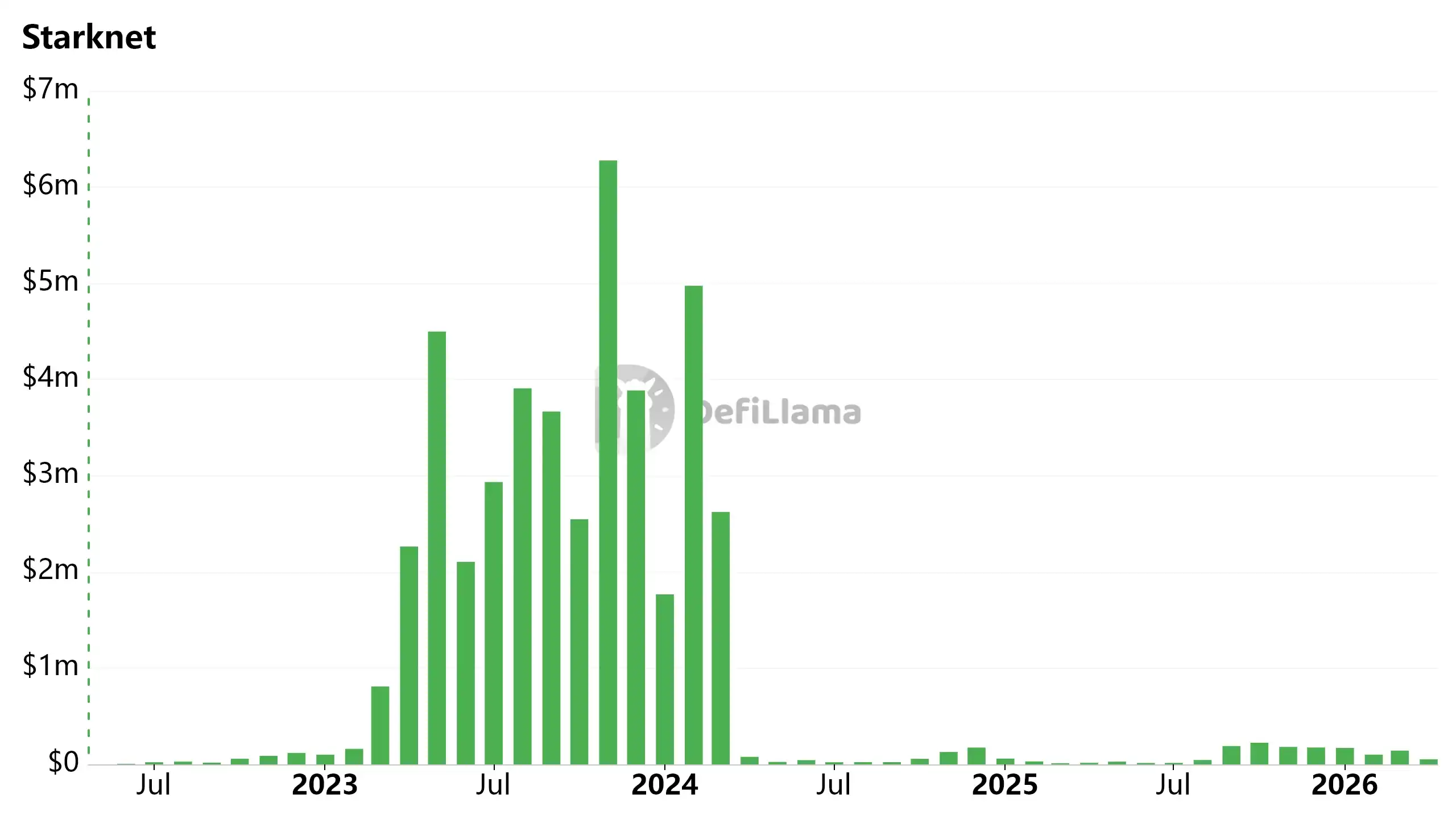
Starknet Chain Fees (Monthly)

Retreating from 'Infrastructure' to 'Independent Applications'

Facing a shift in identity from a 'platform infrastructure company' to a 'product-oriented technology company', Ben-Sasson admitted that the past StarkWare was "too big, too inefficient," and stated that it must now return to a startup mode, using small teams for rapid iteration to find Product-Market Fit (PMF).
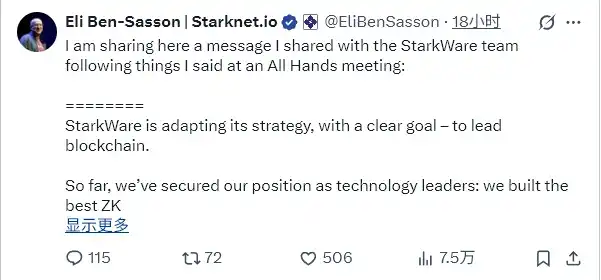
Image Source: Eli Ben-Sasson's Tweet

In this industry-wide contraction, StarkWare is not an isolated case. OP Labs (the core development team behind Optimism) laid off about 20 people in March (approximately 20% of its staff), aiming to focus on core priorities, accelerate decision-making, and reduce coordination costs; Polygon Labs conducted an organizational integration after an acquisition in January, laying off about 60 people across multiple teams, although the company stated that net headcount remained unchanged.

Additionally, the exchange Crypto.com laid off 12% of its staff, the L1 Algorand Foundation laid off 25%, and several other companies or projects, including the crypto research firm Messari, underwent a new round of human resource adjustments.

After the restructuring, Chief Financial Officer Ran Grinshtein will oversee backend functions such as finance and human resources, while the frontend business will be split into two units, each with its own independent BD, engineering, and GTM (Go-To-Market) teams.

  • Starknet Development Department: Led by Product Lead Tom Brand, continuing the underlying work on the core protocol.
  • Applications Department: Led by Chief Product Officer Avihu Levy, tasked with the crucial responsibility of direct revenue generation, dedicated to building products that "can only be realized with the StarkWare technology stack and have minimal external dependencies."

Although the official specific product lines have not been announced, considering Levy's recent paper on achieving quantum-secure transactions (QSB) without modifying the Bitcoin protocol, and Starknet's launch of Zcash-like privacy features, quantum security and Bitcoin-related products are highly likely to be among its first trial directions.

The Impact of EIP-4844 and the Polarization of L2s

Starknet's predicament essentially reflects the collective growing pains of the entire L2 sector following the protocol upgrade.

In March 2024, Ethereum introduced EIP-4844, which significantly reduced Blob data costs, directly destroying the business model L2s relied on—"profiting from the Gas price difference between L1 and L2."

Subsequently, Ethereum continued to expand Blob supply through multiple upgrades. The Pectra upgrade in May 2025 increased the target from 3 per block to 6 per block (maximum 9); after the Fusaka upgrade in late 2025, it was further increased to a target of 14 per block and a maximum of 21 per block.

Ethereum still intends to continue gradually scaling Blob capacity through more BPO mechanisms and technologies like PeerDAS in the future, which will keep the data availability costs for L2s at an extremely low level in the long term.

When data availability costs are significantly reduced, the moat of network value is no longer cheapness, but rather its own user density and capital沉淀能力 (capital sedimentation ability).

Despite suffering the same EIP-4844 impact, the performance of the L2 market is highly polarized.

According to DefiLlama data, Base, leveraging Coinbase's strong user引流 (user diversion) and fiat on-ramp channels, garnered $75.4 million in revenue in 2025 (62% of total L2 revenue) and processed over 60% of the total network transaction volume; Arbitrum, relying on the composable financial stack formed by leading protocols like GMX and Pendle, maintained its TVL stably at the $2 billion level.

Optimism once relied on the OP Stack and Superchain ecosystem, but currently, the Superchain's TVL is highly dependent on Base (over 80%), with OP Mainnet itself accounting for only a single-digit percentage. Its TVL and on-chain fee revenue also declined significantly in 2025-2026. Making matters worse, Base announced in February 2026 that it would break away from OP Stack and transition to its own unified technology stack, further weakening Optimism's hub status in the L2 ecosystem.
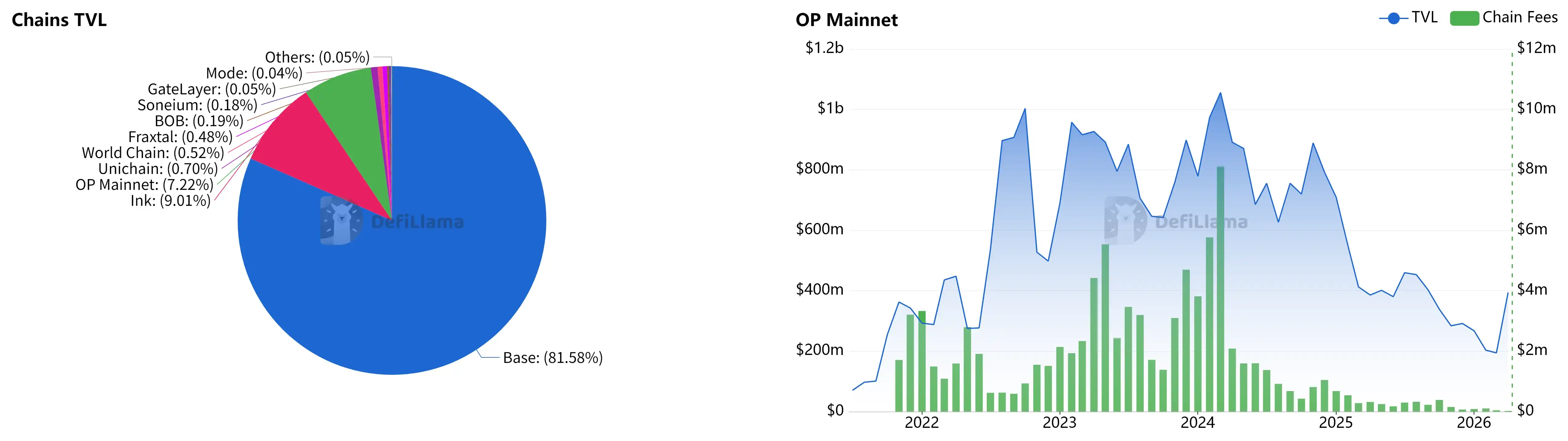
Left: Superchain Chain TVL Pie Chart | Right: OP Mainnet TVL and Chain Fees (Monthly)

Starknet's situation is even more severe. Its TVL is currently only about $241 million, less than one-twentieth of Base's; its native token STRK has plummeted from the airdrop high in February 2024 to $0.033, with a total market capitalization of approximately $187 million—even lower than the company's historical total funding of $260 million.
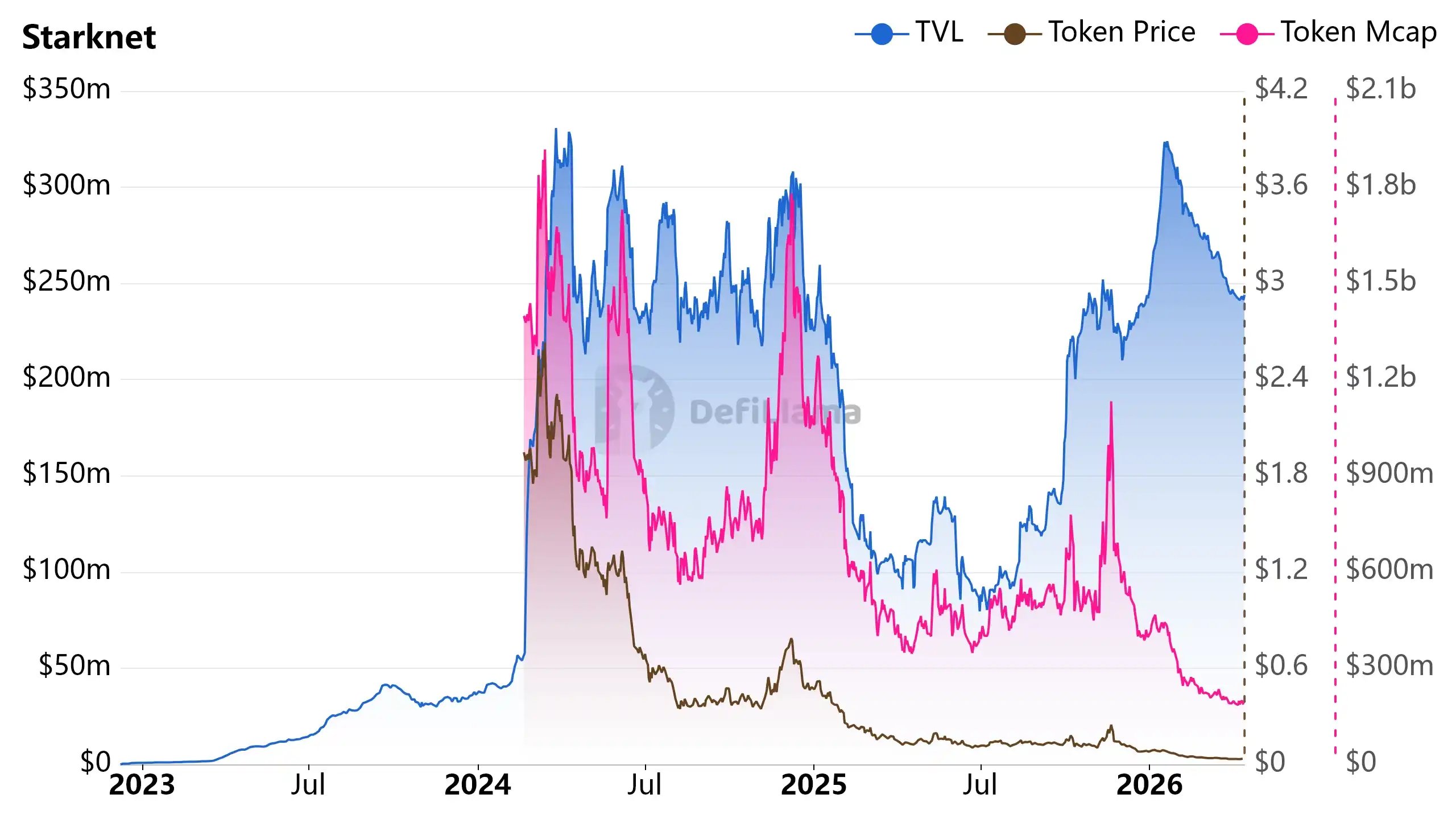
Starknet TVL, STRK Price, and STRK Market Cap

Distribution Capability Determines Who Stays at the Table

"Infrastructure alone doesn't win the race." This statement by Ben-Sasson is a reflection on StarkWare's past eight-year strategy of "build the network and wait for users to come."

StarkWare's investment in cryptographic engineering far exceeded its peers; its from-scratch construction of the Cairo language and quantum-resistant STARK system is extremely hardcore. However, in reality, its technical purism in refusing to be EVM-compatible created a very high migration barrier for developers, which is a factor limiting ecosystem prosperity.

The core driver of L2 growth has long ceased to be technical differentiation, but rather distribution capability and strategic alliances. Currently, Base and Arbitrum together lock in nearly 75% of the total L2 value.

21Shares predicts that the L2赛道 (L2 track) will consolidate into "a slimmer, more resilient set of networks" by the end of the year. In this winner-takes-all淘汰赛 (elimination contest), retreating to self-developed applications is one of the few remaining differentiated paths for StarkWare.

Technical储备 (technical reserves) are just the entry ticket, not the finish line. What StarkWare now needs to prove to the market is no longer what cutting-edge technology it can "invent," but what products it can actually "sell."


Perguntas relacionadas

QWhat major strategic shift did StarkWare announce on April 13th, and what was the reason behind it?

AStarkWare announced a company restructuring involving layoffs and splitting into two separate business units focused on revenue and Starknet development. CEO Eli Ben-Sasson stated the company had become 'too big, too inefficient' and needed to return to a startup mode with smaller teams to iterate quickly and find Product-Market Fit (PMF).

QHow did the implementation of EIP-4844 on Ethereum impact the Layer 2 (L2) business model, specifically for Starknet?

AEIP-4844, introduced in March 2024, drastically reduced the cost of Blob data on Ethereum. This destroyed the core business model for L2s like Starknet, which relied on profiting from the gas fee difference between L1 and L2 transactions.

QAccording to the article, which two L2 networks currently dominate the market in terms of value and revenue?

ABase and Arbitrum dominate the L2 market. Together, they locked in nearly 75% of the total L2 value. In 2025, Base alone accounted for 62% of all L2 revenue.

QWhat are the two new independent business units that StarkWare was reorganized into, and what are their respective goals?

AStarkWare was reorganized into: 1) The Starknet Development unit, led by Tom Brand, which continues core protocol development. 2) The Applications unit, led by Avihu Levy, which is tasked with direct revenue generation by building products that leverage StarkWare's unique tech stack.

QWhat does the article suggest is the primary driver for L2 growth and survival now, rather than technical differentiation?

AThe article states that the core driver for L2 growth and survival is no longer technical differentiation, but rather distribution capability and strategic alliances. The ability to attract users and capital is now the key factor.

Leituras Relacionadas

Why Do You Always Lose Money on Polymarket? Because You're Betting on News, While the Pros Read the Rules

Why do you always lose money on Polymarket? Because you bet on news, while the pros study the rules. This article explains how top traders ("che tou") profit by meticulously analyzing market rules, not just predicting events. Polymarket, a prediction market platform, often sees disputes over event outcomes due to ambiguous rule wording. For instance, a market asking "Who will be the leader of Venezuela by the end of 2026?" was misinterpreted by many who bet on Delcy Rodríguez, assuming she held power. However, the rules specified "officially holds" as the formally appointed, sworn-in individual. Since Nicolás Maduro was still recognized as president officially, he won the market—even being in prison. To resolve such disputes, Polymarket uses a decentralized arbitration system via UMA protocol. The process involves: 1. Proposal: Anyone can propose a market outcome by staking 750 USDC, earning 5 USDC if unchallenged. 2. Dispute: A 2-hour window allows challenges with a 750 USDC stake; successful challengers earn 250 USDC. 3. Discussion: A 48-hour period on UMA Discord for evidence and debate. 4. Voting: UMA token holders vote in two 24-hour phases (blind then public). Outcomes require >65% consensus and 5M tokens voted; otherwise, four re-votes occur before Polymarket intervention. 5. Settlement: Results are final and automatic. Unlike traditional courts, Polymarket’s system lacks separation between arbitrators and stakeholders—voters often hold market positions, creating conflicts of interest. This leads to herd mentality in discussions and non-transparent outcomes without explanatory rulings, preventing precedent formation. Thus, success on Polymarket hinges on deep rule interpretation, not just event prediction, exploiting gaps between reality and contractual wording.

marsbitHá 30m

Why Do You Always Lose Money on Polymarket? Because You're Betting on News, While the Pros Read the Rules

marsbitHá 30m

DeepSeek Funding: Liang Wenfeng's 'Realist' Pivot

DeepSeek, a leading Chinese AI company, has initiated its first external funding round, aiming to raise at least $300 million at a valuation of no less than $10 billion. This move marks a significant shift from its founder Liang Wenfeng’s previous idealistic stance of rejecting external capital to maintain independence. Despite strong financial backing from its parent company, quantitative trading firm幻方量化 (Huanfang Quant), which provided an estimated $700 million in revenue in 2025 alone, DeepSeek faces mounting challenges. Key issues include a 15-month gap in major model updates, delays in its flagship V4 release, and the loss of several core researchers to competitors offering significantly higher compensation. The company is also undergoing a strategic pivot by migrating its infrastructure from NVIDIA’s CUDA to Huawei’s Ascend platform, a move aligned with China’s push for technological self-reliance amid U.S. export controls. However, DeepSeek lags behind rivals like智谱AI and MiniMax—both now publicly listed—in areas such as product ecosystem, multimodal capabilities, and commercialization. The funding round, though relatively small in scale, is seen as a way to establish a market-validated valuation anchor, making employee stock options more competitive and facilitating talent retention. It also signals DeepSeek’s transition from a pure research-oriented organization to a commercially-driven player in the global AI ecosystem.

marsbitHá 1h

DeepSeek Funding: Liang Wenfeng's 'Realist' Pivot

marsbitHá 1h

Trading

Spot
Futuros

Artigos em Destaque

Como comprar T

Bem-vindo à HTX.com!Tornámos a compra de Threshold Network Token (T) simples e conveniente.Segue o nosso guia passo a passo para iniciar a tua jornada no mundo das criptos.Passo 1: cria a tua conta HTXUtiliza o teu e-mail ou número de telefone para te inscreveres numa conta gratuita na HTX.Desfruta de um processo de inscrição sem complicações e desbloqueia todas as funcionalidades.Obter a minha contaPasso 2: vai para Comprar Cripto e escolhe o teu método de pagamentoCartão de crédito/débito: usa o teu visa ou mastercard para comprar Threshold Network Token (T) instantaneamente.Saldo: usa os fundos da tua conta HTX para transacionar sem problemas.Terceiros: adicionamos métodos de pagamento populares, como Google Pay e Apple Pay, para aumentar a conveniência.P2P: transaciona diretamente com outros utilizadores na HTX.Mercado de balcão (OTC): oferecemos serviços personalizados e taxas de câmbio competitivas para os traders.Passo 3: armazena teu Threshold Network Token (T)Depois de comprar o teu Threshold Network Token (T), armazena-o na tua conta HTX.Alternativamente, podes enviá-lo para outro lugar através de transferência blockchain ou usá-lo para transacionar outras criptomoedas.Passo 4: transaciona Threshold Network Token (T)Transaciona facilmente Threshold Network Token (T) no mercado à vista da HTX.Acede simplesmente à tua conta, seleciona o teu par de trading, executa as tuas transações e monitoriza em tempo real.Oferecemos uma experiência de fácil utilização tanto para principiantes como para traders experientes.

340 Visualizações TotaisPublicado em {updateTime}Atualizado em 2025.03.21

Como comprar T

Discussões

Bem-vindo à Comunidade HTX. Aqui, pode manter-se informado sobre os mais recentes desenvolvimentos da plataforma e obter acesso a análises profissionais de mercado. As opiniões dos utilizadores sobre o preço de T (T) são apresentadas abaixo.

活动图片