StarDynamics Secures 2.5 Billion in Two Months, State-Owned Capital Consortium Joins In

marsbitPublicado em 2026-07-06Última atualização em 2026-07-06

Resumo

Star Era Raises 25 Billion Yuan in Two Months with State Capital Leading the Charge. Chinese humanoid robotics leader Star Era has secured a new 10-billion-yuan funding round led by state-owned capital, including funds like Chengtong Fund under the SASAC, marking 25 billion yuan raised within two months. The company, a spin-off from Tsinghua University, has built a comprehensive capital matrix combining state guidance, top-tier financial backers, and industrial partners. Founded in 2023 by Dr. Chen Jianyu, one of Tsinghua's youngest doctoral supervisors, Star Era stands out for its early and pioneering work on "world models" for embodied AI, notably releasing its PAD world action model ahead of major global players. The company follows an AI-native, full-stack R&D strategy from data and AI brain to control, dexterous hands (XHAND series), and robot bodies (bipedal L7, wheeled Q5). A core innovation is its fully direct-drive dexterous hands, which act as high-fidelity data collectors for training its AI models like the ERA-42 and VLAW, creating a virtuous cycle of data and intelligence. Star Era claims to possess one of the world's largest real-world dexterous hand datasets. Commercially, Star Era has achieved product-market fit, most notably in logistics, with robots operating 24/7 in distribution centers for partners like SF Express and China Post, handling over 1,200 parcels per hour. It is also expanding into high-end manufacturing (Samsung, Geely) and commercial servi...

China's top embodied intelligence companies are engaged in a battle of titans—

Investment community learned that today (July 6), StarDynamics completed a new round of 1 billion yuan financing. This round was led by the State-owned Assets Supervision and Administration Commission's (SASAC) state-owned capital operation company, Chengtong Fund. Other major state-owned capital participants included Jiangxi State-owned Capital Operation Holding Group, Guoyuan Equity, Yufu Zhongxin Fund, Hangzhou Capital, and others. Additionally, CICC Renault, Jiukun Venture Capital, Hony Capital, Juntai Capital, and Shenghe Capital followed on; existing shareholders Houxue Capital, Tsinghua Unigroup Tiancheng, and Qianshan Capital continued to invest.

With this, StarDynamics has raised 2.5 billion yuan in intensive financing over two months, constructing a triple capital matrix of "National-Level Capital Leadership + Top-Tier Financial Empowerment + Industrial Ecosystem Synergy," which assembles the industry's most extensive industrial capital injections, totaling over 20 entities.

In past communications with investors, StarDynamics left a deep impression on us: it is Tsinghua University's only equity-held embodied company, one of the earliest to propose world models in embodied AI, and despite being only three years old, it has already achieved scaled deployment in logistics scenarios. China's embodied intelligence landscape is filled with various schools, yet StarDynamics has quietly broken through.

Tsinghua's Direct Robotics Lineage

2.5 Billion in Financing in Two Months

The outside world may not know that StarDynamics is the proponent of the world model concept in embodied intelligence.

Rewind to 2024, VLA (Vision-Language-Action) was still the industry mainstream, but StarDynamics had already begun exploring research on world models. Not only did StarDynamics first propose the "world model" approach, it also released its world model achievement earlier than most globally—the PAD model released in September 2024 was the world's first World Action Model (WAM), integrating video prediction and action prediction, released nearly a year before similar solutions from NVIDIA (like DreamZero).

At the time, this was a pioneering, "minority" voice, somewhat esoteric.

It wasn't until the second half of 2025 that discussions about world models began frequently appearing in the embodied field. In October that year, StarDynamics collaborated with the Stanford University team led by Chelsea Finn to introduce Ctrl-World, using world models as data simulators to generate training data approximating real-world physics, improving performance by 45% over Pi0.5. Subsequently, we witnessed a global explosion of world models, with the entire industry converging towards this direction.

Being able to move slightly ahead of the industry is inseparable from the unique academic background of its helmsman, Chen Jianyu.

Born in 1992, he was admitted to Tsinghua University's Department of Precision Instruments in 2011—one of China's earliest institutions engaged in bipedal humanoid robotics research. During his undergraduate studies, Chen Jianyu began researching gait planning for bipedal robots. He later went to the University of California, Berkeley, for a direct Ph.D., studying under Professor Masayoshi Tomizuka, a member of the U.S. National Academy of Engineering and a pioneer in mechatronic control, delving deeply into robot reinforcement learning and motion control algorithms.

After earning his Ph.D. in 2020, upon invitation from Turing Award laureate and Chinese Academy of Sciences academician Yao Qizhi, Chen Jianyu returned to China and joined Tsinghua University's Institute for Interdisciplinary Information Sciences, serving as an assistant professor. At 28, he became one of the youngest doctoral supervisors at Tsinghua at the time.

These academic and research experiences made Chen Jianyu a rare talent in the industry with both hardware + brain capabilities, leading to very forward-thinking and keen choices in technical roadmaps and model iterations. In August 2023, leveraging Tsinghua's technology transfer policies, Beijing StarDynamics was officially established. It is the only embodied intelligence enterprise with direct equity held by Tsinghua University, with Chen Jianyu as its founder.

His core judgment is: to achieve true general intelligence, robots must simultaneously possess a smart "brain" and a dexterous "body"—a robot without a brain easily becomes scrap metal, and a brain without a body can hardly be called a robot.

Therefore, from day one, StarDynamics has been driven by AI Native principles, constructing the industry's only full-stack self-developed barrier encompassing "data-brain-motion control-dexterous hand-body." The core logic is "algorithm requirements first, data value first," starting from the actual needs of brain model training and deployment, and reverse-defining hardware design. To date, it possesses three major product lines: the full-size bipedal humanoid robot Star-L7, the wheeled humanoid service robot Star-Q5, and the full direct-drive five-finger dexterous hand Star-XHAND series.
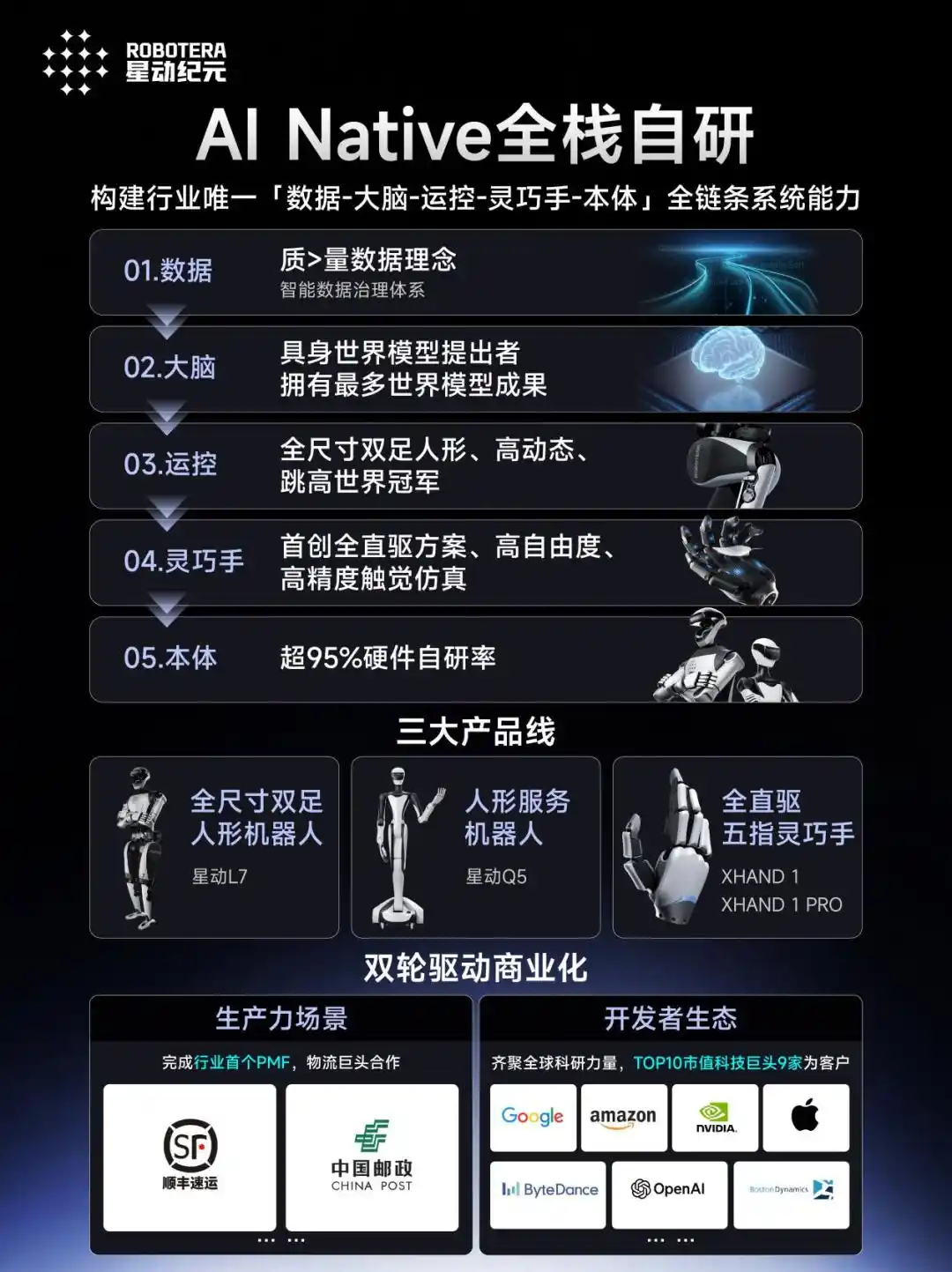
In less than three years, a long queue of investors has lined up behind Chen Jianyu. From early backers like Tsinghua University and Alibaba, to top-tier financial institutions like CDH VGC, Sequoia Capital China, IDG Capital, Qingliu Capital, CICC Capital, to industry giants like SF Express, Samsung, Geely Capital, Haier, Lenovo, Singtel, BAIC Capital, Dongfeng Capital, CICC Porsche, CICC Renault, and funds under China Unicom, as well as local state-owned capital like the Beijing Artificial Intelligence Industry Investment Fund—StarDynamics' shareholder list almost covers the most complete capital spectrum in the embodied intelligence sector.

Entering 2026, the financing pace accelerated dramatically: In March, it completed a 1 billion yuan strategic financing round, with valuation breaking through the 10 billion yuan mark. South Korea's Samsung and Singapore's Singtel appeared among its shareholders as overseas industrial capital for the first time. Just a month later, $200 million in financing arrived, led by SF Express, with leading institutions like Sequoia Capital China and IDG Capital jointly following on, while the industrial investor lineup expanded simultaneously. And today, with national-level state-owned capital platforms like Chengtong Fund collectively joining, a new 1 billion yuan financing round was announced. Securing three consecutive large-scale financings within three months, it set one of the fastest financing speeds in the embodied sector this year.

Thus, StarDynamics has constructed a triple capital matrix of "National-Level Capital Leadership + Top-Tier Financial Empowerment + Industrial Ecosystem Synergy," with over 20 industrial capital entities assembled behind it—a lineup not commonly seen in the industry.

Strengthening the Brain Through the Hand, Forging a New Path in Embodiment

At this juncture, for embodied intelligence to deliver industrial value, the competition is no longer about individual strengths, but the systemic capability integrating software and hardware—the brain (model and data) determines the upper limit of value, while the body (whole machine and end-effectors) constrains the lower limit of capability.

But within this system, there is a core hub often overlooked: the dexterous hand.

StarDynamics adheres to the AI Native principle of full-stack self-development across the entire embodied chain of "data-brain-motion control-dexterous hand-body," meaning hardware design does not start from mechanical structures but is reverse-defined from "what kind of data is most valuable for the brain." The five-finger dexterous hand is precisely the richest and most precise data collection entry point for physical world interaction—whether a grasp is successful, how force feedback changes, if an object slips, these high-dimensional data points directly determine what the model can learn.

Over the past two years, StarDynamics' models have continuously evolved:

In the first half of 2024, the team first proposed the robot fast-slow system VLA architecture (frequency-separated VLA), achieving the unity of "acting in real-time" and "deep thinking"; in the second half, they combined world models with VLA, releasing the VLA algorithm framework PAD and VPP integrating world models, and consolidating them to launch the end-to-end native robot brain model ERA-42.

ERA-42 is one of StarDynamics' core models, integrating vision, understanding, prediction, and action into one, enabling control of whole-body dexterous operations through a single end-to-end VLA model.

In February this year, building upon Ctrl-World, StarDynamics launched VLAW, pioneering the world's first VLA reinforcement learning framework based on world models, achieving synergistic iteration of policy and simulator, making world models not only "look right" but also "be physically correct." To date, StarDynamics is one of the embodied companies with the most world model achievements.

Breakthroughs in brain capability depend on high-quality data. On this front, relying on its self-developed dexterous hand and deployment applications, StarDynamics possesses the world's largest dataset from real dexterous hand hardware.

Simply put, StarDynamics uses dexterous hand hardware to obtain high-quality dexterous manipulation data, then uses this data to train smarter "brain" models, and finally feeds the evolved models back to the dexterous hands, forming a virtuous cycle of "the more used, the smarter; the smarter, the more capable." Therefore, the "dexterous hand" business is not merely a single-point component on the robot body but a core hub connecting the entire full-stack capability, the central entry point for collecting physical world interaction data.

Having long anticipated that end-effectors would become a bottleneck for embodied intelligence deployment, StarDynamics' dexterous hand adopted a brain-friendly, pioneering full direct-drive technical route—joint module output directly acts on joints, with no transmission backlash, elasticity, or friction loss. The generated data inherently possesses high precision, low latency, and reproducibility, and can be directly used for model training, fundamentally solving the quality issue of physical interaction data.

Currently, StarDynamics employs a "dual-hand strategy" with two differently positioned dexterous hand products:

1. Star-XHAND 1 PRO (Brain Hand), emphasizing high performance, core positioning as a data collection and algorithm validation platform, anchoring the upper limit of model capability;
2. Star-XHAND 1 (Work Hand), achieving precise force control and flexible operation through a full direct-drive technical architecture, adaptable to various humanoid robot platforms, solidifying the lower limit for scaled deployment.

It is reported that Star-XHAND 1 is now widely adopted to meet diverse needs in scenarios like industrial sorting and routine operations, becoming a shared choice for global robot manufacturers—American embodied intelligence unicorn Skild AI, South Korea's Rainbow Robotics, UK's Extend Robotics and Discover Robotics, as well as the new-generation humanoid robot HMND 01 from UK's Humanoid AI, among others, have all adopted Star-XHAND 1 as a core end-effector.

When the valuation of a single dexterous hand within the industry can even exceed that of the entire robot body, StarDynamics' narrative of "strengthening the brain through the hand" gains more substance. But ultimately, "strengthening the brain through the hand" is not the goal, but a means—obtaining high-quality data through the hand, training a stronger brain through the data, driving more intelligent robots through the brain, ultimately running through the full-stack system capability of "data-brain-motion control-dexterous hand-body," becoming real productivity in industrial scenarios—that is StarDynamics' true moat.

Relying on its self-developed dexterous hand and deployment applications, StarDynamics has accumulated a leading-scale dataset from real dexterous hand hardware within the industry. Based on this, the company has built a triple-gradient data source system:

Core Value Layer: Long-duration real hardware interaction data from real scenarios like logistics and industry, with 100% physical authenticity, forming the core foundation for models to align with industrial needs;
Precision Training Layer: High-precision teleoperation data, providing standardized action reference paradigms; currently has over 12 million clips of real hardware teleoperation data, including over 1.5 million clips of dexterous hand real hardware teleoperation data, one of the largest datasets of its kind in the industry;
Breadth Expansion Layer: First-person human behavior data and large-scale internet video data, enabling million-hour scaling, cost-effectively covering vast daily behaviors and scenarios.

Among these, long-duration real hardware interaction data from real scenarios and large-scale human video data simultaneously satisfy authenticity and diversity, constituting the dual core engines of the data system.

Currently, StarDynamics' overall dataset covers 100+ real scenarios and 1000+ dexterous manipulation tasks, sufficiently ensuring scene richness and behavioral diversity, laying a high-quality data foundation for the continuous iteration of the general embodied brain.

On this foundation, StarDynamics begins to answer the next question: Can this data support the brain in achieving commercial closed loops in real industrial scenarios?

Robots Begin Stable Deployment

The Watershed Moment

The answer lies on the industrial front lines where robots can stably deploy and work continuously.

StarDynamics adheres to a "B2B first, then B2C" commercialization path, gradually deploying in logistics, high-end manufacturing, and commercial service scenarios.

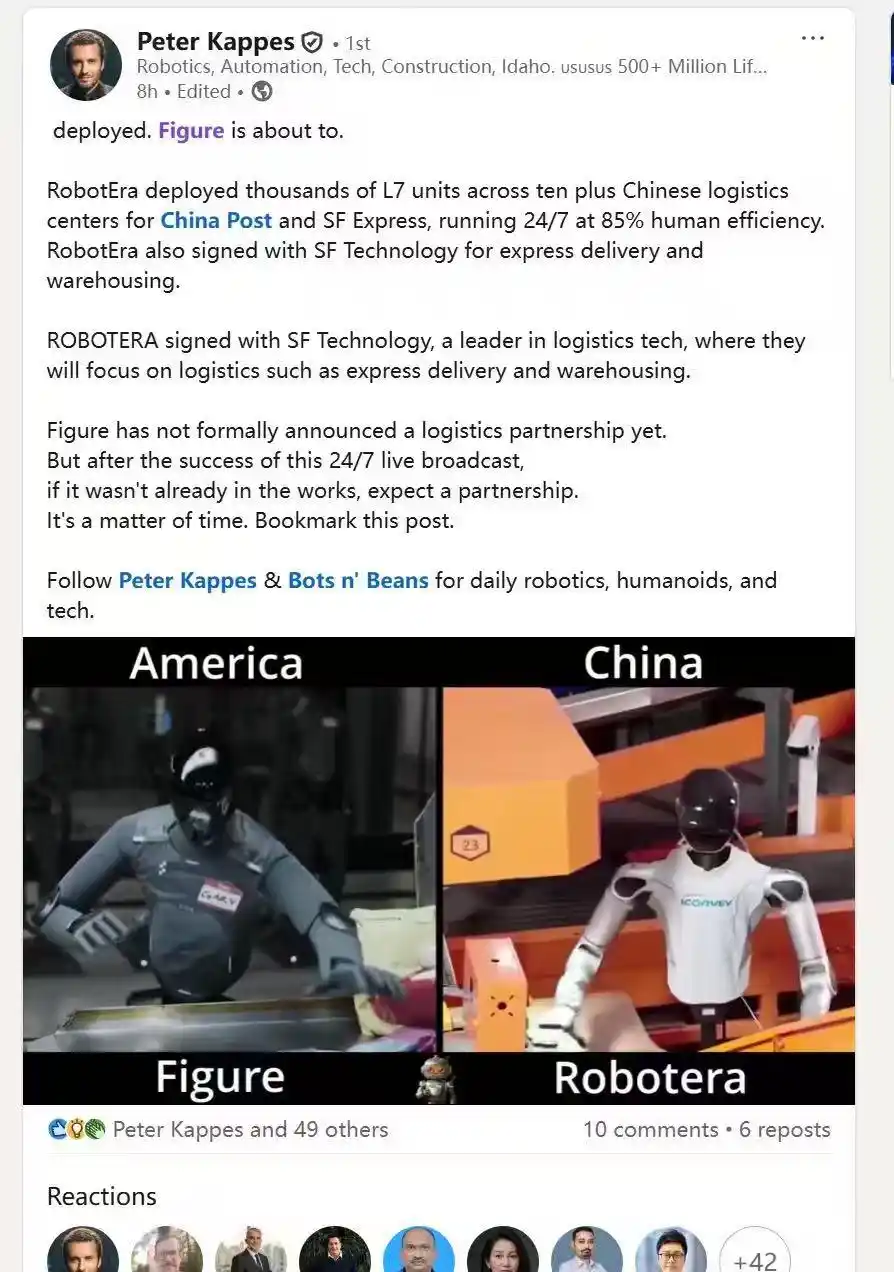
As we have seen, StarDynamics first achieved the industry's first PMF (Product-Market Fit) in logistics scenarios, deeply cooperating with leading clients like SF Express and China Post, batch-deploying to over 10 logistics centers across 5 provinces/municipalities in North, East, and South China, with some achieving normal 7×24 hour operations.

Here, embodied robots can flexibly handle various parcel sorting tasks involving packages of different shapes, materials, and sizes—grasping, turning parcel labels face-up, placing, etc. It's reported that efficiency in some scenarios even surpasses human levels, with processing speeds reaching over 1200 pieces per hour.

There's an interesting anecdote here—when the overseas embodied leader Figure conducted a live stream from its testing room, it was called out by foreign media: "StarDynamics' robots in China are already working at SF Express and China Post. When will Figure step out of the testing room and truly deploy?"
It is revealed that in the future, StarDynamics will continue to expand logistics scenarios, building a full-process embodied logistics service system covering inbound logistics, in-plant logistics, sales logistics, after-sales logistics, and extended express logistics links.

Meanwhile, high-end manufacturing and commercial service scenarios are also being rolled out. In high-end manufacturing for 3C electronics and automotive, StarDynamics has partnered with industry leaders like Samsung, Lenovo, Haier, and Geely. The real hardware data flowing back from these industrial sites continuously provides iterative nourishment for the embodied brain. Additionally, the Star-Q5 super-realistic service robot has been deployed in scenarios like Haier, Lenovo, and Century Golden Resources, providing services like store attraction, guided tours, explanation, and product delivery, exploring B2C entry points.

The underlying body capabilities supporting these deployments are also being validated by global top-tier institutions. StarDynamics' dexterous hands, universal body base, and development kits are not only used internally but have also been shipped globally, serving 9 out of the world's top 10 tech companies by market capitalization, becoming the shared choice of top tech firms and research institutions including OpenAI, Boston Dynamics, NVIDIA, Apple, Google, Amazon, ByteDance, as well as MIT, UC Berkeley, Stanford University, Tsinghua University, and Shanghai Qizhi Research Institute. Feedback from top-tier research clients further drives continuous upgrades to StarDynamics' hardware base.

As robots begin stable deployment, the prelude to the era of embodied intelligence leaders opens. As more robots enter the real world to perform tasks, those who can first establish data moats and evolution barriers for the next-generation robot brain that others find difficult to replicate will occupy key positions in the new round of competition.

As widely believed, 2026 is a watershed year for embodied models: in the first half, model capabilities diverge; in the second half, commercialization closed loops diverge. Capital markets no longer pay for stories, only recognizing one thing—whether technology can deploy, whether deployment can scale, and whether scale can feed back into technology.

The watershed moment has emerged—not under the spotlight of the laboratory, but on the logistics sorting lines at 3 a.m.

This article is from the WeChat public account "Investment Community" (ID: pedaily2012), author: Yang Jiyun


Criptomoedas em alta

Perguntas relacionadas

QWhat is the significance of Xingdong Jiyuan's recent financing round, and which type of investors led it?

AXingdong Jiyuan recently completed a new 10 billion RMB financing round. It is significant because it was led by the State-owned Assets Supervision and Administration Commission (SASAC) state-owned capital operation company, Chengtong Fund, and involved participation from other major state-owned entities. This builds a 'three-fold capital matrix' of national capital leadership, top-tier financial empowerment, and industrial ecosystem collaboration. The company has raised 25 billion RMB in just two months.

QAccording to the article, what core technical concept did Xingdong Jiyuan pioneer in the field of embodied intelligence?

AXingdong Jiyuan was the proposer of the World Model concept in the field of embodied intelligence. It was an early pioneer, releasing its PAD model (a World Action Model) in September 2024, nearly a year before similar solutions like NVIDIA's DreamZero were announced.

QHow does Xingdong Jiyuan's 'AI Native' approach and its focus on dexterous hands (XHAND) create a competitive advantage?

AXingdong Jiyuan's 'AI Native' approach reverses the traditional hardware-first design. It starts by asking 'what data is most valuable for the AI brain?' and uses its self-developed, fully direct-drive dexterous hands (XHAND) as the primary sensor to collect high-quality, high-precision physical interaction data. This data is then used to train smarter brain models. This creates a virtuous cycle where better hands gather better data, which trains a better brain, enabling more capable robots, forming a core barrier through its full-stack 'data-brain-control-hand-body' capability.

QIn which industrial sector has Xingdong Jiyuan first achieved Product-Market Fit (PMF) with its robots?

AXingdong Jiyuan has first achieved Product-Market Fit (PMF) in the logistics sector. Its robots are deployed in-depth with leading clients like SF Express and China Post, operating 24/7 in over 10 logistics centers across China. They perform tasks like parcel sorting, handling items of various shapes and materials, with reported efficiency exceeding human levels in some scenarios.

QWhat does the article suggest is the key factor for success in the embodied intelligence field as of 2026?

AThe article suggests that 2026 is a watershed year where success is no longer about stories or isolated technologies. The key factors are whether the technology can be implemented, whether that implementation can be scaled, and whether the scale can, in turn, feed back to improve the technology. The 'dividing line' is now drawn in real-world industrial settings, like late-night logistics sorting lines, rather than in research labs.

Leituras Relacionadas

DeepMind's Classic Masterpiece Crowned Again, ICML 2026 Awards Announced

ICML 2026 has announced its annual awards, with diffusion models and AI safety ethics taking center stage. The Outstanding Paper Award was shared by two diffusion model studies. One challenges a core assumption of diffusion language models (DLMs), arguing that their touted "arbitrary order generation" is a "flexibility trap" that harms performance. The other provides a high-accuracy sampling method, pushing the technical ceiling for diffusion models and log-concave distributions. A position paper winning the Outstanding Award raises a critical ethical concern: AI alignment research is unintentionally building a "censor's toolkit," where safety tools like RLHF can be repurposed for content control. Several papers received Honorable Mentions, spanning key areas: mapping where honesty emerges in RLHF-trained models, motion attribution in video generation, quantifying how much language models memorize, analyzing diffusion model consistency via random matrix theory, and providing a mathematical proof for the "grokking" phenomenon in a simple model. The Test of Time Award was given to DeepMind's 2016 seminal work "Asynchronous Methods for Deep Reinforcement Learning," recognizing the enduring impact of the A3C algorithm. Overall, the awards signal a shift in AI research from rapid expansion to deeper scrutiny—validating diffusion models as a major architectural contender while prompting serious ethical reflection within the safety community.

marsbitHá 14m

DeepMind's Classic Masterpiece Crowned Again, ICML 2026 Awards Announced

marsbitHá 14m

ARK's Massive Buying Spree in Crypto-Linked Stocks: Lower Risk, or Double the Pressure?

ARK Invest, led by Cathie Wood, significantly increased its holdings in crypto-related public stocks in June, purchasing $77 million worth of shares in Coinbase, Circle, and Bullish during Bitcoin's worst monthly performance in four years. The investment thesis is that these stocks offer regulated exposure to the crypto cycle without direct Bitcoin ownership. However, data analysis reveals significant downsides: these stocks exhibit nearly double the volatility of Bitcoin (68%-90% vs. 37.6% 30-day annualized volatility) and carry substantial company-specific risks like earnings, competition, and equity dilution, which account for much of their price movement. Only MicroStrategy closely tracks Bitcoin, acting as a leveraged proxy. Coinbase shows moderate correlation, while Circle and Robinhood have low correlation, being more influenced by stablecoin competition and diversified brokerage operations, respectively. Mining companies like RIOT and MARA have surged due to AI-related ventures, decoupling from Bitcoin's price. The case of Strategy highlights additional equity-structure risks, such as potential value erosion when its market value falls below its net asset value. Ultimately, investing in crypto stocks often means accepting amplified Bitcoin volatility or layering on unrelated business risks, rather than obtaining a safer alternative to direct cryptocurrency ownership.

Foresight NewsHá 18m

ARK's Massive Buying Spree in Crypto-Linked Stocks: Lower Risk, or Double the Pressure?

Foresight NewsHá 18m

Tsinghua University's Special Award Winner, Gu Yuxian, Joins DeepSeek

Tsinghua University's prestigious Graduate Special Scholarship recipient and 2021 Ph.D. candidate, Yuxian Gu, has officially joined DeepSeek. This news coincides with DeepSeek's major recruitment drive and the imminent launch of DeepSeek V4, on whose research paper Gu is listed as an author. A doctoral student in the Conversational AI group under Professor Minlie Huang at Tsinghua, Gu's research focuses on enhancing efficiency throughout the entire lifecycle of large language models. His key contributions span three areas: innovative methods for pre-training data selection (e.g., PDS), advanced knowledge distillation techniques for model compression (notably MiniLLM), and the development of efficient model architectures like Jet-Nemotron. His work has gained significant recognition, with nearly 5,000 citations on Google Scholar. Key publications include the highly cited surveys and papers on pre-trained models and the MiniLLM distillation method. As first author, he has presented at top-tier AI conferences including NeurIPS, ICLR, and ACL. One of his notable achievements is the Jet-Nemotron architecture, which combines Post-Neural Architecture Search (PostNAS) and a novel linear attention module called JetBlock. This model series demonstrates state-of-the-art performance rivaling larger models while achieving substantial efficiency gains in inference. Gu's expertise in creating powerful yet efficient AI systems aligns with industry needs, as evidenced by the adoption of his MiniLLM method by leading tech companies. His move to DeepSeek is anticipated to contribute further advancements in the field.

marsbitHá 44m

Tsinghua University's Special Award Winner, Gu Yuxian, Joins DeepSeek

marsbitHá 44m

Trading

Spot

Artigos em Destaque

O que é $S$

Compreender o SPERO: Uma Visão Abrangente Introdução ao SPERO À medida que o panorama da inovação continua a evoluir, o surgimento de tecnologias web3 e projetos de criptomoeda desempenha um papel fundamental na formação do futuro digital. Um projeto que tem atraído atenção neste campo dinâmico é o SPERO, denotado como SPERO,$$s$. Este artigo tem como objetivo reunir e apresentar informações detalhadas sobre o SPERO, para ajudar entusiastas e investidores a compreender as suas bases, objetivos e inovações nos domínios web3 e cripto. O que é o SPERO,$$s$? O SPERO,$$s$ é um projeto único dentro do espaço cripto que procura aproveitar os princípios da descentralização e da tecnologia blockchain para criar um ecossistema que promove o envolvimento, a utilidade e a inclusão financeira. O projeto é concebido para facilitar interações peer-to-peer de novas maneiras, proporcionando aos utilizadores soluções e serviços financeiros inovadores. No seu núcleo, o SPERO,$$s$ visa capacitar indivíduos ao fornecer ferramentas e plataformas que melhoram a experiência do utilizador no espaço das criptomoedas. Isso inclui a possibilidade de métodos de transação mais flexíveis, a promoção de iniciativas impulsionadas pela comunidade e a criação de caminhos para oportunidades financeiras através de aplicações descentralizadas (dApps). A visão subjacente do SPERO,$$s$ gira em torno da inclusão, visando fechar lacunas dentro das finanças tradicionais enquanto aproveita os benefícios da tecnologia blockchain. Quem é o Criador do SPERO,$$s$? A identidade do criador do SPERO,$$s$ permanece algo obscura, uma vez que existem recursos publicamente disponíveis limitados que fornecem informações detalhadas sobre o(s) seu(s) fundador(es). Esta falta de transparência pode resultar do compromisso do projeto com a descentralização—uma ética que muitos projetos web3 partilham, priorizando contribuições coletivas em vez de reconhecimento individual. Ao centrar as discussões em torno da comunidade e dos seus objetivos coletivos, o SPERO,$$s$ incorpora a essência do empoderamento sem destacar indivíduos específicos. Assim, compreender a ética e a missão do SPERO é mais importante do que identificar um criador singular. Quem são os Investidores do SPERO,$$s$? O SPERO,$$s$ é apoiado por uma diversidade de investidores que vão desde capitalistas de risco a investidores-anjo dedicados a promover a inovação no setor cripto. O foco desses investidores geralmente alinha-se com a missão do SPERO—priorizando projetos que prometem avanço tecnológico social, inclusão financeira e governança descentralizada. Essas fundações de investidores estão tipicamente interessadas em projetos que não apenas oferecem produtos inovadores, mas que também contribuem positivamente para a comunidade blockchain e os seus ecossistemas. O apoio desses investidores reforça o SPERO,$$s$ como um concorrente notável no domínio em rápida evolução dos projetos cripto. Como Funciona o SPERO,$$s$? O SPERO,$$s$ emprega uma estrutura multifacetada que o distingue de projetos de criptomoeda convencionais. Aqui estão algumas das características-chave que sublinham a sua singularidade e inovação: Governança Descentralizada: O SPERO,$$s$ integra modelos de governança descentralizada, capacitando os utilizadores a participar ativamente nos processos de tomada de decisão sobre o futuro do projeto. Esta abordagem promove um sentido de propriedade e responsabilidade entre os membros da comunidade. Utilidade do Token: O SPERO,$$s$ utiliza o seu próprio token de criptomoeda, concebido para servir várias funções dentro do ecossistema. Esses tokens permitem transações, recompensas e a facilitação de serviços oferecidos na plataforma, melhorando o envolvimento e a utilidade gerais. Arquitetura em Camadas: A arquitetura técnica do SPERO,$$s$ suporta modularidade e escalabilidade, permitindo a integração contínua de funcionalidades e aplicações adicionais à medida que o projeto evolui. Esta adaptabilidade é fundamental para manter a relevância no panorama cripto em constante mudança. Envolvimento da Comunidade: O projeto enfatiza iniciativas impulsionadas pela comunidade, empregando mecanismos que incentivam a colaboração e o feedback. Ao nutrir uma comunidade forte, o SPERO,$$s$ pode melhor atender às necessidades dos utilizadores e adaptar-se às tendências do mercado. Foco na Inclusão: Ao oferecer taxas de transação baixas e interfaces amigáveis, o SPERO,$$s$ visa atrair uma base de utilizadores diversificada, incluindo indivíduos que anteriormente podem não ter participado no espaço cripto. Este compromisso com a inclusão alinha-se com a sua missão abrangente de empoderamento através da acessibilidade. Cronologia do SPERO,$$s$ Compreender a história de um projeto fornece insights cruciais sobre a sua trajetória de desenvolvimento e marcos. Abaixo está uma cronologia sugerida que mapeia eventos significativos na evolução do SPERO,$$s$: Fase de Conceituação e Ideação: As ideias iniciais que formam a base do SPERO,$$s$ foram concebidas, alinhando-se de perto com os princípios de descentralização e foco na comunidade dentro da indústria blockchain. Lançamento do Whitepaper do Projeto: Após a fase conceitual, um whitepaper abrangente detalhando a visão, os objetivos e a infraestrutura tecnológica do SPERO,$$s$ foi lançado para atrair o interesse e o feedback da comunidade. Construção da Comunidade e Primeiros Envolvimentos: Esforços ativos de divulgação foram feitos para construir uma comunidade de primeiros adotantes e investidores potenciais, facilitando discussões em torno dos objetivos do projeto e angariando apoio. Evento de Geração de Tokens: O SPERO,$$s$ realizou um evento de geração de tokens (TGE) para distribuir os seus tokens nativos a apoiantes iniciais e estabelecer liquidez inicial dentro do ecossistema. Lançamento da dApp Inicial: A primeira aplicação descentralizada (dApp) associada ao SPERO,$$s$ foi lançada, permitindo que os utilizadores interagissem com as funcionalidades principais da plataforma. Desenvolvimento Contínuo e Parcerias: Atualizações e melhorias contínuas nas ofertas do projeto, incluindo parcerias estratégicas com outros players no espaço blockchain, moldaram o SPERO,$$s$ em um jogador competitivo e em evolução no mercado cripto. Conclusão O SPERO,$$s$ é um testemunho do potencial do web3 e das criptomoedas para revolucionar os sistemas financeiros e capacitar indivíduos. Com um compromisso com a governança descentralizada, o envolvimento da comunidade e funcionalidades inovadoras, abre caminho para um panorama financeiro mais inclusivo. Como em qualquer investimento no espaço cripto em rápida evolução, potenciais investidores e utilizadores são incentivados a pesquisar minuciosamente e a envolver-se de forma ponderada com os desenvolvimentos em curso dentro do SPERO,$$s$. O projeto demonstra o espírito inovador da indústria cripto, convidando a uma exploração mais aprofundada das suas inúmeras possibilidades. Embora a jornada do SPERO,$$s$ ainda esteja a desenrolar-se, os seus princípios fundamentais podem, de facto, influenciar o futuro de como interagimos com a tecnologia, as finanças e uns com os outros em ecossistemas digitais interconectados.

82 Visualizações TotaisPublicado em {updateTime}Atualizado em 2024.12.17

O que é $S$

O que é AGENT S

Agent S: O Futuro da Interação Autónoma no Web3 Introdução No panorama em constante evolução do Web3 e das criptomoedas, as inovações estão constantemente a redefinir a forma como os indivíduos interagem com plataformas digitais. Um projeto pioneiro, o Agent S, promete revolucionar a interação humano-computador através do seu framework aberto e agente. Ao abrir caminho para interações autónomas, o Agent S visa simplificar tarefas complexas, oferecendo aplicações transformadoras em inteligência artificial (IA). Esta exploração detalhada irá aprofundar-se nas complexidades do projeto, nas suas características únicas e nas implicações para o domínio das criptomoedas. O que é o Agent S? O Agent S é um framework aberto e agente, especificamente concebido para abordar três desafios fundamentais na automação de tarefas computacionais: Aquisição de Conhecimento Específico de Domínio: O framework aprende inteligentemente a partir de várias fontes de conhecimento externas e experiências internas. Esta abordagem dupla capacita-o a construir um rico repositório de conhecimento específico de domínio, melhorando o seu desempenho na execução de tarefas. Planeamento ao Longo de Longos Horizontes de Tarefas: O Agent S emprega planeamento hierárquico aumentado por experiência, uma abordagem estratégica que facilita a decomposição e execução eficientes de tarefas intrincadas. Esta característica melhora significativamente a sua capacidade de gerir múltiplas subtarefas de forma eficiente e eficaz. Gestão de Interfaces Dinâmicas e Não Uniformes: O projeto introduz a Interface Agente-Computador (ACI), uma solução inovadora que melhora a interação entre agentes e utilizadores. Utilizando Modelos de Linguagem Multimodais de Grande Escala (MLLMs), o Agent S pode navegar e manipular diversas interfaces gráficas de utilizador de forma fluida. Através destas características pioneiras, o Agent S fornece um framework robusto que aborda as complexidades envolvidas na automação da interação humana com máquinas, preparando o terreno para uma infinidade de aplicações em IA e além. Quem é o Criador do Agent S? Embora o conceito de Agent S seja fundamentalmente inovador, informações específicas sobre o seu criador permanecem elusivas. O criador é atualmente desconhecido, o que destaca ou o estágio nascente do projeto ou a escolha estratégica de manter os membros fundadores em anonimato. Independentemente da anonimidade, o foco permanece nas capacidades e no potencial do framework. Quem são os Investidores do Agent S? Como o Agent S é relativamente novo no ecossistema criptográfico, informações detalhadas sobre os seus investidores e financiadores não estão explicitamente documentadas. A falta de informações disponíveis publicamente sobre as fundações de investimento ou organizações que apoiam o projeto levanta questões sobre a sua estrutura de financiamento e roteiro de desenvolvimento. Compreender o apoio é crucial para avaliar a sustentabilidade do projeto e o seu impacto potencial no mercado. Como Funciona o Agent S? No núcleo do Agent S reside uma tecnologia de ponta que lhe permite funcionar eficazmente em diversos ambientes. O seu modelo operacional é construído em torno de várias características-chave: Interação Humano-Computador Semelhante: O framework oferece planeamento avançado em IA, esforçando-se para tornar as interações com computadores mais intuitivas. Ao imitar o comportamento humano na execução de tarefas, promete elevar as experiências dos utilizadores. Memória Narrativa: Utilizada para aproveitar experiências de alto nível, o Agent S utiliza memória narrativa para acompanhar os históricos de tarefas, melhorando assim os seus processos de tomada de decisão. Memória Episódica: Esta característica fornece aos utilizadores orientações passo a passo, permitindo que o framework ofereça suporte contextual à medida que as tarefas se desenrolam. Suporte para OpenACI: Com a capacidade de funcionar localmente, o Agent S permite que os utilizadores mantenham o controlo sobre as suas interações e fluxos de trabalho, alinhando-se com a ética descentralizada do Web3. Fácil Integração com APIs Externas: A sua versatilidade e compatibilidade com várias plataformas de IA garantem que o Agent S possa integrar-se perfeitamente em ecossistemas tecnológicos existentes, tornando-o uma escolha apelativa para desenvolvedores e organizações. Estas funcionalidades contribuem coletivamente para a posição única do Agent S no espaço cripto, à medida que automatiza tarefas complexas e em múltiplos passos com mínima intervenção humana. À medida que o projeto evolui, as suas potenciais aplicações no Web3 podem redefinir a forma como as interações digitais se desenrolam. Cronologia do Agent S O desenvolvimento e os marcos do Agent S podem ser encapsulados numa cronologia que destaca os seus eventos significativos: 27 de Setembro de 2024: O conceito de Agent S foi lançado num artigo de pesquisa abrangente intitulado “Um Framework Agente Aberto que Usa Computadores como um Humano”, mostrando a base para o projeto. 10 de Outubro de 2024: O artigo de pesquisa foi disponibilizado publicamente no arXiv, oferecendo uma exploração aprofundada do framework e da sua avaliação de desempenho com base no benchmark OSWorld. 12 de Outubro de 2024: Uma apresentação em vídeo foi lançada, proporcionando uma visão visual das capacidades e características do Agent S, envolvendo ainda mais potenciais utilizadores e investidores. Estes marcos na cronologia não apenas ilustram o progresso do Agent S, mas também indicam o seu compromisso com a transparência e o envolvimento da comunidade. Pontos-Chave Sobre o Agent S À medida que o framework Agent S continua a evoluir, várias características-chave destacam-se, sublinhando a sua natureza inovadora e potencial: Framework Inovador: Concebido para proporcionar um uso intuitivo de computadores semelhante à interação humana, o Agent S traz uma abordagem nova à automação de tarefas. Interação Autónoma: A capacidade de interagir autonomamente com computadores através de GUI significa um avanço em direção a soluções computacionais mais inteligentes e eficientes. Automação de Tarefas Complexas: Com a sua metodologia robusta, pode automatizar tarefas complexas e em múltiplos passos, tornando os processos mais rápidos e menos propensos a erros. Melhoria Contínua: Os mecanismos de aprendizagem permitem que o Agent S melhore a partir de experiências passadas, aprimorando continuamente o seu desempenho e eficácia. Versatilidade: A sua adaptabilidade em diferentes ambientes operacionais, como OSWorld e WindowsAgentArena, garante que pode servir uma ampla gama de aplicações. À medida que o Agent S se posiciona no panorama do Web3 e das criptomoedas, o seu potencial para melhorar as capacidades de interação e automatizar processos significa um avanço significativo nas tecnologias de IA. Através do seu framework inovador, o Agent S exemplifica o futuro das interações digitais, prometendo uma experiência mais fluida e eficiente para os utilizadores em diversas indústrias. Conclusão O Agent S representa um ousado avanço na união da IA e do Web3, com a capacidade de redefinir a forma como interagimos com a tecnologia. Embora ainda esteja nas suas fases iniciais, as possibilidades para a sua aplicação são vastas e cativantes. Através do seu framework abrangente que aborda desafios críticos, o Agent S visa trazer interações autónomas para o primeiro plano da experiência digital. À medida que avançamos mais profundamente nos domínios das criptomoedas e da descentralização, projetos como o Agent S desempenharão, sem dúvida, um papel crucial na formação do futuro da tecnologia e da colaboração humano-computador.

697 Visualizações TotaisPublicado em {updateTime}Atualizado em 2025.01.14

O que é AGENT S

Como comprar S

Bem-vindo à HTX.com!Tornámos a compra de Sonic (S) simples e conveniente.Segue o nosso guia passo a passo para iniciar a tua jornada no mundo das criptos.Passo 1: cria a tua conta HTXUtiliza o teu e-mail ou número de telefone para te inscreveres numa conta gratuita na HTX.Desfruta de um processo de inscrição sem complicações e desbloqueia todas as funcionalidades.Obter a minha contaPasso 2: vai para Comprar Cripto e escolhe o teu método de pagamentoCartão de crédito/débito: usa o teu visa ou mastercard para comprar Sonic (S) instantaneamente.Saldo: usa os fundos da tua conta HTX para transacionar sem problemas.Terceiros: adicionamos métodos de pagamento populares, como Google Pay e Apple Pay, para aumentar a conveniência.P2P: transaciona diretamente com outros utilizadores na HTX.Mercado de balcão (OTC): oferecemos serviços personalizados e taxas de câmbio competitivas para os traders.Passo 3: armazena teu Sonic (S)Depois de comprar o teu Sonic (S), armazena-o na tua conta HTX.Alternativamente, podes enviá-lo para outro lugar através de transferência blockchain ou usá-lo para transacionar outras criptomoedas.Passo 4: transaciona Sonic (S)Transaciona facilmente Sonic (S) no mercado à vista da HTX.Acede simplesmente à tua conta, seleciona o teu par de trading, executa as tuas transações e monitoriza em tempo real.Oferecemos uma experiência de fácil utilização tanto para principiantes como para traders experientes.

1.3k Visualizações TotaisPublicado em {updateTime}Atualizado em 2026.06.02

Como comprar S

Discussões

Bem-vindo à Comunidade HTX. Aqui, pode manter-se informado sobre os mais recentes desenvolvimentos da plataforma e obter acesso a análises profissionais de mercado. As opiniões dos utilizadores sobre o preço de S (S) são apresentadas abaixo.

活动图片