Solana Takes Aim At Hyperliquid With Push For Fully Onchain Perps

bitcoinistPublicado em 2026-06-02Última atualização em 2026-06-02

Resumo

The Solana Foundation has announced a new initiative to actively support teams building fully onchain perpetual futures (perps) on Solana. This move directly challenges the current market structure, exemplified by platforms like Hyperliquid, where much of the derivatives volume still relies on centralized exchanges or hybrid models with offchain components. Solana argues that its high-performance blockchain makes fully onchain perps viable without sacrificing speed or user experience, aiming to shift a lucrative trading segment entirely onchain. The Foundation seeks to back projects that prioritize onchain price discovery (like order books or RFQ systems) over pool-based models, require projects to be "Solana-first" with revenue routed back to the chain, and mandate open-source development. The support includes distribution, technical assistance, and capital for core perps protocols as well as complementary infrastructure.

Solana Foundation is moving to back teams building fully onchain perpetual futures, setting up a clear challenge to the market structure that has powered Hyperliquid’s rapid rise. The initiative targets one of crypto’s most lucrative trading segments: perps, where volume still sits largely on centralized exchanges or hybrid venues.

Solana Vs. Hyperliquid

The Foundation framed the push as a bid to move derivatives execution more fully onto Solana, without relying on the offchain components that still underpin much of the sector. “Perpetuals are one of the most important financial primitives in crypto,” the Foundation wrote on X. “Solana makes it viable to run them fully onchain, without sacrificing the performance real participants and institutions require.”

The timing is notable. Hyperliquid has become the reference point for onchain derivatives, turning perpetual futures into one of the strongest product-market-fit stories in crypto. While Solana did not name Hyperliquid in its announcement, the competitive subtext is hard to miss.

In its post, the Foundation argued that most perp volume still flows through centralized exchanges or through hybrid architectures that use offchain sequencers and matching engines. “We view that as a transitional state, not a permanent one,” the Foundation said. “We want to support teams building onchain perps, other derivatives, and the applications around them, that prioritize price discovery infrastructure. Our support takes several forms: distribution, technical assistance, and above all, capital.”

That language matters because it draws a line between merely settling crypto trades onchain and running the entire execution path onchain. The foundation said it wants to support systems where every order submission, oracle update, match, cancellation and settlement happens onchain. For a chain that has long marketed itself around high throughput and low latency, perps are an obvious stress test: the product requires fast updates, deep liquidity, competitive market making and credible settlement.

The Foundation also made clear that it is not looking for pool-based pricing models as the center of this effort. It said it is interested in “models where price is set based on two-sided flow, not pool-based or as a function of deposits,” including orderbooks, RFQ systems with genuinely competing makers, or alternative designs where active participants set bids and offers against each other.

That is where the Hyperliquid comparison becomes especially relevant. Hyperliquid’s success has shown that crypto traders will use onchain or semi-onchain derivatives venues when the trading experience is fast, liquid and expressive enough.

Solana Wants Revenue Back Onchain

The announcement also included a more ecosystem-specific requirement: teams should build “Solana-first.” The Foundation said it wants projects optimized for SOL’s design and culture, with application revenue structurally routed back to the chain, preferably at the protocol level from launch rather than left to future governance decisions.

That is a pointed detail. In the current perps market, the battle is not only over where traders execute, but where fees, order flow and liquidity incentives accrue. A successful Solana-native perps venue would not merely add another DeFi app; it could become a recurring source of transaction activity, MEV-adjacent flow, validator economics and ecosystem-level liquidity.

The Foundation also said it is open to teams that have already built offchain or hybrid perps products and want to migrate to a fully onchain model. “We’ll support existing teams with a live product that are willing to explore a fully onchain, on-Solana model,” it said.

Open source is another filter. “Onchain integrity means little if the code behind it can’t be inspected,” Solana Foundation wrote. “Contributing to Solana culturally means contributing in the open.”

The initiative is not limited to core perps protocols. Solana said it also wants complementary infrastructure, including frontend integrations, vaults, structured products, aggregators, advanced trading interfaces, market making operations and social trading applications. Grants may be available through Solana Foundation funding channels or local Superteam chapters.

At press time, SOL traded at $79.54.
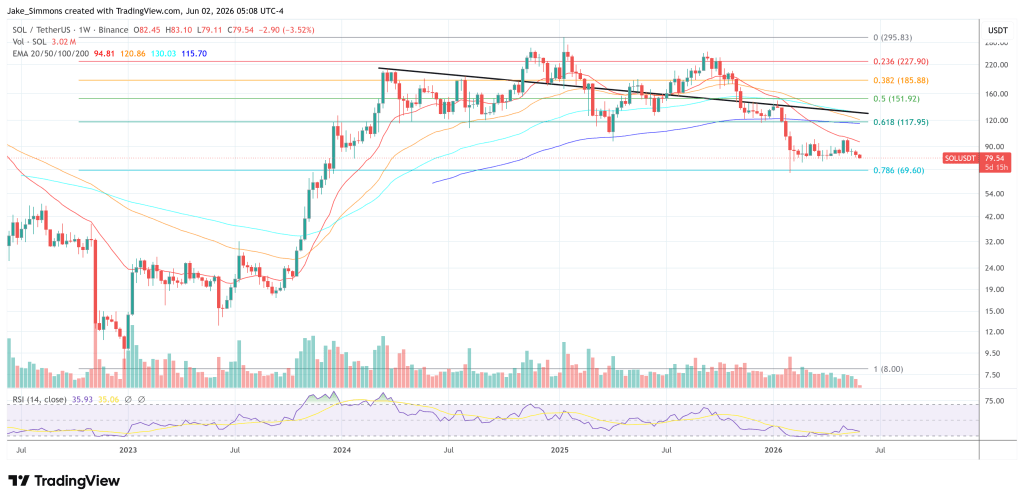
SOL remains in sideways trend, 1-week chart | Source: SOLUSDT on TradingView.com

Perguntas relacionadas

QWhat is the primary goal of the Solana Foundation's new initiative as described in the article?

AThe primary goal of the Solana Foundation's initiative is to support teams building fully onchain perpetual futures and other derivatives on Solana. It aims to move derivatives execution more fully onto the blockchain without relying on offchain components, capturing revenue for the Solana ecosystem, and supporting models based on two-sided flow for price discovery.

QAccording to the article, which platform is positioned as the main competitive reference point for Solana's onchain perps push?

AThe main competitive reference point is Hyperliquid. The article states that Hyperliquid has become the reference point for onchain derivatives, and Solana's initiative sets up a clear challenge to the market structure that powered Hyperliquid's rapid rise.

QWhat specific type of pricing models is the Solana Foundation NOT interested in supporting for this initiative?

AThe Solana Foundation is not looking for pool-based pricing models as the center of this effort. It is interested in models where price is set based on two-sided flow, such as orderbooks, RFQ systems with competing makers, or designs where active participants set bids and offers against each other.

QBesides the core perps protocols, what other types of complementary infrastructure does Solana want to support through this initiative?

ASolana also wants to support complementary infrastructure including frontend integrations, vaults, structured products, aggregators, advanced trading interfaces, market making operations, and social trading applications.

QWhat are the key requirements or filters mentioned for teams interested in the Solana Foundation's support?

AKey requirements include building 'Solana-first' (optimized for SOL's design and culture), structuring application revenue to route back to the chain, being open to teams migrating from offchain/hybrid models, and committing to open-source development ('contributing in the open').

Leituras Relacionadas

When Google Also 'Prints Stocks' to Build AI, Whose Narrative is Shattering the High Valuations of Neocloud?

Google has announced its first equity financing since 2005, a series of moves totaling $80 billion that signal a strategic challenge to Nvidia's GPU dominance in the AI compute market. This impacts "Neocloud" companies like CoreWeave, Nebius, and IREN, whose valuations are heavily tied to Nvidia's perceived uniqueness. Google's three-part strategy involves: launching new TPU chips (TPU 8t/8i) and selling them to third parties for the first time; forming a $25 billion compute-as-a-service joint venture with Blackstone; and raising ~$50 billion in new equity (part of an $80B package) to fund AI infrastructure, underscoring the massive capital demands even for tech giants. This marks a divergence from Microsoft's path. Microsoft, lacking a mature in-house AI chip, relies heavily on outsourcing to Neocloud providers using Nvidia GPUs. Google, with its proprietary TPU, is pursuing vertical integration—building its own data centers, selling chips, and competing directly with Neocloud services. While Neocloud firms have strong near-term revenue from locked-in Nvidia GPU contracts (e.g., CoreWeave's ~$100B backlog), Google's moves undermine their long-term valuation narrative based on Nvidia's sole supremacy and perpetual supply shortage. TPU performance claims and adoption by firms like Anthropic add credibility to Google's alternative. The AI compute market is transitioning from a uniform seller's market to a layered one: top AI labs are diversifying their hardware stacks; hyperscalers are pursuing different chip strategies; and financing costs will become a critical differentiator, favoring players like Google with lower capital costs. Key metrics to watch include the progress of the Google-Blackstone JV, expansion of the TPU customer base beyond Anthropic, and potential shifts in Microsoft's sourcing strategy. If Google succeeds on these fronts, the Neocloud investment thesis will require significant reassessment.

marsbitHá 21m

When Google Also 'Prints Stocks' to Build AI, Whose Narrative is Shattering the High Valuations of Neocloud?

marsbitHá 21m

Trading

Spot
Futuros

Artigos em Destaque

Como comprar PUSH

Bem-vindo à HTX.com!Tornámos a compra de Push Protocol (PUSH) simples e conveniente.Segue o nosso guia passo a passo para iniciar a tua jornada no mundo das criptos.Passo 1: cria a tua conta HTXUtiliza o teu e-mail ou número de telefone para te inscreveres numa conta gratuita na HTX.Desfruta de um processo de inscrição sem complicações e desbloqueia todas as funcionalidades.Obter a minha contaPasso 2: vai para Comprar Cripto e escolhe o teu método de pagamentoCartão de crédito/débito: usa o teu visa ou mastercard para comprar Push Protocol (PUSH) instantaneamente.Saldo: usa os fundos da tua conta HTX para transacionar sem problemas.Terceiros: adicionamos métodos de pagamento populares, como Google Pay e Apple Pay, para aumentar a conveniência.P2P: transaciona diretamente com outros utilizadores na HTX.Mercado de balcão (OTC): oferecemos serviços personalizados e taxas de câmbio competitivas para os traders.Passo 3: armazena teu Push Protocol (PUSH)Depois de comprar o teu Push Protocol (PUSH), armazena-o na tua conta HTX.Alternativamente, podes enviá-lo para outro lugar através de transferência blockchain ou usá-lo para transacionar outras criptomoedas.Passo 4: transaciona Push Protocol (PUSH)Transaciona facilmente Push Protocol (PUSH) no mercado à vista da HTX.Acede simplesmente à tua conta, seleciona o teu par de trading, executa as tuas transações e monitoriza em tempo real.Oferecemos uma experiência de fácil utilização tanto para principiantes como para traders experientes.

515 Visualizações TotaisPublicado em {updateTime}Atualizado em 2026.06.02

Como comprar PUSH

Discussões

Bem-vindo à Comunidade HTX. Aqui, pode manter-se informado sobre os mais recentes desenvolvimentos da plataforma e obter acesso a análises profissionais de mercado. As opiniões dos utilizadores sobre o preço de PUSH (PUSH) são apresentadas abaixo.

活动图片













