SOL Set for a Comeback? Whales Hoard 200K Coins, Shorts Liquidated, $145 Becomes the Make-or-Break Line

金色财经Publicado em 2025-12-11Última atualização em 2025-12-11

Resumo

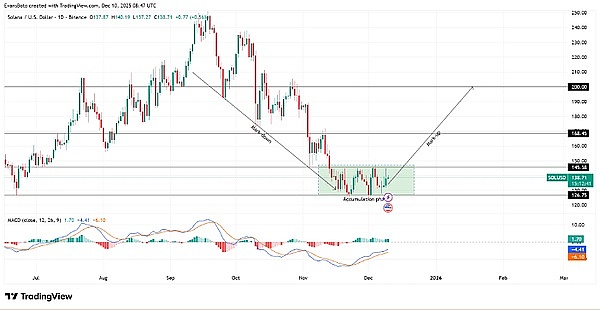
Solana (SOL) is showing multiple bullish signals, indicating a possible major price movement. Large investors, or "whales," have been aggressively accumulating SOL, with one new wallet withdrawing 200,000 SOL from Binance, reducing market supply by approximately $28 million and tightening exchange liquidity. Technically, SOL has formed a bullish MACD crossover, and its price is consolidating with higher lows within a $126-$145 range. A decisive break above the key $145 resistance level could trigger a rally toward $168 and beyond. On-chain data reveals a surge in organic demand, with DEX volume reaching $3.798 billion in 24 hours and $24.6 billion over the past week, a 12.7% increase. Furthermore, short sellers are being squeezed, with $293,000 in short liquidations—more than double the long liquidations—particularly on Binance around the $138.64 level. Futures market data shows persistent buying pressure, with the Cumulative Volume Delta (CVD) favoring buyers, indicating the accumulation of long-term positions rather than short-term speculation. This aligns with whale accumulation, suggesting coordinated capital deployment ahead of a potential upward move. In summary, SOL exhibits strong reversal signals from whale activity, technical indicators, on-chain momentum, and futures market dynamics. A sustained break above $145 is the critical level needed to confirm a shift from accumulation to a full bullish trend.

Solana (SOL) has been making subtle moves lately, with whales, technical indicators, and on-chain data all sending signals—is it gearing up for something big?

Whales on a Buying Spree, Drying Up Exchange Liquidity

SOL whales have been insatiable lately! A new wallet directly withdrew 200,000 SOL from Binance, reducing market supply by nearly $28 million in one go—this aggressive accumulation clearly signals bullish sentiment for future price action. Free group + QQ:3260353596

When whales make their move, SOL on centralized exchanges becomes scarcer. Tightened supply naturally fuels bullish sentiment. SOL is currently stuck at the upper end of the $126-$145 consolidation range, with big funds waiting to add more—all it needs is a breakout catalyst.

Technical Signals Unavoidable: MACD Golden Cross, Higher Lows

It's not just the whales; technicals are quietly improving too! The MACD line has risen above the signal line, forming a bullish golden cross—a clear sign of strengthening short-term momentum. Moreover, the price is consolidating near the midpoint of the range, with successively higher lows, erasing any trace of the previous downtrend.

Now, all eyes are on breaking the key resistance at $145! If it can hold above this level, the next target is $168, and if momentum remains strong, further upside potential awaits.
DEX Trading Volume Surges, Shorts Get Crushed

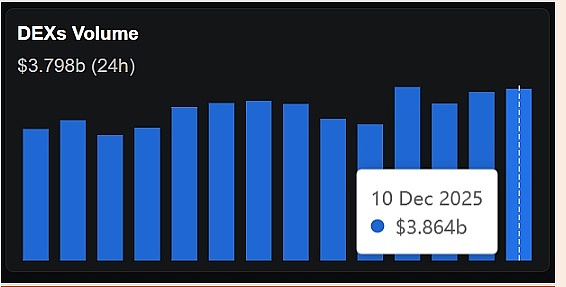
On-chain ecosystem news is also positive: SOL's DEX 24-hour trading volume surged to $3.798 billion, with a seven-day volume skyrocketing to $24.6 billion, up 12.7% week-over-week! This indicates increased willingness to trade on-chain, not just leverage speculation, signaling growing organic demand.
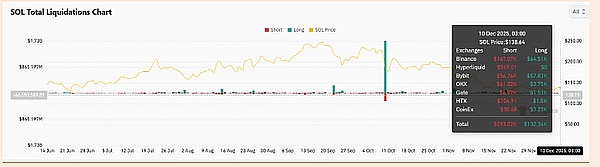
Even more satisfying for bulls—shorts are getting squeezed! Recently, SOL shorts were liquidations totaled $293,000, more than double the long liquidations, especially on Binance, where shorts kept betting on a drop below $138.64 but were repeatedly stopped by buyers. The more shorts lose, the weaker the downward momentum, paving the way for upward moves.
Futures Market Buyers Hold Firm, Long-Term Capital Accumulating

The futures market also tells a story: the buying CVD indicator has been skewed toward buyers, with purchases absorbing sell-offs even when sellers dump. This suggests participants aren't just speculating short-term but are quietly building long-term positions, growing increasingly confident in SOL. Free group + QQ:3260353596
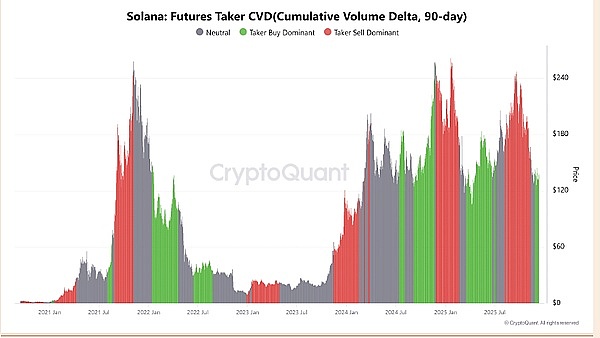
Moreover, whale accumulation aligns perfectly with futures buyers stepping in—no coincidence here. Capital is positioning early, awaiting the rally.

Summary: Break $145 and Take Off!

SOL's reversal signals are now evident: whale accumulation, strengthening technicals, active DEXs, and short liquidations. The key is whether it can break through $145 smoothly. If it holds above this level, SOL will transition from consolidation to uptrend mode, charging toward $168 and beyond. Free group + QQ:3260353596


Perguntas relacionadas

QWhat key price level is identified as the critical resistance point for SOL's potential bullish breakout?

AThe critical resistance point for SOL's potential bullish breakout is $145.

QHow many SOL tokens did a new whale wallet withdraw from Binance according to the article?

AA new whale wallet withdrew 200,000 SOL tokens from Binance.

QWhat technical indicator is mentioned as having formed a bullish crossover (golden cross)?

AThe MACD line rising above the signal line to form a bullish golden cross is mentioned.

QWhat was the 24-hour DEX trading volume for Solana, and what does this high volume suggest?

AThe 24-hour DEX trading volume for Solana was $3.798 billion, suggesting strong organic demand and increased on-chain activity rather than leveraged speculation.

QHow much was liquidated from SOL short positions recently, and how did it compare to long liquidations?

A$293,000 was liquidated from SOL short positions recently, which was more than double the amount liquidated from long positions.

Leituras Relacionadas

Dalio's Latest Warning: Don't Get Carried Away by AI, Real Returns on US Stocks in the Next 5-10 Years Could Be -5% to -10%

Ray Dalio, founder of Bridgewater Associates, warns investors against excessive concentration in AI stocks. He argues the current market, dominated by a few AI giants, mirrors historical patterns where revolutionary new technologies lead to high risk, volatility, and uncertainty. While acknowledging AI's transformative potential, Dalio emphasizes that most investors fail at this stage of the cycle by over-concentrating in a handful of leading companies. He cites inherent risks: companies cannot accurately forecast investment needs or external shocks (e.g., monetary policy, geopolitics, taxes), face potential disruption from future technologies and international competition (notably from China), and experience significant price swings. Dalio's core advice is diversification, calling it his "Holy Grail of Investing." He presents a mathematical case that a well-diversified portfolio of 15-20 uncorrelated, good bets offers a superior risk-adjusted return compared to a concentrated position. Dalio also offers a cautious outlook, suggesting U.S. stocks may deliver real returns of -5% to -10% over the next 5-10 years based on valuation and bubble indicators. He concludes that in the face of high uncertainty, the prudent strategy is not to avoid betting entirely, but to avoid large, concentrated bets where one lacks sufficient informational edge. Instead, investors should build a strategically balanced, diversified portfolio.

marsbitHá 46m

Dalio's Latest Warning: Don't Get Carried Away by AI, Real Returns on US Stocks in the Next 5-10 Years Could Be -5% to -10%

marsbitHá 46m

Rain Valuation Approaches $20 Billion: The Battle for U-Cards Extends to Rewards Systems

Rain, a stablecoin payments infrastructure company, is shifting the competitive focus for U Cards from simple issuance to user retention and repeated usage. On June 15, Rain launched "Rain Rewards," an embedded loyalty program capability within its card-issuing infrastructure. This allows partner businesses—like fintech platforms and neobanks—to configure branded loyalty points, earning rules, redemptions, and merchant promotions directly within their card products. The system, built from the 2025 acquisition of Uptop, ensures points are only issued upon final transaction settlement, preventing liabilities from refunds. Trials, such as with Avalanche Card, reportedly boosted spending by 25% among enrolled users. Founded by Farooq Malik and Charles Yoo-Naut, Rain evolved from a tool for managing Web3 company expenses into a full-stack enterprise platform. It is a Principal Member of Visa and Mastercard, enabling partners to issue stablecoin-backed cards and wallets while leveraging traditional payment networks. Notably, the popular U Card Plasma One is issued by Rain under Visa's authority. Rain also integrates with Visa's stablecoin settlement pilot, using USDC for network settlement. Rain's rapid funding reflects growing institutional interest in stablecoin payment infrastructure. It raised a $245 million Series A in March 2025, a $58 million Series B in August 2025, and a $250 million Series C in January of this year, reaching a $19.5 billion valuation. Annualized transaction volume exceeds $3 billion, serving over 200 partners including Western Union and Nuvei. Beyond cards, Rain is expanding into programmable payments. Its June 2026 "Agent Control Layer" allows businesses to set spending rules—like merchant categories, amounts, and frequency—for AI agents before transactions occur. This positions Rain not as a single product but as an operating system for stablecoin payments, handling everything from card issuance and wallet management to rewards, on/off-ramps, and automated compliance. The goal is to enable seamless, often invisible, real-world spending of on-chain assets.

Foresight NewsHá 49m

Rain Valuation Approaches $20 Billion: The Battle for U-Cards Extends to Rewards Systems

Foresight NewsHá 49m

Google TPU Shipments Revised Up by 50%

Recent industry research indicates a significant upward revision in the shipments of Google's TPU (Tensor Processing Unit) chips. Previous expectations for 2027 were set at around 10 million units, but new estimates now point to 15 million units, a 50% increase. This substantial boost directly translates to higher demand across the entire supporting supply chain. Google's TPU clusters utilize a standardized all-optical interconnect architecture. Consequently, key hardware components are deeply integrated and scaled in fixed ratios with the chips. The 15 million TPU target will drive corresponding demand increases for NPO optical engines (roughly a 1:1 match), 1.6T optical modules, OCS optical switches, high-end server power supplies, fiber optics & MPO connectors, and liquid cooling solutions. Among these, liquid cooling is highlighted as the sector experiencing the most significant transformation and offering the most stable potential for excess returns. As next-generation TPU chips reach power levels where traditional air cooling is insufficient, liquid cooling becomes essential. 2026 is forecasted as the first year of substantial adoption for Google's liquid cooling solutions. This shift, coupled with delivery and capacity bottlenecks faced by incumbent overseas manufacturers, is creating a prime window for domestic Chinese suppliers to enter and secure Google's core supply chain. The market size for Google-specific liquid cooling is projected to potentially triple from a baseline of hundreds of billions to around 300 billion units by 2028. The logic for the fiber optic sector is also being rewritten. Once considered a cyclical commodity tied to telecom operator procurement, fiber is now a strategic and scarce resource for AI Data Centers (AIDC). A severe supply-demand imbalance, driven by the long lead time for preform production (18-24 months) and surging demand from cloud giants, is supporting strong performance. Chinese fiber manufacturers are well-positioned to capture a significant share of global AIDC demand, with exports potentially reaching 200-300 million core kilometers in 2026. Overall, the investment focus within the AI computing industry is shifting from pure "chip performance speculation" towards the more certain incremental growth in computing infrastructure and its supporting ecosystem. The upward revision in Google TPU shipments, along with the potential for further doubling by 2028, is seen as solidifying performance visibility for the entire supporting supply chain over the next two years.

marsbitHá 2h

Google TPU Shipments Revised Up by 50%

marsbitHá 2h

Trading

Spot
Futuros

Artigos em Destaque

O que é ATWO

I. Introdução ao ProjetoArena Two é uma plataforma interativa descentralizada que permite aos fãs desempenhar um papel ativo e tokenizado nos resultados de eventos em tempo real. Ao contrário dos modelos tradicionais de transmissão que reduzem os fãs a espectadores passivos, a Arena Two utiliza a tecnologia blockchain para permitir que os fãs votem diretamente em tempo real e influenciem os resultados em campo.II. Informação sobre o TokenNome do token: ATWO(Arena Two)III. Links RelacionadosWebsite:https://arenatwo.com/Exploradores:https://basescan.org/token/0x499D35eBE6cEe9B2Ac35Fd003fcBbeeB9CFc7B32Twitter:https://x.com/arenatwoXNota: A introdução ao projeto provém dos materiais publicados ou fornecidos pela equipa oficial do projeto, que é apenas para referência e não constitui aconselhamento de investimento. A HTX não se responsabiliza por quaisquer perdas diretas ou indiretas resultantes.

258 Visualizações TotaisPublicado em {updateTime}Atualizado em 2026.06.02

O que é ATWO

Como comprar ATWO

Bem-vindo à HTX.com!Tornámos a compra de Arena Two (ATWO) simples e conveniente.Segue o nosso guia passo a passo para iniciar a tua jornada no mundo das criptos.Passo 1: cria a tua conta HTXUtiliza o teu e-mail ou número de telefone para te inscreveres numa conta gratuita na HTX.Desfruta de um processo de inscrição sem complicações e desbloqueia todas as funcionalidades.Obter a minha contaPasso 2: vai para Comprar Cripto e escolhe o teu método de pagamentoCartão de crédito/débito: usa o teu visa ou mastercard para comprar Arena Two (ATWO) instantaneamente.Saldo: usa os fundos da tua conta HTX para transacionar sem problemas.Terceiros: adicionamos métodos de pagamento populares, como Google Pay e Apple Pay, para aumentar a conveniência.P2P: transaciona diretamente com outros utilizadores na HTX.Mercado de balcão (OTC): oferecemos serviços personalizados e taxas de câmbio competitivas para os traders.Passo 3: armazena teu Arena Two (ATWO)Depois de comprar o teu Arena Two (ATWO), armazena-o na tua conta HTX.Alternativamente, podes enviá-lo para outro lugar através de transferência blockchain ou usá-lo para transacionar outras criptomoedas.Passo 4: transaciona Arena Two (ATWO)Transaciona facilmente Arena Two (ATWO) no mercado à vista da HTX.Acede simplesmente à tua conta, seleciona o teu par de trading, executa as tuas transações e monitoriza em tempo real.Oferecemos uma experiência de fácil utilização tanto para principiantes como para traders experientes.

141 Visualizações TotaisPublicado em {updateTime}Atualizado em 2026.06.02

Como comprar ATWO

O que é ZEST

I. Introdução ao Projeto1. O que é o Zest Protocol?O Zest Protocol é um protocolo de empréstimos nativo do Bitcoin construído na camada 2 do Stacks que permite aos utilizadores ganhar rendimento com BTC ou emprestar ativos colateralizando BTC. Os contratos inteligentes do protocolo são escritos na linguagem Clarity, operam totalmente em cadeia e são de código aberto, com um design inspirado no Aave v3. O Zest é atualmente o maior protocolo DeFi no Stacks, com mais de 800 BTC depositados e um pico de TVL superior a 100 milhões de dólares. Em maio de 2026, o protocolo introduziu ainda os Cofres de Colateral em Bitcoin, estendendo as capacidades de empréstimo do Stacks para a rede principal do Bitcoin. Isso permite que os utilizadores emprestem stablecoins sem mover BTC da rede Bitcoin, possibilitando empréstimos com custódia própria.2. Como funciona o Zest Protocol?O Zest Protocol consiste em dois mercados. O mercado do Stacks é construído sobre o Aave v3, permitindo que os utilizadores depositem ativos como sBTC, STX e USDC para ganhar rendimento ou contrair empréstimos sobre-colateralizados. O LTV máximo padrão é de 50% (70% para sBTC). O mercado do Bitcoin opera através dos recém-lançados Cofres de Colateral em Bitcoin. Os utilizadores emprestam stablecoins ao bloquear BTC em cofres de custódia própria na cadeia do Bitcoin. O colateral permanece na rede principal do Bitcoin durante todo o processo, e os utilizadores mantêm a custódia, a menos que a posição seja liquidada.3. Quem fundou o Zest Protocol?Tycho Onnasch (Co-Fundador): Formado na Universidade de Oxford. Envolvido em pesquisa e subsídios para a Stacks Open Internet Foundation. Antigo Gestor na Trust Machines e Fundador da Deedmob. Perfil do LinkedIn: https://www.linkedin.com/in/tychokoonnasch/.Fernando Foy (Co-Fundador): Trabalhou anteriormente em consultoria de TI na Objectif Emploi. Perfil do LinkedIn: https://www.linkedin.com/in/fernando-foy/.Emil E. (Co-Fundador): Possui um Mestrado em Física pela Universidade de Warwick. Antigo Partner de Engenharia na Trust Machines, Desenvolvedor Full-Stack para projetos Web3 e Cientista de Dados no HSBC. Perfil do LinkedIn: https://www.linkedin.com/in/emil-e-49771a145/.Detalhes de Financiamento: Em maio de 2024, o Zest Protocol anunciou a conclusão de uma ronda de financiamento inicial de 3,5 milhões de dólares liderada por Tim Draper, com a participação da Binance Labs, Flow Traders, Trust Machines, entre outros.4. Tokenomics do $ZEST$ZEST é o token nativo do Zest Protocol com um fornecimento total fixo de 1 mil milhões de tokens e sem mecanismo inflacionário.Comunidade (27,83%): Usado para airdrops e incentivos aos utilizadores;Desenvolvimento do Ecossistema (24,82%): Usado para liquidez, parcerias, marketing, listagens em bolsas, etc.;Investidores (22,35%): Apoio às partes investidoras que apoiaram o desenvolvimento inicial do Zest Protocol;Equipa (25%): Alocado para colaboradores principais.Calendário de Vesting: Os tokens da Equipa e dos Investidores estão sujeitos a um período de bloqueio de 1 ano, seguido de 3 anos de desbloqueio linear.5. Cronologia dos Principais Marcos2022: O Zest Protocol é oficialmente fundado.Março de 2024: Concluída a auditoria de segurança e lançado o mercado de empréstimos do Stacks na rede principal.Em fevereiro de 2026, é lançado o Stacks Market V2, introduzindo Grupos de Risco.Em maio de 2026, foram introduzidos os Cofres de Colateral em Bitcoin, e um protótipo operacional da rede principal está agora disponível. Isso permite que os utilizadores utilizem BTC com custódia própria na L1 do Bitcoin como colateral para emprestar stablecoins em cadeias EVM, encerrando a necessidade de bridging, wrapping e custódia de terceiros. Este lançamento é dividido em duas fases. Fase 1: Utiliza transações pré-assinadas para restringir o movimento de BTC; Fase 2: Utiliza BitVM para verificação. II. Informações sobre o TokenNome do token: ZEST (Zest Protocol)III. Links RelacionadosWebsite: https://www.zestprotocol.com/Exploradores: https://bscscan.com/token/0x5506599c722389a60580b5213ea1da60d64754a1Twitter: https://twitter.com/ZestProtocolNota: A introdução ao projeto provém dos materiais publicados ou fornecidos pela equipa oficial do projeto, que é apenas para referência e não constitui aconselhamento de investimento. A HTX não se responsabiliza por quaisquer perdas diretas ou indiretas resultantes.

207 Visualizações TotaisPublicado em {updateTime}Atualizado em 2026.06.02

O que é ZEST

Discussões

Bem-vindo à Comunidade HTX. Aqui, pode manter-se informado sobre os mais recentes desenvolvimentos da plataforma e obter acesso a análises profissionais de mercado. As opiniões dos utilizadores sobre o preço de A (A) são apresentadas abaixo.

活动图片