Silver Is Soaring, Can Tokenized Silver Amplify Leverage Further?

marsbitPublicado em 2026-01-27Última atualização em 2026-01-27

Resumo

Silver prices have surged dramatically, breaking historical records by reaching over $117 per ounce and accumulating a 517% increase since 2017—outpacing both Bitcoin and gold. With a market cap of approximately $6.18 trillion, silver is the second most valuable asset globally. This rally has spurred interest in tokenized silver as a way to gain exposure, including through leveraged contracts. Two major tokenized silver assets stand out: - **Kinesis Silver (KAG)**, with a market cap of $406 million, is backed by physical silver (1 token = 1 oz), offers global payments and redemption, but carries issuer dependency and regulatory risks. - **iShares Silver Trust (SLV)**, with a $39.5 million market cap, tracks a traditional ETF managed by BlackRock, provides good liquidity and institutional backing, but does not allow physical redemption and incurs management fees. Additionally, leveraged trading is available on platforms like Hyperliquid, Binance (offering up to 20x leverage on XAG/USDT), and Bitget, with significant trading volumes. The surge is driven by factors including Trump’s trade policies, expectations of U.S. interest rate cuts, silver’s new classification as a critical mineral in the U.S., supply constraints, and its role as a hedge amid geopolitical tensions. Analysts suggest the rally may continue due to these structural and macroeconomic tailwinds.

Original|Odaily Planet Daily(@OdailyChina)

Author|Wenser(@wenser 2010)
Silver, this precious metal asset once called "poor man's gold," is sweeping the global market with a storm-like momentum. The reason is none other than its terrifying surge.

Recently, the price of silver once broke through $117 per ounce intraday, hitting a record high. As a result, since the high point of the 2017 crypto cycle, silver has officially surpassed Bitcoin's gain (about 500%) and gold's gain (slightly less than 300%) with a cumulative increase of approximately 517%. According to data from the 8marketcap website, the current price of silver is around $110, with a market capitalization reaching $6.18 trillion, ranking second among global assets, second only to gold. Such an astonishing trend naturally triggers market frenzy. Besides buying silver funds or physical silver through traditional brokers or offline stores, tokenized silver might also be an option, especially the leveraged contracts on exchanges and on-chain Perp DEXs.

Current State of Tokenized Silver: Only 2 Targets Have Relatively Good Liquidity

According to data from the Coingecko website, the overall market capitalization of the tokenized silver sector is temporarily reported at approximately $446 million, with a 24-hour increase of about 5.6%; specifically, the tokenized silver with relatively good liquidity are the following 2 types:

Kinesis Silver (KAG): Market cap temporarily reported at $406 million

Like the gold token KAU, the KAG silver token is launched by Kinesis, a British digital asset utility platform registered in the Cayman Islands. Major trading platforms include Kinesis Money, BitMart, UAE exchange Emirex, and others.

It is understood that KAG is backed by fully insured and regularly audited vaults (globally distributed storage), with each token pegged to 1 ounce of investment-grade silver; it supports global real-time payments; supports physical silver redemption; and has no storage fees.

Its potential risks are similar to those of the Tether company, which issues the XAUT gold token. This token highly depends on the asset credibility of the issuer and faces certain regulatory uncertainties. Furthermore, limited by its small market cap, the market depth is relatively average, and market fluctuations may lead to premiums or discounts, relying more on the trading platform to manage order matching.

Nevertheless, information on the Coingecko website shows that KAG's 24-hour trading volume is about $5.5 million, already ranking second in trading volume in the tokenized silver market.

iShares Silver Trust(SLV): Market cap temporarily reported at $39.5 million

A silver token pegged to the iShares Silver Trust, launched by Ondo Finance, holds the corresponding physical silver through the BlackRock iShares Silver Trust (SLV) ETF.

Its advantages lie in tracking a regulated traditional SLV ETF, having good liquidity, and supporting instant minting or redemption (for users outside the US); combining traditional finance with blockchain convenience; institutional-level endorsement; no need to handle physical silver directly.

Its potential risks include: primarily relying on the asset credibility of issuers like BlackRock and Ondo; does not support physical silver ownership or direct redemption; includes certain ETF fund management fee costs; US users are restricted from trading, and it faces potential securities regulatory restrictions.

Main trading platforms include centralized exchanges such as Gate, Bitmart, Bitget, AscendEX, etc.

It is worth mentioning that SLV also supports contract trading, with leverage up to 10x.

Coingecko website information shows that SLVON's 24-hour trading volume is about $21.2 million, ranking first in trading volume in the tokenized silver market.

Besides the two major silver tokens KAG and SLVON, the silver token Silver rStock (SLVR) launched by Solana生态 stock tokenization platform Remora Market, and the Gram Silver (GRAMS) token pegged to 1 gram of silver launched by Token Teknoloji A.Ş also belong to spot tokens, but their market capitalization and liquidity are extremely low. Compared to KAG and SLVON, the price difference from physical silver is larger, and participation in trading is not recommended.

Silver Leverage Trading Platforms: Hyperliquid, Binance, Bitget, and other exchanges

Besides spot silver tokens, currently many US stock tokenization platforms, on-chain Perp DEXs, CEXs, and DEXs have opened leveraged contract trading related to silver, supporting leverage up to 20x. The following are specific trading platforms for readers' reference:

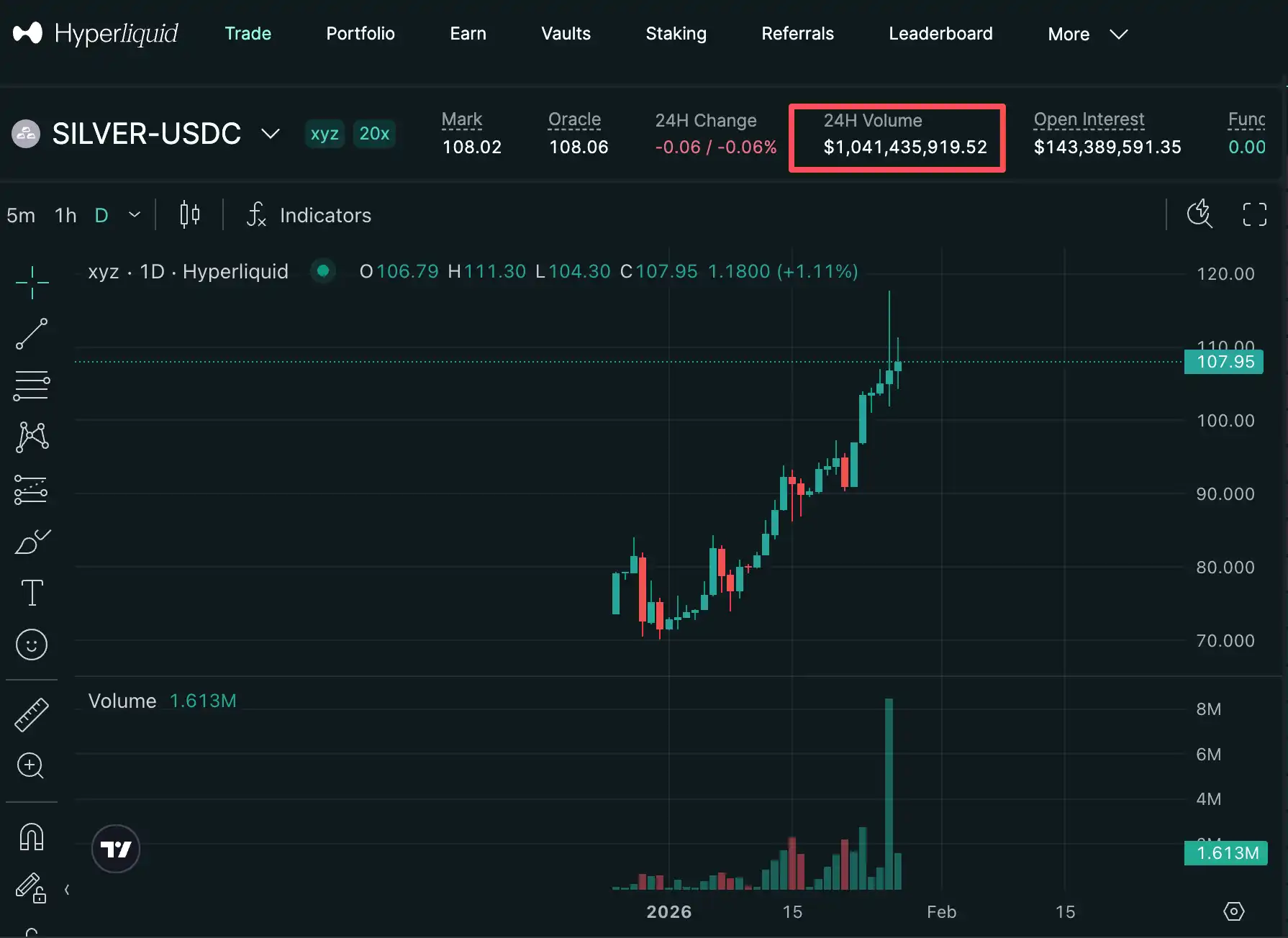
Channel One——Hyperliquid: https://app.hyperliquid.xyz/trade/xyz:SILVER, the Silver/USDC contract trading pair's 24-hour trading volume exceeded $1 billion;
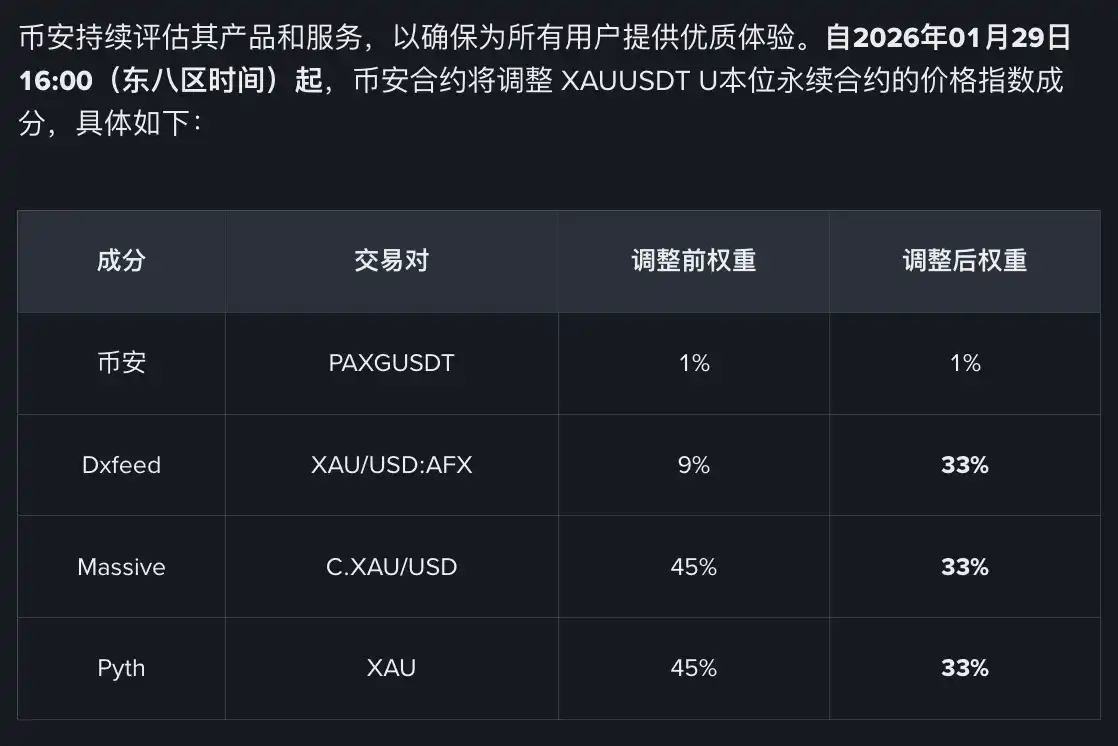
Channel Two——Binance:https://www.binance.com/zh-CN/futures/XAGUSDT, supports leveraged trading for the XAG/USDT trading pair, with leverage up to 20x. Currently, the 24-hour trading volume is $1.32 billion. According to the announcement, this trading pair was officially opened on January 7th; the latest news shows that Binance will change the price index composition of this contract on January 29, 2026.
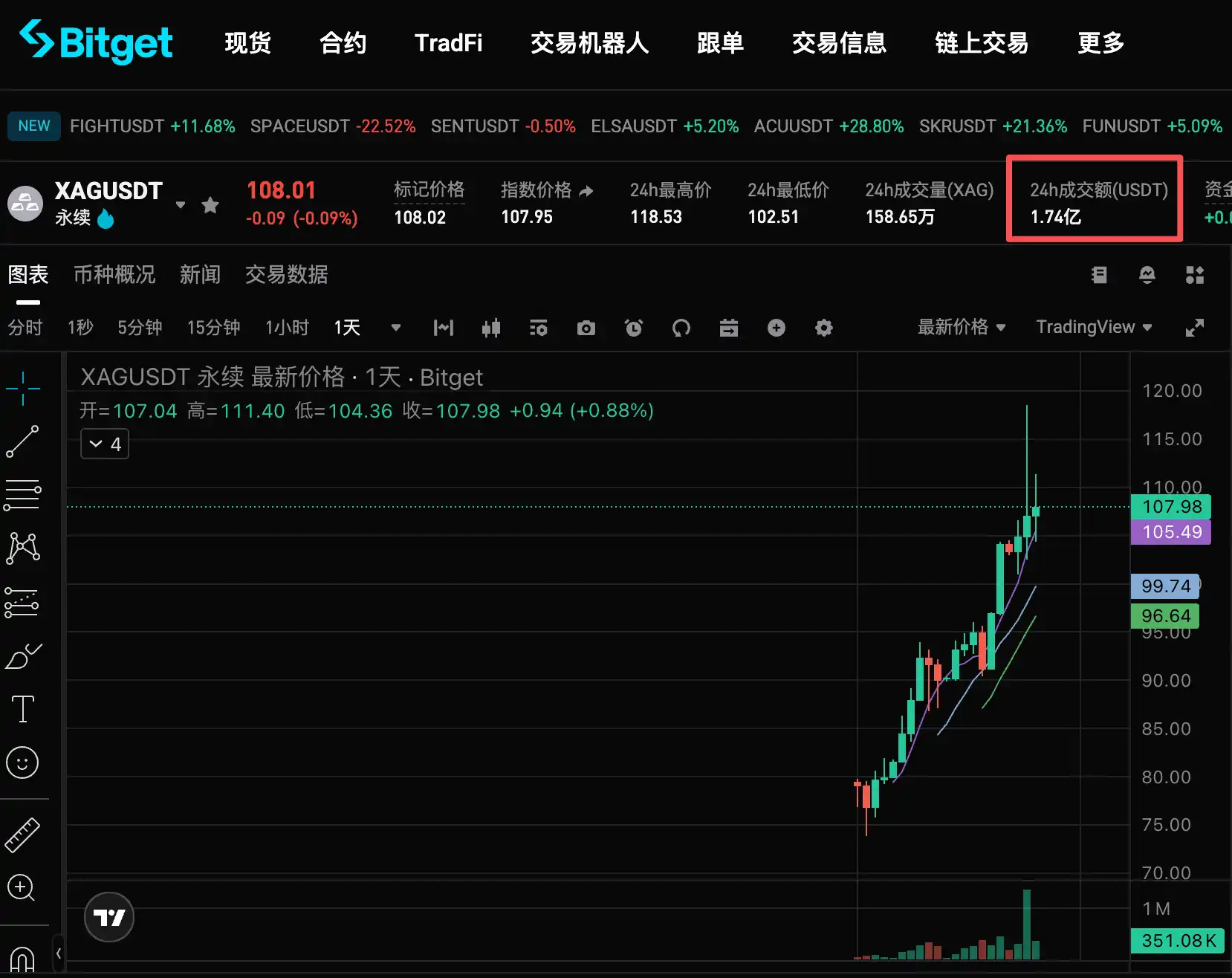
Channel Three——Bitget:https://www.bitget.site/zh-CN/futures/usdt/XAGUSDT, supports leveraged trading for the XAG/USDT trading pair, with leverage up to 20x. Currently, the 24-hour trading volume is $174 million.
Conclusion: Trump's Hawkish Policies and Dovish Rate Preferences Will Be the Best Catalyst for Precious Metals

Looking back, Trump's rise to power leading to tense international political and economic situations, tariff trade wars, and his preference for Federal Reserve rate cuts are the best catalysts for the rise in precious metal prices. Specifically for silver, besides past reasons like supply tightness and its role as an important raw material, risk-off assets and the US attitude are crucial.

J. Safra Sarasin strategist Claudio Wewel pointed out that the continuous surge in silver prices stems from the market's reduced expectations for US rate cuts and silver's newly acquired status as a key mineral. The US Department of the Interior listed silver as a critical mineral in November, increasing the possibility of the US imposing tariffs on this metal. He noted that this exacerbates long-term supply tightness and prompts US importers to accelerate silver purchases. Meanwhile, retail investors, finding it difficult to buy gold at historically high prices, are turning to silver as a safe-haven asset.

In other words, silver's main rise comes from both "scarcity" and "safe-haven nature." Combined with the recently tense Middle East situation again, the price peak for silver may be far from over.


Perguntas relacionadas

QWhat are the two tokenized silver assets with relatively good liquidity mentioned in the article?

AKinesis Silver (KAG) and iShares Silver Trust (SLV).

QWhich platform offers a silver contract with up to 20x leverage and has a 24-hour trading volume of 13.2 billion US dollars?

ABinance, for the XAG/USDT trading pair.

QWhat are the main reasons cited for the surge in silver prices according to the article?

AMarket expectations of reduced US interest rate cuts, its new status as a US critical mineral (increasing potential tariffs), long-term supply tightness, and its role as a risk-off asset for retail investors.

QWhat is the key difference between the KAG and SLV tokenized silver products regarding physical redemption?

AKAG supports physical silver redemption, while SLV does not offer direct physical silver ownership or redemption.

QWhich on-chain Perp DEX is mentioned for trading a silver/USDC perpetual contract with a significant 24-hour volume?

AHyperliquid, for its SILVER/USDC trading pair.

Leituras Relacionadas

The Macroeconomic Underpinnings of Africa's Payment Market Landscape

The African payments market, characterized by the world's highest mobile money penetration and fastest-growing cryptocurrency adoption, is not a coincidence but a macroeconomic necessity driven by deep structural factors. Two key drivers create this landscape: (1) Africa's heavy reliance on commodity exports, trade, and remittances, generating massive cross-border settlement and remittance demand; and (2) chronically underdeveloped financial infrastructure, exacerbated by international bank de-risking, foreign exchange mismanagement, and persistent inflation. This vacuum has allowed mobile money and crypto to thrive. Mobile money platforms replace banks for domestic payments, while cryptocurrencies serve as a store of value against local currency depreciation and a low-cost medium for cross-border exchange. A crucial division lies along the Sahara Desert. North Africa is integrated into the oil-anchored MENA framework, while Sub-Saharan Africa (SSA), plagued by dollar shortages and fragmented currencies, has become a natural, massive market for mobile money and crypto. Nigeria, Kenya, and South Africa are global leaders in adoption. The SSA economy is deeply dollarized due to currency instability, yet suffers from a severe "dollar shortage" caused by trade deficits and limited export capacity. This creates parallel forex markets and high remittance costs. Cryptocurrencies, particularly stablecoins, fill this gap by providing access to dollar liquidity, cheaper cross-border transfers, and an inflation-resistant store of value, primarily driven by retail users for small-value transactions. While regional initiatives like PAPSS aim to reduce dollar dependence, the fundamental constraints of commodity reliance, trade imbalances, and shallow financial markets persist. Therefore, mobile money and cryptocurrencies are not niche trends but essential financial infrastructure filling a structural void, and they are likely to remain central to Africa's economic landscape for the foreseeable future.

链捕手Há 7m

The Macroeconomic Underpinnings of Africa's Payment Market Landscape

链捕手Há 7m

Is the Sharp Decline Over? Let the Data Speak

**Has the Sharp Decline Ended? Let Data Speak** Bitcoin's recent significant drop has placed short sellers in a precarious position. Three concurrent pressures—sustained outflows from ETFs, miners offloading coins to exchanges, and short-term holders capitulating—pushed the price near $63k. The asset fell 13% this week and 21% this month, roughly halving from its all-time high. A critical data point is the extremely crowded short positioning, with a short-to-long ratio reaching 8:1, representing nearly $100 billion in short interest overhead. This creates conditions for a potential short squeeze if selling pressure merely pauses, similar to the event in November 2022 which triggered a 24% rally. The selling pressures are real: spot Bitcoin ETFs have seen a record $5.4 billion outflow over 20 days. Short-term holders moved 53k loss-held BTC to exchanges in a day, and miners sent 24k BTC to Binance, a six-month high. Capital is also rotating towards AI and tech stocks like SpaceX, with $400 billion invested in AI infrastructure recently. However, on-chain data shows accumulation by long-term holders, who added 200k BTC in a month, and institutions/miners have absorbed 1.24 million BTC since 2023. This indicates strong buying beneath the surface. Key levels to watch are the $67k-$70k zone (2021 high & 2024 breakout point). A swift recovery above it suggests a leverage washout; failure could test $60k-$55k. The direction also hinges on ETF flow reversal. Currently, the S&P 500 hits new highs driven by AI, while Bitcoin and DeFi (TVL down from $173b to $73.9b) lag. The most probable path is a grinding basing process between $60k-$58k with continued ETF outflows. A less likely but explosive scenario involves a sudden flow reversal, a surge above $70k triggering a short squeeze, and a rally back above $76k. The immediate trigger depends on when the relentless selling pauses. A final cautionary note questions Bitcoin's correlation: if the high-flying U.S. stock market corrects, will Bitcoin once again miss the rally but not the decline?

foresightnews_apiHá 22m

Is the Sharp Decline Over? Let the Data Speak

foresightnews_apiHá 22m

Single-Day Plunge of 30%, Arthur Hayes Suddenly Liquidates: Why Did ZEC Get Exploded by Security Issues?

On June 5th, Zcash founder Zooko Wilcox disclosed a critical soundness vulnerability in the project's latest Orchard privacy pool. This flaw, found in the elliptic curve multiplication constraints, could allow an attacker to create unlimited counterfeit ZEC within the shielded pool, with transactions appearing valid. The vulnerability was discovered in late May by security researcher Taylor Hornby, who utilized Anthropic's new Opus 4.8 AI model for a targeted audit. The Zcash ecosystem had already performed an emergency network upgrade to patch the issue. However, the detailed disclosure triggered severe market panic, causing ZEC's price to plummet over 30% in a single day. Notably, prominent investor Arthur Hayes announced he had sold his entire ZEC position following the news. The incident starkly challenges the "technological trust" narrative central to privacy coins. Despite years of top-tier cryptographic audits, the bug persisted until uncovered with advanced AI-assisted research. This highlights the growing gap between theoretical perfection and practical implementation in privacy technology. The event serves as a industry-wide warning: in an AI-driven security landscape, the assumption that "undiscovered equals safe" is obsolete. It underscores the urgent need for continuous, proactive security practices combining AI audits, formal verification, and rapid response mechanisms.

foresightnews_apiHá 1h

Single-Day Plunge of 30%, Arthur Hayes Suddenly Liquidates: Why Did ZEC Get Exploded by Security Issues?

foresightnews_apiHá 1h

Trading

Spot
Futuros

Artigos em Destaque

Como comprar T

Bem-vindo à HTX.com!Tornámos a compra de Threshold Network Token (T) simples e conveniente.Segue o nosso guia passo a passo para iniciar a tua jornada no mundo das criptos.Passo 1: cria a tua conta HTXUtiliza o teu e-mail ou número de telefone para te inscreveres numa conta gratuita na HTX.Desfruta de um processo de inscrição sem complicações e desbloqueia todas as funcionalidades.Obter a minha contaPasso 2: vai para Comprar Cripto e escolhe o teu método de pagamentoCartão de crédito/débito: usa o teu visa ou mastercard para comprar Threshold Network Token (T) instantaneamente.Saldo: usa os fundos da tua conta HTX para transacionar sem problemas.Terceiros: adicionamos métodos de pagamento populares, como Google Pay e Apple Pay, para aumentar a conveniência.P2P: transaciona diretamente com outros utilizadores na HTX.Mercado de balcão (OTC): oferecemos serviços personalizados e taxas de câmbio competitivas para os traders.Passo 3: armazena teu Threshold Network Token (T)Depois de comprar o teu Threshold Network Token (T), armazena-o na tua conta HTX.Alternativamente, podes enviá-lo para outro lugar através de transferência blockchain ou usá-lo para transacionar outras criptomoedas.Passo 4: transaciona Threshold Network Token (T)Transaciona facilmente Threshold Network Token (T) no mercado à vista da HTX.Acede simplesmente à tua conta, seleciona o teu par de trading, executa as tuas transações e monitoriza em tempo real.Oferecemos uma experiência de fácil utilização tanto para principiantes como para traders experientes.

468 Visualizações TotaisPublicado em {updateTime}Atualizado em 2026.06.02

Como comprar T

Discussões

Bem-vindo à Comunidade HTX. Aqui, pode manter-se informado sobre os mais recentes desenvolvimentos da plataforma e obter acesso a análises profissionais de mercado. As opiniões dos utilizadores sobre o preço de T (T) são apresentadas abaixo.

活动图片









