SharpLink's Helm: Buying Only, Never Selling, Making ETH Generate Profits Through the Cold Winter

Odaily星球日报Publicado em 2026-07-29Última atualização em 2026-07-29

Resumo

SharpLink co-CEO Joseph Chalom shares his bullish outlook on Ethereum during the recent "Injective Summit 2026." Despite prevailing negative market sentiment, Chalom argues that fundamentals and data tell a different story: Ethereum dominates with over 50% of stablecoin transaction volume, nearly 60% of tokenized real-world assets (RWA), and remains the uncontested leader in DeFi. He attributes the communication gap and lack of confidence partly to the Ethereum Foundation's restructuring. In response, SharpLink, alongside ConsenSys and Bitmain, is funding three key spin-off teams from the Foundation: ETH Labs (for institutional-scale scalability), Ethereum Institutional (for business development and marketing), and EthSystems (for next-gen privacy and compliance solutions). Chalom emphasizes these are critical for accelerating institutional adoption. Regarding SharpLink's strategy, Chalom details a conservative, yield-focused approach. The firm holds 886,725 ETH, acquired with zero leverage or debt. They generate revenue by staking ETH and strategically deploying capital into DeFi protocols via a dedicated fund, aiming for returns above the native staking yield. This contrasts with some Bitcoin-focused firms that have become net sellers. On the broader institutional adoption of tokenization, Chalom sees current progress as just the beginning. He breaks it down into layers: stablecoins as the currency/value layer, tokenized assets as the exposure layer, and DeFi as the exec...

Original article byTony Edward

Compiled by|Odaily Planet Daily Qin Xiaofeng(@QinXiaofeng 888 )
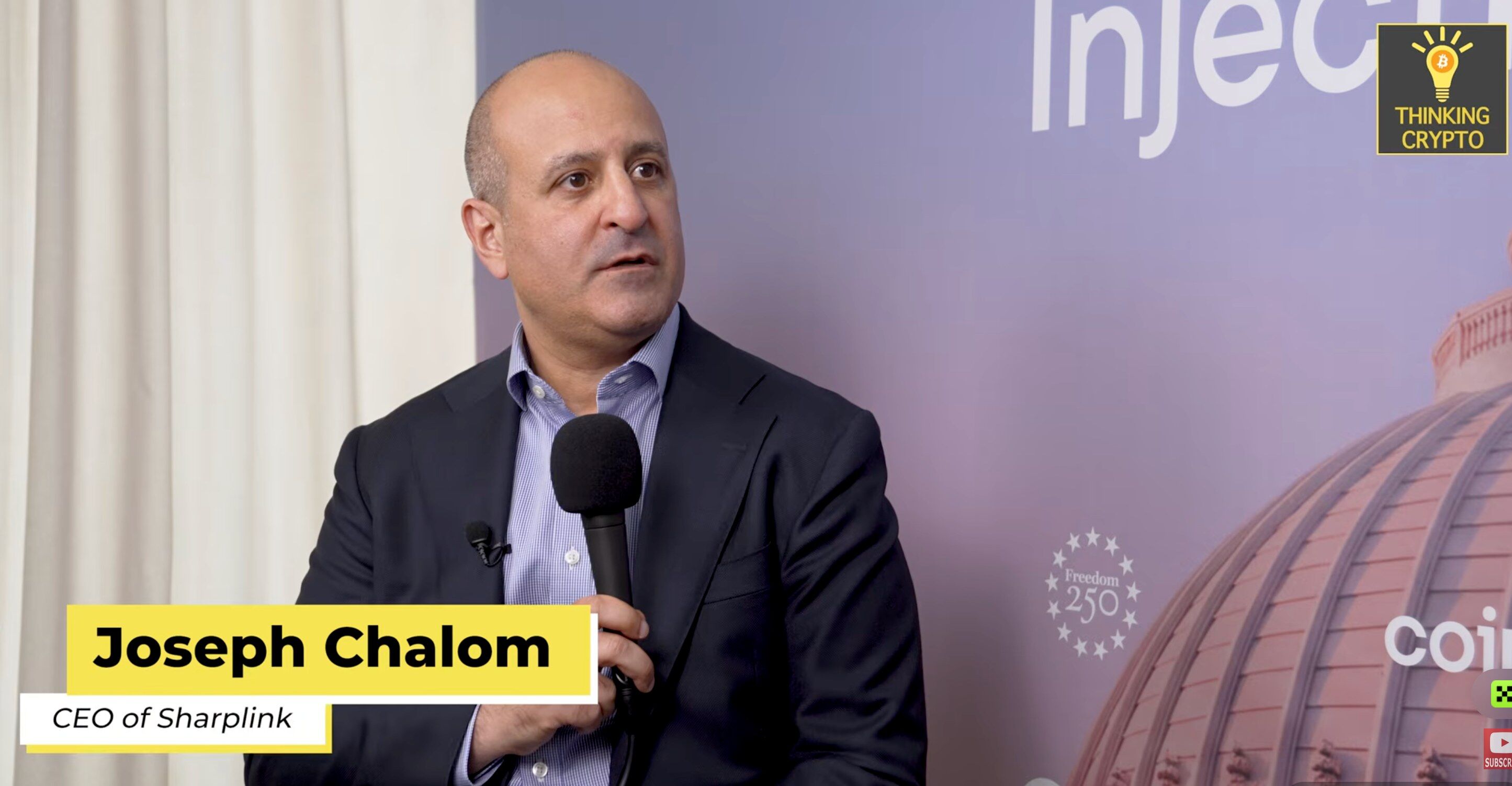
Editor's Note: At the recent "Injective Summit 2026" in Washington, D.C., SharpLink Co-CEO Joseph Chalom gave an exclusive interview.

He stated that while current market sentiment towards Ethereum is pessimistic, there is a divergence between reality and market sentiment. In reality, multiple data points from the Ethereum ecosystem indicate a bright future: stablecoin transaction volume accounts for over 50%, tokenized RWAs nearly 60%, and its DeFi dominance remains unchallenged. He said, "Ethereum is winning, but there's a communication problem." SharpLink has already joined forces with giants like ConsenSys, investing heavily to support three core teams spun off from the Ethereum Foundation, focusing on institutional-grade scaling, privacy/compliance, and market promotion. More crucially, they adopt zero leverage and no borrowing during the bear market, insisting on making ETH "productive" to generate revenue, and predict that tokenization and 24/7 trading will ignite the next wave of institutional adoption.

This week, ETH once surged close to $2000, and the ETH/BTC exchange rate also reached 0.03, hitting a nearly 3-month high, seemingly indicating that things are improving. Additionally, after roughly 8 months without large-scale new purchases, SharpLink bought another 10,000 ETH in June this year at an average cost of about $1611; after this purchase, their total ETH holdings reached 886,725 ETH.

The following is the original interview dialogue, Enjoy~

————————

Host (Tony Edward/Thinking Crypto): Everyone, we are recording at the Injective Policy Summit in Washington, D.C., and with me today is Joseph Chalom, CEO of SharpLink. Joseph, great to see you.

Joseph Chalom: Great to be back with you. First, a quick introduction: we are a digital asset capital management firm. We've raised billions of dollars to buy Ethereum (ETH) and make it highly efficient. The two most interesting things in the last month: first, we returned to the public markets for an equity raise and actually bought back ETH at a very good price and repurchased some stock. Second, together with Joe Lubin from ConsenSys and Tom Lee from Bitmine, we've started to support and invest in spin-out projects from the Ethereum ecosystem, which will be very positive for Ethereum's new narrative and new era.

Host: There's been a lot of negative sentiment around ETH lately, including some skepticism towards the Ethereum Foundation. Do you think this negativity is just a symptom of the bear market?

Joseph Chalom: Actually, I think for about the last year and a half, there's been a divergence between reality and market sentiment.

The reality is, let's start with the very positive side. The Ethereum ecosystem accounts for over 50% of all stablecoin transaction volume and nearly 60% of tokenized real-world assets, and the vast majority of DeFi is built on Ethereum. So if you look at the report card, they are winning. The sentiment is quite negative largely because of the industry malaise and because the Ethereum Foundation—though it has done a great job for the last decade or so—made the decision to streamline and have more ecosystem participants support the roadmap. And the way that communication happened led to a lack of clarity and confidence in the ecosystem, even though it is actually winning.

So some of us as ecosystem stewards and large holders of ETH have stood up, and we're putting our money where our mouth is, and I'm happy to share some of the things we are doing as an industry collective.

Host: Dive a little deeper into that. What are some specific actions?

Joseph Chalom: Start with the positive. Ethereum is the longest-running blockchain other than Bitcoin, never gone down, most secure, most trusted, most liquid. It also has a multi-year, very aggressive scaling roadmap.

Now, their ethos and approach now is to get back to its roots. The Ethereum Foundation will focus on privacy and censorship resistance and some core tenets to ensure Ethereum stays credibly neutral for decades to come. But what that means is that some of the most critical talent and functions inside the Foundation have been spun out. In the last three weeks or so, three teams have spun out of the Ethereum Foundation and have gotten the backing of Joe Lubin, myself, and Tom Lee from Bitmine. These are actually super critical for institutional adoption.

I'll tell you who they are. The first is ETH Labs, some of the most powerful developers in the Ethereum ecosystem, building the scaling capability that institutions need. The second is Ethereum Institutional, which is the go-to-market front-end, the business development activities, spun out of the Foundation with our support. And just earlier this week, the three of us also backed EthSystems, who are building next-gen privacy and compliance capabilities on Ethereum, an absolute necessity for the largest institutions to transact and ensure their data privacy. It might sound like three disparate nodes in the ecosystem, but these are the three most important things that will drive institutional adoption over the next year and beyond.

Host: That's interesting. I see a lot of institutions, when they're preparing to do tokenization and dive into DeFi and other areas, they start with Ethereum, and then they eventually expand to other chains.

Joseph Chalom: Exactly. As I said before, Ethereum has the characteristics that institutions need. I worked at BlackRock for 20 years, I know that before you want to move financial rails that have been around for 40, 50, 60 years, you want to move to a system that is trusted, never goes down, secure, and most liquid. Most importantly, people don't talk about decentralization enough.

Truly decentralized blockchain means that once you make a decision, the rules cannot be changed. So, having a fully distributed decentralized chain, not controlled by a single individual or a single treasury, is super important for institutions because they are doing a generational infrastructure migration.

Host: Absolutely agree. So during the bear market, how is SharpLink creating value for shareholders? Is it through staking, DeFi protocols to generate passive income?

Joseph Chalom: Of course. During the digital asset capital management craze last summer, about six or seven Ethereum digital asset capital management firms, and maybe five Solana capital management firms launched. Only a few of us were able to raise billions of dollars and achieve scale-out speed. You need scale when you compete in this industry.

What we do is, first, use all that capital to buy ETH, and then from day one make it productive, because ETH itself is a productive asset. You can stake it, get 2.5% to 3% yield. We've been doing that and making it more efficient than that benchmark. We also participate in DeFi. We announced a $125 million fund with another public company Galaxy, deploying our ETH into new protocols, helping them launch and get so-called TVL (Total Value Locked) or initial capital. So, we make ETH produce more than the native staking yield.

Finally, I'll say that when you start a business and 3 months later hit consolidation, winter, cycle, you really see who is running a public company in an institutional way. We didn't take on debt, didn't issue preferred stock, didn't borrow against our ETH. We decided to be conservative during the winter. A few of us survived, holding billions of dollars worth of ETH. That's how we protect our investors.

Honestly, going through winter is not fun, but treating investors with respect has always been what motivates us. You know, after winter comes spring and summer. When the market recovers, we are positioned very well. And we are starting to see the recovery in ETH. Just since these recent announcements, ETH is up about 20% from the lows. Short term is indeed challenging, but the long-term adoption story has never been more optimistic.

Host: That's really great to hear. I love that you didn't take on debt because I think that's risky and goes somewhat against the spirit of crypto.

Joseph Chalom: Yes. You know, I have respect for Michael Saylor; he basically invented a new asset exposure vehicle. You can own a public company and get exposure to Bitcoin.

The challenge in the Bitcoin space is that it's not inherently productive. The only way to have your Bitcoin compound and generate yield is to financialize your stock, issue convertible bonds, preferred stock. And then you might get into a pickle where you ultimately have to sell your reserve asset. That's been a challenge for the Bitcoin community because the digital asset capital management firms, including Michael Saylor's, have gone from being large net buyers of Bitcoin to now being sellers, which is very detrimental to short-term price action.

Host: Absolutely correct. Joseph, with your background at BlackRock and in TradFi, you have a wealth of experience. What's your outlook on institutional adoption of this technology? It seems everyone on Wall Street is looking into tokenization, getting involved with stablecoins, DeFi.

Joseph Chalom: Yes, I think the tokenization space, whether it's tokenizing the dollar into stablecoins or tokenizing treasuries or real-world assets, has been a phenomenon for about 8 or 9 years now.

Progress has actually been fairly slow so far, largely due to a lack of regulatory clarity. I want to describe to people in very simple terms how these things work together and how they layer on top of each other.

You can think of stablecoins as the dollar or value layer of future finance, you can think of tokenized assets as the asset exposure layer, and DeFi is the execution layer. If you have the money layer, exposure layer, and execution layer, you are off to the races. What you're starting to see is not just the tokenization of new funds but also the tokenization of existing multi-billion dollar funds and the tokenization of stocks. Getting one step more complicated, there's another layer, which is you have cash, assets, execution layer. Agentic will be the automation layer.

I think we are still in the bottom of the first inning. We are waiting for more regulatory clarity, but institutions have gone from a learning phase to an experimentation phase to now moving into production, and now it's a race not to be left behind.

Host: Do you feel that once something like the Clarity Act passes, it would serve as a catalyst or give confidence to institutions to innovate and invest more?

Joseph Chalom: 100%. I think the Clarity Act is super important in two ways. One, it clarifies that if you are a DeFi developer, you are a software provider, you are not responsible for the actions that happen on your software, but if you as a DeFi protocol hold client assets, then you are regulated and responsible for everything that happens. So the future of DeFi becomes brighter with the Clarity Act.

The second point, I think it also affects market sentiment and momentum. In crypto, even a little tailwind can lead to an outsized move.

The third point is, if you are at a large institution and your leadership is interested in digital assets, then with the "good housekeeping" seal of approval from the government, you have more room to do things faster that you might have done slowly. I think we'll see a lot of momentum this summer. And I think we'll get to a point where tokenization will be the norm, not the exception.

Host: Do you think there will be major challenges when some companies tokenize while traditional markets still exist? For example, you could have a tokenized version of Tesla stock, but there's still the traditional stock on the stock market. What differences or issues do you see arising?

Joseph Chalom: I think the biggest challenge is having disparate liquidity pools. For tokenization to succeed, we need to ensure the digital version of the stock or fund has similar trading volume and liquidity as the traditional version. But any time there is technological progress, there is analog and digital side-by-side. Like slow trains and fast trains running on parallel tracks, eventually they all become fast.

But I think the more important inflection point is this: Imagine a world where your government announces a war in the Middle East on a Friday night, and suppose you hold the analog version of a stock in your portfolio and you want to sell it. If you hold the digital version, you can trade 24/7 and express your view. You want to go long oil companies, you can. You want to sell consumer cyclical stocks, you can.

At some point, the fiduciaries deciding whether to buy the analog version or the digital on-chain version will almost certainly choose to buy and hold the on-chain version because it's 24/7 tradable, programmable, and instantly settles. So fiduciaries will get to a point and say to themselves: I can't hold the slow analog version because I can't express my view over the weekend. So at some point, there will be a tipping point, and I think that's still a few years away.

Host: That's a great point. As the market moves towards 24/7 trading, if you're still using the analog version, you're almost at a disadvantage. You have to move to the tokenized digital version.

Joseph Chalom: Yes. But you need the liquidity to tip in favor of the more liquid version because that's important too.

Host: I guess that's why stock exchanges, large institutions, banks are all moving towards 24/7 markets. That makes a lot of sense.

Joseph Chalom: Yes. Nasdaq, NYSE are transitioning to 23-hour-a-day, 7-day-a-week or 24/7 trading. Just this week, DTCC (Depository Trust & Clearing Corporation) – the clearing and settlement house that processes about 400 trillion transactions a year – just launched on-chain collateral tokenization. So, I find that super exciting. When you see announcements that have become so commonplace every day, whereas three or four years ago they would have rocked the market. That's when you know momentum is here.

Host: Exactly. It feels like the asset class is maturing. We are entering a new phase of adoption. It's pretty remarkable. Last item, could you share your roadmap?

Joseph Chalom: I think the most important thing SharpLink is doing right now, besides accumulating ETH and making it productive (we've consistently been the highest yield producer on our ETH among digital asset capital management firms), is stepping up to do something we never anticipated we'd need to do, which is become ecosystem stewards. Not just with words, but putting capital to work into new capabilities, into the spin-outs from the Ethereum Foundation, and basically helping Ethereum go to market.

I'm often asked: Whose interest does this serve? The answer is, it serves our shareholders' interest, it's completely aligned. So, helping Ethereum win, whether it's Layer 1 or Layer 2, and telling the story of why the ETH token will be the demanded settlement and trust commodity, actually serves our investors' interest. So, we're going to lean in with our ecosystem partners and try to be very good stewards. What we won't do is participate in core protocol, that's fully decentralized. We won't participate in Ethereum governance, but we will participate in funding talent and funding go-to-market capabilities, which serves the long-term interest of our investors.

(End)

Criptomoedas em alta

Perguntas relacionadas

QAccording to Joseph Chalom, what is the main reason for the negative sentiment surrounding Ethereum despite its strong fundamentals?

AJoseph Chalom attributes the negative sentiment to a communication problem from the Ethereum Foundation, specifically its decision to downsize and let more ecosystem participants support the roadmap. This approach led to a lack of clarity and confidence in the ecosystem, even though Ethereum is performing well.

QWhat are the three key teams spun out from the Ethereum Foundation that SharpLink, ConsenSys, and Bitmine are supporting, and what do they focus on?

AThe three teams are: 1) ETH Labs, focusing on building scaling capabilities for institutions. 2) Ethereum Institutional, focusing on market-facing and business development activities. 3) EthSystems, focusing on building next-generation privacy and compliance capabilities on Ethereum.

QHow does SharpLink generate yield for its shareholders using its ETH holdings in a bear market?

ASharpLink generates yield by first staking its ETH to earn a base return of 2.5% to 3%. They further enhance this yield by deploying ETH into new DeFi protocols through partnerships, such as a $125 million fund with Galaxy, to help bootstrap these protocols and earn higher returns than native staking.

QWhat is the primary difference Joseph Chalom highlights between Bitcoin-focused asset management firms (like MicroStrategy) and his approach with ETH at SharpLink?

AThe key difference is that Bitcoin is not a productive asset, so firms focused on it often have to financialize their stock (issue debt, convertible notes) to generate yield or accumulate more, which can lead to them becoming net sellers of Bitcoin. In contrast, SharpLink treats ETH as a productive asset from day one, generates yield from it without leverage or debt, and therefore does not need to sell its core holdings.

QWhat future development does Joseph Chalom believe will be a major catalyst for the institutional adoption of tokenized assets?

AJoseph Chalom believes that the ability for 24/7 trading of tokenized digital versions of assets (like stocks or funds) will be a major catalyst. As traditional markets move towards 24/7 trading, fiduciaries will prefer the digital, on-chain versions because they allow for expressing investment views and trading at any time, unlike their slower 'analog' counterparts.

Leituras Relacionadas

Bernstein Reveals Details of Core Scientific's $14 Billion Deal with AMD

Analysts from Bernstein revealed details of a deal between Core Scientific and AMD with a potential total value of over $14 billion. According to the report, initial contracts for 530 MW of capacity could generate this revenue over 15 years, with AMD acting as a credit guarantor for part of the bitcoin miner's infrastructure. The partnership, announced on July 28, has the potential to allocate up to 2.5 GW of data center capacity for AI. Bernstein broke down the 530 MW into 377 MW of direct triple-net lease for AMD and 152 MW for an unnamed cloud provider backed by AMD's credit. This structure is seen as lowering financing costs and counterparty risk. AMD also received warrants to buy 30 million Core Scientific shares at $23.47 each, which vest upon reaching the 2.5 GW target. Average annual revenue from the deal is estimated at around $0.9 billion, or about $1.8 million per megawatt, which is 5-25% below recent AI hosting deals by other miners. However, the 377 MW triple-net lease for AMD carries a margin close to 100%. Core Scientific expects capital expenditures for the deal to be $11-12 million per MW, totaling about $6 billion. Bernstein views this partnership as a new phase in the transformation of former bitcoin miners into AI infrastructure operators, with AI chipmakers like AMD now acting as direct anchor tenants. Recent similar deals include Hut 8 allocating 704 MW to a tenant believed to be Nvidia, and AMD reserving 200 MW with Riot Platforms. Core Scientific also paid Block $41.9 million to terminate a mining chip supply contract as part of its accelerated diversification into AI.

cryptonews.ruHá 52m

Bernstein Reveals Details of Core Scientific's $14 Billion Deal with AMD

cryptonews.ruHá 52m

Trading

Spot

Artigos em Destaque

O que é $S$

Compreender o SPERO: Uma Visão Abrangente Introdução ao SPERO À medida que o panorama da inovação continua a evoluir, o surgimento de tecnologias web3 e projetos de criptomoeda desempenha um papel fundamental na formação do futuro digital. Um projeto que tem atraído atenção neste campo dinâmico é o SPERO, denotado como SPERO,$$s$. Este artigo tem como objetivo reunir e apresentar informações detalhadas sobre o SPERO, para ajudar entusiastas e investidores a compreender as suas bases, objetivos e inovações nos domínios web3 e cripto. O que é o SPERO,$$s$? O SPERO,$$s$ é um projeto único dentro do espaço cripto que procura aproveitar os princípios da descentralização e da tecnologia blockchain para criar um ecossistema que promove o envolvimento, a utilidade e a inclusão financeira. O projeto é concebido para facilitar interações peer-to-peer de novas maneiras, proporcionando aos utilizadores soluções e serviços financeiros inovadores. No seu núcleo, o SPERO,$$s$ visa capacitar indivíduos ao fornecer ferramentas e plataformas que melhoram a experiência do utilizador no espaço das criptomoedas. Isso inclui a possibilidade de métodos de transação mais flexíveis, a promoção de iniciativas impulsionadas pela comunidade e a criação de caminhos para oportunidades financeiras através de aplicações descentralizadas (dApps). A visão subjacente do SPERO,$$s$ gira em torno da inclusão, visando fechar lacunas dentro das finanças tradicionais enquanto aproveita os benefícios da tecnologia blockchain. Quem é o Criador do SPERO,$$s$? A identidade do criador do SPERO,$$s$ permanece algo obscura, uma vez que existem recursos publicamente disponíveis limitados que fornecem informações detalhadas sobre o(s) seu(s) fundador(es). Esta falta de transparência pode resultar do compromisso do projeto com a descentralização—uma ética que muitos projetos web3 partilham, priorizando contribuições coletivas em vez de reconhecimento individual. Ao centrar as discussões em torno da comunidade e dos seus objetivos coletivos, o SPERO,$$s$ incorpora a essência do empoderamento sem destacar indivíduos específicos. Assim, compreender a ética e a missão do SPERO é mais importante do que identificar um criador singular. Quem são os Investidores do SPERO,$$s$? O SPERO,$$s$ é apoiado por uma diversidade de investidores que vão desde capitalistas de risco a investidores-anjo dedicados a promover a inovação no setor cripto. O foco desses investidores geralmente alinha-se com a missão do SPERO—priorizando projetos que prometem avanço tecnológico social, inclusão financeira e governança descentralizada. Essas fundações de investidores estão tipicamente interessadas em projetos que não apenas oferecem produtos inovadores, mas que também contribuem positivamente para a comunidade blockchain e os seus ecossistemas. O apoio desses investidores reforça o SPERO,$$s$ como um concorrente notável no domínio em rápida evolução dos projetos cripto. Como Funciona o SPERO,$$s$? O SPERO,$$s$ emprega uma estrutura multifacetada que o distingue de projetos de criptomoeda convencionais. Aqui estão algumas das características-chave que sublinham a sua singularidade e inovação: Governança Descentralizada: O SPERO,$$s$ integra modelos de governança descentralizada, capacitando os utilizadores a participar ativamente nos processos de tomada de decisão sobre o futuro do projeto. Esta abordagem promove um sentido de propriedade e responsabilidade entre os membros da comunidade. Utilidade do Token: O SPERO,$$s$ utiliza o seu próprio token de criptomoeda, concebido para servir várias funções dentro do ecossistema. Esses tokens permitem transações, recompensas e a facilitação de serviços oferecidos na plataforma, melhorando o envolvimento e a utilidade gerais. Arquitetura em Camadas: A arquitetura técnica do SPERO,$$s$ suporta modularidade e escalabilidade, permitindo a integração contínua de funcionalidades e aplicações adicionais à medida que o projeto evolui. Esta adaptabilidade é fundamental para manter a relevância no panorama cripto em constante mudança. Envolvimento da Comunidade: O projeto enfatiza iniciativas impulsionadas pela comunidade, empregando mecanismos que incentivam a colaboração e o feedback. Ao nutrir uma comunidade forte, o SPERO,$$s$ pode melhor atender às necessidades dos utilizadores e adaptar-se às tendências do mercado. Foco na Inclusão: Ao oferecer taxas de transação baixas e interfaces amigáveis, o SPERO,$$s$ visa atrair uma base de utilizadores diversificada, incluindo indivíduos que anteriormente podem não ter participado no espaço cripto. Este compromisso com a inclusão alinha-se com a sua missão abrangente de empoderamento através da acessibilidade. Cronologia do SPERO,$$s$ Compreender a história de um projeto fornece insights cruciais sobre a sua trajetória de desenvolvimento e marcos. Abaixo está uma cronologia sugerida que mapeia eventos significativos na evolução do SPERO,$$s$: Fase de Conceituação e Ideação: As ideias iniciais que formam a base do SPERO,$$s$ foram concebidas, alinhando-se de perto com os princípios de descentralização e foco na comunidade dentro da indústria blockchain. Lançamento do Whitepaper do Projeto: Após a fase conceitual, um whitepaper abrangente detalhando a visão, os objetivos e a infraestrutura tecnológica do SPERO,$$s$ foi lançado para atrair o interesse e o feedback da comunidade. Construção da Comunidade e Primeiros Envolvimentos: Esforços ativos de divulgação foram feitos para construir uma comunidade de primeiros adotantes e investidores potenciais, facilitando discussões em torno dos objetivos do projeto e angariando apoio. Evento de Geração de Tokens: O SPERO,$$s$ realizou um evento de geração de tokens (TGE) para distribuir os seus tokens nativos a apoiantes iniciais e estabelecer liquidez inicial dentro do ecossistema. Lançamento da dApp Inicial: A primeira aplicação descentralizada (dApp) associada ao SPERO,$$s$ foi lançada, permitindo que os utilizadores interagissem com as funcionalidades principais da plataforma. Desenvolvimento Contínuo e Parcerias: Atualizações e melhorias contínuas nas ofertas do projeto, incluindo parcerias estratégicas com outros players no espaço blockchain, moldaram o SPERO,$$s$ em um jogador competitivo e em evolução no mercado cripto. Conclusão O SPERO,$$s$ é um testemunho do potencial do web3 e das criptomoedas para revolucionar os sistemas financeiros e capacitar indivíduos. Com um compromisso com a governança descentralizada, o envolvimento da comunidade e funcionalidades inovadoras, abre caminho para um panorama financeiro mais inclusivo. Como em qualquer investimento no espaço cripto em rápida evolução, potenciais investidores e utilizadores são incentivados a pesquisar minuciosamente e a envolver-se de forma ponderada com os desenvolvimentos em curso dentro do SPERO,$$s$. O projeto demonstra o espírito inovador da indústria cripto, convidando a uma exploração mais aprofundada das suas inúmeras possibilidades. Embora a jornada do SPERO,$$s$ ainda esteja a desenrolar-se, os seus princípios fundamentais podem, de facto, influenciar o futuro de como interagimos com a tecnologia, as finanças e uns com os outros em ecossistemas digitais interconectados.

134 Visualizações TotaisPublicado em {updateTime}Atualizado em 2024.12.17

O que é $S$

O que é AGENT S

Agent S: O Futuro da Interação Autónoma no Web3 Introdução No panorama em constante evolução do Web3 e das criptomoedas, as inovações estão constantemente a redefinir a forma como os indivíduos interagem com plataformas digitais. Um projeto pioneiro, o Agent S, promete revolucionar a interação humano-computador através do seu framework aberto e agente. Ao abrir caminho para interações autónomas, o Agent S visa simplificar tarefas complexas, oferecendo aplicações transformadoras em inteligência artificial (IA). Esta exploração detalhada irá aprofundar-se nas complexidades do projeto, nas suas características únicas e nas implicações para o domínio das criptomoedas. O que é o Agent S? O Agent S é um framework aberto e agente, especificamente concebido para abordar três desafios fundamentais na automação de tarefas computacionais: Aquisição de Conhecimento Específico de Domínio: O framework aprende inteligentemente a partir de várias fontes de conhecimento externas e experiências internas. Esta abordagem dupla capacita-o a construir um rico repositório de conhecimento específico de domínio, melhorando o seu desempenho na execução de tarefas. Planeamento ao Longo de Longos Horizontes de Tarefas: O Agent S emprega planeamento hierárquico aumentado por experiência, uma abordagem estratégica que facilita a decomposição e execução eficientes de tarefas intrincadas. Esta característica melhora significativamente a sua capacidade de gerir múltiplas subtarefas de forma eficiente e eficaz. Gestão de Interfaces Dinâmicas e Não Uniformes: O projeto introduz a Interface Agente-Computador (ACI), uma solução inovadora que melhora a interação entre agentes e utilizadores. Utilizando Modelos de Linguagem Multimodais de Grande Escala (MLLMs), o Agent S pode navegar e manipular diversas interfaces gráficas de utilizador de forma fluida. Através destas características pioneiras, o Agent S fornece um framework robusto que aborda as complexidades envolvidas na automação da interação humana com máquinas, preparando o terreno para uma infinidade de aplicações em IA e além. Quem é o Criador do Agent S? Embora o conceito de Agent S seja fundamentalmente inovador, informações específicas sobre o seu criador permanecem elusivas. O criador é atualmente desconhecido, o que destaca ou o estágio nascente do projeto ou a escolha estratégica de manter os membros fundadores em anonimato. Independentemente da anonimidade, o foco permanece nas capacidades e no potencial do framework. Quem são os Investidores do Agent S? Como o Agent S é relativamente novo no ecossistema criptográfico, informações detalhadas sobre os seus investidores e financiadores não estão explicitamente documentadas. A falta de informações disponíveis publicamente sobre as fundações de investimento ou organizações que apoiam o projeto levanta questões sobre a sua estrutura de financiamento e roteiro de desenvolvimento. Compreender o apoio é crucial para avaliar a sustentabilidade do projeto e o seu impacto potencial no mercado. Como Funciona o Agent S? No núcleo do Agent S reside uma tecnologia de ponta que lhe permite funcionar eficazmente em diversos ambientes. O seu modelo operacional é construído em torno de várias características-chave: Interação Humano-Computador Semelhante: O framework oferece planeamento avançado em IA, esforçando-se para tornar as interações com computadores mais intuitivas. Ao imitar o comportamento humano na execução de tarefas, promete elevar as experiências dos utilizadores. Memória Narrativa: Utilizada para aproveitar experiências de alto nível, o Agent S utiliza memória narrativa para acompanhar os históricos de tarefas, melhorando assim os seus processos de tomada de decisão. Memória Episódica: Esta característica fornece aos utilizadores orientações passo a passo, permitindo que o framework ofereça suporte contextual à medida que as tarefas se desenrolam. Suporte para OpenACI: Com a capacidade de funcionar localmente, o Agent S permite que os utilizadores mantenham o controlo sobre as suas interações e fluxos de trabalho, alinhando-se com a ética descentralizada do Web3. Fácil Integração com APIs Externas: A sua versatilidade e compatibilidade com várias plataformas de IA garantem que o Agent S possa integrar-se perfeitamente em ecossistemas tecnológicos existentes, tornando-o uma escolha apelativa para desenvolvedores e organizações. Estas funcionalidades contribuem coletivamente para a posição única do Agent S no espaço cripto, à medida que automatiza tarefas complexas e em múltiplos passos com mínima intervenção humana. À medida que o projeto evolui, as suas potenciais aplicações no Web3 podem redefinir a forma como as interações digitais se desenrolam. Cronologia do Agent S O desenvolvimento e os marcos do Agent S podem ser encapsulados numa cronologia que destaca os seus eventos significativos: 27 de Setembro de 2024: O conceito de Agent S foi lançado num artigo de pesquisa abrangente intitulado “Um Framework Agente Aberto que Usa Computadores como um Humano”, mostrando a base para o projeto. 10 de Outubro de 2024: O artigo de pesquisa foi disponibilizado publicamente no arXiv, oferecendo uma exploração aprofundada do framework e da sua avaliação de desempenho com base no benchmark OSWorld. 12 de Outubro de 2024: Uma apresentação em vídeo foi lançada, proporcionando uma visão visual das capacidades e características do Agent S, envolvendo ainda mais potenciais utilizadores e investidores. Estes marcos na cronologia não apenas ilustram o progresso do Agent S, mas também indicam o seu compromisso com a transparência e o envolvimento da comunidade. Pontos-Chave Sobre o Agent S À medida que o framework Agent S continua a evoluir, várias características-chave destacam-se, sublinhando a sua natureza inovadora e potencial: Framework Inovador: Concebido para proporcionar um uso intuitivo de computadores semelhante à interação humana, o Agent S traz uma abordagem nova à automação de tarefas. Interação Autónoma: A capacidade de interagir autonomamente com computadores através de GUI significa um avanço em direção a soluções computacionais mais inteligentes e eficientes. Automação de Tarefas Complexas: Com a sua metodologia robusta, pode automatizar tarefas complexas e em múltiplos passos, tornando os processos mais rápidos e menos propensos a erros. Melhoria Contínua: Os mecanismos de aprendizagem permitem que o Agent S melhore a partir de experiências passadas, aprimorando continuamente o seu desempenho e eficácia. Versatilidade: A sua adaptabilidade em diferentes ambientes operacionais, como OSWorld e WindowsAgentArena, garante que pode servir uma ampla gama de aplicações. À medida que o Agent S se posiciona no panorama do Web3 e das criptomoedas, o seu potencial para melhorar as capacidades de interação e automatizar processos significa um avanço significativo nas tecnologias de IA. Através do seu framework inovador, o Agent S exemplifica o futuro das interações digitais, prometendo uma experiência mais fluida e eficiente para os utilizadores em diversas indústrias. Conclusão O Agent S representa um ousado avanço na união da IA e do Web3, com a capacidade de redefinir a forma como interagimos com a tecnologia. Embora ainda esteja nas suas fases iniciais, as possibilidades para a sua aplicação são vastas e cativantes. Através do seu framework abrangente que aborda desafios críticos, o Agent S visa trazer interações autónomas para o primeiro plano da experiência digital. À medida que avançamos mais profundamente nos domínios das criptomoedas e da descentralização, projetos como o Agent S desempenharão, sem dúvida, um papel crucial na formação do futuro da tecnologia e da colaboração humano-computador.

753 Visualizações TotaisPublicado em {updateTime}Atualizado em 2025.01.14

O que é AGENT S

Como comprar S

Bem-vindo à HTX.com!Tornámos a compra de Sonic (S) simples e conveniente.Segue o nosso guia passo a passo para iniciar a tua jornada no mundo das criptos.Passo 1: cria a tua conta HTXUtiliza o teu e-mail ou número de telefone para te inscreveres numa conta gratuita na HTX.Desfruta de um processo de inscrição sem complicações e desbloqueia todas as funcionalidades.Obter a minha contaPasso 2: vai para Comprar Cripto e escolhe o teu método de pagamentoCartão de crédito/débito: usa o teu visa ou mastercard para comprar Sonic (S) instantaneamente.Saldo: usa os fundos da tua conta HTX para transacionar sem problemas.Terceiros: adicionamos métodos de pagamento populares, como Google Pay e Apple Pay, para aumentar a conveniência.P2P: transaciona diretamente com outros utilizadores na HTX.Mercado de balcão (OTC): oferecemos serviços personalizados e taxas de câmbio competitivas para os traders.Passo 3: armazena teu Sonic (S)Depois de comprar o teu Sonic (S), armazena-o na tua conta HTX.Alternativamente, podes enviá-lo para outro lugar através de transferência blockchain ou usá-lo para transacionar outras criptomoedas.Passo 4: transaciona Sonic (S)Transaciona facilmente Sonic (S) no mercado à vista da HTX.Acede simplesmente à tua conta, seleciona o teu par de trading, executa as tuas transações e monitoriza em tempo real.Oferecemos uma experiência de fácil utilização tanto para principiantes como para traders experientes.

1.3k Visualizações TotaisPublicado em {updateTime}Atualizado em 2026.06.02

Como comprar S

Discussões

Bem-vindo à Comunidade HTX. Aqui, pode manter-se informado sobre os mais recentes desenvolvimentos da plataforma e obter acesso a análises profissionais de mercado. As opiniões dos utilizadores sobre o preço de S (S) são apresentadas abaixo.

活动图片