Senate Judiciary flags DeFi oversight ‘gaps’ in U.S. crypto bill

ambcryptoPublicado em 2026-01-17Última atualização em 2026-01-17

Resumo

The Senate Judiciary Committee, led by Chuck Grassley and Dick Durbin, has raised concerns about the CLARITY Act, a broader crypto market structure bill. They warn that exemptions in the bill could allow DeFi software developers to avoid financial licensing requirements for money-transmitting businesses, potentially weakening federal criminal code enforcement tools used by the Department of Justice. The Judiciary Committee argues it was not consulted on these changes and urged the Senate Banking Committee to reject the exemptions, citing risks such as enabling money laundering. In response, the Banking Committee defended the protections for developers, stating the provisions fall under its jurisdiction and aim to prevent unfair prosecution of those without control over funds or transactions. The bill faces further uncertainty after Coinbase withdrew support, and the White House reportedly warned the exchange to return to negotiations or risk losing backing. The future of the legislation remains unclear.

The broader crypto market structure, the CLARITY Act, has hit another snag, this time from the Senate Judiciary Committee.

The Committee’s Chair, Chuck Grassley (R-Iowa), and ranking member, Dick Durbin (D-Illinois), raised an alarm about a section of the bill.

They pointed out that it would exempt some DeFi software developers from financial licensing requirements for money-transmitting businesses (MTBs).

In a letter to Senate Banking Committee Chair Tim Scott and Ranking Member Elizabeth Warren (D‐Massachusetts), Senators Grassley and Durbin emphasized that they had not been consulted. They argued that the mandate nonetheless falls within their jurisdiction.

The Senate Judiciary Committee went further, warning that the bill’s exemptions “weaken” the federal criminal code. They stressed that this code is a critical enforcement tool for the Department of Justice in combating serious crime.

“By providing a sweeping exemption to non-controlling developers or providers from critical portions of Titles 18 and 31.”

The letter further stated,

“The Senate Judiciary Committee, which has jurisdiction over Title 18, was not consulted or given the opportunity to meaningfully review the proposed changes in advance.”

The senators warned that the proposed exemptions could allow founders, such as Roman Storm of the crypto mixer Tornado Cash, to walk free, even after facilitating the laundering of large‐scale criminal proceeds.

As a consequence, the Judiciary Committee urged its banking colleagues to reject these exemptions. They emphasized the need to close potential DeFi oversight “gaps” in the bill to ensure accountability.

Senate Banking defends developer protections

For perspective, Storm was convicted of conspiracy to operate an unlicensed MTBs despite not having custody of funds or discretionary control over transactions.

This section of the bill, known as the Blockchain Regulatory Certainty Act (BRCA), was added to the broader crypto legislation.

Its purpose is to protect software developers from what lawmakers describe as “unfair” prosecution. Specifically, it seeks to shield them from liability under the Bank Secrecy Act and criminal law.

Even pro-crypto Cynthia Lummis backed these exemptions, provided the platforms don’t control the funds or transactions.
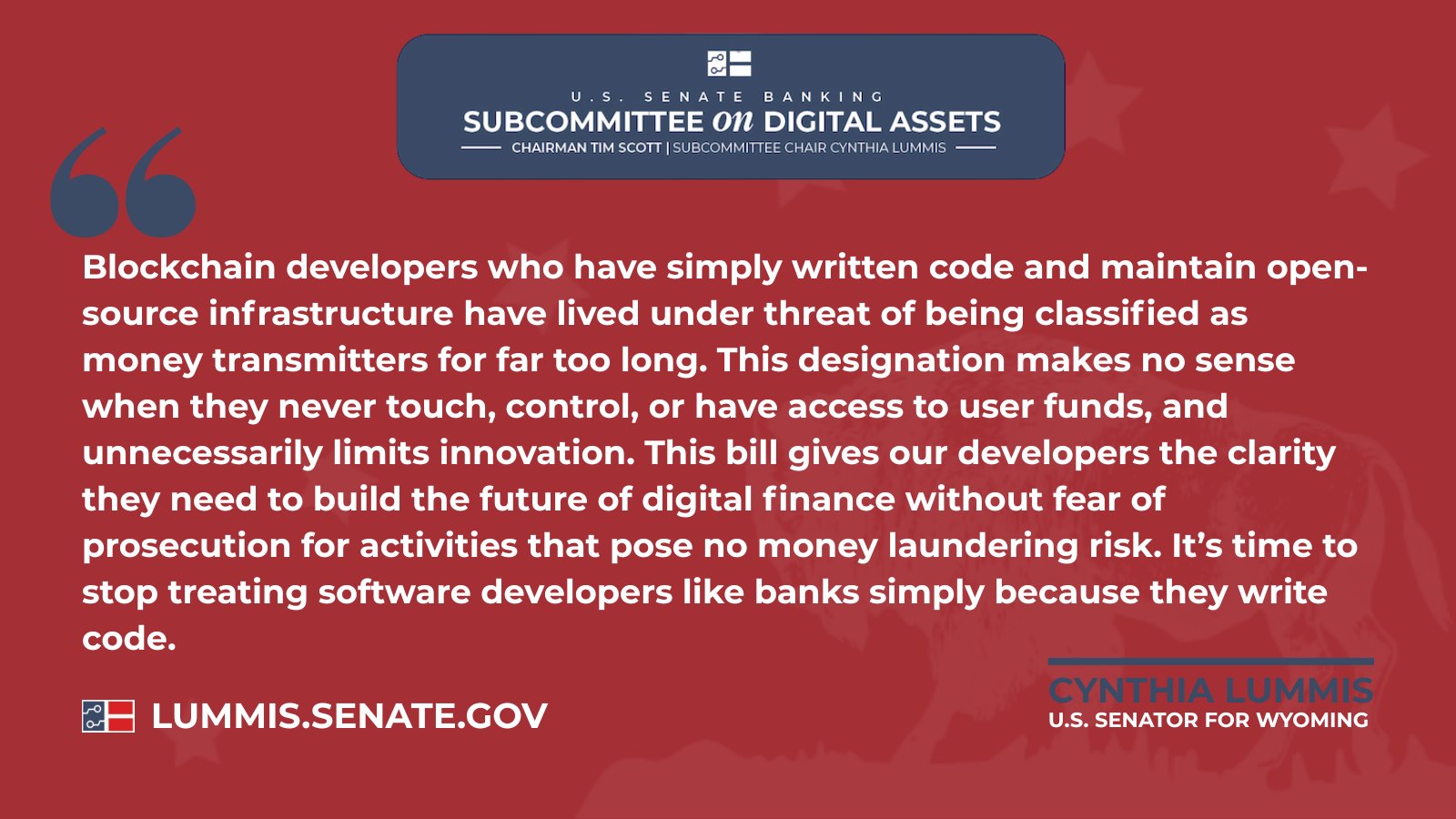
Source: X/Cynthia Lummis

In a response to Senate Judiciary claims, Tim Scott’s spokesperson, Jeff Naft, told Politico that BRCA falls within the Banking Committee and added,

“The Chairman (Scott) remains committed to protecting software developers while ensuring that law enforcement has the necessary tools to prosecute actual illegal money transmission operations.”

Uncertainty rocks crypto bill

The bill’s progress hit a roadblock after Coinbase withdrew support, citing ‘too many issues’ including a ban on stablecoin rewards.

Coinbase’s CEO Brian Armstrong’s “no bill, better than bad bill” stance has left the industry divided, intensifying uncertainty on the bill’s way forward.

That said, White House was reportedly unhappy with Coinbase’s move, calling it a ‘rug-pull’ against the entire industry.

According to reporter Eleanor Terrett, citing an insider, the White House will also pull support if Coinbase does come back to negotiations, adding that,

“This is President Trump’s bill at the end of the day, not Brian Armstrong’s”

It remains to be seen whether the bill will regain momentum in the coming days.


Final Thoughts

  • Senate Judiciary pressed for rejection of DeFi software developer exemptions to strengthen DoJ oversight in the space.
  • The White House reportedly warned Coinbase to return to negotiations or risk losing support.

Perguntas relacionadas

QWhat specific concern did the Senate Judiciary Committee raise about the CLARITY Act?

AThe Senate Judiciary Committee raised concerns that the bill would exempt some DeFi software developers from financial licensing requirements for money-transmitting businesses, which they argue would 'weaken' the federal criminal code and create oversight gaps.

QWhich specific legal titles did the Judiciary Committee argue were being weakened by the proposed exemptions?

AThe Judiciary Committee argued that the exemptions would weaken critical portions of Titles 18 and 31 of the U.S. Code, which fall under their jurisdiction.

QWhat is the purpose of the Blockchain Regulatory Certainty Act (BRCA) section added to the broader crypto bill?

AThe Blockchain Regulatory Certainty Act (BRCA) aims to protect software developers from what lawmakers describe as 'unfair' prosecution by shielding them from liability under the Bank Secrecy Act and criminal law, provided they don't control funds or transactions.

QWhy did Coinbase withdraw its support for the crypto bill?

ACoinbase withdrew its support for the bill citing 'too many issues,' including a proposed ban on stablecoin rewards.

QWhat was the White House's reported reaction to Coinbase's withdrawal from the bill negotiations?

AThe White House was reportedly unhappy with Coinbase's move, calling it a 'rug-pull' against the entire industry, and warned that they would also pull support if Coinbase did not return to negotiations.

Leituras Relacionadas

How Does Codex Use a Computer? Three Entry Points and Permission Boundaries

This article explains the three primary methods for Codex to interact with a computer, each with distinct use cases, permission boundaries, and trust levels. **1. Computer Use:** This offers the broadest access, allowing Codex to visually control and interact with the graphical user interface of authorized macOS/Windows apps, system settings, and even iOS simulators. It's ideal for tasks lacking APIs or structured tools, such as operating legacy software or multi-app workflows. However, it's the slowest method and has the widest permission scope, requiring careful supervision for sensitive actions. **2. Chrome Extension:** This grants Codex access to the user's logged-in Chrome browser state, including cookies, profiles, and open tabs. It's best for tasks requiring user identity across websites like Gmail, LinkedIn, Salesforce, or internal dashboards. Its key advantage is multi-tab control for complex workflows. While more powerful for browser-based tasks than Computer Use, it carries higher sensitivity as actions are performed under the user's identity. **3. In-App Browser:** This is a browser isolated within the Codex thread, separate from the user's personal browsing data. It excels in web development and debugging scenarios—previewing local servers, testing responsive layouts, or annotating designs directly on the page. Its isolation is a strength for development but a limitation for tasks requiring login sessions. The core principle is to choose the narrowest, safest, and most structured interface for the task. Use plugins or MCPs first, resort to visual control (Computer Use) only for GUI-dependent tasks, employ the Chrome extension for identity-reliant browser work, and prefer the In-App Browser for isolated development. **Appshots** are clarified as a fourth, complementary tool for *inputting* context—capturing a screenshot of a window to point Codex to something—rather than a method for Codex to *act*. Together, this layered approach highlights a key to AI agent productization: not granting unlimited permissions, but constraining them within clear boundaries for specific tasks while preserving user oversight.

marsbitHá 21m

How Does Codex Use a Computer? Three Entry Points and Permission Boundaries

marsbitHá 21m

The "Iron Rule" of Chip Equipment Is Being Broken

For years, the semiconductor equipment industry followed an unwritten "iron rule": suppliers offered steep discounts for new tool introductions (Design-in) and faced consistent price pressure during repeat orders, especially during market downturns. This long-standing buyer's market dynamic is now being upended. Recently, SK Hynix's primary equipment suppliers have reportedly requested a 3-4% price *increase*, a nearly unprecedented move. This shift is driven by a severe supply-demand imbalance fueled by the AI compute boom. Securing equipment has become an urgent arms race as chipmakers' expansion speed dictates their ability to fulfill massive AI chip orders. Key areas feeling the strain include: **TCB (Thermal Compression Bonding) Equipment:** Demand is exploding, driven by the simultaneous needs of HBM4 memory stacking, AI chip Chip-on-Substrate (C2S), and logic Chiplet Chip-on-Wafer (C2W) packaging. Players like Hanmi Semiconductor, Hanwha Semitech, and ASMPT are receiving major orders. While hybrid bonding is seen as the future, TCB remains the pragmatic choice for HBM4 mass production, with its lifecycle extended by relaxed specifications and ongoing technological upgrades. **Test Equipment Bottlenecks:** Ironically, AI-driven shortages are now crippling test equipment manufacturing. Critical components like FPGAs, Driver ICs, and CPUs face severe shortages and extended lead times (up to 52 weeks for FPGAs), as AI data center and server vendors prioritize supply. This creates a paradoxical cycle: AI chip shortages drive fab expansion, which requires more test equipment, whose production is delayed because its key parts are diverted to make AI chips. The industry is entering a broad, AI-powered upcycle. SEMI forecasts global semiconductor equipment sales to hit a record $156 billion by 2027, fueled by investment in advanced logic/foundry, HBM-driven DRAM, and advanced packaging (like CoWoS). Major players like TSMC, SK Hynix, and Micron are aggressively ramping capital expenditure. In conclusion, leading equipment vendors are no longer just selling tools; they are selling the critical capability to deliver AI-era capacity. Pricing power is shifting decisively to those with indispensable technology in key process nodes like advanced logic, HBM, and advanced packaging, rewriting the industry's traditional power structure.

marsbitHá 34m

The "Iron Rule" of Chip Equipment Is Being Broken

marsbitHá 34m

Trading

Spot
Futuros
活动图片