Sell Nvidia, Buy Power Plants: A 24-Year-Old Unconventional AI Investor Made $5 Billion in a Year

marsbitPublicado em 2026-03-06Última atualização em 2026-03-06

Resumo

Leopold Aschenbrenner, a 24-year-old former OpenAI researcher, achieved a 14x return in 12 months, growing his fund to $5.517 billion by investing unconventionally in AI infrastructure. Instead of popular AI stocks, he focused on physical constraints like power and hardware. Key holdings include Bloom Energy (fuel cells for power generation), CoreWeave (GPU cloud services), Intel (U.S. chip manufacturing), and Bitcoin miners (cheap power and data center space). He also invested in Lumentum (optical components) and SanDisk (data storage). Aschenbrenner sold top AI performers like Nvidia, betting that AI's real bottleneck is electricity, not algorithms. His strategy stems from a 165-page manifesto predicting AGI by 2027, emphasizing compute and energy demands. Despite market panic during the DeepSeek shock, he held firm, arguing efficiency gains would fuel, not reduce, demand. His approach combines deep AI insight with real-world infrastructure analysis, capitalizing on mispriced opportunities in the AI value chain.

By|Sleepy.txt

In February 2026, hedge fund Situational Awareness LP filed its quarterly holdings report, showing that as of the end of the fourth quarter of 2025, the total market value of the fund's U.S. stock holdings was $5.517 billion.

Wall Street manages tens of trillions of dollars in assets, and $5.5 billion is just a drop in the bucket. But this fund had less than $400 million in assets under management just 12 months ago, and its founder and chief investment officer is a young man born in 1999.

His name is Leopold Aschenbrenner. 24 years old.

In 12 months, he grew this fund from $383 million to $5.517 billion, an increase of over 14 times. During the same period, the S&P 500 gained only single digits.

What's even more surprising is his holdings. Opening the quarterly holdings report, you won't find any of the AI star companies you always see in financial news headlines. Instead, there are companies making fuel cells, Bitcoin miners that have just crawled back from the brink of bankruptcy, and a chip giant being abandoned by the entire market.

He says his fund invests in AI, but this doesn't look like an AI fund's portfolio at all. It looks more like a madman's shopping list.

But this madman happens to be one of the earliest and deepest thinkers in the world on how AI will change the world. Before joining Wall Street, he was a researcher at OpenAI, responsible for thinking about how to ensure AI doesn't go rogue when it becomes smarter than humans; later, he was kicked out for saying the wrong things and wrote a 165-page manifesto predicting a future that most people find absurd.

Later, he went all-in with his entire net worth.

Deconstructing $5.5 Billion: What Did He Actually Buy?

The most direct way to understand how brilliant Leopold Aschenbrenner is at investing is to open his holdings report and read it line by line.

His largest holding is Bloom Energy. Holding value: $876 million, representing 15.87% of the portfolio.

This company makes fuel cells. More precisely, it makes something called "solid oxide fuel cells," which convert natural gas directly into electricity with extremely high efficiency. Founder KR Sridhar was formerly an engineer on NASA's Mars exploration program and was named by Fortune magazine as "one of the five top futurists creating the future today."
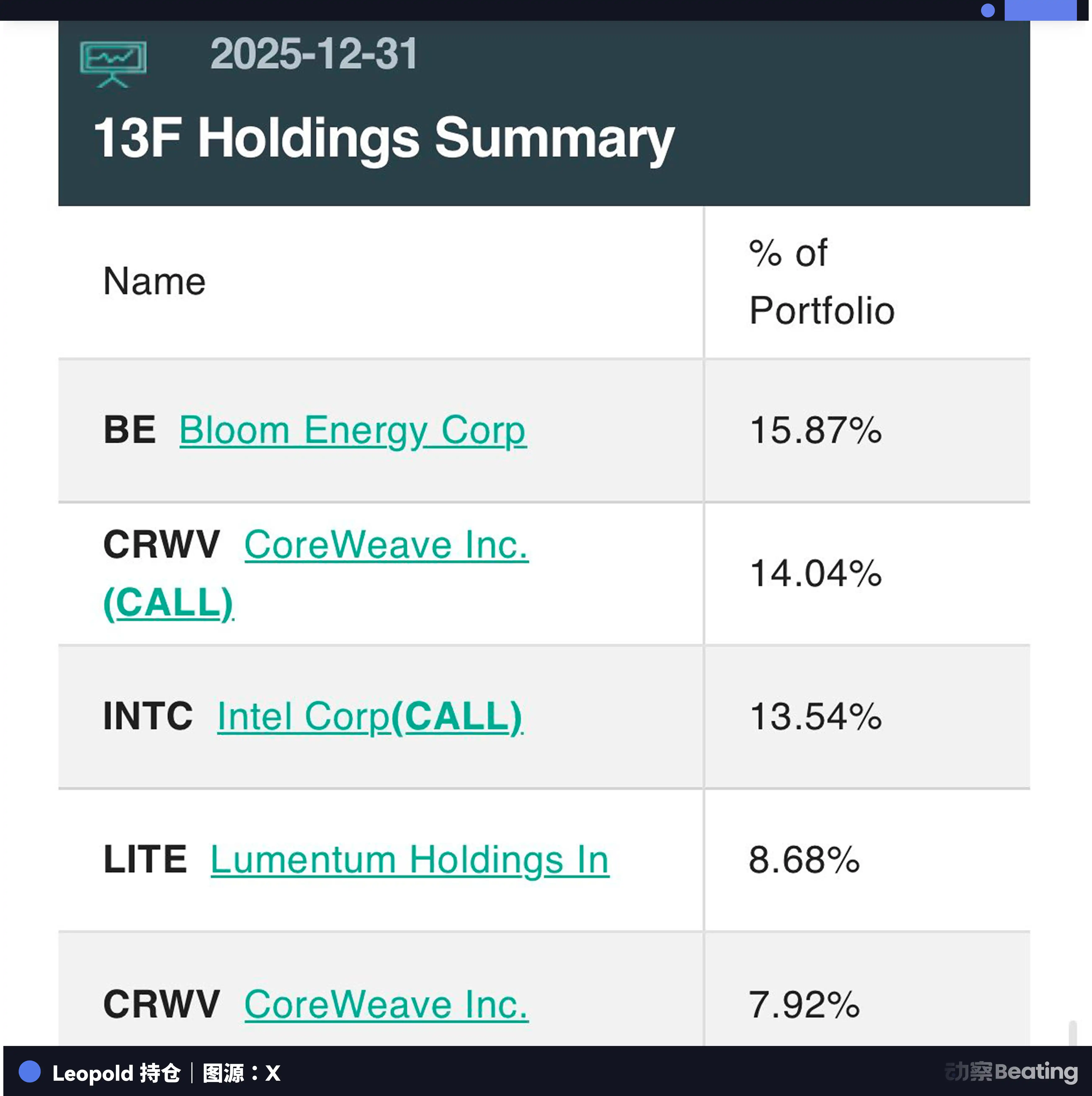
An AI fund placed its biggest bet on a power generation company.

According to Gartner's predictions, the global electricity consumption of AI-optimized servers will skyrocket from 93 terawatt-hours in 2025 to 432 terawatt-hours in 2030, nearly quintupling in five years. The U.S. data center grid power demand will nearly triple by 2030, reaching 134.4 gigawatts. And the average age of the U.S. power infrastructure is already over 25 years, with many components between 40 and 70 years old, far exceeding their design lifespan.

In other words, AI needs more electricity than the entire grid can provide. And the grid itself is so old it's falling apart.

The scarcest resource in the AI era is not chips; it's electricity.

Bloom Energy's fuel cells恰好 bypass this bottleneck. They don't need to connect to the grid; they generate power directly next to data centers, 24/7. In 2025, Bloom Energy secured a contract from CoreWeave to provide fuel cells for its AI data center in Illinois.

Speaking of CoreWeave, this is恰好 Leopold's second-largest holding.

He holds $774 million worth of CoreWeave call options, plus $437 million in common stock, totaling over $1.2 billion, representing 22% of the portfolio. CoreWeave is a GPU cloud service provider that transitioned from a cryptocurrency mining operation.

In 2017, Mike Intrator and Brian Venturo got together to mine Bitcoin. In 2018, the crypto market crashed, and mining became unsustainable. But they had a bunch of GPUs. In 2019, they had a brainstorm: GPUs aren't just for mining; they can also run AI.

So the company pivoted, from a mining operation to an AI compute arms dealer. On March 27, 2025, CoreWeave IPO'd on the Nasdaq, raising $1.5 billion at $40 per share. A company that crawled out of a mining operation became a core supplier of AI infrastructure.

Leopold was attracted to CoreWeave's massive GPU holdings and its deep ties to Nvidia. In an era where compute is productivity, whoever has GPUs is king.

But what's truly baffling is his third-largest holding: Intel. Holding value: $747 million,全部是 call options, representing 13.54% of the portfolio.

In 2025, Intel was one of Wall Street's least favored companies. Its stock price had halved from its 2024 high, its market share was being eroded by AMD and Nvidia, and CEOs were being replaced one after another. Almost every analyst was saying Intel was finished.

But Leopold偏偏 chose this moment to go heavily long with call options. This is an extremely aggressive move—soar if right, zero if wrong.

What is he betting on? Two words: foundry.

In November 2024, the U.S. Department of Commerce announced that Intel would receive up to $7.86 billion in direct funding support through the CHIPS and Science Act. The purpose of this money is singular: to make Intel a domestic U.S. chip foundry, competing with TSMC.

In the context of U.S.-China tech decoupling, the U.S. needs an "insider" to make chips. Intel, though落后, is the only choice. Leopold isn't betting on Intel's technology; he's betting on U.S. national will.

The following holdings are even more interesting. Core Scientific, holding $419 million; IREN, $329 million; Cipher Mining, $155 million; Riot Platforms, $78 million; Hut 8, $39.5 million.

These companies share a common characteristic: they are all Bitcoin mining companies.

Why would an AI fund invest in a bunch of Bitcoin miners?

Simple: because Bitcoin mining companies possess the cheapest electricity and the largest data center sites in the U.S.

Core Scientific has over 1,300 megawatts of power capacity. IREN plans to expand its capacity by 1.6 gigawatts in Oklahoma. To survive the intense computing competition, these miners have long since secured the world's cheapest electricity resources, signing long-term power purchase agreements.

And now, what AI data centers lack most is precisely electricity and sites.

In 2022, Core Scientific filed for bankruptcy due to the crypto crash. It completed restructuring in January 2024, reducing its debt by about $1 billion, and relisted on the Nasdaq. Then, it signed a 12-year contract with CoreWeave worth over $10.2 billion to convert its mining facilities into AI data centers. To focus fully on this shift, Core Scientific even plans to sell all its Bitcoin holdings.

IREN (formerly Iris Energy) signed a $9.7 billion AI contract with Microsoft, receiving a $1.9 billion prepayment. Cipher Mining signed a 15-year lease agreement with Amazon. Riot Platforms signed a 10-year, $311 million contract with AMD.

Overnight, Bitcoin miners became the landlords of the AI era.

Now, let's complete this puzzle.

Bloom Energy provides power, CoreWeave provides GPU compute, Bitcoin miners provide sites and cheap power, Intel provides domestic U.S. chip manufacturing capability. Add to that the fourth-largest holding Lumentum ($479 million, makes optical components, core for interconnecting AI data centers), the ninth-largest holding SanDisk ($250 million, data storage), and the eleventh-largest holding EQT Corp ($133 million, natural gas producer, provides fuel for fuel cells).

This is a complete AI infrastructure supply chain.

From power generation, to power transmission, to chip manufacturing, to GPU compute, to data storage, to fiber optic interconnection. He bought every link.

And the other thing he did simultaneously makes this logic even clearer. In Q4 2025, he completely sold off his positions in Nvidia, Broadcom, and Vistra. These three companies were恰恰 the biggest star performers of the 2024 AI rally.

He also shorted Infosys, one of India's largest IT outsourcing companies.

Sell the hottest AI chip stocks, buy the unwanted power plants and mining sites. Short traditional IT outsourcing because AI programming tools are making programmers more efficient, compressing outsourcing demand.

Every trade points to the same judgment: AI's bottleneck is not in software, but in hardware; not in algorithms, but in electricity; not in cloud models, but in the physical world.

So the question is: How did a 24-year-old form this set of beliefs?

From Son of an East German Doctor to OpenAI Rebel

Leopold Aschenbrenner was born in Germany; both his parents were doctors. His mother grew up in former East Germany, his father was from former West Germany; they met after the fall of the Berlin Wall. The family itself carries the imprint of a historical fracture—the Cold War, division, reunion. His later obsession with geopolitical competition might find its earliest seed here.

But Germany couldn't keep him. He later said in an interview: "I really wanted to leave Germany. If you're the most curious kid in class, wanting to learn more, the teachers don't encourage you; they get jealous and try to suppress you."

He called this phenomenon "tall poppy syndrome"—whoever stands tall gets cut down.

At age 15, he convinced his parents and flew alone to the U.S., entering Columbia University.

Attending university at 15 is an outlier anywhere. But Leopold's performance at Columbia turned "outlier" into "legend." He majored in a double degree in Economics and Mathematics-Statistics, won every possible award, like the Albert Asher Green Memorial Prize, the Romine Prize in Economics, and Junior Phi Beta Kappa.

At 17, he wrote a paper on economic growth and existential risk. Prominent economist Tyler Cowen read it and said: "When I read it, I couldn't believe it was written by a 17-year-old. I would have been impressed if it were an MIT PhD thesis."

At 19, he graduated from Columbia as Valedictorian. This is the highest honor for undergraduates at the university. In 2021, with the world still in the shadow of the pandemic, a 19-year-old German kid stood at Columbia's graduation ceremony, delivering the address on behalf of all graduates.
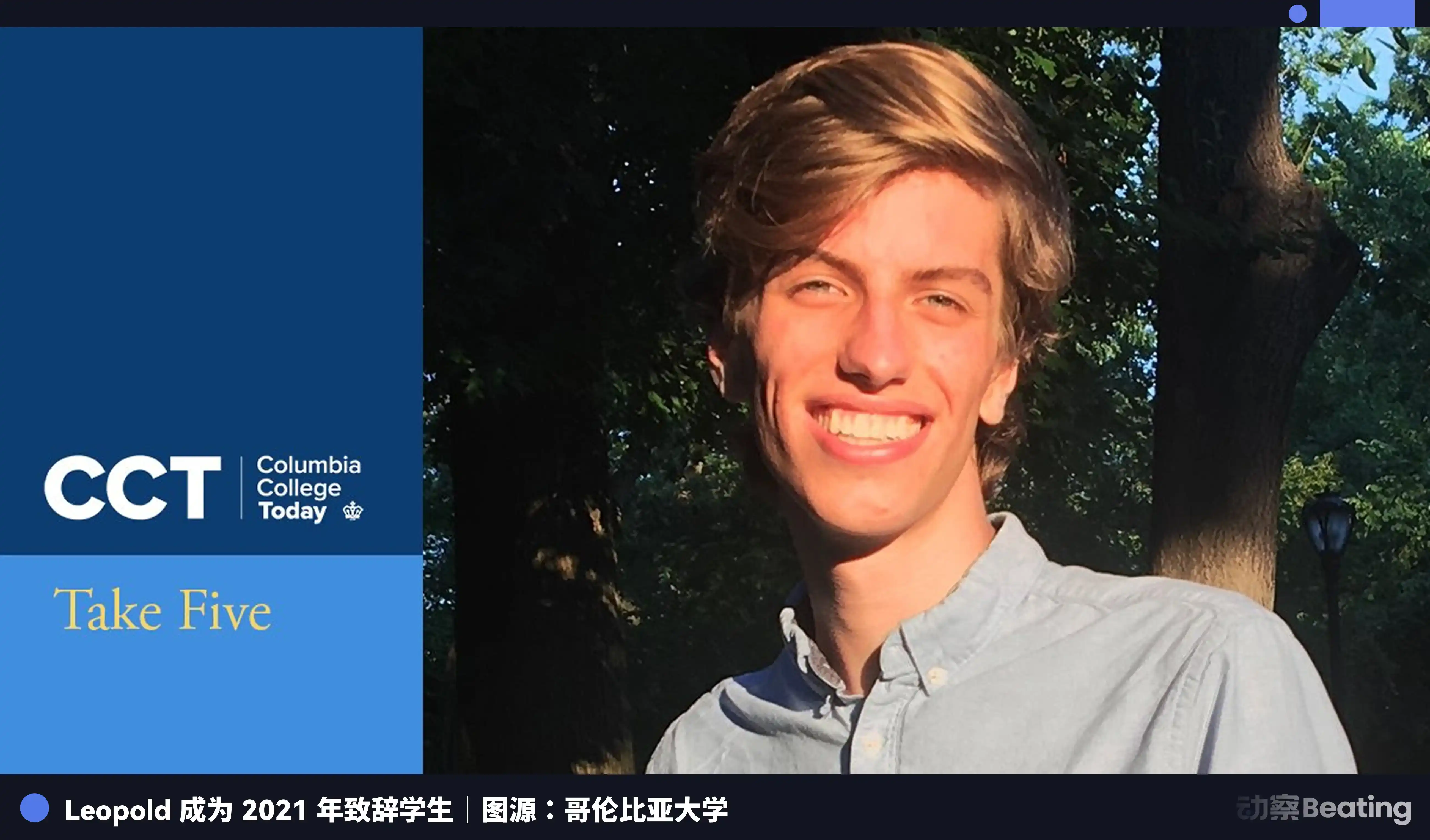
Tyler Cowen gave him a piece of advice: don't get a PhD in economics.

Cowen felt economics academia had become somewhat "decadent" and encouraged him to do bigger things. Cowen also introduced him to Silicon Valley's "Twitter weirdo" culture circle, a group obsessed with AI, effective altruism, and humanity's long-term fate.

After graduation, Leopold first went to the Forethought Foundation, researching long-term economic growth and existential risks. Then he joined the FTX Future Fund founded by SBF, working with core figures of the effective altruism movement, Nick Beckstead and William MacAskill. His title was "Economist affiliated with the University of Oxford's Global Priorities Institute."

This experience was important. It meant that before entering the AI industry, Aschenbrenner had spent years systematically thinking about one question: what kind of events can fundamentally alter the course of human civilization.

Then, he joined OpenAI.

The exact timing is unclear, but he joined a special team—the "Superalignment" team. This team was formed on July 5, 2023, co-led by OpenAI co-founder Ilya Sutskever and alignment team lead Jan Leike. The goal was to solve the superintelligence alignment problem within four years, i.e., ensuring an AI vastly smarter than humans would still listen to them.

OpenAI had承诺 to dedicate 20% of its compute to this team. But there was a chasm between promise and reality.

Leopold saw things inside OpenAI that made him uneasy. He submitted a security memo to the board, warning that the company's security measures were "grossly inadequate" to prevent foreign governments from stealing critical algorithmic secrets. The company's reaction surprised him. HR spoke to him, saying his concerns about espionage were "racist" and "unconstructive." Company lawyers grilled him on his views about AGI and his team's loyalty.

In April 2024, OpenAI fired him for "leaking confidential information."

The alleged "leak" was sharing a brainstorming document on AGI safety measures with three external researchers. Leopold said the document contained no sensitive information and that sharing such documents internally for feedback was standard practice.

A month later, Ilya Sutskever left OpenAI. Three days after that, Jan Leike left too. The Superalignment team was dissolved. OpenAI's承诺 20% compute was never delivered.

The irony of a team researching "how to control superintelligence" being disbanded by the company creating superintelligence cannot be overstated. But for Leopold, being fired became a form of liberation. He was no longer employed by anyone, no longer needed to carefully phrase internal memos. He could say what he truly wanted to say to the whole world.

On June 4, 2024, he published a 165-page article on a website called situational-awareness.ai. The title was simply "Situational Awareness: The Decade Ahead."

The 165-Page Prophecy

To understand Leopold's investment logic, you must first read this manifesto. Because that $5.5 billion portfolio is the financial translation of these 165 pages.

The core thesis of the manifesto can be summarized in one sentence: AGI (Artificial General Intelligence) has a very high probability of being realized by 2027.

This sounded like madness in June 2024. But Leopold's method of argumentation is direct: count the orders of magnitude.

From GPT-2 to GPT-4, AI's capabilities made a qualitative leap, from a preschooler to a smart high school student. Behind this leap was roughly a 100,000-fold (5 orders of magnitude) increase in effective computation. This growth came from stacking physical compute, improving algorithmic efficiency, and capability release through model "unbinding."

His prediction is that by 2027, growth of the same scale will happen again. In physical compute, the computational resources for training cutting-edge models will be 100 times greater than for GPT-4. In algorithmic efficiency, improvement is about 0.5 orders of magnitude per year, accumulating to about 100 times over four years. Add the gain from "unbinding," turning AI from a chatbot into a tool-using, autonomous agent, another order of magnitude jump.
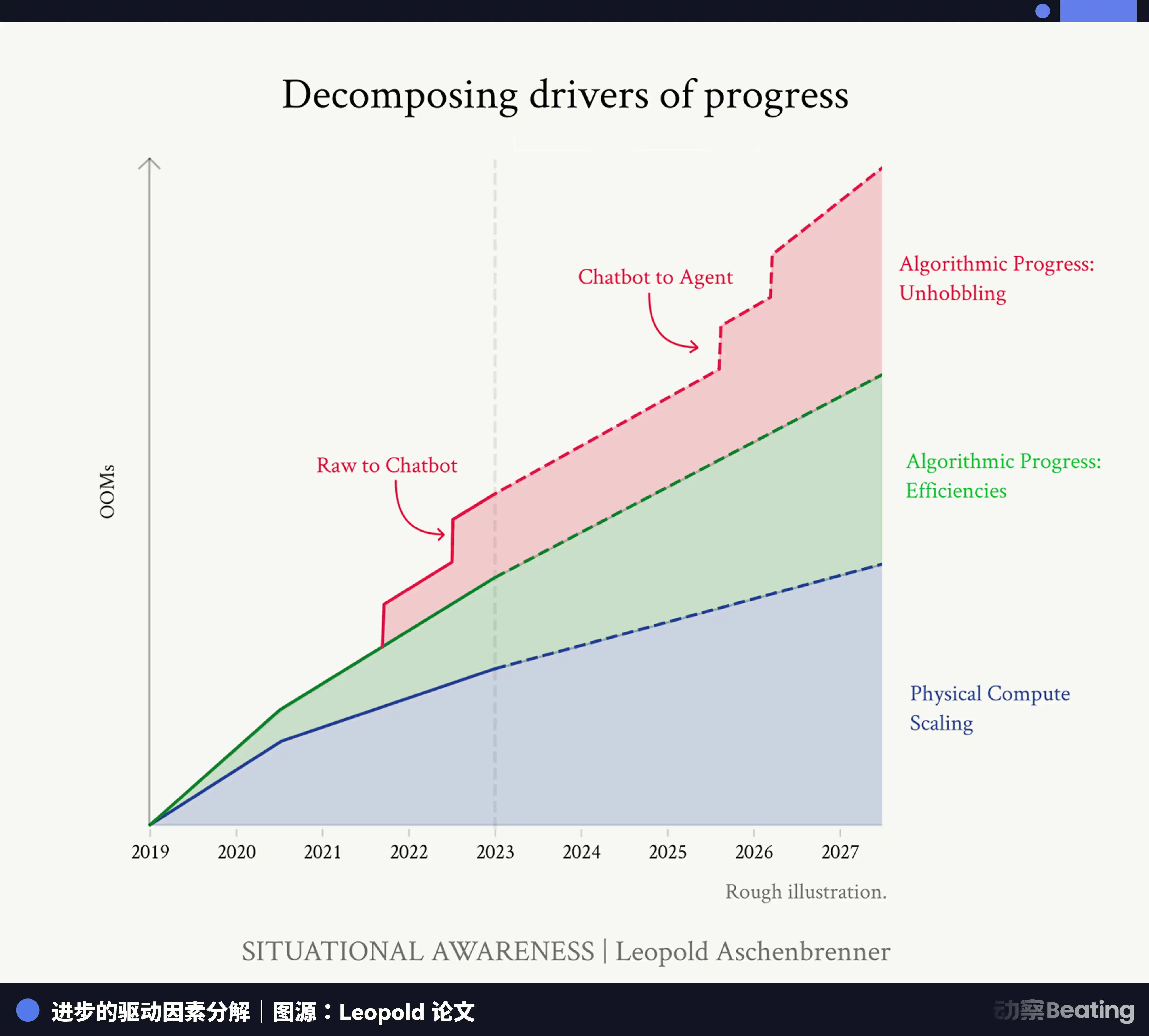
Three 100-fold increases叠加在一起 is another 100,000-fold, another qualitative leap. From a smart high school student to surpassing humans.

What truly made people sit up in this article were the series of consequences he derived from this prediction.

First consequence: Trillion-dollar compute clusters.

He wrote that in the past year, talk in Silicon Valley had shifted from $10 billion compute clusters to $100 billion clusters, and recently to trillion-dollar clusters. Every six months, the board's plans add a zero. By the end of this decade, hundreds of millions of GPUs will be in operation.

This prediction sounded exaggerated in June 2024. But in January 2025, the Trump administration announced the Stargate project, jointly invested in by SoftBank, OpenAI, Oracle, and MGX, planning to invest $500 billion over four years to build AI infrastructure in the U.S. The first deployment of funds was immediately $100 billion. Construction has already begun in Texas.

The "trillion-dollar clusters" he wrote about in the manifesto became an official White House plan half a year later.

Second consequence: Power crisis.

How much electricity do hundreds of millions of GPUs need? Leopold's answer: it requires increasing U.S. electricity production capacity by tens of percentage points.
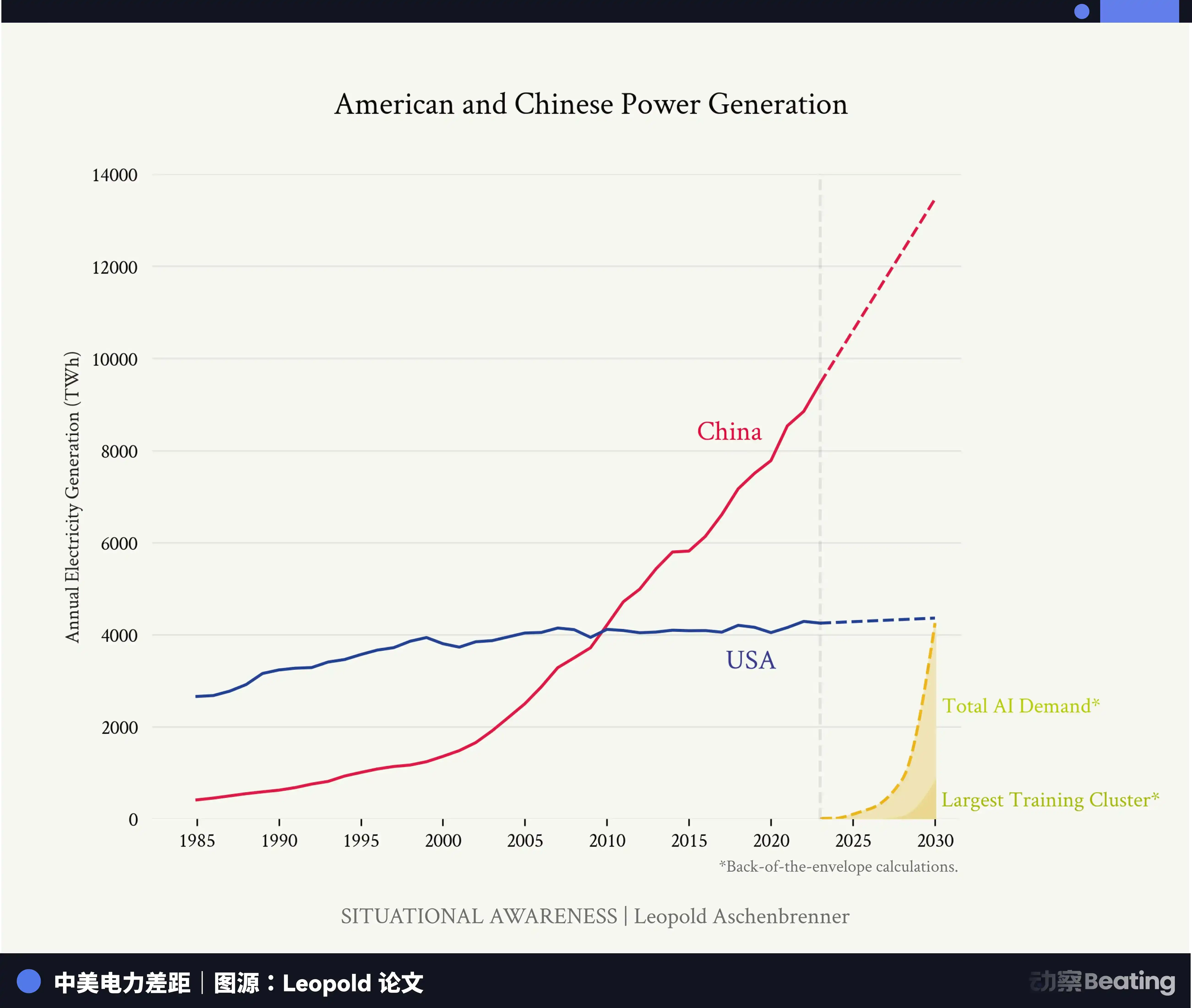
Data confirms his judgment. In 2024, the combined capital expenditure of Amazon, Microsoft, Google, and Meta exceeded $200 billion, a 62% increase from 2023. Amazon alone spent $85.8 billion, a 78% year-on-year increase. In 2025, Amazon's capex is expected to exceed $100 billion.

Most of this money was spent on data centers and power infrastructure.

Microsoft even did something unimaginable a decade ago: it signed a 20-year power purchase agreement with Constellation Energy to restart the Three Mile Island nuclear power plant.

Yes, that Three Mile Island, the site of the worst nuclear accident in U.S. history in 1979.

This nuclear plant will reopen in 2028, renamed the Crane Clean Energy Center, dedicated to powering Microsoft's data centers. Constellation Energy's CEO Joe Dominguez said: "Powering critical industries, including data centers, requires ample, carbon-free, and reliable energy every hour of every day, and nuclear power plants are the only ones that can consistently deliver on this promise."

When a software company starts restarting nuclear power plants, you know electricity has shifted from an infrastructure issue to a strategic resource issue.

Third consequence: Geopolitical competition.

The most controversial part of the manifesto is where Leopold, in near-Cold War language, defines the AGI race as a struggle for the survival of the "free world." He严厉批评 the security measures of top U.S. AI labs as mere formalities. He urgently called for AI algorithms and model weights to be treated as state secrets of the highest order.

He even predicted that the U.S. government would ultimately have to launch a national AGI project similar to the "Manhattan Project."

These arguments sparked fierce debate. Critics argued he oversimplified geopolitical complexity, using alarmist narratives to justify unconstrained acceleration.

But others felt he spoke the truth. Anthropic's Dario Amodei and OpenAI's Sam Altman also believe AGI will arrive soon.

The true value of the manifesto lies not in whether its predictions are 100% accurate, but in providing a complete, actionable thinking framework.

If AGI truly arrives around 2027, what does the world need before that? Massive amounts of compute.

What does compute need? GPUs.

What do GPUs need? Electricity.

Where does electricity come from? Power plants, nuclear plants, Bitcoin mining sites with cheap electricity.

Where are chips made? At TSMC.

But what if the U.S. and China decouple? Then you need Intel.

How do data centers interconnect? Need optical components—Lumentum.

Where is data stored? Need storage—SanDisk.

See, this is the logic of that holdings report.

The manifesto is the map; the holdings are the route. Leopold translated this 165-page macro prediction into an investment portfolio that could be bet on with real money. Every buy corresponds to a point in the manifesto. Every sell corresponds to an assumption he believes the market has mispriced.

But having a map isn't enough. In the real market, you need one more thing: the ability to keep believing you are right when everyone says you are wrong.

This ability was put to the most severe test on January 27, 2025.

The DeepSeek Shock

On January 27, 2025, the release of DeepSeek's DeepSeek-R1 model sent Wall Street into a panic. This model's performance was close to OpenAI's o1, but its usage cost was 20 to 50 times cheaper. Even more shocking, its predecessor model DeepSeek-V3 reportedly cost less than $6 million to train, using Nvidia H800 chips that were sanctioned and performance-limited by the U.S.

The market's logic instantly collapsed.

If the Chinese can train a top-tier model with $6 million and crippled chips, what does the hundreds of billions of dollars U.S. tech giants pour in every year count for? Are those trillion-dollar compute cluster plans still meaningful? Will GPU demand plummet?

Panic spread like plague. Nvidia's stock plummeted nearly 17%, losing $593 billion in market value in a single day, the largest single-day market cap loss in Wall Street history. The Philadelphia Semiconductor Index crashed 9.2%, its biggest single-day drop since the pandemic panic of March 2020. Broadcom fell 17.4%, Marvell fell 19.1%, Oracle fell 13.8%.

The decline started in Asia, spread to Europe, and finally exploded in the U.S. Nasdaq 100 index components alone lost nearly a trillion dollars in market value in one day.

Silicon Valley venture capital godfather Marc Andreessen called DeepSeek AI's "Sputnik moment" on Twitter, saying: "This is one of the most amazing and impressive breakthroughs I've ever seen, and as an open-source project, a gift to the world."

For Leopold's fund, this day should have been a disaster. His holdings were all AI infrastructure stocks, and the market was questioning the entire logic of AI infrastructure.

But according to a Fortune magazine report, an investor in Situational Awareness LP revealed that day, during the market's panic selling, a large tech fund called to inquire. The answer they got was five words:

"Leopold says it's fine."

Why was Leopold so calm? Because in his view, the emergence of DeepSeek did not推翻 his logic; it confirmed it.

His manifesto had a core argument: AI progress will not slow down; it will only accelerate.
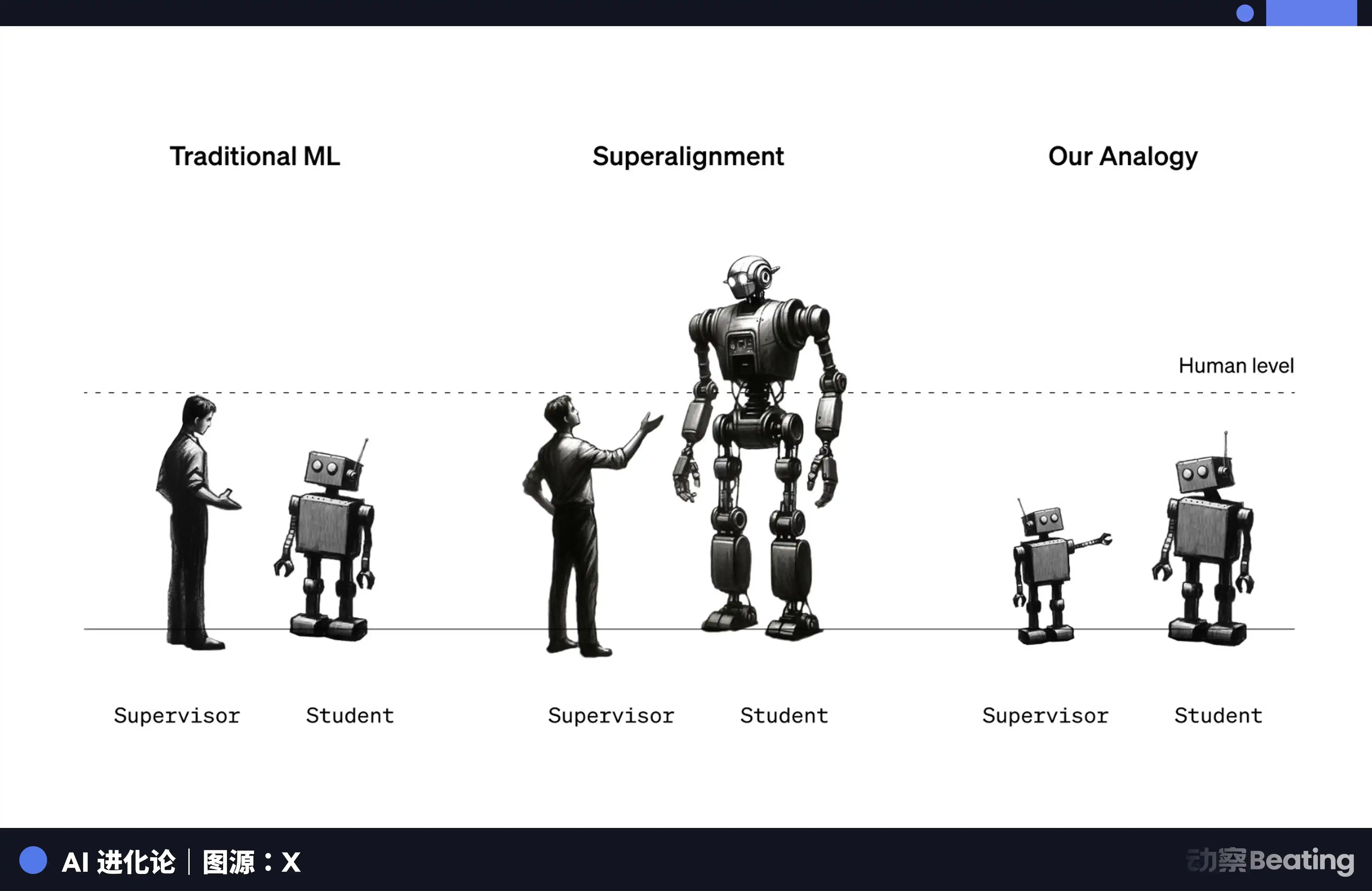
Improving algorithmic efficiency is one of the three engines driving AI development. DeepSeek training a stronger model with less money and weaker chips恰恰 proves algorithmic efficiency is improving rapidly. And the higher the algorithmic efficiency, the stronger the AI that can be produced with the same compute, which will stimulate more compute demand, not reduce it.

Using the framework of his manifesto: DeepSeek did not prove "we don't need that many GPUs"; it proved "every GPU becomes more valuable." When you can train a better model with less money, you don't stop; you train more, larger, stronger models.

Panic stems from the fear that "demand will disappear." But those who truly understand AI know that cost reduction never destroys demand; it only creates greater demand.

Leopold bought against the trend during the panic. The market soon proved him right. Nvidia and the entire AI sector quickly rebounded in the following weeks, returning to levels higher than before the crash.

In the world of investing, conviction is the scarcest asset. Not because forming conviction is hard, but because坚持 conviction when everyone says you're wrong is almost anti-human.

The End of the Physical World

The story of Leopold Aschenbrenner can, of course, be simplified into a爽文 about a天才少年 getting rich. But if you only see the money, you waste the true value of this story.

What he truly did right was to shift his gaze from the code and model parameters on the screen to the smokestacks of power plants, the substations of mining sites, and the fiber optic cables spanning the continent, while everyone else was staring at the screen.
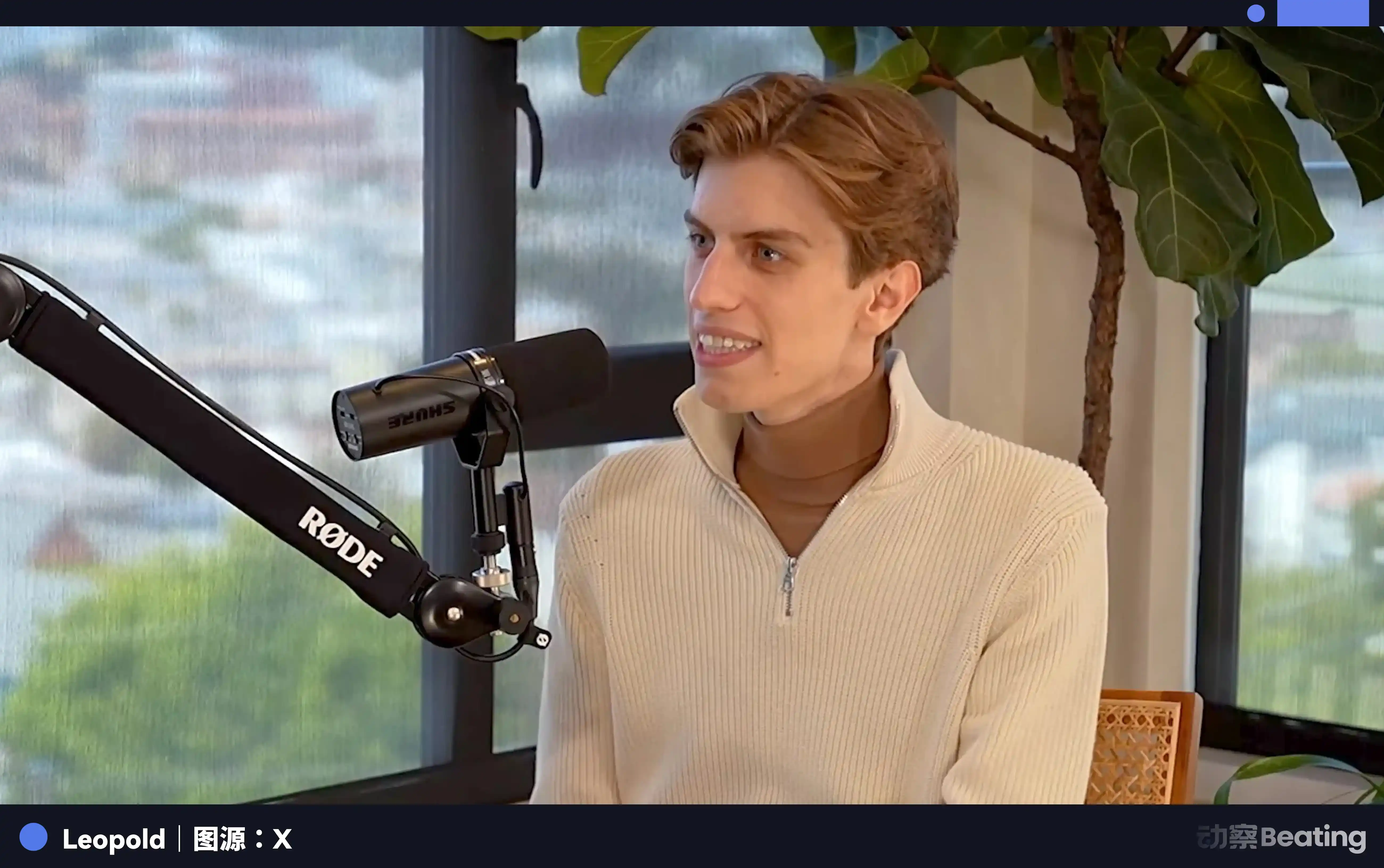
In 2024, the whole world was discussing how powerful GPT-5 would be, how realistic Sora's videos would be, when AI would replace programmers. These discussions are important, of course. But Leopold asked a more fundamental question: how much electricity do these things need? Where does the electricity come from?

This question sounds too simple, but恰恰 this simple question points to the biggest investment opportunity of the AI era.

AI is growing at an exponential rate, while the physical infrastructure supporting it remains stuck in the last century. Leopold saw this crack. Then he traced along this crack all the way to the end of the physical world. Every step started from a physical bottleneck, found the company solving that bottleneck, and placed a bet.

The essence of this methodology isn't new. During the 19th-century California Gold Rush, the people who made the most money weren't the gold prospectors, but those selling shovels and jeans. Levi Strauss made his fortune then.

But knowing this道理 is one thing; executing it in the AI era is another.

Because to execute it, you need two abilities simultaneously: a deep understanding of technological trends, knowing AI's development path and resource needs; and a concrete认知 of the physical world, knowing where electricity comes from, how data centers are built, how fiber is laid.

The former requires you to have been in an OpenAI lab; the latter requires you to be willing to蹲下来 and study the power contracts of a bankrupt mining company.

Technical people understand AI but not electricity markets. Finance people understand markets but not AI's physical constraints. Leopold恰好 had both.

But more important than ability is perspective.

There's a line in his manifesto that is often quoted: "You can see the future first in San Francisco." The subtext of this sentence is: the future is not evenly distributed.

The essence of investing is finding price mismatches in a future that has arrived but is not yet evenly distributed.

Leopold亲眼 saw the AI capability curve in OpenAI's labs. He knew GPT-4 was not the end but the beginning. He knew there would be larger models, more compute, crazier capital investment. And the market was still discussing "is AI a bubble?"

This is the mismatch. What he did was turn this mismatch into $5.5 billion.

Perguntas relacionadas

QWhat was the core investment thesis behind Leopold Aschenbrenner's portfolio, and how did it differ from typical AI-focused funds?

ALeopold's core investment thesis was that the true bottleneck for AI advancement is not software or algorithms, but physical infrastructure—specifically electricity, compute hardware, and data center capacity. Unlike typical AI funds that invested heavily in high-profile AI software and chip companies like Nvidia, he focused on undervalued enablers: power generation (Bloom Energy), GPU cloud providers (CoreWeave), Bitcoin miners (for their cheap power and data center space), and semiconductor manufacturing (Intel). He believed AI's exponential growth would strain existing infrastructure, creating massive value for companies solving these physical constraints.

QHow did Leopold Aschenbrenner's background at OpenAI and his 'Situational Awareness' manifesto influence his investment strategy?

AHis work at OpenAI's 'Superalignment' team exposed him to the rapid pace of AI development and the resource-intensive nature of advanced models. His 165-page manifesto, 'Situational Awareness: The Decade Ahead,' predicted AGI by 2027 and outlined consequent infrastructure demands: trillion-dollar compute clusters, a looming electricity crisis, and geopolitical competition. This framework directly informed his investments—each position (e.g., Bloom Energy for power, CoreWeave for compute, Intel for chip sovereignty) was a bet on a specific bottleneck highlighted in his manifesto.

QWhy did Leopold invest heavily in Bitcoin mining companies, and how did they relate to AI infrastructure?

AHe invested in Bitcoin miners (e.g., Core Scientific, IREN) because they possessed two critical resources for AI: cheap, long-term power contracts and large-scale data center facilities. These companies had secured low-cost electricity and built infrastructure for mining, which could be repurposed for AI data centers. Post-crypto crash, many pivoted to AI, signing massive deals with tech giants (e.g., CoreWeave, Microsoft) to lease their power and space, effectively becoming 'landlords' for the AI era.

QHow did Leopold's fund react to the DeepSeek-R1 model release that caused a market panic in AI stocks?

ADuring the panic, when DeepSeek's low-cost, high-efficiency model triggered fears that AI infrastructure spending was overhyped, Leopold remained calm and even bought more. He argued that DeepSeek's efficiency gains validated his thesis: cheaper training costs would increase, not decrease, demand for compute and power, as it enables more and larger models. The event confirmed algorithmic progress was accelerating, reinforcing the need for the physical infrastructure he had invested in.

QWhat key risks or bottlenecks in AI development did Leopold identify that are not addressed by software or algorithms alone?

AHe identified electricity as the primary bottleneck—AI data centers require massive, reliable power, but aging grids cannot meet demand. Other physical bottlenecks included semiconductor manufacturing (especially U.S.-based production due to geopolitics), data center construction, optical networking (for inter-data center connectivity), and storage. His investments targeted these areas, emphasizing that AI's growth is constrained by code but by the tangible limits of the physical world.

Leituras Relacionadas

Google and Amazon Simultaneously Invest Heavily in a Competitor: The Most Absurd Business Logic of the AI Era Is Becoming Reality

In a span of four days, Amazon announced an additional $25 billion investment, and Google pledged up to $40 billion—both direct competitors pouring over $65 billion into the same AI startup, Anthropic. Rather than a typical venture capital move, this signals the latest escalation in the cloud wars. The core of the deal is not equity but compute pre-orders: Anthropic must spend the majority of these funds on AWS and Google Cloud services and chips, effectively locking in massive future compute consumption. This reflects a shift in cloud market dynamics—enterprises now choose cloud providers based on which hosts the best AI models, not just price or stability. With OpenAI deeply tied to Microsoft, Anthropic’s Claude has become the only viable strategic asset for Google and Amazon to remain competitive. Anthropic’s annualized revenue has surged to $30 billion, and it is expanding into verticals like biotech, positioning itself as a cross-industry AI infrastructure layer. However, this funding comes with constraints: Anthropic’s independence is challenged as it balances two rival investors, its safety-first narrative faces pressure from regulatory scrutiny, and its path to IPO introduces new financial pressures. Globally, this accelerates a "tri-polar" closed-loop structure in AI infrastructure, with Microsoft-OpenAI, Google-Anthropic, and Amazon-Anthropic forming exclusive model-cloud alliances. In contrast, China’s landscape differs—investments like Alibaba and Tencent backing open-source model firm DeepSeek reflect a more decoupled approach, though closed-source models from major cloud providers still dominate. The $65 billion bet is ultimately about securing a seat at the table in an AI-defined future—where missing the model layer means losing the cloud war.

marsbitHá 3h

Google and Amazon Simultaneously Invest Heavily in a Competitor: The Most Absurd Business Logic of the AI Era Is Becoming Reality

marsbitHá 3h

Computing Power Constrained, Why Did DeepSeek-V4 Open Source?

DeepSeek-V4 has been released as a preview open-source model, featuring 1 million tokens of context length as a baseline capability—previously a premium feature locked behind enterprise paywalls by major overseas AI firms. The official announcement, however, openly acknowledges computational constraints, particularly limited service throughput for the high-end DeepSeek-V4-Pro version due to restricted high-end computing power. Rather than competing on pure scale, DeepSeek adopts a pragmatic approach that balances algorithmic innovation with hardware realities in China’s AI ecosystem. The V4-Pro model uses a highly sparse architecture with 1.6T total parameters but only activates 49B during inference. It performs strongly in agentic coding, knowledge-intensive tasks, and STEM reasoning, competing closely with top-tier closed models like Gemini Pro 3.1 and Claude Opus 4.6 in certain scenarios. A key strategic product is the Flash edition, with 284B total parameters but only 13B activated—making it cost-effective and accessible for mid- and low-tier hardware, including domestic AI chips from Huawei (Ascend), Cambricon, and Hygon. This design supports broader adoption across developers and SMEs while stimulating China's domestic semiconductor ecosystem. Despite facing talent outflow and intense competition in user traffic—with rivals like Doubao and Qianwen leading in monthly active users—DeepSeek has maintained technical momentum. The release also comes amid reports of a new funding round targeting a valuation exceeding $10 billion, potentially setting a new record in China’s LLM sector. Ultimately, DeepSeek-V4 represents a shift toward open yet realistic infrastructure development in the constrained compute landscape of Chinese AI, emphasizing engineering efficiency and domestic hardware compatibility over pure model scale.

marsbitHá 3h

Computing Power Constrained, Why Did DeepSeek-V4 Open Source?

marsbitHá 3h

Trading

Spot
Futuros

Artigos em Destaque

O que é GROK AI

Grok AI: Revolucionar a Tecnologia Conversacional na Era Web3 Introdução No panorama em rápida evolução da inteligência artificial, a Grok AI destaca-se como um projeto notável que liga os domínios da tecnologia avançada e da interação com o utilizador. Desenvolvida pela xAI, uma empresa liderada pelo renomado empreendedor Elon Musk, a Grok AI procura redefinir a forma como interagimos com a inteligência artificial. À medida que o movimento Web3 continua a florescer, a Grok AI visa aproveitar o poder da IA conversacional para responder a consultas complexas, proporcionando aos utilizadores uma experiência que é não apenas informativa, mas também divertida. O que é a Grok AI? A Grok AI é um sofisticado chatbot de IA conversacional projetado para interagir com os utilizadores de forma dinâmica. Ao contrário de muitos sistemas de IA tradicionais, a Grok AI abraça uma gama mais ampla de perguntas, incluindo aquelas tipicamente consideradas inadequadas ou fora das respostas padrão. Os principais objetivos do projeto incluem: Raciocínio Fiável: A Grok AI enfatiza o raciocínio de senso comum para fornecer respostas lógicas com base na compreensão contextual. Supervisão Escalável: A integração de assistência de ferramentas garante que as interações dos utilizadores sejam monitorizadas e otimizadas para qualidade. Verificação Formal: A segurança é primordial; a Grok AI incorpora métodos de verificação formal para aumentar a fiabilidade das suas saídas. Compreensão de Longo Contexto: O modelo de IA destaca-se na retenção e recordação de um extenso histórico de conversas, facilitando discussões significativas e contextualizadas. Robustez Adversarial: Ao focar na melhoria das suas defesas contra entradas manipuladas ou maliciosas, a Grok AI visa manter a integridade das interações dos utilizadores. Em essência, a Grok AI não é apenas um dispositivo de recuperação de informações; é um parceiro conversacional imersivo que incentiva um diálogo dinâmico. Criador da Grok AI A mente por trás da Grok AI não é outra senão Elon Musk, um indivíduo sinónimo de inovação em vários campos, incluindo automóvel, viagens espaciais e tecnologia. Sob a égide da xAI, uma empresa focada em avançar a tecnologia de IA de maneiras benéficas, a visão de Musk visa reformular a compreensão das interações com a IA. A liderança e a ética fundacional são profundamente influenciadas pelo compromisso de Musk em ultrapassar os limites tecnológicos. Investidores da Grok AI Embora os detalhes específicos sobre os investidores que apoiam a Grok AI permaneçam limitados, é reconhecido publicamente que a xAI, a incubadora do projeto, é fundada e apoiada principalmente pelo próprio Elon Musk. As anteriores empreitadas e participações de Musk fornecem um forte apoio, reforçando ainda mais a credibilidade e o potencial de crescimento da Grok AI. No entanto, até agora, informações sobre fundações ou organizações de investimento adicionais que apoiam a Grok AI não estão prontamente acessíveis, marcando uma área para exploração futura potencial. Como Funciona a Grok AI? A mecânica operacional da Grok AI é tão inovadora quanto a sua estrutura conceptual. O projeto integra várias tecnologias de ponta que facilitam as suas funcionalidades únicas: Infraestrutura Robusta: A Grok AI é construída utilizando Kubernetes para orquestração de contêineres, Rust para desempenho e segurança, e JAX para computação numérica de alto desempenho. Este trio assegura que o chatbot opere de forma eficiente, escale eficazmente e sirva os utilizadores prontamente. Acesso a Conhecimento em Tempo Real: Uma das características distintivas da Grok AI é a sua capacidade de aceder a dados em tempo real através da plataforma X—anteriormente conhecida como Twitter. Esta capacidade concede à IA acesso às informações mais recentes, permitindo-lhe fornecer respostas e recomendações oportunas que outros modelos de IA poderiam perder. Dois Modos de Interação: A Grok AI oferece aos utilizadores a escolha entre “Modo Divertido” e “Modo Regular”. O Modo Divertido permite um estilo de interação mais lúdico e humorístico, enquanto o Modo Regular foca em fornecer respostas precisas e exatas. Esta versatilidade assegura uma experiência adaptada que atende a várias preferências dos utilizadores. Em essência, a Grok AI combina desempenho com envolvimento, criando uma experiência que é tanto enriquecedora quanto divertida. Cronologia da Grok AI A jornada da Grok AI é marcada por marcos fundamentais que refletem as suas fases de desenvolvimento e implementação: Desenvolvimento Inicial: A fase fundamental da Grok AI ocorreu ao longo de aproximadamente dois meses, durante os quais o treinamento inicial e o ajuste do modelo foram realizados. Lançamento Beta do Grok-2: Numa evolução significativa, o beta do Grok-2 foi anunciado. Este lançamento introduziu duas versões do chatbot—Grok-2 e Grok-2 mini—cada uma equipada com capacidades para conversar, programar e raciocinar. Acesso Público: Após o seu desenvolvimento beta, a Grok AI tornou-se disponível para os utilizadores da plataforma X. Aqueles com contas verificadas por um número de telefone e ativas há pelo menos sete dias podem aceder a uma versão limitada, tornando a tecnologia disponível para um público mais amplo. Esta cronologia encapsula o crescimento sistemático da Grok AI desde a sua concepção até ao envolvimento público, enfatizando o seu compromisso com a melhoria contínua e a interação com o utilizador. Principais Características da Grok AI A Grok AI abrange várias características principais que contribuem para a sua identidade inovadora: Integração de Conhecimento em Tempo Real: O acesso a informações atuais e relevantes diferencia a Grok AI de muitos modelos estáticos, permitindo uma experiência de utilizador envolvente e precisa. Estilos de Interação Versáteis: Ao oferecer modos de interação distintos, a Grok AI atende a várias preferências dos utilizadores, convidando à criatividade e personalização na conversa com a IA. Base Tecnológica Avançada: A utilização de Kubernetes, Rust e JAX fornece ao projeto uma estrutura sólida para garantir fiabilidade e desempenho ótimo. Consideração de Discurso Ético: A inclusão de uma função de geração de imagens demonstra o espírito inovador do projeto. No entanto, também levanta considerações éticas em torno dos direitos autorais e da representação respeitosa de figuras reconhecíveis—uma discussão em curso dentro da comunidade de IA. Conclusão Como uma entidade pioneira no domínio da IA conversacional, a Grok AI encapsula o potencial para experiências transformadoras do utilizador na era digital. Desenvolvida pela xAI e impulsionada pela abordagem visionária de Elon Musk, a Grok AI integra conhecimento em tempo real com capacidades avançadas de interação. Esforça-se por ultrapassar os limites do que a inteligência artificial pode alcançar, mantendo um foco nas considerações éticas e na segurança do utilizador. A Grok AI não apenas incorpora o avanço tecnológico, mas também representa um novo paradigma de conversas no panorama Web3, prometendo envolver os utilizadores com conhecimento hábil e interação lúdica. À medida que o projeto continua a evoluir, ele permanece como um testemunho do que a interseção da tecnologia, criatividade e interação humana pode alcançar.

354 Visualizações TotaisPublicado em {updateTime}Atualizado em 2024.12.26

O que é GROK AI

O que é ERC AI

Euruka Tech: Uma Visão Geral do $erc ai e as suas Ambições no Web3 Introdução No panorama em rápida evolução da tecnologia blockchain e das aplicações descentralizadas, novos projetos surgem frequentemente, cada um com objetivos e metodologias únicas. Um desses projetos é a Euruka Tech, que opera no vasto domínio das criptomoedas e do Web3. O foco principal da Euruka Tech, particularmente do seu token $erc ai, é apresentar soluções inovadoras concebidas para aproveitar as capacidades crescentes da tecnologia descentralizada. Este artigo tem como objetivo fornecer uma visão abrangente da Euruka Tech, uma exploração das suas metas, funcionalidade, a identidade do seu criador, potenciais investidores e a sua importância no contexto mais amplo do Web3. O que é a Euruka Tech, $erc ai? A Euruka Tech é caracterizada como um projeto que aproveita as ferramentas e funcionalidades oferecidas pelo ambiente Web3, focando na integração da inteligência artificial nas suas operações. Embora os detalhes específicos sobre a estrutura do projeto sejam um tanto elusivos, ele é concebido para melhorar o envolvimento dos utilizadores e automatizar processos no espaço cripto. O projeto visa criar um ecossistema descentralizado que não só facilita transações, mas também incorpora funcionalidades preditivas através da inteligência artificial, daí a designação do seu token, $erc ai. O objetivo é fornecer uma plataforma intuitiva que facilite interações mais inteligentes e um processamento eficiente de transações dentro da crescente esfera do Web3. Quem é o Criador da Euruka Tech, $erc ai? Neste momento, a informação sobre o criador ou a equipa fundadora da Euruka Tech permanece não especificada e algo opaca. Esta ausência de dados levanta preocupações, uma vez que o conhecimento sobre o histórico da equipa é frequentemente essencial para estabelecer credibilidade no setor blockchain. Portanto, categorizamos esta informação como desconhecida até que detalhes concretos sejam disponibilizados no domínio público. Quem são os Investidores da Euruka Tech, $erc ai? De forma semelhante, a identificação de investidores ou organizações de apoio para o projeto Euruka Tech não é prontamente fornecida através da pesquisa disponível. Um aspeto que é crucial para potenciais partes interessadas ou utilizadores que consideram envolver-se com a Euruka Tech é a garantia que vem de parcerias financeiras estabelecidas ou apoio de empresas de investimento respeitáveis. Sem divulgações sobre afiliações de investimento, é difícil tirar conclusões abrangentes sobre a segurança financeira ou a longevidade do projeto. Em linha com a informação encontrada, esta seção também se encontra no estado de desconhecido. Como funciona a Euruka Tech, $erc ai? Apesar da falta de especificações técnicas detalhadas para a Euruka Tech, é essencial considerar as suas ambições inovadoras. O projeto procura aproveitar o poder computacional da inteligência artificial para automatizar e melhorar a experiência do utilizador no ambiente das criptomoedas. Ao integrar IA com tecnologia blockchain, a Euruka Tech visa fornecer funcionalidades como negociações automatizadas, avaliações de risco e interfaces de utilizador personalizadas. A essência inovadora da Euruka Tech reside no seu objetivo de criar uma conexão fluida entre os utilizadores e as vastas possibilidades apresentadas pelas redes descentralizadas. Através da utilização de algoritmos de aprendizagem automática e IA, visa minimizar os desafios enfrentados por utilizadores de primeira viagem e agilizar as experiências transacionais dentro do quadro do Web3. Esta simbiose entre IA e blockchain sublinha a importância do token $erc ai, que se apresenta como uma ponte entre interfaces de utilizador tradicionais e as capacidades avançadas das tecnologias descentralizadas. Cronologia da Euruka Tech, $erc ai Infelizmente, devido à informação limitada disponível sobre a Euruka Tech, não conseguimos apresentar uma cronologia detalhada dos principais desenvolvimentos ou marcos na jornada do projeto. Esta cronologia, tipicamente inestimável para traçar a evolução de um projeto e compreender a sua trajetória de crescimento, não está atualmente disponível. À medida que informações sobre eventos notáveis, parcerias ou adições funcionais se tornem evidentes, atualizações certamente aumentarão a visibilidade da Euruka Tech na esfera cripto. Esclarecimento sobre Outros Projetos “Eureka” É importante abordar que múltiplos projetos e empresas partilham uma nomenclatura semelhante com “Eureka.” A pesquisa identificou iniciativas como um agente de IA da NVIDIA Research, que se concentra em ensinar robôs a realizar tarefas complexas utilizando métodos generativos, bem como a Eureka Labs e a Eureka AI, que melhoram a experiência do utilizador na educação e na análise de serviços ao cliente, respetivamente. No entanto, estes projetos são distintos da Euruka Tech e não devem ser confundidos com os seus objetivos ou funcionalidades. Conclusão A Euruka Tech, juntamente com o seu token $erc ai, representa um jogador promissor, mas atualmente obscuro, dentro do panorama do Web3. Embora os detalhes sobre o seu criador e investidores permaneçam não divulgados, a ambição central de combinar inteligência artificial com tecnologia blockchain destaca-se como um ponto focal de interesse. As abordagens únicas do projeto em promover o envolvimento do utilizador através da automação avançada podem diferenciá-lo à medida que o ecossistema Web3 avança. À medida que o mercado cripto continua a evoluir, as partes interessadas devem manter um olhar atento sobre os avanços em torno da Euruka Tech, uma vez que o desenvolvimento de inovações documentadas, parcerias ou um roteiro definido pode apresentar oportunidades significativas no futuro próximo. Neste momento, aguardamos por insights mais substanciais que possam desvendar o potencial da Euruka Tech e a sua posição no competitivo panorama cripto.

401 Visualizações TotaisPublicado em {updateTime}Atualizado em 2025.01.02

O que é ERC AI

O que é DUOLINGO AI

DUOLINGO AI: Integrar a Aprendizagem de Línguas com Inovação Web3 e IA Numa era em que a tecnologia transforma a educação, a integração da inteligência artificial (IA) e das redes blockchain anuncia uma nova fronteira para a aprendizagem de línguas. Apresentamos DUOLINGO AI e a sua criptomoeda associada, $DUOLINGO AI. Este projeto aspira a unir o poder educativo das principais plataformas de aprendizagem de línguas com os benefícios da tecnologia descentralizada Web3. Este artigo explora os principais aspectos do DUOLINGO AI, analisando os seus objetivos, estrutura tecnológica, desenvolvimento histórico e potencial futuro, mantendo a clareza entre o recurso educativo original e esta iniciativa independente de criptomoeda. Visão Geral do DUOLINGO AI No seu cerne, DUOLINGO AI procura estabelecer um ambiente descentralizado onde os alunos podem ganhar recompensas criptográficas por alcançar marcos educativos em proficiência linguística. Ao aplicar contratos inteligentes, o projeto visa automatizar processos de verificação de habilidades e alocação de tokens, aderindo aos princípios do Web3 que enfatizam a transparência e a propriedade do utilizador. O modelo diverge das abordagens tradicionais de aquisição de línguas ao apoiar-se fortemente numa estrutura de governança orientada pela comunidade, permitindo que os detentores de tokens sugiram melhorias ao conteúdo dos cursos e à distribuição de recompensas. Alguns dos objetivos notáveis do DUOLINGO AI incluem: Aprendizagem Gamificada: O projeto integra conquistas em blockchain e tokens não fungíveis (NFTs) para representar níveis de proficiência linguística, promovendo a motivação através de recompensas digitais envolventes. Criação de Conteúdo Descentralizada: Abre caminhos para educadores e entusiastas de línguas contribuírem com os seus cursos, facilitando um modelo de partilha de receitas que beneficia todos os colaboradores. Personalização Através de IA: Ao empregar modelos avançados de aprendizagem de máquina, o DUOLINGO AI personaliza as lições para se adaptar ao progresso de aprendizagem individual, semelhante às características adaptativas encontradas em plataformas estabelecidas. Criadores do Projeto e Governança A partir de abril de 2025, a equipa por trás do $DUOLINGO AI permanece pseudónima, uma prática frequente no panorama descentralizado das criptomoedas. Esta anonimidade visa promover o crescimento coletivo e o envolvimento das partes interessadas, em vez de se concentrar em desenvolvedores individuais. O contrato inteligente implementado na blockchain Solana indica o endereço da carteira do desenvolvedor, o que significa o compromisso com a transparência em relação às transações, apesar da identidade dos criadores ser desconhecida. De acordo com o seu roteiro, o DUOLINGO AI pretende evoluir para uma Organização Autónoma Descentralizada (DAO). Esta estrutura de governança permite que os detentores de tokens votem em questões críticas, como implementações de funcionalidades e alocação de tesouraria. Este modelo alinha-se com a ética de empoderamento comunitário encontrada em várias aplicações descentralizadas, enfatizando a importância da tomada de decisão coletiva. Investidores e Parcerias Estratégicas Atualmente, não existem investidores institucionais ou capitalistas de risco publicamente identificáveis ligados ao $DUOLINGO AI. Em vez disso, a liquidez do projeto origina-se principalmente de trocas descentralizadas (DEXs), marcando um contraste acentuado com as estratégias de financiamento das empresas tradicionais de tecnologia educacional. Este modelo de base indica uma abordagem orientada pela comunidade, refletindo o compromisso do projeto com a descentralização. No seu whitepaper, o DUOLINGO AI menciona a formação de colaborações com “plataformas de educação blockchain” não especificadas, com o objetivo de enriquecer a sua oferta de cursos. Embora parcerias específicas ainda não tenham sido divulgadas, estes esforços colaborativos sugerem uma estratégia para misturar inovação em blockchain com iniciativas educativas, expandindo o acesso e o envolvimento dos utilizadores em diversas vias de aprendizagem. Arquitetura Tecnológica Integração de IA O DUOLINGO AI incorpora dois componentes principais impulsionados por IA para melhorar as suas ofertas educativas: Motor de Aprendizagem Adaptativa: Este motor sofisticado aprende a partir das interações dos utilizadores, semelhante a modelos proprietários de grandes plataformas educativas. Ele ajusta dinamicamente a dificuldade das lições para abordar desafios específicos dos alunos, reforçando áreas fracas através de exercícios direcionados. Agentes Conversacionais: Ao empregar chatbots alimentados por GPT-4, o DUOLINGO AI oferece uma plataforma para os utilizadores se envolverem em conversas simuladas, promovendo uma experiência de aprendizagem de línguas mais interativa e prática. Infraestrutura Blockchain Construído na blockchain Solana, o $DUOLINGO AI utiliza uma estrutura tecnológica abrangente que inclui: Contratos Inteligentes de Verificação de Habilidades: Esta funcionalidade atribui automaticamente tokens aos utilizadores que passam com sucesso em testes de proficiência, reforçando a estrutura de incentivos para resultados de aprendizagem genuínos. Emblemas NFT: Estes tokens digitais significam vários marcos que os alunos alcançam, como completar uma seção do seu curso ou dominar habilidades específicas, permitindo-lhes negociar ou exibir as suas conquistas digitalmente. Governança DAO: Membros da comunidade com tokens podem participar na governança votando em propostas-chave, facilitando uma cultura participativa que incentiva a inovação nas ofertas de cursos e funcionalidades da plataforma. Cronologia Histórica 2022–2023: Conceituação O trabalho preliminar para o DUOLINGO AI começa com a criação de um whitepaper, destacando a sinergia entre os avanços em IA na aprendizagem de línguas e o potencial descentralizado da tecnologia blockchain. 2024: Lançamento Beta Um lançamento beta limitado introduz ofertas em línguas populares, recompensando os primeiros utilizadores com incentivos em tokens como parte da estratégia de envolvimento comunitário do projeto. 2025: Transição para DAO Em abril, ocorre um lançamento completo da mainnet com a circulação de tokens, promovendo discussões comunitárias sobre possíveis expansões para línguas asiáticas e outros desenvolvimentos de cursos. Desafios e Direções Futuras Obstáculos Técnicos Apesar dos seus objetivos ambiciosos, o DUOLINGO AI enfrenta desafios significativos. A escalabilidade continua a ser uma preocupação constante, particularmente no equilíbrio dos custos associados ao processamento de IA e à manutenção de uma rede descentralizada responsiva. Além disso, garantir a criação e moderação de conteúdo de qualidade num ambiente descentralizado apresenta complexidades na manutenção dos padrões educativos. Oportunidades Estratégicas Olhando para o futuro, o DUOLINGO AI tem o potencial de aproveitar parcerias de micro-certificação com instituições académicas, proporcionando validações verificadas em blockchain das habilidades linguísticas. Além disso, a expansão cross-chain poderia permitir que o projeto acedesse a bases de utilizadores mais amplas e a ecossistemas de blockchain adicionais, melhorando a sua interoperabilidade e alcance. Conclusão DUOLINGO AI representa uma fusão inovadora de inteligência artificial e tecnologia blockchain, apresentando uma alternativa focada na comunidade aos sistemas tradicionais de aprendizagem de línguas. Embora o seu desenvolvimento pseudónimo e o modelo económico emergente tragam certos riscos, o compromisso do projeto com a aprendizagem gamificada, educação personalizada e governança descentralizada ilumina um caminho a seguir para a tecnologia educativa no domínio do Web3. À medida que a IA continua a avançar e o ecossistema blockchain evolui, iniciativas como o DUOLINGO AI poderão redefinir a forma como os utilizadores interagem com a educação linguística, empoderando comunidades e recompensando o envolvimento através de mecanismos de aprendizagem inovadores.

388 Visualizações TotaisPublicado em {updateTime}Atualizado em 2025.04.11

O que é DUOLINGO AI

Discussões

Bem-vindo à Comunidade HTX. Aqui, pode manter-se informado sobre os mais recentes desenvolvimentos da plataforma e obter acesso a análises profissionais de mercado. As opiniões dos utilizadores sobre o preço de AI (AI) são apresentadas abaixo.

活动图片













