Saylor Unveils Global Push To Make Bitcoin Quantum-Ready

bitcoinistPublicado em 2026-02-06Última atualização em 2026-02-06

Resumo

Michael Saylor, during MicroStrategy's Q4 2025 earnings call, announced a global initiative to prepare Bitcoin for the future threat of quantum computing. While acknowledging the seriousness of the quantum risk, which he estimates is at least a decade away, Saylor warned against panic and rushed protocol changes that could introduce new vulnerabilities. Instead of advocating for a specific technical solution or timeline, MicroStrategy will launch a "Bitcoin security program" to coordinate with global cybersecurity and crypto communities. The goal is to build consensus and develop solutions responsibly when the time is right. The company also reported holding 713,502 BTC after purchasing an additional 32,470 BTC in Q4 and establishing a $2.25 billion cash reserve.

Strategy used its Q4 2025 earnings call to spotlight what Michael Saylor framed as the next long-horizon security agenda for Bitcoin: coordinating a global “Bitcoin security program” aimed at quantum readiness, while warning against rushed protocol changes that could create more risk than they remove.

The remarks came as Strategy reported a quarter shaped by Bitcoin’s drawdown under fair-value accounting, even as it continued to add to its treasury. CFO Andrew Kang said the company ended 2025 with 713,502 Bitcoin—about 3.4% of all Bitcoin that will ever exist—after buying an additional 32,470 BTC in Q4 for roughly $3.1 billion.

Kang added that Strategy raised more than $25 billion of total capital during 2025 and established a $2.25 billion cash reserve designed to cover roughly 2.5 years of interest and dividend obligations.

Strategy Will Initiate A Bitcoin Security Program

Saylor addressed quantum computing directly at the end of the call, calling it the latest in a long sequence of recurring existential narratives around Bitcoin. His message was twofold: treat the risk seriously, but resist a “stampede” into premature changes.

“The concern today is quantum computers and many people ask if quantum computers represent a threat to Bitcoin,” Saylor said, before arguing the debate fits a familiar pattern. “What I would say is whenever dealing with each of these concerns we have to take them seriously... but we have to remember two things. One... ‘Don’t panic.’... The second observation, the hypocratic oath, does no harm... You don’t want an iatrogenic intervention where the cure is worse than the disease.”

In his view, the timing matters as much as the engineering. “Our position on quantum computing... we think it’s probably 10 or more years away before there’s a threat. That is the consensus,” he said. Saylor added that quantum-resistant work is happening broadly across industries that rely on conventional cryptography, and that Bitcoin-specific R&D is already underway, but emphasized that there is not yet “global consensus that existing cryptographic libraries are at risk.”

That lack of consensus, he argued, is precisely why Strategy won’t advocate a specific quantum roadmap today. “To stampede into a hypothetical fix before there is consensus would introduce new attack surfaces and new complexity and new failure modes that don’t currently exist,” Saylor said.

Pressed by Fundstrat’s Tom Lee on how Bitcoin might handle quantum-vulnerable wallet types, Saylor reiterated that Strategy would not try to steer the technical outcome. “I don’t think it’s appropriate for us to advocate a particular solution or a particular approach nor a particular time frame,” he said. “Our role is to support all of the various communities and facilitate the evolution of consensus about what should be done, how it should be done, when it should be done.”

The most concrete announcement was a commitment to formalize that support into an organized effort. “Strategy is going to initiate a Bitcoin security program that coordinates with the global cyber security community, the global crypto security community and the global Bitcoin security committee... to contribute to consensus and solutions to address the quantum computing threat as well as any other emergent security threats that evolve,” Saylor said.

He framed the initiative as a responsibility commensurate with Strategy’s scale as a holder, but also as a coordination problem: the goal is to engage “very brilliant minds,” align with the work already being done, and help solutions emerge “at the right time in a responsible fashion.”

At press time, BTC traded at $65,183.
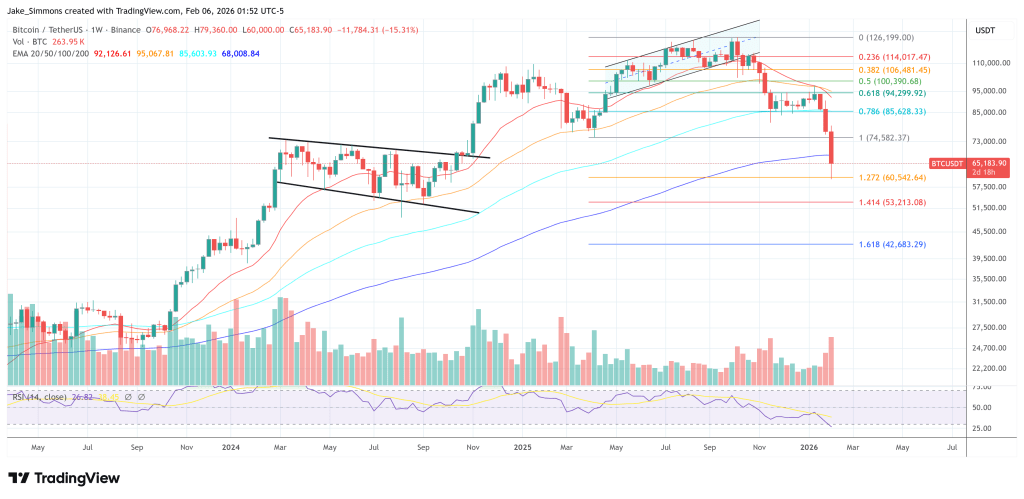
BTC needs a weekly closer above the 200-week EMA ideally, 1-week chart | Source: BTCUSDT on TradingView.com

Criptomoedas em alta

Perguntas relacionadas

QWhat is the main focus of Michael Saylor's new Bitcoin security initiative announced during the Q4 2025 earnings call?

AThe main focus is coordinating a global 'Bitcoin security program' aimed at achieving quantum readiness and addressing emergent security threats, while cautioning against rushed protocol changes.

QHow many Bitcoin did MicroStrategy hold by the end of 2025, and what percentage of the total supply does this represent?

AMicroStrategy held 713,502 Bitcoin by the end of 2025, representing about 3.4% of all Bitcoin that will ever exist.

QWhat is Michael Saylor's estimated timeline for when quantum computing might pose a threat to Bitcoin?

AMichael Saylor estimates that a quantum computing threat to Bitcoin is probably 10 or more years away, which he states is the consensus view.

QAccording to Saylor, why is MicroStrategy not advocating for a specific quantum-resistant solution for Bitcoin at this time?

AMicroStrategy is not advocating for a specific solution because there is not yet a global consensus that existing cryptographic libraries are at risk, and rushing a fix could introduce new attack surfaces and complexity.

QWhat specific financial preparation did MicroStrategy's CFO mention regarding the company's obligations?

ACFO Andrew Kang stated that MicroStrategy established a $2.25 billion cash reserve designed to cover roughly 2.5 years of interest and dividend obligations.

Leituras Relacionadas

Strategy's Loss in the Second Quarter Reaches $8.22 Billion Amid Bitcoin Decline

Strategy, the largest corporate holder of Bitcoin, reported a net loss of $8.22 billion for the second quarter. This loss was primarily driven by an $8.32 billion unrealized loss on its Bitcoin holdings due to a decline in the asset's price during the period. Despite these paper losses, the company increased its Bitcoin holdings to 843,775 BTC, a 25% growth since the start of the year. As part of a new monetization strategy, Strategy sold approximately $218.4 million worth of Bitcoin, mainly to fund dividends for preferred shareholders, with $216 million of that sold after Q2 ended. The company also built a $3.75 billion cash reserve, which it claims is sufficient to cover over two years of dividend and interest payments, aiming to insulate itself from Bitcoin's volatility while meeting obligations. Following the earnings release, Strategy's stock (MSTR) rose 4.7% in regular trading but corrected slightly after-hours. This pattern reflects how the company's accounting results are heavily tied to Bitcoin's price swings, even as its long-term strategy remains unchanged. The report indicates that Strategy is maintaining its core strategy of accumulating Bitcoin while building a financial buffer. This quarterly loss follows a recognizable pattern, with the company posting significant unrealized losses in previous quarters (e.g., $12.4 billion in Q4 2025 and ~$12.5 billion in Q1 2026) due to fair-value accounting. A key technical shift is its new monetization program, which introduces periodic selling pressure on the market, transitioning Strategy from a pure accumulator to a participant that occasionally adds supply. A critical question remains: how long can the cash reserve cover dividend obligations if a Bitcoin price downturn persists beyond two years?

cryptonews.ruHá 7m

Strategy's Loss in the Second Quarter Reaches $8.22 Billion Amid Bitcoin Decline

cryptonews.ruHá 7m

Will Terrorist Durov Ban Russian Officials?

Telegram founder Pavel Durov publicly reacted to being labeled a "terrorist" by Russian authorities, stating the designation came after he refused demands for mass surveillance and censorship on the platform. In a Telegram post, he highlighted that this status formally bans him from "publishing information online." Durov concluded with a statement widely circulated: Russian officials "clearly don't understand who can ban whom on the internet." This remark suggests Durov could potentially restrict official Russian government and officials' channels on Telegram, which continue to operate on the platform despite its formal blocking in Russia. The situation parallels previous, slow-moving state directives, like switching officials to domestic cars, contrasted with the current push to migrate all government communication to the Russian-made messenger MAX by 2030. However, reports indicate many officials still use Telegram via workarounds, fearing surveillance on MAX, while alternatives like BiP and KakaoTalk recently became inaccessible in Russia without a VPN. Durov has not specified any immediate actions against state channels. His statement is an initial response, with further developments depending on the authorities' reaction. The dynamic differs from 2020 when Russian regulators lifted a block on Telegram; now, Durov implies control from within the platform itself over the official accounts that persisted through that earlier blockade.

cryptonews.ruHá 7m

Will Terrorist Durov Ban Russian Officials?

cryptonews.ruHá 7m

DeepSeek V4 Official Version Arrives, New Capabilities Emerge, Value-for-Money King Enters the Fray

On July 31st, DeepSeek officially launched the public API beta for its DeepSeek-V4-Flash model. A key highlight is its performance on multiple Agent benchmark tests, reportedly nearing or even surpassing the level of the V4-Pro preview version from three months ago. Notably, the Flash model achieves this with significantly smaller scale (130B active parameters vs. Pro's 490B), suggesting that post-training optimization and data quality may be as crucial as raw model size. DeepSeek emphasized that the V4-Flash-0731 uses the same model architecture and size as its preview version, with improvements attributed solely to "re-trained post-training." The update also marks the official debut of DeepSeek's self-developed Agent framework, "Harness." The move signals DeepSeek's strategic push to position its cost-effective Flash model as a competitive base for Agent applications—scenarios requiring autonomous planning, tool usage, and complex task execution—where inference speed and cost are critical. By natively supporting OpenAI's Responses API format and adapting for code-generation scenarios, DeepSeek aims not just to be a cheaper alternative but to establish its own ecosystem in the Agent era. This release follows DeepSeek's record-breaking ~$50 billion fundraising round roughly two months prior, underscoring market confidence in its technology and commercialization prospects. The company is reportedly preparing for another funding round at a valuation of approximately $71 billion. The Flash model's advancement represents a step in fulfilling the high expectations that come with this valuation, setting the stage for the impending release of the V4-Pro official version and intensifying competition in the global Agent landscape.

marsbitHá 11m

DeepSeek V4 Official Version Arrives, New Capabilities Emerge, Value-for-Money King Enters the Fray

marsbitHá 11m

Trading

Spot

Artigos em Destaque

Como comprar PUSH

Bem-vindo à HTX.com!Tornámos a compra de Push Protocol (PUSH) simples e conveniente.Segue o nosso guia passo a passo para iniciar a tua jornada no mundo das criptos.Passo 1: cria a tua conta HTXUtiliza o teu e-mail ou número de telefone para te inscreveres numa conta gratuita na HTX.Desfruta de um processo de inscrição sem complicações e desbloqueia todas as funcionalidades.Obter a minha contaPasso 2: vai para Comprar Cripto e escolhe o teu método de pagamentoCartão de crédito/débito: usa o teu visa ou mastercard para comprar Push Protocol (PUSH) instantaneamente.Saldo: usa os fundos da tua conta HTX para transacionar sem problemas.Terceiros: adicionamos métodos de pagamento populares, como Google Pay e Apple Pay, para aumentar a conveniência.P2P: transaciona diretamente com outros utilizadores na HTX.Mercado de balcão (OTC): oferecemos serviços personalizados e taxas de câmbio competitivas para os traders.Passo 3: armazena teu Push Protocol (PUSH)Depois de comprar o teu Push Protocol (PUSH), armazena-o na tua conta HTX.Alternativamente, podes enviá-lo para outro lugar através de transferência blockchain ou usá-lo para transacionar outras criptomoedas.Passo 4: transaciona Push Protocol (PUSH)Transaciona facilmente Push Protocol (PUSH) no mercado à vista da HTX.Acede simplesmente à tua conta, seleciona o teu par de trading, executa as tuas transações e monitoriza em tempo real.Oferecemos uma experiência de fácil utilização tanto para principiantes como para traders experientes.

570 Visualizações TotaisPublicado em {updateTime}Atualizado em 2026.06.02

Como comprar PUSH

Discussões

Bem-vindo à Comunidade HTX. Aqui, pode manter-se informado sobre os mais recentes desenvolvimentos da plataforma e obter acesso a análises profissionais de mercado. As opiniões dos utilizadores sobre o preço de PUSH (PUSH) são apresentadas abaixo.

活动图片