The golden age of AI writing is collapsing!
Entering it, each generation of models grows stronger, yet the articles become increasingly worse.
It knows when to list several suggestions, where to insert subheadings, and never forgets to add a concluding sentence at the end.
But after reading the entire piece, not a single sentence remains in your mind.
The Stronger the Model, the Less Human the Writing Sounds
Recently, Cambridge University postdoctoral researcher Adam Hunt also noticed this phenomenon. His research focuses on evolutionary psychiatry and human evolution.
Hunt was previously optimistic about AI. However, on July 28, he frankly admitted in a long post: he is growing increasingly pessimistic now.
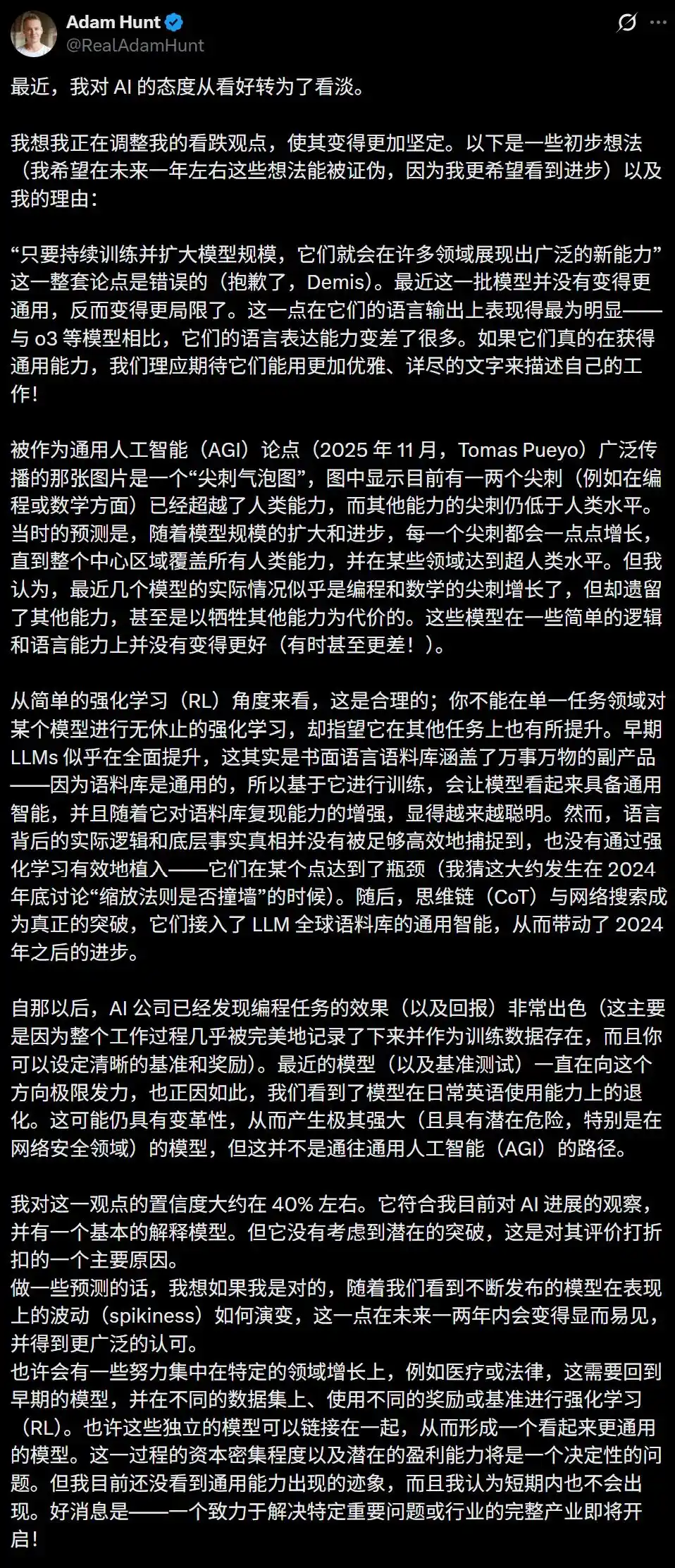
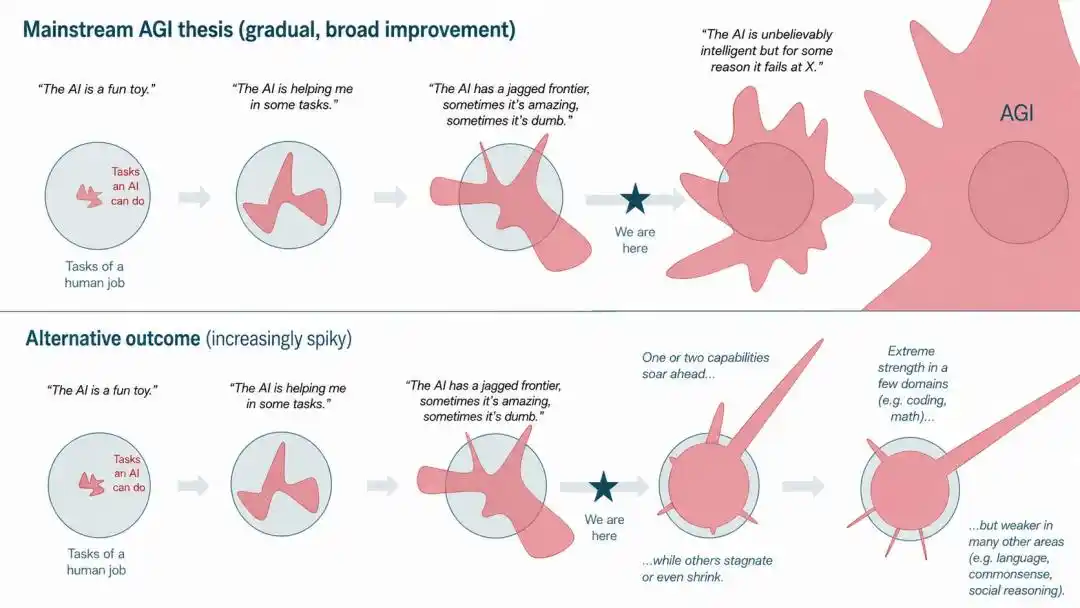
There was a popular metaphor before, depicting model capability as a circle with a sharp spike.
First, code and mathematics surpass humans, then as scale increases, every direction gradually grows, ultimately achieving AGI.
But in reality, the spike for code and mathematics is indeed growing longer, while language expression and simple reasoning have not improved synchronously.
From a reinforcement learning perspective, this outcome is almost inevitable.
Earlier generations of LLMs appeared to become "comprehensively smarter" because the training corpus itself covered all domains, from poetry to theses, encompassing the entire internet.
However, that was a byproduct of the corpus, not the model's genuine "comprehension."
Chain-of-thought and web search were subsequently introduced, giving models a temporary boost. But ultimately, this path hit a wall.
Following that, AI companies eager for a turnaround turned their focus to code.
The reason is simple: there is a constant stream of training data available.
GitHub commits, reviews, and PRs are all readily available. Moreover, similar to mathematics, code provides clear feedback signals: either it runs or it doesn't.
What about writing articles? How do you automatically score "how well a piece of prose is written"? Without a reward, RL won't optimize in that direction.
Thus, all training efforts shifted to code, while language expression had to rely on the foundation laid during the pre-training phase.
This foundational knowledge can only diminish over time. To accommodate improvements in other areas, it might even degrade.
This is precisely where Goodhart's law tends to manifest.
When a metric becomes the training target, it no longer accurately reflects true capability. Labs optimize models using benchmark tests, then prove their improvement with similar tests.
Benchmark accuracy scores will continue to rise. Yet, the actual user experience may stagnate or even decline.
This Time, Imitation Is Also Restricted
While capabilities are degrading, another development is occurring simultaneously.
A Reddit user complained in a post that they had been using ChatGPT to write a book for several months, subscribing to the advanced model. They took a break in between.
When they returned, the prompt that had always worked suddenly returned a refusal.
The prompt itself wasn't complex: specify an author, request to increase dialogue, enrich details, and avoid fragmented sentences.
In the past, simply writing the author's name allowed the model to generate content approximating their style, without needing additional explanations on sentence length, rhythm, or perspective.
Now, this type of prompt no longer works.
Ars Technica tested with Stephen King, J.K. Rowling, Amy Tan, Dickens, Hemingway, and Engadget tested with Agatha Christie. ChatGPT refused to imitate all of them.
If you don't name names and only request abstract features like "suspense intensity," "narrative pacing," or "dialogue density," it can still output. But the flavor is no longer the same.

The Golden Age of AI Writing Has Collapsed
Today, this controversy has shaken users' fundamental expectations regarding AI writing.
Models may not necessarily write better, and prompts are no longer guaranteed to remain effective long-term.
When platforms change their rules, entire writing pipelines built around specific models can collapse overnight.
However, AI writing won't disappear; it has merely retreated to its proper place: as a tool.
It can research information, structure content, and revise sentences, but it cannot replace the author in deciding what to write and why to write it.
In other words, human experience, judgment, and desire to express are becoming increasingly valuable.
Reference: https://arstechnica.com/ai/2026/07/chatgpt-stops-cloning-famous-writers-voices-but-may-capture-a-similar-feeling/
This article is from WeChat public account "New Zhiyuan," author: ASI Apocalypse