Saylor Says ‘Don’t Sell Your Bitcoin’, as LiquidChain Unites Liquidity for Utility

bitcoinistPublicado em 2026-02-03Última atualização em 2026-02-03

Resumo

Michael Saylor advocates holding Bitcoin as long-term "economic energy," but this creates capital inefficiency. DeFi needs high-quality collateral, yet moving Bitcoin across chains is complex and risky. LiquidChain ($LIQUID) addresses this with a Layer 3 solution that unifies liquidity from Bitcoin, Ethereum, and Solana into a single execution layer. Its Cross-Chain VM allows developers to build applications that use assets from all three chains simultaneously, reducing friction and counterparty risk. The protocol also enables liquidity staking, letting users earn yield without selling their assets. $LIQUID tokens power the network and offer staking rewards, positioning LiquidChain as infrastructure for connected, multi-chain DeFi.

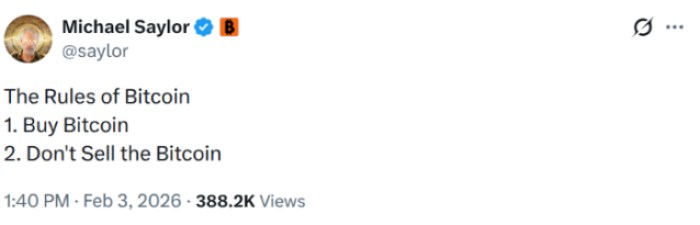
Michael Saylor says that Bitcoin isn’t currency for spending, it’s ‘economic energy’ meant to be preserved for 100 years.

The Strategy chairman’s thesis is simple: you don’t sell the winner to buy the losers. While this ‘Diamond Hand’ philosophy has shifted Bitcoin from speculative toy to treasury reserve asset, it creates a massive friction point: capital inefficiency.

While Saylor advocates for indefinite holding, the broader DeFi ecosystem is starving for high-quality collateral. Right now, traders face a binary choice: leave Bitcoin gathering dust in cold storage, or risk it in a maze of bridges, wrapped tokens, and centralized custodians just to chase yield on Ethereum. (Sound familiar?)
This fragmentation is the bottleneck of the current cycle. Liquidity is trapped in silos, making cross-chain moves slow, expensive, and technically risky.
We’re seeing a shift from ‘store of value’ to ‘productive assets.’ As institutional flows stabilize, the next frontier isn’t just owning crypto; it’s using it across ecosystems without selling the bag.

This demand is fueling Layer 3 (L3) infrastructure designed to smash these barriers. Enter LiquidChain ($LIQUID), a protocol engineering a fusion of Bitcoin, Ethereum, and Solana liquidity into a single execution environment.

Breaking Down The Silos With A Unified Liquidity Layer

The real risk in the DeFi landscape today isn’t price drops, it’s execution complexity. Moving value from Bitcoin to Solana usually involves multiple hops, slippage, and ‘wrapped’ assets that introduce sketchy counterparty risk. This fragmentation means billions in liquidity remain trapped on their native chains.

LiquidChain fixes this by deploying a Cross-Chain VM (Virtual Machine) that serves as a unified execution layer.
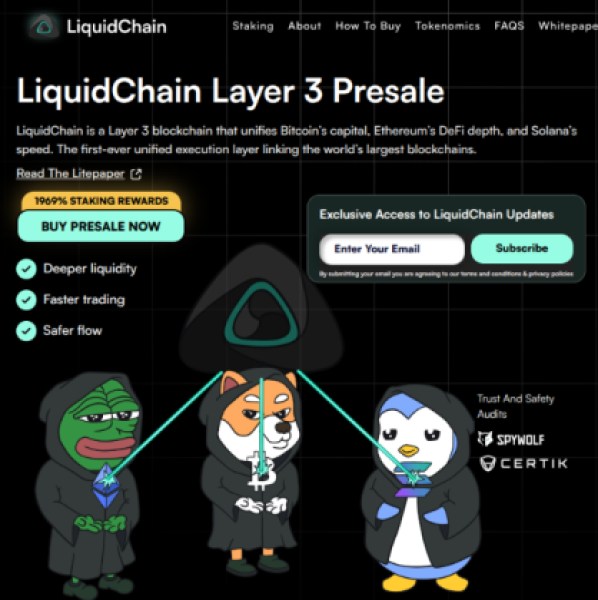
Instead of forcing users to bridge assets manually, LiquidChain’s ‘Deploy-Once Architecture’ allows developers to build applications that tap into $BTC, $ETH, and $SOL simultaneously. That’s critical for removing the friction that kills adoption.

In the LiquidChain model, you could theoretically pledge Bitcoin collateral to access Solana-speed execution or Ethereum-based DeFi protocols in a single step.
The protocol’s architecture focuses on verifiable settlement. By operating as Layer 3 infrastructure, it aggregates security from the underlying chains while offering a single interface.

If you’re a developer, this ends the headache of maintaining different codebases for different ecosystems. Instead of having to choose between Ethereum’s TVL (Total Value Locked) or Solana’s speed, LiquidChain offers a venue where they coexist.

EXPLORE UNIFIED LIQUIDITY WITH $LIQUID.

Unlocking Capital Efficiency Through Liquidity Staking

Saylor’s advice to ‘never sell’ is a solid strategy, but it doesn’t solve the cash flow problem. Investors holding large caps are often asset-rich but liquidity-poor. LiquidChain tackles this through its native utility model, which centers on Liquidity Staking.

The protocol is designed to use the $LIQUID token not just for governance, but as transaction fuel powering the network. By staking liquidity, you can earn rewards derived from the economic activity passing through the Layer 3 infrastructure. It matches the ‘productive crypto’ narrative perfectly, assets generate yield without you having to sell a dime.

You can buy your $LIQUID now for $0.0135 and don’t miss the staking opportunities currently sitting at 1966%.

Plus, the platform aims to include a grant system for developers, incentivizing dApps that use this cross-chain fluidity. This ecosystem approach suggests the future of DeFi isn’t about which chain ‘wins,’ but which infrastructure connects them.

By enabling single-step execution across the industry’s three largest liquidity pools, LiquidChain positions itself as the connective tissue for the next phase of market maturity. To paraphrase an adage, it appears in crypto, it’s no longer what you have but how its connected.’

JOIN THE LIQUIDCHAIN ECOSYSTEM.

Disclaimer: This article is for informational purposes only and does not constitute financial advice. Cryptocurrency investments, including presales and new protocols, carry high risks, including the potential for total loss. Always verify smart contract audits and conduct your own due diligence.


Perguntas relacionadas

QWhat is Michael Saylor's main thesis regarding Bitcoin, as mentioned in the article?

AMichael Saylor's main thesis is that Bitcoin isn't currency for spending, but 'economic energy' meant to be preserved for 100 years. He advocates for not selling the winner (Bitcoin) to buy the losers, promoting a 'Diamond Hand' philosophy of indefinite holding.

QWhat problem does the article identify with the current DeFi ecosystem in relation to Bitcoin?

AThe article identifies that the current DeFi ecosystem suffers from capital inefficiency and fragmentation. Liquidity is trapped in silos, making cross-chain moves slow, expensive, and technically risky. Traders face a binary choice: either leave Bitcoin idle in cold storage or risk it through complex bridges, wrapped tokens, and centralized custodians to chase yield.

QHow does LiquidChain aim to solve the problem of fragmented liquidity across different blockchains?

ALiquidChain aims to solve fragmentation by deploying a Cross-Chain VM (Virtual Machine) that serves as a unified execution layer. Its 'Deploy-Once Architecture' allows developers to build applications that can tap into Bitcoin ($BTC), Ethereum ($ETH), and Solana ($SOL) liquidity simultaneously, enabling single-step execution across these ecosystems.

QWhat is the role of the $LIQUID token within the LiquidChain ecosystem?

AThe $LIQUID token is used not just for governance but also as transaction fuel powering the network. Users can stake their liquidity to earn rewards derived from the economic activity on the Layer 3 infrastructure, allowing them to generate yield without having to sell their underlying assets.

QWhat specific benefit does LiquidChain's Liquidity Staking offer to investors who follow a 'never sell' strategy like Saylor's?

ALiquidity Staking offers a solution to the 'cash flow problem' for investors who are asset-rich but liquidity-poor due to holding large caps like Bitcoin. It allows them to earn yield on their assets by staking liquidity, generating rewards from network activity without having to sell any of their principal holdings.

Leituras Relacionadas

$292 Million KelpDAO Cross-Chain Bridge Hack: Who Should Foot the Bill?

On April 18, 2026, an attacker stole 116,500 rsETH (worth ~$292M) from KelpDAO’s cross-chain bridge in 46 minutes—the largest DeFi exploit of 2026. The stolen assets were deposited into Aave V3 as collateral, causing $177–200M in bad debt and triggering a cascade of losses across nine DeFi protocols. Aave’s TVL dropped by ~$6B overnight. This legal analysis argues that KelpDAO and LayerZero Labs share concurrent liability, with fault apportioned 60%/40%. KelpDAO negligently configured its bridge with a 1-of-1 decentralized verifier network (DVN)—a single point of failure—despite LayerZero’s explicit recommendation of a 2-of-3 setup. LayerZero, which operated the compromised DVN, failed to secure its RPC infrastructure against a known poisoning attack vector. Both protocols’ terms of service cap liability at $200 (KelpDAO) or $50 (LayerZero), but these limits are likely unenforceable due to unconscionability, gross negligence exceptions, and potential securities law invalidation (if rsETH is deemed a security under the Howey test). Aave’s governance also faces fiduciary duty claims for raising rsETH’s loan-to-value ratio to 93%—far above competitors’ 72–75%—without adequately assessing bridge risks, amplifying the systemic fallout. Practical recovery targets include LayerZero Labs (a registered Canadian entity), KelpDAO’s founders, auditors, and identifiable Aave governance delegates. The incident underscores escalating legal risks for DeFi protocols, infrastructure providers, and governance participants.

marsbitHá 6m

$292 Million KelpDAO Cross-Chain Bridge Hack: Who Should Foot the Bill?

marsbitHá 6m

Insider Trading in War: 5 People Involved, the Highest Earner Was Arrested

On April 24, the U.S. Department of Justice arrested U.S. Army Special Forces Staff Sergeant Gannon Ken Van Dyke for insider trading related to the capture of Venezuelan President Nicolás Maduro on January 3. Van Dyke allegedly profited over $400,000 by placing bets on a prediction market, Polymarket, using insider knowledge of the covert operation. According to the indictment, Van Dyke registered an account (0x31a5) on December 26 and made a series of bets predicting Maduro’s capture and U.S. military involvement in Venezuela. He withdrew most of his funds on the day of the operation and attempted to obscure his tracks by transferring assets through crypto and brokerage accounts. This case marks the first time the DOJ has prosecuted insider trading on Polymarket. PolyBeats had previously identified five suspicious accounts, including Van Dyke’s—the highest earner—in January. The other accounts, with profits ranging from $34,000 to $145,000, remain under unofficial scrutiny but have not been charged. Their lower profits, indirect access to information, and unclear legal boundaries may complicate prosecution. Polymarket has since strengthened its market integrity rules, explicitly prohibiting trading based on confidential or insider information. Van Dyke’s arrest, nearly four months after his trades, signals increased regulatory attention and the persistent traceability of blockchain-based transactions.

marsbitHá 7m

Insider Trading in War: 5 People Involved, the Highest Earner Was Arrested

marsbitHá 7m

Bitwise: Bullish on Bitcoin's Performance in the Second Half of the Year, AI and Regulation Will Spark a New Altcoin Season

Bitwise CIO Matt Hougan and Research Lead Ryan Rasmussen express strong bullish sentiment on Bitcoin's long-term prospects, suggesting that its $1 million price target may be too conservative. They argue Bitcoin serves a dual role: as digital gold and a potential global settlement asset, especially amid declining trust in traditional monetary systems. Despite a weak Q1 2026 where nearly all crypto assets and prices saw double-digit declines, the analysts remain optimistic due to strong forward-looking catalysts, including institutional adoption via Bitcoin ETFs from major firms like Morgan Stanley and Goldman Sachs. Geopolitical instability, such as Iran’s mention of using Bitcoin for international payments, increases the value of Bitcoin’s “out-of-the-money call option” as a non-political, global settlement currency. This enhances its appeal beyond a mere store of value. . Additionally, Hougan highlights that a clearer regulatory token framework under current SEC leadership, combined with AI efficiency gains and high-performance blockchains, could fuel a new “altseason” by late 2026. This may lead to a wave of legitimate, value-capturing token projects, unlike the earlier ICO boom. . Bitwise also announced an Avalanche ETF, citing its unique architecture and rapid growth in real-world asset (RWA) tokenization, which has surged 10x to nearly $30 billion in two years. The firm believes Layer 1 blockchains are still early in their growth cycle, with significant potential ahead.

marsbitHá 53m

Bitwise: Bullish on Bitcoin's Performance in the Second Half of the Year, AI and Regulation Will Spark a New Altcoin Season

marsbitHá 53m

Trading

Spot
Futuros

Artigos em Destaque

Como comprar T

Bem-vindo à HTX.com!Tornámos a compra de Threshold Network Token (T) simples e conveniente.Segue o nosso guia passo a passo para iniciar a tua jornada no mundo das criptos.Passo 1: cria a tua conta HTXUtiliza o teu e-mail ou número de telefone para te inscreveres numa conta gratuita na HTX.Desfruta de um processo de inscrição sem complicações e desbloqueia todas as funcionalidades.Obter a minha contaPasso 2: vai para Comprar Cripto e escolhe o teu método de pagamentoCartão de crédito/débito: usa o teu visa ou mastercard para comprar Threshold Network Token (T) instantaneamente.Saldo: usa os fundos da tua conta HTX para transacionar sem problemas.Terceiros: adicionamos métodos de pagamento populares, como Google Pay e Apple Pay, para aumentar a conveniência.P2P: transaciona diretamente com outros utilizadores na HTX.Mercado de balcão (OTC): oferecemos serviços personalizados e taxas de câmbio competitivas para os traders.Passo 3: armazena teu Threshold Network Token (T)Depois de comprar o teu Threshold Network Token (T), armazena-o na tua conta HTX.Alternativamente, podes enviá-lo para outro lugar através de transferência blockchain ou usá-lo para transacionar outras criptomoedas.Passo 4: transaciona Threshold Network Token (T)Transaciona facilmente Threshold Network Token (T) no mercado à vista da HTX.Acede simplesmente à tua conta, seleciona o teu par de trading, executa as tuas transações e monitoriza em tempo real.Oferecemos uma experiência de fácil utilização tanto para principiantes como para traders experientes.

376 Visualizações TotaisPublicado em {updateTime}Atualizado em 2025.03.21

Como comprar T

Discussões

Bem-vindo à Comunidade HTX. Aqui, pode manter-se informado sobre os mais recentes desenvolvimentos da plataforma e obter acesso a análises profissionais de mercado. As opiniões dos utilizadores sobre o preço de T (T) são apresentadas abaixo.

活动图片












