Satoshi Nakamoto statue lands on NYSE in sign of changing times

cointelegraphPublicado em 2025-12-11Última atualização em 2025-12-11

Resumo

The New York Stock Exchange (NYSE) has installed a statue of Satoshi Nakamoto, Bitcoin’s pseudonymous creator, marking a symbolic shift in the acceptance of cryptocurrency within traditional finance. The statue, designed by artist Valentina Picozzi, was placed by Bitcoin firm Twenty One Capital. This event coincides with the anniversary of the Bitcoin mailing list launched in 2008. The installation reflects Bitcoin’s journey from a niche concept to a mainstream asset, now held by major institutions, companies, and ETFs. Picozzi has placed six of a planned 21 statues worldwide, each representing Nakamoto’s elusive legacy and the decentralized ideals of Bitcoin.

The New York Stock Exchange (NYSE) has just become the sixth home for Valentina Picozzi’s “disappearing” Satoshi Nakamoto statue — a massive contrast to just a few years ago, when crypto was seen as taboo on Wall Street.

The NYSE is considered a center of traditional financial institutions, and the inclusion of a Nakamoto statue marks it as “shared ground between emerging systems and established institutions,” the stock exchange said in an X post on Wednesday.

The statue was installed by Bitcoin company Twenty One Capital, which launched for trading this week; however, the design is the brainchild of artist Valentina Picozzi, who said on X, under her Satoshigallery handle, that her latest creation coming to such a prominent location is “Mind-blowing.”
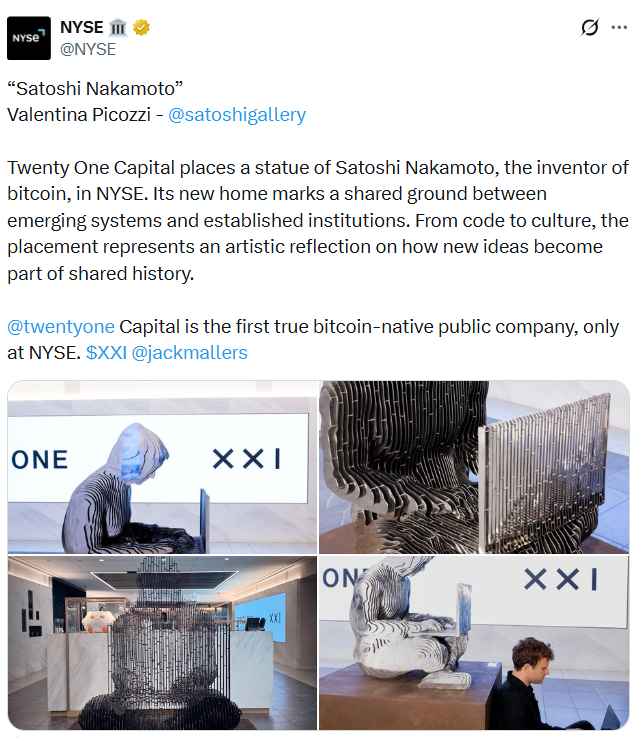
Source: New York Stock Exchange

“This is such an achievement, even in our wildest dream we wouldn’t think about placing the statue of Satoshi Nakamoto in this location! The 6th/21 statues of Satoshi Nakamoto found its home in the NYSE,” she added.

It also happens to coincide with the anniversary of the Bitcoin mailing list, which Nakamoto launched on Dec. 10, 2008.

Bitcoin's journey from thought experiment to mainstream asset

Satoshi Nakamoto mined the genesis block on Jan. 3, 2009, minting the first 50 Bitcoin in history and planting the seeds for the crypto industry we see today.

Over a year later, on May 22, 2010, programmer Laszlo Hanyecz made the first documented purchase of goods using Bitcoin, paying 10,000 Bitcoin for two Papa John’s pizzas.

In the intervening years, Bitcoin and cryptocurrency faced many challenges, as institutions and banks shunned them, and governments allegedly attempted to suppress them through efforts such as Operation Chokepoint 2.0.

However, it has since turned a corner, as skeptics, such as BlackRock CEO Larry Fink, have changed their minds about the technology, and institutions and Wall Street have scrambled to invest through vehicles like exchange-traded funds and directly by holding Bitcoin in their treasuries.

Public and private companies, countries and ETFs now collectively hold more than 3.7 million Bitcoin, according to Bitbo, worth more than $336 billion.

More Satoshi statues incoming

Picozzi has five other Nakamoto statues around the world, located in Switzerland, El Salvador, Japan, Vietnam, and Miami, a city in the US State of Florida.

Related: Disappearing Satoshi statue in Lugano took 21 months to create, says artist

Picozzi, under her Satoshigallery handle, said she is committed to placing 21 around the world, a possible reference to the theoretical 21 million Bitcoin maximum supply.

Speaking to Cointelegraph last year, she said Nakamoto is one of the most intriguing and fascinating figures of this era, and the statues stand as a tribute to the person behind Bitcoin.

“The statue itself wants to give to the viewer this feeling of disappearance, and the sense that the inventor stays between the lines — as of today, Satoshi exists in the lines of the Bitcoin code, allowing humanity to have the first decentralized payment system,” she said.

“It represents a hacker in his stereotyped pose, sitting with the laptop on his legs, and is a tribute to all the developers and programmers around the world that helped build the Bitcoin ecosystem, fighting for transparency and freedom.”

Magazine: 6 reasons Jack Dorsey is definitely Satoshi... and 5 reasons he’s not

Leituras Relacionadas

Two Companies Capture 90% of AI Startup's $80 Billion ARR

The AI startup landscape is highly concentrated, with OpenAI and Anthropic capturing 89% of an estimated $80 billion in annualized revenue among 34 leading companies. OpenAI, with $24-25B in revenue, primarily drives growth through ChatGPT's consumer subscriptions, while Anthropic, exceeding $30B, focuses on enterprise API integration and has rapidly grown its U.S. enterprise market share from under 1% to 34.4% in under two years. The remaining 32 companies share just 11% of the revenue, facing intense pressure as resources, talent, and market attention consolidate around the two giants. This creates a self-reinforcing cycle where higher revenue fuels greater compute investment and model improvement. Despite their dominance, both leaders face challenges. OpenAI is navigating significant legal disputes and partnership tensions, while Anthropic operates under the high expectations of its massive backers like Amazon. Historical parallels in tech infrastructure (e.g., search engines, mobile OS) suggest such oligopolistic tendencies are common due to scale, network effects, and high switching costs, indicating the market could become even more concentrated. However, the rapid pace of AI innovation leaves room for disruption. For other players, the strategic path forward is not direct competition with the giants but specialization in vertical domains where general-purpose models fall short—such as legal, medical, or industrial applications—building indispensable, niche solutions.

marsbitHá 6m

Two Companies Capture 90% of AI Startup's $80 Billion ARR

marsbitHá 6m

Silicon Bull, Carbon Bear: The Wealth Code of 2026 is Only 'Chips' and 'Light'

The article, titled "Silicon Bull, Carbon Bear: In 2026, the Wealth Code Lies Only in 'Chips' and 'Optics'", discusses the extreme market divergence in 2026 driven by the AI investment frenzy. Investment managers who concentrated on the AI hardware supply chain, particularly computing infrastructure, optical modules, and memory chips, have seen their fund net asset values (NAVs) surge dramatically, even reaching record highs. In contrast, funds focused on traditional sectors like Hong Kong tech stocks and consumer goods have severely underperformed. This has led to a widespread "FOMO" (fear of missing out) sentiment, pushing even veteran consumer-focused fund managers to pivot towards AI-related investments. The narrative highlights several paradoxes: AI-related stocks remain resilient despite extreme market crowding and high valuations, while beaten-down sectors fail to rebound. The author dubs this split market "Silicon Bull, Carbon Bear," suggesting a bull market only for those invested in silicon-based tech (AI hardware) and a bear market for carbon-based traditional economy sectors. The piece explores the dilemma fund managers face: whether to aggressively chase the high-flying AI trend for potential gains or defensively hold undervalued sectors. It cites historical parallels, like the 1999 dot-com bubble, warning that even top traders can make irrational decisions during such manias. Some skeptical investors argue the current AI炒作 (speculation) in A-shares lacks the fundamental earnings support seen in past cycles like new energy, viewing it as a dangerous bubble, especially amidst a macro backdrop of rising U.S. bond yields. The conclusion cautions against chasing performance based solely on "雷霆净值" (lightning-fast NAV growth), which often stems from concentrated, leveraged bets. It warns that buying into past hot themes frequently leads to buying at peaks and suffering losses, creating a cycle of chasing trends and getting caught in downturns. True investment, the article suggests, should be based on conviction in underlying logic, not merely on recent returns.

marsbitHá 24m

Silicon Bull, Carbon Bear: The Wealth Code of 2026 is Only 'Chips' and 'Light'

marsbitHá 24m

Trading

Spot
Futuros

Artigos em Destaque

Como comprar HOME

Bem-vindo à HTX.com!Tornámos a compra de Defi.app (HOME) simples e conveniente.Segue o nosso guia passo a passo para iniciar a tua jornada no mundo das criptos.Passo 1: cria a tua conta HTXUtiliza o teu e-mail ou número de telefone para te inscreveres numa conta gratuita na HTX.Desfruta de um processo de inscrição sem complicações e desbloqueia todas as funcionalidades.Obter a minha contaPasso 2: vai para Comprar Cripto e escolhe o teu método de pagamentoCartão de crédito/débito: usa o teu visa ou mastercard para comprar Defi.app (HOME) instantaneamente.Saldo: usa os fundos da tua conta HTX para transacionar sem problemas.Terceiros: adicionamos métodos de pagamento populares, como Google Pay e Apple Pay, para aumentar a conveniência.P2P: transaciona diretamente com outros utilizadores na HTX.Mercado de balcão (OTC): oferecemos serviços personalizados e taxas de câmbio competitivas para os traders.Passo 3: armazena teu Defi.app (HOME)Depois de comprar o teu Defi.app (HOME), armazena-o na tua conta HTX.Alternativamente, podes enviá-lo para outro lugar através de transferência blockchain ou usá-lo para transacionar outras criptomoedas.Passo 4: transaciona Defi.app (HOME)Transaciona facilmente Defi.app (HOME) no mercado à vista da HTX.Acede simplesmente à tua conta, seleciona o teu par de trading, executa as tuas transações e monitoriza em tempo real.Oferecemos uma experiência de fácil utilização tanto para principiantes como para traders experientes.

303 Visualizações TotaisPublicado em {updateTime}Atualizado em 2025.06.10

Como comprar HOME

Discussões

Bem-vindo à Comunidade HTX. Aqui, pode manter-se informado sobre os mais recentes desenvolvimentos da plataforma e obter acesso a análises profissionais de mercado. As opiniões dos utilizadores sobre o preço de HOME (HOME) são apresentadas abaixo.

活动图片