Santa Didn’t Come For Bitcoin ETFs: $782 Million Walks Out The Door

bitcoinistPublicado em 2025-12-29Última atualização em 2025-12-29

Resumo

Spot Bitcoin ETFs experienced significant outflows of approximately $782 million during the Christmas week, reducing total net assets to around $113.5 billion. The outflows were led by major funds including BlackRock’s IBIT and Fidelity’s FBTC. Despite the withdrawals, Bitcoin price remained near $87,000. Market analysts attribute part of the decline to seasonal factors and reduced liquidity during the holidays, but data shows a broader trend of institutional outflows since early November. Meanwhile, gold and silver rallied, drawing some investment away from crypto. The divergence suggests a potential shift in institutional risk allocation, though flows may recover in early 2026 if monetary easing expectations strengthen and market conditions normalize.

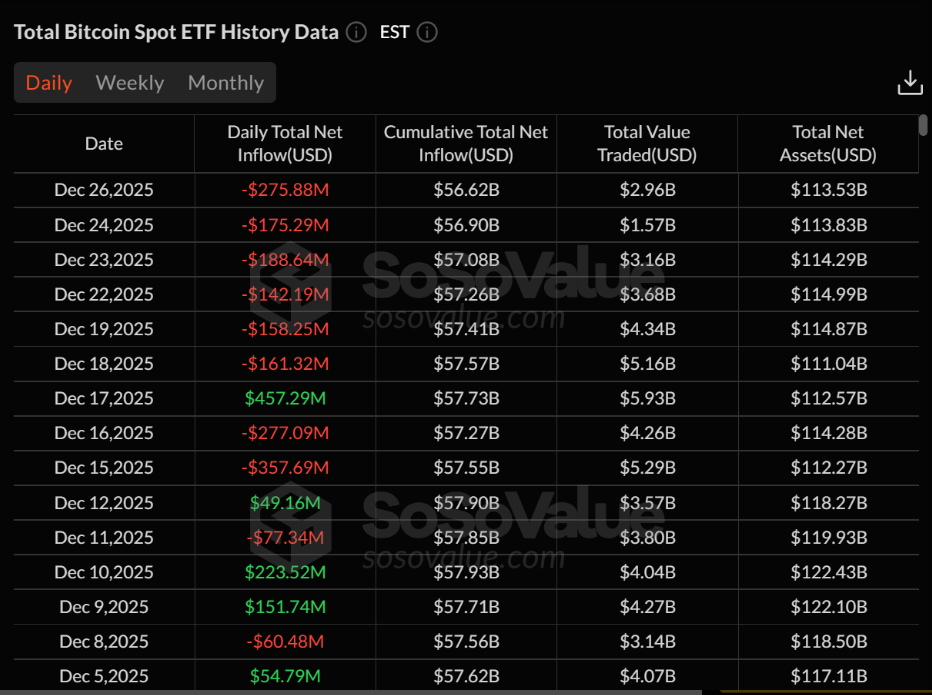
Spot Bitcoin ETFs suffered heavy withdrawals over the Christmas week as investors pulled about $782 million from the products, according to data from SoSoValue.

Bitcoin’s market price stayed roughly near $87,000, even as the funds lost cash. The drop trimmed total net assets in US-listed spot Bitcoin ETFs to about $113.5 billion, down from levels above $120 billion earlier in December.

Major Funds Lead The Withdrawals

Friday was the worst single day of the stretch, when ETFs recorded a combined $276 million in net outflows. BlackRock’s IBIT accounted for nearly $193 million of that exit, while Fidelity’s FBTC lost about $74 million.

Grayscale’s GBTC saw more modest redemptions during the same period. Friday also marked the sixth straight day of outflows — the longest streak since early autumn — with more than $1.1 billion draining out across that run.

December sees heavy outflows from spot Bitcoin ETFs. Source: SoSoValue
Seasonal Pressure Or A Bigger Shift

According to Vincent Liu, chief investment officer at Kronos Research, holiday moves and thin market depth can cause short-term withdrawals as desks close for the holidays.

He expects institutional flows to come back when trading desks reopen in early January and thinks a shift toward Fed easing in 2026 — markets are pricing roughly 75–100 bps of cuts — could lift demand for ETFs.

Based on reports from Glassnode, however, the trend looks broader than holiday noise: the 30-day moving average of net flows into US spot Bitcoin and Ether ETFs has been negative since early November, signaling sustained outflows by institutional players.

BTCUSD trading at $87,823 on the 24-hour chart: TradingView

Metals Take Center Stage

Meanwhile, gold and silver enjoyed a banner run while crypto saw pullbacks. Gold futures climbed above $4,550, hitting multiple records this year. Silver topped $75 per ounce and has gained about 150% year-to-date.

That rally has prompted some investors to reallocate away from crypto. Market experts like Louis Navellier said that with central banks active in the metal markets and volatility lower, gold has attracted flows that might otherwise have gone into digital assets.

Outspoken critic Peter Schiff wrote on social media that Bitcoin’s inability to rise alongside other risk assets raises doubts about its near-term upside.

What This Means For Institutional Demand

ETFs are widely watched as a proxy for institutional appetite. Based on the latest figures, institutions appear to be pulling back after a period when they were a key driver of crypto markets.

The divergence between rising precious metals and a modest decline in Bitcoin — about 6% year-to-date — has reinforced that view. Some of the selling likely reflects rebalancing and cash needs during the holidays. Some of it may reflect a rethinking of risk allocation by large allocators.

Reports suggest flows could normalize when trading activity returns to normal after the holiday break. If rate markets continue to price in easing and bank-led crypto infrastructure becomes easier for big investors to use, ETF inflows might resume. For now, the flow data points to a cautious institutional stance, even as Bitcoin’s price holds at elevated levels.

Featured image from Shutterstock, chart from TradingView

Criptomoedas em alta

Perguntas relacionadas

QWhat was the total amount of withdrawals from spot Bitcoin ETFs over the Christmas week, according to SoSoValue?

AInvestors pulled about $782 million from spot Bitcoin ETFs over the Christmas week.

QWhich two major funds led the outflows on the worst single day of the stretch, and how much did they lose?

AOn the worst day, BlackRock's IBIT accounted for nearly $193 million in outflows, while Fidelity's FBTC lost about $74 million.

QAccording to Vincent Liu, what two factors could cause a resurgence in institutional demand for Bitcoin ETFs?

AVincent Liu expects institutional flows to return when trading desks reopen in early January and thinks a shift toward Fed easing in 2026 could lift demand for ETFs.

QWhat alternative asset class saw a significant rally while crypto ETFs experienced outflows, and how much has silver gained year-to-date?

AGold and silver enjoyed a banner run. Silver topped $75 per ounce and has gained about 150% year-to-date.

QWhat does the sustained negative 30-day moving average of net flows into US spot Bitcoin and Ether ETFs since early November signal?

AThe negative 30-day moving average signals sustained outflows by institutional players, indicating a broader trend than just holiday-related noise.

Leituras Relacionadas

In Jinjiang, Fujian, a Storage Super Unicorn Lies Quiet

In Fujian's Jinjiang, a city known for sportswear, lies a quiet semiconductor giant: Fujian Jinhua Integrated Circuit Co. (JHICC). Once a promising domestic DRAM manufacturer alongside Yangtze Memory and ChangXin Memory Technologies (CXMT), its journey was derailed in 2018 when the U.S. placed it on an Entity List and filed criminal charges for alleged trade secret theft. This halted production for years. A turning point came in February 2024 when a U.S. federal court found JHICC not guilty. However, it had lost crucial time. While CXMT soared to become a top-valued A-share company in 2024, JHICC, with an estimated valuation of 80 billion RMB, was just restarting. Its current output is primarily customized DDR4 chips, not the advanced DDR5/HBM demanded for AI, but it still benefits from the broader memory chip upcycle. JHICC's story is tied to Chen Zhengkun, a veteran engineer who left Micron to lead the venture. Founded in 2016 with state-backed funding, JHICC partnered with Taiwan's UMC to develop DRAM technology. Rapid progress was cut short by the U.S. actions, which Micron initiated, partly due to its heavy reliance on the Chinese market. Post-sanctions, Chen's team worked to rebuild the production line with reduced reliance on U.S. technology. According to its records, JHICC achieved small-scale production and revenue growth under immense pressure. It now focuses on the stable "niche" DRAM market (e.g., TVs, routers) with a monthly capacity of ~40,000 wafers, aiming for 60,000 by 2026. It holds over 1,000 patents but remains on the Entity List. For Jinjiang, investing in JHICC was a bold industrial leap. The local government provided unwavering financial and logistical support during the crisis, helping the company survive. JHICC has become the anchor for a growing local semiconductor cluster. Though its scale lags behind domestic peers, JHICC's persistence symbolizes a hard-won foothold in a global market long dominated by Samsung, SK Hynix, and Micron. Having missed one boom, it seeks a place in the new AI-driven memory supercycle.

marsbitHá 1h

In Jinjiang, Fujian, a Storage Super Unicorn Lies Quiet

marsbitHá 1h

Trading

Spot

Artigos em Destaque

Como comprar T

Bem-vindo à HTX.com!Tornámos a compra de Threshold Network Token (T) simples e conveniente.Segue o nosso guia passo a passo para iniciar a tua jornada no mundo das criptos.Passo 1: cria a tua conta HTXUtiliza o teu e-mail ou número de telefone para te inscreveres numa conta gratuita na HTX.Desfruta de um processo de inscrição sem complicações e desbloqueia todas as funcionalidades.Obter a minha contaPasso 2: vai para Comprar Cripto e escolhe o teu método de pagamentoCartão de crédito/débito: usa o teu visa ou mastercard para comprar Threshold Network Token (T) instantaneamente.Saldo: usa os fundos da tua conta HTX para transacionar sem problemas.Terceiros: adicionamos métodos de pagamento populares, como Google Pay e Apple Pay, para aumentar a conveniência.P2P: transaciona diretamente com outros utilizadores na HTX.Mercado de balcão (OTC): oferecemos serviços personalizados e taxas de câmbio competitivas para os traders.Passo 3: armazena teu Threshold Network Token (T)Depois de comprar o teu Threshold Network Token (T), armazena-o na tua conta HTX.Alternativamente, podes enviá-lo para outro lugar através de transferência blockchain ou usá-lo para transacionar outras criptomoedas.Passo 4: transaciona Threshold Network Token (T)Transaciona facilmente Threshold Network Token (T) no mercado à vista da HTX.Acede simplesmente à tua conta, seleciona o teu par de trading, executa as tuas transações e monitoriza em tempo real.Oferecemos uma experiência de fácil utilização tanto para principiantes como para traders experientes.

540 Visualizações TotaisPublicado em {updateTime}Atualizado em 2026.06.02

Como comprar T

Discussões

Bem-vindo à Comunidade HTX. Aqui, pode manter-se informado sobre os mais recentes desenvolvimentos da plataforma e obter acesso a análises profissionais de mercado. As opiniões dos utilizadores sobre o preço de T (T) são apresentadas abaixo.

活动图片













