RWA Weekly Report|On-Chain Total Value Rises Again; U.S. SEC Issues Crypto Asset Custody Guidance (12.10-12.17)

Odaily星球日报Publicado em 2025-12-17Última atualização em 2025-12-17

Resumo

RWA Weekly Report: On-Chain Value Rebounds; SEC Issues Crypto Custody Guidance (Dec 10–17) The total distributed asset value (DAV) of real-world assets (RWA) on-chain rose to $18.74 billion, up 1.63% from the previous week, ending a period of stagnation. The represented asset value (RAV) increased 4.92% to $410.38 billion, marking the largest weekly gain in two months. The number of asset holders grew by over 14,000 to 575,752. Stablecoin market cap slightly declined to $300.18 billion, but user numbers increased by 1.42% to 210.72 million. U.S. Treasuries remained the largest asset class but decreased marginally to $8.7 billion. Commodity assets grew to $3.2 billion, while private credit saw a modest rise to $2.4 billion. Public equities and non-U.S. government debt also increased, whereas private equity slightly declined. Key developments include the U.S. Congress urging the SEC to allow cryptocurrencies in 401(k) plans, the SEC releasing crypto custody guidance emphasizing wallet risks, and approving DTCC to custody tokenized stocks and RWAs on blockchain. Nasdaq proposed extending trading hours to 23 hours daily to align with crypto markets. Visa began USDC settlement via Solana for U.S. banks. Ondo Finance announced plans to launch tokenized stocks and ETFs on Solana in early 2026 after the SEC closed its investigation without charges. MSX (STONKS) reported a record $2 billion in daily trading volume and is preparing for potential official tokenized stock adoption fo...

Original | Odaily Planet Daily (@OdailyChina)

Author | Ethan (@ethanzhang_web3)
RWA Sector Market Performance

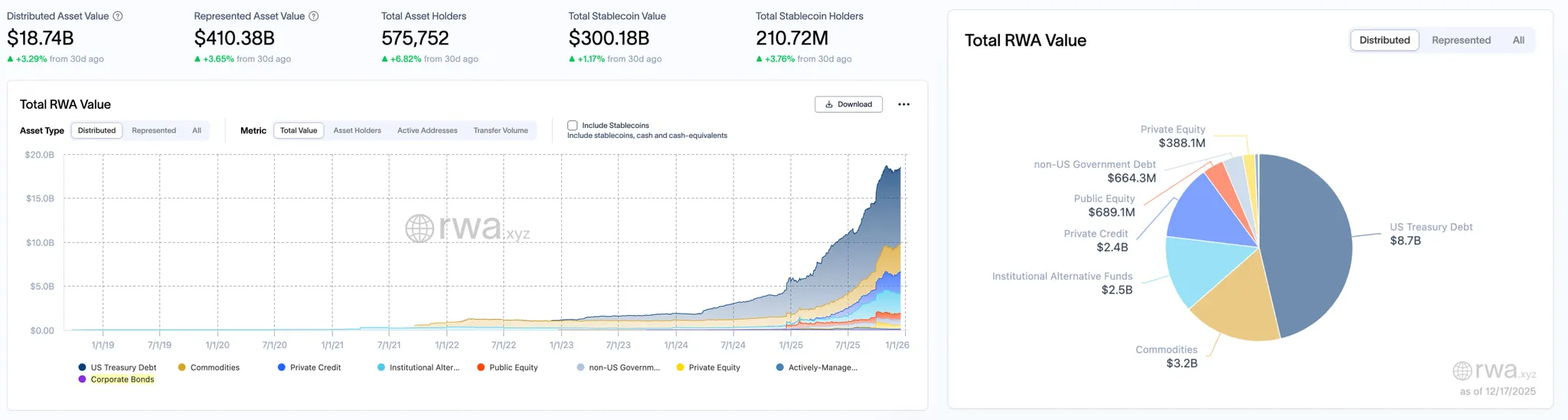
According to the rwa.xyz data panel, as of December 17, 2025, the total on-chain value of RWA (Distributed Asset Value) was $18.74 billion, an increase of $300 million from $18.44 billion on December 9, a rise of approximately 1.63%, ending a multi-day period of sideways movement and indicating a gradual recovery in on-chain asset activity. The broad Represented Asset Value increased from $391.66 billion to $410.38 billion, a weekly surge of 4.92%, the largest single-week increase in nearly two months, potentially related to the recovery of off-chain asset valuations. The total number of asset holders also continued its upward trend, rising from 561,558 to 575,752, a net increase of over 14,000 in one week, a growth rate of 2.52%. The stablecoin market was relatively stable, with the total market capitalization slightly decreasing from $3.0192 trillion to $3.0018 trillion, but still remaining high. The number of users grew from 207.75 million to 210.72 million, an increase of nearly 3 million, a growth rate of 1.42%.

In terms of asset structure, U.S. Treasury bonds remain the largest component of on-chain distributed assets, but saw a marginal decline this week, slightly decreasing from $8.8 billion to $8.7 billion, indicating a cooling off in the U.S. bond frenzy. Meanwhile, commodity assets remained stable, growing slightly from $3.1 billion to $3.2 billion, maintaining an upward trend for the third consecutive week and gradually showing potential as an emerging safe-haven asset. Private credit did not continue its previous rebound this week, with the scale only marginally increasing from $2.2 billion to $2.4 billion, maintaining a neutral stance. Institutional alternative funds remained unchanged at $2.5 billion, indicating a more cautious allocation of funds.

Among other segmented assets, public equity continued to rise, increasing from last week's $671.7 million to $689.1 million, performing relatively prominently among equity assets. Non-U.S. government debt also saw a slight synchronous increase, rising from $637.2 million to $664.3 million, but its scale is still less than 1/10th that of U.S. Treasuries. Private equity decreased from $391.6 million to $381 million this week, a slight numerical reduction.

Trend Analysis (Compared to Last Week)

The keywords for the RWA sector this week are "Valuation Repair + User Growth". The overall on-chain asset value recovered, and the scale of representative assets increased significantly, indicating that the repricing of off-chain assets may be driving the overall RWA valuation center upward. Structurally, the correction in U.S. Treasuries may be releasing some highly liquid funds, diverting them to the commodity and public equity sectors, forming new risk preference indicators. The growth in the stablecoin user base is particularly crucial, as off-market funds continue to enter the market, creating a "reservoir" for subsequent on-chain asset growth.

Market Keywords: Structural Optimization, Valuation Recovery, User Base Expansion.
Key Event Review

U.S. Congress Urges SEC to Allow Bitcoin and Other Cryptocurrencies into 401(k) Retirement Plans

The U.S. Congress is urging the U.S. Securities and Exchange Commission (SEC) to approve the inclusion of Bitcoin and other cryptocurrencies in 401(k) retirement plans. Members of the House Financial Services Committee sent a letter to SEC Chairman Paul Atkins urging him to update securities rules so that digital assets can be treated as an investment category equivalent to other alternative investments in retirement accounts. The letter stated that Americans saving for retirement deserve more investment choices, and current rules are outdated and overly restrictive, preventing millions of people from accessing new asset classes. Additionally, the letter emphasized the need to redefine the "accredited investor" standard. Current strict investor qualification rules limit participation in some private and alternative investment markets.

BNB Chain: A New Stablecoin to Be Launched

BNB Chain posted on platform X that a new stablecoin will be launched based on BNB Chain, aiming to integrate liquidity across various application scenarios and built for mass adoption.

According to community speculation, the project might be United Stables, with more details expected to be announced on December 18.

U.S. Crypto Market Structure Bill Negotiations Continue, Possibly Delayed Until Next January

Negotiations in the U.S. Senate on the crypto market structure bill may be delayed until next January for substantial progress due to several unresolved分歧点 (divergence points). The legislative text has been privately circulated among industry insiders, and industry executives briefly reviewed the current draft at a White House meeting on Thursday, chaired by U.S. President Donald Trump's crypto advisor Patrick Witt. The negotiations involve four parties: Senate Democrats, Republicans, the White House, and the crypto industry, with four major分歧点 still needing resolution. These分歧点 include ethical guidelines for government officials' involvement in digital assets, particularly the participation of U.S. President Donald Trump, whether stablecoins should be yield-bearing, and the jurisdiction of the U.S. Securities and Exchange Commission (SEC) over tokens and the handling of decentralized finance (DeFi). Patrick Witt posted on platform X that the White House and Senate Republicans are "aligned on the need to protect software developers and DeFi." Despite the分歧点, the intensity and pace of negotiations remain high. Digital Chamber CEO Cody Carbone stated that there is a genuine desire and momentum from all sides to complete the legislation, expecting practical progress early next year.

U.S. SEC Issues Crypto Asset Custody Guidance, Systematically Outlining Wallet Types and Main Risks

The U.S. Securities and Exchange Commission (SEC) issued guidance for investors on crypto wallets and asset custody on Friday local time, systematically outlining the advantages and risks of different crypto asset storage methods. The guidance compares self-custody and third-party custody models and reminds investors that when choosing third-party custody, they should focus on understanding whether the custodian engages in asset rehypothecation, whether customer assets are commingled, and other situations. The SEC also introduced the main differences between hot wallets and cold wallets: hot wallets, being connected to the internet, face higher risks of hacking and network security; cold wallets, while reducing the risk of online attacks, can lead to permanent loss of assets if the storage device is damaged, stolen, or the private key is lost. Market participants believe this guidance shows a significant shift in the SEC's regulatory attitude towards the crypto industry. The day before, SEC Chairman Paul Atkins stated that the traditional financial system is accelerating its migration on-chain, and the SEC has also approved DTCC to begin tokenization exploration for assets such as stocks, ETFs, and government bonds.

South Korea's Financial Services Commission Fails to Submit Won Stablecoin Regulatory Bill on Time

The ruling party in South Korea had previously called on ministries and the Financial Services Commission (FSC) to submit a Won stablecoin regulatory bill by December 10, but the FSC failed to meet the deadline. A spokesperson for the agency stated that the FSC needs more time to coordinate positions with relevant agencies, and rather than rushing to meet the stipulated deadline, it would announce its proposal while submitting the bill to the National Assembly.

Nasdaq Plans to Extend Stock and ETP Trading Hours to 23 Hours

Nasdaq has filed a document with the U.S. Securities and Exchange Commission (SEC) planning to extend the trading hours for stocks and exchange-traded products (ETPs) from 16 hours per day to 23 hours per day, five days a week. This move aims to meet the growing demand from global investors for extended trading hours in the U.S. stock market and to match the new investor expectations formed by the 24/7 trading cryptocurrency market. According to the proposal, Nasdaq's new trading hours will include: Day Session: 4:00 AM to 8:00 PM ET; One-hour break: 8:00 PM to 9:00 PM (for maintenance, testing, and trade settlement); Night Session: 9:00 PM to 4:00 AM the next day. The entire trading week will run from 9:00 PM Sunday to 8:00 PM Friday. The opening and closing times of the existing regular trading session (9:30 AM to 4:00 PM) remain unchanged. Nasdaq stated in the document that this move is to compete for order flow from foreign investors in different time zones like Asia and investors active in the crypto digital asset market. This will make stocks listed on Nasdaq, such as Coinbase (COIN), Robinhood (HOOD), and Strategy (MSTR), as well as many Bitcoin mining company stocks, more convenient for global traders.

U.S. SEC Allows DTCC to Custody and Recognize Tokenized Stocks and Other RWA Assets on Blockchain

The U.S. Securities and Exchange Commission (SEC) granted permission to the Depository Trust & Clearing Corporation (DTCC) in the form of a no-action letter, allowing the company to custody and recognize tokenized stocks and other real-world assets (RWA) on the blockchain. This allows DTCC to provide tokenization services on pre-approved blockchains for a three-year pilot period. SEC Commissioner Hester Peirce stated in a statement: "Although the project is still in its pilot phase and subject to various operational limitations, it marks an important step forward in the market's migration on-chain." Michael Winnike, Global Head of Strategy & Market Solutions at DTCC's Clearing & Securities Services division, said in an interview that after obtaining permission, DTCC will also extend its record-keeping work to the blockchain. DTCC, as the core clearing and settlement center of the U.S. financial system, plays a crucial role in the stock and fixed income product fields. Many liquid assets in the U.S. market are custodied at DTCC's depository unit—Depository Trust Co. The company expects to launch new tokenization services in the second half of next year.

Trump Family Crypto Project WLFI Plans to Deploy USD1 Stablecoin on Canton Network

Canton Network announced that the Trump family's crypto project, World Liberty Financial (WLFI), will deploy its USD1 stablecoin on its network, aiming to expand the coverage of USD1 in the institutional on-chain finance field and accelerate its adoption among globally regulated market participants, including collateral for derivatives and institutional loans, instant cross-border payments and 24/7 settlement, on-chain asset issuance, financing, and redemption.

U.S. SEC Chairman: DTC Participants Can Transfer Tokenized Securities to Other Participants' Registered Wallets

U.S. Securities and Exchange Commission (SEC) Chairman Paul Atkins posted on platform X, stating that the U.S. financial market is about to transition on-chain and will prioritize innovation and actively adopt new technologies. The SEC has issued a no-action letter to the Depository Trust & Clearing Corporation (DTC). The on-chain market will bring higher predictability, transparency, and efficiency to investors. Now DTC participants can directly transfer tokenized securities to other participants' registered wallets, and these transactions will be tracked by DTC's official records.

Trump Family Crypto Project WLFI Plans to Deploy USD1 Stablecoin on Canton Network

Canton Network announced that the Trump family's crypto project, World Liberty Financial (WLFI), will deploy its USD1 stablecoin on its network, aiming to expand the coverage of USD1 in the institutional on-chain finance field and accelerate its adoption among globally regulated market participants, including collateral for derivatives and institutional loans, instant cross-border payments and 24/7 settlement, on-chain asset issuance, financing, and redemption.

Visa Opens USDC Settlement Services to U.S. Banks via Solana

Visa has begun allowing U.S. banks and payment partners to use the USD-backed stablecoin USDC for transaction settlement within the United States.

Cross River Bank and Lead Bank are the first institutions to use Visa's USDC settlement service via the Solana blockchain. Visa plans to promote the service more widely in 2026.

Visa stated that this move aims to provide participating banks with faster fund transfers and a seven-day settlement window, without changing the consumer card experience. As of November 2025, the company's annualized stablecoin settlement volume run rate has exceeded $3.5 billion.

Hot Project Dynamics

Ondo Finance (ONDO)

One-Sentence Introduction:

Ondo Finance is a decentralized finance protocol focused on structured financial products and the tokenization of real-world assets. Its goal is to provide users with fixed-income products, such as tokenized U.S. Treasury bonds or other financial instruments, through blockchain technology. Ondo Finance allows users to invest in low-risk, highly liquid assets while maintaining decentralized transparency and security. Its token, ONDO, is used for protocol governance and incentive mechanisms. The platform also supports cross-chain operations to expand its application scope in the DeFi ecosystem.

Latest Developments:

On December 15, Ondo Finance announced on platform X that its tokenized stock and ETF platform will launch on the Solana blockchain in early 2026, aiming to bring Wall Street liquidity to the internet capital market.

Previously, it was reported that the U.S. Securities and Exchange Commission (SEC) has ended its investigation into tokenized asset company Ondo Finance without recommending any charges.

This investigation began in October 2023, initiated by former SEC Chairman Gary Gensler, primarily reviewing whether Ondo complied with U.S. securities laws when tokenizing U.S. Treasury products and whether the ONDO token should be classified as a security. An Ondo spokesperson stated that the company received formal notice in late November that this two-year SEC investigation had concluded. Since the pro-crypto SEC Chairman Paul Atkins took office, the agency has ended most crypto-related investigations. Ondo stated that the resolution of the investigation clears obstacles for its expansion in the U.S. The company had previously registered as an investment adviser and acquired Oasis Pro Markets, an SEC-registered broker-dealer, ATS operator, and transfer agent. Ondo is scheduled to host its annual Ondo Summit in New York on February 3, where new tools and products for tokenizing real-world assets are expected to be announced.

MSX (STONKS)
One-Sentence Introduction:

MSX is a community-driven DeFi platform focused on tokenizing U.S. stocks and other RWAs for on-chain trading. Through a partnership with Fidelity, the platform achieves 1:1 physical custody and token issuance. Users can use stablecoins like USDC, USDT, and USD1 to mint stock tokens such as AAPL.M and MSFT.M, and trade 24/7 on the Base blockchain. All trading, minting, and redemption processes are executed by smart contracts, ensuring transparency, security, and auditability. MyStonks is committed to bridging the gap between TradFi and DeFi, providing users with a high-liquidity, low-barrier entry to U.S. stock investment on-chain, building the "Nasdaq of the Crypto World".

Latest Developments:

On December 3, data from the MSX official website (msx.com) showed that the platform's trading volume reached $2 billion in the past 24 hours, setting a new all-time high for a single day. As of the time of writing, the total platform trading volume has exceeded $20.6 billion, surging by over $7.5 billion in the past 5 days, a cumulative increase of over 57%. Additionally, MSX ended its points season S1 on December 2. The M Credits (M Beans) earned by users will be directly used for future MSX token distribution.

On December 5, MSX founder Bruce posted on X that Nasdaq has submitted a stock token application, and MSX is prepared to convert to "official" tokens. He said: "Nasdaq submitted its stock token application to the SEC as early as September this year. If progress is fast, it will officially launch in Q1 next year. The launch of Nasdaq's stock tokens will impact all 'non-official stock tokens.' MSX is prepared to convert to 'official' tokens at any time."

Related Links

《RWA Weekly Report Series》

Curates the latest insights and market data on the RWA sector.

《5 Major L1 Public Chains Most Worth Watching in 2026: The Mainline Evolution from DeFi to RWA》

For investors, developers, and traders, helping to see which public chains are continuously gathering real activity, users, and long-term value.


Perguntas relacionadas

QWhat was the total Distributed Asset Value (DAV) of RWA on-chain as of December 17, 2025, and what was the weekly increase?

AThe total Distributed Asset Value (DAV) of RWA on-chain was $18.74 billion as of December 17, 2025, representing a weekly increase of approximately 1.63% from $18.44 billion on December 9.

QWhat significant action did the U.S. SEC take regarding crypto asset custody, and what key risks did it highlight for investors?

AThe U.S. SEC issued an investor guidance on crypto asset custody, systematically outlining the advantages and risks of different storage methods. It compared self-custody with third-party custody and warned investors to understand if a custodian engages in asset rehypothecation or commingles customer assets. It also highlighted that hot wallets face higher cybersecurity risks, while cold wallets risk permanent loss from device damage, theft, or lost private keys.

QWhich company received a no-action letter from the SEC to custody tokenized stocks and other RWA assets on a blockchain, and what is the significance of this move?

AThe Depository Trust & Clearing Corporation (DTCC) received a no-action letter from the SEC, permitting it to custody and recognize tokenized stocks and other real-world assets (RWA) on a pre-approved blockchain. This is a significant step marking the migration of traditional markets onto the blockchain, as DTCC is a core clearing and settlement hub for the U.S. financial system.

QWhat major announcement did Ondo Finance make regarding its platform, and what regulatory hurdle was recently cleared for the company?

AOndo Finance announced that its tokenized stock and ETF platform will launch on the Solana blockchain in early 2026. Additionally, the SEC recently concluded its investigation into the company without recommending any charges, which began in October 2023 to examine compliance with U.S. securities laws regarding its tokenized U.S. Treasury products and the classification of its ONDO token.

QWhat change did Nasdaq propose to the SEC regarding trading hours, and what was the stated reason for this proposal?

ANasdaq proposed to the SEC to extend the trading hours for stocks and exchange-traded products (ETPs) from 16 hours per day to 23 hours per day, five days a week. The stated reason was to meet the growing global demand for extended U.S. equity trading and to align with the new investor expectations set by the 24/7 cryptocurrency market, aiming to attract orders from foreign investors in different time zones and active crypto market participants.

Leituras Relacionadas

Cook's Curtain Call and Ternus Takes the Helm: The Disruption and Reboot of Apple's 4 Trillion Dollar Empire

Tim Cook has officially announced he will step down as CEO of Apple in September, transitioning to executive chairman after a 15-year tenure during which he grew the company’s market value from around $350 billion to nearly $4 trillion. He will be succeeded by John Ternus, a 50-year-old hardware engineering veteran who has been groomed for the role through increasing public visibility and internal responsibility. Ternus’s appointment signals a strategic shift toward hardware and engineering leadership, with Johny Srouji—head of Apple Silicon—taking on an expanded role as Chief Hardware Officer. This consolidation aims to strengthen Apple’s core technological capabilities. However, Cook’s departure highlights a significant unresolved issue: Apple’s delayed and fragmented approach to artificial intelligence. Despite early efforts, such as hiring John Giannandrea from Google in 2018, Apple’s AI initiatives—particularly around Siri—have struggled with internal restructuring and reliance on external partnerships, including with Google. The transition comes at a critical moment as Apple faces paradigm shifts with the rise of artificial general intelligence (ASI). The company’s closed ecosystem of hardware, software, and services—once a major advantage—now presents challenges in adapting to an AI-centric world where intelligence may matter more than the device itself. Ternus must quickly articulate a clear AI strategy, possibly starting at WWDC, to reassure markets and redefine Apple’s role in a new technological era. His task is not only to maintain Apple’s operational excellence but also to reinvigorate its capacity to innovate and lead in the age of AI.

marsbitHá 41m

Cook's Curtain Call and Ternus Takes the Helm: The Disruption and Reboot of Apple's 4 Trillion Dollar Empire

marsbitHá 41m

Trading

Spot
Futuros

Artigos em Destaque

O que é $S$

Compreender o SPERO: Uma Visão Abrangente Introdução ao SPERO À medida que o panorama da inovação continua a evoluir, o surgimento de tecnologias web3 e projetos de criptomoeda desempenha um papel fundamental na formação do futuro digital. Um projeto que tem atraído atenção neste campo dinâmico é o SPERO, denotado como SPERO,$$s$. Este artigo tem como objetivo reunir e apresentar informações detalhadas sobre o SPERO, para ajudar entusiastas e investidores a compreender as suas bases, objetivos e inovações nos domínios web3 e cripto. O que é o SPERO,$$s$? O SPERO,$$s$ é um projeto único dentro do espaço cripto que procura aproveitar os princípios da descentralização e da tecnologia blockchain para criar um ecossistema que promove o envolvimento, a utilidade e a inclusão financeira. O projeto é concebido para facilitar interações peer-to-peer de novas maneiras, proporcionando aos utilizadores soluções e serviços financeiros inovadores. No seu núcleo, o SPERO,$$s$ visa capacitar indivíduos ao fornecer ferramentas e plataformas que melhoram a experiência do utilizador no espaço das criptomoedas. Isso inclui a possibilidade de métodos de transação mais flexíveis, a promoção de iniciativas impulsionadas pela comunidade e a criação de caminhos para oportunidades financeiras através de aplicações descentralizadas (dApps). A visão subjacente do SPERO,$$s$ gira em torno da inclusão, visando fechar lacunas dentro das finanças tradicionais enquanto aproveita os benefícios da tecnologia blockchain. Quem é o Criador do SPERO,$$s$? A identidade do criador do SPERO,$$s$ permanece algo obscura, uma vez que existem recursos publicamente disponíveis limitados que fornecem informações detalhadas sobre o(s) seu(s) fundador(es). Esta falta de transparência pode resultar do compromisso do projeto com a descentralização—uma ética que muitos projetos web3 partilham, priorizando contribuições coletivas em vez de reconhecimento individual. Ao centrar as discussões em torno da comunidade e dos seus objetivos coletivos, o SPERO,$$s$ incorpora a essência do empoderamento sem destacar indivíduos específicos. Assim, compreender a ética e a missão do SPERO é mais importante do que identificar um criador singular. Quem são os Investidores do SPERO,$$s$? O SPERO,$$s$ é apoiado por uma diversidade de investidores que vão desde capitalistas de risco a investidores-anjo dedicados a promover a inovação no setor cripto. O foco desses investidores geralmente alinha-se com a missão do SPERO—priorizando projetos que prometem avanço tecnológico social, inclusão financeira e governança descentralizada. Essas fundações de investidores estão tipicamente interessadas em projetos que não apenas oferecem produtos inovadores, mas que também contribuem positivamente para a comunidade blockchain e os seus ecossistemas. O apoio desses investidores reforça o SPERO,$$s$ como um concorrente notável no domínio em rápida evolução dos projetos cripto. Como Funciona o SPERO,$$s$? O SPERO,$$s$ emprega uma estrutura multifacetada que o distingue de projetos de criptomoeda convencionais. Aqui estão algumas das características-chave que sublinham a sua singularidade e inovação: Governança Descentralizada: O SPERO,$$s$ integra modelos de governança descentralizada, capacitando os utilizadores a participar ativamente nos processos de tomada de decisão sobre o futuro do projeto. Esta abordagem promove um sentido de propriedade e responsabilidade entre os membros da comunidade. Utilidade do Token: O SPERO,$$s$ utiliza o seu próprio token de criptomoeda, concebido para servir várias funções dentro do ecossistema. Esses tokens permitem transações, recompensas e a facilitação de serviços oferecidos na plataforma, melhorando o envolvimento e a utilidade gerais. Arquitetura em Camadas: A arquitetura técnica do SPERO,$$s$ suporta modularidade e escalabilidade, permitindo a integração contínua de funcionalidades e aplicações adicionais à medida que o projeto evolui. Esta adaptabilidade é fundamental para manter a relevância no panorama cripto em constante mudança. Envolvimento da Comunidade: O projeto enfatiza iniciativas impulsionadas pela comunidade, empregando mecanismos que incentivam a colaboração e o feedback. Ao nutrir uma comunidade forte, o SPERO,$$s$ pode melhor atender às necessidades dos utilizadores e adaptar-se às tendências do mercado. Foco na Inclusão: Ao oferecer taxas de transação baixas e interfaces amigáveis, o SPERO,$$s$ visa atrair uma base de utilizadores diversificada, incluindo indivíduos que anteriormente podem não ter participado no espaço cripto. Este compromisso com a inclusão alinha-se com a sua missão abrangente de empoderamento através da acessibilidade. Cronologia do SPERO,$$s$ Compreender a história de um projeto fornece insights cruciais sobre a sua trajetória de desenvolvimento e marcos. Abaixo está uma cronologia sugerida que mapeia eventos significativos na evolução do SPERO,$$s$: Fase de Conceituação e Ideação: As ideias iniciais que formam a base do SPERO,$$s$ foram concebidas, alinhando-se de perto com os princípios de descentralização e foco na comunidade dentro da indústria blockchain. Lançamento do Whitepaper do Projeto: Após a fase conceitual, um whitepaper abrangente detalhando a visão, os objetivos e a infraestrutura tecnológica do SPERO,$$s$ foi lançado para atrair o interesse e o feedback da comunidade. Construção da Comunidade e Primeiros Envolvimentos: Esforços ativos de divulgação foram feitos para construir uma comunidade de primeiros adotantes e investidores potenciais, facilitando discussões em torno dos objetivos do projeto e angariando apoio. Evento de Geração de Tokens: O SPERO,$$s$ realizou um evento de geração de tokens (TGE) para distribuir os seus tokens nativos a apoiantes iniciais e estabelecer liquidez inicial dentro do ecossistema. Lançamento da dApp Inicial: A primeira aplicação descentralizada (dApp) associada ao SPERO,$$s$ foi lançada, permitindo que os utilizadores interagissem com as funcionalidades principais da plataforma. Desenvolvimento Contínuo e Parcerias: Atualizações e melhorias contínuas nas ofertas do projeto, incluindo parcerias estratégicas com outros players no espaço blockchain, moldaram o SPERO,$$s$ em um jogador competitivo e em evolução no mercado cripto. Conclusão O SPERO,$$s$ é um testemunho do potencial do web3 e das criptomoedas para revolucionar os sistemas financeiros e capacitar indivíduos. Com um compromisso com a governança descentralizada, o envolvimento da comunidade e funcionalidades inovadoras, abre caminho para um panorama financeiro mais inclusivo. Como em qualquer investimento no espaço cripto em rápida evolução, potenciais investidores e utilizadores são incentivados a pesquisar minuciosamente e a envolver-se de forma ponderada com os desenvolvimentos em curso dentro do SPERO,$$s$. O projeto demonstra o espírito inovador da indústria cripto, convidando a uma exploração mais aprofundada das suas inúmeras possibilidades. Embora a jornada do SPERO,$$s$ ainda esteja a desenrolar-se, os seus princípios fundamentais podem, de facto, influenciar o futuro de como interagimos com a tecnologia, as finanças e uns com os outros em ecossistemas digitais interconectados.

69 Visualizações TotaisPublicado em {updateTime}Atualizado em 2024.12.17

O que é $S$

O que é AGENT S

Agent S: O Futuro da Interação Autónoma no Web3 Introdução No panorama em constante evolução do Web3 e das criptomoedas, as inovações estão constantemente a redefinir a forma como os indivíduos interagem com plataformas digitais. Um projeto pioneiro, o Agent S, promete revolucionar a interação humano-computador através do seu framework aberto e agente. Ao abrir caminho para interações autónomas, o Agent S visa simplificar tarefas complexas, oferecendo aplicações transformadoras em inteligência artificial (IA). Esta exploração detalhada irá aprofundar-se nas complexidades do projeto, nas suas características únicas e nas implicações para o domínio das criptomoedas. O que é o Agent S? O Agent S é um framework aberto e agente, especificamente concebido para abordar três desafios fundamentais na automação de tarefas computacionais: Aquisição de Conhecimento Específico de Domínio: O framework aprende inteligentemente a partir de várias fontes de conhecimento externas e experiências internas. Esta abordagem dupla capacita-o a construir um rico repositório de conhecimento específico de domínio, melhorando o seu desempenho na execução de tarefas. Planeamento ao Longo de Longos Horizontes de Tarefas: O Agent S emprega planeamento hierárquico aumentado por experiência, uma abordagem estratégica que facilita a decomposição e execução eficientes de tarefas intrincadas. Esta característica melhora significativamente a sua capacidade de gerir múltiplas subtarefas de forma eficiente e eficaz. Gestão de Interfaces Dinâmicas e Não Uniformes: O projeto introduz a Interface Agente-Computador (ACI), uma solução inovadora que melhora a interação entre agentes e utilizadores. Utilizando Modelos de Linguagem Multimodais de Grande Escala (MLLMs), o Agent S pode navegar e manipular diversas interfaces gráficas de utilizador de forma fluida. Através destas características pioneiras, o Agent S fornece um framework robusto que aborda as complexidades envolvidas na automação da interação humana com máquinas, preparando o terreno para uma infinidade de aplicações em IA e além. Quem é o Criador do Agent S? Embora o conceito de Agent S seja fundamentalmente inovador, informações específicas sobre o seu criador permanecem elusivas. O criador é atualmente desconhecido, o que destaca ou o estágio nascente do projeto ou a escolha estratégica de manter os membros fundadores em anonimato. Independentemente da anonimidade, o foco permanece nas capacidades e no potencial do framework. Quem são os Investidores do Agent S? Como o Agent S é relativamente novo no ecossistema criptográfico, informações detalhadas sobre os seus investidores e financiadores não estão explicitamente documentadas. A falta de informações disponíveis publicamente sobre as fundações de investimento ou organizações que apoiam o projeto levanta questões sobre a sua estrutura de financiamento e roteiro de desenvolvimento. Compreender o apoio é crucial para avaliar a sustentabilidade do projeto e o seu impacto potencial no mercado. Como Funciona o Agent S? No núcleo do Agent S reside uma tecnologia de ponta que lhe permite funcionar eficazmente em diversos ambientes. O seu modelo operacional é construído em torno de várias características-chave: Interação Humano-Computador Semelhante: O framework oferece planeamento avançado em IA, esforçando-se para tornar as interações com computadores mais intuitivas. Ao imitar o comportamento humano na execução de tarefas, promete elevar as experiências dos utilizadores. Memória Narrativa: Utilizada para aproveitar experiências de alto nível, o Agent S utiliza memória narrativa para acompanhar os históricos de tarefas, melhorando assim os seus processos de tomada de decisão. Memória Episódica: Esta característica fornece aos utilizadores orientações passo a passo, permitindo que o framework ofereça suporte contextual à medida que as tarefas se desenrolam. Suporte para OpenACI: Com a capacidade de funcionar localmente, o Agent S permite que os utilizadores mantenham o controlo sobre as suas interações e fluxos de trabalho, alinhando-se com a ética descentralizada do Web3. Fácil Integração com APIs Externas: A sua versatilidade e compatibilidade com várias plataformas de IA garantem que o Agent S possa integrar-se perfeitamente em ecossistemas tecnológicos existentes, tornando-o uma escolha apelativa para desenvolvedores e organizações. Estas funcionalidades contribuem coletivamente para a posição única do Agent S no espaço cripto, à medida que automatiza tarefas complexas e em múltiplos passos com mínima intervenção humana. À medida que o projeto evolui, as suas potenciais aplicações no Web3 podem redefinir a forma como as interações digitais se desenrolam. Cronologia do Agent S O desenvolvimento e os marcos do Agent S podem ser encapsulados numa cronologia que destaca os seus eventos significativos: 27 de Setembro de 2024: O conceito de Agent S foi lançado num artigo de pesquisa abrangente intitulado “Um Framework Agente Aberto que Usa Computadores como um Humano”, mostrando a base para o projeto. 10 de Outubro de 2024: O artigo de pesquisa foi disponibilizado publicamente no arXiv, oferecendo uma exploração aprofundada do framework e da sua avaliação de desempenho com base no benchmark OSWorld. 12 de Outubro de 2024: Uma apresentação em vídeo foi lançada, proporcionando uma visão visual das capacidades e características do Agent S, envolvendo ainda mais potenciais utilizadores e investidores. Estes marcos na cronologia não apenas ilustram o progresso do Agent S, mas também indicam o seu compromisso com a transparência e o envolvimento da comunidade. Pontos-Chave Sobre o Agent S À medida que o framework Agent S continua a evoluir, várias características-chave destacam-se, sublinhando a sua natureza inovadora e potencial: Framework Inovador: Concebido para proporcionar um uso intuitivo de computadores semelhante à interação humana, o Agent S traz uma abordagem nova à automação de tarefas. Interação Autónoma: A capacidade de interagir autonomamente com computadores através de GUI significa um avanço em direção a soluções computacionais mais inteligentes e eficientes. Automação de Tarefas Complexas: Com a sua metodologia robusta, pode automatizar tarefas complexas e em múltiplos passos, tornando os processos mais rápidos e menos propensos a erros. Melhoria Contínua: Os mecanismos de aprendizagem permitem que o Agent S melhore a partir de experiências passadas, aprimorando continuamente o seu desempenho e eficácia. Versatilidade: A sua adaptabilidade em diferentes ambientes operacionais, como OSWorld e WindowsAgentArena, garante que pode servir uma ampla gama de aplicações. À medida que o Agent S se posiciona no panorama do Web3 e das criptomoedas, o seu potencial para melhorar as capacidades de interação e automatizar processos significa um avanço significativo nas tecnologias de IA. Através do seu framework inovador, o Agent S exemplifica o futuro das interações digitais, prometendo uma experiência mais fluida e eficiente para os utilizadores em diversas indústrias. Conclusão O Agent S representa um ousado avanço na união da IA e do Web3, com a capacidade de redefinir a forma como interagimos com a tecnologia. Embora ainda esteja nas suas fases iniciais, as possibilidades para a sua aplicação são vastas e cativantes. Através do seu framework abrangente que aborda desafios críticos, o Agent S visa trazer interações autónomas para o primeiro plano da experiência digital. À medida que avançamos mais profundamente nos domínios das criptomoedas e da descentralização, projetos como o Agent S desempenharão, sem dúvida, um papel crucial na formação do futuro da tecnologia e da colaboração humano-computador.

525 Visualizações TotaisPublicado em {updateTime}Atualizado em 2025.01.14

O que é AGENT S

Como comprar S

Bem-vindo à HTX.com!Tornámos a compra de Sonic (S) simples e conveniente.Segue o nosso guia passo a passo para iniciar a tua jornada no mundo das criptos.Passo 1: cria a tua conta HTXUtiliza o teu e-mail ou número de telefone para te inscreveres numa conta gratuita na HTX.Desfruta de um processo de inscrição sem complicações e desbloqueia todas as funcionalidades.Obter a minha contaPasso 2: vai para Comprar Cripto e escolhe o teu método de pagamentoCartão de crédito/débito: usa o teu visa ou mastercard para comprar Sonic (S) instantaneamente.Saldo: usa os fundos da tua conta HTX para transacionar sem problemas.Terceiros: adicionamos métodos de pagamento populares, como Google Pay e Apple Pay, para aumentar a conveniência.P2P: transaciona diretamente com outros utilizadores na HTX.Mercado de balcão (OTC): oferecemos serviços personalizados e taxas de câmbio competitivas para os traders.Passo 3: armazena teu Sonic (S)Depois de comprar o teu Sonic (S), armazena-o na tua conta HTX.Alternativamente, podes enviá-lo para outro lugar através de transferência blockchain ou usá-lo para transacionar outras criptomoedas.Passo 4: transaciona Sonic (S)Transaciona facilmente Sonic (S) no mercado à vista da HTX.Acede simplesmente à tua conta, seleciona o teu par de trading, executa as tuas transações e monitoriza em tempo real.Oferecemos uma experiência de fácil utilização tanto para principiantes como para traders experientes.

930 Visualizações TotaisPublicado em {updateTime}Atualizado em 2025.03.21

Como comprar S

Discussões

Bem-vindo à Comunidade HTX. Aqui, pode manter-se informado sobre os mais recentes desenvolvimentos da plataforma e obter acesso a análises profissionais de mercado. As opiniões dos utilizadores sobre o preço de S (S) são apresentadas abaixo.

活动图片