RWA Weekly Report|Data: Approximately 50% of Euro Stablecoins Deployed on Ethereum; Potential Policy Adjustments as Trump Prepares for Next November's Midterm Elections May Again Impact Digital Assets (12.18-12.23)

Odaily星球日报Publicado em 2025-12-23Última atualização em 2025-12-23

Resumo

RWA Weekly Report: Data shows approximately 50% of euro-denominated stablecoins are deployed on Ethereum; potential policy shifts as Trump prepares for midterm elections may impact digital asset markets (Dec 18–23, 2025). The on-chain value of Real World Assets (RWA) grew 1.65% to $19.05 billion, while the broader RWA market contracted slightly to $402.57 billion. User adoption continued to rise, with RWA holders increasing to 582,639 and stablecoin holders reaching 212.54 million. U.S. Treasury bonds remained the core asset at $8.7 billion, while commodities and private equity saw notable growth. Key developments include the SEC issuing new guidance for crypto asset custody and ATS operations, Hong Kong proposing new rules for insurer investments in crypto assets, and U.S. lawmakers discussing tax exemptions for small stablecoin transactions. Data from Token Terminal indicates about half of all euro stablecoins are on Ethereum. Political focus remains on potential policy adjustments by Trump ahead of the 2026 midterm elections, which could affect digital asset markets. Projects like Ondo Finance and MSX (STONKS) are advancing tokenized traditional assets, with Ondo expanding to Solana and MSX preparing for Nasdaq’s potential entry into tokenized stocks. Ghana legalized cryptocurrency trading and is exploring gold-backed stablecoins, reflecting global regulatory evolution. Stablecoin supply reached $300 billion in 2025, with significant transaction volume driving growth i...

Original | Odaily Planet Daily (@OdailyChina)

Author | Ethan(@ethanzhang_web3)
RWA Sector Market Performance

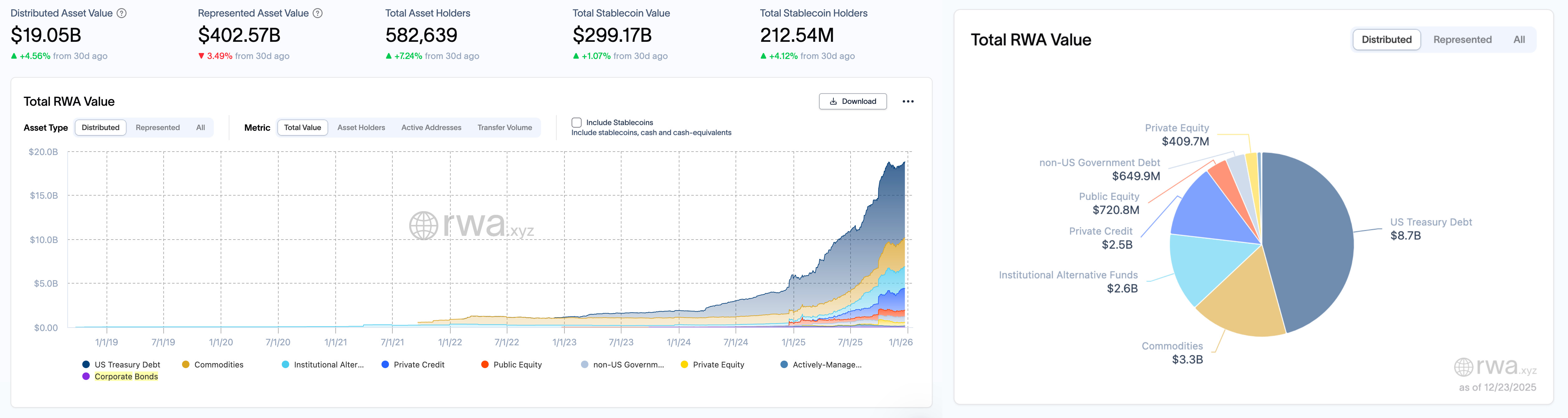
According to the rwa.xyz data dashboard, as of December 23, 2025, the total on-chain value (Distributed Asset Value) of RWA continued its moderate growth trend this week, increasing from $187.4 billion on December 17 to $190.5 billion, a rise of approximately $3.1 billion, representing a weekly gain of 1.65%. The broader RWA market size contracted slightly, falling from $410.38 billion to $402.57 billion, a decrease of $7.81 billion, or 1.9%. The total number of asset holders on the user side increased from 575,752 to 582,639, adding 6,887 new users in a single week, a sequential growth of 1.2%. Meanwhile, the stablecoin user base continued to expand, with the number of holders climbing from 210.72 million to 212.54 million, an increase of about 1.82 million people, or 0.86%. The total market capitalization of stablecoins saw a slight pullback, decreasing from $300.18 billion to $299.17 billion. Although it declined slightly (by about $101 million), the drop was minimal, and the market remained relatively steady overall.

In terms of asset structure, US Treasury bonds remain the core anchor of the RWA sector, with their on-chain scale holding steady at $8.7 billion. Commodity assets saw an uptick, rising from $3.22 billion to $3.33 billion, a gain of $110 million, contributing the most incremental growth this week. The institutional alternative fund sector also experienced a slight increase, moving from $2.5 billion to $2.6 billion, indicating a trend of capital reallocation into stable, non-traditional assets. Private equity recorded significant growth, jumping from $381 million to $410 million, an increase of $29 million. Non-US government debt saw a slight correction, decreasing modestly from $664.3 million to $649.9 million, a drop of 2.2%. However, public equity quietly grew, increasing from $689.1 million to $720.8 million. Private credit remained stable, edging up by $10 million to $2.5 billion, continuing its sideways trend after stabilizing previously.

Trend Analysis (Compared to Last Week)

Overall, the total volume of on-chain RWA assets showed steady growth this week, while the broader traditional representative assets experienced some fluctuations. User numbers continued to grow, indicating a gradual strengthening of real activity in the on-chain RWA market. Assets with medium risk appetites, such as commodities, private equity, and institutional alternative funds, began to attract more capital allocation, suggesting that some market participants are releasing liquidity from low-risk instruments like US Treasuries and转而 seeking higher marginal returns. Furthermore, the continued climb in stablecoin holders remains a key variable driving potential capital inflows in the future.

Market Keywords: Stable with upward momentum, structural shift, user activity.
Key Event Recap

Potential Policy Adjustments as Trump Prepares for Next November's Midterm Elections May Again Impact Digital Assets

Caixin published its "2026 New Year Special Review and Outlook," which pointed out that the "Trump Trade" took effect in 2025, with gold and virtual currencies shining. In March, an executive order was signed to include approximately 210,000 Bitcoin held by the federal government into the national strategic reserve. Various transactions based on stablecoins and digital currencies saw significant implementation in 2025, and listed companies transforming into treasury companies专门囤积 digital currencies sparked speculation. However, the seizure of $15 billion in Bitcoin from the Chen Zhi telecom fraud group by the US brought transaction security issues into sharp focus, and Bitcoin fell from its historical highs by year-end. Moving into 2026, as Trump begins preparing for the November midterm elections, which areas his policies will adjust in response to feedback, and how this will impact the performance of various major asset classes, becomes a theme requiring持续关注 in 2026.

US SEC Issues Guidance on Broker Crypto Asset Custody and Crypto ATS Operations

The U.S. Securities and Exchange Commission (SEC) this week issued a new staff statement through its Division of Trading and Markets, providing operational guidance for regulated broker-dealers custodying client crypto assets, and simultaneously released a FAQ document regarding crypto alternative trading systems (ATS).

Regarding custody, the SEC stated that as long as broker-dealers follow the informal standards proposed in the statement, including properly safeguarding client private keys and预先 considering scenarios like blockchain failures, 51% attacks, hard forks, or airdrops, the regulatory层面 will not take enforcement action. This guidance applies to crypto securities including tokenized stocks and debt securities, but related definitions仍需进一步明确.

Additionally, the SEC highlighted key regulatory focuses for the trading and settlement activities of crypto ATSs. SEC Crypto Assets and Cyber Unit Chief, Commissioner Hester Peirce, stated that trading platforms and market participants need to operate under clear market structure rules to promote a fair and orderly market environment without adding unnecessary burdens.

Bloomberg: Hong Kong Plans to Introduce New Rules for Insurer Investments in Crypto Assets and Infrastructure

The Hong Kong Insurance Authority (IA) has proposed new rules aimed at guiding insurance funds into crypto assets and infrastructure sectors. According to a presentation document dated December 4, the regulator plans to impose a 100% risk capital requirement on crypto assets, while the risk capital requirement for stablecoin investments will be determined based on the fiat currency to which the Hong Kong-regulated stablecoin is pegged.

The Hong Kong IA stated that it initiated a review of the risk-based capital制度 this year, with the primary goal of supporting the insurance industry and broader economic development. The proposal is expected to undergo public consultation from February to April next year, before being submitted to the legislature. Furthermore, the new rules involve incentives for infrastructure investment, proposing capital benefits for investments in infrastructure projects in Hong Kong, mainland China, or Hong Kong-linked projects (such as the development of new towns like the Northern Metropolis), to support the SAR government's local infrastructure construction plans. As of 2024, the total premium income of Hong Kong's insurance industry was approximately HK$635 billion.

US Lawmakers Propose Tax Breaks for Small Stablecoin Payments and Staking Rewards

US lawmakers have introduced a discussion draft that would ease the tax burden on ordinary cryptocurrency users by exempting small stablecoin transactions from capital gains tax, including a $200 tax exemption for stablecoin payments, and providing new deferral options for staking and mining rewards. According to the draft, if a stablecoin is issued by an issuer permitted under the GENIUS Act, is pegged to the US dollar, and its trading price remains within a narrow range around $1, users would not need to recognize gains or losses on transactions not exceeding $200.

Data: Approximately 50% of Euro Stablecoins Deployed on Ethereum

According to Token Terminal data, approximately 50% of the market capitalization of Tokenized Euro (Euro stablecoins) is deployed on the Ethereum chain, with the remainder distributed across multiple chains including Arbitrum, Polygon, Base, and Solana.

Grayscale: 2025 Stablecoin Supply Reached $300 Billion, Monthly Average Trading Volume $1.1 Trillion, Multiple Token Projects to Benefit

Grayscale posted on X platform, stating that stablecoins experienced explosive growth in 2025, with supply reaching $300 billion and monthly average trading volume reaching $1.1 trillion. With the passage of the GENIUS Act (Stablecoin Genius Act) and increased stablecoin adoption, blockchain projects like ETH, TRX, BNB, and SOL will benefit from the growing transaction flow. Infrastructure like Chainlink (LINK) and emerging networks like XPL will also benefit.

Gemini: Urges US Congress to Maintain the Genius Act As Is

Gemini posted on X platform, stating that Gemini, along with over 125 companies and organizations, has co-signed a letter urging the US Congress to maintain the Genius Act as is. Gemini stated that legitimate stablecoin rewards benefit consumers and competition, and are already legally permitted. Amending the Genius Act at this time would harm certainty and innovation.

Stablecoin U Officially Launches: Live on BNB Chain and Ethereum, Integrated with Mainstream DeFi Protocols like PancakeSwap, ListaDAO, and Listed on Centralized Exchange HTX

United Stables announced the official launch of the USD stablecoin U, currently deployed on both BNB Smart Chain (BSC) and Ethereum (ETH), with multiple ecosystem integrations completed. It is reported that the U stablecoin is backed 1:1 by full reserves (USD + major stablecoins), features real-time on-chain proof-of-reserve (PoR), monthly audits, and will support enterprise-grade privacy protection and AI-native payments (EIP-3009/x402) in the future. U is the first "unified stablecoin" on BNB Chain, integrating mainstream stablecoins as usable collateral assets to form a unified liquidity base layer.

Ecosystem Integration: U has been integrated into mainstream DeFi protocols including PancakeSwap, Aster, Four.meme, and ListaDAO, allowing users to directly trade, stake, lend, and provide liquidity on-chain. Wallet Support: Binance Wallet, Trust Wallet, and SafePal have simultaneously listed U. Beyond the on-chain world, U is also listed on the centralized exchange HTX.

United Stables stated that U will focus on empowering scenarios such as trading, DeFi, institutional settlement, cross-border payments, and the AI autonomous economy, and plans to expand to more public chains, DeFi protocols, and trading platforms in the future.

WLFI Releases Governance Proposal: Proposes Using Part of Unlocked Treasury Funds to Incentivize USD1 Adoption

WLFI released a governance update announcement stating that a new community governance proposal is open for voting, proposing the use of part of the unlocked WLFI treasury funds as incentives to drive the adoption and growth of the stablecoin USD1.

The announcement showed that in the past three weeks, WLFI has used USD1 to repurchase approximately $10 million worth of WLFI tokens and successfully obtained multiple spot trading pair supports on Binance. Meanwhile, the usage scale of USD1 in CeFi and DeFi scenarios has grown significantly, and the WLFI token unlock schedule is also steadily progressing and nearing finalization.

The proposal aims to延续 the current growth momentum, further expanding the integration, use cases, and number of partners for USD1 through incentive mechanisms, thereby enhancing the overall level of economic activity within the WLFI ecosystem. The announcement pointed out that the growth of USD1 will directly drive the expansion of the WLFI ecosystem and benefit the entire community.

Ghana Passes New Bill Legalizing Cryptocurrency Trading, Plans to Explore Gold-Backed Stablecoins

The Ghanaian parliament has voted to pass the Virtual Asset Service Provider Bill, formally legalizing cryptocurrency trading and related digital asset activities. The bill stipulates that individuals and entities engaged in digital asset activities must register with the Bank of Ghana or the Securities and Exchange Commission based on the nature of their business.

Bank of Ghana Governor Johnson Asiama stated in a speech that the bill lays the foundation for the licensing and supervision of industry participants, ensuring that emerging activities are brought into a transparent and regulated framework. Johnson Asiama explicitly stated that after the bill is passed, no one will be arrested for trading cryptocurrencies. Additionally, Ghana plans to conduct specialized explorations in 2026 focusing on payments, trade finance, and market infrastructure, including researching asset-backed digital settlement instruments like gold-backed stablecoins. According to estimates by Web3 Africa Group, Ghana processed approximately $3 billion in cryptocurrency transactions between July 2023 and June 2024.

Bankless Founder's 2026 Predictions: Focus on Tokenization, ICO Return, and Quantum Challenges

Bankless founder David Hoffman released his market predictions for 2026, stating: He believes 2026 will be the first year of asset tokenization, with traditional financial giants like BlackRock fully embracing blockchain technology; as the environment improves, ICOs will return to the market in a more mature form; the DeFi ecosystem will accelerate its expansion, with stablecoin neo-banks有望 developing into financial super-apps; robot-related tokens may see speculative price frenzies; meanwhile, the potential threat of quantum computing to cryptocurrency security will gradually attract industry attention.

Hot Project Dynamics

Ondo Finance (ONDO)

One-Sentence Introduction:

Ondo Finance is a decentralized finance protocol focused on structured financial products and the tokenization of real-world assets. Its goal is to provide users with fixed-income products, such as tokenized US Treasury bonds or other financial instruments, through blockchain technology. Ondo Finance allows users to invest in low-risk, highly liquid assets while maintaining decentralized transparency and security. Its token, ONDO, is used for protocol governance and incentive mechanisms, and the platform also supports cross-chain operations to expand its application within the DeFi ecosystem.

Latest Developments:

On December 15, Ondo Finance announced on the X platform that its tokenized stocks and ETF platform will launch on the Solana blockchain in early 2026, aiming to bring Wall Street liquidity to the internet capital market.

Previously, it was reported that the U.S. Securities and Exchange Commission (SEC) has concluded its investigation into tokenized asset company Ondo Finance without recommending any charges.

This investigation began in October 2023, initiated by former SEC Chairman Gary Gensler, primarily examining whether Ondo complied with US securities laws when tokenizing US Treasury products and whether the ONDO token should be classified as a security. An Ondo spokesperson stated that the company received formal notice in late November that this two-year SEC investigation had concluded. Since the pro-cryptocurrency SEC Chairman Paul Atkins took office, the agency has closed most cryptocurrency-related investigations. Ondo stated that the resolution of the investigation clears obstacles for its expansion in the US. The company had previously registered as an investment adviser and acquired Oasis Pro Markets, an SEC-registered broker-dealer, ATS operator, and transfer agent. Ondo is scheduled to host its annual Ondo Summit in New York on February 3, where new tools and products for tokenizing real-world assets are expected to be announced.

MSX(STONKS)
One-Sentence Introduction:

MSX is a community-driven DeFi platform focused on tokenizing US stocks and other RWAs for on-chain trading. Through a partnership with Fidelity, the platform achieves 1:1 physical custody and token issuance. Users can use stablecoins like USDC, USDT, and USD1 to mint stock tokens such as AAPL.M and MSFT.M, and trade them 24/7 on the Base blockchain. All trading, minting, and redemption processes are executed by smart contracts, ensuring transparency, security, and auditability. MyStonks is committed to bridging the gap between TradFi and DeFi, providing users with a high-liquidity, low-barrier entry to on-chain US stock investment, building the "Nasdaq of the crypto world".

Latest Developments:

On December 22, MSX founder Bruce posted, stating that recent BTC selling pressure has encountered resistance, marginal selling has dried up, and there is actual capital absorbing筹码 below, not emotional buying, and he holds a bullish view on this.

Previously, Bruce posted on X that Nasdaq has submitted a stock token application, and MSX is prepared to convert into "official" tokens. He said: "Nasdaq submitted a stock token application to the SEC as early as September this year. If progress is fast, it will officially launch in Q1 next year. The launch of Nasdaq's stock tokens will impact all 'non-official stock tokens.' MSX is prepared to convert into 'official' tokens at any time."

Related Links

《RWA Weekly Report Series》

Curates the latest insights and market data on the RWA sector.

《5 Major L1 Public Chains Most Worth Watching in 2026: The Main Evolution from DeFi to RWA》

For investors, developers, and traders, helping to see which public chains are continuously gathering real activity, users, and long-term value.

《After 13 Ministries and 7 Associations Issued a Document to Prevent Virtual Currency Risks, Where is the Path for RWA?》

Article: Our advice is: If you want to engage in RWA, please first sever all ties with domestic RMB, ordinary retail investors, and promotional channels. In front of the red line, living long is more important than running fast. The red line of the law is never meant for jumping rope.


Perguntas relacionadas

QWhat percentage of Euro stablecoins are deployed on the Ethereum blockchain according to the article?

AApproximately 50% of Euro stablecoins are deployed on the Ethereum blockchain.

QHow did the RWA sector's on-chain total value (Distributed Asset Value) change during the week of December 18-23, 2025?

AThe RWA on-chain total value increased from $187.4 billion to $190.5 billion, a weekly gain of $3.1 billion or 1.65%.

QWhat potential impact could former President Trump's policy adjustments have on digital assets, as mentioned in the article?

AAs Trump prepares for the midterm elections in November 2026, his policy adjustments could once again influence the performance of various major asset classes, including digital currencies.

QWhat new regulations did the Hong Kong Insurance Authority propose regarding crypto assets?

AThe Hong Kong Insurance Authority proposed new rules to guide insurance funds into crypto assets and infrastructure, including a 100% risk capital requirement for crypto assets and a risk-based capital requirement for stablecoins tied to the fiat currency they are pegged to.

QWhat is the core focus of the asset tokenization platform Ondo Finance?

AOndo Finance is a decentralized finance protocol focused on structured financial products and the tokenization of real-world assets (RWA), aiming to provide users with fixed-income products like tokenized U.S. Treasuries through blockchain technology.

Leituras Relacionadas

Gensyn AI: Don't Let AI Repeat the Mistakes of the Internet

In recent months, the rapid growth of the AI industry has attracted significant talent from the crypto sector. A persistent question among researchers intersecting both fields is whether blockchain can become a foundational part of AI infrastructure. While many previous AI and Crypto projects focused on application layers (like AI Agents, on-chain reasoning, data markets, and compute rentals), few achieved viable commercial models. Gensyn differentiates itself by targeting the most critical and expensive layer of AI: model training. Gensyn aims to organize globally distributed GPU resources into an open AI training network. Developers can submit training tasks, nodes provide computational power, and the network verifies results while distributing incentives. The core issue addressed is not decentralization for its own sake, but the increasing centralization of compute power among tech giants. In the era of large models, access to GPUs (like the H100) has become a decisive bottleneck, dictating the pace of AI development. Major AI companies are heavily dependent on large cloud providers for compute resources. Gensyn's approach is significant for several reasons: 1) It operates at the core infrastructure layer (model training), the most resource-intensive and technically demanding part of the AI value chain. 2) It proposes a more open, collaborative model for compute, potentially increasing resource utilization by dynamically pooling idle GPUs, similar to early cloud computing logic. 3) Its technical moat lies in solving complex challenges like verifying training results, ensuring node honesty, and maintaining reliability in a distributed environment—making it more of a deep-tech infrastructure company. 4) It targets a validated, high-growth market with genuine demand, rather than pursuing blockchain integration without purpose. Ultimately, the boundaries between Crypto and AI are blurring. AI requires global resource coordination, incentive mechanisms, and collaborative systems—areas where crypto-native solutions excel. Gensyn represents a step toward making advanced training capabilities more accessible and collaborative, moving beyond a niche controlled by a few giants. If successful, it could evolve into a fundamental piece of AI infrastructure, where the most enduring value in the AI era is often created.

marsbitHá 11h

Gensyn AI: Don't Let AI Repeat the Mistakes of the Internet

marsbitHá 11h

Why is China's AI Developing So Fast? The Answer Lies Inside the Labs

A US researcher's visit to China's top AI labs reveals distinct cultural and organizational factors driving China's rapid AI development. While talent, data, and compute are similar to the West, Chinese labs excel through a pragmatic, execution-focused culture: less emphasis on individual stardom and conceptual debate, and more on teamwork, engineering optimization, and mastering the full tech stack. A key advantage is the integration of young students and researchers who approach model-building with fresh perspectives and low ego, prioritizing collective progress over personal credit. This contrasts with the US culture of self-promotion and "star scientist" narratives. Chinese labs also exhibit a strong "build, don't buy" mentality, preferring to develop core capabilities—like data pipelines and environments—in-house rather than relying on external services. The ecosystem feels more collaborative than tribal, with mutual respect among labs. While government support exists, its scale is unclear, and technical decisions appear driven by labs, not state mandates. Chinese companies across sectors, from platforms to consumer tech, are building their own foundational models to control their tech destiny, reflecting a broader cultural drive for technological sovereignty. Demand for AI is emerging, with spending patterns potentially mirroring cloud infrastructure more than traditional SaaS. Despite challenges like a less mature data industry and GPU shortages, Chinese labs are propelled by vast talent, rapid iteration, and deep integration with the open-source community. The competition is evolving beyond a pure model race into a contest of organizational execution, developer ecosystems, and industrial pragmatism.

marsbitHá 13h

Why is China's AI Developing So Fast? The Answer Lies Inside the Labs

marsbitHá 13h

3 Years, 5 Times: The Rebirth of a Century-Old Glass Factory

Corning, a 175-year-old glass company, is experiencing a dramatic revival as a key player in AI infrastructure, driven by surging demand for high-performance optical fiber in data centers. AI data centers require vastly more fiber than traditional ones—5 to 10 times as much per rack—to handle high-speed data transmission between GPUs. This structural demand shift, coupled with supply constraints from the lengthy expansion cycle for fiber preforms, has created a significant supply-demand gap. Nvidia has invested in Corning, along with Lumentum and Coherent, in a $4.5 billion total commitment to secure the optical supply chain for AI. Corning's competitive edge lies in its expertise in producing ultra-low-loss, high-density, and bend-resistant specialty fiber, which is critical for 800G+ and future 1.6T data rates. Its deep involvement in co-packaged optics (CPO) with partners like Nvidia further solidifies its position. While not the largest fiber manufacturer globally, Corning's revenue from enterprise/data center clients now exceeds 40% of its optical communications sales, and it has secured multi-year supply agreements with major hyperscalers including Meta and Nvidia. Financially, Corning's optical communications revenue has surged, doubling from $1.3 billion in 2023 to over $3 billion in 2025. Its stock price has risen nearly 6-fold since late 2023. Key future catalysts include the rollout of Nvidia's CPO products and the scale of undisclosed customer agreements. However, risks include high current valuations and potential disruption from next-generation technologies like hollow-core fiber. The company's long-term bet on light over electricity, maintained even through the telecom bubble crash, is now being validated by the AI boom.

marsbitHá 13h

3 Years, 5 Times: The Rebirth of a Century-Old Glass Factory

marsbitHá 13h

Trading

Spot
Futuros

Artigos em Destaque

O que é $S$

Compreender o SPERO: Uma Visão Abrangente Introdução ao SPERO À medida que o panorama da inovação continua a evoluir, o surgimento de tecnologias web3 e projetos de criptomoeda desempenha um papel fundamental na formação do futuro digital. Um projeto que tem atraído atenção neste campo dinâmico é o SPERO, denotado como SPERO,$$s$. Este artigo tem como objetivo reunir e apresentar informações detalhadas sobre o SPERO, para ajudar entusiastas e investidores a compreender as suas bases, objetivos e inovações nos domínios web3 e cripto. O que é o SPERO,$$s$? O SPERO,$$s$ é um projeto único dentro do espaço cripto que procura aproveitar os princípios da descentralização e da tecnologia blockchain para criar um ecossistema que promove o envolvimento, a utilidade e a inclusão financeira. O projeto é concebido para facilitar interações peer-to-peer de novas maneiras, proporcionando aos utilizadores soluções e serviços financeiros inovadores. No seu núcleo, o SPERO,$$s$ visa capacitar indivíduos ao fornecer ferramentas e plataformas que melhoram a experiência do utilizador no espaço das criptomoedas. Isso inclui a possibilidade de métodos de transação mais flexíveis, a promoção de iniciativas impulsionadas pela comunidade e a criação de caminhos para oportunidades financeiras através de aplicações descentralizadas (dApps). A visão subjacente do SPERO,$$s$ gira em torno da inclusão, visando fechar lacunas dentro das finanças tradicionais enquanto aproveita os benefícios da tecnologia blockchain. Quem é o Criador do SPERO,$$s$? A identidade do criador do SPERO,$$s$ permanece algo obscura, uma vez que existem recursos publicamente disponíveis limitados que fornecem informações detalhadas sobre o(s) seu(s) fundador(es). Esta falta de transparência pode resultar do compromisso do projeto com a descentralização—uma ética que muitos projetos web3 partilham, priorizando contribuições coletivas em vez de reconhecimento individual. Ao centrar as discussões em torno da comunidade e dos seus objetivos coletivos, o SPERO,$$s$ incorpora a essência do empoderamento sem destacar indivíduos específicos. Assim, compreender a ética e a missão do SPERO é mais importante do que identificar um criador singular. Quem são os Investidores do SPERO,$$s$? O SPERO,$$s$ é apoiado por uma diversidade de investidores que vão desde capitalistas de risco a investidores-anjo dedicados a promover a inovação no setor cripto. O foco desses investidores geralmente alinha-se com a missão do SPERO—priorizando projetos que prometem avanço tecnológico social, inclusão financeira e governança descentralizada. Essas fundações de investidores estão tipicamente interessadas em projetos que não apenas oferecem produtos inovadores, mas que também contribuem positivamente para a comunidade blockchain e os seus ecossistemas. O apoio desses investidores reforça o SPERO,$$s$ como um concorrente notável no domínio em rápida evolução dos projetos cripto. Como Funciona o SPERO,$$s$? O SPERO,$$s$ emprega uma estrutura multifacetada que o distingue de projetos de criptomoeda convencionais. Aqui estão algumas das características-chave que sublinham a sua singularidade e inovação: Governança Descentralizada: O SPERO,$$s$ integra modelos de governança descentralizada, capacitando os utilizadores a participar ativamente nos processos de tomada de decisão sobre o futuro do projeto. Esta abordagem promove um sentido de propriedade e responsabilidade entre os membros da comunidade. Utilidade do Token: O SPERO,$$s$ utiliza o seu próprio token de criptomoeda, concebido para servir várias funções dentro do ecossistema. Esses tokens permitem transações, recompensas e a facilitação de serviços oferecidos na plataforma, melhorando o envolvimento e a utilidade gerais. Arquitetura em Camadas: A arquitetura técnica do SPERO,$$s$ suporta modularidade e escalabilidade, permitindo a integração contínua de funcionalidades e aplicações adicionais à medida que o projeto evolui. Esta adaptabilidade é fundamental para manter a relevância no panorama cripto em constante mudança. Envolvimento da Comunidade: O projeto enfatiza iniciativas impulsionadas pela comunidade, empregando mecanismos que incentivam a colaboração e o feedback. Ao nutrir uma comunidade forte, o SPERO,$$s$ pode melhor atender às necessidades dos utilizadores e adaptar-se às tendências do mercado. Foco na Inclusão: Ao oferecer taxas de transação baixas e interfaces amigáveis, o SPERO,$$s$ visa atrair uma base de utilizadores diversificada, incluindo indivíduos que anteriormente podem não ter participado no espaço cripto. Este compromisso com a inclusão alinha-se com a sua missão abrangente de empoderamento através da acessibilidade. Cronologia do SPERO,$$s$ Compreender a história de um projeto fornece insights cruciais sobre a sua trajetória de desenvolvimento e marcos. Abaixo está uma cronologia sugerida que mapeia eventos significativos na evolução do SPERO,$$s$: Fase de Conceituação e Ideação: As ideias iniciais que formam a base do SPERO,$$s$ foram concebidas, alinhando-se de perto com os princípios de descentralização e foco na comunidade dentro da indústria blockchain. Lançamento do Whitepaper do Projeto: Após a fase conceitual, um whitepaper abrangente detalhando a visão, os objetivos e a infraestrutura tecnológica do SPERO,$$s$ foi lançado para atrair o interesse e o feedback da comunidade. Construção da Comunidade e Primeiros Envolvimentos: Esforços ativos de divulgação foram feitos para construir uma comunidade de primeiros adotantes e investidores potenciais, facilitando discussões em torno dos objetivos do projeto e angariando apoio. Evento de Geração de Tokens: O SPERO,$$s$ realizou um evento de geração de tokens (TGE) para distribuir os seus tokens nativos a apoiantes iniciais e estabelecer liquidez inicial dentro do ecossistema. Lançamento da dApp Inicial: A primeira aplicação descentralizada (dApp) associada ao SPERO,$$s$ foi lançada, permitindo que os utilizadores interagissem com as funcionalidades principais da plataforma. Desenvolvimento Contínuo e Parcerias: Atualizações e melhorias contínuas nas ofertas do projeto, incluindo parcerias estratégicas com outros players no espaço blockchain, moldaram o SPERO,$$s$ em um jogador competitivo e em evolução no mercado cripto. Conclusão O SPERO,$$s$ é um testemunho do potencial do web3 e das criptomoedas para revolucionar os sistemas financeiros e capacitar indivíduos. Com um compromisso com a governança descentralizada, o envolvimento da comunidade e funcionalidades inovadoras, abre caminho para um panorama financeiro mais inclusivo. Como em qualquer investimento no espaço cripto em rápida evolução, potenciais investidores e utilizadores são incentivados a pesquisar minuciosamente e a envolver-se de forma ponderada com os desenvolvimentos em curso dentro do SPERO,$$s$. O projeto demonstra o espírito inovador da indústria cripto, convidando a uma exploração mais aprofundada das suas inúmeras possibilidades. Embora a jornada do SPERO,$$s$ ainda esteja a desenrolar-se, os seus princípios fundamentais podem, de facto, influenciar o futuro de como interagimos com a tecnologia, as finanças e uns com os outros em ecossistemas digitais interconectados.

69 Visualizações TotaisPublicado em {updateTime}Atualizado em 2024.12.17

O que é $S$

O que é AGENT S

Agent S: O Futuro da Interação Autónoma no Web3 Introdução No panorama em constante evolução do Web3 e das criptomoedas, as inovações estão constantemente a redefinir a forma como os indivíduos interagem com plataformas digitais. Um projeto pioneiro, o Agent S, promete revolucionar a interação humano-computador através do seu framework aberto e agente. Ao abrir caminho para interações autónomas, o Agent S visa simplificar tarefas complexas, oferecendo aplicações transformadoras em inteligência artificial (IA). Esta exploração detalhada irá aprofundar-se nas complexidades do projeto, nas suas características únicas e nas implicações para o domínio das criptomoedas. O que é o Agent S? O Agent S é um framework aberto e agente, especificamente concebido para abordar três desafios fundamentais na automação de tarefas computacionais: Aquisição de Conhecimento Específico de Domínio: O framework aprende inteligentemente a partir de várias fontes de conhecimento externas e experiências internas. Esta abordagem dupla capacita-o a construir um rico repositório de conhecimento específico de domínio, melhorando o seu desempenho na execução de tarefas. Planeamento ao Longo de Longos Horizontes de Tarefas: O Agent S emprega planeamento hierárquico aumentado por experiência, uma abordagem estratégica que facilita a decomposição e execução eficientes de tarefas intrincadas. Esta característica melhora significativamente a sua capacidade de gerir múltiplas subtarefas de forma eficiente e eficaz. Gestão de Interfaces Dinâmicas e Não Uniformes: O projeto introduz a Interface Agente-Computador (ACI), uma solução inovadora que melhora a interação entre agentes e utilizadores. Utilizando Modelos de Linguagem Multimodais de Grande Escala (MLLMs), o Agent S pode navegar e manipular diversas interfaces gráficas de utilizador de forma fluida. Através destas características pioneiras, o Agent S fornece um framework robusto que aborda as complexidades envolvidas na automação da interação humana com máquinas, preparando o terreno para uma infinidade de aplicações em IA e além. Quem é o Criador do Agent S? Embora o conceito de Agent S seja fundamentalmente inovador, informações específicas sobre o seu criador permanecem elusivas. O criador é atualmente desconhecido, o que destaca ou o estágio nascente do projeto ou a escolha estratégica de manter os membros fundadores em anonimato. Independentemente da anonimidade, o foco permanece nas capacidades e no potencial do framework. Quem são os Investidores do Agent S? Como o Agent S é relativamente novo no ecossistema criptográfico, informações detalhadas sobre os seus investidores e financiadores não estão explicitamente documentadas. A falta de informações disponíveis publicamente sobre as fundações de investimento ou organizações que apoiam o projeto levanta questões sobre a sua estrutura de financiamento e roteiro de desenvolvimento. Compreender o apoio é crucial para avaliar a sustentabilidade do projeto e o seu impacto potencial no mercado. Como Funciona o Agent S? No núcleo do Agent S reside uma tecnologia de ponta que lhe permite funcionar eficazmente em diversos ambientes. O seu modelo operacional é construído em torno de várias características-chave: Interação Humano-Computador Semelhante: O framework oferece planeamento avançado em IA, esforçando-se para tornar as interações com computadores mais intuitivas. Ao imitar o comportamento humano na execução de tarefas, promete elevar as experiências dos utilizadores. Memória Narrativa: Utilizada para aproveitar experiências de alto nível, o Agent S utiliza memória narrativa para acompanhar os históricos de tarefas, melhorando assim os seus processos de tomada de decisão. Memória Episódica: Esta característica fornece aos utilizadores orientações passo a passo, permitindo que o framework ofereça suporte contextual à medida que as tarefas se desenrolam. Suporte para OpenACI: Com a capacidade de funcionar localmente, o Agent S permite que os utilizadores mantenham o controlo sobre as suas interações e fluxos de trabalho, alinhando-se com a ética descentralizada do Web3. Fácil Integração com APIs Externas: A sua versatilidade e compatibilidade com várias plataformas de IA garantem que o Agent S possa integrar-se perfeitamente em ecossistemas tecnológicos existentes, tornando-o uma escolha apelativa para desenvolvedores e organizações. Estas funcionalidades contribuem coletivamente para a posição única do Agent S no espaço cripto, à medida que automatiza tarefas complexas e em múltiplos passos com mínima intervenção humana. À medida que o projeto evolui, as suas potenciais aplicações no Web3 podem redefinir a forma como as interações digitais se desenrolam. Cronologia do Agent S O desenvolvimento e os marcos do Agent S podem ser encapsulados numa cronologia que destaca os seus eventos significativos: 27 de Setembro de 2024: O conceito de Agent S foi lançado num artigo de pesquisa abrangente intitulado “Um Framework Agente Aberto que Usa Computadores como um Humano”, mostrando a base para o projeto. 10 de Outubro de 2024: O artigo de pesquisa foi disponibilizado publicamente no arXiv, oferecendo uma exploração aprofundada do framework e da sua avaliação de desempenho com base no benchmark OSWorld. 12 de Outubro de 2024: Uma apresentação em vídeo foi lançada, proporcionando uma visão visual das capacidades e características do Agent S, envolvendo ainda mais potenciais utilizadores e investidores. Estes marcos na cronologia não apenas ilustram o progresso do Agent S, mas também indicam o seu compromisso com a transparência e o envolvimento da comunidade. Pontos-Chave Sobre o Agent S À medida que o framework Agent S continua a evoluir, várias características-chave destacam-se, sublinhando a sua natureza inovadora e potencial: Framework Inovador: Concebido para proporcionar um uso intuitivo de computadores semelhante à interação humana, o Agent S traz uma abordagem nova à automação de tarefas. Interação Autónoma: A capacidade de interagir autonomamente com computadores através de GUI significa um avanço em direção a soluções computacionais mais inteligentes e eficientes. Automação de Tarefas Complexas: Com a sua metodologia robusta, pode automatizar tarefas complexas e em múltiplos passos, tornando os processos mais rápidos e menos propensos a erros. Melhoria Contínua: Os mecanismos de aprendizagem permitem que o Agent S melhore a partir de experiências passadas, aprimorando continuamente o seu desempenho e eficácia. Versatilidade: A sua adaptabilidade em diferentes ambientes operacionais, como OSWorld e WindowsAgentArena, garante que pode servir uma ampla gama de aplicações. À medida que o Agent S se posiciona no panorama do Web3 e das criptomoedas, o seu potencial para melhorar as capacidades de interação e automatizar processos significa um avanço significativo nas tecnologias de IA. Através do seu framework inovador, o Agent S exemplifica o futuro das interações digitais, prometendo uma experiência mais fluida e eficiente para os utilizadores em diversas indústrias. Conclusão O Agent S representa um ousado avanço na união da IA e do Web3, com a capacidade de redefinir a forma como interagimos com a tecnologia. Embora ainda esteja nas suas fases iniciais, as possibilidades para a sua aplicação são vastas e cativantes. Através do seu framework abrangente que aborda desafios críticos, o Agent S visa trazer interações autónomas para o primeiro plano da experiência digital. À medida que avançamos mais profundamente nos domínios das criptomoedas e da descentralização, projetos como o Agent S desempenharão, sem dúvida, um papel crucial na formação do futuro da tecnologia e da colaboração humano-computador.

621 Visualizações TotaisPublicado em {updateTime}Atualizado em 2025.01.14

O que é AGENT S

Como comprar S

Bem-vindo à HTX.com!Tornámos a compra de Sonic (S) simples e conveniente.Segue o nosso guia passo a passo para iniciar a tua jornada no mundo das criptos.Passo 1: cria a tua conta HTXUtiliza o teu e-mail ou número de telefone para te inscreveres numa conta gratuita na HTX.Desfruta de um processo de inscrição sem complicações e desbloqueia todas as funcionalidades.Obter a minha contaPasso 2: vai para Comprar Cripto e escolhe o teu método de pagamentoCartão de crédito/débito: usa o teu visa ou mastercard para comprar Sonic (S) instantaneamente.Saldo: usa os fundos da tua conta HTX para transacionar sem problemas.Terceiros: adicionamos métodos de pagamento populares, como Google Pay e Apple Pay, para aumentar a conveniência.P2P: transaciona diretamente com outros utilizadores na HTX.Mercado de balcão (OTC): oferecemos serviços personalizados e taxas de câmbio competitivas para os traders.Passo 3: armazena teu Sonic (S)Depois de comprar o teu Sonic (S), armazena-o na tua conta HTX.Alternativamente, podes enviá-lo para outro lugar através de transferência blockchain ou usá-lo para transacionar outras criptomoedas.Passo 4: transaciona Sonic (S)Transaciona facilmente Sonic (S) no mercado à vista da HTX.Acede simplesmente à tua conta, seleciona o teu par de trading, executa as tuas transações e monitoriza em tempo real.Oferecemos uma experiência de fácil utilização tanto para principiantes como para traders experientes.

1.2k Visualizações TotaisPublicado em {updateTime}Atualizado em 2025.03.21

Como comprar S

Discussões

Bem-vindo à Comunidade HTX. Aqui, pode manter-se informado sobre os mais recentes desenvolvimentos da plataforma e obter acesso a análises profissionais de mercado. As opiniões dos utilizadores sobre o preço de S (S) são apresentadas abaixo.

活动图片