Author: @BlazingKevin_, Blockbooster Researcher
Robinhood reached a turning point in its business model in 2025. By developing its wealth management business, including the launch of disruptive IRA retirement accounts, high-yield cash products, and comprehensive Robinhood Banking services, Robinhood successfully guided its young user base from high-frequency options and cryptocurrency trading towards long-term savings and investment.
In 2025, Robinhood's financial data fully validated the success of this strategy: full-year net revenue reached a record $4.5 billion, a 52% year-over-year increase; full-year net income reached $1.9 billion, a 35% year-over-year increase; retirement account Assets Under Custody (AUC) reached $26.5 billion by the end of Q4, a sharp 102% year-over-year increase; total platform assets reached $324 billion, a 68% year-over-year increase; full-year net deposits reached $68 billion.
This article will analyze the development trajectory of Robinhood's wealth management business in 2025 using data, and discuss its strategic advantages across five core dimensions: customer acquisition and asset transfer mechanisms, evolution of the profit model, ecosystem closure loop, brand repositioning, and operational cost structure.
1. Customer Acquisition and Asset Transfer Mechanisms
Traditional wealth management typically relies on financial advisors for high-cost customer acquisition and relationship maintenance, while Robinhood adopted a highly internet-based subsidy and incentive mechanism to break down barriers to asset transfer, thereby achieving rapid掠夺 of assets under management.
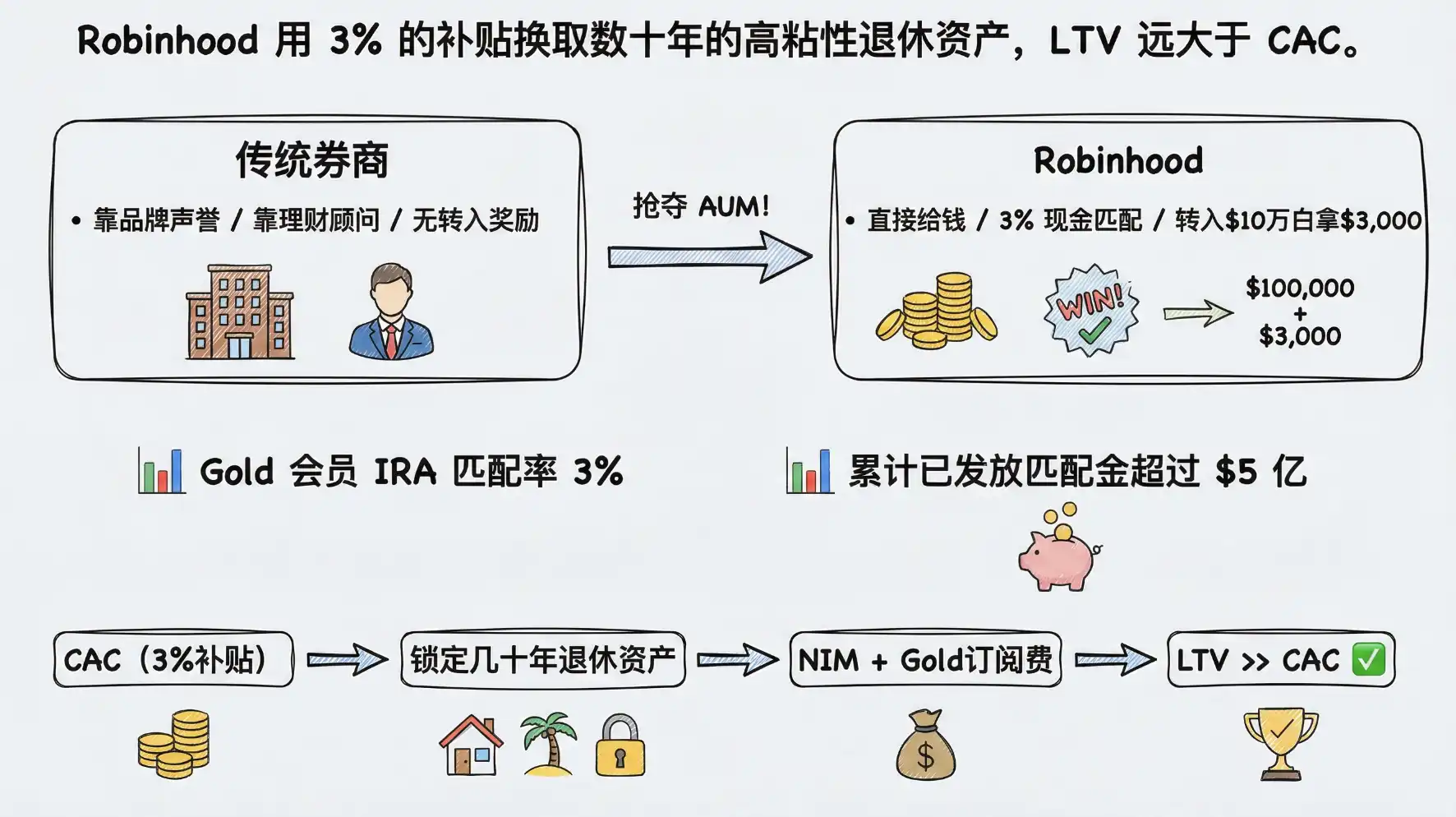
1.1 Matching Fund Subsidies: The Economics of "Buying AUM"
Traditional retirement account providers (such as Fidelity, Charles Schwab) typically rely on brand reputation and advisory services to attract customers, while Robinhood adopted a more direct and aggressive strategy: cash matching subsidies. Using real cash rewards to lower the psychological cost of user migration.
For Robinhood Gold members, the platform offers up to a 3% match on IRA deposits (1% for non-members). Based on the 2025 IRS contribution limit of $7,000 for individuals under 50, users can receive up to $210 in free matching funds annually. More aggressively, for 401(k) or IRA assets transferred (Rollover) from other brokerages, Robinhood also offers a matching reward of up to 3%. This means a user transferring $100,000 in 401(k) assets into a Robinhood IRA can immediately receive a $3,000 cash reward.
Is this economically viable? We can analyze it from the perspective of Customer Acquisition Cost (CAC) and Customer Lifetime Value (LTV). By the end of 2025, customers had received over $500 million in cumulative matching funds for retirement account transfers and contributions. This expenditure is treated by Robinhood as a customer acquisition cost. Given the extremely high stickiness of retirement accounts (typically held for decades), these assets not only bring long-term Net Interest Income (NIM) and potential advisory fees but also lock users into becoming Gold members (annual fee $50). Compared to the customer acquisition costs of traditional brokerages, which can be hundreds of dollars and have high churn rates, Robinhood exchanges a 3% subsidy for decades of highly sticky assets, where the LTV far exceeds the CAC.

1.2 Frictionless Account Transfer Experience: Technological Dimensionality Reduction Attack
Subsidies alone are not enough; if the transfer process is cumbersome, users will still be deterred. Robinhood used technological means to significantly lower the barrier for users to transfer from traditional brokerages.
By integrating the Automated Customer Account Transfer Service (ACATS), Robinhood achieved seamless cross-brokerage asset transfers. Users simply need to enter their original brokerage account information within the App, often without manually liquidating existing assets, and Robinhood's clearing system can automatically complete the asset transfer in the background. For outgoing transfer fees charged by some brokerages (typically $75), Robinhood will also reimburse them if conditions are met. This "one-click move" experience completely breaks down the asset transfer barriers established by traditional institutions relying on cumbersome processes.
2. Profit Model Evolution from PFOF to Recurring Revenue
In the past, Wall Street's skepticism about Robinhood focused on its heavy reliance on Payment for Order Flow (PFOF) and high-frequency trading. This model is highly profitable in bull markets but extremely fragile in bear markets. In 2025, Robinhood successfully evolved towards a more stable asset management profit model.
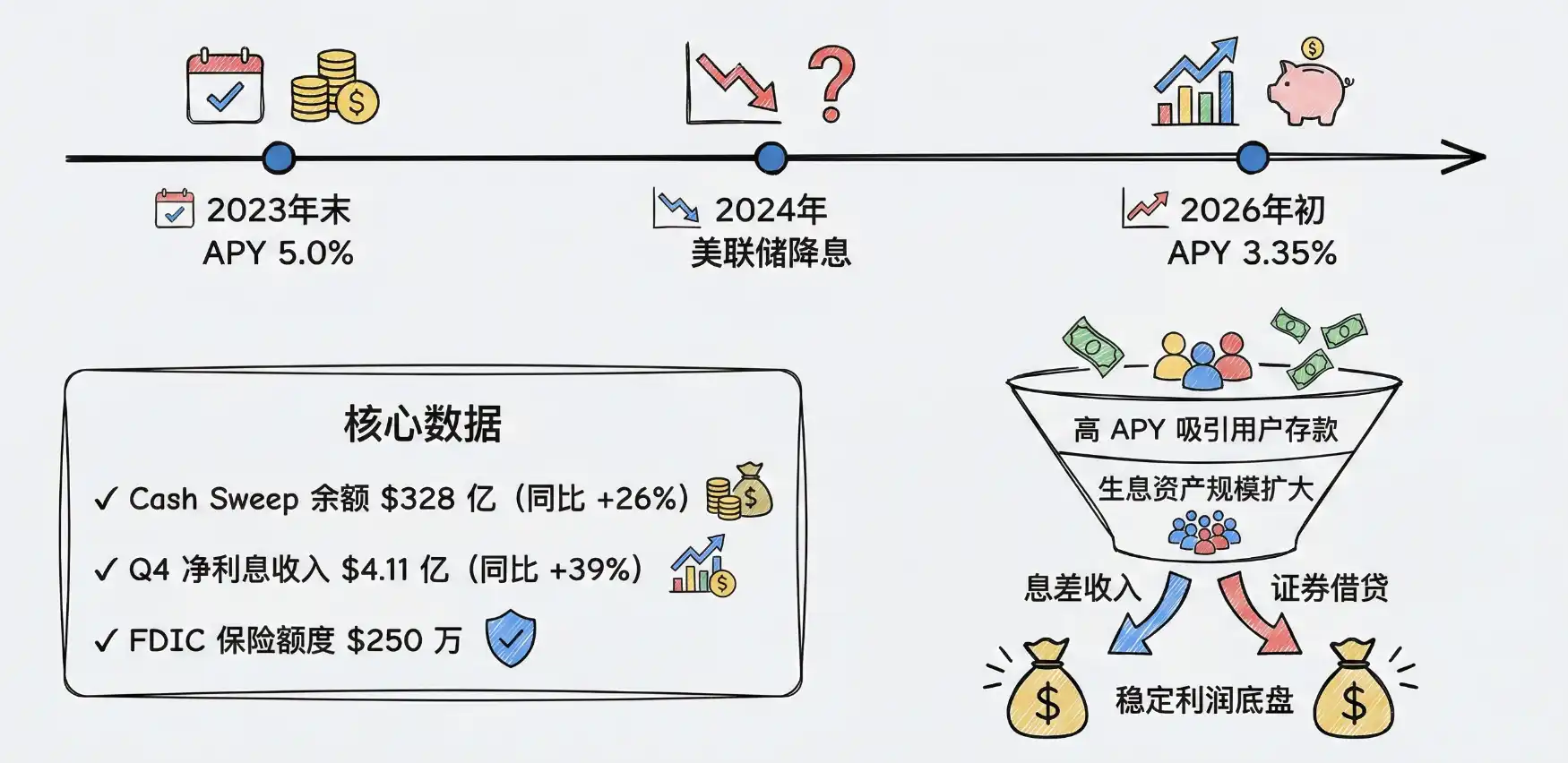
2.1 Net Interest Income (NIM): Attracting Deposits with High-Yield Cash
By offering highly competitive cash yields, Robinhood liberated "cash management" from the low-yield trap of traditional banks, thereby attracting massive deposits.
At the end of 2023, the APY for uninvested cash for Robinhood Gold members once reached as high as 5.0%, far exceeding the national average savings account rate at the time. As the Federal Reserve cut rates, the APY was gradually adjusted (to 3.35% as of early 2026), but it still remained significantly higher than the checking account rates offered by major banks. In Q4 2025, Robinhood's Cash Sweep balance grew 26% year-over-year to $32.8 billion.
This massive pool of interest-earning assets generated substantial net interest income for Robinhood. In Q4 2025, its net interest income grew 39% year-over-year to $411 million, primarily driven by growth in interest-earning assets and securities lending activities. Under specific interest rate cycles, this "earning interest spread" model provides a strong profit foundation.
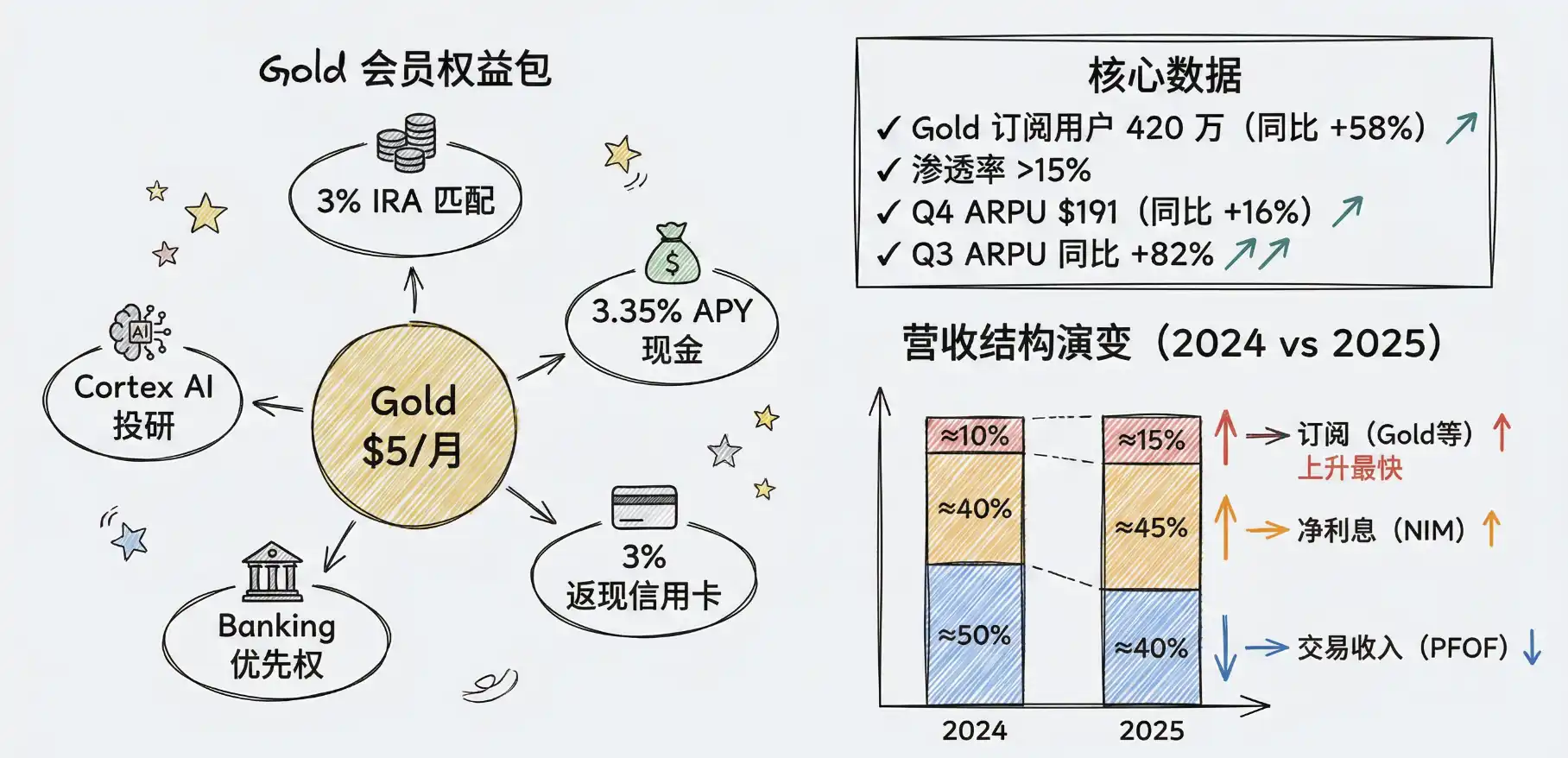
2.2 Subscription Economy (Robinhood Gold): The SaaS-ification of Financial Services
The Robinhood Gold subscription service ($5 monthly or $50 annually) is central to its profit model evolution. It exchanges a fee for high interest rates, in-depth research reports, a 3% IRA match, and a 3% cashback credit card on all categories. This is essentially an attempt to SaaS-ify financial services.
By the end of Q4 2025, Robinhood Gold subscription users reached a record 4.2 million, a 58% year-over-year increase, with a penetration rate of over 15% among its 27 million funded customers. This subscription model significantly increases user stickiness and Average Revenue Per User (ARPU). Q4 ARPU increased 16% year-over-year to $191, and Q3 ARPU surged 82% year-over-year.
The table below shows the evolution of Robinhood's revenue structure:

3. Ecosystem Closed Loop
Young users dislike downloading multiple apps to manage their finances. Robinhood deeply understands this and is building a super app covering investing, saving, spending, and borrowing.
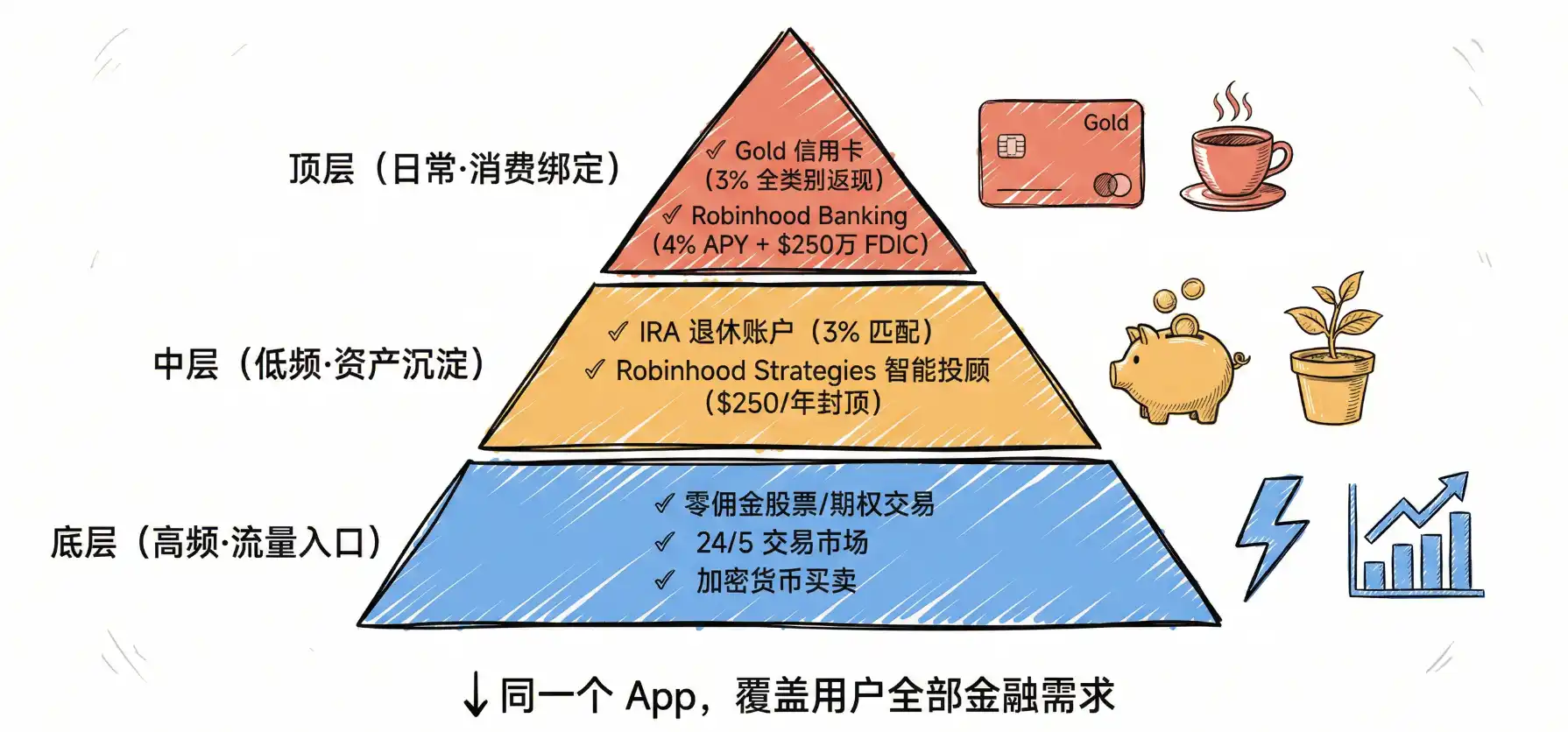
3.1 One-Stop Experience: Seamless Integration of High and Low-Frequency Scenarios
In 2025, Robinhood launched or upgraded several products, forming a complete ecosystem closed loop:
- High-frequency scenarios: Zero-commission stock/options trading, 24/5 trading markets, cryptocurrency buying/selling.
- Low-frequency defensive scenarios: IRA retirement accounts (3% match), Robinhood Strategies robo-advisor ($250/year capped management fee for Gold members).
- Daily spending scenarios: Robinhood Gold credit card (3% cashback), Robinhood Banking (4% savings APY, FDIC insured).
Seamlessly integrating high-frequency speculative trading with low-frequency retirement investing and daily spending in the same App is Robinhood's killer feature.
3.2 Traffic Conversion: Smooth Cross-Selling from "IPO Investing" to "Retirement Planning"
Robinhood possesses the massive traffic that traditional asset managers dream of (27 million accounts as of end-2025). Its core strategy is: use high-frequency trading (like Meme stocks, cryptocurrencies) and high-yield cash as traffic entry points, then smoothly cross-sell low-frequency but high-value wealth management products.
For example, when a 22-year-old Gen Z user downloads Robinhood to trade Dogecoin, they might be attracted by the 5% cash yield to sign up for Gold membership; subsequently, the App will use precise push notifications to inform them that "as a Gold member, you can get a 3% free match by opening an IRA"; when their assets grow to $100,000, the system will recommend the "robo-advisor service for only $250 per year".
This conversion path from "traffic funnel" to "asset沉淀 (sedimentation)" allows Robinhood to acquire high-net-worth clients at extremely low marginal cost.
4. Trust Building
4.1 Compliance and Security Endorsement: Leveraging Traditional Finance's Safety Net
To make users feel safe entrusting their retirement savings for decades to the platform, Robinhood cleverly leveraged traditional finance's safety net to endorse its innovative products.

- SIPC Protection & Additional Insurance: Robinhood emphasizes its status as an SIPC member (providing basic protection of $500,000) and has additionally purchased commercial insurance, providing up to $50 million in securities protection and $1.9 million in cash protection per client.
- FDIC Deposit Insurance: When promoting Cash Sweep and Robinhood Banking, the platform, through partnerships with multiple banks, provides users with FDIC deposit insurance of up to $2.5 million, far exceeding the standard $250,000 coverage at ordinary banks.
This narrative strategy of being "safer than traditional banks" greatly alleviates young users' trust concerns about emerging Fintech platforms.
5. Operational Cost Structure
Robinhood's ability to offer a 3% IRA match and a capped $250 advisory fee stems not only from confidence in LTV but also from its far superior personnel efficiency and underlying technology costs compared to traditional institutions.
5.1 Technology-Driven Automation and High Personnel Efficiency Ratio
Robinhood lacks extensive physical branches and teams of financial advisors. All its advisory services (such as the ETF portfolios recommended by Robinhood Strategies) are highly automated, relying on algorithmic models for asset allocation and rebalancing.
This "light-asset" model results in an astonishing personnel efficiency ratio. According to public data, as of the end of 2025, Robinhood's total number of employees was approximately 2,900. Based on full-year revenue of $4.5 billion, its revenue per employee is as high as $1.55 million. In contrast, traditional financial giants with tens of thousands of employees often have revenue per employee only half or even less of this figure.
5.2 Decreasing Marginal Costs: The Power of a Self-Developed Clearing System
Robinhood freed itself from reliance on third-party clearing agencies (like Apex Clearing) as early as 2018 by building its own clearing system. This infrastructure investment demonstrated huge operating leverage during the asset scale explosion of 2025.
When AUC surged from $193 billion to $324 billion, the marginal cost of processing additional transactions and asset transfers was almost negligible because the clearing system is self-developed and highly automated. According to macro trend data, Robinhood's full-year 2025 operating expenses were $2.379 billion; although revenue surged 52%, the growth in operating expenses was relatively controlled, directly driving the full-year GAAP net income to $1.9 billion and significantly improving the adjusted EBITDA margin.
6. User Profile Transition
The core driver of the success of Robinhood's wealth management business is the profound transformation in the investment behavior of its young user base.
6.1 Younger User Base: Structural Advantage
According to research by ARK Invest, Gen Z and Millennials make up as much as 63% of Robinhood's user base, while this proportion is only 14% at Charles Schwab and relatively limited at Vanguard. The median age of a Robinhood user is approximately 32-35 years old (2025 data), while the average age of clients at Schwab and other traditional brokerages is over 50.
This structural advantage is also reflected in platform asset density. Currently, Schwab's average Assets Under Custody (AUC) per client is about $250,000, far higher than Robinhood's current level of approximately $12,000. However, the essence of this gap is an age gap. As Robinhood's young user base gradually enters their peak wealth accumulation years, this gap will gradually narrow.
6.2 From "Meme Stocks" to "Long-Termism": Profound Shift in Investment Behavior
Robinhood CEO Vlad Tenev pointed out at the end of 2025 that a trend is occurring: 19-year-old Gen Z individuals are actively opening retirement accounts.
This trend is supported by data. According to the latest savings data cited by USA Today, Gen Z's retirement savings rate has risen for several consecutive years, reaching 6.2% in 2025, up from 5.9% in 2024, while the savings rates for all other age groups are declining. Fidelity data shows that Gen Z investors allocate up to 95% of their IRA contributions to Roth accounts, demonstrating a clear awareness of long-term tax optimization.
6.3 Capturing the "Largest Intergenerational Wealth Transfer in Human History"
Over the next few decades, an estimated $124 trillion in assets is expected to transfer from the Baby Boomer generation to Millennials and Gen Z. Given Robinhood holds an overwhelming market share among the younger population, when these young users inherit wealth, they are highly likely to choose to keep the funds within the familiar and better-experienced Robinhood ecosystem, rather than transferring them to the traditional brokerages their parents used.
Conclusion: The Rise of a Financial Super App
2025 was a watershed year in Robinhood's development history. It successfully shed the label of a "casino for retail speculation only" and transformed into a comprehensive, mature, and highly competitive "super financial app".
The core logic of this transformation lies in Robinhood's deep understanding of its user base's lifetime value. A 22-year-old Gen Z user might just buy a few ETFs with Robinhood today; tomorrow, he will open an IRA account and enjoy a 3% match reward; the year after, he will roll over his workplace 401(k) into Robinhood; a few years later, when his asset size grows to $100,000, he will activate Robinhood Strategies to enjoy professional advisory services at a capped fee; finally, when he inherits an estate from his parents, he will naturally deposit it into Robinhood Banking.
Through aggressive customer acquisition mechanisms, stable recurring revenue models, a one-stop ecosystem closed loop, a重塑 (reshaped) trust brand, and an extreme low-cost structure, Robinhood has perfectly prepared its infrastructure to capture this "largest intergenerational wealth transfer in human history".
About BlockBooster:
BlockBooster is a next-generation alternative asset management company for the digital age. We use blockchain technology to invest in, incubate, and manage core assets of the digital era—from blockchain-native projects to Real World Assets (RWA). As value co-creators, we are committed to discovering and unleashing the long-term potential of assets, capturing卓越 (outstanding) value for our partners and investors in the wave of the digital economy. Disclaimer: This article/blog is for informational purposes only and represents the personal views of the author, not the position of BlockBooster.
This article is not intended to provide:
(i) investment advice or recommendations; (ii) an offer or solicitation to buy, sell, or hold digital assets; or (iii) financial, accounting, legal, or tax advice. Holding digital assets, including stablecoins and NFTs, is highly risky, with significant price volatility, and could potentially become worthless. You should carefully consider whether trading or holding digital assets is suitable for you based on your financial situation. Please consult your legal, tax, or investment advisor for matters related to specific situations. The information provided herein (including market data and statistical information, if any) is for general reference only. Reasonable care has been taken in compiling this data and charts, but no responsibility is accepted for any factual inaccuracies or omissions expressed therein.