Ripple President Long Unveils Her 2026 Crypto Predictions

bitcoinistPublicado em 2026-01-21Última atualização em 2026-01-21

Resumo

Ripple President Monica Long predicts that by 2026, institutional crypto adoption will shift decisively from pilots to production stage, driven by four key trends: stablecoins, tokenization, custody consolidation, and AI automation. She expects stablecoins like Ripple USD (RLUSD) to become the foundational global settlement layer, especially in B2B payments, citing growing regulatory support and significant idle corporate capital. Tokenization will drive institutional adoption, with over $1 trillion in digital assets on balance sheets and half of Fortune 500 companies formalizing digital asset strategies. Custody services will consolidate as the sector matures, with major banks expanding custody relationships. Finally, AI and blockchain will converge to automate treasury and risk management through smart contracts and privacy-preserving tech like zero-knowledge proofs.

Ripple President Monica Long says 2026 will be the year institutional crypto usage shifts decisively from pilots to production, as regulated infrastructure and clearer rules pull banks, corporates, and market intermediaries deeper onchain. In a January 20 blog post, Long frames the next leg of adoption around four forces: stablecoins, tokenized assets, custody consolidation, and automation powered by AI.

#1 Stablecoins (Ripple USD) As The Settlement Layer

Long’s central prediction is that stablecoins will stop being treated as an “alternative rail” and become foundational to global settlement. “Within the next five years, stablecoins will become fully integrated into global payment systems—not as an alternative rail, but as the foundational one,” she wrote. “We’re seeing this shift not in theory, but in practice, as heavyweights like Visa and Stripe hard-wire these rails into incumbent flows.”

She ties that trajectory to US policy momentum, arguing the GENIUS Act “inaugurated the digital dollar era,” and positioning “highly compliant, US issued stablecoins, including Ripple USD (RLUSD)” as a standard for programmable, 24/7 payments and collateral use in markets. Long also points to “conditional approval from the OCC to charter the Ripple National Trust Bank” as part of Ripple’s compliance strategy.

The near-term demand driver, in her telling, is B2B, not retail. Long cites research claiming B2B payments became the largest real-world stablecoin use case last year, reaching an annualized $76 billion run-rate—up sharply from early 2023 levels. She argues stablecoins can unlock liquidity and reduce working-capital drag, citing “over $700 billion” of idle cash on S&P 1500 balance sheets and “more than €1.3 trillion across Europe.”

#2 Institutional Exposure And Tokenization

Long argues crypto is increasingly used as financial infrastructure rather than just a speculative asset. “Crypto has evolved from a speculative asset into the operating layer of modern finance,” she wrote. “By the end of 2026, balance sheets will hold over $1 trillion in digital assets, and roughly half of Fortune 500 companies will have formalized digital asset strategies.”

She points to a 2025 Coinbase survey she says found 60% of Fortune 500 companies are working on blockchain initiatives, and notes “more than 200 public companies” holding bitcoin in treasury. She also highlights the rise of “digital asset treasury” firms, claiming they grew from four in 2020 to more than 200 today, with nearly 100 formed in 2025 alone.

On market structure, Long forecasts “collateral mobility” as a key institutional use case, with custodians and clearing houses using tokenization to modernize settlement. Her stated expectation is that “5–10% of capital markets settlement” moves onchain in 2026, supported by regulatory momentum and stablecoin adoption by systemically important institutions.

#3 Custody Consolidation Accelerates

Long frames digital asset custody as the institutional on-ramp and predicts consolidation as custody offerings commoditize. “M&A activity in this space is a signal of maturity, not just momentum,” she wrote, citing $8.6 billion in crypto M&A in 2025. She argues regulation will push banks toward multi-custodian setups and predicts “more than half of the world’s top 50 banks” will add at least one new custody relationship in 2026.

She also points to convergence between crypto and traditional finance through deals such as Kraken’s purchase of NinjaTrader and Ripple’s acquisitions of GTreasury and Hidden Road, positioning them as steps toward safer, more integrated institutional workflows.

#4 Blockchain And AI Converge

Long’s final theme is automation: smart contracts paired with AI models running treasury and asset-management processes continuously. “Stablecoins and smart contracts will enable treasuries to manage liquidity, execute margin calls and optimize yield across onchain repo agreements, all in real-time without manual intervention,” she wrote.

She argues privacy tech is critical for regulated deployment, pointing to zero-knowledge proofs as a way for AI to assess risk or creditworthiness without exposing sensitive data.

Long’s overarching claim is that 2026 marks a transition from experimentation to infrastructure: stablecoins as settlement and collateral, tokenization in core market plumbing, custody as a trust anchor, and AI-driven automation as the efficiency layer.

At press time, XRP traded at $1.905.
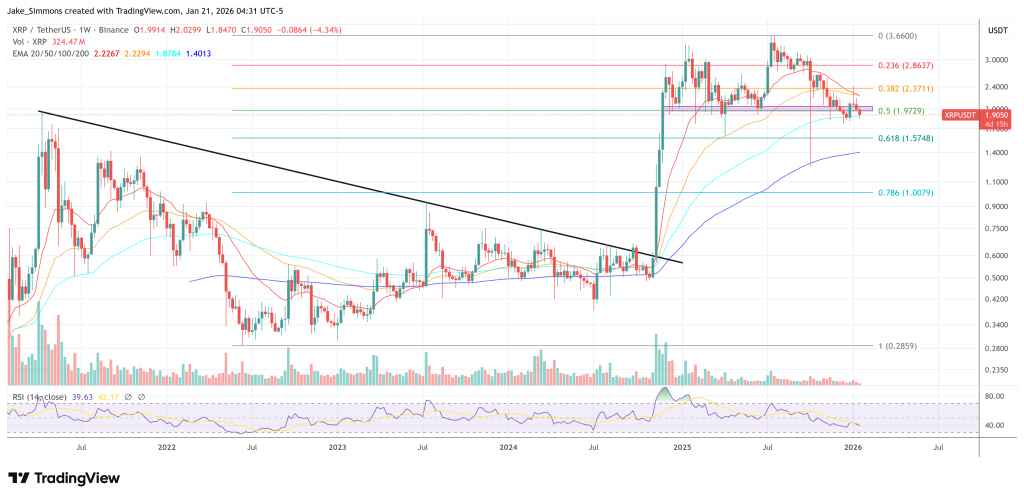
XRP bulls must defend the 100-week EMA, 1-week chart | Source: XRPUSDT on TradingView.com

Perguntas relacionadas

QWhat are the four key forces that Ripple President Monica Long predicts will drive institutional crypto adoption by 2026?

AThe four key forces are stablecoins, tokenized assets, custody consolidation, and automation powered by AI.

QAccording to Long, what role will stablecoins like Ripple USD (RLUSD) play in the global financial system by 2026?

AStablecoins will become the foundational layer for global settlement, fully integrated into payment systems for programmable, 24/7 payments and collateral use, moving beyond being an 'alternative rail'.

QWhat percentage of Fortune 500 companies does Long predict will have formalized digital asset strategies by the end of 2026?

AShe predicts roughly half (about 50%) of Fortune 500 companies will have formalized digital asset strategies by the end of 2026.

QHow does Long characterize the role of digital asset custody in the institutional adoption of crypto?

AShe frames digital asset custody as the institutional on-ramp and predicts consolidation in the space as custody offerings become commoditized, with more than half of the world's top 50 banks adding new custody relationships.

QWhat convergence does Long highlight as a key driver for automation in treasury and asset management processes?

AShe highlights the convergence of blockchain and AI, where smart contracts paired with AI models will enable real-time, automated treasury management, liquidity management, and risk assessment without manual intervention.

Leituras Relacionadas

Only a 50% Chance of Passing This Year, Can the CLARITY Bill Succeed Before the Midterm Elections?

The CLARITY Act, which passed the House in July 2025 with strong bipartisan support (294-134), faces a critical juncture in the Senate. The Senate Banking Committee is expected to hold a markup soon, but key issues remain unresolved, including stablecoin yield provisions, DeFi regulations, and securing full Republican committee support. Other contentious points involve the Blockchain Regulatory Certainty Act (BRCA), ethics amendments for government officials, and SEC-related matters. The legislative calendar is tight, with limited time before the midterm elections. If the committee markup is delayed beyond mid-May, the chances of passage in 2026 drop significantly. Senator Cynthia Lummis has warned that failure this year could delay comprehensive crypto market structure legislation until 2030 or later. Galaxy estimates the probability of the CLARITY Act becoming law in 2026 is only about 50%. The bill provides crucial regulatory clarity by defining jurisdictional boundaries between the SEC and CFTC, establishing a path for decentralization, and bringing digital commodity intermediaries under federal regulation. Its passage is seen as vital before potential power shifts in the next Congress, which could bring less favorable leadership to key committees. The timeline is compressed, and the bill must compete for floor time with other priorities like Iran authorization and DHS appropriations. Key hurdles include finalizing the stablecoin yield compromise text, addressing law enforcement concerns about BRCA, and navigating political dynamics around SEC nominations. The outcome of the Banking Committee markup and the level of bipartisan support will be critical indicators of its future success.

marsbitHá 3m

Only a 50% Chance of Passing This Year, Can the CLARITY Bill Succeed Before the Midterm Elections?

marsbitHá 3m

Only a 50% Chance of Passing This Year, Can the CLARITY Bill Succeed Before the Midterm Elections?

The CLARITY Act, which passed the U.S. House in July 2025 with strong bipartisan support (294-134), faces a critical juncture in the Senate. The Senate Banking Committee is expected to hold a markup soon, but key issues remain unresolved, including stablecoin yield provisions, DeFi regulations, and securing full Republican committee support. Additional challenges involve the Blockchain Regulatory Certainty Act (BRCA), ethics amendments for government officials, and SEC-related concerns. Galaxy estimates only a 50% chance of the bill becoming law in 2026. The tight legislative calendar, competing priorities like Iran military authorization and DHS appropriations, and the impending midterm elections create significant time pressure. If the bill is not passed before the new Congress convenes in 2027, comprehensive crypto market structure legislation could be delayed until 2030 or later, especially if leadership changes result in less favorable committee chairs. The act provides crucial regulatory clarity by defining the jurisdictional boundaries between the SEC and CFTC, establishing a path for decentralized networks to be classified as non-securities, and bringing digital commodity intermediaries under federal regulation. The outcome of ongoing Senate negotiations, particularly the release of revised text on stablecoin yields, will be a key indicator of its future prospects.

Odaily星球日报Há 13m

Only a 50% Chance of Passing This Year, Can the CLARITY Bill Succeed Before the Midterm Elections?

Odaily星球日报Há 13m

Four-Dimensional Resonance: Hong Kong Web3 Carnival Sub-Forum Co-Creates Blueprint for Global Financial New Infrastructure

The "Four-Dimensional Resonance: 2026 Global Financial New Infrastructure" forum, a core event of the Hong Kong Web3 Festival, was successfully held at the Hong Kong Convention and Exhibition Centre. Co-hosted by Web3Labs and DeShang Singularity Tech, with joint support from Bitroot, Injective, Microsoft, and Z Oracle, the event gathered policymakers, industry leaders, and investors to explore the integration and innovation of global financial infrastructure, focusing on RWA, AI, DeFi, and compliant payments. Policy speakers, including Hong Kong Legislative Council Member Mr. Wu Jiezhuang, South Korean National Assembly Member Mr. Min Byung-duk, and ACED Chairman Mr. Yun Seok-hun, emphasized the importance of cross-border regulatory collaboration and an open policy environment for fintech innovation. Web3Labs CEO Caspar and DeShang Singularity Tech CEO Chang Shuai highlighted Hong Kong’s role as a financial innovation center and the approaching "singularity moment" for global financial infrastructure. Technical insights were shared by MagnetX, Bitroot, Microsoft, and Injective on topics including AI Agent economies, the evolution of public blockchains, and AI’s transformative role in finance. Key partnerships and initiatives were launched: - GWDC 2026 Korea collaboration between Hong Kong and South Korea. - A strategic agreement between Web3Labs and Microsoft. - The launch of a public anti-fraud alliance by Z Oracle and partners. - The "Injective Rising Star" program to support AI and Web3 projects. Panel discussions delved into AI-driven smart payments, compliant cross-border transactions, and the fusion of RWA and DeFi. Participants agreed that integrating RWA with DeFi is crucial for the next stage of financial infrastructure, enabling a shift from physical to digital finance. The forum underscored Hong Kong’s pivotal role in advancing a globalized and sustainable Asian fintech ecosystem.

marsbitHá 21m

Four-Dimensional Resonance: Hong Kong Web3 Carnival Sub-Forum Co-Creates Blueprint for Global Financial New Infrastructure

marsbitHá 21m

Trading

Spot
Futuros
活动图片