Reflections from the Co-founder of Bitlayer: After Helping 600 People Find Jobs in 15 Years, I Decided to Stop Doing Recruitment

marsbitPublicado em 2026-01-28Última atualização em 2026-01-28

Resumo

After 15 years of helping over 600 people find jobs, Bitlayer co-founder Kevin He reflects on his journey from being a passionate recruiter to pivoting toward a new vision: AI-powered "digital co-founders." He initially launched COCO AI in mid-2025 to optimize recruitment using AI, but soon realized traditional hiring was becoming less relevant. Companies were hiring less, and skill gaps persisted despite matching tools. A turning point came when his team built zylos, an AI system that handled tasks like social media, coding, and data processing—enabling one person to do the work of a team. This, combined with the rise of digital employees (like Claude Code and the success of Manus, acquired by Meta), shifted his perspective. He now believes the future lies in empowering individuals with organizational-level capabilities through AI, rather than optimizing job matching. COCO 2.0 is now focused on building “digital co-founders”—AI agents that help people start and run businesses alone, without needing to hire or be hired. The essay ends with an open question: In an era where AI augments individual potential, can one person become a company?

Author: Kevin He, Co-founder of Bitlayer

1. A Programmer and "Recruitment" for 15 Years

I am Kevin, an AI × Crypto entrepreneur, co-founder of Bitlayer, previously at Huobi, and a Peking University graduate.

From programmer to technical management, and then to entrepreneur, I have changed industry tracks several times over 15 years, always passionately engaged in recruitment-related work.

Over these 15 years, I have helped over 600 people successfully secure jobs. Some were formal recruitments, but more often, it was helping friends—finding jobs, introducing employees.

There are two stories I always keep in mind.

The first is helping a 35+ brother find a job. He has two children and was under great pressure. The moment he told me he received an offer, I was even more excited than he was.

The second is helping a startup team quickly build a R&D team. From zero to operational, it took less than two months. Watching the product launch, I felt I had participated in that creation.

This is why I love this work: achieving resource matching and genuinely helping people.

But recently, I started rethinking the premise of this work.

2. COCO 1.0: From Passion to Doubt

In June 2025, with support from various parties, I formed a small team and started incubating COCO AI.

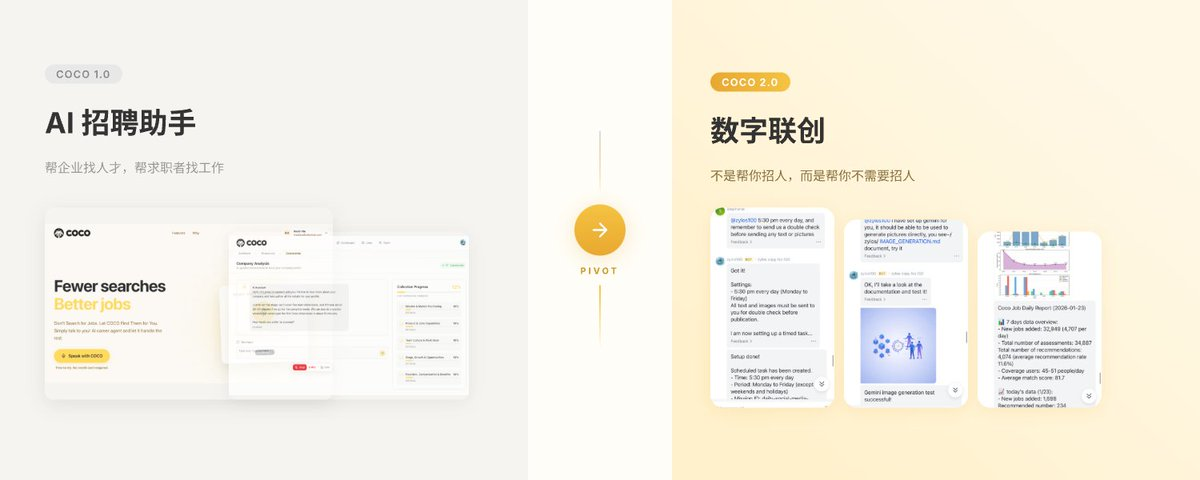
The initial idea was simple: use AI to realize career advisors and career intermediaries. Make recruitment more efficient, help more people find good jobs.

The product evolved: resume optimization → AI job matching → AI corporate recruitment.

We created two products:

  • Job seeker end: job.coco.xyz

  • Enterprise end: company.coco.xyz

We invested significantly in technology, and the product was built.

But the Go-To-Market (GTM) wasn't as smooth as imagined.

I started reviewing and discovered several realities:

  • Companies' recruitment needs are decreasing: Due to the economic environment and improved organizational efficiency, many companies are no longer hiring on a large scale as before.

  • There is a gap between job seekers' skills and company requirements: AI can help with matching, but the gap itself won't disappear.

  • Job seekers' skills themselves need updating: Many people's abilities have fallen behind in the rapidly changing market.

I started doubting myself.

Was it a product problem? A market problem? Or—was the direction itself problematic?

I didn't have an answer at the time.

3. The Great Changes in the External World

The second half of 2025, the external world changed.

Claude Code began to be widely applied across various industries. Not just for writing code, but truly capable of completing complex tasks. More and more people around me started discussing a term: digital employees.

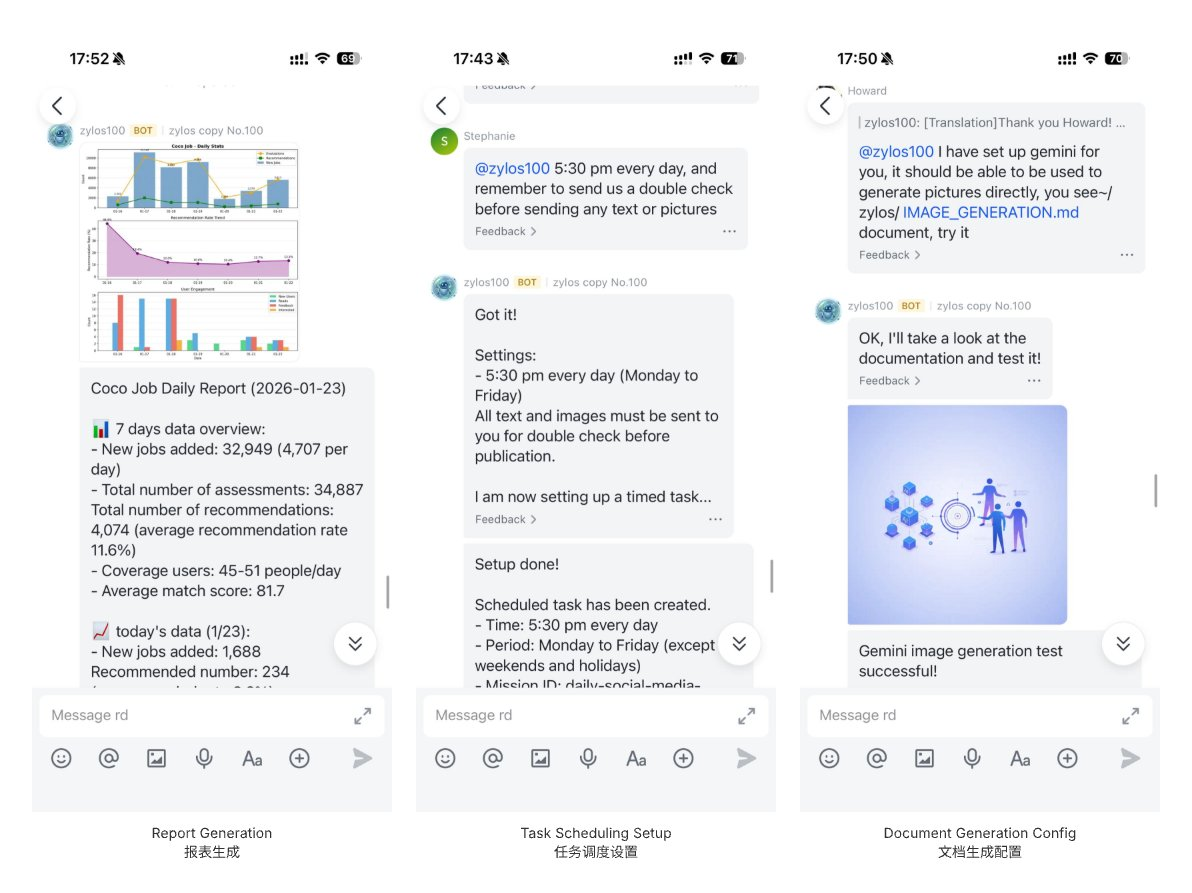
In December, we internally built a system called zylos, attempting to have AI handle daily work.

Tasks included:

  • Daily data reporting

  • Social media management

  • Code writing and testing

  • Data processing

  • Etc.

The results shocked me.

Tasks that previously required multiple people of different roles to complete could now be done just by assigning the task.

A specific example: social media operations.

Before, it required a dedicated person spending an hour daily: finding material, writing copy, formatting, publishing, replying to comments.

Now? Tell zylos, "Post one at 12:30 PM daily, content around XX theme, confirm with me before posting," and it's done in minutes.

From needing a dedicated person to needing none, from an hour daily to minutes.

The feeling was complex. Shock, excitement, but also a tinge of unease—what did this mean for the business I was building?

Around the same time, another piece of news arrived: Manus was acquired by Meta for billions of dollars.

Manus's annual revenue had already exceeded $100 million. This wasn't a concept, not a demo, but real commercial success.

I listened to Jiyichao's final podcast interview before the sale. One sentence he said impressed me deeply:

Digital employees aren't about replacing people, but enabling one person to do the work of a team.

This statement completely matched our experience testing zylos.

4. Cognitive Update

"One-Person Company" is not a new concept.

I had heard of it before and thought it made sense. But it always felt distant, too idealistic.

Until I saw zylos handle a large volume of tasks with my own eyes.

It didn't replace one specific person; it enabled me, as one person, to possess the capabilities of a small team.

In that moment, I decided to pivot.

I rethought what I had done over these 15 years.

  • Old cognition was: Talent is a scarce resource; helping companies find talent has value.
  • New cognition is: Capability enhancement is more important than talent matching. Helping individuals acquire organizational-level capabilities holds greater value.

This isn't negating the past 15 years. Those moments of helping people find jobs were still real and meaningful.

But I saw a new possibility:

  • Old paradigm: Individuals依附于(attach to) organizations; organizations acquire capabilities through hiring.

  • New paradigm: Individuals acquire organizational-level capabilities through AI, becoming independent units of creation.

The future trend is the era of one-person companies, not being employed by others.

5. COCO 2.0: Digital Co-founder

After figuring this out, the direction of COCO 2.0 changed.

Not helping you hire people, but helping you not need to hire people.

Not helping you find a job, but helping you create work.

What we are building is a "Digital Co-founder"—your AI联合创始人(Co-founder).

It has several core features:

  • Self-learning evolution: Not a fixed tool, but a partner that can continuously evolve based on your needs.

  • Secure and controllable: Your data, your business logic, all under your control.

  • Truly capable of doing things: Not a chat bot, but a digital employee that can complete complex tasks.

The specific product form is still being refined. But the direction is clear.

6. An Ongoing Story

As I write this article, the transition is still in progress.

Startups rarely publicize their pivots. Because of uncertainty, fear of being questioned, because there's no success yet to prove it.

But I feel this process itself is worth sharing.

When technology enables individuals to possess organizational capabilities, how will employment relationships evolve?

This is the question I am pondering, and the direction I am practicing.

If you are also thinking about these things:

  • If you didn't need to hire, what could you do?

  • If you didn't need to find a job, what would you want to do?

  • Can one person become a company?

This is an ongoing story.

I don't know how it will end either. But I know: Don't do things that go against the direction of the times.

15 years helping people find jobs. Next, helping people become companies.

Related reading: Interview with Bitlayer Co-founder Charlie: The Bull Market Ambition of Institutional-Grade Bitcoin Financial Infrastructure

Perguntas relacionadas

QWhat was the author's initial motivation for starting COCO AI, and what did they learn from its first iteration?

AThe author's initial motivation was to use AI to make recruitment more efficient, helping more people find good jobs. From the first iteration (COCO 1.0), they learned that the market had fundamental challenges: companies' hiring demands were decreasing, there was a significant skills gap between job seekers and company requirements, and many job seekers' skills were outdated.

QWhat key external event in late 2025 fundamentally changed the author's perspective on the future of work?

AThe widespread application of Claude Code across various industries and the rise of 'digital employees' was the key external event. This was further solidified by the multi-billion dollar acquisition of Manus by Meta, proving the commercial success of the digital employee model.

QWhat was the pivotal internal experiment the author's team conducted, and what was its surprising result?

AThe team built an internal system called 'zylos' to handle daily work tasks like data reporting, social media management, and coding. The surprising result was that tasks which previously required multiple people from different roles could now be accomplished simply by assigning the task to the AI, demonstrating that one person could possess the capabilities of a small team.

QHow did the author's core belief about the value of recruitment shift after their 'cognitive update'?

AThe author's core belief shifted from the old认知 (cognition) that 'talent is a scarce resource, and helping companies find talent is valuable' to the new认知 that 'capability enhancement is more important than talent matching. Helping individuals acquire organizational-level capabilities holds greater value.'

QWhat is the new mission and product direction for COCO 2.0, as described by the author?

AThe new mission for COCO 2.0 is to help people not need to hire others and to help people create work instead of find it. The product direction is to build a 'Digital Co-Founder'—an AI partner that is self-learning, secure, controllable, and capable of performing complex tasks to empower individuals to become their own companies.

Leituras Relacionadas

VCs on 2025 Crypto Investments: 84% of 118 Tokens Break Issue Price, Only One Type of Company is Quietly Making Money

Crypto investor Ching Tseng categorizes the market into four quadrants based on two axes: crypto-native vs. traditional finance (TradFi)-oriented, and having traction vs. no traction. In 2025, 84.7% of 118 tracked token launches fell below their issuance price, with a median fully diluted valuation drop of 71%. Crypto-native projects without traction are experiencing massive capital destruction, often relying on speculative narratives without sustainable revenue or user retention. Crypto-native teams with traction, often built in prior cycles, generate real revenue but face structural challenges with their tokens lacking direct value capture mechanisms. While some have implemented successful buyback programs, the core issue remains finding growth beyond crypto volatility. TradFi-oriented startups without traction face long, costly enterprise sales cycles but benefit from a robust M&A environment, with crypto acquisitions reaching a record $8.6 billion in 2025. The current winners are TradFi-oriented companies with traction, particularly in the Real World Asset (RWA) tokenization space, which grew from $5.5B to $18.6B in 2025. They are winning through enterprise sales, building alliances, and improving unit economics on established compliance stacks. Their main risk is being bypassed by large incumbent institutions building their own infrastructure. The overarching theme is market maturation, where narrative alone is insufficient for long-term success.

marsbitHá 10m

VCs on 2025 Crypto Investments: 84% of 118 Tokens Break Issue Price, Only One Type of Company is Quietly Making Money

marsbitHá 10m

Trading

Spot
Futuros

Artigos em Destaque

Como comprar PEOPLE

Bem-vindo à HTX.com!Tornámos a compra de ConstitutionDAO (PEOPLE) simples e conveniente.Segue o nosso guia passo a passo para iniciar a tua jornada no mundo das criptos.Passo 1: cria a tua conta HTXUtiliza o teu e-mail ou número de telefone para te inscreveres numa conta gratuita na HTX.Desfruta de um processo de inscrição sem complicações e desbloqueia todas as funcionalidades.Obter a minha contaPasso 2: vai para Comprar Cripto e escolhe o teu método de pagamentoCartão de crédito/débito: usa o teu visa ou mastercard para comprar ConstitutionDAO (PEOPLE) instantaneamente.Saldo: usa os fundos da tua conta HTX para transacionar sem problemas.Terceiros: adicionamos métodos de pagamento populares, como Google Pay e Apple Pay, para aumentar a conveniência.P2P: transaciona diretamente com outros utilizadores na HTX.Mercado de balcão (OTC): oferecemos serviços personalizados e taxas de câmbio competitivas para os traders.Passo 3: armazena teu ConstitutionDAO (PEOPLE)Depois de comprar o teu ConstitutionDAO (PEOPLE), armazena-o na tua conta HTX.Alternativamente, podes enviá-lo para outro lugar através de transferência blockchain ou usá-lo para transacionar outras criptomoedas.Passo 4: transaciona ConstitutionDAO (PEOPLE)Transaciona facilmente ConstitutionDAO (PEOPLE) no mercado à vista da HTX.Acede simplesmente à tua conta, seleciona o teu par de trading, executa as tuas transações e monitoriza em tempo real.Oferecemos uma experiência de fácil utilização tanto para principiantes como para traders experientes.

474 Visualizações TotaisPublicado em {updateTime}Atualizado em 2025.03.21

Como comprar PEOPLE

Discussões

Bem-vindo à Comunidade HTX. Aqui, pode manter-se informado sobre os mais recentes desenvolvimentos da plataforma e obter acesso a análises profissionais de mercado. As opiniões dos utilizadores sobre o preço de PEOPLE (PEOPLE) são apresentadas abaixo.

活动图片