Recruiting Veterans from Polymarket, Coinbase Dives into the Deep End of Prediction Markets

marsbitPublicado em 2025-12-23Última atualização em 2025-12-23

Resumo

On December 22, Coinbase announced its agreement to acquire The Clearing Company, a move expected to close in January. The deal, involving both cash and stock, marks a strategic shift from distribution partnerships to deeper integration of technology and talent in the prediction market space. The Clearing Company’s team includes former executives and engineers from leading prediction platforms Polymarket and Kalshi, bringing significant expertise. Despite being an early-stage startup, it raised a $15 million seed round—nearly four times Polymarket’s seed funding—reflecting high market expectations. This acquisition follows Coinbase’s recent partnership with CFTC-regulated Kalshi, allowing user access to prediction markets via Coinbase. The company is expanding into stock trading, prediction markets, and other asset classes, positioning itself as a comprehensive trading platform. It has also co-founded the Coalition for Prediction Markets to advocate for regulated, transparent market access. The move is part of Coinbase’s broader M&A strategy in 2025, which includes several other acquisitions. By internalizing key prediction market capabilities, Coinbase aims to compete in the next phase of regulated, institutional-grade prediction markets.

On December 22, Coinbase announced it had reached an agreement to acquire The Clearing Company, with the transaction expected to be completed in January. The team from The Clearing Company will join Coinbase to assist in expanding its product offerings. A spokesperson declined to disclose the transaction amount, calling it "immaterial," and confirmed the deal includes a combination of cash and Coinbase stock.

Although the specific financial terms of this acquisition have not been disclosed, it marks Coinbase's shift from simple distribution partnerships to a deep integration of technology and talent in the growing prediction market sector.

Just one week before this deal was announced, Coinbase had just launched a partnership with the CFTC-regulated prediction platform Kalshi, allowing its users to access Kalshi's markets through the Coinbase interface. This acquisition of The Clearing Company is seen by the market as a further move by Coinbase to own the underlying technology stack and strengthen its internal product development capabilities.

The "Hybrid DNA" of Polymarket and Kalshi

In August 2025, The Clearing Company completed a $15 million seed funding round led by Union Square Ventures, with participation from Haun Ventures, Variant, Coinbase Ventures, Compound, Rubik, Earl Grey, Cursor Capital, and Asylum. The company has not yet announced a platform launch timeline but emphasized a focus on designing products that balance simplicity and compliance.

Although it is an early-stage startup, its team composition holds significant background advantages in the prediction market space.
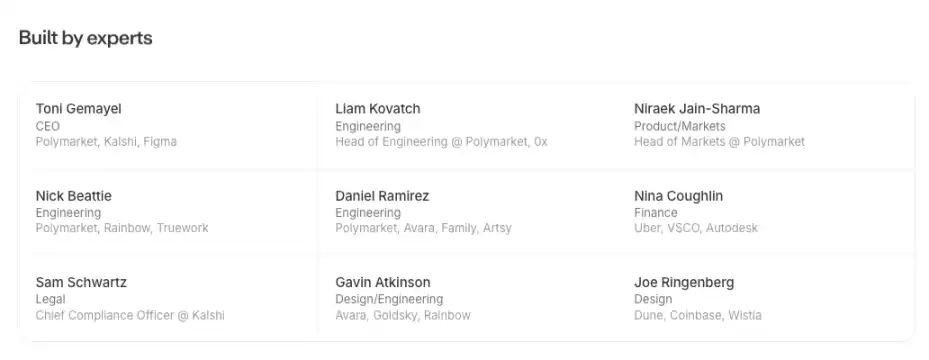
According to information on its official website, The Clearing Company's core team consists of several former executives and technical leads from Polymarket and Kalshi. The company's founder and CEO, Toni Gemayel, is a seasoned operator in the prediction market space. His resume shows he previously worked at both Polymarket and Kalshi as Head of Growth. Additionally, he has a work background at the design unicorn Figma.

Beyond this, The Clearing Company's core engineering team is primarily composed of early employees from Polymarket, while also incorporating some operations personnel from Kalshi.

· Liam Kovatch (Engineering): Former Head of Engineering at Polymarket;

· Niraek Jain-Sharma (Product/Markets): Former Head of Markets at Polymarket;

· Sam Schwartz: Former Chief Compliance Officer at Kalshi;

· Nick Beattie and Daniel Ramirez: These two engineers also hail from the Polymarket team and have experience in development at Raibow and Avara, among others.

A Coinbase spokesperson told The Block that the startup has about 10 employees, and nearly the entire team will join Coinbase as part of the deal.

Relatively speaking, although The Clearing Company is a latecomer, its starting capital far exceeds that of Polymarket and Kalshi in their early days. Comparing the seed round funding data of the three companies clearly shows the leap in the prediction market sector's valuation system over the past five years.
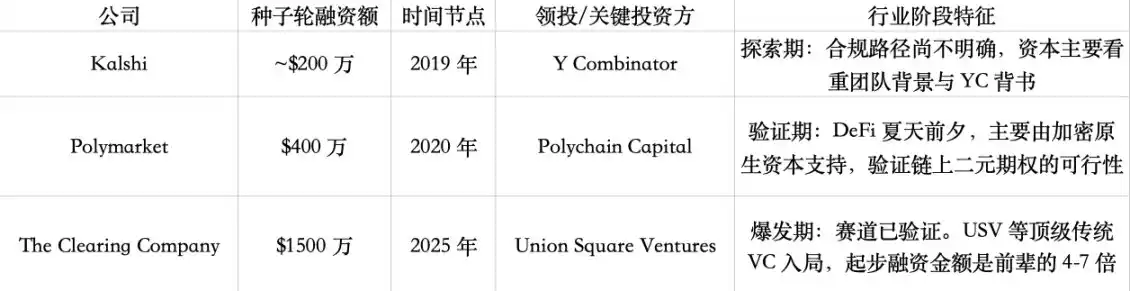
The Clearing Company completed a $15 million seed round led by Union Square Ventures even before its product launched. This amount is almost four times that of Polymarket's seed round at the time. This indicates that even before the Coinbase acquisition, the primary market had already tagged this hybrid-genes team with extremely high expectations.

Coinbase Launches Stock Trading and Prediction Market Services

At its System Update launch event on December 18, Coinbase announced a significant expansion of the range of assets tradable on its platform, including stock trading, prediction markets, new cryptocurrencies, and perpetual futures, among other new services, aiming to solidify its market positioning as an "all-in-one trading platform."

Coinbase will first launch trading services for hundreds of stocks based on market capitalization and trading volume, with plans to add thousands more stocks and ETFs in the coming months. Users can enjoy zero-commission trading, unrestricted by traditional market hours, available 24 hours a day, five days a week. Additionally, Coinbase has partnered with the $11 billion prediction market provider Kalshi, allowing users to trade on the outcomes of real-world events like elections, sports, collectibles, and economic indicators.

Simultaneously, Coinbase also launched the AI-driven wealth management tool Coinbase Advisor and the Coinbase Business service for startups, further expanding its business scope. Company executives stated that these new features will be supported by the Coinbase Tokenize platform, an end-to-end institutional-grade platform designed for tokenizing real-world assets.

Recently, Coinbase, Kalshi, Crypto.com, Robinhood, and Underdog jointly formed the Prediction Market Alliance (the Coalition for Prediction Markets). This national organization is dedicated to maintaining a safe, transparent, and federally regulated access environment for prediction markets.

Coinbase is gradually downplaying its label as a mere cryptocurrency trading platform. As Robinhood and Interactive Brokers venture into prediction markets, Coinbase must defend its territory. Having a native prediction product will complete its product matrix of spot, futures, and prediction markets, enabling users to perform a full suite of operations from buying Bitcoin to hedging macroeconomic risks within a single account.

The Next Stage of Competition in Prediction Markets

The acquisition of The Clearing Company is Coinbase's tenth announced acquisition in 2025. Deals completed earlier this year include Roam, Spindl, Iron Fish, Deribit, Opyn Markets, Liquifi, Sensible, Echo, and Vector.fun.

From the distribution partnership with Kalshi to acquiring the team and technology of The Clearing Company, Coinbase's path in the prediction market has become clear. First, validate demand and product form through partnerships, then internalize key capabilities through mergers and acquisitions, ultimately forming scalable long-term business lines.

Competition in prediction markets is shifting from who launches first to who can run compliantly and sustainably in the long term. By bringing people and technology into its system, Coinbase is clearly positioning itself early for the next stage of licensed, institutionalized competition.


Perguntas relacionadas

QWhat did Coinbase announce on December 22nd, and what is the expected timeline for the deal?

ACoinbase announced it has reached an agreement to acquire The Clearing Company, with the transaction expected to be completed in January.

QWhich two major prediction market platforms do the core team members of The Clearing Company come from?

AThe core team members of The Clearing Company come from Polymarket and Kalshi.

QWhat was the amount of The Clearing Company's seed funding round, and which firm led it?

AThe Clearing Company completed a $15 million seed funding round led by Union Square Ventures.

QWhat new types of trading did Coinbase announce in its System Update on December 18th?

ACoinbase announced it would expand its platform to include stock trading, prediction markets, new cryptocurrencies, and perpetual futures.

QWhat is the name of the coalition formed by Coinbase, Kalshi, and others to advocate for prediction markets?

AThe coalition is named the Coalition for Prediction Markets.

Leituras Relacionadas

Gensyn AI: Don't Let AI Repeat the Mistakes of the Internet

In recent months, the rapid growth of the AI industry has attracted significant talent from the crypto sector. A persistent question among researchers intersecting both fields is whether blockchain can become a foundational part of AI infrastructure. While many previous AI and Crypto projects focused on application layers (like AI Agents, on-chain reasoning, data markets, and compute rentals), few achieved viable commercial models. Gensyn differentiates itself by targeting the most critical and expensive layer of AI: model training. Gensyn aims to organize globally distributed GPU resources into an open AI training network. Developers can submit training tasks, nodes provide computational power, and the network verifies results while distributing incentives. The core issue addressed is not decentralization for its own sake, but the increasing centralization of compute power among tech giants. In the era of large models, access to GPUs (like the H100) has become a decisive bottleneck, dictating the pace of AI development. Major AI companies are heavily dependent on large cloud providers for compute resources. Gensyn's approach is significant for several reasons: 1) It operates at the core infrastructure layer (model training), the most resource-intensive and technically demanding part of the AI value chain. 2) It proposes a more open, collaborative model for compute, potentially increasing resource utilization by dynamically pooling idle GPUs, similar to early cloud computing logic. 3) Its technical moat lies in solving complex challenges like verifying training results, ensuring node honesty, and maintaining reliability in a distributed environment—making it more of a deep-tech infrastructure company. 4) It targets a validated, high-growth market with genuine demand, rather than pursuing blockchain integration without purpose. Ultimately, the boundaries between Crypto and AI are blurring. AI requires global resource coordination, incentive mechanisms, and collaborative systems—areas where crypto-native solutions excel. Gensyn represents a step toward making advanced training capabilities more accessible and collaborative, moving beyond a niche controlled by a few giants. If successful, it could evolve into a fundamental piece of AI infrastructure, where the most enduring value in the AI era is often created.

marsbitHá 12h

Gensyn AI: Don't Let AI Repeat the Mistakes of the Internet

marsbitHá 12h

Why is China's AI Developing So Fast? The Answer Lies Inside the Labs

A US researcher's visit to China's top AI labs reveals distinct cultural and organizational factors driving China's rapid AI development. While talent, data, and compute are similar to the West, Chinese labs excel through a pragmatic, execution-focused culture: less emphasis on individual stardom and conceptual debate, and more on teamwork, engineering optimization, and mastering the full tech stack. A key advantage is the integration of young students and researchers who approach model-building with fresh perspectives and low ego, prioritizing collective progress over personal credit. This contrasts with the US culture of self-promotion and "star scientist" narratives. Chinese labs also exhibit a strong "build, don't buy" mentality, preferring to develop core capabilities—like data pipelines and environments—in-house rather than relying on external services. The ecosystem feels more collaborative than tribal, with mutual respect among labs. While government support exists, its scale is unclear, and technical decisions appear driven by labs, not state mandates. Chinese companies across sectors, from platforms to consumer tech, are building their own foundational models to control their tech destiny, reflecting a broader cultural drive for technological sovereignty. Demand for AI is emerging, with spending patterns potentially mirroring cloud infrastructure more than traditional SaaS. Despite challenges like a less mature data industry and GPU shortages, Chinese labs are propelled by vast talent, rapid iteration, and deep integration with the open-source community. The competition is evolving beyond a pure model race into a contest of organizational execution, developer ecosystems, and industrial pragmatism.

marsbitHá 14h

Why is China's AI Developing So Fast? The Answer Lies Inside the Labs

marsbitHá 14h

3 Years, 5 Times: The Rebirth of a Century-Old Glass Factory

Corning, a 175-year-old glass company, is experiencing a dramatic revival as a key player in AI infrastructure, driven by surging demand for high-performance optical fiber in data centers. AI data centers require vastly more fiber than traditional ones—5 to 10 times as much per rack—to handle high-speed data transmission between GPUs. This structural demand shift, coupled with supply constraints from the lengthy expansion cycle for fiber preforms, has created a significant supply-demand gap. Nvidia has invested in Corning, along with Lumentum and Coherent, in a $4.5 billion total commitment to secure the optical supply chain for AI. Corning's competitive edge lies in its expertise in producing ultra-low-loss, high-density, and bend-resistant specialty fiber, which is critical for 800G+ and future 1.6T data rates. Its deep involvement in co-packaged optics (CPO) with partners like Nvidia further solidifies its position. While not the largest fiber manufacturer globally, Corning's revenue from enterprise/data center clients now exceeds 40% of its optical communications sales, and it has secured multi-year supply agreements with major hyperscalers including Meta and Nvidia. Financially, Corning's optical communications revenue has surged, doubling from $1.3 billion in 2023 to over $3 billion in 2025. Its stock price has risen nearly 6-fold since late 2023. Key future catalysts include the rollout of Nvidia's CPO products and the scale of undisclosed customer agreements. However, risks include high current valuations and potential disruption from next-generation technologies like hollow-core fiber. The company's long-term bet on light over electricity, maintained even through the telecom bubble crash, is now being validated by the AI boom.

marsbitHá 15h

3 Years, 5 Times: The Rebirth of a Century-Old Glass Factory

marsbitHá 15h

Trading

Spot
Futuros
活动图片




