Recalling 10 Little-Known Key Contributions of the Early TON Core Team

marsbitPublicado em 2026-03-15Última atualização em 2026-03-15

Resumo

Despite TON Foundation being widely recognized, the early contributions of the NEWTON team—TON's core developers—are less known. As an early member, Dr. Awesome Doge recounts their pivotal role in maintaining TON testnet2 and enhancing developer tools before Telegram’s official endorsement in 2021, marking a historic community-led takeover. Key contributions include: 1. **mytonctrl**: An automated node management tool for validator setup, wallet creation, and DNS registration. 2. **tonmon**: A monitoring tool for blockchain health, tracking metrics like block time and validator status. 3. **tonmine**: A system to monitor Giver contracts, which distributed ~200,000 $TON daily. 4. **Cross-chain bridge**: Enabled transfers between TON, Ethereum, and BSC before jetton standards existed. 5. **cryptobot**: An early Telegram wallet supporting multiple cryptocurrencies. 6. **toncenter**: A public API simplifying blockchain data access for developers. 7. **explorer.toncoin.org**: TON’s first technical blockchain explorer. 8. **ton.sh**: A user-friendly blockchain explorer focusing on wallet balances and transaction memos. 9. **TonWeb**: A JavaScript SDK to simplify interactions with TON’s complex smart contract languages. 10. **ton wallet**: An early functional wallet that remains operational. In June 2021, NEWTON’s public letter to Telegram led to official recognition and GitHub access, catalyzing TON’s growth. These foundational efforts underscore the team’...

Author: Dr. Awesome Doge

Compiled by: WuBlockchain

Although the TON Foundation is a more well-known name, few people know the story of its early contributors—the NEWTON team (TON Core Team).

Through voluntary technical contributions, the NEWTON team gained recognition from the @Telegram official team in 2021, ultimately achieving a technical handover, marking the most significant "community takeover" in blockchain history.

As one of the early members of NEWTON, let me share this story. — @drawesomedoge

Introduction: Joining the NEWTON Team and Its Mission

When I joined the NEWTON team, our main mission was clear: to maintain the stability of the TON testnet2 code while enhancing developer tools.

Since we couldn't directly control the ton-blockchain GitHub repository but needed to continuously optimize the code, we established a new organization called NEWTON. To ensure smooth network updates, we encouraged the community to use the validator developed by NEWTON as the standard version.

From our establishment to June 2021, the NEWTON team completed several groundbreaking development and infrastructure projects. Let's delve into the 10 key contributions that shaped the early days of TON.

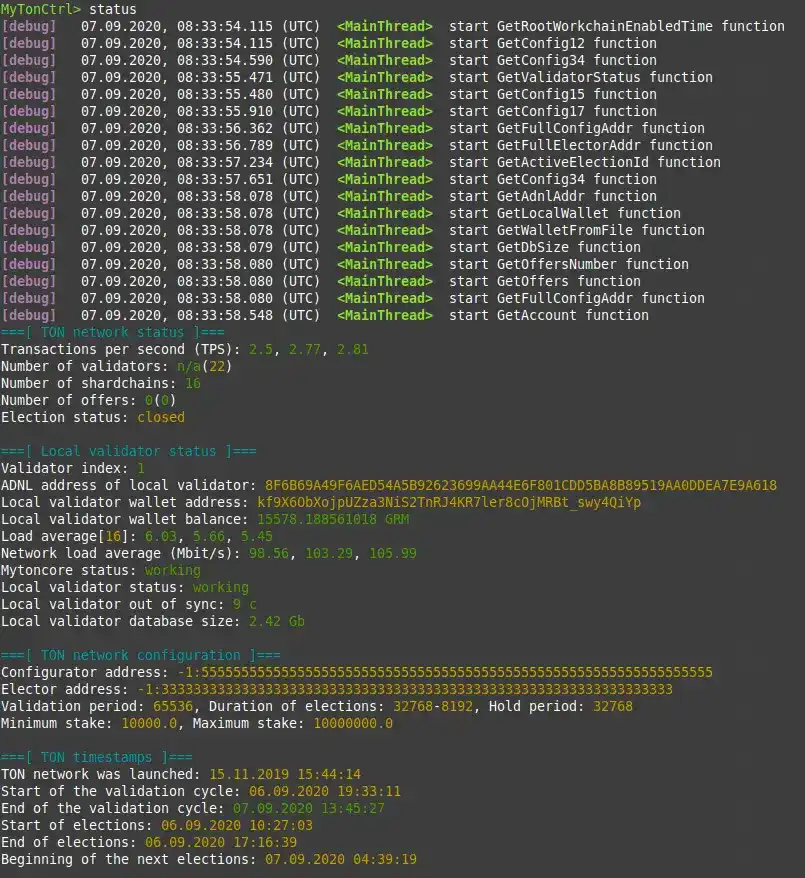
1. mytonctrl: Automated Node Management Tool

Our first major contribution was mytonctrl, a powerful automation tool for node installation and validator setup.

It provided essential functions including wallet creation, contract deployment, transaction history retrieval, and even a DNS registration system—interestingly, the DNS at that time was not the same as the modern NFT-wrapped DNS we see today.

mytonctrl could also configure validators, lite servers, and lite clients, making it easy to access and parse node data. In 2021, we added CPU-based mining scripts and automated performance tests to simplify the $TON mining process.
2. tonmon: Blockchain Health Visualization Tool

Having nodes and accessing data wasn't enough; we needed more visualization tools to monitor the blockchain's health.

To better monitor the blockchain's health status, we developed tonmon. This tool could track key metrics: block generation time, shard status, dPoS election schedule, number and weight of validators, and mining contract status. Through it, we could quickly respond to any network anomalies.

In those early days, the network scale was quite small, with only about 80 validators globally.

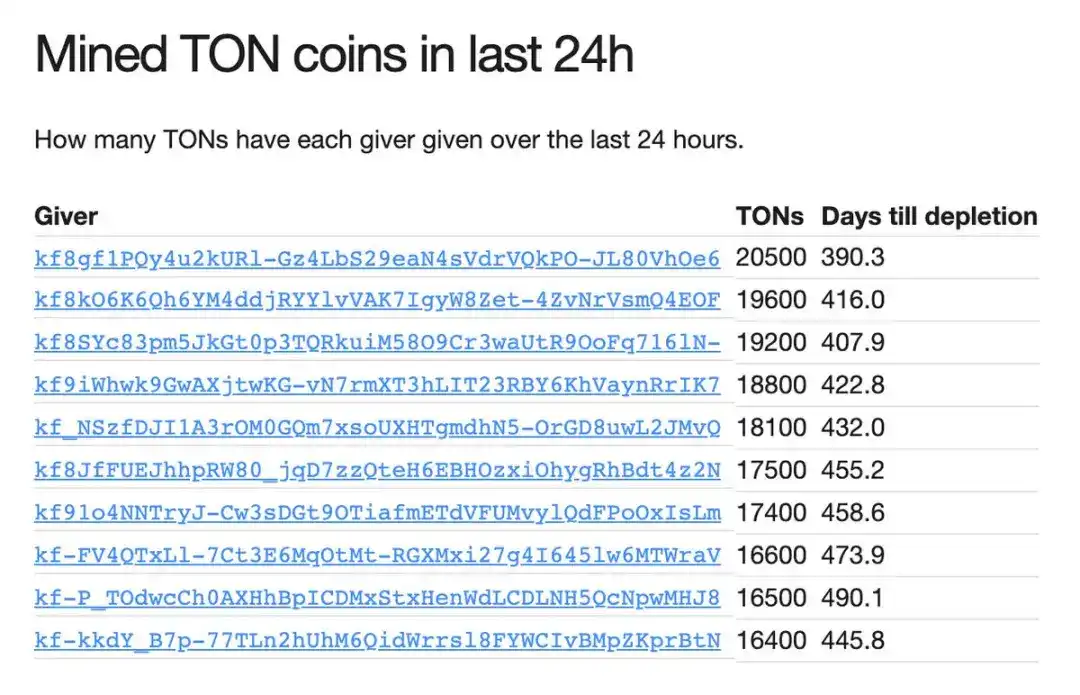
3. tonmine: Monitoring Giver Contracts

We developed tonmine to track TON's mining activities. Although the TON blockchain initially had many large and small Givers, by 2021 only ten small Givers remained.

tonmine showed the daily mining statistics for each contract, with a single contract producing an average of 20,000 $TON per day, totaling about 200,000 $TON per day across all contracts.

The mining difficulty varied significantly between different Givers, depending on the number of miners—some Givers had lower difficulty due to fewer miners, while others had extremely high difficulty due to a large number of miners.
4. Cross-Chain Bridge

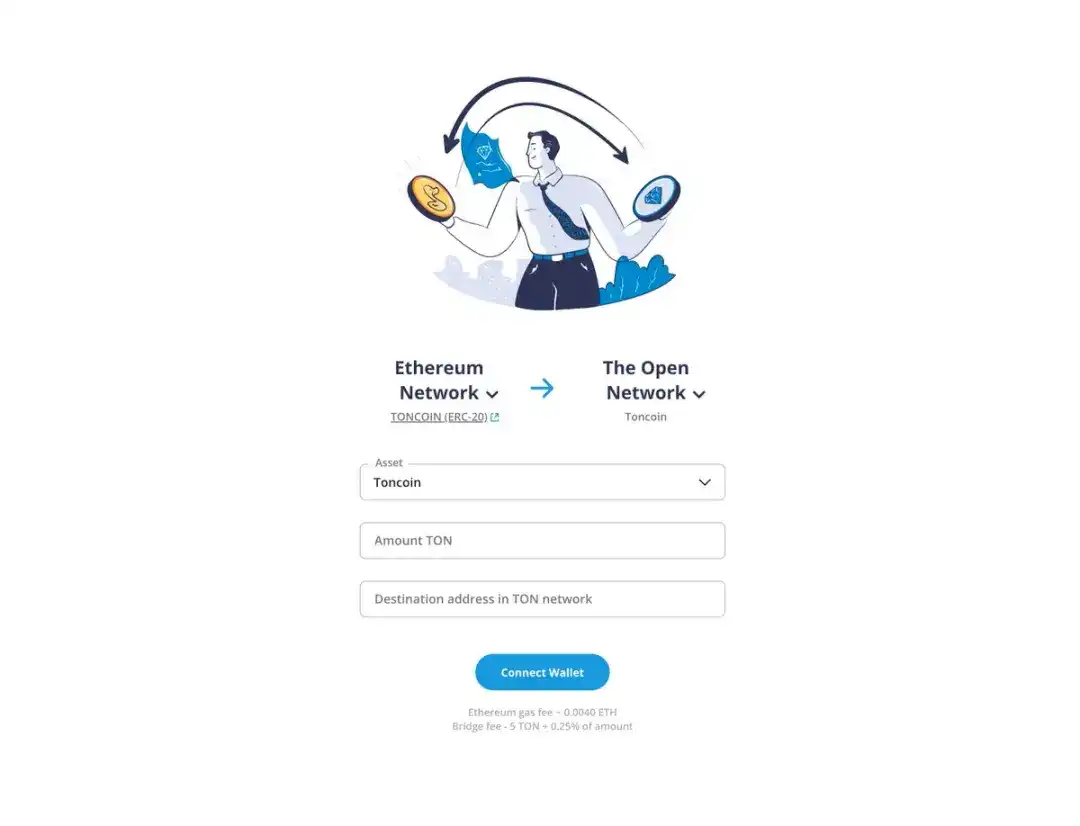
Before TON had jetton or NFT standards, we recognized the importance of cross-chain compatibility. The NEWTON team developed a native $TON cross-chain bridge for ERC-20 tokens on EVM-compatible chains, which was successfully tested on bridge.ton.org. This enabled seamless transfers between TON, Ethereum, and BSC.
极

5. cryptobot: Telegram Bot Wallet

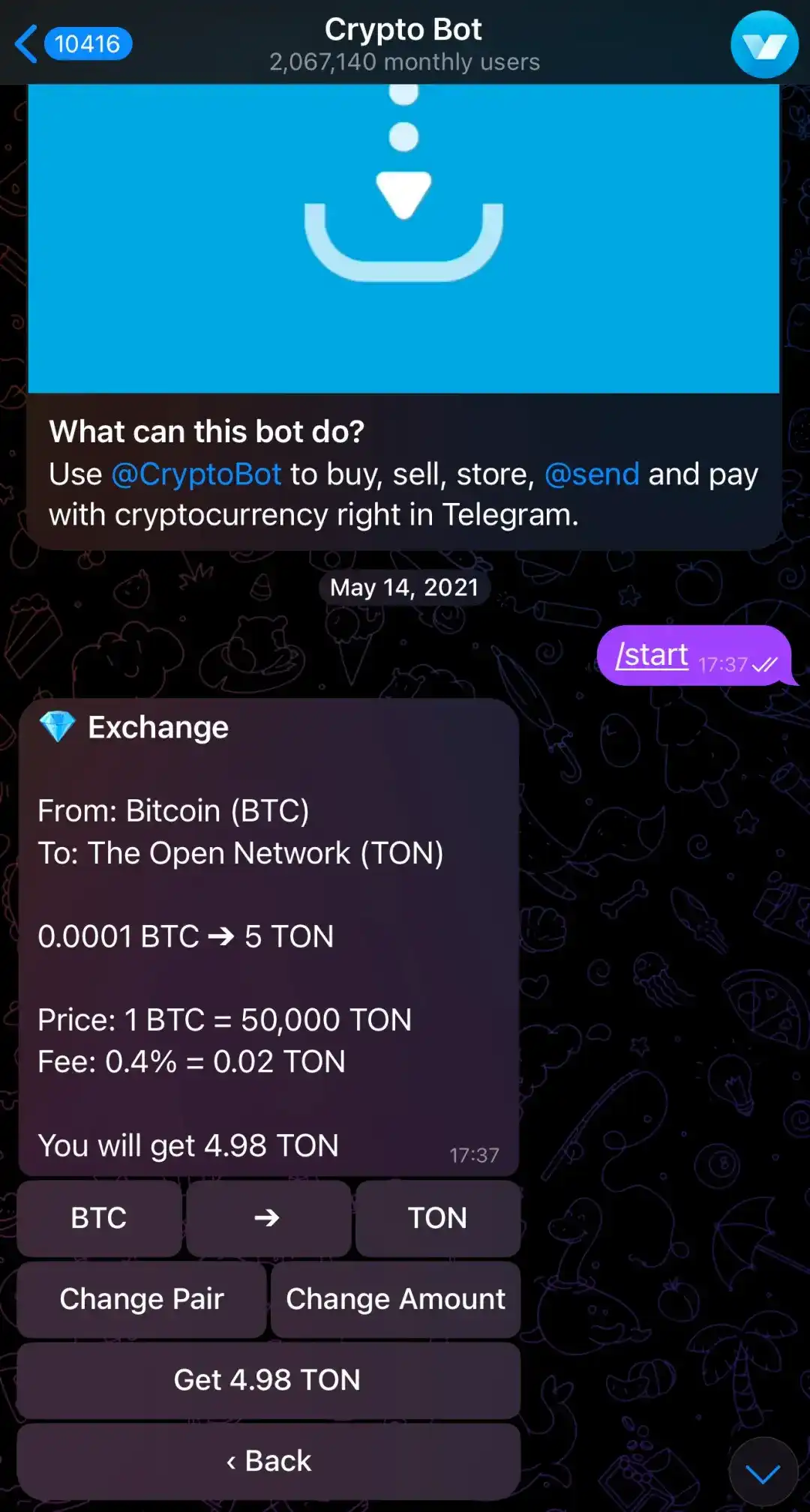
Before Telegram mini apps existed in 2021, team members developed cryptobot, a Telegram wallet. It initially supported $BTC, $TON, $BNB, and $USDT. Later, with the launch of Telegram mini apps, the wallet underwent a comprehensive overhaul.
6. toncenter: Simplifying Blockchain Data Access

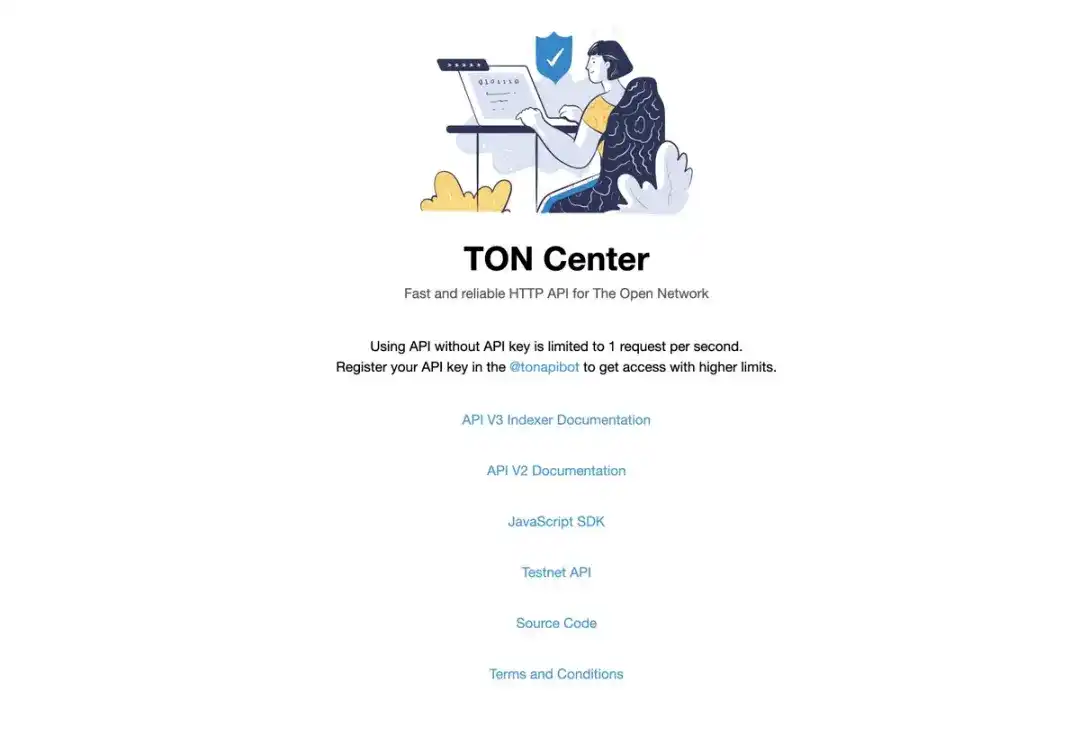
With toncenter, developers no longer needed to set up full nodes, research liteclient or liteserver, or worry about serialized data formats.

toncenter provided a public API, greatly simplifying the process for various wallets and blockchain explorers to access on-chain data.

Although TON's infrastructure has evolved with the emergence of more API providers like tonxapi.com, toncenter continues to serve developers, its robust design becoming a classic.
7. explorer.toncoin.org: TON's First Blockchain Explorer

The first TON blockchain explorer was built into the core codebase and located at explorer.toncoin.org. Although it was extremely fast, the data presentation was too technical for most users.
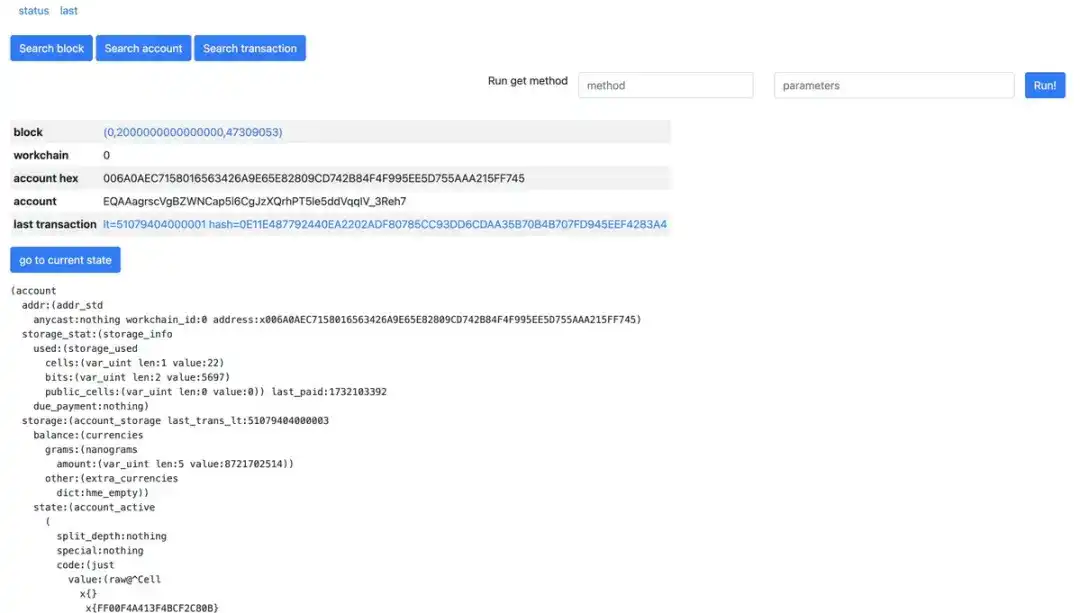
8. ton.sh: The New Generation Blockchain Explorer

To address the complexity of explorer.toncoin.org, we created ton.sh. After solving the challenge of deserializing blockchain data, we launched a public API for ton.sh.

ton.sh focused on core functions: wallet balances, transaction records, and particularly memos. For early TON users, memos were crucial, serving as carriers for command operations before TON Connect or complex DeFi contracts existed, especially in exchange deposit operations.

Although more advanced explorers like TONScan and TONViewer exist today, ton.sh remains a historical milestone in TON's development.
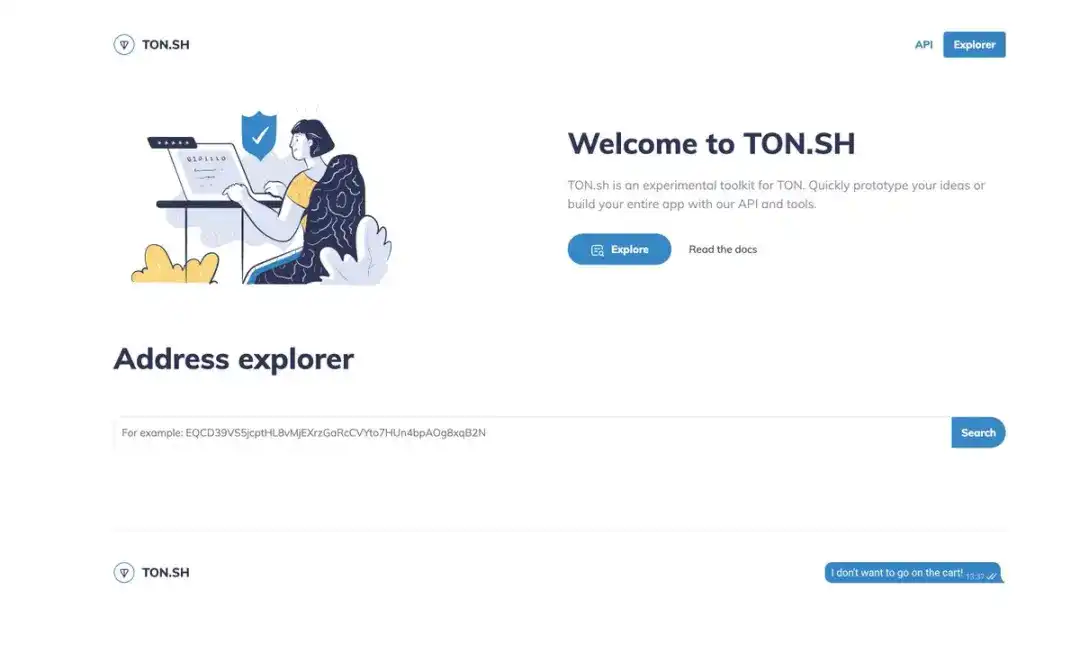
9. TonWeb: Important JavaScript SDK

Since TON smart contracts use Fift and Func, two relatively complex languages, the NEWTON team developed TonWeb—a JavaScript SDK that simplified wallet creation, deployment, and transaction operations.
10. ton wallet: My First TON Wallet

This TON wallet dates back to the Telegram era—it was my first wallet, and surprisingly, it still works perfectly today.

Historic Recognition: NEWTON Team's Open Letter to the @Telegram Official Team

By June 2021, the NEWTON team had made significant contributions, including running public lite servers, DHT servers, and archive nodes to maintain network stability. At this point, tolya-yanot wrote an open letter (link) documenting our year's work to the TON blockchain team and requesting GitHub organization permissions.
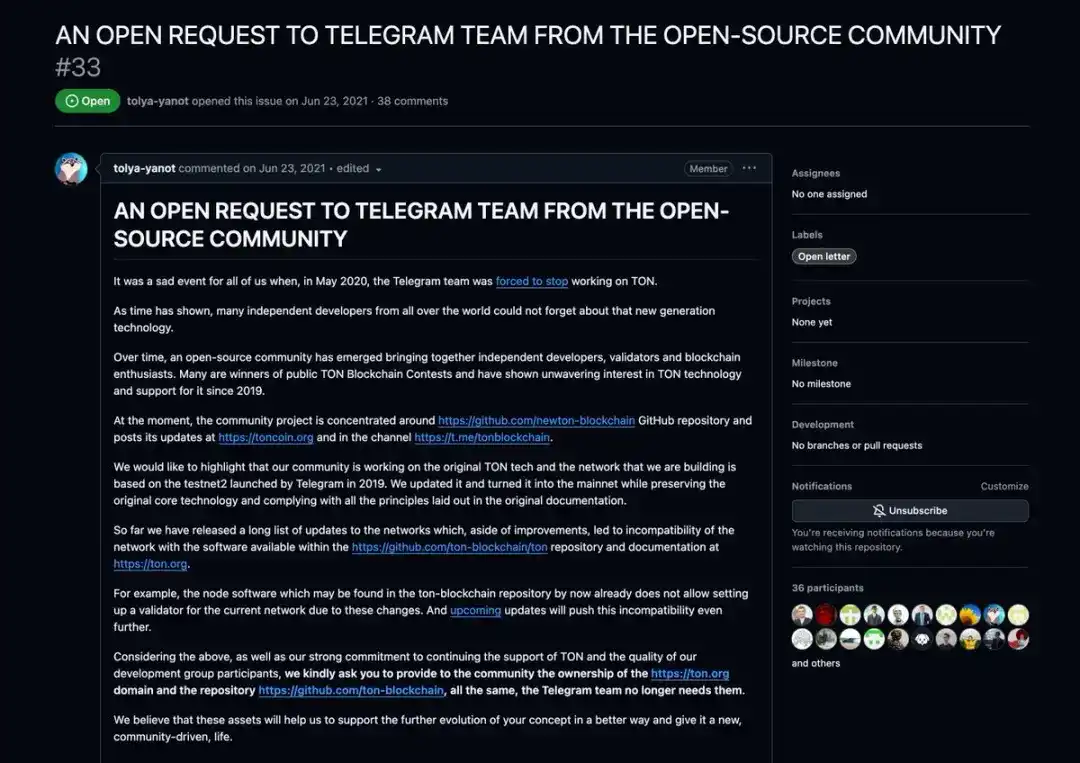
The letter listed the two leaders of NEWTON and key team members.

That's right, me—Dr. Awesome Doge, was also on the list.

At the time, I thought it was just an open letter—a good attempt to showcase our contributions to the network, and I didn't expect any response.

To our surprise, the @Telegram official team responded on June 30, 2021.

This marked the beginning of a new chapter in TON blockchain history.

Retrospect and Outlook: A Builder's Reflection

Looking back on this extraordinary journey, the early contributions of the NEWTON team were far more than just code. Every line of code, every tool we built, every sleepless night spent maintaining the network—these efforts laid the foundation for TON's development today.

Seeing TON's explosive growth in 2024, with thousands of developers joining the ecosystem, validates what we believed in during those challenging early days—TON's potential was worth fighting for.


Criptomoedas em alta

Perguntas relacionadas

QWhat was the main mission of the NEWTON team when the author joined?

AThe main mission was to maintain the stability of the TON testnet2 code while enhancing developer tools.

QWhat was the purpose of the tool 'mytonctrl' developed by the NEWTON team?

Amytonctrl was a powerful automation tool for node installation and validator setup, providing functions like wallet creation, contract deployment, transaction history retrieval, and DNS registration.

QWhat significant event occurred in June 2021 that marked a new chapter for TON blockchain?

AThe @Telegram official team responded to the NEWTON team's open letter, which led to the technical handover and marked the beginning of a new chapter in TON's history.

QWhat was the function of 'toncenter' and why was it important for developers?

Atoncenter provided a public API that simplified access to on-chain data, allowing developers to build wallets and blockchain explorers without setting up a full node or dealing with serialized data formats.

QWhich tool did the NEWTON team create to monitor the health of the TON blockchain?

AThe team created 'tonmon' to track key metrics like block generation time, shard status, dPoS election schedules, validator count and weight, and mining contract status.

Leituras Relacionadas

Base Under Pressure

**Title: The Pressure Mounts for Base** Base, the Ethereum Layer 2 scaling solution backed by Coinbase, is facing significant pressure and public scrutiny from its leadership following the launch of Robinhood Chain. Base co-founder Jesse Pollak recently acknowledged strategic missteps, admitting that the chain's past focus on social and creator tokens (e.g., through Farcaster, Zora) failed to deliver sustainable adoption. He has refocused on core infrastructure, handing leadership of the Base App back to Coinbase's Cobie. While Base remains a top L2 contender alongside OP Mainnet and Arbitrum, and boasts the highest TVL (nearly $12B), its weaknesses are being highlighted by the new competitor. Key criticisms include its slow progress on decentralization. Base has faced issues with its single sequencer causing block production halts, and L2BEAT is reportedly considering downgrading its decentralization rating from Stage 1 to Stage 0. This contrasts sharply with the rapid initial success of Robinhood Chain, whose DEX quickly entered the top five by volume. The leadership styles of the parent companies are also being compared: Robinhood's CEO actively engages with new projects, while a recent incident where Coinbase's Brian Armstrong briefly changed his profile picture—sparking and then crashing a related meme token—drew community ire and mockery. Pollak stated Base is working with Coinbase on tokenized stocks backed 1:1 by real equity, differentiating it from Robinhood's derivatives model. However, the article argues that Base's most urgent task is to address its long-standing technical and trust issues. With more traditional finance players likely to emulate Robinhood's path, Base must use this competitive pressure to solidify its position as long-term financial infrastructure.

Foresight NewsHá 11m

Base Under Pressure

Foresight NewsHá 11m

White House Concession Removes Ethical Hurdle, Clarity Act Races Against Final Window Before Recess?

On July 21st, industry sources reported that the Trump administration has agreed to include an ethics provision in the "Clarity Act" (Digital Asset Market Clarity Act of 2025). This concession addresses the long-standing conflict-of-interest concerns regarding government officials and the crypto industry, potentially removing the final major obstacle to the bill's progress. Additionally, Patrick Witt, the executive director of the White House's Digital Asset Advisory Committee, confirmed he will remain in his role to help finalize the bill, alleviating previous concerns about his potential departure. The Clarity Act aims to establish a unified federal regulatory framework for the U.S. digital asset market. Its core objective is to resolve regulatory ambiguity by defining different types of digital assets (digital commodities, investment contract assets, and permitted payment stablecoins) and clarifying the respective oversight roles of the SEC and CFTC. This would end the long-running jurisdictional dispute between the two agencies and provide clearer compliance paths for the industry. With the ethics issue moving toward resolution, the most urgent challenge now is time. The U.S. Congress is set to begin its August recess in mid-August, leaving only a few working weeks to finalize the text and advance the bill through the Senate. Industry advocates, like the Blockchain Association's Kristin Smith, stress that this is a critical moment. If negotiations conclude successfully in the coming weeks, the Clarity Act could pass a key hurdle before the recess; otherwise, it may face significant delays. If enacted, the Clarity Act could mark a historic turning point in crypto regulation. By providing a clearer and more predictable legal framework, it aims to reduce uncertainty for businesses, developers, and traditional financial institutions looking to enter the digital asset space, potentially setting a global benchmark for market structure regulation.

Odaily星球日报Há 17m

White House Concession Removes Ethical Hurdle, Clarity Act Races Against Final Window Before Recess?

Odaily星球日报Há 17m

AI Era, Industrial Revolution, and Future Civilization Interview — Zhang Dingwen: The Future Does Not Belong to Chasers

"AI Era, Industrial Revolution and Future Civilization: An Interview with Zhang Dingwen – The Future Does Not Belong to Those Who Chase" In this interview, entrepreneur Zhang Dingwen reflects on his entrepreneurial journey and philosophy, moving beyond discussions of financing or success to emphasize understanding the "era" itself. He argues that true entrepreneurs should not chase short-term trends ("winds"), but position themselves in the direction of long-term technological and societal evolution. Zhang shares key lessons from his early days, including the realization that user value does not automatically translate to commercial value. For him, the core of entrepreneurship is not building a company but constantly upgrading one's own "cognition" – the ability to interpret information, ask the right questions, and understand the underlying "causes" behind business outcomes, not just the effects. His thinking has evolved from a focus on creating good products to a strategic focus on building "entrances" – platforms that naturally connect users to digital services. He sees smart wearables, like watches, not merely as hardware but as potential future gateways combining technological, financial, social, and even fashion attributes to create sustained user relationships and ecosystems. Ultimately, Zhang's vision transcends individual products or companies. He discusses business competition in three stages: product, platform, and finally, "civilization" – where the greatest companies influence how society operates by defining new rules and ways of life. He believes the mission of a truly great enterprise is to solve problems of its time, build enduring trust, and contribute lasting value, leaving behind not just wealth but a positive impact on how the world works. The future, he concludes, belongs not to the fastest, but to those with the correct long-term direction and a commitment to continuous learning and evolution.

marsbitHá 28m

AI Era, Industrial Revolution, and Future Civilization Interview — Zhang Dingwen: The Future Does Not Belong to Chasers

marsbitHá 28m

Cryptocurrency & Stock Market Barometer丨Strategy Cash Reserves Increase to $3.23 Billion, Halting BTC Purchases; Vanguard and Other Asset Managers Increase Holdings in Strategy Stock (July 21)

Market Overview & Warnings: The article warns of high volatility in South Korean stocks and continued dependence on U.S. stocks on geopolitics. Chinese A-shares remain under pressure. It advises against using leverage in current equity markets. For crypto-linked stocks, most have limited growth except Robinhood, with caution advised. U.S. Stock Market: Bearish bets on U.S. stocks, particularly targeting AI-related companies, have reached record highs since 2010, signaling deep skepticism about the sustainability of the AI-driven rally. Tech and chip stocks led a market decline, with the Philadelphia Semiconductor Index potentially entering a bear market. Increased expectations for Federal Reserve interest rate hikes and geopolitical tensions contributed to the negative sentiment. Bitcoin Treasury Company Updates: * Strategy: Increased its cash reserves to $3.23 billion and paused Bitcoin purchases. Several major asset managers, including Vanguard Group and Capital Group, increased their holdings of Strategy (MSTR) stock. * Global corporate Bitcoin buying slowed significantly to just $1.33 million last week. * Other notable activity: Strive purchased 21 BTC; ORANGE JUICE raised $40 million for Bitcoin acquisitions; Bitcoin Japan Corp. raised $60 million, allocating $4.08 million for its first BTC purchase. Other Crypto Treasury Holdings: * Ethereum: BitMine increased its ETH holdings to 5.78 million, nearing its 5% of supply goal. Its total crypto assets, cash, and securities are valued at $11.5 billion. * Solana: No significant corporate treasury activity reported. * Altcoins: HypeStrat made no adjustments to its treasury; its mNAV ratio fell to a long-term low. (Note: This summary is for informational purposes only and does not constitute investment advice.)

marsbitHá 29m

Cryptocurrency & Stock Market Barometer丨Strategy Cash Reserves Increase to $3.23 Billion, Halting BTC Purchases; Vanguard and Other Asset Managers Increase Holdings in Strategy Stock (July 21)

marsbitHá 29m

Trading

Spot

Artigos em Destaque

Como comprar CORE

Bem-vindo à HTX.com!Tornámos a compra de CORE (CORE) simples e conveniente.Segue o nosso guia passo a passo para iniciar a tua jornada no mundo das criptos.Passo 1: cria a tua conta HTXUtiliza o teu e-mail ou número de telefone para te inscreveres numa conta gratuita na HTX.Desfruta de um processo de inscrição sem complicações e desbloqueia todas as funcionalidades.Obter a minha contaPasso 2: vai para Comprar Cripto e escolhe o teu método de pagamentoCartão de crédito/débito: usa o teu visa ou mastercard para comprar CORE (CORE) instantaneamente.Saldo: usa os fundos da tua conta HTX para transacionar sem problemas.Terceiros: adicionamos métodos de pagamento populares, como Google Pay e Apple Pay, para aumentar a conveniência.P2P: transaciona diretamente com outros utilizadores na HTX.Mercado de balcão (OTC): oferecemos serviços personalizados e taxas de câmbio competitivas para os traders.Passo 3: armazena teu CORE (CORE)Depois de comprar o teu CORE (CORE), armazena-o na tua conta HTX.Alternativamente, podes enviá-lo para outro lugar através de transferência blockchain ou usá-lo para transacionar outras criptomoedas.Passo 4: transaciona CORE (CORE)Transaciona facilmente CORE (CORE) no mercado à vista da HTX.Acede simplesmente à tua conta, seleciona o teu par de trading, executa as tuas transações e monitoriza em tempo real.Oferecemos uma experiência de fácil utilização tanto para principiantes como para traders experientes.

332 Visualizações TotaisPublicado em {updateTime}Atualizado em 2026.06.02

Como comprar CORE

Discussões

Bem-vindo à Comunidade HTX. Aqui, pode manter-se informado sobre os mais recentes desenvolvimentos da plataforma e obter acesso a análises profissionais de mercado. As opiniões dos utilizadores sobre o preço de CORE (CORE) são apresentadas abaixo.

活动图片