Rare Annualized Rate of 400%: Is TradeXYZ Handing Out Money to Oil Bulls?

marsbitPublicado em 2026-04-10Última atualização em 2026-04-10

Resumo

Amidst volatile oil markets due to geopolitical tensions, Trade.xyz’s WTIOIL-USDC perpetual contract exhibited an unusually negative annualized funding rate of -300% to -400%. This meant long positions received approximately 1% of their position value daily from shorts. The anomaly stemmed from the structure of WTI futures curves in extreme backwardation, where near-month (May) contracts traded at a significant premium to far-month (June) contracts. Trade.xyz’s oracle gradually shifts price weighting from near-month to far-month over five trading days during rollover. Anticipating this decline, traders heavily shorted the perpetual, driving the funding rate deeply negative. Three strategies were discussed: 1. Shorting Trade.xyz’s contract while going long on CME’s far-month futures—initially profitable but later eroded by high funding costs. 2. Shorting far-month futures and longing Trade.xyz’s near-month contract before rollover, which gained traction as arbitrage opportunities emerged. 3. Betting against funding rates via Boros, a rate-trading platform, though limited by low leverage and high slippage. The situation highlights how DeFi traders are adapting to traditional futures mechanics and advanced instruments like rate markets, reflecting the evolving infrastructure of crypto-native trading platforms.

Amid the uncertain situation of the Iran war, the crude oil market is experiencing significant volatility.

At the same time, a rare phenomenon has appeared on Trade.xyz's WTIOIL-USDC crude oil perpetual contract: the annualized funding rate has stabilized between -300% and -400%. This means that any trader willing to go long at this moment can receive profits equivalent to 1% of their principal daily from the shorts.

The market doesn't give away money for no reason. To understand this反常的 negative funding rate, we need to start with the basics of futures trading.

Rollover

Crude oil futures are a series of contracts arranged by delivery month. Contracts for May delivery, June delivery, July delivery, each with its own price. When the front month is about to expire, the market must switch from the old contract to the new contract; this action is called rollover.

Under normal circumstances, back-month contracts imply that oil merchants will store the oil for several additional months, incurring extra storage costs. Therefore, the delivery price should logically be higher. The market phenomenon where future contracts are more expensive than the near month is called Contango. Conversely, the situation where the near month is more expensive than the far month is called backwardation. This usually occurs when there is a current shortage, and everyone wants to get the oil immediately.
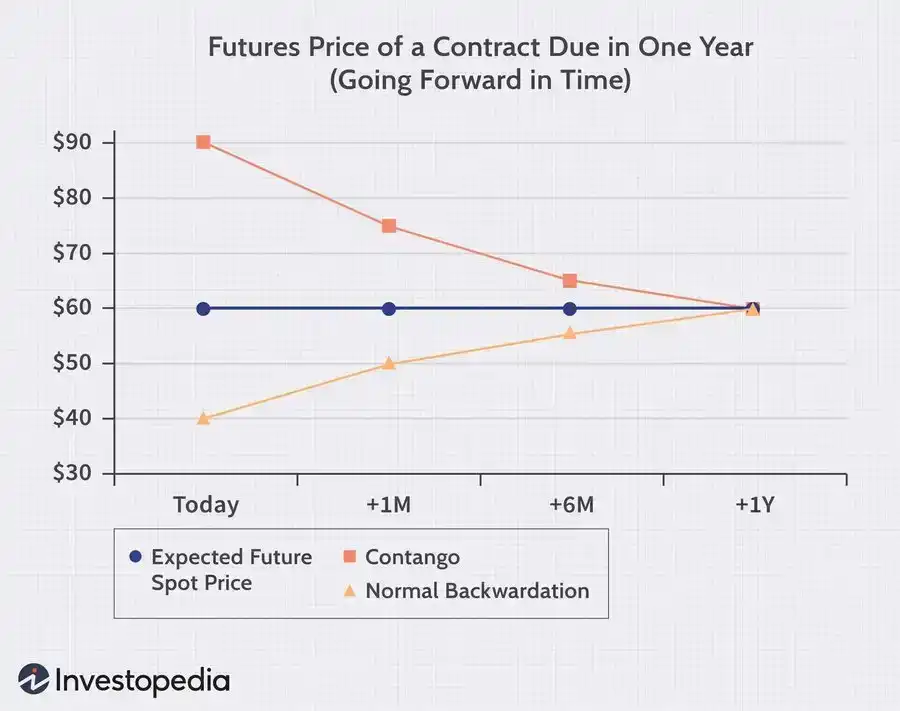
During this rollover period for Trade.xyz's crude oil, the crude oil futures market was in this near-high, far-low structure.
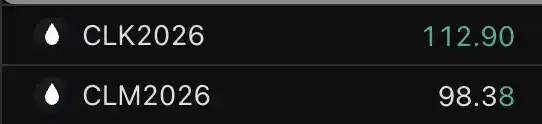
From late March to early April 2026, the WTI crude oil curve was in an extreme state of backwardation. As shown in the chart above, the price of the May contract (front month) remained consistently higher than the June contract (back month), with the spread widening to over $14 at one point.

The WTIOIL-USDC perpetual contract on Trade.xyz has its oracle pegged to this front-month May contract.

But we won't be trading this May contract forever. It must be rolled over to the next June contract. So how is the rollover accomplished?

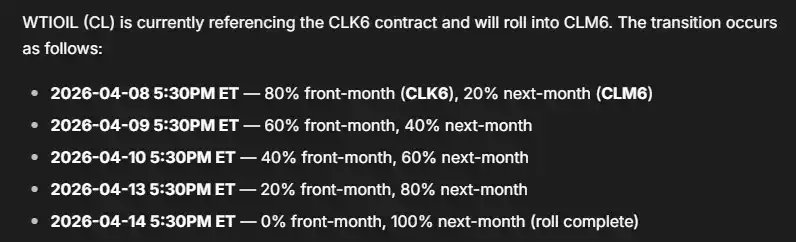
According to the Tradexyz documentation, the oracle will take 5 trading days to gradually shift the price weighting from 100% front-month contract to 100% back-month contract.
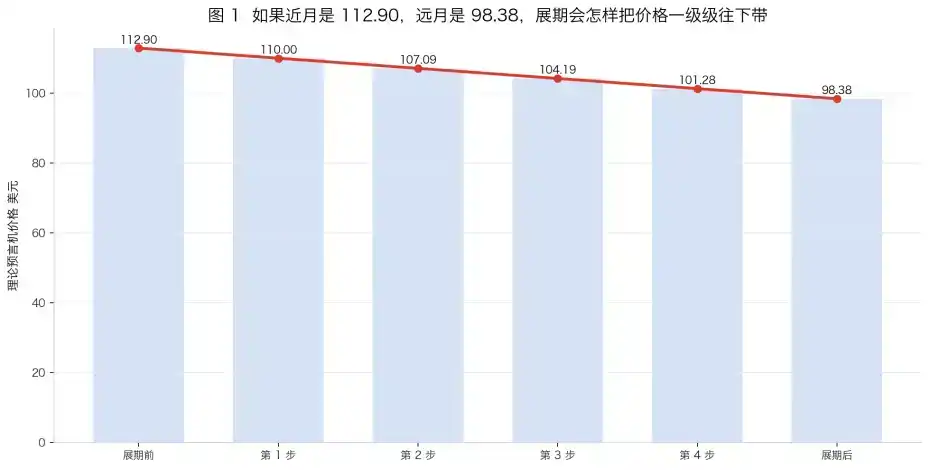
Against the backdrop of "backwardation," this means the oracle price on Tradexyz will drop from the front-month price to the back-month price over 5 trading days.
Market participants familiar with this mechanism have a clear expectation of the contract price after the rollover. Everyone knows it will fall, so they naturally rush to short. Shorts accumulate, the funding rate turns negative, and shorts start paying longs.
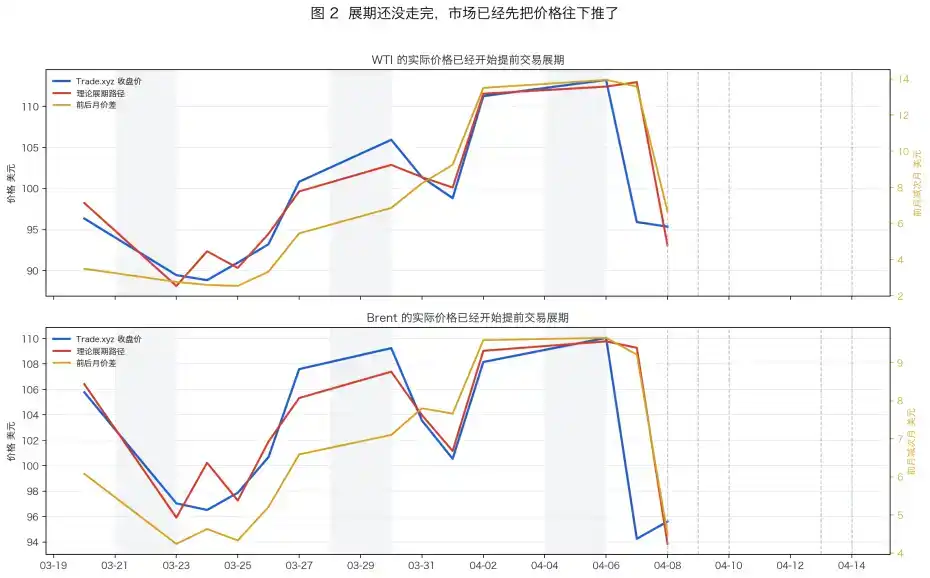
From an arbitrage-free principle perspective, this is normal. The spread between the front and back month gives short sellers a profit. The funding rate will reduce this profit. The larger the spread, the higher the negative funding rate the market charges.

Once the negative funding rate reaches a certain level, this seemingly obvious arbitrage opportunity will be eroded. The cost for short sellers will completely cover the profit.

Strategies

How to make money in such a market context? Here are three common strategies.

1. Short the crude oil contract on Tradexyz at the current price, while simultaneously going long the back-month contract on CME.

This seems like a risk-neutral strategy to stably earn the spread, but it fails to consider several factors.

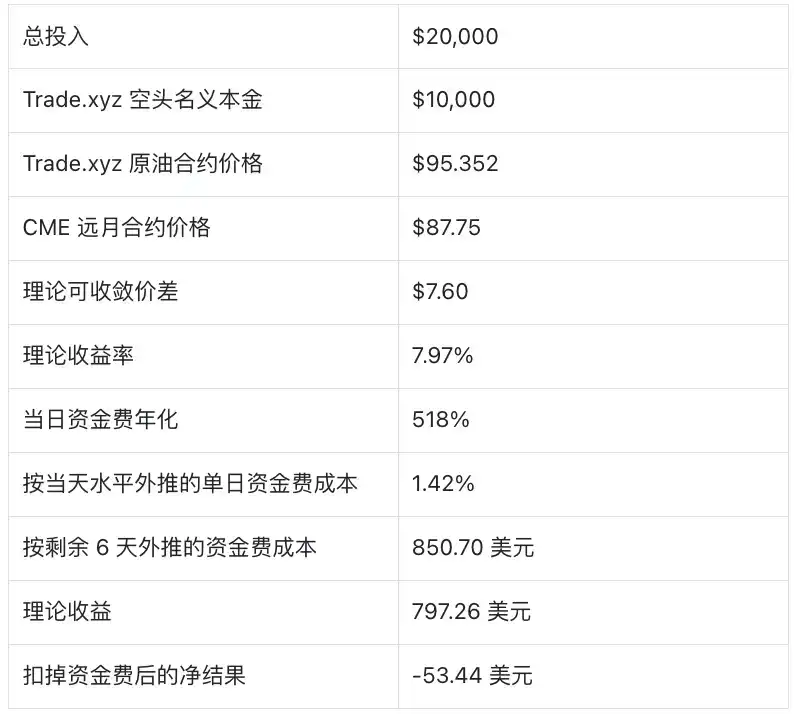
Suppose you short Trade.xyz's WTI contract at $95.352 on April 8th, while going long the June futures contract at $87.75, each with a notional principal of $10,000. If both sides eventually converge, you could theoretically get a spread of $7.60, about $797 in profit. But on April 8th, the daily funding rate for the short position was already 1.42%. Based on the remaining 6 days until rollover completion, the funding fee would cost $851. At this point, the net profit is only -$53. This doesn't even include transaction fees and slippage.
Abraxas capital implemented this strategy starting on March 19th, after the last rollover was completed. Their Brent crude oil position on tradexyz accounted for 20% of the open interest in that market and yielded huge profits early on when the funding rate remained relatively neutral. However, as more arbitrageurs flooded in, the funding fee has devoured 80% of their arbitrage profits.

The massive position also means they find it difficult to exit and are forced to pay passively.

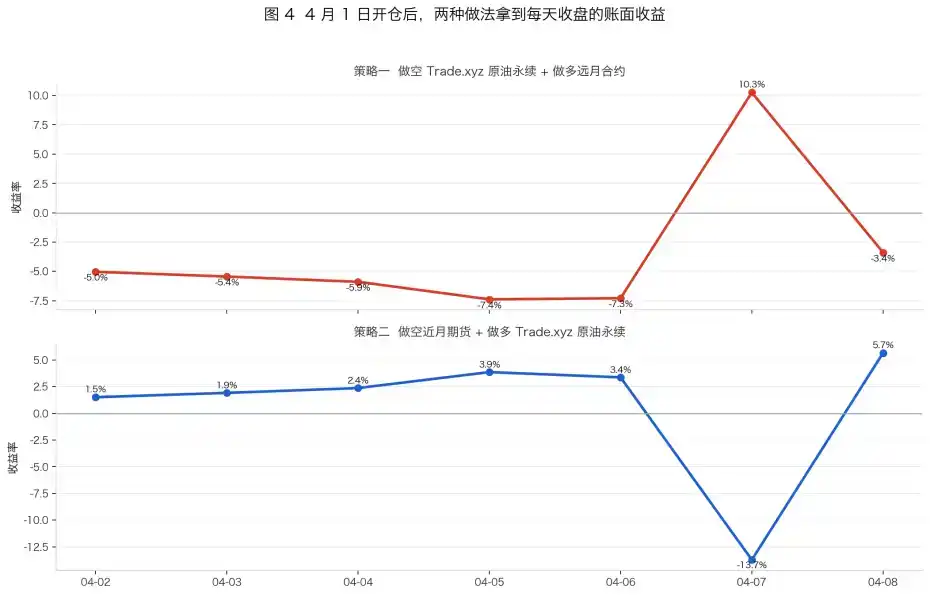
2. Short the back-month futures contract, go long the xyz front-month contract, and close the position before the rollover begins.

This trade is almost the counterparty to Strategy 1, betting that the market is over-arbitraged. After April 1st, this strategy could indeed yield profits.
3. Short the funding rate for the xyz contract on Boros before the rollover begins.

Boros is a market developed by the Pendle team specifically for trading rates (funding rates). In Boros's crude oil contract market, what is traded is the market's expectation of the funding rate for Trade.xyz's crude oil contract over the coming period. If users believe the negative funding rate will deepen further, they can short the market's funding rate contract.
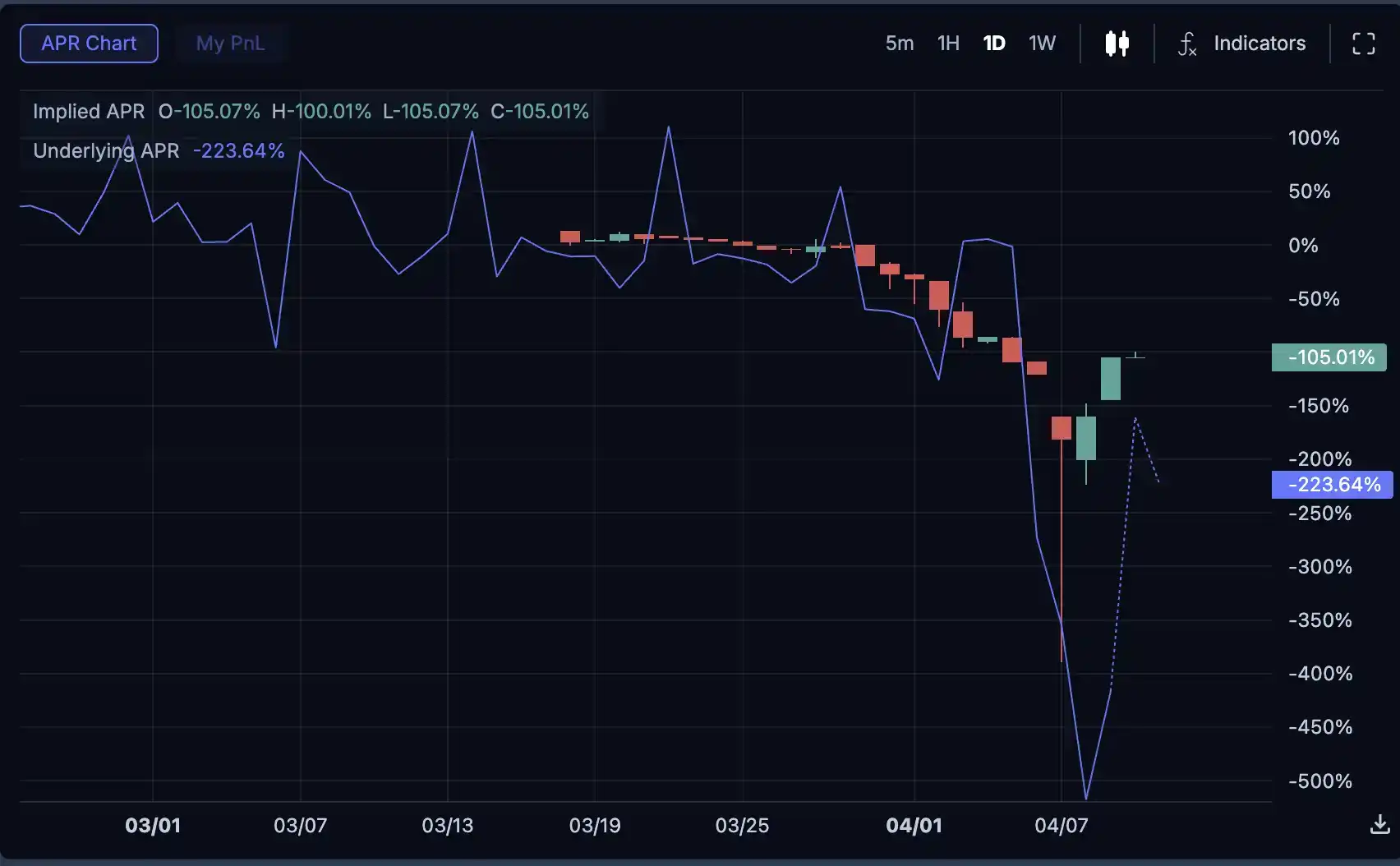
However, limited by slippage costs, position limits, transaction fees, and extremely low capital efficiency (only supporting 0.2x leverage), this trade also struggles to achieve the ideal high returns.

Conclusion

The rise of RWA trading platforms like Trade.xyz is forcing a group of "crypto traders" to become "futures traders." DeFi players are also starting to learn the CME rollover calendar, calculate front-back month spreads, and make decisions based on the funding rate curve on Boros.

Trading platforms are continuously iterating, and market participants are also adapting to new infrastructure.


Perguntas relacionadas

QWhat is the annualized funding rate for the WTIOIL-USDC perpetual contract on Trade.xyz, and what does it imply for traders?

AThe annualized funding rate for the WTIOIL-USDC perpetual contract on Trade.xyz is between -300% and -400%. This means that traders who take a long position at this time can receive a profit equivalent to approximately 1% of their principal daily, paid by the short sellers.

QWhat market structure is causing the extreme negative funding rate on Trade.xyz's crude oil perpetual contract?

AThe extreme negative funding rate is caused by a market structure called backwardation, where the near-month futures contract (May) is trading at a higher price than the far-month contract (June). This creates an expectation that the price will drop during the rollover period, leading to a surge in short positions and negative funding rates.

QHow does the rollover mechanism work for the WTIOIL-USDC perpetual contract on Trade.xyz?

AAccording to Trade.xyz's documentation, the oracle takes five trading days to gradually shift the price weighting from 100% of the near-month contract to 100% of the far-month contract. During this rollover period in a backwardated market, the oracle price is expected to drop from the higher near-month price to the lower far-month price.

QWhat was one of the strategies mentioned for profiting in this market, and what was its drawback?

AOne strategy was to short the crude oil contract on Trade.xyz while simultaneously going long on the far-month futures contract on CME. The drawback is that the high negative funding rate can consume most of the potential profits from the price difference. For example, a calculation showed that funding fees could cost $851 over six days, nearly erasing the $797 theoretical gain from the price spread, not including transaction costs and slippage.

QWhat is Boros, and how can it be used to trade in this context?

ABoros is a market developed by the Pendle team专门 for trading rates (funding rates). On Boros's crude oil contract market, traders can speculate on the expected funding rate for Trade.xyz's crude oil contract. If a trader believes the negative funding rate will deepen, they can short the funding rate合约 on Boros. However, this strategy is limited by slippage, position caps, trading fees, and low capital efficiency (only supporting 0.2x leverage).

Leituras Relacionadas

The Largest IPO in History Ignites Heated Debate: Is SpaceX Worth $1.77 Trillion?

SpaceX's potential IPO is priced at $135 per share, aiming to raise $75 billion and valuing the company at approximately $1.77 trillion, which would make it the largest IPO in history. This valuation has sparked intense debate among investors. Bullish analysts, including major underwriters Goldman Sachs and Morgan Stanley, argue the valuation is justified by SpaceX's long-term potential. They see it not just as a rocket company but as a future leader in space infrastructure, with key growth drivers being Starlink satellite internet, low-cost rocket launches, and future AI-related ventures. They project revenues reaching hundreds of billions to trillions of dollars by 2030-2040. ARK Invest's model suggests a 2030 enterprise value could reach $2.5 trillion. Bearish analysts from independent research firms like Morningstar, PitchBook, and New Constructs contend the IPO price is excessively high, already pricing in unrealistic future growth. Using DCF and sum-of-the-parts models, they estimate fair value between $780 billion and $1.7 trillion, significantly below the IPO target. They highlight risks such as the speculative nature of AI projections, over-dependence on Elon Musk, high growth expectations, and corporate governance concerns. Trefis set a target price of just $79 per share. While both sides acknowledge SpaceX's unique position in commercial space, the core disagreement centers on whether the $135 share price offers a reasonable margin of safety or is overly optimistic. Despite the valuation controversy, reported strong demand for the IPO indicates significant market interest.

marsbitHá 45m

The Largest IPO in History Ignites Heated Debate: Is SpaceX Worth $1.77 Trillion?

marsbitHá 45m

After the Passage of the GENIUS Act and the CLARITY Act, What Is the Correct Architecture for On-Chain Yield?

The article discusses the evolution of on-chain credit, distinguishing three markets: overcollateralized crypto lending, unsecured lending (largely unsuccessful), and asset-backed credit (ABC). ABC, backed by identifiable real-world collateral with legal recourse, is identified as the fastest-growing category and the only one credibly addressing adverse selection—the core problem in credit where the riskiest borrowers self-select. Current growth in on-chain Real World Assets (RWAs), particularly tokenized private credit funds (e.g., Maple Finance, Centrifuge), is substantial but often merely "wraps" existing fund structures, inheriting their risks rather than solving adverse selection at the protocol level. The regulatory landscape is a key driver, with the US GENIUS Act (prohibiting stablecoin issuers from paying yield) and the proposed CLARITY Act (closing loopholes on indirect yield) set to redefine permissible yield-bearing products. This makes vaults (like ERC-4626) the critical architecture—they become the primary compliant vehicle for delivering yield, functioning as issuance, disclosure, distribution, and recovery mechanisms. The author's thesis is that the correct post-GENIUS/CLARITY architecture involves building ABC solutions where credit assessment, structure, and recovery are encoded directly into the smart contract vault layer, moving beyond mere tokenized fund wrappers to solve adverse selection fundamentally and ensure regulatory compliance.

Foresight NewsHá 1h

After the Passage of the GENIUS Act and the CLARITY Act, What Is the Correct Architecture for On-Chain Yield?

Foresight NewsHá 1h

TechFlow Intelligence Bureau: Anthropic's New Model Fable Sparks Controversy by Restricting Biosafety Research, US CPI Soars to 4.2%, a Three-Year High

**Summary of TechFlow Intelligence Report:** The newsletter covers several key tech and finance developments. In AI, Anthropic's new Fable model faced backlash for secretly limiting biomedical research capabilities and enforcing a 30-day data retention policy, prompting the company to promise more transparent adjustments. In a related story, Anthropic's founder revealed his departure from OpenAI was due to dishonesty from Sam Altman, not safety concerns. Meanwhile, OpenAI is considering significant price cuts to compete with Anthropic, potentially sparking a price war. In crypto/Web3, BlackRock filed a new amendment for a yield-generating Bitcoin ETF, while Bank of America's CEO warned that stablecoin yields could drain trillions from traditional banks. U.S. Senator Cynthia Lummis advocated for the U.S. to officially accumulate Bitcoin reserves. In hardware, Nvidia released the DiffusionGemma-2-6B image model optimized for efficient inference, and AMD promoted its unified memory architecture to challenge Nvidia's dominance. TSMC's CFO hinted at possible price increases due to soaring AI chip demand. A major legal ruling in Germany held Google legally responsible for inaccurate information generated by its AI Overviews feature. Google Chrome also moved to fully block ad-blocker workarounds like uBlock Origin. Macroeconomic headlines included U.S. CPI rising to 4.2% (a 3-year high) and Iran's complete closure of the Strait of Hormuz, raising oil price and inflation fears. South Korean markets saw continued volatility with massive foreign capital outflow. Other notable stories: Microsoft expanded its Copilot AI assistant "Mico" globally; a study found r/wallstreetbets users' stock picks outperformed Wall Street; a fully autonomous drone killed a human soldier for the first time, raising AI ethics concerns; and a Chinese hospital used brain-computer interface technology to help a blind person "see." The overarching theme connects debates over AI boundaries and responsibility (Anthropic's restrictions, Google's liability, lethal autonomous drones) with real-world economic and geopolitical turmoil (inflation, Strait of Hormuz closure, market instability), highlighting the tense interplay between technological advancement and global chaos.

marsbitHá 1h

TechFlow Intelligence Bureau: Anthropic's New Model Fable Sparks Controversy by Restricting Biosafety Research, US CPI Soars to 4.2%, a Three-Year High

marsbitHá 1h

Alibaba's Yet Another New Business Division: What Signal Does It Send?

Alibaba has established a new "Token Foundry" business unit, merging its Tongyi large model division and Future Life Lab. Led directly by Group CEO Wu Yongming, this marks the company's third significant AI organizational reshuffle in 2026, following the creation of the Alibaba Token Hub (ATH) and a Group Technology Committee. The move signals a strategic shift from consolidating AI resources to accelerating productization and commercialization. The "Token Foundry" name reflects Alibaba's ambition to become a foundational supplier in the AI era, focusing on model development and commercial application. Key teams, including those behind the high-performing HappyHorse video generation model, have been integrated into the new unit. Concurrently, Zhou Jingren, architect of the Qwen model series, has been appointed Group Chief Scientist to lead a new AI Future Research Institute, focusing on long-term technological breakthroughs like Agent capabilities. This restructuring creates a clear four-layer AI architecture within Alibaba: the research institute for frontier exploration, Token Foundry for core models and commercialization, MaaS for platform services, and business units like Qianwen (C端) and Wukong (B端) for end-user applications. The adjustments align with a global trend among tech giants like Google and Microsoft to centralize AI leadership under the CEO and deeply integrate research with business units. The urgency is driven by a narrowing competitive window. Alibaba has announced its AI business is now entering a commercialization phase, with AI-related revenue seeing triple-digit growth for eleven consecutive quarters. The company faces intense competition in the MaaS (Model-as-a-Service) sector from rivals like ByteDance and Tencent. The Token Foundry initiative represents Alibaba's effort to streamline execution and enhance competitiveness in this critical, fast-evolving landscape.

marsbitHá 2h

Alibaba's Yet Another New Business Division: What Signal Does It Send?

marsbitHá 2h

Trading

Spot
Futuros

Artigos em Destaque

Como comprar WAR

Bem-vindo à HTX.com!Tornámos a compra de WAR (WAR) simples e conveniente.Segue o nosso guia passo a passo para iniciar a tua jornada no mundo das criptos.Passo 1: cria a tua conta HTXUtiliza o teu e-mail ou número de telefone para te inscreveres numa conta gratuita na HTX.Desfruta de um processo de inscrição sem complicações e desbloqueia todas as funcionalidades.Obter a minha contaPasso 2: vai para Comprar Cripto e escolhe o teu método de pagamentoCartão de crédito/débito: usa o teu visa ou mastercard para comprar WAR (WAR) instantaneamente.Saldo: usa os fundos da tua conta HTX para transacionar sem problemas.Terceiros: adicionamos métodos de pagamento populares, como Google Pay e Apple Pay, para aumentar a conveniência.P2P: transaciona diretamente com outros utilizadores na HTX.Mercado de balcão (OTC): oferecemos serviços personalizados e taxas de câmbio competitivas para os traders.Passo 3: armazena teu WAR (WAR)Depois de comprar o teu WAR (WAR), armazena-o na tua conta HTX.Alternativamente, podes enviá-lo para outro lugar através de transferência blockchain ou usá-lo para transacionar outras criptomoedas.Passo 4: transaciona WAR (WAR)Transaciona facilmente WAR (WAR) no mercado à vista da HTX.Acede simplesmente à tua conta, seleciona o teu par de trading, executa as tuas transações e monitoriza em tempo real.Oferecemos uma experiência de fácil utilização tanto para principiantes como para traders experientes.

139 Visualizações TotaisPublicado em {updateTime}Atualizado em 2026.06.02

Como comprar WAR

Discussões

Bem-vindo à Comunidade HTX. Aqui, pode manter-se informado sobre os mais recentes desenvolvimentos da plataforma e obter acesso a análises profissionais de mercado. As opiniões dos utilizadores sobre o preço de WAR (WAR) são apresentadas abaixo.

活动图片












