Ransomware Crooks Are Busier Than Ever — But Making Less Money, Researchers Say

bitcoinistPublicado em 2026-02-27Última atualização em 2026-02-27

Resumo

According to a Chainalysis report, ransomware attacks increased by 50% in 2025, with nearly 8,000 incidents recorded. However, total ransom payments fell by 8% to $820 million. This decline is attributed to stricter regulations, improved law enforcement, and more companies refusing to pay. Attackers have shifted focus to small and medium-sized businesses, which pay faster but yield smaller sums. The cost of launching attacks has also decreased significantly, with access to victim systems on the dark web dropping from $1,427 in 2023 to $439 in early 2026. Despite the drop in ransomware revenue, broader crypto crime remains significant, with $370 million stolen in January 2026 alone, mostly through phishing attacks.

The cybercrime business is booming, at least on paper. According to a new report from blockchain analytics firm Chainalysis, the number of ransomware attacks jumped 50% in 2025, with nearly 8,000 separate incidents recorded throughout the year. Yet for all that hustle, hackers walked away with less cash than the year before.

Smaller Targets, Smaller Payouts

Total ransom payments collected in 2025 came in at $820 million — an 8% drop from 2024. Reports say the decline is tied to several factors: tougher rules from regulators, law enforcement cracking down on the networks criminals use to launder money, and a growing number of companies simply refusing to pay.

With big organizations shutting the door, attackers moved on to easier prey. Small and medium-sized businesses became the new focus. “Smaller victims pay faster,” said Corsin Camichel, founder of eCrime.ch, in the Chainalysis report.

But faster doesn’t mean bigger. Those smaller targets yield smaller sums, and that math is catching up with the criminals running these schemes.
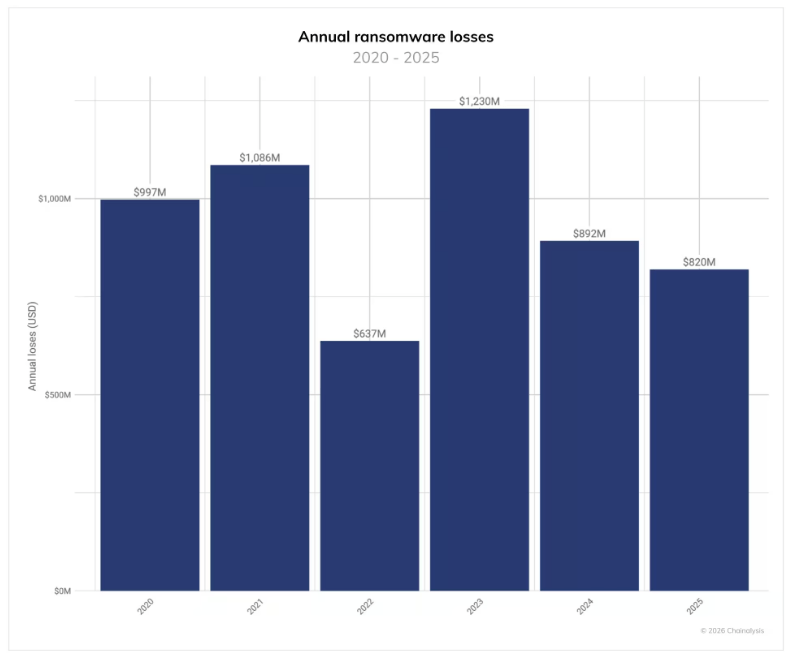
Source: Chainalysis

The gap between how many attacks are being claimed publicly and how much money is actually being collected tells its own story. Attackers are filing more claims than ever, yet the money flowing back to them keeps shrinking.

BTCUSD now trading at $67,800. Chart: TradingView

According to Chainalysis, that gap signals something important — the people running these operations are putting in more work for a worse result.
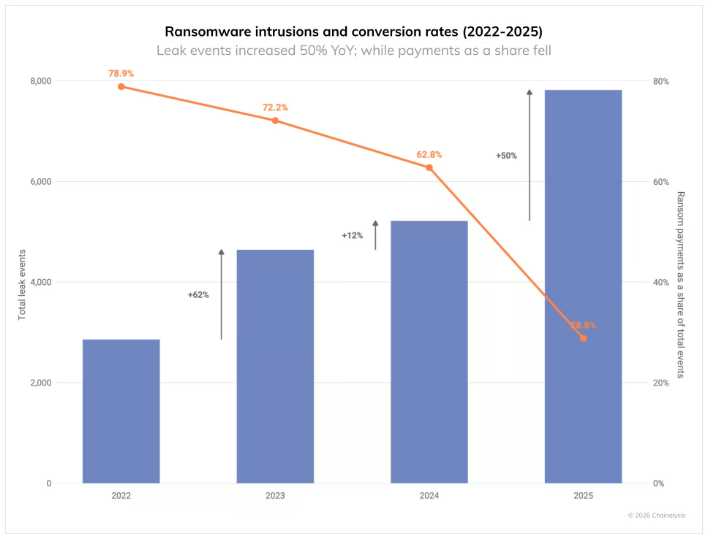
Source: Chainalysis

Ransomware: The Cost Of Breaking In Has Fallen Sharply

Part of what’s fueling the surge in attack numbers is how cheap it has become to launch one. Reports note that the average price for purchasing access to a victim’s system on the dark web fell from $1,427 in early 2023 to just $439 by early 2026.

Artificial intelligence tools and an oversupply of ready-made attack software have made it easier for more people to get into the ransomware game.

The result is a crowded field of attackers competing for the same pool of victims — and driving down their own profits in the process. It mirrors what happens in any flooded market. More sellers, same number of buyers, prices fall.

2026 Has Already Seen Major Crypto Losses

Even as ransomware payments trended downward last year, the broader picture of crypto-related crime remains grim. According to cybersecurity firm CertiK, $370 million in crypto was stolen in January 2026 alone through various exploits and scams.

Phishing attacks were responsible for the bulk of those losses, accounting for $311 million of the total. Ransomware may be generating less revenue for its operators, but the wider world of crypto theft is far from slowing down.

Featured image from Unsplash, chart from TradingView

Perguntas relacionadas

QAccording to the Chainalysis report, what was the percentage increase in ransomware attacks in 2025 and the total number of incidents?

AThe number of ransomware attacks jumped 50% in 2025, with nearly 8,000 separate incidents recorded.

QWhat was the total value of ransom payments collected in 2025 and how does it compare to the previous year?

ATotal ransom payments collected in 2025 came in at $820 million, which is an 8% drop from 2024.

QWhat are the three main factors cited for the decline in ransom payments?

AThe decline is tied to tougher rules from regulators, law enforcement cracking down on money laundering networks, and a growing number of companies refusing to pay.

QHow much did the average price for purchasing access to a victim's system on the dark web fall between early 2023 and early 2026?

AThe average price fell from $1,427 in early 2023 to just $439 by early 2026.

QHow much cryptocurrency was reported stolen in January 2026 by CertiK, and what type of attack was responsible for the majority of those losses?

A$370 million in crypto was stolen in January 2026, with phishing attacks accounting for the bulk of those losses at $311 million.

Leituras Relacionadas

Has Hook Summer Really Arrived? sato, Lo0p, FLOOD Ignite the New Narrative of Uniswap v4

"Hook Summer" Arrives? Sato, Lo0p, FLOOD Ignite Uniswap v4 Narrative Amidst a slight market recovery, attention within the Ethereum ecosystem has shifted to Meme coins built on Uniswap v4's Hook protocol. Following ASTEROID, tokens like sato, sat1, Lo0p, and FLOOD have become market focal points, with market caps ranging from millions to tens of millions, bringing concentrated liquidity to a narrative-dry market. Uniswap v4 Hooks are "plugin smart contracts" that allow developers to inject custom logic at key points in a liquidity pool's lifecycle (initialization, adding/removing liquidity, swaps, etc.), making the AMM programmable. Recent representative projects include: * **sato**: Market cap peaked over $38M; uses a v4 curve mechanism for minting/burning, locking ETH as reserve. * **sat1**: Market cap briefly exceeded $10M, positioning as an "optimized sato," but later declined significantly. * **Lo0p**: Market cap neared $6.6M; a "lending AMM protocol" allowing users to borrow ETH against deposited LO0P tokens without immediate selling pressure. * **FLOOD**: Market cap approached $6M; channels trading reserves into Aave v3 to generate yield, which is retained in the pool. The emergence of these Hook-based tokens could drive long-term growth for the Uniswap ecosystem by attracting users and liquidity to v4 pools. Combined with Uniswap's activated fee switch (partially used to burn UNI), the long-term outlook for UNI appears positive. However, short-term UNI price appreciation is not directly guaranteed. Factors include the sustainability and lifecycle of these new tokens, their price volatility, overall market conditions, and regulatory pressures. Currently, Uniswap v4's TVL ($595M) lags behind v3 and v2, indicating Hook adoption still requires time to mature. In summary, the Hook ecosystem serves as "long-term nourishment" for UNI, but acts more as a "catalyst" than a direct "booster" in the short term. Note: These are early-stage experimental tokens and may carry unknown risks.

marsbitHá 22m

Has Hook Summer Really Arrived? sato, Lo0p, FLOOD Ignite the New Narrative of Uniswap v4

marsbitHá 22m

Has Hook Summer Truly Arrived? sato, Lo0p, FLOOD Ignite the New Uniswap v4 Narrative

With the broader market showing signs of recovery, a new wave of interest has emerged around Ethereum-based meme coins. Following ASTEROID, tokens like sato, sat1, Lo0p, and FLOOD, built upon the Uniswap v4 Hook protocol, are capturing market attention. Their market capitalizations range from millions to tens of millions of dollars, injecting much-needed focused liquidity into a market lacking narratives. This article explores whether this trend signifies an incoming "Hook Summer" and its potential impact on UNI's price. Hooks are essentially plug-in smart contracts for Uniswap v4 liquidity pools, allowing developers to inject custom logic at key points in a pool's lifecycle (like initialization, adding/removing liquidity, swaps). This transforms the AMM into programmable building blocks. Key highlighted projects include: * **sato**: Peaked over $38M market cap. It utilizes a v4 curve for minting/burning; buying locks ETH as reserve to mint new tokens, while selling redeems ETH from the reserve and burns tokens. * **sat1**: Market cap briefly exceeded $10M, promoted as an "optimized sato," but later declined significantly. * **Lo0p**: Reached nearly $6.6M. It's a lending AMM protocol where buying LO0P tokens locks them as collateral, allowing users to borrow ETH from the pool reserve at 40% LTV, aiming to improve capital efficiency for idle ETH in LPs. * **FLOOD**: Peaked near $6M. Its mechanism directs asset reserves from buys into Aave v3 to generate yield, with fees and interest retained in the pool to potentially influence the token's price long-term. In the long term, the development of the Hook ecosystem can attract users and liquidity to Uniswap v4, benefiting UNI's fundamentals—especially combined with the recent activation of the protocol fee switch, where a portion of fees is used to burn UNI. However, in the short term, these Hook-based tokens are unlikely to directly drive significant UNI price appreciation. Their impact is moderated by factors like token sustainability, price volatility, and broader market and regulatory conditions. Currently, Uniswap v4's TVL ($595M) still trails behind v2 and v3, indicating adoption and growth will take time. The article concludes that while the Hook ecosystem provides long-term "nourishment" for UNI, its short-term role is more of a "catalyst" than a "booster." Readers are cautioned that these are early-stage experimental tokens and may carry unknown risks.

Odaily星球日报Há 35m

Has Hook Summer Truly Arrived? sato, Lo0p, FLOOD Ignite the New Uniswap v4 Narrative

Odaily星球日报Há 35m

Interview with Michael Saylor: I Did Say I Would Sell Bitcoin, But Never a Net Sale

Interview with Michael Saylor: I Said We'd Sell Bitcoin, But Never Be a Net Seller In a recent podcast, MicroStrategy Executive Chairman Michael Saylor clarified the company's stance on potentially selling Bitcoin. Following MicroStrategy's earnings call statement about being prepared to sell BTC to fund dividends for its STRC (Strategic) credit product, Saylor emphasized the distinction between selling and being a "net seller." Saylor explained the core business model: MicroStrategy sells credit instruments like STRC and uses the proceeds to buy Bitcoin, which is viewed as "digital capital" expected to appreciate around 30-40% annually. A portion of these capital gains can then be used to pay the dividends on the credit products. He stressed that even if the company sells some Bitcoin for dividends, it simultaneously buys much more with new credit issuance. For example, after raising $3.2 billion from STRC sales in April, the dividend obligation was only $80-90 million, making the company a net buyer. The clarification aims to counter market narratives questioning the value of Bitcoin on MicroStrategy's balance sheet if it were never sold, and to dismiss claims of a "Ponzi scheme." Saylor reiterated his personal philosophy for investors: "Don't be a net seller of bitcoin" and ensure your Bitcoin holdings increase each year. Saylor also discussed Bitcoin's role as the foundation for "digital credit," noting that STRC has become the largest and most liquid preferred stock issue in the U.S., offering high risk-adjusted returns (Sharpe ratio). He highlighted Bitcoin's deep liquidity, stating that even large purchases by MicroStrategy do not move the market significantly, which is driven by macro factors, geopolitical tensions, and capital flows from ETFs and credit products. Finally, Saylor reflected on his early inspiration from sci-fi books, which motivated his path to MIT, and maintained his fundamental thesis on Bitcoin remains unchanged: it is superior digital capital enabling superior digital credit.

链捕手Há 39m

Interview with Michael Saylor: I Did Say I Would Sell Bitcoin, But Never a Net Sale

链捕手Há 39m

Trading

Spot
Futuros
活动图片





