Ranger Public Offering Introduces New Features, Can a Grassroots Team Win Market Trust?

marsbitPublicado em 2026-01-08Última atualização em 2026-01-08

Resumo

On January 6th, Ranger Finance, a DEX aggregator on Solana, launched its ICO for the RNGR token via the MetaDAO platform to raise funds and accelerate development. The project aims to address fragmented liquidity and poor execution quality in the derivatives market by using an intelligent order routing system that scans multiple venues for optimal trade execution. It also offers a unified interface for managing diverse trading positions and plans to introduce cross-margin support. The public sale, running until January 10th, has a minimum fundraising target of $6 million. If exceeded, Ranger will initiate a buyback plan to repurchase and burn tokens at the difference between the ICO and listing price. The total token supply is 25,625,000, with 10 million allocated to the ICO. Team tokens (29.6% of supply) are subject to performance-based vesting, unlocking at multiples of the ICO price (2x to 32x). Ranger raised $1.9 million in December 2024 from investors like RockawayX and Asymmetric. The team, including co-founders with backgrounds at SolanaFM and mtnCapital, is partially anonymous, which may pose trust issues despite alignment incentives. Currently, the ICO has raised $2.9 million from nearly 1,800 investors, with market predictions suggesting a high probability of exceeding $30 million.

On January 6th, the public offering (ICO) for Ranger Finance, a DEX aggregator on the Solana blockchain, officially launched. This public offering is conducted through the MetaDAO platform to raise funds for Ranger's token, RNGR, aiming to expand the team's capabilities and accelerate development.

Currently, the daily derivatives trading volume on Solana, Arbitrum, and Hyperliquid reaches approximately $50 billion. However, most trading platforms still lock each order to a single trading venue, leading to fragmented liquidity, reduced execution quality, and ultimately a worse experience for traders. Ranger's core intelligent order routing system scans integrated trading venues in real-time, assesses liquidity depth, intelligently splits large orders, and executes trades at the optimal price.
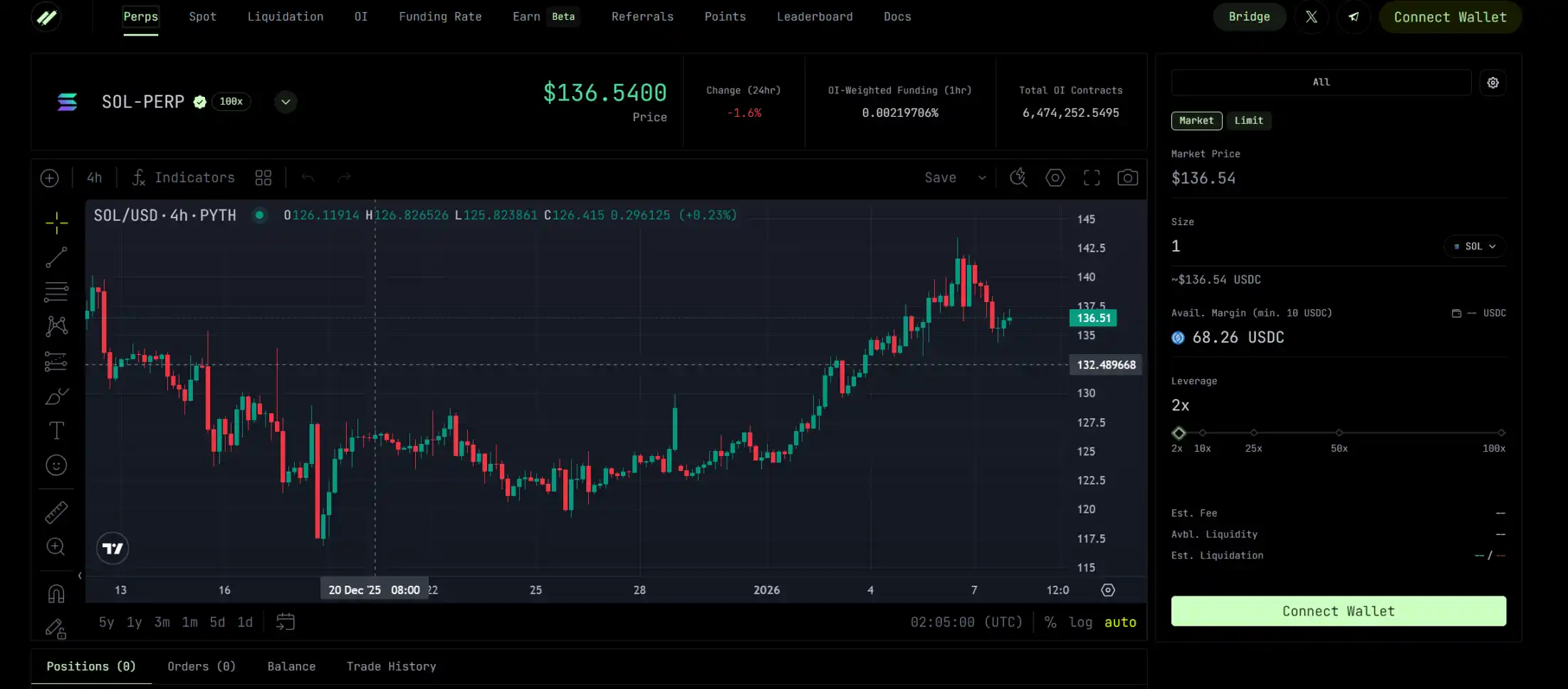
Ranger Finance also provides an intuitive interface for managing diverse trading positions, all operable on a single platform. The cross-margin support system (coming soon) allows the use of multiple assets in a single wallet as collateral, enabling greater flexibility and capital efficiency.

Public Offering Minimum Target $6 Million, Team Sets Performance-Based Unlock

The public offering runs until January 10th, with the officially announced minimum fundraising target of $6 million and a monthly spending limit of $250,000 (project founders can use this amount at their discretion each month without submitting a DAO proposal. The DAO reserves the right to adjust this amount in the future). Ranger point holders have priority in committing funds to the ICO. This priority is allocated proportionally among all point holders, with the remaining portion then allocated proportionally among non-point committers.

If the fundraising exceeds the minimum target ($6 million), Ranger will initiate a buyback plan, repurchasing tokens within 90 days based on the difference between the ICO price and the post-listing price. The repurchased tokens will be burned.

Ranger's total token supply is 25,625,000. The ICO token pool consists of 10 million tokens. Existing investors are allocated a total of 4,356,250 tokens (with a 24-month linear vesting period).

Notably, the project has specifically set up performance rewards. Team performance reward package: 7,600,000 tokens (18-month lock-up period, then unlocked based on price, using a 3-month TWAP as a benchmark, unlocking at 2x, 4x, 8x, 16x, and 32x the ICO price).

Ambassadors and ecosystem partners: 768,750 tokens (25% unlocked immediately, remaining 25% vested linearly over 6 months).

The remaining supply is for providing liquidity, with 20% of the raised funds plus 2 million tokens to be deposited into FutarchyAMM, and 900,000 tokens to be deposited unilaterally into Meteora's liquidity pool.

Previously Raised Funding at a $30 Million Valuation

In December 2024, during a period of excitement in the crypto market, Ranger completed a $1.9 million funding round led by RockawayX, with participation from Asymmetric, Big Brain Holdings, RISE Capital, and Anagram, among others.

This year, Ranger not only launched tokenized stocks based on xStocks but also acquired the strategy protocol Voltr in November.

Public information about the Ranger team is relatively limited. Its co-founder, Fathurrahman Faizal, graduated from Singapore Management University and previously served as COO at SolanaFM. Another co-founder, Barrett Williams, is also a co-founder of mtnCapital and has invested in the on-chain order book trading protocol BULK and MetaDAO.

The team allocation accounts for 29.6% of the total supply, unlocking only upon reaching ICO price milestones (e.g., 2x, 4x, 8x, 16x, 32x FDV). This incentive mechanism aligns with investor interests and is one of the few highlights. The team emphasizes "no pre-mining" and transparent governance but lacks specific links for verification, which may raise trust issues. The project claims to be built on TechFlow but does not disclose core developer experience.

Overall, the team's anonymity aligns with DeFi culture, but for a project seeking to raise millions in a public offering, this could be a potential risk point.
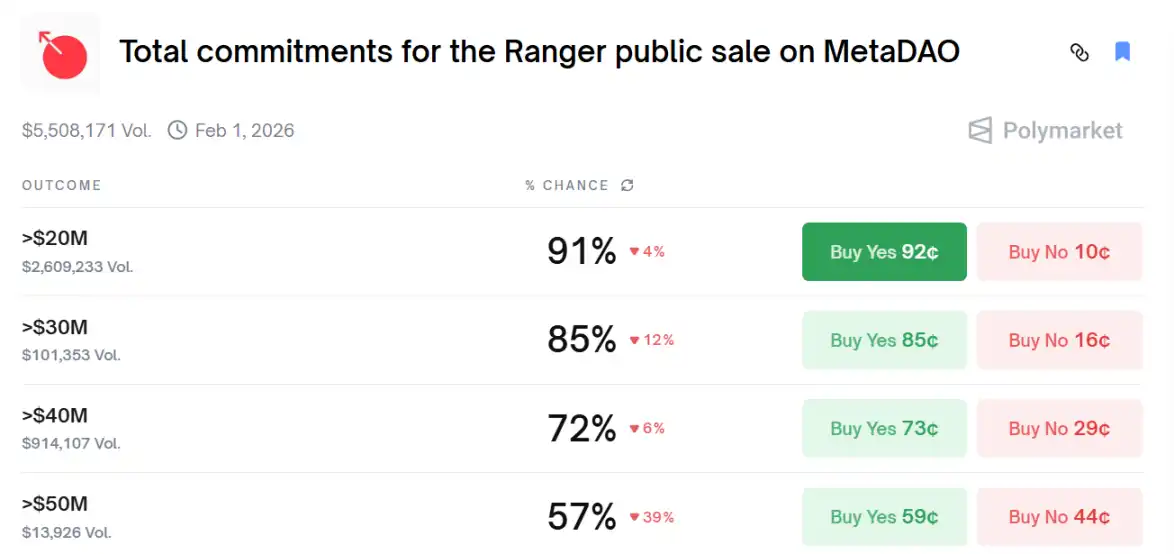
As of now, the official website shows that fundraising has reached $2.9 million, with nearly 1,800 investors participating. Polymarket data indicates an 85% probability that the market is betting on the public offering subscription amount exceeding $30 million.


Criptomoedas em alta

Perguntas relacionadas

QWhat is the main purpose of Ranger Finance's ICO and on which platform is it being conducted?

AThe ICO aims to raise funds for Ranger Finance's RNGR token to expand team capabilities and accelerate development. It is being conducted on the MetaDAO platform.

QWhat is the core technological solution that Ranger Finance provides to address liquidity fragmentation in decentralized exchanges?

ARanger Finance's core solution is its smart order routing system, which scans integrated trading venues in real-time, assesses liquidity depth, intelligently splits large orders, and executes trades at the best available price.

QWhat is the minimum fundraising target for the Ranger ICO and what happens if this target is exceeded?

AThe minimum fundraising target is $6 million. If this target is exceeded, Ranger will initiate a buyback plan within 90 days to repurchase tokens at the difference between the ICO price and the post-listing price, with the repurchased tokens being burned.

QHow is the team's token allocation structured to align their incentives and investor interests?

AThe team's allocation of 7,600,000 tokens has an 18-month lockup period, followed by unlocks based on price milestones. These unlocks occur when the token's 3-month TWAP reaches 2x, 4x, 8x, 16x, and 32x the ICO price.

QWhat are some of the potential trust issues or risks associated with the Ranger Finance project mentioned in the article?

APotential risks include the team's relatively anonymous nature, which is common in DeFi but a concern for a project seeking a public sale. The article also notes a lack of specific links to substantiate claims of 'no pre-mining' and transparent governance, as well as undisclosed core developer experience.

Leituras Relacionadas

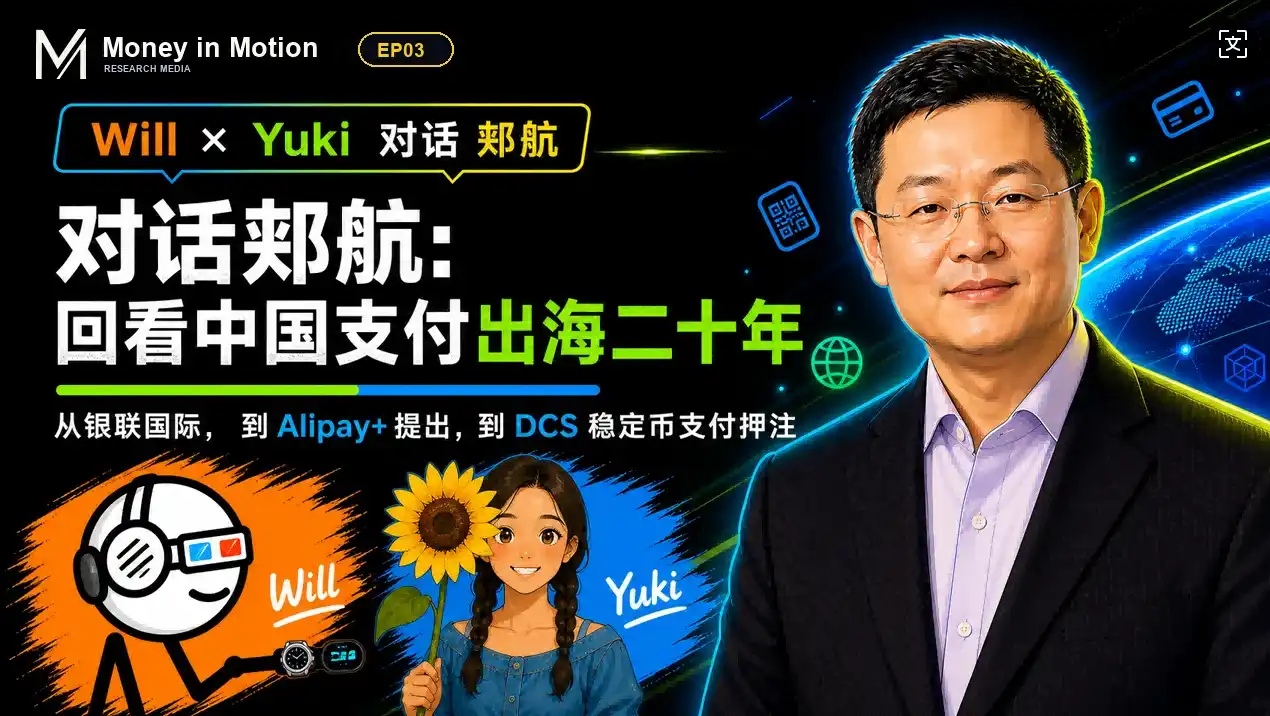
Dialogue with Jia Hang | Looking Back at Two Decades of Chinese Payment Going Global

**Summary: A Conversation with Jia Hang on Two Decades of China's Payment Globalization** Jia Hang, a veteran with over twenty years in payments, reflects on China's attempts to build a global payment network through three key phases: UnionPay (card networks), Alipay+ (digital wallets), and now, stablecoins. His journey began at UnionPay International, aiming to establish China's card network abroad. While successful in following Chinese tourists ("where Chinese go, UnionPay goes"), it struggled to achieve true global scale. The core lesson: card networks like Visa/Mastercard's unassailable advantage isn't just technical standards, but their deeply entrenched **governance and profit-sharing models** that create powerful network effects. Competing as the "same species" is nearly impossible. At Ant Group, he led Alipay+, a strategy to bypass card networks by interconnecting local e-wallets worldwide. While innovative, it faced a similar ceiling. Mobile QR payments and card swipes were essentially **the same species competing for the same pie**, lacking a disruptive value proposition for users or a sustainable new incentive model to replace the card networks' established flywheel. Today, at Singapore's DCS, Jia focuses on stablecoin-based payments. He argues stablecoins represent a fundamental shift. They are not competing with Visa for consumer payments but challenging the **traditional banking and account system for value movement**. Products like "U Cards" (stablecoin-linked payment cards) are transitional, leveraging existing card networks for acceptance while building new rails. The real potential lies in stablecoins enabling seamless, low-cost global value transfer, potentially reorganizing the financial infrastructure around **accounts rather than cards**. Jia believes stablecoin adoption for local retail payments, cross-border transactions, and as high-yield savings vehicles is becoming irreversible. This could gradually reduce reliance on traditional fiat channels, especially in regions with weak currencies or capital controls. The quest for the "next global payment network" continues, now centered on whether stablecoins can successfully bridge Web2 and Web3, establish new governance, and create compelling user value beyond mere cost reduction.

marsbitHá 17m

Dialogue with Jia Hang | Looking Back at Two Decades of Chinese Payment Going Global

marsbitHá 17m

Circle's Stock Price Plunges 76%, Hong Kong Dollar Stablecoin Set to Launch Within Two Weeks

Circle's stock price has plunged approximately 76% from its 2023 peak, reflecting a major market revaluation. Despite this, Circle President Heath Tarbert emphasized the company's focus on long-term execution and its dominant position with USDC's $73 billion circulation across 34 blockchains. The competitive landscape is intensifying. A new consortium-backed stablecoin, Open USD, is attempting to challenge incumbents by sharing reserve yields with partners. More significantly, Visa's new stablecoin platform, initially supporting Open USD while also being compatible with USDC, could erode Circle's network effects. In response, Circle is expanding into real-world payments through partnerships like the one with Japan's JCB. Separately, Tether (USDT) faces a two-year compliance window under new U.S. regulations, requiring it to adjust its reserve composition away from assets like Bitcoin and loans towards cash and U.S. Treasuries. Meanwhile, in Hong Kong, Standard Chartered-backed fintech firm Dian Dian is poised to launch a licensed HKD-pegged stablecoin (HKDAP), moving the industry into a phase where the real test is integrating licensed stablecoins into actual payment flows and corporate treasury systems. The sharp decline in Circle's stock underscores a broader shift: the stablecoin market is moving from a winner-takes-all dynamic to a multi-player competitive arena where execution, compliance, and real-world utility are becoming paramount.

marsbitHá 17m

Circle's Stock Price Plunges 76%, Hong Kong Dollar Stablecoin Set to Launch Within Two Weeks

marsbitHá 17m

Amidst Capital's Encirclement, Decentralization is the Sole Defense for Public Blockchains

In a landscape dominated by power and profit motives, the author argues that decentralization is not merely one desirable feature among many in blockchain design—it is the singular, non-negotiable defense against corporate and capital capture. The article adopts a Machiavellian, realist perspective on human institutions, positing that businesses will inevitably attempt to co-opt any valuable network to protect their profits and dominance. While external attacks like 51% forks are often discussed, the greater existential risk is internal capture—the gradual erosion of a protocol’s neutrality by vested interests, as seen historically with platforms like Visa and Google. The piece critiques permissioned chains, highly centralized “permissionless” layer-1s, and layer-2s without sufficient decentralization (e.g., single sequencers) as inherently vulnerable. These compromised systems, promoted by established financial players, are framed as delaying tactics to stifle truly open networks that threaten existing high-fee, inefficient business models. Real-world examples, such as closed enterprise consortiums that exclude competitors, illustrate how such systems cement oligopolies rather than foster innovation. The author concludes that while decentralized protocols like Ethereum are imperfect and costly to operate, they represent the only viable long-term equilibrium. In a market where value naturally flows to the most secure and neutral settlement layer, only maximally decentralized public blockchains can resist being subsumed by capital and powerful incumbents.

Foresight NewsHá 28m

Amidst Capital's Encirclement, Decentralization is the Sole Defense for Public Blockchains

Foresight NewsHá 28m

Trading

Spot

Artigos em Destaque

Como comprar WIN

Bem-vindo à HTX.com!Tornámos a compra de WINkLink (WIN) simples e conveniente.Segue o nosso guia passo a passo para iniciar a tua jornada no mundo das criptos.Passo 1: cria a tua conta HTXUtiliza o teu e-mail ou número de telefone para te inscreveres numa conta gratuita na HTX.Desfruta de um processo de inscrição sem complicações e desbloqueia todas as funcionalidades.Obter a minha contaPasso 2: vai para Comprar Cripto e escolhe o teu método de pagamentoCartão de crédito/débito: usa o teu visa ou mastercard para comprar WINkLink (WIN) instantaneamente.Saldo: usa os fundos da tua conta HTX para transacionar sem problemas.Terceiros: adicionamos métodos de pagamento populares, como Google Pay e Apple Pay, para aumentar a conveniência.P2P: transaciona diretamente com outros utilizadores na HTX.Mercado de balcão (OTC): oferecemos serviços personalizados e taxas de câmbio competitivas para os traders.Passo 3: armazena teu WINkLink (WIN)Depois de comprar o teu WINkLink (WIN), armazena-o na tua conta HTX.Alternativamente, podes enviá-lo para outro lugar através de transferência blockchain ou usá-lo para transacionar outras criptomoedas.Passo 4: transaciona WINkLink (WIN)Transaciona facilmente WINkLink (WIN) no mercado à vista da HTX.Acede simplesmente à tua conta, seleciona o teu par de trading, executa as tuas transações e monitoriza em tempo real.Oferecemos uma experiência de fácil utilização tanto para principiantes como para traders experientes.

401 Visualizações TotaisPublicado em {updateTime}Atualizado em 2025.03.21

Como comprar WIN

Discussões

Bem-vindo à Comunidade HTX. Aqui, pode manter-se informado sobre os mais recentes desenvolvimentos da plataforma e obter acesso a análises profissionais de mercado. As opiniões dos utilizadores sobre o preço de WIN (WIN) são apresentadas abaixo.

活动图片