Quid Pro Quo or Crypto? Congress Probes UAE Deal as LiquidChain Emerges as Secure Institutional Alternative

bitcoinistPublicado em 2026-02-05Última atualização em 2026-02-05

Resumo

High politics and decentralized finance collide as a U.S. congressional inquiry probes potential conflicts of interest involving World Liberty Financial (WLFI) and foreign entities, including UAE dealings and investments from figures like Justin Sun. Lawmakers question whether crypto projects are being used for political influence, highlighting vulnerabilities in personality-driven ventures. This scrutiny creates an institutional shift toward infrastructure-focused alternatives like LiquidChain ($LIQUID), a Layer 3 protocol that unifies Bitcoin, Ethereum, and Solana into a single execution layer. Emphasizing code over connections, LiquidChain offers a trustless, interoperable environment, attracting presale investment of over $526K as capital flees politically sensitive assets for verifiable, utility-driven solutions.

High politics and decentralized finance just collided in Washington, and lawmakers aren’t happy.

A formal inquiry into potential conflicts of interest surrounding World Liberty Financial (WLFI) has triggered alarm bells across the sector. At the center of the storm sits a letter from Rep. Jamie Raskin (D-MD) and Rep. Robert Garcia (D-CA), probing whether foreign entities, specifically those connected to recent UAE dealings and investments from figures like Justin Sun, are using crypto projects as a vehicle for political influence.
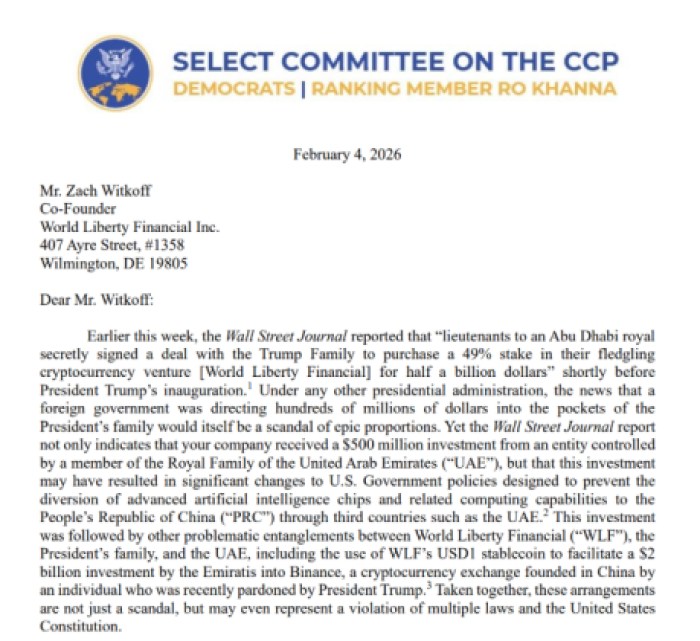

It’s not just about blockchain mechanics; the concern focuses on the ‘quid pro quo’ potential of opaque financial structures. When a project is tied intrinsically to a political figurehead, large foreign investments raise national security questions: are these purchases of tokens, or purchases of access?

The probe highlights a critical vulnerability in personality-driven crypto ventures. If the underlying value proposition relies on connections rather than code, the project becomes a lightning rod for regulatory enforcement.

This scrutiny creates a vacuum in the institutional DeFi sector. While D.C. dissects the tangled web of WLFI’s foreign ties, the market is quietly shifting capital toward infrastructure-heavy alternatives that prioritize code over connections.

The volatility of politically exposed assets is driving smart money toward verifiable, tech-first solutions. That flight to quality is evident in the rising interest surrounding LiquidChain ($LIQUID), a Layer 3 protocol designed to solve fragmentation without the geopolitical baggage.

Escaping Geopolitical Risk Through LiquidChain’s Unified Layer

The congressional probe into World Liberty Financial exposes a fatal flaw in centralized, personality-centric DeFi: counterparty risk. When a protocol relies on opaque dealings with foreign sovereign wealth funds or controversial crypto tycoons, ‘decentralization’ becomes little more than a marketing slogan.

In contrast, LiquidChain is capitalizing on the market’s demand for a trustless execution environment. Rather than relying on boardroom deals to move liquidity, LiquidChain utilizes a Layer 3 architecture to fuse Bitcoin, Ethereum, and Solana into a single execution layer.
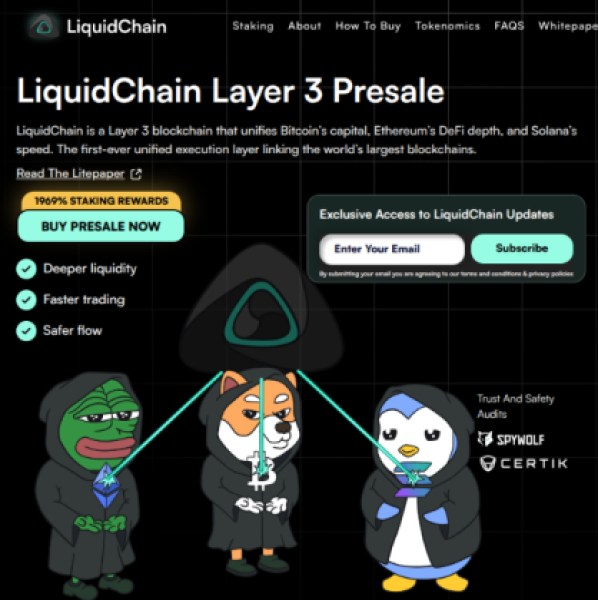
That distinction matters because institutions require certainty. They can’t allocate capital to platforms where the regulatory status hinges on the outcome of an election or a congressional hearing. LiquidChain’s ‘Deploy-Once’ architecture allows developers to build applications that access liquidity across all major chains simultaneously, removing the need for risky, fragmented bridges or politically sensitive partnerships.

By creating a Unified Liquidity Layer, the protocol offers the interoperability that WLFI promised, but delivers it through verifiable smart contracts rather than handshake deals in Dubai.

For the developer ecosystem, this represents a massive efficiency unlock. Instead of writing distinct code for the EVM (Ethereum) and SVM (Solana), LiquidChain’s Cross-Chain VM handles the translation.

As regulatory heat increases on projects like WLFI, infrastructure plays that solve the ‘wrapped asset risk’ problem. where assets are pegged and potentially manipulated, are becoming the preferred safe harbor for long-term capital.

EXPLORE LIQUIDCHAIN ON ITS PRESALE PAGE

$LIQUID Presale Gains Traction Amidst Regulatory Uncertainty

While headlines scream about subpoenas and congressional letters, on-chain data reveals a divergence in where retail and developer capital is actually flowing. The LiquidChain presale has quietly accelerated, with the project raising over $526K to date.

Unlike the hype-driven cycles of meme coins or political tokens, this capital injection suggests a methodical accumulation by investors betting on infrastructure over narrative.

At the current entry price of $0.0135, the market is pricing $LIQUID as an early-stage infrastructure bet. The tokenomics model positions $LIQUID not just as a governance token, but as the transaction fuel for the entire cross-chain environment. Every time a user swaps $SOL for $BTC or engages in DeFi activities across the unified layer, the protocol generates demand for the token.

This utility-driven demand contrasts sharply with the speculative nature of tokens currently under the congressional microscope. It’s easy to see why it could be one of the next crypto to explode.

The timing of this capital raise is notable. As investors rotate out of high-risk, politically sensitive assets, they’re seeking ‘picks and shovels’ plays, protocols that facilitate the industry’s growth regardless of which political party holds power.

With liquidity staking incentives encouraging long-term holding, LiquidChain is positioning itself to capture the volume that is fleeing from regulatory uncertainty.

BUY YOUR $LIQUID TODAY

This article is for informational purposes only and does not constitute financial advice. Cryptocurrency investments carry high risk, including the potential loss of principal. Always perform your own due diligence.


Perguntas relacionadas

QWhat is the main concern raised by the congressional inquiry into World Liberty Financial (WLFI)?

AThe main concern is whether foreign entities, particularly those linked to recent dealings with the UAE and investments from figures like Justin Sun, are using cryptocurrency projects as a vehicle for political influence, creating potential 'quid pro quo' situations and national security risks.

QHow does LiquidChain aim to address the vulnerabilities exposed by the WLFI probe?

ALiquidChain addresses these vulnerabilities by offering a trustless, tech-first solution with its Layer 3 architecture that unifies Bitcoin, Ethereum, and Solana into a single execution layer, prioritizing verifiable smart contracts and code over opaque political connections and partnerships.

QWhat key technological feature does LiquidChain use to solve the problem of blockchain fragmentation?

ALiquidChain uses its 'Deploy-Once' architecture and Cross-Chain VM, which allows developers to build applications that can access liquidity across all major chains simultaneously, eliminating the need for risky bridges and reducing fragmentation.

QWhat is the current status of the LiquidChain ($LIQUID) presale and what does it indicate about investor sentiment?

AThe LiquidChain presale has raised over $526K, indicating a methodical accumulation by investors who are betting on long-term infrastructure solutions rather than hype-driven or politically sensitive narrative tokens amidst regulatory uncertainty.

QHow does the utility of the $LIQUID token differ from the tokens under congressional scrutiny?

AThe $LIQUID token is designed as a utility token that serves as the governance and transaction fuel for the entire cross-chain environment, generating demand through actual platform use, in contrast to the speculative and politically exposed nature of the tokens under investigation.

Leituras Relacionadas

Gensyn AI: Don't Let AI Repeat the Mistakes of the Internet

In recent months, the rapid growth of the AI industry has attracted significant talent from the crypto sector. A persistent question among researchers intersecting both fields is whether blockchain can become a foundational part of AI infrastructure. While many previous AI and Crypto projects focused on application layers (like AI Agents, on-chain reasoning, data markets, and compute rentals), few achieved viable commercial models. Gensyn differentiates itself by targeting the most critical and expensive layer of AI: model training. Gensyn aims to organize globally distributed GPU resources into an open AI training network. Developers can submit training tasks, nodes provide computational power, and the network verifies results while distributing incentives. The core issue addressed is not decentralization for its own sake, but the increasing centralization of compute power among tech giants. In the era of large models, access to GPUs (like the H100) has become a decisive bottleneck, dictating the pace of AI development. Major AI companies are heavily dependent on large cloud providers for compute resources. Gensyn's approach is significant for several reasons: 1) It operates at the core infrastructure layer (model training), the most resource-intensive and technically demanding part of the AI value chain. 2) It proposes a more open, collaborative model for compute, potentially increasing resource utilization by dynamically pooling idle GPUs, similar to early cloud computing logic. 3) Its technical moat lies in solving complex challenges like verifying training results, ensuring node honesty, and maintaining reliability in a distributed environment—making it more of a deep-tech infrastructure company. 4) It targets a validated, high-growth market with genuine demand, rather than pursuing blockchain integration without purpose. Ultimately, the boundaries between Crypto and AI are blurring. AI requires global resource coordination, incentive mechanisms, and collaborative systems—areas where crypto-native solutions excel. Gensyn represents a step toward making advanced training capabilities more accessible and collaborative, moving beyond a niche controlled by a few giants. If successful, it could evolve into a fundamental piece of AI infrastructure, where the most enduring value in the AI era is often created.

marsbitHá 11h

Gensyn AI: Don't Let AI Repeat the Mistakes of the Internet

marsbitHá 11h

Why is China's AI Developing So Fast? The Answer Lies Inside the Labs

A US researcher's visit to China's top AI labs reveals distinct cultural and organizational factors driving China's rapid AI development. While talent, data, and compute are similar to the West, Chinese labs excel through a pragmatic, execution-focused culture: less emphasis on individual stardom and conceptual debate, and more on teamwork, engineering optimization, and mastering the full tech stack. A key advantage is the integration of young students and researchers who approach model-building with fresh perspectives and low ego, prioritizing collective progress over personal credit. This contrasts with the US culture of self-promotion and "star scientist" narratives. Chinese labs also exhibit a strong "build, don't buy" mentality, preferring to develop core capabilities—like data pipelines and environments—in-house rather than relying on external services. The ecosystem feels more collaborative than tribal, with mutual respect among labs. While government support exists, its scale is unclear, and technical decisions appear driven by labs, not state mandates. Chinese companies across sectors, from platforms to consumer tech, are building their own foundational models to control their tech destiny, reflecting a broader cultural drive for technological sovereignty. Demand for AI is emerging, with spending patterns potentially mirroring cloud infrastructure more than traditional SaaS. Despite challenges like a less mature data industry and GPU shortages, Chinese labs are propelled by vast talent, rapid iteration, and deep integration with the open-source community. The competition is evolving beyond a pure model race into a contest of organizational execution, developer ecosystems, and industrial pragmatism.

marsbitHá 13h

Why is China's AI Developing So Fast? The Answer Lies Inside the Labs

marsbitHá 13h

3 Years, 5 Times: The Rebirth of a Century-Old Glass Factory

Corning, a 175-year-old glass company, is experiencing a dramatic revival as a key player in AI infrastructure, driven by surging demand for high-performance optical fiber in data centers. AI data centers require vastly more fiber than traditional ones—5 to 10 times as much per rack—to handle high-speed data transmission between GPUs. This structural demand shift, coupled with supply constraints from the lengthy expansion cycle for fiber preforms, has created a significant supply-demand gap. Nvidia has invested in Corning, along with Lumentum and Coherent, in a $4.5 billion total commitment to secure the optical supply chain for AI. Corning's competitive edge lies in its expertise in producing ultra-low-loss, high-density, and bend-resistant specialty fiber, which is critical for 800G+ and future 1.6T data rates. Its deep involvement in co-packaged optics (CPO) with partners like Nvidia further solidifies its position. While not the largest fiber manufacturer globally, Corning's revenue from enterprise/data center clients now exceeds 40% of its optical communications sales, and it has secured multi-year supply agreements with major hyperscalers including Meta and Nvidia. Financially, Corning's optical communications revenue has surged, doubling from $1.3 billion in 2023 to over $3 billion in 2025. Its stock price has risen nearly 6-fold since late 2023. Key future catalysts include the rollout of Nvidia's CPO products and the scale of undisclosed customer agreements. However, risks include high current valuations and potential disruption from next-generation technologies like hollow-core fiber. The company's long-term bet on light over electricity, maintained even through the telecom bubble crash, is now being validated by the AI boom.

marsbitHá 13h

3 Years, 5 Times: The Rebirth of a Century-Old Glass Factory

marsbitHá 13h

Trading

Spot
Futuros
活动图片