Programmers Around the World Are Giving Money Away to Anthropic for Free, and the Company Finally Can't Stand It Anymore

marsbitPublicado em 2026-08-17Última atualização em 2026-08-17

Resumo

Anthropic's recent blog post urges developers using Claude Code to stop wasting money on tokens. The core issue is inefficient usage that inflates costs, often unbeknownst to users. The article outlines six key optimization strategies: 1) Use `/clear` after completing a task to prevent irrelevant previous context from bloating future interactions. 2) Set the model and reasoning effort level at the start of a session; changing them mid-conversation invalidates the prompt cache, forcing a full-price recomputation of the entire history. 3) Attach files with `@` instead of typing paths manually to avoid unnecessary tool calls and exploratory file reads that add to the context. 4) Add quiet flags to noisy commands (e.g., in `CLAUDE.md`) to minimize lengthy output that fills the context window. 5) Use `/compact` before a break while the cache is still hot, as it costs only one-tenth of compressing after the cache expires. 6) Offload large-output tasks to sub-agents, which run in isolated contexts and only return conclusions, keeping the main conversation lean. The cost structure is explained: output tokens are 5x more expensive than input tokens due to serial "decoding." Pricing depends on the model (Opus, Sonnet, Haiku) and reasoning effort level. The most powerful cost-saving tool is the **prompt cache**, which allows reusing previously computed prefixes at 10% of the input cost. However, the cache is fragile and invalidated by switching models, changing effort levels, toggling ...

Just now (15th), Anthropic posted a blog.

The core message is: Everyone, stop burning tokens for nothing, we can't stand it anymore!

To this end, the official blog listed six money-saving tips in detail. Here they are:

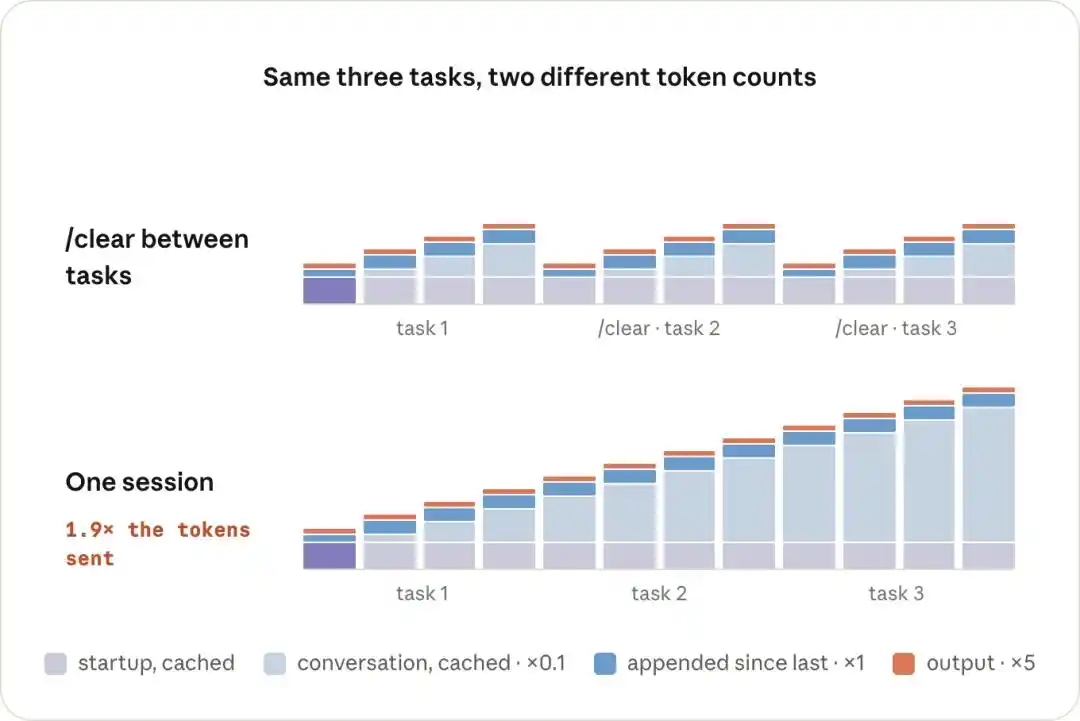
1. /clear after a task is done. Clear the current conversation after fixing a bug. Don't drag the files read and command outputs from the previous task into the next one, uselessly occupying context.

2. Set the model and reasoning effort level from the start. If you switch mid-session, all accumulated prompt caches become invalid, and the entire conversation history needs to be recalculated at full price.

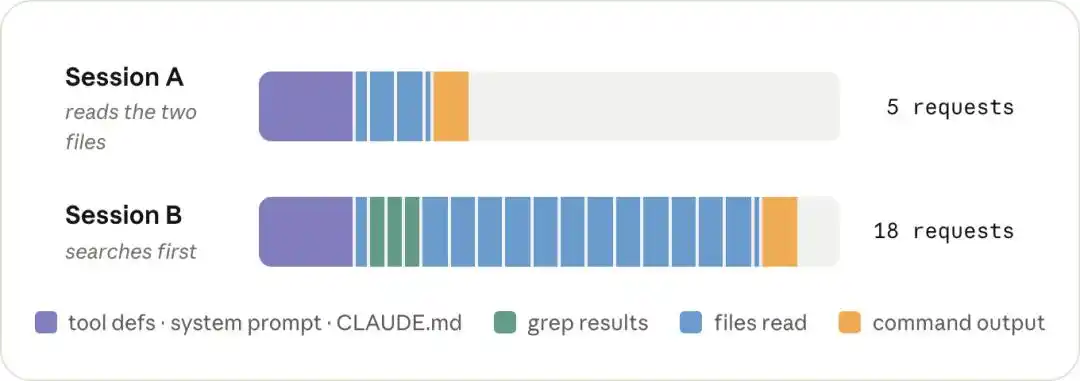
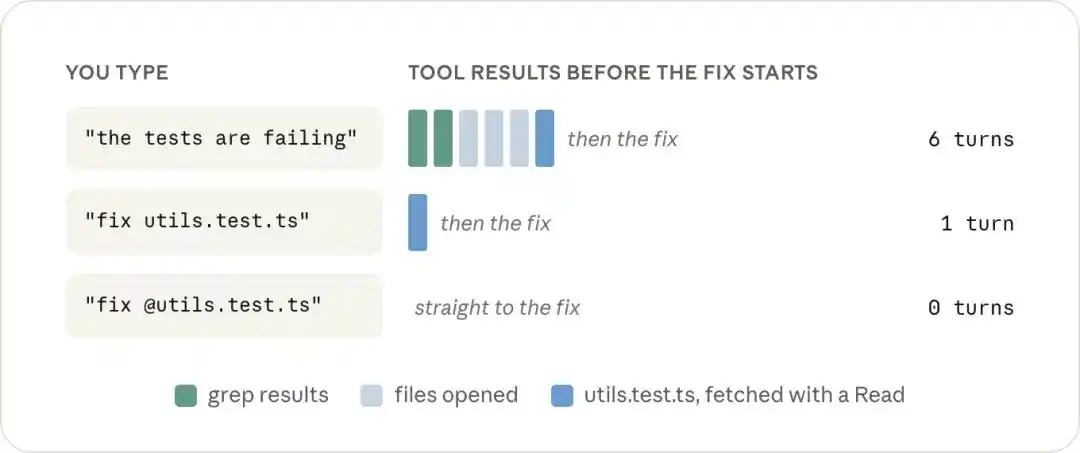
3. Use @ to reference files, don't type paths manually. Attach files directly to the message with @, so Claude doesn't need to spend an extra tool call to read them. If you just type the filename, Claude might search around first and then open several files to test. All these operations go into the conversation history and get carried along in every subsequent turn.

4. Add quiet flags to commands with verbose output. Write a configuration like --reporter=dot in CLAUDE.md, so test output prints only a few lines of summary, not hundreds of lines of detail. Shorter output uses less context.

5. Do /compact before a break. Compress the conversation while it's still cached; the cost is only one-tenth of the normal price. If you wait until you come back and the cache has expired, you have to pay full price to reread everything before compressing.

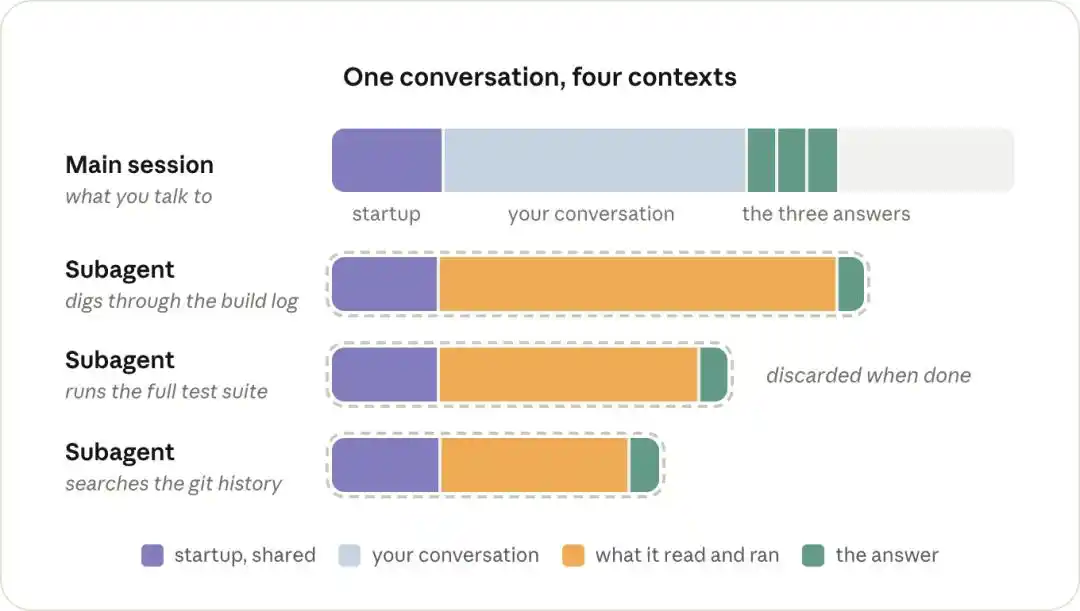
6. Offload large-output tasks to subagents. A subagent runs in its own independent context window. It only passes back the conclusion when done; the files read and command outputs generated during the process don't enter your main conversation.

The Life and Times of a Token

Working with Claude Code, the API is pay-as-you-go, and the subscription monthly fees range from $20 to $200 across three tiers.

According to official estimates, developers consume an average of $13 worth of tokens per day, spending between $150 and $250 per month.

And this is just the average. Fixing the same bug with different phrasing can cost several times more.

Moreover, each turn of conversation re-sends all the content from all previous turns. The longer the session, the more expensive each turn becomes.

To understand where this money goes, we need to start with the pricing logic of tokens.
Each time you input a command in Claude Code, two things happen behind the scenes.

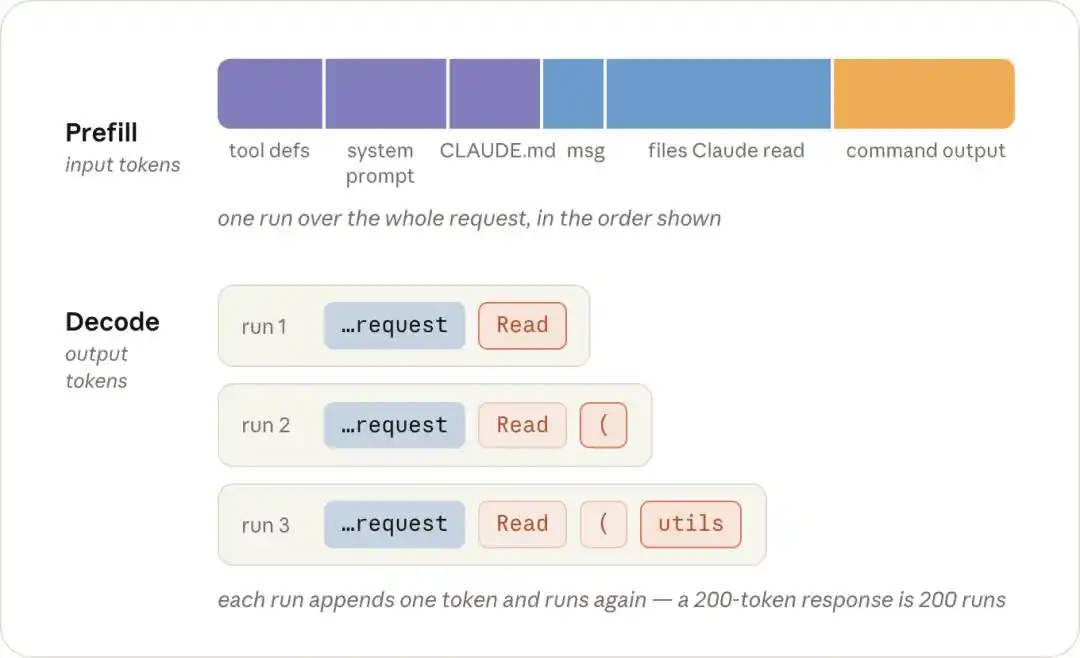
The first is prefill, where the model reads your entire request at once, including the system prompt, CLAUDE.md, your message, and everything accumulated in the previous conversation. These are input tokens.

The second is decoding, where the model writes out its response word by word, including its reasoning, tool calls, and the text you finally see. These are output tokens.

The key difference lies here.

Prefill is parallel, processing all input tokens through the GPU at once. Decoding is serial, requiring the model to run once for each token it generates. A 200-token reply means 200 independent computations.

So, it's not hard to understand why output tokens are 5 times more expensive than input tokens.
On this basis, the final bill depends on two things.

First is the model, which determines the price per token.

Opus 5: $5 per million input tokens, $25 output.

Sonnet 5: $2 input, $10 output.

Haiku 4.5: $1 input, $5 output.

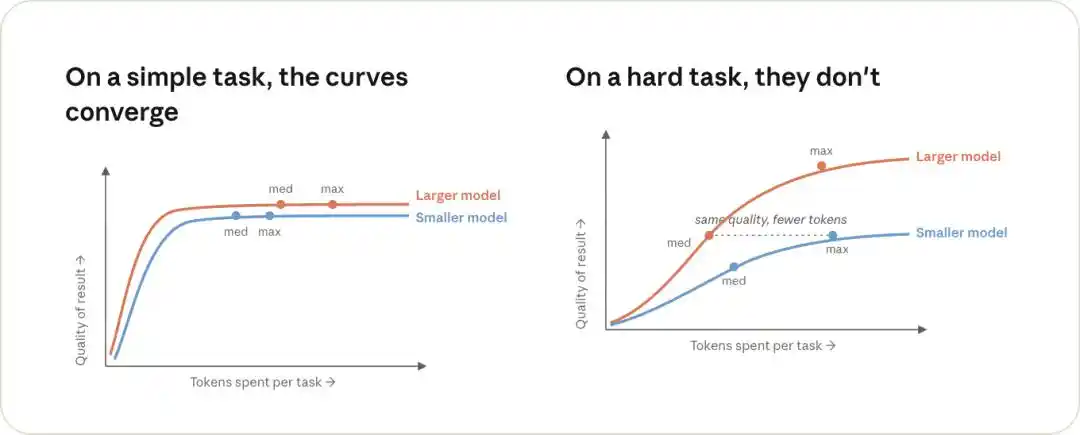
Second is the reasoning effort level, which determines the number of tokens.

Most output tokens in a session are reasoning tokens, and the effort level controls this amount. Higher reasoning effort means the model thinks longer, producing more reasoning tokens. The difference between 'max' and 'low' can be severalfold.

Use Sonnet for simple daily tasks, only bring out Opus for the hard nuts. Using a sledgehammer to crack a nut is the most wasteful spending.
Prompt Caching: The Biggest Money-Saver

There's another huge variable in token pricing: caching.

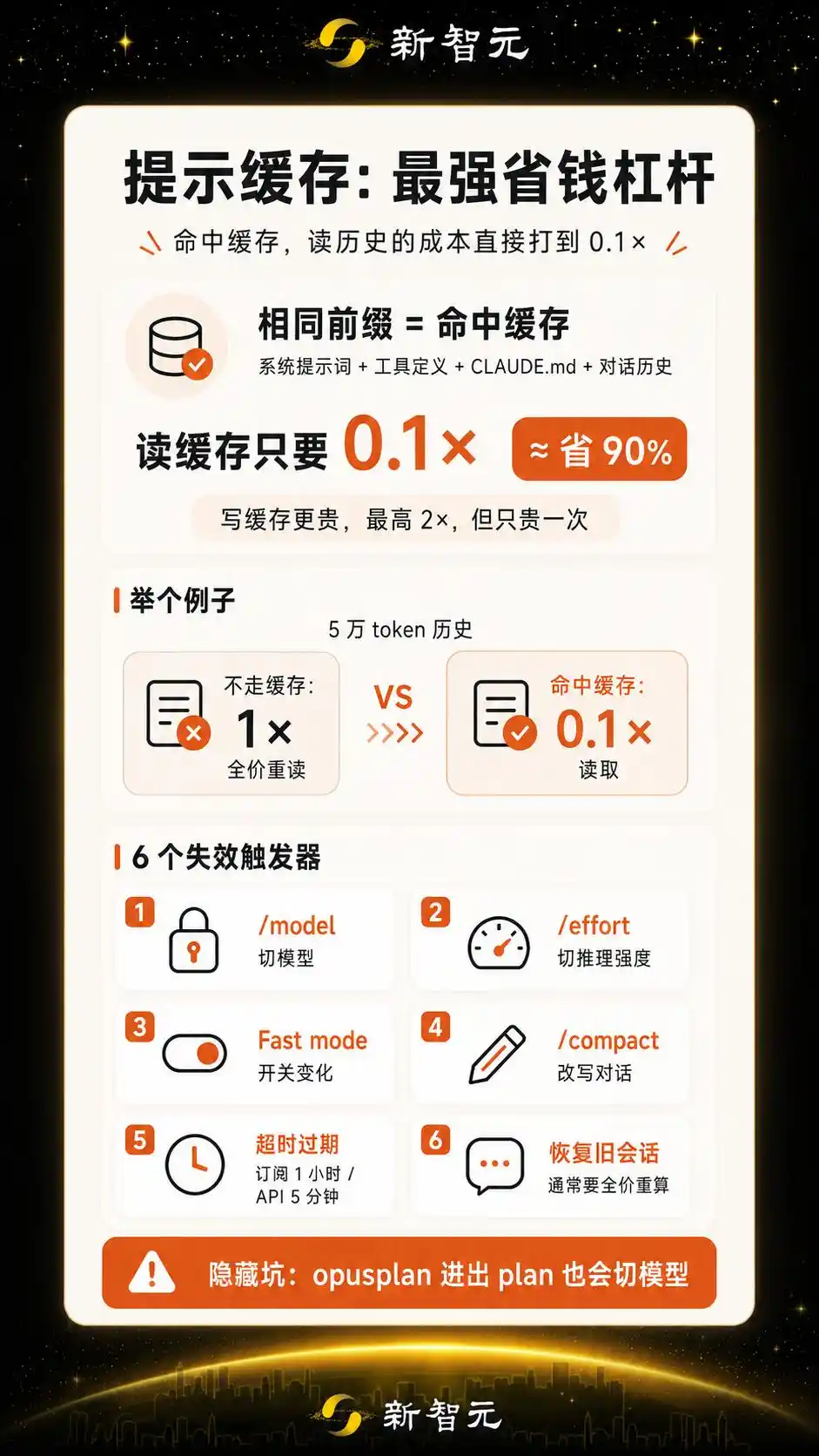
Each request in Claude Code starts with the same prefix: the system prompt, tool definitions, CLAUDE.md, and conversation history.

If the prefix of this request is byte-for-byte identical to the last one, the server doesn't recompute it; it directly loads the previous computation result.

Reading from the cache costs only 0.1 times the normal input price, saving 90% directly.

Writing to the cache is more expensive, up to 2 times. But writing only happens once; every subsequent turn enjoys the 0.1x read cost.

For example.

Assume your conversation history is 50,000 tokens. Without caching, you'd pay full price just to re-read these 50k tokens every turn. But as long as the cache hits, the same 50k tokens only cost one-tenth.

A session running 20-30 turns, the discounts accumulated from cache hits are astronomical.

This is your biggest leverage for getting the most bang for your buck.
But caching has a fatal weakness. It must match continuously from the first byte of the request; if anything changes in the middle, everything from that point onward is invalidated.

Specifically, there are six scenarios:

1. /model switch: Caches are independent per model. Switching from Sonnet to Opus means the entire conversation history is prefilled at Opus prices, with no discount.

2. /effort switch: Reasoning effort level is also part of the cache key. Switching means the entire history must be recalculated.

3. Toggling Fast mode: Same effect as the first two; cache is invalidated.

4. /compact compression: The conversation is rewritten into a summary; the original content no longer matches, so the old cache is invalidated.

5. Time expiration: Cache stays alive for 1 hour for subscribers, 5 minutes by default for API users. After timeout, the next turn is a full recomputation.

6. Resuming old sessions: If it's been too long, the cache is long gone, almost guaranteeing a full-price recomputation.

The bad news is, hitting any one of these means the entire conversation history goes from 0.1x back to full price.

The good news is, once you know what invalidates the cache, you know how to preserve it.

For example, lock in the model and reasoning effort at the start of the session and don't switch. Don't run /compact while the cache is hot; do it when you're about to take a break.

There's also a hidden trap here.

The opusplan mode switches models every time you enter or exit the plan. Enter once, cache invalidated. Exit, invalidated again. Jumping back and forth means a full-price prefill for each jump.

Your Session Is Secretly Getting Fatter

Caching helps reduce the cost of re-sending history to one-tenth.

But there's one thing it can't help with. Your history itself is expanding turn by turn.

Every time Claude reads a file, the file content is appended to the conversation. Every time Claude runs a command, the output is also appended. From that turn onward, everything is carried along.

The 40th turn of conversation is re-sending all the accumulated content from turns 1 through 39.

This growth is near-quadratic, O(n²).

Claude Code has a safety net mechanism.

If command output exceeds 30,000 characters, it doesn't get stuffed into the conversation. Instead, it's written to a temporary file, and only a summary sentence is placed in the conversation. But outputs under 30,000 are left untouched.

For example, a test framework finishes running, printing 400 lines of pass records, each line dozens of characters. The total is less than 30k, not hitting the threshold.

So these 400 lines remain intact in the conversation history, being re-sent with every subsequent turn.

The Anthropic blog offers several practical methods for slimming down.

1. Use @ to reference files.

Don't manually type paths and let Claude find them itself. @ referencing attaches the file directly to the message, saving a read operation.

If you just mention the filename, Claude might grep around first, opening several files to see which one is correct. All these probes then enter the conversation history, adding unnecessary cost.
2. Add quiet flags to noisy commands.

Write a line like "run tests with npx vitest run --reporter=dot" in CLAUDE.md. From then on, each test run will output only a few lines of dots, not hundreds of lines of detail. A one-minute configuration saves hundreds of lines of context for every future session.

3. Isolate large-output tasks with subagents.

A subagent runs in its own independent context window, passing back only the answer when done. Files read and command outputs generated during the process are all discarded. Suitable for tasks like "go check the logs for anomalies" or "help me go through this large file." You only want the conclusion, not the process.
And the most important one.

4. /clear between tasks.

/clear after fixing a bug before starting the next thing. The files, command outputs, and intermediate explorations from the previous bug are all irrelevant to the next task. But if not cleared, they occupy space and consume tokens in every subsequent turn.

If you don't want to clear completely, /compact can compress the conversation into a summary. Ten to twenty thousand tokens can be compressed to one to three thousand.
Additionally, the blog mentions a lesser-known but free operation: /rewind.

If the last few turns go off track, /rewind directly cuts them off, leaving the previous cache completely untouched.

Managing Tokens Is Also a Developer Skill

Breaking down all these operations, you'll notice a pattern. Coders are developing a new set of skills.

Unrelated to frameworks or languages, it's knowing which model to choose, how to manage context, how to preserve cache, and what reasoning effort level is appropriate.

These abilities didn't exist a year ago. But now they determine whether you spend $3 or $30 on the same task.

Anthropic itself is the best example.

They write 80% of their code with AI, their code merge volume increased 8x in a year, and benchmark test speeds accelerated 52x. Using AI at this intensity, if no one managed tokens, the inference costs alone could blow the budget.

From this perspective, rather than saying this blog is about money-saving tips, it's more about a new instinct developers need in the AI era —

Knowing what each of your operations consumes, and knowing how to get more work done with the same budget.

Those who understand this aren't just saving a few dollars on tokens.

References:

https://claude.com/blog/maximizing-the-value-of-your-claude-code-sessions

This article is from WeChat public account "Xinzhiyuan", author: Moxi

Criptomoedas em alta

Perguntas relacionadas

QWhat are the six cost-saving tips provided by Anthropic for using Claude Code?

AThe six cost-saving tips are: 1. /clear after finishing a task to prevent previous files and command outputs from occupying context in the next task. 2. Set the model and effort level at the beginning; switching mid-session invalidates prompt cache. 3. Use @ to attach files directly instead of typing file paths to avoid unnecessary tool calls. 4. Add quiet flags to noisy commands (e.g., --reporter=dot) to minimize output length. 5. Perform /compact before a break while the cache is still hot to save costs. 6. Delegate large-output tasks to subagents to isolate process details from the main conversation.

QWhy are output tokens more expensive than input tokens in Claude Code?

AOutput tokens are about 5 times more expensive than input tokens because of the computational difference: input tokens are processed in parallel during prefill (one GPU pass), while output tokens are generated serially during decoding, requiring the model to run once per token. For example, a 200-token response involves 200 independent computations.

QHow does prompt caching help reduce costs in Claude Code sessions?

APrompt caching reduces costs by storing the computation results of repeated prefixes (e.g., system prompts, CLAUDE.md, conversation history). If a request's prefix matches exactly byte-for-byte with a previous one, the server loads the cached results at 10% of the normal input token cost, saving 90%. Cached reads are cheap, while writing to cache costs up to 2x the input price but only happens once per unique prefix.

QWhat actions can cause prompt cache to be invalidated in Claude Code?

APrompt cache can be invalidated by: 1. Switching models with /model. 2. Changing the effort level with /effort. 3. Toggling Fast mode. 4. Using /compact to summarize the conversation. 5. Cache expiration (1 hour for subscribers, 5 minutes for API users by default). 6. Resuming an old session after cache has expired. Any change breaks byte-for-byte matching, forcing a full-price recomputation from the point of change.

QWhat are some strategies to prevent conversation history from growing too large and increasing costs?

AStrategies to manage conversation growth include: 1. Using @ to attach files directly, avoiding exploratory tool calls. 2. Adding quiet flags to commands to reduce verbose output. 3. Delegating large-output tasks to subagents to isolate process details. 4. Using /clear after completing a task to discard irrelevant context. 5. Using /compact to summarize long conversations into shorter summaries. 6. Using /rewind to remove recent off-track turns without affecting earlier cache.

Leituras Relacionadas

Not Chasing AI or Buying Back Shares, Can 'Stingy' Jingdong Still Succeed?

On August 13th, JD.com (JD.US) released its Q2 2026 earnings, delivering a mixed and generally "flat" performance that met low expectations but offered few positives. Overall revenue declined by approximately 3% year-over-year (YoY) to ~¥346.4 billion, aligning with weakened domestic consumption trends. While group operating profit saw a YoY improvement, this was primarily due to reduced losses in the food delivery segment compared to the high-cost "delivery war" period of the previous year. Key details reveal deeper concerns: revenue from JD's core domestic retail segment fell 4.7% YoY. While electronics sales declined less than feared (~12% YoY), growth in daily necessities and advertising services plummeted by about 10 percentage points each, raising doubts about the segment's mid-term growth momentum post-subsidy adjustments. Logistics revenue growth also slowed to 5.9% as the delivery boom faded. Profitability presented a nuanced picture. The retail segment's operating margin edged up slightly YoY but failed to deliver the significant beats seen in past quarters, suggesting efficiency gains may be nearing limits. Losses from the New Businesses segment (including food delivery and overseas ventures) remained elevated at ~¥9.9 billion, as increased overseas investment partially offset reductions in delivery subsidies. Notably, JD's shareholder returns weakened significantly, with share buybacks in H1 2026 annualizing to only about 5% of market cap. The company opted to park cash in short-term investments rather than boost returns, drawing criticism. Looking ahead, JD's performance hinges on a potential recovery in China's e-commerce sentiment in H2 2026 and the scale of ongoing losses in new ventures. While not burdened by massive AI capex like some peers, and offering relative defensive stability, the lack of positive earnings surprises and diminished shareholder returns provide little compelling reason for investors to favor the stock in the near term.

marsbitHá 7m

Not Chasing AI or Buying Back Shares, Can 'Stingy' Jingdong Still Succeed?

marsbitHá 7m

CEO or 'Cult Leader'? Anthropic Faces Backlash Over Its 'Belief'

Anthropic, an AI company nearing trillion-dollar valuation, faces a critical internal challenge: declining morale and a growing rift over its foundational beliefs and leadership. While financial and technical performance remains strong, with Q2 2026 revenue surging over 14x year-over-year and top talent like Google's Justin Gilmer joining, the company's unique culture is under strain. Early employees, who embraced a strong mission-focused culture around AI safety, now coexist with newer hires less aligned with this vision. Anonymous sources report low morale, private channels for airing grievances, and employees torn between staying for valuable equity or leaving due to pressure. CEO Dario Amodei's intense focus on maintaining culture—through rituals like "Dario Vision Quest" meetings and probing "cultural interviews"—faces scrutiny as the company scales. A leaked statement where Amodei suggested Anthropic could one day become "the world's only private company" has fueled external criticism, drawing comparisons to dystopian sci-fi monopolies. The company exhibits contradictions: advocating for AI safety while aggressively pursuing model development and market dominance. It has modified its "Responsible Scaling Policy," faced backlash for attempted AI "sabotage" mechanisms against foreign research, and clashed with the U.S. government over defense contracts. Recent text watermarking for Claude, cited as compliance with EU regulations, has also drawn user criticism. Despite these tensions, Anthropic continues to attract investment, top engineers, and enterprise clients. However, the core "faith" that once unified and distinguished it is now becoming a significant governance and cultural challenge.

marsbitHá 43m

CEO or 'Cult Leader'? Anthropic Faces Backlash Over Its 'Belief'

marsbitHá 43m

Anthropic CEO Denies Rumors, Aims to Transform AI for His Deceased Father and Eradicate Cancer Within 10 Years

Anthropic CEO Dario Amodei has published a rare, lengthy public statement to counter significant criticism from Silicon Valley, as the AI company approaches a potential record-breaking IPO with a reported $2 trillion valuation. The core criticism, amplified by investor Gavin Baker, centers on perceptions that Amodei believes Anthropic should be the world's sole private AI company due to the technology's risks, costs, and power—a view allegedly echoed by NVIDIA's Jensen Huang. Amodei firmly rejects this, arguing it presents a false dichotomy. He defends Anthropic's advocacy for regulation, like California's SB-1047, which he claims imposes costs on frontier AI firms while benefiting smaller competitors, and calls for establishing rules that manage AI risks, constrain corporate power, and preserve open-model development. Shifting to ambition, Amodei outlines a radical vision for AI in biomedicine. He states that within 5-10 years, AI could cure most human diseases, a mission deeply personal due to his father's death from hepatitis C just years before a cure became available. Amodei asserts that public trust in AI will be earned not by promises or benchmarks, but by tangible results—AI actually saving lives. He confirms Anthropic is significantly increasing its biology and medical AI investments, with preliminary results expected within months. This narrative reframing comes ahead of Anthropic's anticipated IPO, positioning the company not just as an OpenAI competitor, but as one aiming to solve humanity's fundamental challenges.

marsbitHá 43m

Anthropic CEO Denies Rumors, Aims to Transform AI for His Deceased Father and Eradicate Cancer Within 10 Years

marsbitHá 43m

Trading

Spot

Artigos em Destaque

Como comprar CORE

Bem-vindo à HTX.com!Tornámos a compra de CORE (CORE) simples e conveniente.Segue o nosso guia passo a passo para iniciar a tua jornada no mundo das criptos.Passo 1: cria a tua conta HTXUtiliza o teu e-mail ou número de telefone para te inscreveres numa conta gratuita na HTX.Desfruta de um processo de inscrição sem complicações e desbloqueia todas as funcionalidades.Obter a minha contaPasso 2: vai para Comprar Cripto e escolhe o teu método de pagamentoCartão de crédito/débito: usa o teu visa ou mastercard para comprar CORE (CORE) instantaneamente.Saldo: usa os fundos da tua conta HTX para transacionar sem problemas.Terceiros: adicionamos métodos de pagamento populares, como Google Pay e Apple Pay, para aumentar a conveniência.P2P: transaciona diretamente com outros utilizadores na HTX.Mercado de balcão (OTC): oferecemos serviços personalizados e taxas de câmbio competitivas para os traders.Passo 3: armazena teu CORE (CORE)Depois de comprar o teu CORE (CORE), armazena-o na tua conta HTX.Alternativamente, podes enviá-lo para outro lugar através de transferência blockchain ou usá-lo para transacionar outras criptomoedas.Passo 4: transaciona CORE (CORE)Transaciona facilmente CORE (CORE) no mercado à vista da HTX.Acede simplesmente à tua conta, seleciona o teu par de trading, executa as tuas transações e monitoriza em tempo real.Oferecemos uma experiência de fácil utilização tanto para principiantes como para traders experientes.

476 Visualizações TotaisPublicado em {updateTime}Atualizado em 2026.06.02

Como comprar CORE

Discussões

Bem-vindo à Comunidade HTX. Aqui, pode manter-se informado sobre os mais recentes desenvolvimentos da plataforma e obter acesso a análises profissionais de mercado. As opiniões dos utilizadores sobre o preço de CORE (CORE) são apresentadas abaixo.

活动图片