Author: Zhou, ChainCatcher
On June 5th, the leading privacy coin ZEC experienced a maximum intraday drop exceeding 56%, erasing nearly two months of gains, with its market cap shedding approximately $5 billion at one point.
Data shows that the total ZEC contract liquidations across all platforms reached about $100 million in the past 24 hours, with long position liquidations exceeding $76 million, second only to BTC and ETH in liquidation volume.
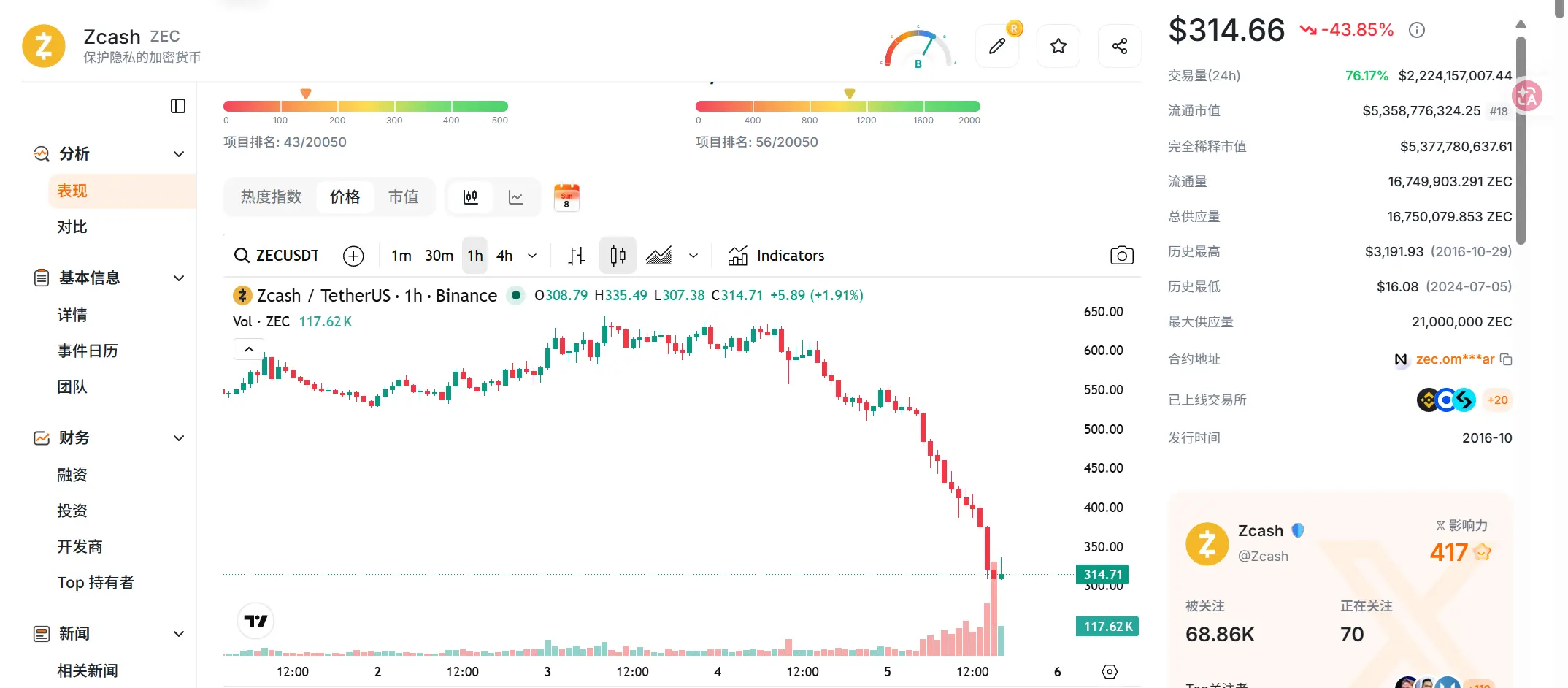
Image Source: RootData
The crash was triggered by a zero-knowledge proof vulnerability that had been latent for four years in Zcash's latest privacy transaction pool, Orchard. Theoretically, it allowed attackers to forge infinite ZEC under privacy protection, making detection extremely difficult.
The good news is the vulnerability was permanently fixed via a hard fork on June 3rd. The bad news is, due to the privacy features of the Orchard pool, no one can cryptographically prove that this vulnerability was never exploited over the past four years, leading to market doubts about ZEC's supply integrity during that period.
BitMEX co-founder Arthur Hayes announced he had liquidated all his ZEC holdings, on-chain whales profited handsomely from short positions, and market confidence was visibly shaken.
How the Vulnerability Arose and Was Discovered
The Orchard pool is Zcash's third-generation privacy transaction layer launched in May 2022. Due to insufficiently strict constraint conditions on one circuit element, attackers could input false values in elliptic curve multiplication operations yet still pass circuit verification, thereby generating unlimited forged ZEC within the pool. Because of Orchard's inherent privacy design, this forgery would leave no detectable on-chain trace.
The vulnerability was discovered by independent security researcher Taylor Hornby on May 29th. In April this year, the Zcash ecosystem independent security organization Shielded Labs had commissioned him to conduct a targeted security audit of the Zcash protocol, aiming to find potential vulnerabilities before attackers.
On May 28th, Anthropic released the Claude Opus 4.8 model. The next day, Hornby integrated it into his customized AI audit framework to conduct targeted analysis of the Orchard circuit, pinpointing the vulnerability that very day. He wrote a complete exploit program in a local test environment, verifying the technical feasibility of infinite minting. That evening, he responsibly disclosed the issue to the Zcash Open Developer Laboratory (ZODL).
ZODL engineers confirmed the vulnerability within hours and immediately activated emergency procedures. In the early hours of June 2nd, Zcash pushed an emergency soft fork via Zebra 4.5.3, temporarily disabling all Orchard transactions. On June 3rd, at 12:05 Beijing time, the mainnet completed the NU6.2 hard fork at block height 3,364,600, deploying the patched circuit and permanently closing the vulnerability.
From discovery to hard fork completion took about five days. The Zcash Foundation stated this was only the second time in Zcash's history since its 2016 launch that a protocol upgrade was triggered by a security issue. No known exploits occurred throughout the process, network total supply safeguarding mechanisms confirmed the total supply remained intact, and user privacy along with Sapling and transparent transactions were unaffected.
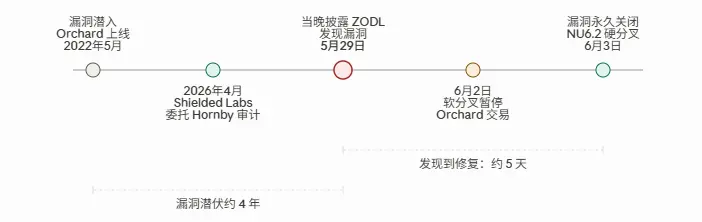
Image Source: Claude
After the Fix, Doubts Remain
Due to Orchard's privacy design, if an attacker never transfers forged tokens to the transparent pool, no existing mechanism can detect anomalies on-chain. This means the conclusion of an 'intact total supply' is based on currently observable data, not strict cryptographic proof. The vulnerability has existed since May 2022, and no one can rule out the possibility it was exploited over the past four years.
Shielded Labs believes the likelihood of exploitation is low, citing three reasons: the fact it remained undiscovered for four years indicates an extremely high technical barrier; its discovery resulted from a proactive targeted audit, not a passive exposure; and the short window from discovery to fix gave attackers very limited time to exploit. However, this very explanation itself shows the problem cannot be completely disproven.
To address this gap, Shielded Labs is collaborating with various developers to explore a new network upgrade proposal. The plan is to deploy a new privacy pool and enforce mandatory turnstile accounting scrutiny for all tokens migrating out of Orchard, allowing anyone to publicly verify supply integrity. The specific proposal is expected to be announced next week and will still need to go through community governance processes.
Crypto investor Simon Dedic pointed out that this event reveals two concurrent shifts in perception: privacy is not always an advantage; it can also be a risk in protocol design. The involvement of AI tools means vulnerabilities of similar scale can now be discovered with a lower barrier to entry, increasing the security audit pressure faced by the entire crypto industry.
On-chain analyst Haotian described the core issue of this event as 'unclearable.' Even if Shielded Labs introduces a new turnstile audit scheme, it can only prove the current supply is less than the total amount that entered the pool, still failing to cover potential historical hidden depreciation. He also noted the inherent contradiction between verifiable supply and privacy black boxes is a structural dilemma ZEC struggles to circumvent.
Concentrated Release of Market Panic
Although the technical crisis has passed, the market has not fully digested the true nature of the vulnerability.
This morning, Zcash founder Zooko Wilcox, Shielded Labs, and Taylor Hornby jointly published a detailed article comprehensively disclosing the exploitability of the vulnerability, the technical feasibility of infinite ZEC forgery, and the fact that 'cryptographic proof of historical non-exploitation is impossible' due to Orchard's privacy features, which truly ignited market panic.
On the same day, Arthur Hayes announced liquidating all his ZEC holdings, stating that while the probability of malicious minting is extremely low, it cannot be formally excluded at the cryptographic level. The value proposition of the privacy narrative demands 'perfect security,' not 'probable safety.' Hayes also indicated he might consider buying back at lower prices if subsequent assumptions are disproven.
Hayes was previously one of ZEC's most prominent public supporters, even listing it as his second-largest personal holding. He once stated ZEC should reach 10% of BTC's price, with the current rally 'having plenty of upside left.' His public departure now inevitably impacts market sentiment.
The combination of these two events caused ZEC's price to plummet rapidly. According to on-chain analyst monitoring, when ZEC fell below $400, the leveraged short position opened at $626.47 by 'insider whale' Garrett Jin resulted in floating profits reaching tens of millions of dollars.
However, some hold the view that the sharp price drop was not solely driven by the vulnerability. Crypto KOL OzLion pointed out that ZEC's previous rally already showed signs of large capital involvement. The vulnerability news might have merely provided an exit timing, with a massive influx of spot sell-offs on the day being a more direct price driver. He lamented that a 'strong-consensus blue-chip' with a $12 billion market cap losing $6 billion in a single day shows that building consensus in the crypto world is difficult, breaking it is easy, and repairing it is an even longer process.