Prediction Markets Plunge into Major Controversy Again: Are You Trading Facts or Rules?

Odaily星球日报Publicado em 2026-04-08Última atualização em 2026-04-08

Resumo

The prediction market sector, particularly in Web3, is facing significant controversy over the interpretation of event outcomes versus predefined rules. Two recent high-profile cases highlight this tension. On Polymarket, a market asking "Will US forces enter Iran by a certain date?" was settled as "Yes" after US special operations troops entered Iranian territory to rescue a downed pilot. While the rules explicitly qualified such operational entries—including humanitarian missions—as valid, many users argued that a limited, rescue-focused operation should not be considered an "invasion," contradicting common understanding. On Predict.fun, a market asking if Polymarket would "launch a token" was triggered when the platform introduced a native stablecoin, Polymarket USD, pegged 1:1 to USDC. The rules defined "token" broadly as any fungible asset, but critics argued that issuing a stablecoin—a collateralized utility token—should not count as a "token launch," which is typically associated with governance or equity tokens. This raised questions about whether the outcome reflected market expectations about valuation (FDV) or merely technical rule compliance. The core issue is whether participants are betting on real-world events or narrowly defined rules. These cases show that even high-probability markets can become "lose-everything" scenarios if rule nuances are overlooked. Understanding the rules—including definitions, exceptions, and interpretation boundaries—is crucial, a...

Original | Odaily Planet Daily (@OdailyChina)

Author | Asher (@Asher_ 0210)

Prediction markets are arguably the hottest topic in Web3 right now.

Trading on predictions surrounding macroeconomic events, the crypto industry, and even entertainment topics continues to heat up, with discussion fervor and participation numbers constantly rising. However, as the market develops rapidly, some discordant voices have gradually emerged—some events, upon settlement, deviate from user expectations based on common sense or "real-world understanding," sparking controversies about rule design, fairness, and even platform credibility.

Recently, two highly controversial events occurred in quick succession within prediction markets. Below, Odaily Planet Daily will summarize and discuss them.

Polymarket: US Rescue of Downed Pilot in Iran Judged as US Invasion of Iran

On April 3rd, a US F-15E Strike Eagle fighter jet was shot down by Iranian air defense systems in southwestern Iran. The two crew members (one pilot, one Weapon Systems Officer/WSO) ejected; one was quickly rescued, while the other was missing for several days, hiding in the Iranian mountains.

  • The US military subsequently launched a Search and Rescue (SAR) operation involving armed aircraft, helicopters, etc., ultimately rescuing the second, severely injured crew member (Trump personally announced "WE GOT HIM").
  • The rescue operation involved US forces entering Iranian territory (mountain search and rescue, possible ground or low-altitude operations), which drew attention given the current sensitive geopolitical conflict backdrop.

Since the US military entering Iranian territory could, in a way, be considered a US invasion of Iran, it directly affected the prediction event on the Polymarket platform regarding when US forces would enter Iran (US forces enter Iran by?).
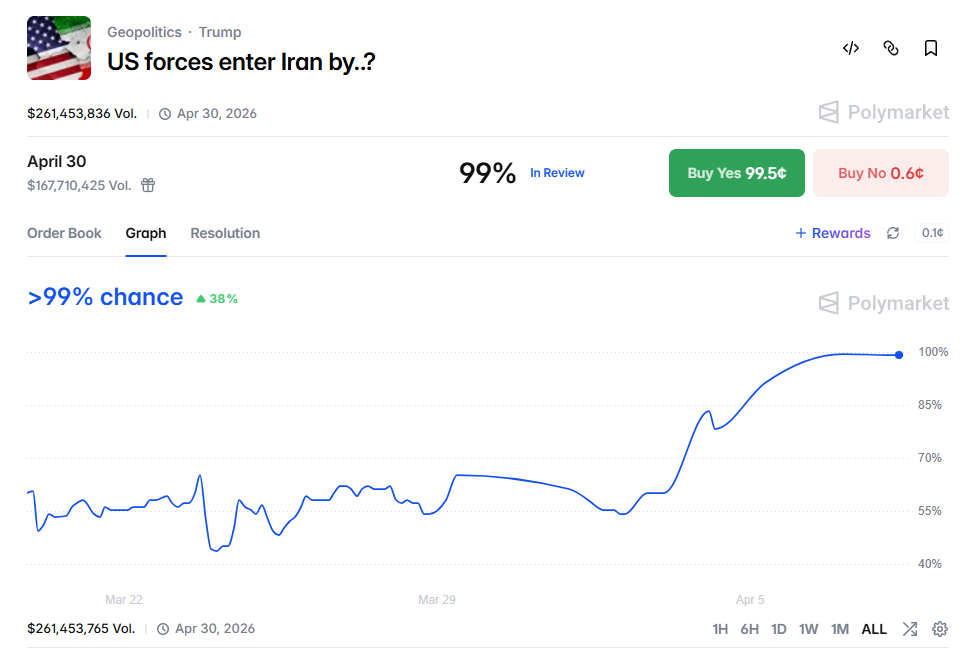
According to the settlement rules, active US military personnel (including special operations forces) entering Iranian land territory before the specified date counts as an invasion. Downed pilots do not count as invasion, but the special forces sent by the US military did indeed enter Iranian territory to rescue the pilot. Therefore, the special forces entering Iran for the rescue mission met the criteria for a Yes判定 on the US invasion of Iran.
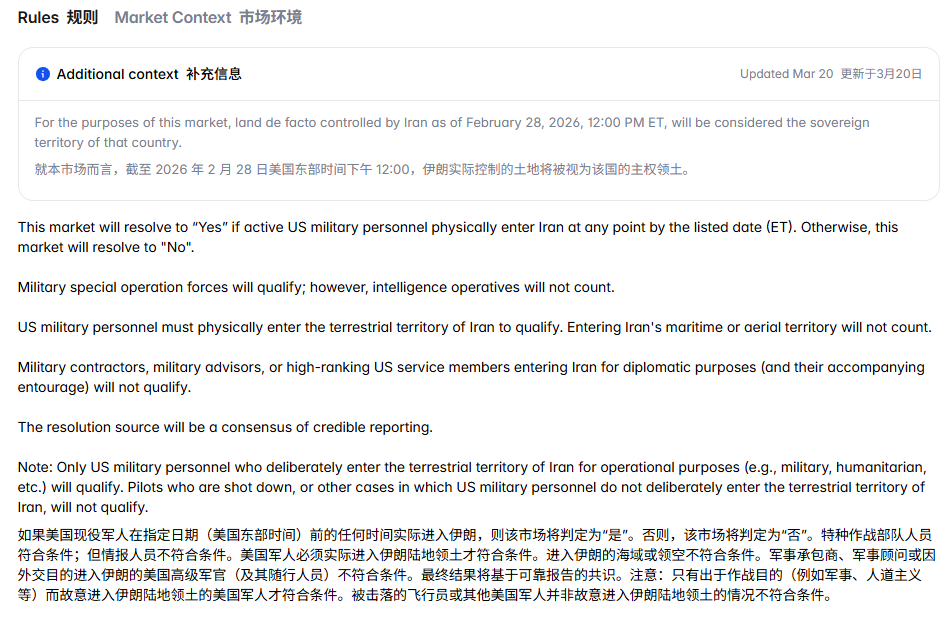
Polymarket's判定 of the "pilot rescue" event as a US invasion of Iran has sparked strong community controversy.

Those supporting "counts as entry" (Yes side) argue that this operation符合 the definition of "entry" in the rules. The US special forces deliberately entered Iranian territory to execute a mission, and the rules explicitly state "special operation forces will qualify", also covering "for operational purposes (including humanitarian)". Objectively, this is the first confirmed ground infiltration by US forces in the current conflict context; US personnel did set foot on Iranian soil, so it should be considered "entry".

Those opposing "counts as entry" (No side) believe this definition is an overextension. The action was essentially a short-term, limited-scale humanitarian rescue, not a combat invasion (invasion), nor did it have an intent to occupy,不符合 the public's common-sense understanding of "US forces entering Iran". Furthermore, the rules explicitly exclude "pilots who are shot down... will not qualify", and this operation was precisely centered around a downed pilot, possessing a "forced entry" nature, logically falling under a similar exception. Referencing past cases (e.g., similar regional actions not deemed invasions), rescue operations should not be equated with military entry;判定 it as Yes might encourage marginal interpretations of the rules, weakening the market's seriousness and consistency. The Chinese community also普遍 believes "entering Iran" should refer more to large-scale ground or amphibious warfare, not a short-term "rescue and leave" operation.

Predict.fun: Polymarket Issuing Stablecoin Judged as Token Launch

On the evening of April 6th, Polymarket官方 announced on X a comprehensive exchange upgrade:

  • Rebuilding the trading engine, upgrading smart contracts;
  • Launching a new native collateral token, Polymarket USD (1:1 pegged to USDC, intended to replace USDC.e and reduce bridging risks).

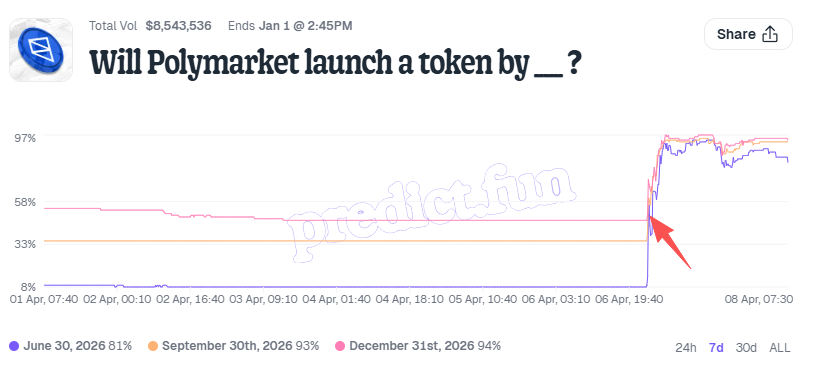
The second point, mentioning the launch of the native collateral token Polymarket USD, directly affected the probability of two related prediction events on the Predict.fun platform: one关于 token launch; the other about post-launch market cap:

1. When will Polymarket launch a token? (Will Polymarket launch a token by ___?)
2. Polymarket's FDV one day after launch (Polymarket FDV above ___ one day after launch?);
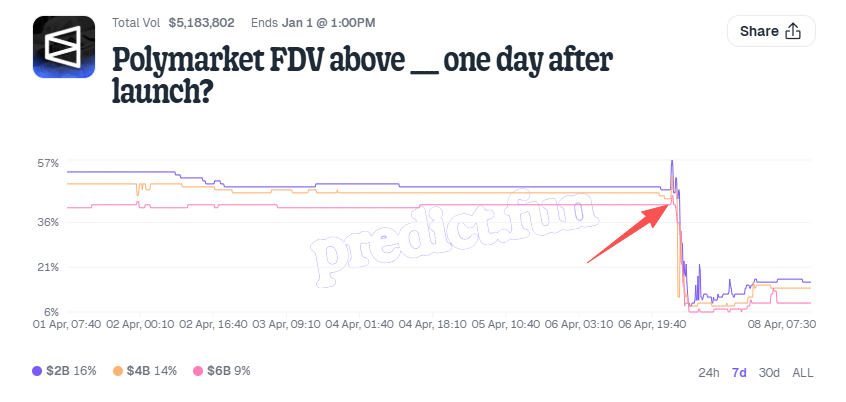
According to the settlement rules document, it clearly states that "Any fungible token issued by Polymarket counts as a 'token launch' for this event", and stablecoins are certainly no exception. Therefore, the Polymarket stablecoin meets the criteria for a Yes判定.
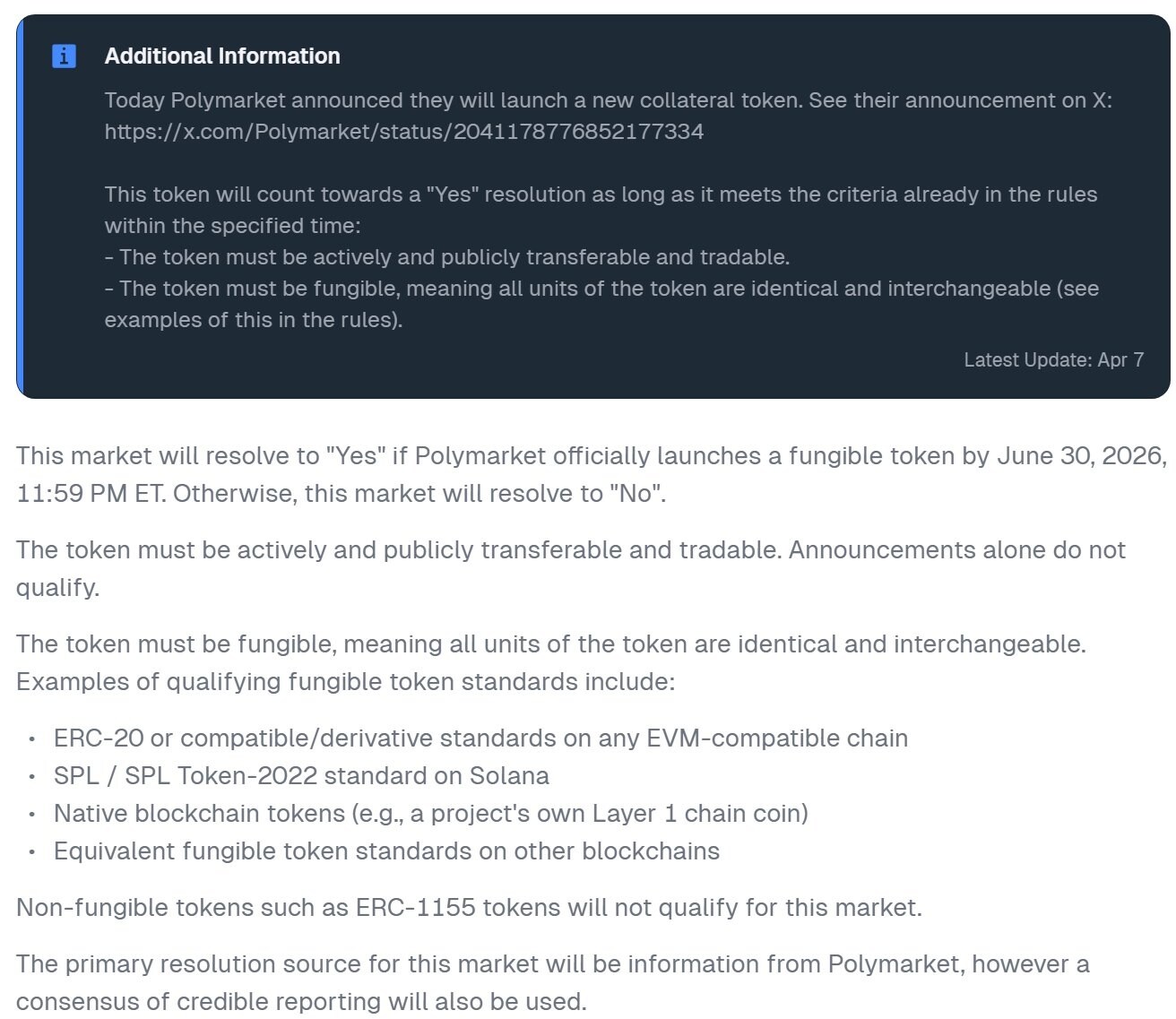
Relevant settlement rule说明

The community debated this.

Supporters argue that, literally from the rules, "issuing a token" is not limited to必须是 a "governance token" but is a general term for all tokens. Under this premise, Polymarket USD, as a fungible token (ERC20/SPL, etc.) issued by Polymarket,本质上符合 the definition of a "token launch". Additionally, the subsequent official clarification was more a reiteration of the existing rules rather than a临时 modification, so it has some legitimacy in terms of compliance.

However, skeptics do not accept this explanation. On one hand, they believe including stablecoins in the "token launch" category is an overinterpretation of the rules, a typical play on words; on the other hand, even if stablecoins are acknowledged as "token launches", the core of this prediction market is "Polymarket FDV", not "Polymarket USD FDV". Stablecoins serve more as collateral or settlement tools; their market cap structure is fundamentally different from that of a project's main token (e.g., a POLY governance token), and therefore should not be directly equated or substitute for the project's overall valuation logic.

Which Side Are You On?

Looking at the整体 picture, controversial events in prediction markets ultimately revolve around a core question: are you betting on "reality" or are you betting on "rules". Often, these two do not completely overlap.

For those of us participating in prediction markets, understanding the rules themselves might be more important than judging the direction of the event. How the information source is defined, whether there are exception clauses, whether there is room for interpretation—these details can directly determine win or loss at critical moments.

Precisely because of this, some high-probability events that look like "sure bets" are not without risk; they might instead be potential "lose-everything bets". Many reversals happen precisely in these overlooked details. Rather than betting blindly, taking an extra look at the rules is more useful than complaining after losing money.

Perguntas relacionadas

QWhat is the core issue discussed in the article regarding prediction markets?

AThe core issue is the discrepancy between user expectations based on real-world understanding and the actual settlement outcomes determined by platform rules, leading to debates about rule design, fairness, and platform credibility.

QWhy did the rescue operation for the downed US pilot in Iran trigger a 'Yes' settlement on Polymarket's 'US forces enter Iran' event?

ABecause the settlement rules defined 'entry' as active, deliberate incursion by US forces (including special operations) for operational purposes, and the rescue mission involved special forces entering Iranian territory, qualifying as 'invasion' under the platform's criteria.

QWhat was the opposition's argument against the 'Yes' outcome in the Polymarket Iran event?

AThey argued that the rescue was a short-term humanitarian operation, not an invasion or occupation, and should be considered an exception similar to excluded cases like shot-down pilots, as it didn't align with common understanding of 'US forces entering Iran'.

QHow did Predict.fun justify settling 'Will Polymarket launch a token?' as 'Yes' after the stablecoin announcement?

AThe rules specified that any fungible token issued by Polymarket counted as 'launching a token,' and Polymarket USD, being a fungible token, met this definition despite being a stablecoin rather than a governance token.

QWhat key advice does the article offer to participants in prediction markets to avoid losses?

AParticipants should prioritize understanding the specific rules—including definitions, exceptions, and interpretive nuances—over merely predicting real-world outcomes, as rule details ultimately determine settlement and can turn high-probability bets into losses.

Leituras Relacionadas

South Korean Exchanges 'Battle' Regulators, Challenging the Boundaries of Enforcement and Legislation

South Korea's cryptocurrency industry is engaged in a rare, direct confrontation with regulators. The Financial Intelligence Unit (FIU), the primary anti-money laundering (AML) watchdog, has recently imposed heavy penalties on major exchanges like Upbit and Bithumb for alleged violations involving unregistered overseas VASPs and AML procedures. However, exchanges are now actively challenging these actions in court and through industry associations. In a significant shift, the Seoul Administrative Court ruled in favor of Upbit's operator, Dunamu, overturning part of an FIU-ordered business suspension. The court found the FIU's penalty criteria and justification insufficiently clear. Similarly, the court suspended the enforcement of a six-month business suspension against Bithumb pending a final ruling, citing potential irreversible harm to the exchange. Beyond legal battles, the industry is contesting proposed legislative amendments. The Digital Asset eXchange Alliance (DAXA) strongly opposes a draft rule that would mandate Suspicious Transaction Reports (STRs) for all crypto transfers over 10 million KRW (~$6,800). DAXA argues this "poison pill" clause violates legal principles and would overwhelm the STR system, increasing reports from 63,000 to an estimated 5.45 million annually for major exchanges, thereby crippling effective AML monitoring. This conflict highlights a structural tension in South Korea's crypto governance: comprehensive digital asset laws are still developing, while regulators rely heavily on AML enforcement. The industry's move from passive compliance to active legal and legislative challenges signifies a new phase, pressing for clearer rules and more proportionate enforcement. While short-term disputes may intensify, this clash could ultimately lead to a more mature and sustainable regulatory framework for South Korea's vibrant crypto market.

marsbitHá 54m

South Korean Exchanges 'Battle' Regulators, Challenging the Boundaries of Enforcement and Legislation

marsbitHá 54m

After 50x Storage Surge, Justin Sun Always Looks to the Next Decade

Sun Yuchen, known for his controversial stunts like a $30 million lunch with Warren Buffett (canceled due to a kidney stone) and eating a $6.2 million duct-taped banana, is often overshadowed by a significant fact: his decade-long track record of spotting major investment trends. In 2016, he famously advised young people to invest in Bitcoin, Nvidia, Tesla, and Tencent instead of buying property. A hypothetical $20,000 investment in Nvidia and Tesla from that list would now be worth over 50 million RMB. His latest major call was on November 6, 2025, predicting a "50x storage opportunity" tied to the AI boom, which materialized with Sandisk's stock surging nearly 50-fold by 2026. Looking ahead, Sun now focuses on the next frontier: Physical AI. He identifies four key areas: 1. **Embodied AI/Robotics**: He sees this reaching its "iPhone moment," with companies like UBTech and Galaxy General leading in commercialization. 2. **Drones**: Viewed as the first commercially viable form of Physical AI, revolutionizing sectors from warfare (e.g., AeroVironment's Switchblade) to logistics. 3. **Spatial Computing**: Beyond VR, it's about AI understanding physical space, a foundational technology for robotics and autonomous systems, exemplified by Apple's Vision Pro. 4. **Space Exploration**: After a 2025 suborbital flight with Blue Origin, Sun advocates for space as the ultimate frontier, discussing blockchain's potential role in space asset management and data transactions. His investment philosophy involves betting on entire, inevitable trends rather than single companies. For robotics, he sees Tesla (the body/manufacturer) and Nvidia (the brain/AI platform) as complementary plays. In defense drones, he highlights companies making tanks obsolete (AeroVironment) and those augmenting fighter jets (Kratos). For space, he participated in Blue Origin's flight and anticipates SpaceX's potential IPO to redefine the sector's valuation. Sun Yuchen's vision frames the next two decades not as a revolution in information flow (like the internet), but in the fundamental operation of the physical world through AI-powered robots, autonomous systems, and spatial intelligence, ultimately extending human and AI activity into space. While many still focus on conventional assets, he continues to look toward the next technological horizon.

marsbitHá 1h

After 50x Storage Surge, Justin Sun Always Looks to the Next Decade

marsbitHá 1h

The Billionaires Behind the Most Expensive Midterm Election in History

"The Most Expensive Midterm Elections and Their Billionaire Backers" This analysis details the unprecedented scale of spending in the 2026 midterm elections, highlighting the key billionaire donors shaping the political landscape. Jeff Yass, founder of Susquehanna International Group, has contributed over $81 million, ranking third among individual donors behind George Soros ($102.6M) and Elon Musk ($84.8M). Yass is a major donor to Trump's MAGA Inc. and supports school choice and various candidates. Overall, federal committees have raised over $4.7 billion this cycle, with political ad spending projected to reach $10.8 billion. Republican-aligned groups are significantly out-raising their Democratic counterparts. "Dark money" from undisclosed sources continues to grow. The core stakes involve control of Congress and policy direction for Trump's final term. Donors are also motivated by specific issues: Sergey Brin and Chris Larsen are funding opposition to a proposed California wealth tax and supporting crypto-friendly policies. Other top donors include OpenAI's Greg Brockman and his wife Anna ($50M total to MAGA Inc. and an AI-focused PAC), Richard Uihlein ($45.3M to conservative causes), venture capitalists Marc Andreessen and Ben Horowitz (each over $44M to crypto/AI PACs and MAGA Inc.), Miriam Adelson ($42.6M to GOP leadership PACs), Paul Singer ($33.9M), and Diane Hendricks ($25.8M to MAGA Inc.). The article notes that the peak fundraising period is still ahead, with major primaries approaching.

marsbitHá 1h

The Billionaires Behind the Most Expensive Midterm Election in History

marsbitHá 1h

The Largest IPO in History Is Approaching, Surpassing SpaceX, 28 Years of AI Self-Iteration, Countdown to Intelligence Explosion

"Anthropic Nears Trillion-Dollar IPO, Fueled by Explosive Growth and 2028 'Intelligence Explosion' Warning Anthropic is considering a deal valuing the AI company near $1 trillion, potentially leading to one of the largest IPOs ever and surpassing SpaceX. Its revenue has skyrocketed, with Annual Recurring Revenue (ARR) reaching $45 billion in May 2026—a 500% increase in just five months. This vertical growth curve is attributed to its key products, Claude Code and Cowork, dominating AI coding and enterprise collaboration. Beyond commercial success, co-founder Jack Clark issued a pivotal warning in an interview: there is a greater than 50% chance that by the end of 2028, AI systems will achieve recursive self-improvement—the ability to autonomously build a 'better version' of themselves, initiating an 'intelligence explosion.' This prophecy underpins the company's astronomical valuation, as the market prices in the potential for transformative and disruptive AI. Further signaling its ambition, Anthropic formed a $1.5 billion joint venture with Goldman Sachs and Blackstone, aiming to disrupt traditional consulting firms like McKinsey by deploying Claude AI for complex strategic work. This move tests AI's capacity to replace high-level cognitive labor, a precursor to its predicted autonomous evolution. The narrative presents a dual future: unprecedented economic opportunity alongside significant risks like economic restructuring and security threats. Anthropic's meteoric rise and Clark's 2028 prediction frame the coming years as a countdown to a potential technological singularity."

marsbitHá 2h

The Largest IPO in History Is Approaching, Surpassing SpaceX, 28 Years of AI Self-Iteration, Countdown to Intelligence Explosion

marsbitHá 2h

Trading

Spot
Futuros
活动图片