Prediction Market Leaders Are Frantically Competing for Top-Tier Sports IPs

Odaily星球日报Publicado em 2026-01-28Última atualização em 2026-01-28

Resumo

Prediction market platforms are aggressively securing exclusive partnerships with major sports leagues, as seen in Polymarket's recent multi-year deal with Major League Soccer (MLS). This follows similar agreements with the NHL and UFC. While these "official exclusive prediction market" designations don’t legally prevent other platforms from offering markets on these leagues (due to the current ambiguous regulatory landscape for prediction markets compared to sports betting), they provide significant advantages. The core benefits include access to official, high-quality data for more accurate odds and faster settlements, brand authorization for marketing, and collaborative integrity monitoring to prevent market manipulation. With sports-related markets dominating trading volume on leading platforms like Kalshi (over 90%) and Polymarket (43%), competition for these lucrative partnerships is intensifying. This trend mirrors the established sports betting industry, where data and brand deals are crucial for service quality. While the top players battle for mainstream sports, data suggests emerging platforms may find opportunity in niche markets, such as crypto-native events, to differentiate themselves.

Original | Odaily Planet Daily (@OdailyChina)

Author | Azuma (@azuma_eth)

On January 27 local time in the United States, the commercial department of Major League Soccer (MLS), Soccer United Marketing (SUM), announced a multi-year cooperation agreement with the prediction market platform Polymarket. According to the agreement, Polymarket will become the official exclusive prediction market partner for the MLS league, MLS All-Star Game, MLS Cup Final, and the Leagues Cup. Meanwhile, MLS will require Polymarket to use the league's official data and third-party integrity monitoring systems, and it is not allowed to set up betting items that the league deems easily manipulated or potentially involving insider information.

This is not the first time a sports league has partnered with a prediction market. As early as last October, the National Hockey League (NHL) reached multi-year licensing agreements with both Kalshi and Polymarket; later, in November last year, Polymarket also reached an agreement with the Ultimate Fighting Championship (UFC), becoming UFC's official exclusive prediction market partner.

What does "official exclusive prediction market" mean? Does this mean that other unauthorized platforms will no longer be able to offer related markets in the future? What impact will this have on future competition? Although there are currently limited mature cases of prediction markets cooperating with sports events, and the observable samples are few, we can find similar answers to the above questions from the sports betting market, which has extremely similar service effects.

  • Odaily Note: For the similarities in services and differences in regulation between prediction markets and sports betting, as well as the regulatory博弈 surrounding prediction markets, please refer to our article from two weeks ago: "Prediction Markets Are Being Chased by the Old Order for Moving a Trillion-Dollar Cake of the Betting Industry."

Exclusive Authorization Market Licensing

First, let's answer the most critical question — Does the existence of exclusive authorization mean that other unauthorized platforms will no longer be able to offer related markets in the future?

The current situation in sports betting is that since the U.S. Supreme Court overturned the federal law "Professional and Amateur Sports Protection Act" (PASPA), which had prohibited commercial sports betting, on May 14, 2018, U.S. states have gained the autonomy to decide whether to legalize sports betting within their jurisdictions. In other words, the legality of betting services depends on state-level licensing, not commercial authorization from the leagues — in reality, when betting companies set up markets or provide betting services for various legal sports events, they do not need to obtain commercial authorization from the league operators.

However, in a few states like Tennessee, state-level sports betting regulatory agencies require betting companies to use the league's official data when providing in-play betting services, unless it can be proven that the data is not applicable or unavailable. This makes official authorization affect the scope of services of betting companies at a factual level — only by obtaining data authorization can they provide the most complete betting services.

But this logic does not directly apply to prediction markets at present. Due to the unclear (and objectively more lenient) regulatory system for prediction markets, before the final results of the appellate court or even the Supreme Court are determined, Polymarket and Kalshi are not obliged to follow similar requirements in betting regulations.

Therefore, although Polymarket has now obtained exclusive authorization from MLS, at least at this stage, it does not mean that other platforms like Kalshi are no longer allowed to set up MLS-related markets.

If Not Necessary, What Is the Significance of Authorization?

Although it is not "necessary to have authorization to open markets," in actual commercial operations, there are indeed a large number of commercial cooperation and authorization agreements between major sports leagues and betting companies. For example, the NFL has signed a long-term cooperation agreement with Genius Sports, authorizing real-time event data to betting companies through Genius as the sole official data provider, including rosters, match reports, technical statistics, etc.

For betting companies, the main significance of authorization is that they can directly obtain official data and brand authorization from the operators of sports events through commercial agreements to improve their service quality and user experience. If it is an exclusive authorization, an additional layer of exclusivity can be added on this basis.

The most core significance naturally lies in the quality and completeness of the data. Compared with data scraping through third-party channels, the official data obtained based on authorization agreements will definitely be more accurate, timely, and complete, which has a direct impact on improving the accuracy of betting odds, accelerating settlement efficiency, and expanding betting categories. As for brand and trademark authorization, it can allow betting companies to be more flexible in promoting related markets — they can use the logos of leagues, teams, and players while avoiding infringement risks.

Conversely, for sports events, reaching authorization agreements directly with betting companies also helps reduce the possibility of market manipulation (which may sound a bit abstract...). Both parties can standardize the betting range and share abnormal betting data to promptly detect potential manipulation possibilities. For example, in the cooperation between Polymarket and MLS, it has been clearly stated that markets that are easily manipulated by individuals, such as red and yellow card decisions, or those that may involve insider information, such as coach dismissals and player transfers, are not allowed.

Given the high overlap in service effects between prediction markets and sports betting, the significance of authorization agreements for the sports betting market will also take effect in prediction markets.

Head-on Clash of the Leaders, the Unconventional Second Tier

Sports betting has long been verified as a business with a huge scale and certain growth, and in prediction markets, sports events have gradually become the category with the highest transaction volume proportion.

Dovey Wan (@DoveyWan), founder of Primitive Ventures, yesterday posted the proportion of turnover of various types of events on several major prediction markets. Among them, the betting scale proportion of sports events on Kalshi has exceeded 90%, and the proportion of sports events on Polymarket has also reached 43% — obviously, sports events have become the core traffic source for these two leading prediction markets.
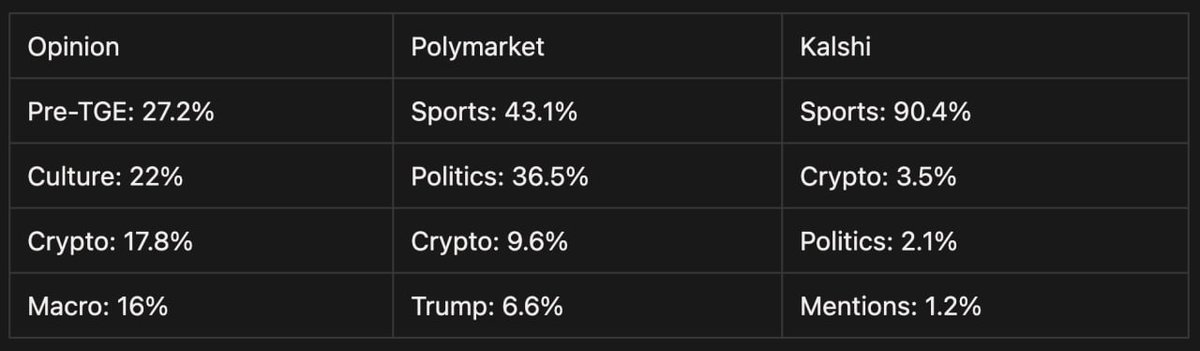
In the face of the huge存量规模 and visible增量空间, market competition is inevitable. Currently, among the four major U.S. sports leagues, only the NHL has stepped in and signed authorization agreements with Kalshi and Polymarket respectively, while the NFL, NBA, and MLB are still in a wait-and-see stage. It is expected that after Polymarket has successively seized the exclusive authorization of UFC and MLS, Kalshi and Polymarket, the two leaders with compliance and capital advantages, are likely to engage in more intense competition for the authorization of various top-tier sports events in the future, and there will inevitably be more exclusive agreements.

But the data also reveals another interesting phenomenon — perhaps due to cultural differences and user habits, emerging prediction markets on the other side of the world are moving towards截然不同的差异化道路. As shown in the previous figure, the proportion of event turnover围绕ing原生加密市场 events on Opinion is much higher than that on Kalshi and Polymarket. While the leaders are clashing head-on over the huge cake of sports events, choosing to take an unconventional path may be an opportunity for second-tier projects to catch up on a curve.


Perguntas relacionadas

QWhat is the significance of the partnership between MLS's Soccer United Marketing (SUM) and Polymarket?

AThe partnership makes Polymarket the official exclusive prediction market partner for MLS, MLS All-Star Game, MLS Cup, and Leagues Cup, allowing it to use official league data and integrity monitoring systems while restricting markets prone to manipulation or insider information.

QDoes an exclusive prediction market partnership like Polymarket's with MLS prevent other platforms from offering related markets?

ANo, it does not necessarily prevent other platforms from offering markets, as prediction markets currently operate under a less clear regulatory framework compared to sports betting, and authorization isn't legally required to open markets in most cases.

QWhat are the key benefits for a prediction market platform in securing an official data授权 from a sports league?

AOfficial data授权 provides more accurate, timely, and complete data, improving odds accuracy, settlement efficiency, and market variety. It also includes brand授权 for marketing and helps mitigate manipulation through regulated markets and shared monitoring.

QAccording to the data shared by Dovey Wan, what is the proportion of sports-related event volume on Kalshi and Polymarket?

ASports-related event volume accounts for over 90% on Kalshi and 43% on Polymarket, making it a core traffic source for these leading prediction markets.

QHow might the competition for top sports IP affect the prediction market landscape, particularly for second-tier projects?

AThe intense competition for exclusive sports授权 between giants like Kalshi and Polymarket may push second-tier projects to pursue差异化 strategies, such as focusing on crypto-native markets, as seen with Opinion's higher volume in that area.

Leituras Relacionadas

The Essence of AI Layoffs: Why More AI Adoption Leads to More Corporate Anxiety?

The author, awaiting potential inclusion on an 8000-person layoff list, analyzes the true nature of recent "AI-driven" layoffs. They argue that while AI use, particularly tools like Claude for code generation, has skyrocketed and boosted developer output (e.g., 2-5x more code commits), this has not translated into proportional business growth or revenue. The core issue is a misalignment between increased "Input" (code) and tangible "Outcomes" (user value, revenue). AI acts as a costly B2B SaaS, inflating operational expenses without guaranteed returns. Two key problems emerge: 1) The friction that once filtered out bad ideas is gone, as AI allows cheap pursuit of even weak concepts. 2) Organizational "alignment tax"—the difficulty of coordinating across teams—becomes crippling when development velocity outpaces consensus-building. Thus, layoffs serve two immediate purposes: 1) To offset ballooning AI costs (Token consumption) and maintain cash flow, as rising input costs without outcome growth destroys unit economics. 2) To reduce organizational bloat and alignment friction by simply removing teams, thereby speeding up execution in the short term. Therefore, these layoffs are fundamentally caused by AI, even if AI doesn't directly replace roles. They represent a painful correction until companies learn to convert AI-driven productivity into real business outcomes and streamline organizational coordination to match the new pace of work. The cycle will continue until this learning curve is mastered.

marsbitHá 2m

The Essence of AI Layoffs: Why More AI Adoption Leads to More Corporate Anxiety?

marsbitHá 2m

Can the Solana Foundation and Google's Collaboration on Pay.sh Bridge the Payment Link Between Web2 and Web3 in the Agent Economy?

Solana Foundation, in collaboration with Google Cloud, has launched Pay.sh, a payment gateway designed to bridge the gap between AI agents and enterprise-grade service infrastructure. The initiative aims to solve a key bottleneck in the "agent economy": existing payment systems are ill-suited for autonomous AI agents. Traditional methods like credit cards require human verification, while newer on-chain protocols like x402 and MPP create a separate, Web3-native system that raises barriers for service providers. Pay.sh functions as a universal payment layer. It allows users to fund a Solana wallet via credit card or stablecoin, which then acts as an identity and payment proxy for AI agents. When an agent needs to access a paid API service (e.g., Google Cloud, Alibaba Cloud), Pay.sh handles the transaction seamlessly. It leverages the HTTP 402 status code ("Payment Required") to initiate payments, intelligently choosing between one-time transfers (x402-style) or session-based authorizations (MPC-style) based on the service's billing model. This spares agents from manual account registration and API key management. A key feature for service providers is low integration effort. They can adopt Pay.sh by providing a declarative configuration file, enabling features like tiered pricing, free tiers, and automatic revenue splitting to multiple addresses (e.g., for royalties, cloud costs). Providers can also list their APIs in a central Pay Skill Registry for agent discovery. The collaboration with Google Cloud provides crucial infrastructure for API proxying, traffic routing, and compliance logging, aiming to keep agent activities within regulated boundaries. By connecting Web2 services with Web3 payment rails, Pay.sh positions the Solana wallet as a foundational identity and payment tool for AI agents, potentially driving more transaction volume to the Solana ecosystem. However, the report notes challenges. The service registry currently lacks robust vetting, risking exposure to unauthorized or malicious third-party APIs. Pay.sh also inherits security and compatibility risks from its underlying payment protocols (x402, MPC). Furthermore, adoption may be hindered by varying regional data privacy and payment compliance regulations among API providers. Despite these hurdles, Pay.sh represents a significant step towards integrating Web2 and Web3 for autonomous agent commerce.

marsbitHá 8m

Can the Solana Foundation and Google's Collaboration on Pay.sh Bridge the Payment Link Between Web2 and Web3 in the Agent Economy?

marsbitHá 8m

Bitcoin's Bull-Bear Cycle Indicator Turns Positive for the First Time in 7 Months: End of Bear Market or False Breakout?

Bitcoin's "Bull-Bear Market Cycle Indicator" from CryptoQuant has turned positive for the first time since October 2025. This gauge, based on the P&L Index relative to its 365-day moving average, suggests a potential shift from a bear market phase. Concurrently, the Bull Score Index rose to a neutral reading of 50 in late April. The indicator's move into positive territory follows a roughly 35% price rebound from a low near $60,000 in February to above $81,000. The recovery over approximately three months was faster than the 12-month period observed during the 2022 bear market. However, analysts caution against premature optimism, citing a historical precedent from March 2022. Back then, the Bull Score Index briefly hit 50, but it proved to be a false signal as Bitcoin's price subsequently plunged further. Structural differences exist in the current cycle, including consistent inflows into spot Bitcoin ETFs and an increase in large holder addresses. Yet, some models, referencing the four-year halving cycle, suggest a potential deeper bottom near $50,000 might still be possible around late 2026. In summary, while on-chain data shows marked improvement and the worst panic may be over, market participants remain cautious. A convincing trend reversal confirmation likely requires Bitcoin to sustainably break above key resistance, such as the 200-day moving average near $82,000.

marsbitHá 16m

Bitcoin's Bull-Bear Cycle Indicator Turns Positive for the First Time in 7 Months: End of Bear Market or False Breakout?

marsbitHá 16m

How to Automate Any Workflow with Claude Skills (Complete Tutorial)

This is a comprehensive guide to mastering Claude Skills, a feature for creating permanent, reusable instruction sets that automate specific workflows. Unlike simple saved prompts, Skills function like trained employees, delivering consistent, high-quality outputs by defining the entire task process, standards, error handling, and output format. The guide is structured in four phases: **Phase 1: Installation (5 minutes).** Skills are folders containing a `SKILL.md` file. The user is instructed to find a relevant Skill online, install it, test it on a real task, and compare its performance to one-off prompts. **Phase 2: Building Your First Custom Skill.** Start by rigorously defining the Skill's purpose, trigger phrases, and providing a concrete example of perfect output. The `SKILL.md` file has two parts: a YAML frontmatter with a specific name/description/triggers, and a detailed, step-by-step workflow written in natural language with examples and quality standards. **Phase 3: Testing & Optimization for Production.** Test the Skill in three scenarios: 1) a standard, common task; 2) edge cases with missing or conflicting data; and 3) a pressure test with maximum complexity. Any failure indicates a needed instruction. Implement a weekly optimization cycle to continuously refine the Skill based on real usage. **Phase 4: Building a Complete Skill Library.** The goal is to create a team of Skills for all repetitive tasks. Examples are given for industries like real estate, marketing, finance, consulting, and e-commerce. The user should list their tasks, prioritize them, and build one new Skill per week, maintaining a master document to track their library. The conclusion emphasizes the compounding time savings: ten Skills saving 30 minutes each per week reclaims over 260 hours (6.5 work weeks) per year, fundamentally transforming one's work system.

marsbitHá 39m

How to Automate Any Workflow with Claude Skills (Complete Tutorial)

marsbitHá 39m

Trading

Spot
Futuros
活动图片




