Prediction Market ETFs: A Foray into the Mainstream or Playing with Fire?

Odaily星球日报Publicado em 2026-02-22Última atualização em 2026-02-22

Resumo

A new wave of ETF applications has been submitted to the SEC by asset managers including Bitwise, GraniteShares, and Roundhill Investments. These ETFs aim to track the outcomes of U.S. political elections—such as the 2028 presidential race and 2026 midterm control of Congress—by packaging prediction market contracts into tradable securities. This would allow mainstream investors to use traditional brokerage accounts to bet on electoral results, similar to platforms like Polymarket or Kalshi, but within the regulated financial system. Prediction markets aggregate crowd-sourced probabilities through financial incentives, often demonstrating stronger predictive accuracy than traditional polls, as seen during the 2024 U.S. election. The proposed ETFs would reflect binary event probabilities, with share prices fluctuating between $0 and $1. If the predicted outcome occurs, the ETF value approaches $1; otherwise, it nears zero. Most funds would liquidate after the event settles. This move could significantly broaden participation and liquidity, potentially making prediction markets a tool for hedging policy risks or macro strategies. However, it also raises regulatory and ethical concerns, including potential market influence on public perception and the risk of manipulation. The SEC’s approval remains uncertain, as it may view these products as blurring the line between investing and gambling. The outcome of these applications could signal a major shift in how probabilistic even...

Original | Odaily Planet Daily (@OdailyChina)

Author | DingDang (@XiaMiPP)

Recently, ETF issuers Bitwise Asset Management and GraniteShares have filed applications with the U.S. Securities and Exchange Commission (SEC) for prediction market ETFs. Among them, Bitwise submitted six products under the "PredictionShares" brand, and GraniteShares quickly followed with a similarly structured proposal. A bit earlier, on February 13th, Roundhill Investments also filed documents for a similar type of product.

The core of these ETFs is tracking the outcomes of U.S. political elections. They attempt to package the "probability of outcomes" of U.S. political elections into a financial product that can be traded directly in traditional securities accounts. Specifically, the underlying focus is on the 2028 presidential election (whether the Democrat or Republican wins) and which party will control the Senate and House of Representatives in the 2026 midterm elections.

In other words, investors in the future might no longer need to go to the crypto world's Polymarket or register with the CFTC-regulated Kalshi; they could simply open their Robinhood or Fidelity account and place a bet on "who will win the White House" just like buying a stock.

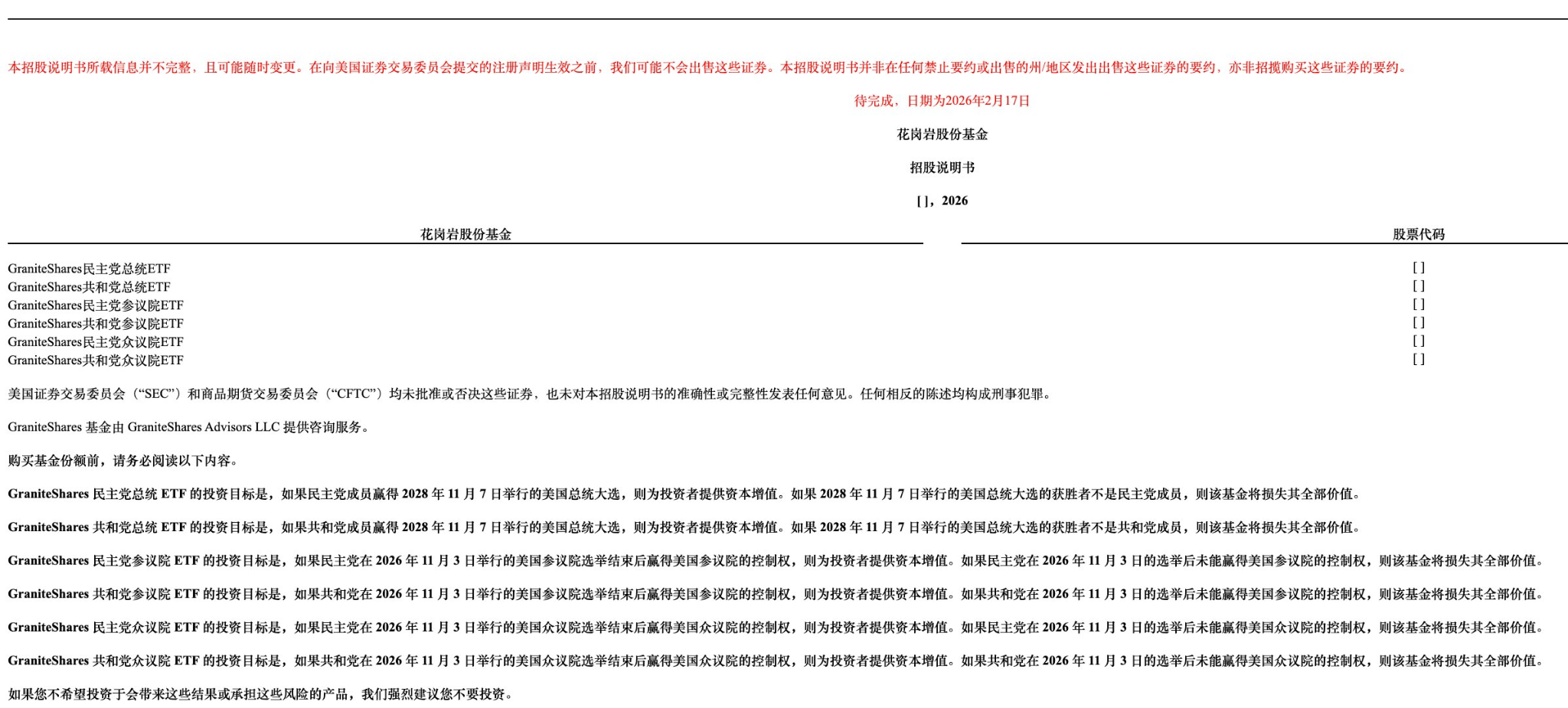
Screenshot from @jason_chen998

What does this leap forward signify?

Why Do Prediction Markets Always Seem "One Step Ahead"?

The "foresight" of prediction markets regarding political events is hardly news anymore.

A prediction market is essentially a group of people using real money to express judgments. Participants buy and sell "Yes/No" contracts to express their confidence in an event occurring. The prices of these contracts fluctuate between $0 and $1, representing the market's consensus on probability. For example, if you believe a candidate has a 70% chance of winning, you might buy a "Yes" contract for $0.70. If the event happens, the contract's value rises to $1; otherwise, it becomes worthless.

This is a form of crowd judgment weighted by capital. Unlike mere verbal expression, participants must bear the consequences of profit and loss for their judgments. The 2024 U.S. election was a concentrated example. At that time, trading volumes on Polymarket and Kalshi surged rapidly, with political contracts becoming the absolute mainstay. Before election day, the cumulative trading volume on Polymarket for the single market "2024 Presidential Election Winner" was approximately $3.7 billion. Kalshi, a later entrant, won a key lawsuit against the CFTC in September 2024, allowing it to legally offer election-related contracts. By November, its monthly trading volume reached $127 million, with about 89% coming from politics and election markets.

More noteworthy is the signal the data itself conveyed. Weeks before the 2024 election, the probability of a Trump victory on Polymarket stabilized above 60%, while mainstream polls showed a tight race, sometimes even with Harris slightly ahead. The result? The prediction market seemed to "read" the election situation early.

This doesn't mean prediction markets are "magically accurate," but across multiple election cycles, they have indeed demonstrated a strong ability to aggregate information. Research has found that, with sufficient liquidity and broad participation, the statistical performance of prediction markets often surpasses that of traditional poll samples. The older platform PredictIt has also been repeatedly regarded as an effective information aggregator. In contrast, traditional polls are susceptible to factors like sample bias and response bias.

The root of the difference lies in the incentive structure: polls express attitudes, prediction markets entail bearing consequences. The former has no cost, the latter has clear profits and losses. This structural difference determines the different ways information is processed.

Although prediction markets cooled down significantly after the election—Polymarket's daily trading volume plummeted by about 84% after the results were announced—the number of prediction market projects grew rapidly entering 2025. Now, in 2026, data from predictionindex.xyz shows there are as many as 137 prediction market projects, with the leading player, Polymarket, having a total trading volume exceeding $50 billion and a monthly trading volume of $8 billion.

From a fringe experiment to a mainstream sector, prediction markets are a far cry from what they once were. Now, imagine if participation could be made easy through ETFs; this collective intelligence could influence public perception of political events even more widely.
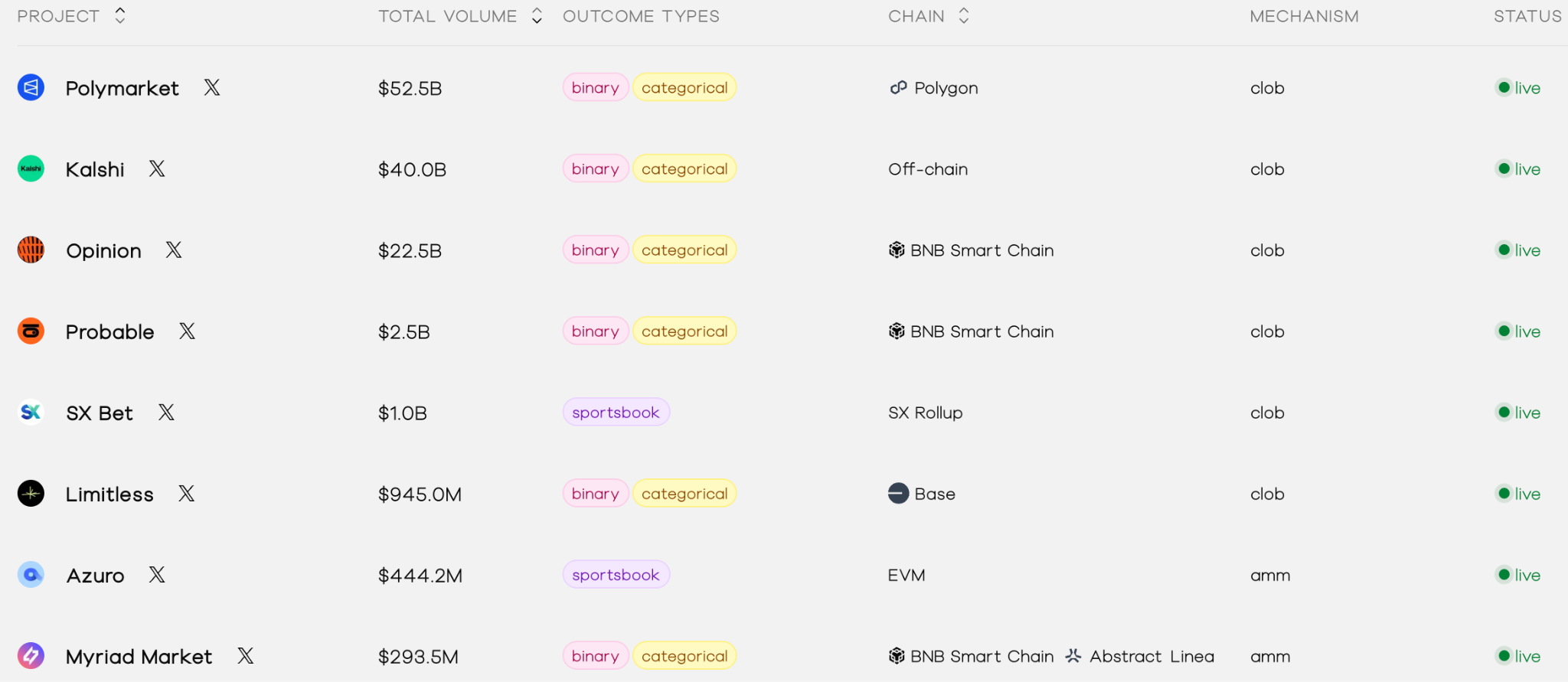
How ETFs Package Prediction Markets

So, how are these ETFs bringing the玩法 (gameplay) of prediction markets to Wall Street?

What these issuers are doing is essentially translating the contract prices of prediction markets into a product structure understandable by the securities market. Dressed in the cloak of an ETF, it allows you to buy and sell through a正规 (formal) brokerage account, but you're still betting on the outcome of a political event.

Taking the six ETFs filed by Bitwise as an example, four directly target the 2028 presidential election (Democrat/Republican win), and the remaining two correspond to control of the Senate and House in the 2026 midterm elections. The structures from GraniteShares and Roundhill are largely similar. Simply put, these ETFs directly map the price performance of those binary event contracts on Kalshi or Polymarket into tradable ETF shares.

Mechanically, the share price of these ETFs will fluctuate between $0 and $1, reflecting the market's real-time consensus on the event's likelihood. The funds will invest at least 80% of their assets in derivatives linked to these political events, such as contracts obtained from CFTC-approved exchanges like Kalshi, or synthetic swaps to mimic the performance. The buying process is the same as buying a stock: through brokerage accounts like Robinhood or Fidelity, with expected expense ratios between 0.5% and 1%, and the trading venue being NYSE Arca.

At settlement, if the event occurs (e.g., Democrat wins the presidential election), the corresponding "Yes" ETF's value approaches $1; otherwise, it approaches $0. Bitwise's plan is for the fund to liquidate and terminate shortly after the event outcome is determined, distributing the remaining assets proportionally to holders; some products from GraniteShares and Roundhill are more "flexible," potentially allowing a "roll" into the next election cycle.

Compared to the Bitcoin ETFs we are familiar with, there is a clear distinction here. Bitcoin ETFs like BlackRock's IBIT track the price of Bitcoin, with unlimited upside or downside potential, suitable as part of an asset allocation. Prediction market ETFs, however, lean more towards binary probability bets, with a cap fixed at $1, similar to buying insurance or options—winner takes all, loser loses everything.

The question is, when probability becomes a tradable asset, is it still merely an information aggregation mechanism?

Mainstreaming, or Gamblification?

If these ETFs are approved, prediction markets will truly enter the mainstream financial view.

Currently, political prediction markets are still concentrated among crypto users or professional traders. Once ETFs go live, the participation barrier for institutional capital and traditional investors will be significantly lowered. Companies might use them to hedge against policy change risks, and portfolio managers might see them as macro risk management tools. Liquidity will be amplified, and price signals might become sharper.

But the problems on the other side are equally obvious. The 2024 election already proved that prediction market prices are cited by media, amplified on social platforms, and even influence public sentiment. When probability is packaged as "market consensus," it can easily be interpreted as an objective trend. If the scale of capital expands further, could there be deliberate attempts to manipulate prices to influence public opinion? PredictIt was embroiled in legal disputes in its early days due to compliance issues; such concerns are not unfounded.

Regulation remains the biggest uncertainty. The SEC might worry that this is essentially the "gamblification" of finance, increasing the risk of manipulation or moral hazard. The approval process might come with conditions, such as trading limits or additional disclosures. Currently, the CFTC has allowed Kalshi to trade election futures, which is a positive signal, but the SEC's stance remains unclear.

Conclusion

From crypto-native markets to Wall Street ETFs, prediction markets are undergoing an identity transformation. However, before the regulatory framework is clear, the moves by issuers seem more like a probe. They are testing regulatory boundaries and also testing the market's acceptance of "probability as an asset."


Perguntas relacionadas

QWhat is the core function of the prediction market ETFs recently filed with the SEC by Bitwise and GraniteShares?

AThe core function is to track the outcome probabilities of U.S. political elections, such as the 2028 presidential election and the 2026 midterm elections, packaging these probabilities into tradable financial products.

QHow do prediction markets differ from traditional polls in terms of accuracy and incentives?

APrediction markets use real-money stakes where participants bear financial consequences for their judgments, leading to more accurate information aggregation. Traditional polls rely on expressed attitudes without financial incentives, making them prone to sample and expression biases.

QWhat mechanism do these ETFs use to translate prediction market contracts into tradable securities?

AThe ETFs map the price movements of binary event contracts (e.g., from CFTC-approved exchanges like Kalshi) onto ETF shares, with prices fluctuating between $0 and $1 to reflect real-time market consensus on event probabilities.

QWhat are the potential risks associated with mainstreaming prediction markets through ETFs?

ARisks include the potential for market manipulation to influence public opinion, moral hazards, and regulatory uncertainties, as the SEC may view these products as akin to gambling rather than legitimate financial instruments.

QHow did prediction markets perform during the 2024 U.S. presidential election compared to traditional polls?

APrediction markets like Polymarket showed Trump's win probability consistently above 60% weeks before the election, while traditional polls indicated a tight race or a slight lead for Harris, demonstrating the markets' superior information aggregation capabilities.

Leituras Relacionadas

Annual Salary of Millions Competing for Electricians, Meta Rushes to Open Its Own Technical School

The AI boom is facing an unexpected bottleneck: a severe shortage of skilled construction workers and electricians. As tech giants like Meta, OpenAI, and Alphabet race to build massive data centers—such as OpenAI's $16 billion "Stargate" project—they are hitting a critical labor wall. The U.S. needs an estimated 130,000 more electricians, 240,000 construction workers, and 150,000 supervisors by 2030 for AI infrastructure alone, but tens of thousands of electrician jobs go unfilled each year. While AI companies offer high premiums, with electricians earning up to $280,000 annually, worker scarcity still causes massive losses—delays on a single project can cost $14.2 million per month. The complexity of building AI data centers, which require immense power (equivalent to powering hundreds of thousands of homes), sophisticated electrical systems, and advanced liquid cooling solutions, demands highly skilled technicians who are in short supply. To combat this, companies are investing heavily in training. Meta has committed $115 million to a free training school offering tuition, housing, and stipends, targeting 5,000 new workers. OpenAI is partnering with unions to secure skilled labor. These efforts are paying off, with a significant rise in Gen Z interest in trade schools over college. However, the power demands are staggering. AI data centers are driving a rapid surge in electricity consumption, projected to account for up to 12% of U.S. power use by 2028 and raising costs for consumers. Furthermore, the construction boom is project-based, leading to a potential future glut of trained workers once building peaks, which could depress wages industry-wide. The race for AI supremacy now depends as much on skilled hands as on advanced chips.

marsbitHá 24m

Annual Salary of Millions Competing for Electricians, Meta Rushes to Open Its Own Technical School

marsbitHá 24m

OpenAI No Longer Sells Its Most Expensive Model for Profit

OpenAI is shifting its business strategy away from promoting its most expensive, flagship models for every task. Recent price cuts—80% for GPT-5.6 Luna and 20% for Terra—signal a deeper change: the company now actively advises users that many tasks don't require the most powerful model. Instead, OpenAI recommends a tiered approach: use the high-end GPT-5.6 Sol for complex planning and analysis, then delegate execution to cheaper models like Luna. This mirrors moves by Anthropic, which recently launched Claude Opus 5 at half the price of its top model, Fable 5. Both companies are de-emphasizing flagship models as primary revenue drivers, using them instead for brand prestige and technological showcases. The industry is entering a "mass-market" phase, similar to automotive, where high-volume, cost-effective models handle daily operations and drive scale. OpenAI's price reductions are partly enabled by AI models themselves optimizing underlying code and infrastructure, creating a self-reinforcing cycle of efficiency gains and cost reduction. Competition is shifting from "who is smartest" to "who offers the best value." The goal is no longer selling individual models but fostering widespread API adoption and ecosystem lock-in. By making AI calls cheap and ubiquitous, companies like OpenAI aim to become the indispensable, utility-like infrastructure powering automated workflows—the "water and electricity" of software, quietly embedded everywhere.

marsbitHá 24m

OpenAI No Longer Sells Its Most Expensive Model for Profit

marsbitHá 24m

Will the Fed Definitely Raise Interest Rates in September? How Will Crypto and U.S. Stocks Withstand the Pressure?

The market's expectation for a September Fed rate hike surged dramatically in early August, jumping from under 50% to over 80% within a week. This shift followed a contentious July FOMC meeting, where a 9-3 vote to hold rates revealed growing dissent from hawkish members advocating for an immediate hike to combat persistent inflation. The primary catalyst for this repricing is rising oil prices, driven by renewed geopolitical tensions around the Strait of Hormuz, which threaten global supply. Energy costs directly influence inflation metrics, making the upcoming July CPI report (due August 12th) a critical data point. If it shows inflation reaccelerating, the probability of a September hike will solidify. For Bitcoin and crypto assets, this is typically bearish news. Bitcoin continues to behave as a high-beta, liquidity-sensitive risk asset. A rate hike raises the opportunity cost of holding non-yielding assets and could drive capital toward money markets, pressuring crypto prices in the short term. However, historical patterns suggest that if a hike is perceived as the end of a tightening cycle rather than the start, any negative price impact may be brief. U.S. stocks, particularly crypto-linked equities like Coinbase and growth-oriented tech stocks, are also vulnerable. Higher rates increase discount rates in valuation models, putting pressure on high-multiple companies. This coincides with a pivotal tech earnings season where investor focus has shifted from massive AI capital expenditure to tangible revenue and cash flow generation. Companies with negative cash flow and weak growth narratives could face heightened volatility if borrowing costs rise in September. In summary, a September Fed hike has evolved into a mainstream market scenario. Key factors to watch are oil prices, the July CPI report, and Fed communications, which will determine the final decision and its impact on volatile crypto and equity markets.

marsbitHá 35m

Will the Fed Definitely Raise Interest Rates in September? How Will Crypto and U.S. Stocks Withstand the Pressure?

marsbitHá 35m

Trading

Spot
活动图片




