Prediction Market ETFs: A Foray into the Mainstream or Playing with Fire?

marsbitPublicado em 2026-02-22Última atualização em 2026-02-22

Resumo

Several major ETF issuers, including Bitwise Asset Management, GraniteShares, and Roundhill Investments, have recently filed applications with the U.S. SEC to launch prediction market ETFs. These ETFs are designed to track the outcomes of U.S. political events, such as the 2028 presidential election and the 2026 midterms, allowing investors to trade election probabilities through traditional brokerage accounts like Robinhood or Fidelity. Prediction markets aggregate crowd-sourced forecasts using real-money contracts, where prices reflect the market’s consensus probability of an event occurring. Platforms like Polymarket and Kalshi have demonstrated strong predictive accuracy in events like the 2024 U.S. election, often outperforming traditional polls due to their incentive-based structure. The proposed ETFs would track the price movements of these prediction market contracts, with share values fluctuating between $0 and $1. If the predicted event occurs, the corresponding “Yes” ETF would settle near $1; otherwise, it would approach $0. Unlike Bitcoin ETFs, which track asset prices, these are binary outcome products, more akin to options or insurance. If approved, these ETFs could bring prediction markets into mainstream finance, offering new tools for hedging and macro risk management. However, concerns remain about potential market manipulation, public perception influence, and regulatory approval, as the SEC may view them as gambling-like instruments. The move represents...

Original | Odaily Planet Daily (@OdailyChina)

Author | DingDang (@XiaMiPP)
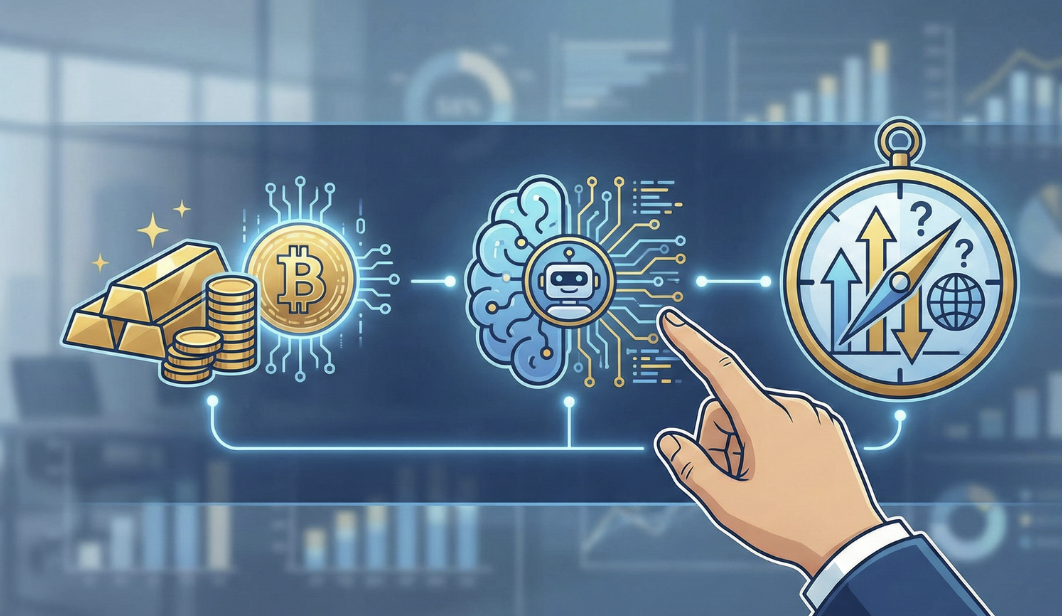
Recently, ETF issuers Bitwise Asset Management and GraniteShares have filed applications with the U.S. Securities and Exchange Commission (SEC) for prediction market ETFs. Among them, Bitwise submitted six products under the "PredictionShares" brand, and GraniteShares quickly followed with a structurally similar proposal. A bit earlier, on February 13th, Roundhill Investments also submitted documents for a similar type of product.

The core of these ETFs is tracking the outcomes of U.S. political elections. They attempt to package the "probability of outcomes" of U.S. political elections into a financial product that can be traded directly in traditional securities accounts. Specifically, the underlying focus is on the 2028 presidential election (whether a Democrat or Republican wins) and the control of the Senate and House of Representatives in the 2026 midterm elections.

In other words, investors in the future might no longer need to go to the crypto world's Polymarket or register with the CFTC-regulated Kalshi; they could simply open their Robinhood or Fidelity account and, like buying a stock, bet on "who will win the White House."
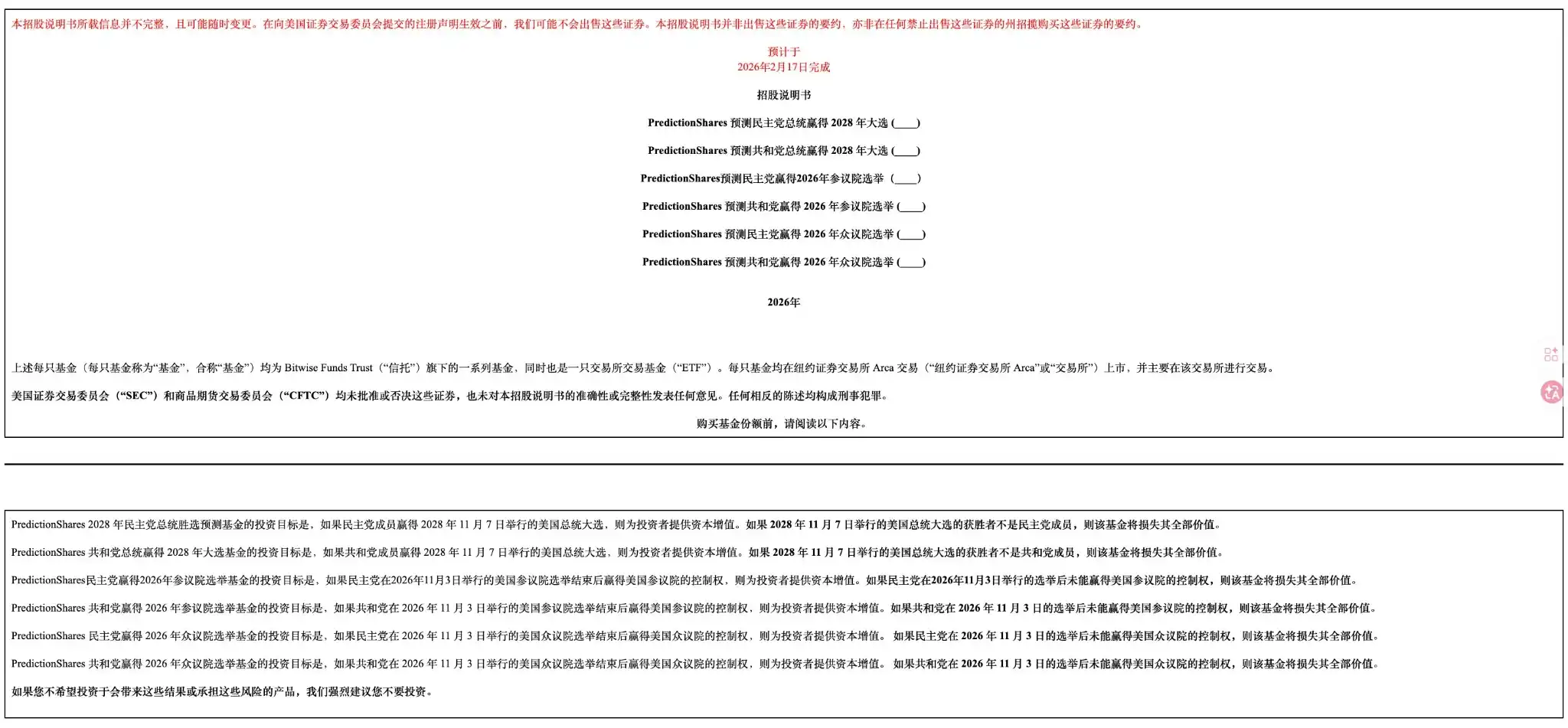
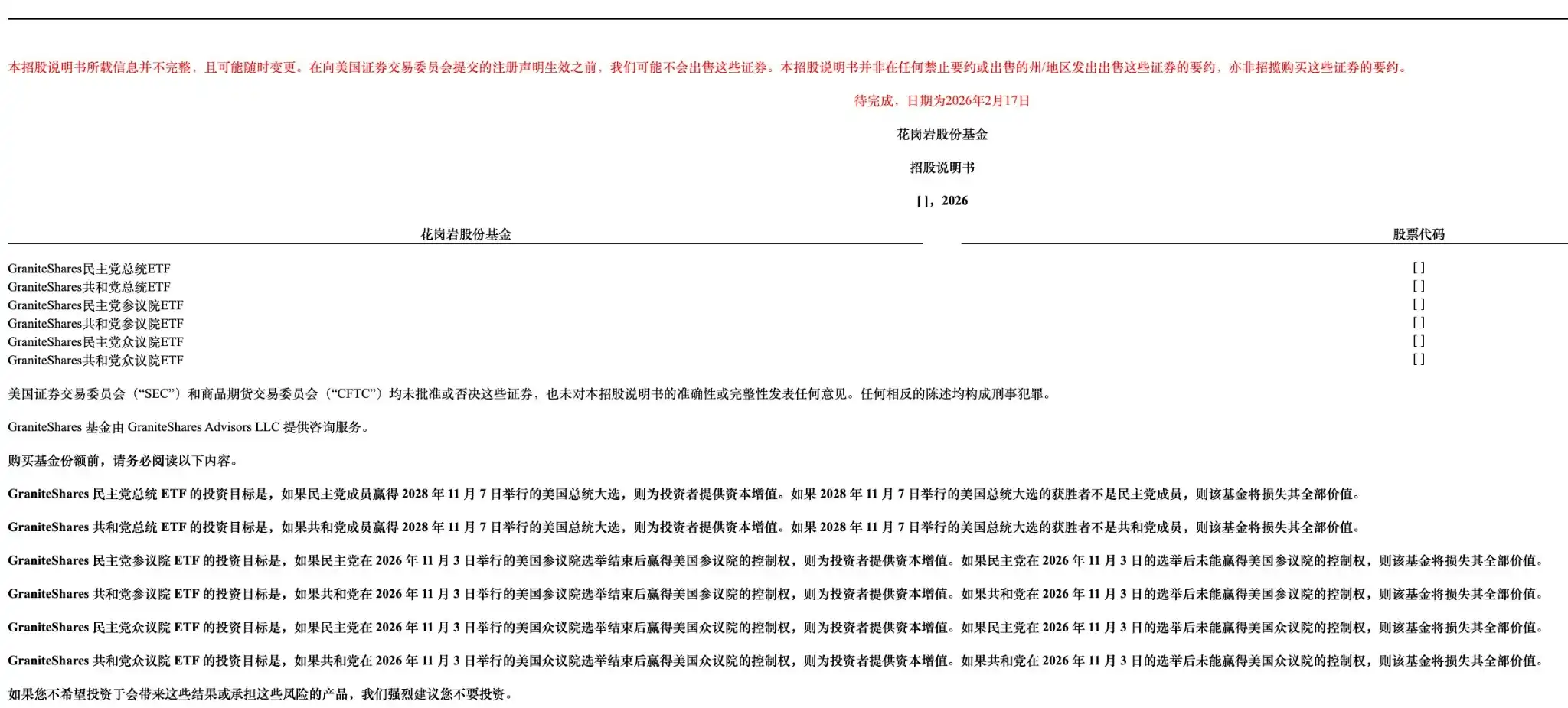
Screenshot from @jason_chen998

What does this leap forward signify?

Why Do Prediction Markets Always Seem "One Step Ahead"?

The "foresight" of prediction markets regarding political events is hardly new.

A prediction market is a group of people using real money to express judgments. Participants buy and sell "Yes/No" contracts to express their confidence in an event occurring. The prices of these contracts fluctuate between $0 and $1, representing the market's consensus on the probability. For example, if you believe a candidate has a 70% chance of winning, you might buy a "Yes" contract for $0.70. If the event happens, the contract's worth rises to $1; otherwise, it becomes worthless.

This is a form of capital-weighted collective judgment. Unlike mere verbal expression, participants must bear the consequences of profit and loss for their judgments, as was vividly demonstrated in the 2024 U.S. election. At that time, trading volumes on Polymarket and Kalshi surged rapidly, with political contracts becoming the absolute mainstay. In the days leading up to the election, the cumulative trading volume on Polymarket for the single market "2024 Presidential Election Winner" was approximately $3.7 billion. Kalshi, a later entrant, won a key lawsuit against the CFTC in September 2024, allowing it to legally offer election-related contracts. By November, its monthly trading volume reached $127 million, with about 89% coming from politics and election markets.

More noteworthy is the signal the data itself conveyed. Weeks before the 2024 election, the probability of a Trump victory on Polymarket stabilized above 60%, while mainstream polls showed a tight race, sometimes even with a slight lead for Harris. The result? The prediction market seemed to "read" the election situation early.

This doesn't mean prediction markets are "magically accurate," but over multiple election cycles, they have indeed shown a strong ability to aggregate information. Research has found that, with sufficient liquidity and broad participation, the statistical performance of prediction markets often surpasses that of traditional poll samples. The older platform PredictIt has also been repeatedly regarded as an effective information aggregator. In contrast, traditional polls are susceptible to factors like sample bias and response bias.

The root of the difference lies in the incentive structure: polls express attitudes, prediction markets bear consequences. The former has no cost, the latter has clear profits and losses. This structural difference determines how information is processed.

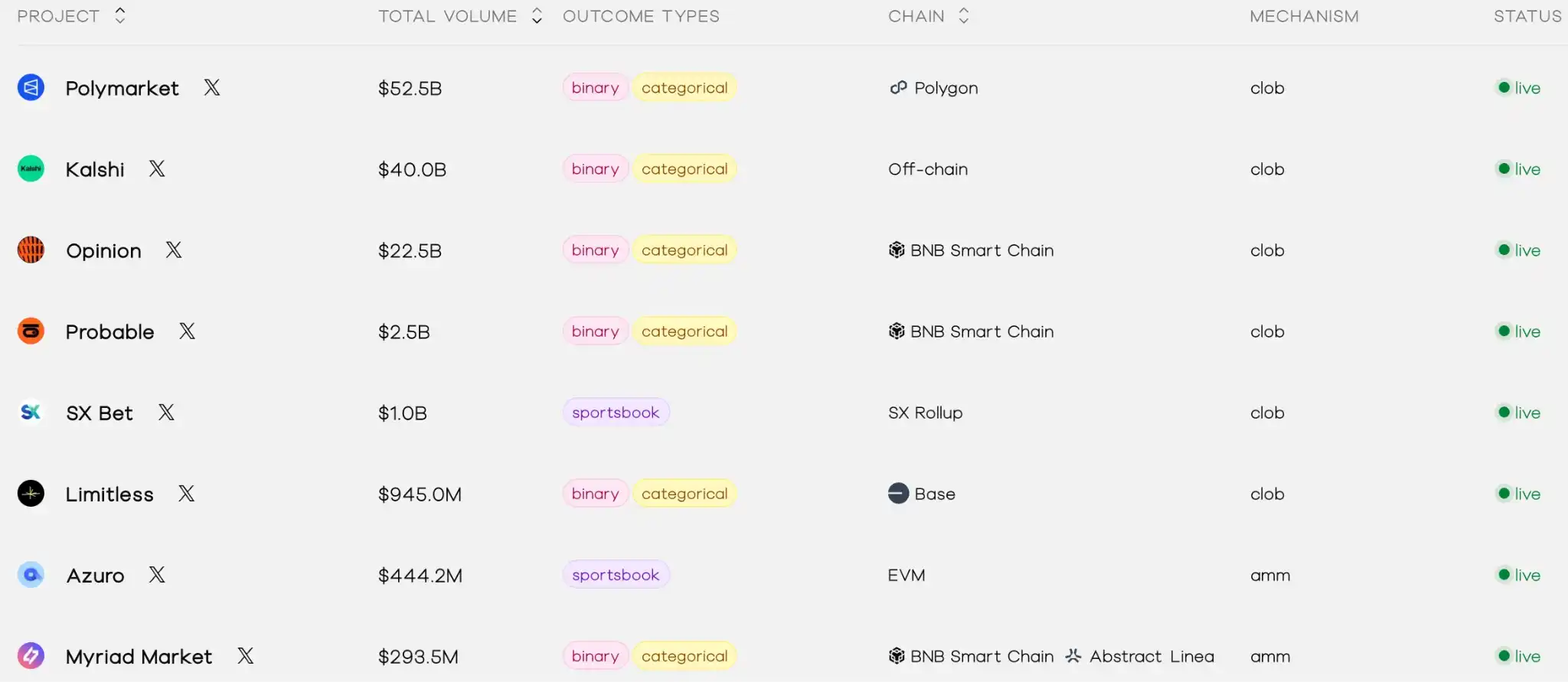
Although prediction markets cooled down after the election—Polymarket's daily trading volume plummeted by about 84% after the results were announced—the number of prediction market projects grew rapidly entering 2025. By 2026, according to data from predictionindex.xyz, there are already 137 prediction market projects, with the leading player Polymarket's total trading volume exceeding $50 billion and monthly trading volume reaching $8 billion.

From a fringe experiment to a mainstream track, prediction markets are a far cry from what they used to be. Now, imagine if participation could be made easy through ETFs, this collective intelligence could more widely influence public perception of political events.
How ETFs Package Prediction Markets

So, how do these ETFs translate the玩法 (play/mechanism) of prediction markets to Wall Street?

What these issuers are essentially doing is translating the contract prices of prediction markets into a product structure understandable by the securities market. Dressed in the cloak of an ETF, it allows you to buy and sell through a正规 (formal/regular) brokerage account, but you're still betting on the outcome of a political event.

Taking the six ETFs submitted by Bitwise as an example, four directly target the 2028 presidential election (Democrat/Republican win), and the remaining two correspond to control of the Senate and House in the 2026 midterms. The structures from GraniteShares and Roundhill are largely similar. Simply put, these ETFs directly map the price performance of those binary event contracts on Kalshi or Polymarket into tradable ETF shares.

Mechanically, the share price of these ETFs will fluctuate between $0 and $1, like the contracts, reflecting the market's real-time consensus on the event probability. The funds will invest at least 80% of their assets in derivatives linked to these political events, such as contracts obtained from CFTC-approved exchanges like Kalshi, or use synthetic swaps to replicate the performance. The buying process is the same as buying a stock: through brokerage accounts like Robinhood or Fidelity, with expense ratios expected to be between 0.5% and 1%, and the trading venue is likely to be NYSE Arca.

At settlement, if the event occurs (e.g., a Democrat wins the presidency), the corresponding "Yes" ETF's value approaches $1; otherwise, it approaches $0. Bitwise's plan is that shortly after the event outcome is determined, the fund will liquidate and terminate, distributing the remaining assets pro-rata to holders; some products from GraniteShares and Roundhill are more "flexible," potentially allowing a "roll" into the next election cycle.

Compared to the Bitcoin ETFs we are familiar with, there is a clear distinction. Bitcoin ETFs like BlackRock's IBIT track the price of Bitcoin, with unlimited upside or downside potential, suitable as part of an asset allocation. Prediction market ETFs are more akin to binary probability bets, with a cap fixed at $1, similar to buying insurance or options—winner takes all, loser loses everything.

The question is, when probability becomes a tradable asset, is it still merely an information aggregation mechanism?

Mainstreaming, or Gamblification?

If these ETFs are approved, prediction markets will truly enter the mainstream financial view.

Currently, political prediction markets are still concentrated among crypto users or professional traders. Once ETFs are launched, the participation barrier for institutional capital and traditional investors will be significantly lowered. Companies might use them to hedge policy change risks, and portfolio managers might see them as macro risk management tools. Liquidity will be amplified, and price signals might become sharper.

But the problems on the other side are equally obvious. The 2024 election already proved that prediction market prices are cited by media, amplified on social platforms, and even influence public sentiment. When probability is packaged as "market consensus," it is easily interpreted as an objective trend. If the scale of capital further expands, could there be deliberate attempts to manipulate prices to influence public opinion? PredictIt was embroiled in legal disputes in its early days due to compliance issues; such concerns are not unfounded.

Regulation remains the biggest uncertainty. The SEC might worry this is essentially the "gamblification" of finance, increasing the risk of manipulation or moral hazard. The approval process might come with conditions, such as trading limits or additional disclosures. Currently, the CFTC allowing Kalshi to trade election futures is a positive signal, but the SEC's stance remains unclear.

Conclusion

From crypto-native markets to Wall Street ETFs, prediction markets are undergoing an identity transformation. However, before the regulatory framework is clear, the moves by issuers seem more like a probe—testing regulatory boundaries and the market's acceptance of "assetized probability."


Perguntas relacionadas

QWhat is the core function of the prediction market ETFs recently filed with the SEC by Bitwise and GraniteShares?

AThe core function of these ETFs is to track the outcome of U.S. political elections, specifically the probability of a particular party winning, and package it as a tradable financial product in traditional securities accounts.

QHow does the mechanism of a prediction market differ from a traditional opinion poll?

AThe key difference lies in the incentive structure. Opinion polls involve expressing an attitude with no cost, while prediction markets require participants to back their judgment with real money, directly linking their financial gain or loss to the outcome of the event.

QWhat is a significant potential risk associated with the mainstream adoption of prediction market ETFs mentioned in the article?

AA significant risk is the potential for 'gamblification' of finance and the possibility of market manipulation to influence public opinion, as the price signals from these large-scale markets could be misinterpreted as objective trends.

QHow do the proposed prediction market ETFs, like those from Bitwise, handle the settlement process after an election outcome is determined?

AFor Bitwise's ETFs, if the event occurs (e.g., a party wins), the corresponding 'Yes' ETF's value will be close to $1. The fund will then be quickly liquidated and terminated, distributing the remaining assets to shareholders proportionally.

QWhat major regulatory body's stance is still uncertain regarding the approval of these prediction market ETFs, according to the article?

AThe stance of the U.S. Securities and Exchange Commission (SEC) is still uncertain, as it may view these products as a form of gambling and have concerns about manipulation or moral hazard, despite the CFTC having already approved election contracts on platforms like Kalshi.

Leituras Relacionadas

GPT-5.6 Countdown: Abandon the Illusion of a Single API, Computational Iteration Can't Outpace a Single Page of Compliance

In mid-June, three seemingly independent industry events—the compliance-driven throttling of Fable 5, the open-sourcing of GLM-5.2, and the leaked release timeline for GPT-5.6—are pushing the global AI industry toward a watershed moment. These shifts signal a fundamental restructuring of the industry's underlying logic. First, **"usability" has substantially overtaken "advanced capabilities"** as the primary weight, pushing the global large language model (LLM) supply chain into a "dual-track" phase of controlled closed-source and local open-source coexistence. Second, **the competitive moats of closed-source giants are shifting**. Their technical focus is moving from "language intelligence" toward "spatial intelligence (world models)"—a domain heavily reliant on computing power. Third, faced with常态化 transnational compliance risks, **a "model-agnostic" decoupled design has become a survival necessity for application-layer developers to maintain business continuity.** The article details how Anthropic's Fable 5, despite its advanced engineering feats, was restricted for non-U.S. citizens within 72 hours of launch, highlighting how geopolitical compliance can instantly limit even the most advanced models. In response, the open-source camp, exemplified by Zhipu AI's MIT-licensed GLM-5.2, is gaining market share by offering stable performance improvements and significant cost advantages (up to 70% savings for enterprises), while achieving full adaptation with domestic semiconductor platforms. Meanwhile, closed-source leaders like OpenAI are pivoting. The anticipated GPT-5.6 reportedly shifts focus from language to spatial intelligence and world models, aiming to rebuild a generational gap in areas like 3D understanding, simulation, and industrial design that demand immense compute. The core conclusion is that the LLM supply chain's logic has changed. Enterprises must now evaluate infrastructure based on a composite of technical performance and policy compliance. For developers, complete reliance on a single closed-source API poses unacceptable risk. Implementing a truly model-agnostic architecture—enabling swift switches to compliant, locally deployable open-source alternatives—is no longer just good practice but a fundamental baseline for business continuity.

marsbitHá 49m

GPT-5.6 Countdown: Abandon the Illusion of a Single API, Computational Iteration Can't Outpace a Single Page of Compliance

marsbitHá 49m

Is the 'Token Subsidy War' Among AI Giants Almost Over?

The article discusses the ongoing "token subsidy war" among AI giants like OpenAI and Anthropic, questioning whether it's nearing its end. It reveals that current AI subscription prices are heavily subsidized, with some plans offering tokens at up to 70 times the actual cost to attract and retain heavy users, especially developers and enterprises. This strategy mirrors past internet-era subsidy battles, but with a key difference: AI tokens lack "lock-in" effects. Unlike ride-hailing or food delivery apps, users can easily switch between AI providers as APIs become standardized, making it difficult for companies to raise prices post-subsidy. The piece highlights a structural asymmetry in the competition. Giants like Google, with massive advertising revenue, can afford to subsidize tokens indefinitely, akin to using "tokens as a weapon." In contrast, venture-backed companies like OpenAI and Anthropic face pressure to become profitable, especially as they approach IPO. The article cites Google Ventures founder Bill Maris, who suggests Google could slash token prices by 80%, putting immense pressure on competitors. Two potential endgames are presented: the "internet service" model (subsidize, monopolize, then raise prices) and the "utility" model (tokens become a standardized, low-margin commodity like electricity). Given the low switching costs, the latter seems more likely. The competition may not have a single winner but could instead accelerate AI's evolution into a foundational, infrastructure-level technology, akin to a public utility. For now, users continue to benefit from heavily subsidized token costs.

marsbitHá 1h

Is the 'Token Subsidy War' Among AI Giants Almost Over?

marsbitHá 1h

Beyond the Stadium: The Profitable Games Surrounding the World Cup

"Beyond the Pitch: The Profit Game Around the World Cup" The FIFA World Cup transcends being a sporting spectacle, evolving into a massive global arena for speculation and profit-seeking. The 2026 tournament has amplified this dynamic, creating a multi-layered ecosystem of financial opportunism alongside the football. **Prediction markets** have surged into the mainstream. Platforms like Polymarket and Kalshi saw trading volumes for World Cup contracts soar, attracting new users with their financial trading model and high-profile, chain-based wealth stories that overshadow traditional sports betting in terms of growth and narrative. However, **traditional sportsbooks** remain the dominant force, leveraging established user habits, legal markets, and comprehensive product offerings to handle the vast majority of speculative wagers, with projections suggesting record-breaking betting volumes. Capital markets also react. **"Concept stocks"** in countries like South Korea and Japan experience volatile price swings based on team performance and anticipated fan spending on items like chicken, beer, and viewing parties, effectively becoming a stock market reflecting fan sentiment. The **ticket resale market** has become a sophisticated arena for arbitrage. Prices fluctuate wildly based on team draws and star power, with sellers sometimes listing tickets they don't yet own in a practice akin to short-selling, while FIFA's own "Right to Buy" tokens add another layer of speculative trading. **Collectibles and merchandise** offer another avenue. Panini sticker albums, with their inherent scarcity and nostalgic value, can become high-value collectibles. Limited-edition or locally themed jerseys command significant premiums on secondary markets, and even counterfeit vendors profit from fans' desire for affordable match-day identity. The **cryptocurrency** space has seen a frenzy of speculative, unauthorized World Cup-themed meme coins on chains like Solana. These tokens, often exploiting team names and player imagery, experience extreme pump-and-dump cycles, creating stories of massive gains for a few early entrants and steep losses for many others. Finally, an entire industry thrives on **providing information and tools** to other speculators. Developers create platforms like SeatSidekick to track ticket inventory and prices, while paid Telegram groups and subscriptions sell betting tips and predictions, monetizing the widespread desire for an informational edge. In essence, the World Cup has become a compressed, global laboratory for speculation. While the games determine champions on the field, a parallel, complex network of financial transactions—spanning prediction contracts, bets, stocks, tickets, collectibles, crypto, and information services—settles its own scores in the global market.

marsbitHá 1h

Beyond the Stadium: The Profitable Games Surrounding the World Cup

marsbitHá 1h

How Does Codex Use a Computer? Three Entry Points and Permission Boundaries

This article explains the three primary methods for Codex to interact with a computer, each with distinct use cases, permission boundaries, and trust levels. **1. Computer Use:** This offers the broadest access, allowing Codex to visually control and interact with the graphical user interface of authorized macOS/Windows apps, system settings, and even iOS simulators. It's ideal for tasks lacking APIs or structured tools, such as operating legacy software or multi-app workflows. However, it's the slowest method and has the widest permission scope, requiring careful supervision for sensitive actions. **2. Chrome Extension:** This grants Codex access to the user's logged-in Chrome browser state, including cookies, profiles, and open tabs. It's best for tasks requiring user identity across websites like Gmail, LinkedIn, Salesforce, or internal dashboards. Its key advantage is multi-tab control for complex workflows. While more powerful for browser-based tasks than Computer Use, it carries higher sensitivity as actions are performed under the user's identity. **3. In-App Browser:** This is a browser isolated within the Codex thread, separate from the user's personal browsing data. It excels in web development and debugging scenarios—previewing local servers, testing responsive layouts, or annotating designs directly on the page. Its isolation is a strength for development but a limitation for tasks requiring login sessions. The core principle is to choose the narrowest, safest, and most structured interface for the task. Use plugins or MCPs first, resort to visual control (Computer Use) only for GUI-dependent tasks, employ the Chrome extension for identity-reliant browser work, and prefer the In-App Browser for isolated development. **Appshots** are clarified as a fourth, complementary tool for *inputting* context—capturing a screenshot of a window to point Codex to something—rather than a method for Codex to *act*. Together, this layered approach highlights a key to AI agent productization: not granting unlimited permissions, but constraining them within clear boundaries for specific tasks while preserving user oversight.

marsbitHá 3h

How Does Codex Use a Computer? Three Entry Points and Permission Boundaries

marsbitHá 3h

Trading

Spot
Futuros
活动图片