Polygon's $250 Million Acquisition Signals Shift in L2 Competition

marsbitPublicado em 2026-01-14Última atualização em 2026-01-14

Resumo

Polygon Labs has announced the acquisition of cryptocurrency payment infrastructure provider Coinme and blockchain development platform Sequence for a total exceeding $250 million. The strategic move aims to bolster Polygon's stablecoin strategy and its vision for an "Open Money Stack." Coinme, a long-standing compliant crypto business in the U.S., operates a vast network of over 50,000 retail locations and holds a series of money transmitter licenses. This acquisition provides Polygon with critical off-ramp and on-ramp capabilities, enabling seamless conversion between cash, fiat, and on-chain assets like stablecoins. Sequence contributes its modular technology stack, including a smart wallet with account abstraction and a cross-chain orchestration engine called Trails. This simplifies the user experience by allowing seamless interactions across multiple chains without users needing to manage gas fees or underlying complexities. Together, these acquisitions form the foundation of Polygon's Open Money Stack, which integrates layers for fiat ramps, wallet infrastructure, cross-chain interoperability, and blockchain settlement. This reflects a broader shift in the Layer 2 competitive landscape, where success is increasingly determined by full-stack integration—combining compliant entry points with seamless user experiences—rather than just technical performance.

Original Author: Sanqing, Foresight News

On January 13, Polygon Labs announced the completion of its acquisition of cryptocurrency payment infrastructure Coinme and blockchain development platform Sequence, with a total acquisition amount exceeding $250 million. However, Polygon Labs did not disclose the specific acquisition price for each company, nor did it specify whether the transactions were conducted in cash, equity, or a combination of both.

Marc Boiron, CEO of Polygon Labs, and Sandeep Nailwal, founder of the Polygon Foundation, stated that this acquisition aims to support the blockchain network's stablecoin strategy. Coinme holds a series of money transmission licenses in the United States, while Sequence is dedicated to building blockchain infrastructure, including crypto wallets.

Coinme: Complementing the Offline Entry Point for the Stablecoin Ecosystem

On January 9, CoinDesk reported, citing sources, that Polygon was in talks to acquire Bitcoin ATM operator Coinme. Polygon plans to spend between $100 million and $125 million to complete this acquisition.

Founded in 2014, Coinme has long operated in the U.S. compliant crypto business. It launched the first licensed Bitcoin ATM in the United States and has partnered with traditional brands like Coinstar and MoneyGram to establish a cash network of over 50,000 retail points across 48 states.

Coinme is regulated by the Nationwide Multistate Licensing System (NMLS) and state financial regulators, offering online wallet and vending machine transaction services. It supports the exchange and withdrawal of mainstream cryptocurrencies such as Bitcoin, Ethereum, and Litecoin, making it easier for users to trade crypto assets.

As early as 2024, Coinme's transaction volume exceeded $1 billion and achieved profitability for the first time, demonstrating the sustained demand for its compliant payment model.

For Polygon, acquiring Coinme means directly obtaining a series of money transmission licenses across the United States, enabling Polygon to connect cash, debit cards, and on-chain assets within a compliant framework, further advancing the integration of stablecoin payments and off-chain capital inflows.

Sequence: Simplifying Web3 User Experience

While Coinme handles "money," Sequence focuses on "users." Sequence is dedicated to eliminating the complexity of blockchain through a modular stack, including smart wallets, account abstraction, and the Trails cross-chain orchestration engine.

Sequence's core technology includes the Smart Wallet, which uses account abstraction to make wallet behavior more akin to Web2 account experiences, supporting features like social recovery, gas fee abstraction, and automatic transactions.

Its key component for cross-chain execution is Trails, which allows users to automatically find and execute the optimal path for cross-chain or cross-protocol transactions without needing to be aware of cross-chain complexities, gas fees, or token compatibility after expressing their intent.

Combining chain abstraction and account abstraction, Sequence not only enables developers to "build once, run on multiple chains" but also allows end-users to trade, pay, and interact across multiple chains with a single identity, much like using internet services, lowering the barrier for new users entering the on-chain world.

Building the Open Money Stack Strategy

Polygon Labs stated that the core goal of this acquisition is its stablecoin strategy and the Open Money Stack, aiming to reduce system fragmentation through a unified API.
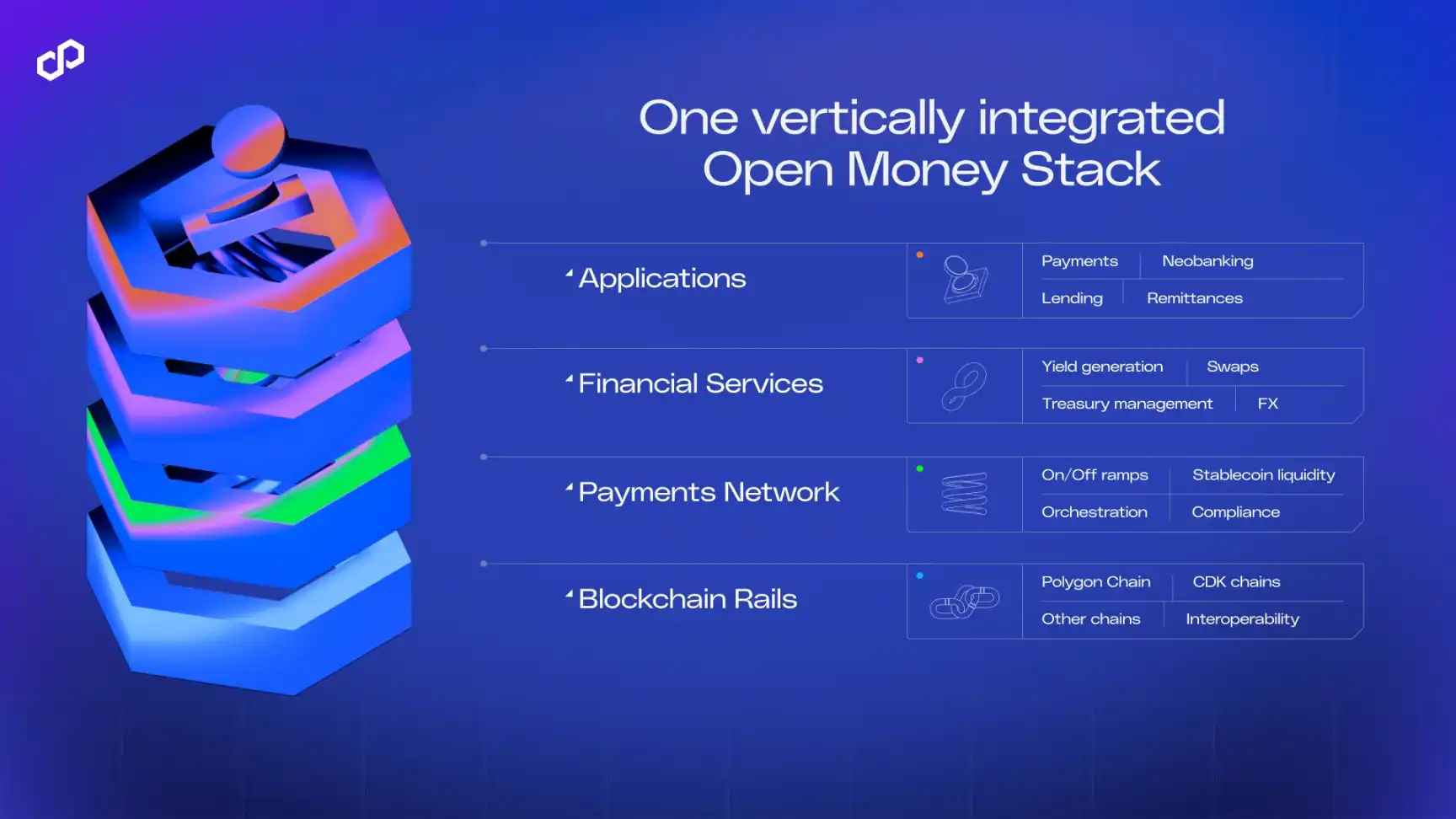
Open Money Stack | Source: Polygon Tweet

On/Off & Cash Ramps Layer: Utilizes Coinme's compliant network and U.S. regulatory licenses to enable instant cash and fiat on-ramps and off-ramps, converting physical cash or electronic fiat into stablecoins or other on-chain assets.

Wallet & Interaction Layer: Leverages Sequence's enterprise-grade smart wallets and account abstraction technology, along with one-click cross-chain transactions and cross-chain interaction capabilities, allowing end-users to receive, send, and make on-chain payments without worrying about underlying chains, gas, or intermediate assets.

Cross-Chain Interoperability Layer: Combines Sequence's Trails cross-chain orchestration engine and Polygon's interoperability protocol to make value flow between different chains completely transparent to users and support cross-chain transactions for any chain and any token.

Settlement Layer (Blockchain Rails): Relies on the Polygon network and its scaling technology to provide high-speed, low-cost, secure on-chain settlement infrastructure, enabling commercial-scale efficiency for stablecoin payments and value transfer.

Additionally, the Open Money Stack plans to integrate stablecoin orchestration with modules for compliance, identity, and yield generation, providing enterprises with payment and treasury management solutions.

L2 Competition Shifts to "Full-Stack Integration"

Polygon's $250 million acquisition reflects that the focus of competition in the L2 space is shifting from underlying technical parameters to full-stack business integration.

This path is highly consistent with the logic behind Coinbase's support for Base. The compliant entry point—acquiring Coinme—is to address the短板 (shortcoming) of fiat on-ramps and off-ramps,对标 (countering) Coinbase's CEX core advantage. For interaction experience, integrating Sequence is to lower the barrier to on-chain entry,对标 (countering) the ease of use of Coinbase Wallet (Base).

Against the backdrop of increasingly converging L2 technologies, ecosystems with compliant channels and low-barrier experiences will more easily attract incremental capital. Through this series of acquisitions, Polygon is attempting to build its own full-link moat in competition with opponents like Base, which possess native centralized advantages.


Criptomoedas em alta

Perguntas relacionadas

QWhat is the total acquisition amount announced by Polygon Labs, and which two companies were acquired?

APolygon Labs announced a total acquisition amount exceeding $250 million for the cryptocurrency payment infrastructure company Coinme and the blockchain development platform Sequence.

QHow does the acquisition of Coinme benefit Polygon's stablecoin strategy?

AThe acquisition of Coinme provides Polygon with a series of U.S. money transmission licenses and an extensive cash network, enabling compliant integration of cash, debit cards, and on-chain assets to facilitate stablecoin payments and off-chain capital inflows.

QWhat core technologies does Sequence offer to simplify the Web3 user experience?

ASequence offers a modular stack including Smart Wallet with account abstraction for features like social recovery and gas fee abstraction, and the Trails cross-chain orchestration engine to enable seamless cross-chain transactions without user awareness of underlying complexities.

QWhat is the 'Open Money Stack' strategy that Polygon aims to build through these acquisitions?

AThe 'Open Money Stack' strategy aims to create a unified API system comprising layers for on/off ramps (using Coinme's network), wallet infrastructure (via Sequence's technology), cross-chain interoperability, and blockchain settlement, all integrated with stablecoin orchestration and compliance modules.

QHow does Polygon's acquisition approach reflect the shifting competitive focus in the L2 space?

APolygon's acquisitions indicate that L2 competition is moving from underlying technical parameters to full-stack business integration, focusing on compliant entry points and user-friendly experiences to attract incremental capital and build a comprehensive competitive moat.

Leituras Relacionadas

US and Japan's Unprecedented Joint Action in 30 Years Marks End of Yen Carry Trade Era

Japan and the U.S. conducted a rare coordinated intervention in the foreign exchange market around August 3rd to stem the yen's sharp depreciation. U.S. Treasury Secretary Scott Bessette's notepad, photographed by Reuters, revealed plans for a $5-10 billion yen-buying operation. Following official confirmation, the USD/JPY pair plunged from near 164 to around 155-156. The intervention marks a significant shift as the U.S. moved from verbal support to practical coordination. While the core carry trade logic—exploiting the higher U.S. interest rates—remains intact, the risk structure has changed. Traders must now account for potential repeated bilateral actions, altering the risk-reward calculation for yen shorts. The intervention's immediate effect is forcing leveraged positions to unwind, amplifying the yen's rebound. However, analysts note this does not signal the end of the yen carry trade. The fundamental driver—the wide interest rate differential between the U.S. (3.50%-3.75%) and Japan (1%)—persists. The action is seen more as buying time for the Bank of Japan's gradual policy normalization while mitigating imported inflation pressures. To avoid destabilizing the U.S. Treasury market during intervention, authorities utilized the Fed's FIMA repo facility, allowing Japan to obtain dollar liquidity using its Treasury holdings as collateral instead of selling them. The move aims to contain spillover risks. While creating short-term volatility and compressing leverage for yen bears, the long-term trend for the yen will ultimately depend on the convergence of U.S. and Japanese monetary policies, not unilateral market operations. The current action is narrower in scope than historical agreements like the Plaza Accord, focused on curbing excessive yen weakness rather than engineering a broad-based dollar decline.

marsbitHá 19m

US and Japan's Unprecedented Joint Action in 30 Years Marks End of Yen Carry Trade Era

marsbitHá 19m

Why Hasn't Bitcoin Made the Expected Surge? There Are Both Positive and Negative Data

Analytical firm Glassnode reports Bitcoin retreated to around $62,600 after failing to sustain above $66,000. Weak spot market demand and defensive positions in derivatives are applying downward pressure. However, structural support remains from resilient long-term holders, surging on-chain activity, and renewed inflows into Bitcoin ETFs. The price action reflects weakened spot momentum, with low trading volume and persistent seller pressure keeping Bitcoin in a consolidation phase with limited breakout potential. While open interest in derivatives has fallen, funding rates have risen again, and options investors maintain a cautious stance. Demand for downside protection has increased. Positively, Bitcoin ETFs have seen renewed net inflows and trading volume, indicating institutional repositioning. On-chain metrics show a significant spike in active addresses and adjusted transaction volume, pointing to increased network usage. The historically low ratio of short-term to long-term holders suggests long-term conviction remains firm. However, overall market profitability continues to decline as the proportion of Bitcoin in profit nears cycle lows, indicating a trend of loss realization and de-risking by investors. Glassnode concludes the Bitcoin market is in a transitional phase. Structural support is present, but valuation pressure, insufficient spot demand, and defensive derivatives positioning continue to limit overall risk appetite.

cryptonews.ruHá 50m

Why Hasn't Bitcoin Made the Expected Surge? There Are Both Positive and Negative Data

cryptonews.ruHá 50m

Trading

Spot

Artigos em Destaque

Como comprar T

Bem-vindo à HTX.com!Tornámos a compra de Threshold Network Token (T) simples e conveniente.Segue o nosso guia passo a passo para iniciar a tua jornada no mundo das criptos.Passo 1: cria a tua conta HTXUtiliza o teu e-mail ou número de telefone para te inscreveres numa conta gratuita na HTX.Desfruta de um processo de inscrição sem complicações e desbloqueia todas as funcionalidades.Obter a minha contaPasso 2: vai para Comprar Cripto e escolhe o teu método de pagamentoCartão de crédito/débito: usa o teu visa ou mastercard para comprar Threshold Network Token (T) instantaneamente.Saldo: usa os fundos da tua conta HTX para transacionar sem problemas.Terceiros: adicionamos métodos de pagamento populares, como Google Pay e Apple Pay, para aumentar a conveniência.P2P: transaciona diretamente com outros utilizadores na HTX.Mercado de balcão (OTC): oferecemos serviços personalizados e taxas de câmbio competitivas para os traders.Passo 3: armazena teu Threshold Network Token (T)Depois de comprar o teu Threshold Network Token (T), armazena-o na tua conta HTX.Alternativamente, podes enviá-lo para outro lugar através de transferência blockchain ou usá-lo para transacionar outras criptomoedas.Passo 4: transaciona Threshold Network Token (T)Transaciona facilmente Threshold Network Token (T) no mercado à vista da HTX.Acede simplesmente à tua conta, seleciona o teu par de trading, executa as tuas transações e monitoriza em tempo real.Oferecemos uma experiência de fácil utilização tanto para principiantes como para traders experientes.

548 Visualizações TotaisPublicado em {updateTime}Atualizado em 2026.06.02

Como comprar T

Discussões

Bem-vindo à Comunidade HTX. Aqui, pode manter-se informado sobre os mais recentes desenvolvimentos da plataforma e obter acesso a análises profissionais de mercado. As opiniões dos utilizadores sobre o preço de T (T) são apresentadas abaixo.

活动图片