Polygon deploys Madhugiri hard fork, aims for 33% throughput boost

cointelegraphPublicado em 2025-12-09Última atualização em 2025-12-09

Resumo

Polygon has deployed the Madhugiri hard fork, targeting a 33% increase in network throughput and reducing block consensus time to one second. The upgrade includes support for three Fusaka Ethereum Improvement Proposals (EIP-7823, EIP-7825, EIP-7883), which improve efficiency and security by limiting gas consumption for heavy mathematical operations. It also introduces a new transaction type for Ethereum-Polygon bridge traffic and adds flexibility for future upgrades. This enhancement aims to better support high-frequency use cases like stablecoins and real-world asset (RWA) tokenization. The hard fork follows the recent Heimdall 2.0 upgrade, which significantly reduced finality times, despite a brief disruption in September due to a bug that was later resolved.

Blockchain network Polygon has rolled out its latest protocol upgrade, known as the Madhugiri hard fork, which aims to achieve a 33% increase in network throughput and reduce block consensus time to one second.

Polygon core developer Krishang Shah said on X that the update includes support for three Fusaka Ethereum Improvement Proposals, specifically EIP-7823, EIP-7825 and EIP-7883. These EIPs make heavy mathematical operations more efficient and secure by limiting the amount of gas they consume.

They also prevent single transactions from consuming excessive computing power, helping the network run more smoothly and predictably.

The upgrade introduces a new transaction type for Ethereum to Polygon bridge traffic and adds a built-in flexibility feature for future upgrades. Polygon previously said that the update makes throughput increases as easy as “flipping a few switches.”

“We are also decreasing the consensus time to 1 second, so blocks can now be announced in 1 second if ready, instead of waiting the full 2 seconds,” Shah wrote.
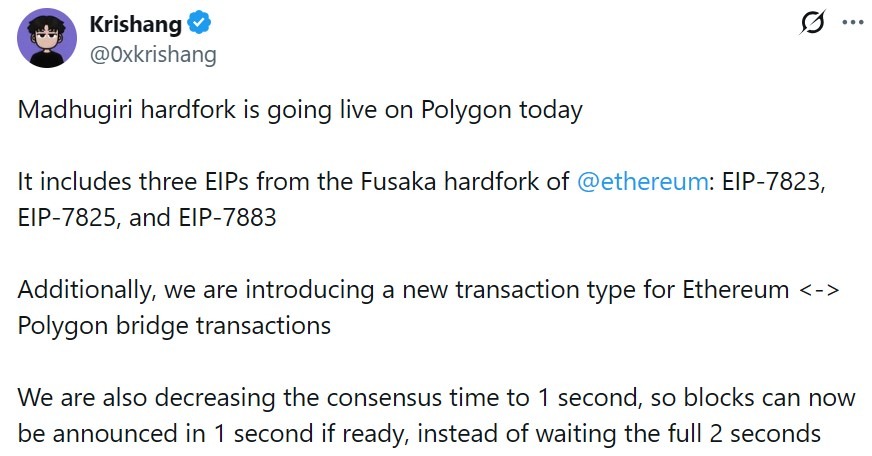
Source: Krishang Shah

New update reinforces Polygon for stablecoins and RWAs

With Madhugiri now live, Polygon aims to reinforce its infrastructure while materially improving its performance. These are prerequisites for high-frequency and high-trust use cases, such as real-world asset (RWA) tokenization and stablecoins.

Aishwary Gupta, the global head of payments and RWAs at Polygon Labs, previously forecasted a “stablecoin supercycle.”

Gupta said there will be a surge of “at least 100,000 stablecoins” in the next five years. However, he said this would not only be about minting tokens and must have a corresponding utility like yield.

Gupta also advocated for more transparency and accountability in the RWA sector. He previously argued that RWA numbers are meaningless if the assets cannot be audited, settled or traded.

“When transparency and accountability are established, RWAs will reach even greater heights, unlocking trillions in institutional capital,” he wrote.

Related: Polygon co-founder mulls resurrecting MATIC a year after POL rebrand

Hard fork follows major Heimdall upgrade

The upgrade comes on the heels of rapid prior improvements. On July 10, Polygon deployed Heimdall 2.0, dubbed by Polygon Foundation CEO Sandeep Nailwal as the network’s “most technically complex” hard fork since its launch.

The update reduced transaction finality times from one to two minutes to roughly five seconds.

However, on Sept. 10, the network experienced a significant disruption when a bug caused finality delays of 10 to 15 minutes, affecting validator sync, remote procedure call services and third-party tooling. Despite this, the team assured the community that blocks were still running.

On Sept. 11, the Polygon Foundation announced that the consensus and finality functions had been restored through a hard fork. With the update, nodes were no longer stuck, while checkpoints and milestones were finalized as expected.

Magazine: Ethereum’s Fusaka fork explained for dummies: What the hell is PeerDAS?

Leituras Relacionadas

Why Isn't Asia's Largest Bitcoin Treasury Company Metaplanet Buying the Dip?

Metaplanet, the Japanese company known as the "Asian MicroStrategy," has paused its Bitcoin accumulation strategy for ten consecutive weeks since September 30, despite the recent market correction. While giants like MicroStrategy continued buying—adding 10,624 BTC at an average of $90,615—Metaplanet shifted its focus to stock buybacks and capital structure improvements. This pause reflects a broader industry trend where Bitcoin treasury firms (DATs) are prioritizing risk management over aggressive accumulation. DATs have faced significant pressure, with median stock prices dropping 43% and some falling over 99%, leading Galaxy to warn of a "Darwinian phase" for the sector. Metaplanet’s tactical halt aims to protect shareholder value and avoid further dilution, especially after its mNAV fell below 1x. The company also seeks to avoid accounting losses under Japan’s conservative standards, as its Bitcoin holdings have over $500 million in unrealized losses with an average cost of $108,000. Instead, Metaplanet is leveraging Japan’s low-interest environment to develop innovative financing tools, such as the "Mercury" perpetual preferred stock offering a 4.9% yield—ten times local bank rates—with 73% of proceeds directed to Bitcoin purchases. It also uses Moving Strike Warrants (MSW) to raise capital without violating Japan’s market restrictions. The company benefits from unique advantages: yen depreciation enhances Bitcoin’s appeal as a hedge, and Japanese investors use tax-free NISA accounts to gain BTC exposure via Metaplanet stock. Major institutions like Capital Group have increased stakes, seeing lower financing costs and higher return potential compared to Western counterparts. However, short-term risks remain, including potential sell pressure if MSCI removes Metaplanet from its Japan Index due to high Bitcoin exposure. Ultimately, the pause is a strategic recalibration, not a retreat, highlighting the DAT sector’s maturation from aggressive accumulation to sustainable, risk-aware growth.

marsbitHá 39m

Why Isn't Asia's Largest Bitcoin Treasury Company Metaplanet Buying the Dip?

marsbitHá 39m

Trading

Spot
Futuros
活动图片