Coinbase opens Solana DEX access as CeFi and DeFi converge

cointelegraphPublicado em 2025-12-11Última atualização em 2025-12-11

Resumo

Coinbase is expanding its support for the Solana ecosystem by enabling users to trade native Solana tokens directly through a decentralized exchange (DEX) integration, bypassing traditional listing requirements. This move allows tokens with sufficient liquidity to become accessible to Coinbase’s user base without a formal listing process. The integration follows a similar rollout for Base blockchain tokens in August and is part of a broader strategy to incorporate DEX support across multiple networks. The announcement comes amid significant growth in Solana’s DeFi ecosystem, including new platform launches and increased on-chain lending and trading activity. Industry reports highlight Solana’s rising dominance in on-chain finance, with institutional-grade DeFi strategies gaining traction. This development reflects a larger trend of centralized exchanges like Coinbase, OKX, and Binance increasingly integrating DEX functionalities, acting as user-friendly frontends for decentralized trading amid growing DEX liquidity and improved user experience.

Coinbase is moving deeper into the Solana ecosystem, letting users trade native Solana tokens through a decentralized exchange integration rather than traditional listings.

Andrew Allen, Coinbase protocol specialist, said in an X post that Coinbase now allows its users to trade all Solana (SOL) tokens through a decentralized exchange (DEX) integration, “without listings,” he noted, adding that “very soon you will be able to open the Coinbase app and see native Solana assets on Coinbase.”

“For issuers and builders, if your token has sufficient liquidity, this means you can be accessible to the millions of users on Coinbase without getting listed,” Allen said.

The announcement follows Coinbase’s integration of tokens from its Base blockchain through a similar DEX integration in early August. The announcement noted that the exchange plans to “expand DEX support to include additional networks, starting with Solana.”
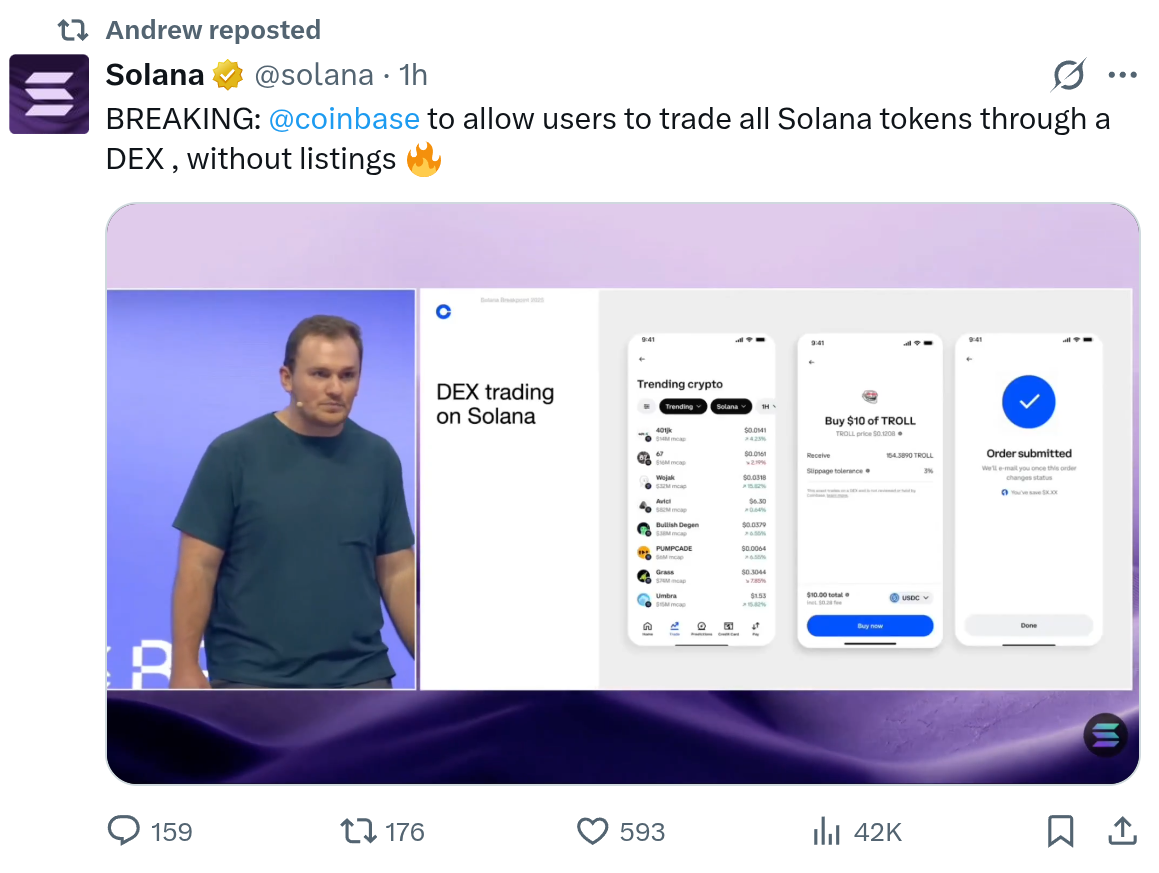
Source: Andrew Allen/Solana

Related: Coinbase to roll out its new ‘DeFi Mullet’ offering in Brazil

Solana’s DeFi ecosystem is booming

Coinbase’s integration comes amid a slew of developments in Solana's decentralized finance (DeFi) ecosystem.

Earlier Thursday, DeFi company Ellipsis Labs announced the launch of its Solana-based perpetual swap DEX. The announcement claims that the platform is fully onchain — including the risk and matching engine — allowing anyone to build on top of it. Still, the platform is currently in private beta and not yet open to the general public.

The launch coincides with a new “Solana Lending Markets Report 2025,” shared with Cointelegraph by DeFi infrastructure firm Redstone. The report argues that “DeFi strategies on Solana have reached institutional-grade sophistication” and points to strong growth in Solana’s onchain lending and trading activity.

Redstone claims that “Solana has become a dominant force in on-chain finance” and “processed $35.9 billion in peak daily DEX volume.” The company expects the next wave of growth to focus on “tokenized real-world assets and institutional capital deployment.”

“Bringing traditional finance onchain at scale can unlock trillions in Internet Capital Markets. Solana's infrastructure is positioned to capture a significant share of this expansion.“

Related: How perp DEXs quietly took over 26% of the futures market

Centralized and decentralized exchanges collide

The Coinbase integration is just the latest manifestation of a broader trend: centralized exchanges are increasingly integrating DEX platforms and serving as a user-friendly front end for them. In early October, Sergej Kunz, the co-founder of DEX aggregator 1inch, stated that centralized crypto exchanges will gradually fade and serve only as frontends for decentralized finance.

The landscape is shifting, with DEX platforms seeing growing liquidity, faster order execution times, lower fees, and an increasingly simplified user experience. DeFi data platform DefiLlama shows that all DEX platforms processed nearly $12 billion worth of trades over the last 24 hours — this is more than Coinbase’s 24-hour spot volume of $2.566 billion and comparable to Binance’s nearly $18 billion as reported by CoinMarketCap.

So far, Kunz’s prediction is holding up, with Coinbase far from the only centralized exchange to roll out similar integrations. In mid-November, crypto exchange OKX also began offering DEX trading on its platform. At the end of March, the world’s top cryptocurrency exchange, Binance, also introduced centralized-to-decentralized exchange trades on Ethereum, Solana, Base, and the BNB Smart Chain.


Leituras Relacionadas

How Does x402 V2 Enable Autonomous Payments for AI Agents?

The x402 protocol, initially developed by Coinbase, leverages the HTTP 402 status code to embed payment logic directly into web requests. The newly released V2 upgrade introduces significant improvements to address limitations in cross-chain support, scalability, identity authentication, and repeated payments experienced in V1. Key enhancements include: - **Wallet Identity and Reusable Sessions**: Supports wallet-based authentication (e.g., Sign-In-With-X via CAIP-122), allowing reusable sessions after initial payment. This reduces latency and costs for high-frequency use cases like AI agent tasks and LLM inference. - **Unified Payment Interface**: Enables multi-chain payments (e.g., Base, Solana) and compatibility with traditional systems (ACH, SEPA, credit cards) via Facilitators. Dynamic payTo routing allows context-aware pricing and complex market structures. - **Modular Architecture**: A plugin-driven SDK simplifies integration, supporting easy expansion to new chains and payment methods without core changes. Multi-Facilitator support automates optimal payment path selection based on preferences. - **Automatic Discovery**: Services can expose metadata for automatic synchronization, ensuring real-time pricing and availability updates without manual intervention. For end-users, V2 enables seamless, subscription-like access with reduced friction. Developers benefit from flexible, low-maintenance payment integration and dynamic pricing models. AI agents gain autonomy to make economic decisions, such as purchasing API calls or compute resources independently using allocated budgets. x402 V2 evolves from a pay-per-use tool into a versatile economic layer, though challenges like ecosystem adoption, modular risks, and regulatory uncertainty remain.

比推Há 14m

How Does x402 V2 Enable Autonomous Payments for AI Agents?

比推Há 14m

Bitcoin (BTC) Price Trend and Investor Sentiment Suggest a Bullish December

Bitcoin (BTC) is showing signs of a potential bullish December, challenging a decade-old bearish seasonal pattern where November losses typically extend into year-end declines. Key factors supporting this shift include reduced leverage, with open interest dropping from $94 billion to $60 billion, and Bitcoin’s price reclaiming its monthly volume-weighted average price (rVWAP), indicating controlled distribution. Liquidity dynamics have also shifted, with deep liquidity clusters moving upward, and around $3 billion in short positions set to liquidate near $96,000. Market structure diverges from historical cycles due to spot ETF inflows, introducing constant structural demand and accelerating price discovery. Analysts note that Bitcoin’s four-year cycle, while not obsolete, is no longer time-aligned, resembling extended accumulation phases like mid-2016 or late-2019. Macro liquidity (M2) growth has plateaued, creating a late-cycle environment where risk assets rally despite underlying economic softening. Supporting indicators, such as CNY/USD and ETH/BTC correlations, along with improving PMI data and gold’s relative strength, suggest continued risk-on momentum rather than cycle fatigue. While buy-sell ratios show urgency, analysts caution this may reflect positioning squeeze rather than sustainable accumulation. Overall, December’s performance may depend more on structural forces—ETF flows, liquidity rotation, and shifting macro correlations—than traditional halving-driven周期 patterns.

cointelegraph_中文Há 30m

Bitcoin (BTC) Price Trend and Investor Sentiment Suggest a Bullish December

cointelegraph_中文Há 30m

Trading

Spot
Futuros
活动图片