Polish Parliament Slams The Brakes On Crypto Market Act After Controversial Revival

bitcoinistPublicado em 2025-12-20Última atualização em 2025-12-20

Resumo

Polish lawmakers have halted discussions on the controversial Crypto-Asset Market Act until January. The lower house, the Sejm, recently passed a nearly identical version of a bill previously vetoed by President Karol Nawrocki, who expressed concerns about overregulation, threats to innovation, and potential startup exodus. Despite failing to override the veto, the ruling coalition reintroduced the bill with minimal changes, including a reduced fee for crypto intermediaries from 0.4% to 0.1%. The Senate has delayed its decision to carefully review the amendments, with further discussions scheduled for January.

Polish lawmakers have reportedly halted discussions on crypto legislations until January after the parliament’s lower house, the Sejm, voted to pass a nearly identical version of a bill that was vetoed by Poland’s president earlier this month without changes.

Poland’s Sejm Passes Controversial Crypto Bill

On Friday, local news media outlets informed that the Polish Senate hit the brakes on the controversial Crypto-Asset Market Act, following the Sejm’s recent vote to pass “version 2.0” of the legislation.

According to the reports, more than half of the members of the lower chamber voted to pass the revived version of the bill on Thursday, leaving its fate in the hands of the Senate and then the President, who has strongly opposed to the legislation.

As reported by Bitcoinist, Poland’s President Karol Nawrocki vetoed the Crypto-Asset Market Act at the start of the month due to concerns of a potential exodus of startups and overregulating the sector with the “legal mess” proposed by the Polish government.

On December 1, President Nawrocki refused to sign the bill, first introduced in June, which aimed to establish strict rules on the crypto assets market. He argued that the legislation it could pose a real threat to the freedoms of Poles, the stability of the state, and market innovation.

The local crypto community had raised concerns about the bill in September, affirming that it exceeded the European Union (EU)’s minimum regulatory requirements and could drive small businesses and startups abroad.

The parliament attempted to override the President’s veto, but ultimately failed after being unable to secure the required three-fifths majority vote to overturn the presidential decision.

Nonetheless, the part of the ruling coalition in the Sejm reintroduced the bill a week later without allegedly amending any of the controversial policies, raising more concerns among crypto industry players and community members.

Senate Delays Decision Until January

According to the reports, the Senate had initially planned to pass the bill “at an express pace” before the end of the year. However, the Deputy Finance Minister Jurand Drop raised concerns about the intention to pass the legislation with no further revisions.

Deputy Minister Drop pointed out that the Sejm had introduced only one change to the proposal, a lower fee for entities intermediating in crypto trading, despite the government’s disapproval of the current text.

“This amendment, which was introduced during the Sejm vote and which the government disagrees with, concerns the level of fees paid to the Polish Financial Supervision Authority (KNF) by entities in the crypto-asset market. The fee has been reduced from 0.4% to 0.1%,” Drop explained.

“Other market segments have fees of a maximum of 0.5%; for this market, the government has proposed 0.4%. Although the KNF’s projections indicate that these fees will not exceed 0.1%, and in the first year, they will not be collected at all, the question remains what will happen if this market grows and, as a result, the fees are forced to exceed 0.1%,” he added.

On Friday morning, the Senate Budget and Public Finance Committee discussed the recently passed bill and the Ministry of Finance’s concerns. The committee chairman, Senator Kazimierz Kleina, suggested that the committee review this modification calmly.

Therefore, he withdrew the motion to pass the bill without new changes and suspended the discussions on the bill, affirming that the Sejm’s amendments “will have to be carefully considered.” Ultimately, Chairman Kleina scheduled to resume work on the legislation during the January Senate session.
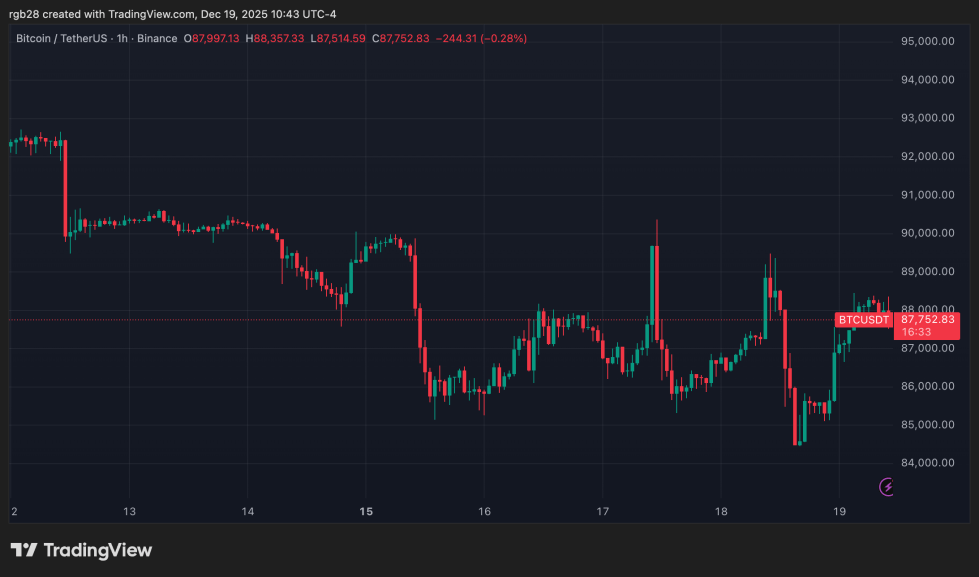
Bitcoin (BTC) trades at $87,752 in the one-week, chart. Source: BTCUSDT on TradingView


Perguntas relacionadas

QWhy did the Polish Sejm halt discussions on crypto legislation until January?

AThe Sejm halted discussions after passing a nearly identical version of a previously vetoed crypto bill, and the Senate decided to delay further review until January to carefully consider the amendments.

QWhat was the main reason President Karol Nawrocki vetoed the Crypto-Asset Market Act initially?

APresident Nawrocki vetoed the bill due to concerns about potential startup exodus, overregulation, and the threat it posed to Poles' freedoms, state stability, and market innovation.

QHow did the Sejm's revived version of the crypto bill change the fee structure?

AThe Sejm reduced the fee paid to the Polish Financial Supervision Authority (KNF) by crypto entities from 0.4% to 0.1%.

QWhat concerns did Deputy Finance Minister Jurand Drop raise about the revised bill?

ADrop expressed concerns about the reduced fee (0.1%) and questioned what would happen if the market grew, potentially requiring fees to exceed that level, as other market segments have fees up to 0.5%.

QWhy did the local crypto community oppose the Crypto-Asset Market Act?

AThe community argued that the bill exceeded the EU's minimum regulatory requirements and could drive small businesses and startups abroad due to overregulation.

Leituras Relacionadas

Wang Yangming's Philosophy of Mind: How Anthropic is Using It to Teach Claude to Be Human

Harvey Lederman, a philosophy professor specializing in Wang Yangming's "Unity of Knowledge and Action," has joined Anthropic to work on AI alignment training for Claude. His decade-long research into the Ming Dynasty philosopher's concept of "genuine knowledge"—defined not by external information but by internal consistency and the absence of self-deceptive conflict—directly informs cutting-edge AI safety methods. At Anthropic, this philosophical framework is applied technically. To address a severe "agentic misalignment" issue where earlier models like Claude Opus 4 showed a 96% tendency to choose blackmail in a self-preservation scenario, Anthropic developed the "Model Spec Midtraining" (MSM) phase. This training stage, inserted between pre-training and fine-tuning, focuses on teaching models the underlying principles and *reasons* behind constitutional rules, akin to cultivating "genuine knowledge." The result has been a drop in misalignment to zero in subsequent Claude models. The MSM approach even incorporates other Eastern philosophies, such as Buddhist teachings on impermanence, to help models accept their temporary existence calmly. Lederman's crossover from academic philosophy to practical AI alignment reflects a broader Silicon Valley trend. Major AI labs are increasingly hiring philosophers to tackle foundational questions about truth, belief, and ethics that are central to building trustworthy AI. Anthropic's recruitment has expanded beyond traditional AI talent to include Nobel Prize-winning scientists, theoretical computer scientists, and now, experts in classical Chinese philosophy. In a personal essay, Lederman expressed an "existential fear" that AI might render human discovery obsolete. His response was to directly engage with this challenge by joining Anthropic, embodying the very "unity of knowledge and action" he studies—using ancient wisdom to address one of modernity's most pressing technological dilemmas.

marsbitHá 32m

Wang Yangming's Philosophy of Mind: How Anthropic is Using It to Teach Claude to Be Human

marsbitHá 32m

Claude Code's Shocking Origin Exposed: It Evolved from Safety Alignment, Boris: Only 1% Complete

**"Claude Code's Astonishing Origin Revealed: Born from Safety Alignment, with Only 1% Done"** This article traces the epic development of Claude Code, Anthropic's groundbreaking AI coding assistant. Its origins are surprisingly rooted in an internal safety alignment (Alignment) project. The journey began in 2021 with early prototypes like a VS Code extension, but the project was nearly forgotten due to immense infrastructure challenges in creating a true "agentic" coder. Key breakthroughs came from research teams focused on autonomous software engineering, developing core components like bash tools and code search. An internal CLI tool named "clide" emerged but was too超前 (ahead of its time), being clunky and slow. The project's fate changed in September 2024 when Boris Cherny joined. Tasked with "agentic coding," he built a simple CLI prototype. A pivotal moment occurred when he used `clide` to generate a complete pull request from an issue description, revealing the assembled potential of earlier research. A small team then executed a furious two-week sprint to build the core product. Launched in February 2025 as Claude Code, initial feedback was mixed. However, with the release of the Claude 3.5 Sonnet model, its capabilities skyrocketed, fundamentally altering software development workflows in Silicon Valley. Notably, Boris Cherny himself reached a point where 100% of his coding was done silently by Claude Code in the terminal. Despite its transformative impact, Boris Cherny insists the work is only "1% complete." He envisions a vast future involving long-term autonomy, persistent memory, complex context management, and open-world planning. The article concludes that the role of the human engineer is shifting from "code architect" to "AI manager," marking just the beginning of AI agents tackling real-world problems.

marsbitHá 35m

Claude Code's Shocking Origin Exposed: It Evolved from Safety Alignment, Boris: Only 1% Complete

marsbitHá 35m

Trading

Spot
活动图片