Poland resubmits vetoed crypto bill: ‘Not even a comma’ changed

cointelegraphPublicado em 2025-12-11Última atualização em 2025-12-11

Resumo

Polish lawmakers from the ruling coalition have resubmitted a crypto asset bill that was recently vetoed by President Karol Nawrocki, unchanged from its previous version. The bill, which designates the Polish Financial Supervision Authority as the primary crypto regulator, has been criticized by opponents as overly restrictive. The political standoff occurs as EU member states prepare to implement the Markets in Crypto-Assets Regulation (MiCA) by 2026. The debate reflects broader tensions within the EU between national and centralized oversight, with some countries advocating for direct supervision by the European Securities and Markets Authority. Despite the president's earlier veto, government officials suggest he may not block the bill again following a security briefing. An alternative draft aligning more closely with MiCA has also been proposed.

Polish lawmakers have doubled down on crypto regulation rejected by President Karol Nawrocki, deepening tensions between the president and Prime Minister Donald Tusk.

Polska2050, part of the ruling coalition in the Sejm — Poland’s lower house of parliament — reintroduced the extensive crypto bill on Tuesday, just days after Nawrocki vetoed an identical bill.

The bill’s backers, including Adam Gomoła — a member of Poland2050 — called Bill 2050 an “improved” successor to the vetoed Bill 1424, but government spokesman Adam Szłapka reportedly declared that “not even a comma” had been changed.

The division over Poland’s crypto bill comes amid the rollout of the European Union’s Markets in Crypto-Assets Regulation (MiCA) across member states ahead of a July 2026 compliance deadline for EU crypto businesses.

Critics say Bill 2050 is “exactly same bill”

The new version of Poland’s draft crypto bill provides an 84-page-long document that essentially replicates the original Bill 1424, aiming to designate the Polish Financial Supervision Authority as the country’s primary crypto asset market regulator.

Crypto advocates like Polish politician Tomasz Mentzen previously criticized Bill 1424 as “118 pages of overregulation,” particularly in comparison to shorter versions in other EU member states like Hungary or Romania.

“The government has once again adopted exactly the same bill on cryptoassets,” Mentzen wrote in an X post on Tuesday.
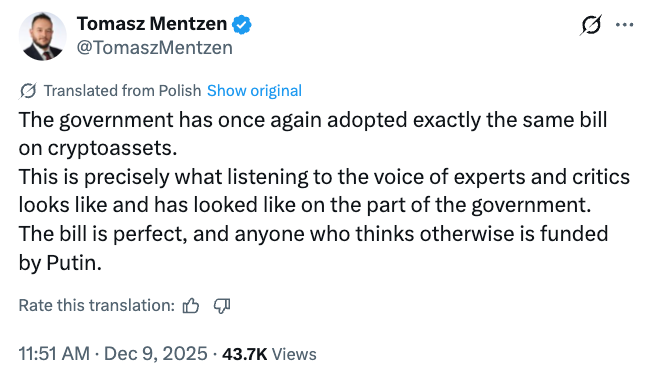
Source: Tomasz Mentzen

He also mocked Tusk’s claim that the president’s earlier veto was tied to the alleged involvement of the “Russian mafia,” saying: “The bill is perfect, and anyone who thinks otherwise is funded by Putin.”

Government spokesman Szłapka reportedly claimed that President Nawrocki will likely not veto the proposed bill this time, following a classified security briefing in parliament last week and “now has full knowledge” of the implications on national security.

The issue with MiCA: Local versus centralized EU oversight

Poland’s debate over its crypto bill sets an important precedent for implementing the EU-wide MiCA regulation, as the proposed legislation would place responsibility for market supervision on the local financial regulator.

The issue is particularly significant amid calls from some member states for more centralized MiCA supervision under the Paris-based European Securities and Markets Authority (ESMA).

In October, the Bank of France urged the EU to give the ESMA direct supervisory powers, warning that a fragmented approach to oversight could undermine the bloc’s financial sovereignty.

Some EU member states have pushed back against centralized oversight under MiCA, with regulators in Malta arguing that it could create additional layers of supervision that might stifle market innovation.

Related: EU plan would boost ESMA powers over crypto and capital markets

Notably, Polish economist Krzysztof Piech — a prominent critic of Poland’s proposed crypto bill — has questioned the need for the local legislation, noting that MiCA protections will take effect in 2026.

While local reports suggest that President Nawrocki may not veto the bill this time, there is also speculation that his office has been presented with an “alternative” draft aimed at creating more favorable market conditions. The proposed alternative is reportedly designed to align with the EU-wide MiCA framework and remove direct oversight from the local regulator.



Criptomoedas em alta

Leituras Relacionadas

Meta Follows the Trend into Prediction Markets: Can It Avoid Repeating the Failure of the Metaverse?

Meta, the tech giant behind Facebook, has reportedly formed a team to develop "Arena," a new application focused on prediction markets. Users would use platform points to place bets on outcomes in politics, sports, and global events. This move follows Meta's massive, nearly $900 billion, losses from its heavily-invested metaverse division, Reality Labs. The prediction market industry is already showing strong demand, with leading platforms like Kalshi and Polymarket facilitating hundreds of billions in annual volume. Meta, with its 3.56 billion daily active users across its apps, possesses the unprecedented scale to bring this niche activity to a mainstream audience, similar to its past success in cloning features like Stories and Reels. However, Arena faces significant hurdles. Meta plans to start with a points-based system to avoid strict financial regulations, but this may dilute the core incentive of accurate prediction that real-money markets provide. More critically, Meta enters the space with a major trust deficit stemming from its past regulatory battles, notably the failed Libra/Diem stablecoin project, and its controversial history with political content and misinformation. The prediction market sector itself is under increasing regulatory scrutiny, with recent CFTC actions including fines and the first-ever insider trading case. While Meta's vast user base offers a unique opportunity to expand the market, its success hinges on navigating complex regulations and rebuilding the credibility necessary for a platform dealing with sensitive topics like elections. The outcome could range from Meta dramatically growing the industry to Arena becoming a high-profile regulatory target before it can scale.

Foresight NewsHá 5m

Meta Follows the Trend into Prediction Markets: Can It Avoid Repeating the Failure of the Metaverse?

Foresight NewsHá 5m

Stock Soars 1200% on First Day, 80s Sales Engineer's Reversal: From Selling FRP to a Fortune of 29 Billion

On its first day of listing, Zhenbao Technology (stock code "N Zhenbao") surged by 1207%, marking itself as the second "ten-bagger" new stock of the year on the STAR Market. The closing price of 585 yuan propelled it into the top 20 of the A-share market by stock price. Dubbed the "first share of semiconductor consumables," the company is backed by a comprehensive shareholder list including National Integrated Circuit Industry Investment Fund Phase II, SMIC, BOE, and YMTC. Zhenbao's business model focuses on supplying critical consumable components like silicon rings and quartz parts to semiconductor fabs. Unlike expensive core equipment with low repurchase rates, these consumables require frequent replacement as long as production lines are running, generating stable recurring revenue—a key reason for its high market valuation. Founder Wang Bing, an 80s-born former sales engineer, built the company by identifying a supply chain vulnerability: foreign monopolies on high-purity materials led to high costs and unstable deliveries for domestic fabs. Zhenbao's strategy emphasized reliability and speed over absolute top-tier performance, offering products at about 50% of the price with 80% of the performance but 100% on delivery and responsiveness. To achieve this, the company vertically integrated its operations across "raw materials + components + surface treatment," ensuring supply chain control and cost reduction. Its clientele now spans major domestic fabs like BOE and Huahong, as well as international players like SK Hynix and Texas Instruments. However, risks accompany its rapid expansion. The IPO raised approximately 1.605 billion yuan primarily for capacity expansion, which will bring significant annual depreciation costs, potentially impacting future profitability. The company's growth is heavily reliant on sustained high levels of fab expansion, making it vulnerable to the semiconductor industry's cyclical downturns. Other concerns include high accounts receivable (70.83% of revenue at one point in 2025), heavy reliance on its top five customers (over 70% of sales), and questions about the stability and authenticity of its R&D investments, evidenced by volatile R&D headcount and unusual spikes in R&D energy consumption. While the "consumables story" commands a premium, long-term valuation will depend on maintaining high capacity utilization and healthy cash flow conversion.

marsbitHá 12m

Stock Soars 1200% on First Day, 80s Sales Engineer's Reversal: From Selling FRP to a Fortune of 29 Billion

marsbitHá 12m

Warsh Deals a Heavy Blow to the 'Dollar Devaluation Trade'! Gold Crashes, Bitcoin Slumps, How Long Can the Chip Frenzy Hold?

The "dollar devaluation trade" that dominated Wall Street this year is rapidly unraveling, driven by a hawkish pivot from Fed Chairman Kevin Warsh and a surging U.S. dollar. This double pressure has triggered a sharp sell-off in non-yielding assets. Gold broke below $4,000 an ounce, silver tumbled below $60, and Bitcoin fell under $60,000, with all retreating significantly from their earlier 2025 peaks. The dollar index hit a 14-month high. Warsh's emphasis on price stability has solidified market expectations for aggressive rate hikes, increasing the opportunity cost of holding assets like precious metals. Concurrently, massive fund flows are rotating out of metals and cryptocurrencies into the semiconductor sector, providing a temporary boost to stocks like Micron and SK Hynix. However, analysts warn this chip rally shows signs of a speculative top. Extreme volatility, with semiconductor stocks seeing trillion-dollar swings, is historically characteristic of major market turning points. Factors like month-end rebalancing, a flood of new equity issuance, and insider selling further signal potential exhaustion. While Micron's strong earnings briefly stemmed selling, it may offer a favorable exit point for remaining chip bulls. The sustainability of the semiconductor frenzy is now in serious doubt as the broader market reprices assets around a stronger dollar and tighter monetary policy.

华尔街日报Há 20m

Warsh Deals a Heavy Blow to the 'Dollar Devaluation Trade'! Gold Crashes, Bitcoin Slumps, How Long Can the Chip Frenzy Hold?

华尔街日报Há 20m

Micron Shuts Up the Bears, Makes India's 'Buffett' Regret: Sold Too Early, Missed Out on $2 Billion

Indian value investor Mohnish Pabrai, a disciple of Warren Buffett, revealed his costly mistake of selling shares in Micron Technology too early. He initially invested in 2017, holding it for six years and building a position as large as 77% of his portfolio, based on a thesis that the memory chip industry would consolidate into a stable oligopoly of Samsung, SK Hynix, and Micron. However, he sold his entire stake in September 2023, fearing oversupply after Samsung announced production expansion. Shortly after his exit, demand for high-bandwidth memory (HBM) surged with the rise of AI, and Micron's stock price skyrocketed over 15 times in two years. Pabrai estimates this premature sale cost him roughly $20 billion in potential gains. He expressed similar regret over selling his investment in SK Hynix too soon, stating he violated his own principle of holding companies forever. Reflecting on these errors, Pabrai emphasized his core investment checklist principles: avoiding leverage, focusing on the durability of a company's competitive moat, and assessing management's character. Despite these personal trading missteps, his long-term view on the remaining memory chip leaders remains bullish, advising current holders not to sell as "the party is just getting started." He concluded by sharing his philosophical outlook, prioritizing character over wealth, and his goal to donate his entire fortune before his passing.

marsbitHá 1h

Micron Shuts Up the Bears, Makes India's 'Buffett' Regret: Sold Too Early, Missed Out on $2 Billion

marsbitHá 1h

Mihoyo's Next Protagonist Is Her, Who Plays the Piano

Mihoyo, widely recognized for its hit game Genshin Impact, has long harbored a grander ambition: creating a virtual world where one billion people would want to live. While its character design is unparalleled, the company recognizes a fundamental limitation—these beloved virtual characters are not truly "alive." Their dialogue and actions are pre-scripted. This drive for authentic "living" characters has guided Mihoyo's strategic investments in cutting-edge fields like brain-computer interfaces, AI (including an early investment in MiniMax), and nuclear fusion. Following the release of ChatGPT in late 2022, co-founder Cai Haoyu stepped down from management to lead a new overseas AI venture, Anuttacon, focused on creating AI-driven virtual beings. Mihoyo's path has involved experimentation and iteration. Anuttacon's early project, *Whisper of the Stars*, showcased real-time AI conversation but revealed limitations in underlying language models. The team subsequently focused its resources on developing a sophisticated "emotional" large language model, distinct from purely utilitarian AI. Co-founder Liu Wei (Dawei) announced plans to invest up to 100 billion RMB in this AI pursuit. The first tangible product of this vision is *BSide: Olivia Lin*, a free Steam application featuring a piano-playing virtual companion. Unlike typical AI chatbots demanding constant interaction, Olivia Lin operates on a slower, more deliberate rhythm—responding to letters, playing user-submitted melodies, and serving as a desktop presence. This design emphasizes "lifelikeness" over exhaustive conversation, strategically working around current technological constraints while building a sense of authentic connection. The company's journey traces back to its name, "miHoYo," where "mi" pays homage to the virtual singer Hatsune Miku. For nearly two decades, fans have loved Miku, a character unaware of their devotion. Mihoyo's ultimate goal, now backed by massive investment and AI research, is to bridge that gap—to create virtual beings that can truly know they are loved.

marsbitHá 1h

Mihoyo's Next Protagonist Is Her, Who Plays the Piano

marsbitHá 1h

Trading

Spot
Futuros

Artigos em Destaque

O que é NASDAQ100

O Índice Nasdaq-100 inclui 100 das maiores empresas não financeiras listadas no Mercado de Ações Nasdaq e é amplamente utilizado como referência para ações de crescimento e tecnologia de grande capitalização nos EUA.

10 Visualizações TotaisPublicado em {updateTime}Atualizado em 2026.06.18

O que é NASDAQ100

Como comprar NASDAQ100

Bem-vindo à HTX.com!Tornámos a compra de Nasdaq-100 Index (NASDAQ100) simples e conveniente.Segue o nosso guia passo a passo para iniciar a tua jornada no mundo das criptos.Passo 1: cria a tua conta HTXUtiliza o teu e-mail ou número de telefone para te inscreveres numa conta gratuita na HTX.Desfruta de um processo de inscrição sem complicações e desbloqueia todas as funcionalidades.Obter a minha contaPasso 2: vai para Comprar Cripto e escolhe o teu método de pagamentoCartão de crédito/débito: usa o teu visa ou mastercard para comprar Nasdaq-100 Index (NASDAQ100) instantaneamente.Saldo: usa os fundos da tua conta HTX para transacionar sem problemas.Terceiros: adicionamos métodos de pagamento populares, como Google Pay e Apple Pay, para aumentar a conveniência.P2P: transaciona diretamente com outros utilizadores na HTX.Mercado de balcão (OTC): oferecemos serviços personalizados e taxas de câmbio competitivas para os traders.Passo 3: armazena teu Nasdaq-100 Index (NASDAQ100)Depois de comprar o teu Nasdaq-100 Index (NASDAQ100), armazena-o na tua conta HTX.Alternativamente, podes enviá-lo para outro lugar através de transferência blockchain ou usá-lo para transacionar outras criptomoedas.Passo 4: transaciona Nasdaq-100 Index (NASDAQ100)Transaciona facilmente Nasdaq-100 Index (NASDAQ100) no mercado à vista da HTX.Acede simplesmente à tua conta, seleciona o teu par de trading, executa as tuas transações e monitoriza em tempo real.Oferecemos uma experiência de fácil utilização tanto para principiantes como para traders experientes.

10 Visualizações TotaisPublicado em {updateTime}Atualizado em 2026.06.18

Como comprar NASDAQ100

O que é RE

I. Introdução ao Projeto O Re Protocol é um mercado de capitais onchain que conecta capital em stablecoin a resseguros totalmente colateralizados e regulados. O resseguro permite que as companhias de seguros transfiram partes do seu risco para outros seguradores especializados, ajudando-as a absorver grandes perdas e a continuar a fornecer cobertura. II. Informações sobre o Token Nome do token: RE(Re) III. Links Relacionados Website:https://re.xyz/ Exploradores:https://bscscan.com/token/0xd41fdb03ba84762dd66a0af1a6c8540ff1ba5dfb https://etherscan.io/token/0x526526528f35ac738177003b8773b402b8df8143 Twitter:https://twitter.com/re Nota: A introdução ao projeto provém dos materiais publicados ou fornecidos pela equipa oficial do projeto, que é apenas para referência e não constitui aconselhamento de investimento. A HTX não se responsabiliza por quaisquer perdas diretas ou indiretas resultantes.

100 Visualizações TotaisPublicado em {updateTime}Atualizado em 2026.06.18

O que é RE

Discussões

Bem-vindo à Comunidade HTX. Aqui, pode manter-se informado sobre os mais recentes desenvolvimentos da plataforma e obter acesso a análises profissionais de mercado. As opiniões dos utilizadores sobre o preço de A (A) são apresentadas abaixo.

活动图片